Fluoroquinolones (FQNs) are commonly used broad-spectrum antibiotics, but they are associated with serious side effects. Since 2016, health agencies have issued warnings regarding FQN-associated adverse events, recommending judicious use.1,2 Furthermore, FQN resistance is increasing, making this an unreliable empiric option.3 Studies indicate inappropriate inpatient FQN prescribing rates as high as 31%–51%, representing an opportunity to optimize FQN use and avoid potential patient harm.Reference Werner, Hecker and Sethi4,Reference Méan, Pavese and Vittoz5
To ensure appropriate use of FQNs, our antimicrobial stewardship program (ASP) instituted prospective audit and feedback (PAF) on inpatient FQN prescriptions. The objective was to assess the impact of PAF on volume and appropriateness of FQN prescriptions.
Methods
Setting and study patients
A multicenter quasi-experimental design was used to compare inpatient adult FQN use during a 3-month preintervention period (June 1 through September 4, 2017) and a 6-month intervention period (September 5, 2017, through February 28, 2018) at 2 acute-care community hospitals (620 beds combined). Outpatient and surgical prophylaxis orders were excluded. The ASP team consists of an infectious diseases physician and 2 ASP pharmacists. The study was approved by the University of Alberta Research Ethics Office and the Covenant Health Research Center.
Intervention
A daily list of all inpatient FQN prescriptions was generated by the hospital pharmacy system. The ASP audited each chart and, when necessary, provided feedback to the attending team, outlining the rationale for the recommendation and information on FQN-associated adverse events. This procedure took place on weekdays, and weekend orders were captured the next business day.
Data and outcomes
Preintervention data were collected by retrospective chart review for June 2017 and prospectively for July and August 2017. Starting September 5, 2017, PAF was performed on inpatient FQN prescriptions, and data were collected prospectively.
Collected data included baseline demographics, antibiotic indication, microbiologic data, and risk factors for adverse events.Reference Wise, Peloquin and Choi6 Indication for use was precategorized by infectious syndrome. Due to overdiagnoses of urinary tract infections (UTIs) historically, these were further classified as asymptomatic bacteriuria, simple cystitis, complicated UTI (structural or functional genitourinary abnormalities, sepsis, urinary catheter associated), uncomplicated pyelonephritis, and query UTI (nonspecific symptoms attributed to UTI, regardless of catheterization). Query UTI cases were classified as “likely” or “unlikely” to be a UTI after review.
The primary outcomes were FQN utilization in days of therapy (DOT) per 1,000 patient days and appropriateness of use (overall and FQN-specific) based on guidelines, in vitro susceptibility, and risk of adverse events. Patients deemed high risk for an adverse event were either already experiencing an FQN adverse effect, on a corrected QT interval (QTc)–prolonging agent with a QTc > 450 ms or with a pre-existing QTc > 500 ms. Secondary outcomes included acute-care length of hospital stay, readmission at 30 days, in hospital mortality, Clostridioides difficile infection (CDI) rate, and CDI-attributed mortality.
Statistical analysis
Categorical variables were described as percentage and were compared using the χ2 test or the Fisher exact test. Continuous variables were expressed as mean with standard deviation or median with interquartile range and were compared with the Student t test or the Mann-Whitney U test. Statistics were calculated using SPSS version 26.0 software (IBM, Chicago, IL).
Results
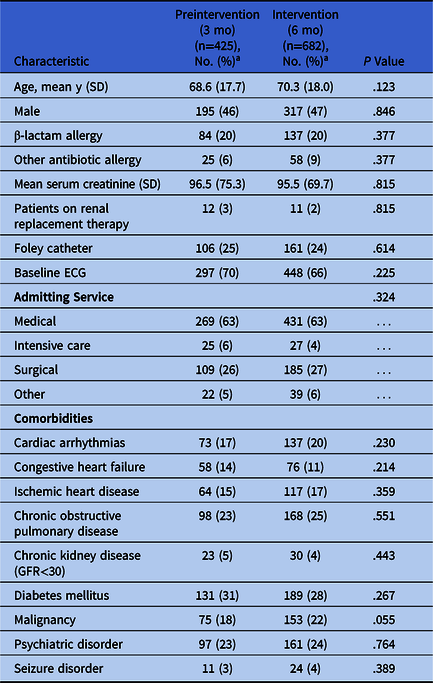
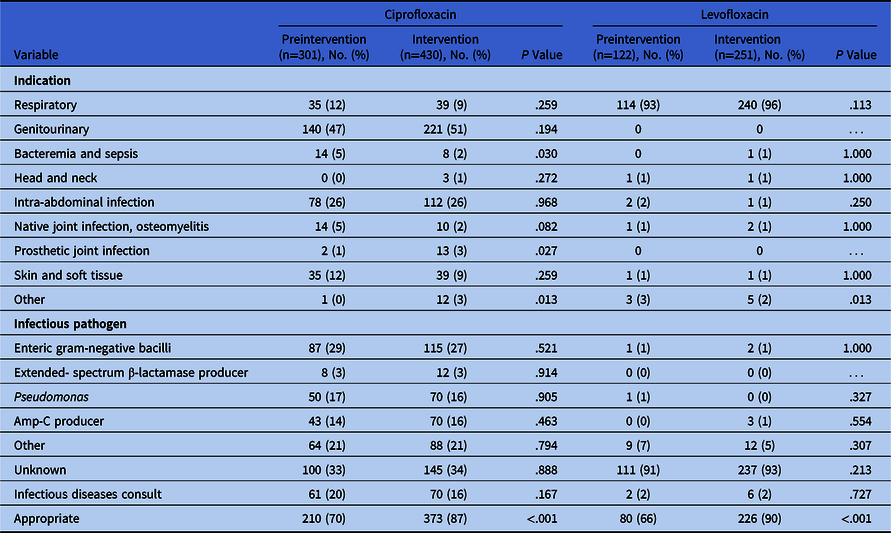
Overall, 1,107 inpatient FQN prescriptions were ordered during the study period (425 in the 3-month preintervention period and 682 in the 6-month intervention period). Baseline characteristics did not differ significantly between groups (Table 1). Of the 1,107 prescriptions, 731 were ciprofloxacin, 374 were levofloxacin, and 3 were moxifloxacin. The most common infectious indications were respiratory (levofloxacin), and genitourinary or intra-abdominal (ciprofloxacin) (Table 2). In total, 128 ASP recommendations were made during the intervention period and 107 (84%) were accepted. The most common recommendations were optimization of duration, FQN discontinuation and suggestions for an alternate antibiotic with fewer adverse effects.
Baseline Demographics of Inpatients Prescribed a Fluoroquinolone Antibiotic

Note. SD, standard deviation; ECG, electrocardiogram; GFR, glomerular filtration rate.
a Units unless otherwise specified.
Fluoroquinolone Prescribing Preintervention Versus Intervention
With PAF, FQN utilization decreased from 39.19 to 29.58 days of therapy (DOT) per 1,000 patient days (P < .001). Appropriateness of all FQN use increased from 290 of 425 (68%) to 599 of 682 (88%) (P < .001), with a reduction in unnecessary FQN prescriptions (17% vs 7%; P < .001) and decreased FQN use in patients at highest risk for adverse events (2% vs 0%; P = .006). Ciprofloxacin appropriateness improved from 210 of 301 (70%) to 373 of 430 (87%) (P < .001), largely attributed to reduced use for nonspecific symptoms and a shift toward use for confirmed UTI diagnoses such as complicated UTIs and cystitis (see Supplement online). Appropriateness of levofloxacin prescribing improved from 80 of 122 (66%) to 226 of 251 (90%) (P < .001), primarily due to fewer unnecessary levofloxacin prescriptions for noninfectious respiratory presentations (Table 2).
Acute-care hospital length of stay, unintended 30-day readmission rates, in hospital mortality rate, CDI rate, and CDI-attributable mortality rate did not differ between the 2 study periods (see Supplement online).
Discussion
In this study, FQN PAF in isolation reduced FQN use by 25% (P < .001) and improved appropriateness of prescriptions by 20% (P < .001), with a high ASP recommendation acceptance rate (84%). Furthermore, we identified target patient populations for reducing inappropriate fluoroquinolone use, including patients with noninfectious respiratory presentations or nonspecific symptoms unlikely due to UTIs.
Through PAF, we were able to provide case-based education to prescribers in real time regarding the safety concerns associated with FQN use. The number of FQN orders decreased from 425 to 327 in the first 3 months of the intervention, suggesting avoidance of FQNs independent of ASP feedback, a concept previously demonstrated.Reference Fleming, Ali and Matelski7 Among the audited FQN prescriptions, PAF was associated with shortening durations of therapy or discontinuing FQN prescriptions altogether. Reassuringly, despite this reduction in antibiotic treatment, there was no negative impact on patient clinical outcomes, which supports the safety of the intervention.
Overall, 30% of ciprofloxacin prescriptions targeted P. aeruginosa or AmpC β-lactamase–producing organisms and another 30% of prescriptions were oral step down orders for serious gram-negative infections. Because these represent appropriate uses of FQNs, there was no change in prescribing for these microbiologically confirmed infections.
Previous studies have demonstrated the impact of PAF on FQN use when embedded within bundled interventions, making it difficult to determine which bundle component was most effective. Willemsen et alReference Willemsen, Cooper and van Buitenen8 introduced 4 FQN optimization initiatives in a staggered fashion, demonstrating a reduction in overall ciprofloxacin use, which they attributed to guideline implementation rather than PAF. Wong-Beringer et alReference Wong-Beringer, Nguyen and Lee9 studied the impact of a pharmacist-led bundled intervention in which empiric FQN use was reduced by 30%. However, for a resource-limited ASP, we demonstrated that PAF alone could similarly reduce FQN use by 25%.
To our knowledge, this is the largest study to examine the effect of PAF in isolation on inpatient FQN appropriateness. Our comprehensive data set reveals high-yield areas for FQN optimization by ASPs. This multisite intervention on all adult inpatients included a diverse patient population with both medical and surgical services.
Our study has several limitations. Maturation effects and potential confounders from variations in medical practice may have affected our data during different study periods, and there was no adjustment period between study groups. We were unable to capture data on adverse effects attributed to the current inpatient FQN prescription. Our intervention did not extend to surgical prophylaxis, emergency department prescribing, or postdischarge prescriptions, which are ideal areas to study given the high rates of FQN misuse reported.Reference Werner, Hecker and Sethi4,Reference Méan, Pavese and Vittoz5,Reference Vaughn, Gandhi, Conlon and Chopra10 The FQN appropriateness categorization was designed to be standardized; however, there is no gold standard for FQN appropriateness.
This study confirms that PAF is an effective ASP tool for decreasing the use of FQNs and improving appropriate prescribing. Given increasing concerns for FQN-associated adverse events, judicious and appropriate prescribing is a matter of patient safety, and PAF is a safe and effective method of accomplishing this goal.
Acknowledgments
Financial support
No financial support was provided relevant to this article.
Conflicts of interest
C.C. reports personal fees from Sunovion, Merck, Astellas, AVIR pharma and Gilead, grants and personal fees from Pfizer, and an unrestricted educational grant from Merck, all outside the submitted work. All other authors report no conflicts of interest relevant to this article.
Supplementary material
To view supplementary material for this article, please visit https://doi.org/10.1017/ice.2020.339