Introduction
Traumatic brain injury (TBI) in the older adult population is a particularly worrisome problem as it results in higher mortality and lower functional outcomes compared to younger adults with head injury (Susman et al., Reference Susman2002). TBI is often defined in the literature as changes to brain functioning or presence of brain pathology, as a result of external force (Manley and Maas, Reference Manley and Maas2013) and manifested by any period of loss of consciousness or other neuropsychological impairments (Adams et al., Reference Adams1993). Falls, road traffic accidents (RTAs), and violence are some of the leading causes of TBI around the world (Hyder et al., Reference Hyder, Wunderlich, Puvanachandra, Gururaj and Kobusingye2007). TBI caused by falls are more prevalent in high-income countries, while TBI caused by RTAs are more prevalent in low- and middle-income countries (LMICs) (Khan et al., Reference Khan, Prince, Brayne and Prina2015). Among adults aged above 65 years in the USA, falls (60.7%) were the leading cause of TBI (Faul et al., Reference Faul, Xu, Wald and Coronado2010).
Previous studies have examined the prevalence of TBI among the older adult population across the globe. TBI prevalence in older adults has been reported, in a 10/66 population-based study, to range from 0.3% to 14.6% in LMICs (Khan et al., Reference Khan, Prince, Brayne and Prina2015). In contrast, among two high-income countries, i.e. Australia and USA, the prevalence was 17.4% (Almeida et al., Reference Almeida, Hankey, Yeap, Golledge and Flicker2015), and 4.4% (Silver et al., Reference Silver, Kramer, Greenwald and Weissman2001) respectively. These findings suggest that there is no clear pattern that can be used to predict the prevalence of TBI in a country based on income levels. The prevalence rates of TBI might be associated with unique characteristics of societies such as alcohol consumption and motorcyclist helmet laws (Roozenbeek et al., Reference Roozenbeek, Maas and Menon2013) rather than the national gross domestic product (GDP).
Socio-demographic factors have also been found to be associated with sustaining TBI. Male gender, for example, has been cited in various studies to have a greater association with having a history of TBI than female gender (Gan et al., Reference Gan, Lim and Ng2004; Almeida et al., Reference Almeida, Hankey, Yeap, Golledge and Flicker2015; Khan et al., Reference Khan, Prince, Brayne and Prina2015). Having a lower level of education and fewer assets were also linked with a greater risk of TBI (Khan et al., Reference Khan, Prince, Brayne and Prina2015).
While there are many studies that have looked at TBI-related mortality and hospitalizations as outcomes of TBI (Faul et al., Reference Faul, Xu, Wald and Coronado2010; Cheng et al., Reference Cheng, Lin, Lee, Hsu, Lee and Su2014), there are other long-term consequences associated with TBI for those who do survive. Long-term disability for one, is a debilitating problem that has been associated with TBI (Selassie et al., Reference Selassie, Zaloshnja, Langlois, Miller, Jones and Steiner2008). In their population-based study, Selassie and colleagues (Reference Selassie, Zaloshnja, Langlois, Miller, Jones and Steiner2008) suggest that as much as “43.3% of hospitalised TBI survivors experienced TBI-related long-term disability” in the USA. While most disability measures assess global functioning in an individual, more specific dysfunctions have also been associated with TBI. Visual impairment (Goodrich et al., Reference Goodrich, Martinsen, Flyg, Kirby, Garvert and Tyler2014), hearing impairment (Munjal et al., Reference Munjal, Panda and Pathak2010), dementia (Lee et al., Reference Lee, Hou, Lee, Hsu, Huang and Su2013), fainting (Vanderploeg et al., Reference Vanderploeg, Belanger and Curtiss2009), and stroke (Burke et al., Reference Burke, Stulc, Skolarus, Sears, Zahuranec and Morgenstern2013) have all been associated with TBI. Hypertension and alcohol abuse have also been reported to be linked with TBI. In a study by Thomson and colleagues (Reference Thompson, Dikmen and Temkin2012), hypertension and alcohol abuse were found to be the commonest comorbid conditions among older adults with TBI. Depression might also be a comorbid condition in older adults with TBI. Although research thus far on depression after TBI in older adults has been limited, a systematic review indicated that depression after TBI stands at a prevalence of 21%–37% (Menzel, Reference Menzel2008). An exploratory study also suggested that age-related cognitive decline might be exacerbated in older adults with a history of TBI compared to those without a history of TBI (Ozen et al., Reference Ozen, Fernandes, Clark and Roy2015). The main aims of the current study were to determine the prevalence of TBI among older adults in Singapore, based on data from the Well-being of the Singapore Elderly (WiSE) – a population-based study. We also aimed to investigate some of the socio-demographic, lifestyle, and clinical correlates of TBI. Lastly, we aimed to determine if the risk of TBI was associated with increased overall disability and cognitive impairment.
Methods
Sample
Singapore is city-state in Southeast Asia with a multi-ethnic resident population of about 3.9 million (Department of Statistics, Reference Singapore2015). Of this, 74.3% are of Chinese ethnicity, 13.3% of Malay ethnicity, 9.1% of Indian ethnicity, and 3.2% of other ethnicities. The current study used data from the WiSE study. Details of its methods have been previously reported (Subramaniam et al., Reference Subramaniam2015). In brief, the WiSE study was a single-phase, cross-sectional, epidemiological study conducted in Singapore between August 2012 and November 2013. The WiSE study surveyed people aged 60 years or above, living in Singapore at the time when the study was conducted. The study was mainly conducted to investigate the prevalence of dementia and its associations (clinical conditions and socio-demographic) among older adults. The 10/66 protocol was adopted for the study (Prince et al., Reference Prince2007). Questionnaires were administered by trained lay interviewers to the participants and an informant (a person who knows the older person the best). The informant was asked questions pertaining to their socio-demographic characteristics, psychological distress, and burden of caregiving (Vaingankar et al., Reference Vaingankar2016) (if applicable), and, they were also asked questions pertaining to the participant's socio-demographic background and clinical history if the participant was unable to provide the relevant information or was not consistent in his or her answers.
The WiSE study was approved by the institutional ethics review boards of participating institutions (National Healthcare Group Domain Specific Review Board) (DSRB) and the SingHealth Centralised Institutional Review Board (CIRB)). Informed consent was obtained from all respondents in the study. In the event where they were not able to provide informed consent, their legally acceptable representative/next of kin provided the written informed consent.
Measures
Traumatic brain injury (TBI)
A history of TBI was ascertained from the participants by asking participants the following question: “have you ever had a serious head injury in which you were knocked out?” (yes/no) from the health status questionnaire which was adapted from the 10/66 dementia research group population-based Study (Prince et al., Reference Prince2007). In the event that the participant was unable to provide the accurate information, the information was obtained by asking the informant, “has your (relative/friend) ever had a serious head injury in which your (relative/friend) was knocked out?”(yes/no).
Socio-demographic information
Participants were administered the socio-demographic and risk factor questionnaire. Socio-demographic information (age, gender, ethnicity, education, highest job level, income, who the participants were living with) of the participants was collected.
Cognitive functioning
Participants were administered a cognitive test battery from the Community Screening Instrument for Dementia (CSI'D) (Hall et al., Reference Hall1993), a 32-item questionnaire. A global cognitive score (COGSCORE) indicative of cognitive functioning was generated based on an item-weighted total score from the number of correct answers ranging from 0 (cognitively impaired) to 32 (no cognitive impairment).
Disability
The 12-item interviewer-administered version of the World Health Organization – Disability Assessment Schedule 2.0 (WHO-DAS 2.0) (Rehm et al., Reference Rehm1999) was used to assess disability in the study for five domains of functioning: (i) understanding and communicating; (ii) self-care; (iii) mobility; (iv) getting along with people; and (v) life activities. For each item, individuals had to estimate the difficulties due to health problems during the previous 30 days from none = 1 to extreme/cannot do = 5.
Chronic physical and mental conditions
The health status questionnaire also included a chronic conditions checklist (stroke, eye sight problems, hearing difficulties or deafness, faints or blackouts, paralysis or weakness, hypertension, diabetes). The 10/66 criteria was used to diagnose a participant with dementia (Prince et al., Reference Prince, Acosta, Chiu, Scazufca and Varghese2003). The CAGE questionnaire was used to screen for lifetime alcohol abuse (Ewing, Reference Ewing1984). The Geriatric Mental State (GMS) questionnaire, which applies a computer algorithm (AGECAT) (Copeland et al., Reference Copeland1976), was also administered to the older adult to obtain a possible diagnosis of depression. The depression syndrome cluster is given a severity level ranging from 0 (non-case) to 5. Levels 1 and 2 indicate “subcases” while levels 3 and above represent a “case.” The stage 1 diagnosis of depression is further organized into a single “stage 2” diagnosis. We used the stage 2 GMS –AGECAT depression syndrome for this analysis.
Statistical analysis
SAS version 9.3 was used to carry out the statistical analyses for the current study. To ensure that the survey findings were representative of the Singapore elderly population, all estimates were analyzed using survey weights to adjust for oversampling, non-response, and post-stratification according to age and ethnicity of the Singapore elderly population for the year 2013.
The prevalence of TBI and other study variables were reported using descriptive statistics. Mean and standard errors were calculated for continuous variables, and frequencies and percentages for categorical variables. Multiple logistic regression analyses were used to find significant associations between TBI, socio-demographic characteristics, cognitive functioning, disability, chronic medical conditions, and depression. Statistically significant differences were evaluated at the p < 0.05, using two-sided tests.
Results
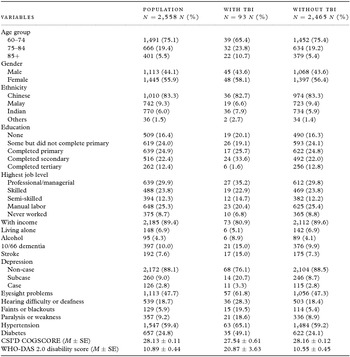
Of the total 2,565 participants who completed the WiSE study, 2,558 individuals responded to the question on head injury and were included in this study. Ninety-three individuals from this study (3.6% prevalence) had a history of TBI. The socio-demographic characteristics of the study participants are shown in Table 1. Overall, 55.9 % of the participants were female and 44.1% were male. Participants of Chinese ethnicity made up the majority of the studies participants (83.3%), with the remaining 9.3%, 6.0%, and 1.5% of participants being of Malay, Indian, and other ethnic groups, respectively.
Socio-demographic and clinical characteristics of older adults and traumatic brain injury

Percentages (%) and means (M) were weighted to general population.
CSI'D COGSCORE = Community Screening Instrument for Dementia Global Cognitive Score.
WHO-DAS 2.0 = World Health Organization – Disability Assessment Schedule.
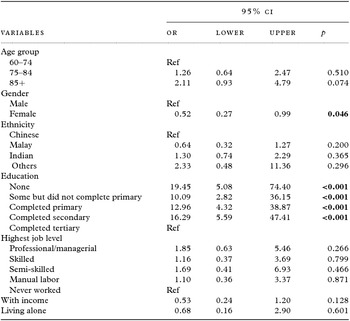
Socio-demographic correlates of TBI
Being female (vs. being male) was found to significantly decrease the odds of having a past history of TBI (odds ratio (OR) = 0.52, 95% CI [0.27, 0.99], p = 0.046) (Table 2). Participants with no education (OR = 19.45, 95% CI [5.08, 74.40], p < 0.001) with some education but did not complete primary education (OR = 10.09, 95% CI [2.82, 36.15], p < 0.001), had completed primary education (OR = 12.96, 95% CI [4.32, 38.87], p < 0.001) and those who had completed secondary education (OR = 16.29, 95% CI [5.59, 47.41], p < 0.01) as compared to those who had completed tertiary education, were significantly associated with increased odds of having a history of TBI.
Socio-demographic correlates of traumatic brain injury in older adults

TBI, traumatic brain injury; OR, odds ratio; 95% CI, 95% confidence interval of odds ratio.
Bold print highlights statistically significant odds ratio.
Correlates of TBI and chronic medical conditions
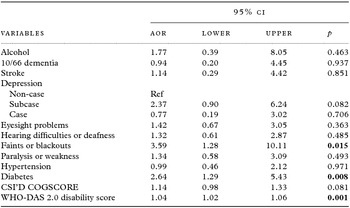
TBI was found to be significantly associated with having a history of faints and blackouts and diabetes, after adjusting for socio-demographic factors (Table 3). Participants with a history of TBI were significantly associated with increased odds (OR = 3.59, 95% CI [1.28, 10.11], p = 0.015) of having a history of faints or blackouts. Participants with a history of TBI were also found to be significantly associated with increased odds (OR = 2.64, 95% CI [1.29, 5.43], p = 0.008) of having a history of diabetes.
Relationship between traumatic brain injury, chronic conditions, cognitive functioning, and disability in older adults

AOR, Adjusted odds ratio, adjusted for socio-demographic factors.
TBI, traumatic brain injury; 95% CI, 95% confidence interval of odds ratio.
Bold print highlights statistically significant odds ratio.
Correlates of TBI, cognitive functioning, and disability
Table 3 shows that after adjusting for socio-demographic factors, significant association was found between a history of TBI and greater disability (OR = 1.04, 95% CI [1.02, 1.06], p = 0.001). However, TBI was not found to be significantly associated with cognitive functioning (OR = 1.1, 95% CI = [0.98, 1.33], p = 0.181).
Discussion
The lifetime prevalence of TBI in the population of older adults in this study was found to be 3.6%. Being female was found to be less likely to be associated with having a past history of TBI compared to being a male. Having completed secondary education or less than secondary school education, was found to be associated with a history of TBI. Participants who reported a history of TBI also were found to have an associated history of blackouts or fainting and diabetes. Lastly, TBI was also found to be associated with greater disability.
The prevalence of TBI from the current study once again illustrates that the prevalence of TBI in any population might not be dependent on whether the country is an LMIC or a developed one. This is in line with the data from earlier studies that suggested a wide variability in prevalence of TBI among older adults in both LMICs (0.3%–14.6% prevalence (Khan et al., Reference Khan, Prince, Brayne and Prina2015)) and developed countries (4.4% in the USA (Silver et al., Reference Silver, Kramer, Greenwald and Weissman2001) and 17.4% in Australia (Almeida et al., Reference Almeida, Hankey, Yeap, Golledge and Flicker2015)). As the prevalence of TBI in the older adult population of Singapore matches that of the USA, there might be similar protective and risk factors in these two nations. There might also be methodological issues to consider that could possible explain the differences observed in the prevalence reported across studies. While the study by Silver and colleagues (Reference Silver, Kramer, Greenwald and Weissman2001) in USA and the current study in Singapore ascertained TBI by self-report alone, Almeida and colleagues (Reference Almeida, Hankey, Yeap, Golledge and Flicker2015) ascertained TBI in Australia by both self-report measures and/or through past medical records. Using two separate measures to determine TBI, may have resulted in higher prevalence in their study compared to the use of a single measure in the current study.
The current study indicates that men are more susceptible than women to TBI. This is in line with the findings of past research (Gan et al., Reference Gan, Lim and Ng2004; Almeida et al., Reference Almeida, Hankey, Yeap, Golledge and Flicker2015; Khan et al., Reference Khan, Prince, Brayne and Prina2015). One possible reason for this might have to do with the different societal roles expected of men and women in Singapore. Men might be more likely to engage in labor-intensive work and risk-taking behaviors, increasing the probability of suffering a TBI, compared to women. Women might be more likely to be homemakers and possibly rendering them less likely to sustain TBI. This is supported by a study which stated that the labor force participation rate in 1961 for women was only around 32%, while the rate for men was around 76% (Fields, Reference Fields and Galenson1985). Furthermore, about 38% of employed persons in 1957 were production workers, transport equipment operator, and laborers (Pang, Reference Pang1981). It is a methodological limitation of the current study that we were not able to measure the specific type of work taken up by the study population. Future studies could perhaps look at the association between specific job roles and association with TBI.
Two clinical correlates of TBI found in the study were faints or blackouts and diabetes. The association between a history of TBI and faints or blackouts is consistent with past literature (Vanderploeg et al., Reference Vanderploeg, Belanger and Curtiss2009). Participants with a history of faints or blackouts were found to be 3.26 times more likely to have a history of TBI than those without a history of TBI. The association between diabetes and TBI on the other hand is a novel finding, without much existing research on this association. Another study finding has suggested that diabetes increases the risk of falls among the older adult population (Maurer et al., Reference Maurer, Burcham and Cheng2005). Maurer and colleagues (Reference Maurer, Burcham and Cheng2005) suggested that this may be attributed to the peripheral neuropathies or diabetic foot complications. As falls are one of the leading causes of TBI in older adults, diabetes might thus indirectly increase the risk of TBI among older adults. However, it is important to note that this is a cross-sectional study and the reverse could be true as well. It might be possible that participant's TBI and/or related sequelae/disability may limit their daily physical activities or contribute to insufficient daily exercise, which could be related to the current diabetes. Further research is still needed to clarify the direction of the association between diabetes and TBI.
The results of the current study suggest that greater disability was associated with TBI, which is in line with past literature (Selassie et al., Reference Selassie, Zaloshnja, Langlois, Miller, Jones and Steiner2008). This association might be attributed to primary injury processes to the brain such as cerebral lacerations and contusions (Chua et al., Reference Chua, Ng, Yap and Bok2007). In addition, Chua and colleagues (Reference Chua, Ng, Yap and Bok2007) also suggested that older adults with moderate-to-severe TBI may have a greater proportion of traumatic intracranial and subarachnoid hemorrhage, also contributing to greater disability. However, once again, the cross-sectional design of the current study prevents us from drawing inferences about the direction of the association.
Contrary to what past literature has suggested (Ozen et al., Reference Ozen, Fernandes, Clark and Roy2015), the results of the current study suggested that cognitive impairment was not associated with a history of TBI. The inconsistency might be due to executive functioning being the main component of cognitive functioning that is impaired in older adults with TBI, while other cognitive components may be preserved. This is supported by Ozen and colleague's (Reference Ozen, Fernandes, Clark and Roy2015) study which suggested that compared to older adults without TBI, those with TBI had only executive functioning impairment. Given that the current study used the global COGSCORE as an indication of cognitive functioning, executive functioning was not directly measured. Therefore, this might have contributed to the lack of association between cognitive impairment and TBI in the current study. Another possible explanation for the lack of significant association between cognitive impairment and TBI in the current study might be due to not segregating the older adult participants based on severity of the TBI. Finnanger et al. (Reference Finnanger, Skandsen, Andersson, Lydersen, Vik and Indredavik2013) indicated in their study that participants with both moderate and severe TBI displayed reduced executive functioning, a year after injury. However, participants with severe TBI also displayed reductions in other domains of their cognitive functioning like motor function and verbal memory. Thus, severity of TBI may be a moderating factor in the association between cognitive impairment and TBI.
Limitations
One of the main limitations of the study is that TBI ascertainment was achieved through participant and informant self-report. Such an approach might be limited by recall bias, reducing the reliability of the results collected. This might cause an underestimation of the actual prevalence of TBI in the population. Realistically, the prevalence of TBI could be higher if other measures were used to collect information on history of TBI among participants. This is especially considering head injury resulting in loss of consciousness (as measured in this study) is not the only manifestation of TBI.
Another limitation is the cross-sectional study design, which does not allow us to make any conclusions on the temporal relationships between the occurrence of TBI and comorbid conditions. The time gap between the event of the TBI and date of examination for the study was also not collected. In addition, the number of times the participant suffered from TBI was also not obtained. Future research could perhaps look at using a longitudinal methodology to establish the relationship between TBI, comorbid conditions, and cognitive functioning.
Conclusion
The current study details the prevalence and correlates of TBI among older adults in the Singapore population. To the best of our knowledge, there have been no previous studies of this proportion carried out focusing on the prevalence of TBI and its clinical correlates in the local context. Being male and having completed less than tertiary education was found to be significantly associated with increased odds of having a history of TBI. Significant associations between a history of TBI and other chronic conditions like diabetes and a history of faints or blackouts were identified. Last, a history of TBI was associated with increased disability which is likely to necessitate support and rehabilitative care.
Conflict of interest
None.
Description of authors’ roles
L. Cetty assisted in the statistical analysis and wrote the paper. E. Abdin was responsible for the statistical analysis and provided input into the study protocol. J. A. Vaingankar provided input into the study protocol, was involved in the conduct of the study and data management, and provided intellectual input into the paper. A. Jeyagurunathan was involved in conducting the study and provided intellectual input into the paper. B.Y. Chua was involved in the data management for the study. L. Picco provided intellectual input into the paper. M. Prince was involved in the development of the study protocol and interviewer training. S.A. Chong provided intellectual input into the paper and was the PI of the WISE study. M. Subramaniam provided input into the study protocol and conduct of the study, and provided intellectual input into the paper.
Acknowledgments
This study was funded by the Ministry of Health, Singapore and the Singapore Millennium Foundation of the Temasek Trust under the Ministry of Health Reinvestment Funds, Project No. RF07(2011-02). The study was sponsored by Ministry of Health, Singapore and the Singapore Millennium Foundation of the Temasek Trust under the Grant Number: RF07(2011-02).