Introduction
Astigmatid mites, small arachnids with no external breathing pores or stigmata, consume stored food. Astigmatid mites are phylogenetically closely related to Oribatids. Many species are fungivorous and commonly occur as detritivorous saprophytes in decaying organic matter in the soil (Duek et al., Reference Duek, Kaufman, Palevsky and Berdicevsky2001; Bowman, Reference Bowman2021). The fungivorous astigmatid mite Histiostoma feroniarum Dufour is an economically important pest of vegetables, Chinese herbs, mushrooms, and stored products. In addition to feeding on fresh plant roots, shoots, and mushroom bodies, H. feroniarum feeds on decaying plants and dead soil animals, spreading diseases and bacteria such as Trichoderma spp., Aspergillus spp., and Candida (Szafranek and Lewandowski, Reference Szafranek and Lewandowski2016; Yong et al., Reference Yong, Ning, Zeng and Li2016; Chai et al., Reference Chai, Guo, Tao and Li2017).
H. feroniarum is one of the most significant pest mites of mushroom cultivation. In China, the first case of H. feroniarum damaging mushrooms was reported in 1986, as it was found to be widely propagated in the cultivation of Agaricus bisporus Lange in Shanghai (Zou and Gao, Reference Zou and Gao1987). The mite occurred on a variety of edible mushrooms, including Pleurotus ostreatus Kumm, P. pulmonarius (Fr.) Quél., and Flammulina velutipes (Fr.) Sing (Jiang and Li, Reference Jiang and Li2005). When H. feroniarum feeds directly on the mycelia of spawn and the fruiting body, it often results in a significant loss of mycelia, which leads to harvest losses (Zou and Gao, Reference Zou and Gao1987; Jiang and Li, Reference Jiang and Li2005). The mushroom cultivation environment requires maintaining a consistently warm temperature, high humidity, and high concentration of substrate materials; these conditions favor the growth of fungivorous astigmatid mites (Lan et al., Reference Lan, Lu and Fan2012; Szafranek and Lewandowski, Reference Szafranek and Lewandowski2016). Development of Rhizoglyphus robini Claparède is significantly affected by mushroom species and temperatures, ranging from 9.45 ± 1.83 days (reared on Lentinula edodes (Berk.) Pegler at 31°C) to 26.39 ± 2.10 days (reared on A. bisporus Lange at 15°C), and the intrinsic rates of natural increase (r m) range from 0.23 to 0.28 (Qu et al., Reference Qu, Luo and Ma2018). Temperature also influences the development of H. feroniarum. When the temperature is not suitable, the mite ultimately produces dispersing heteromorphic deutonymphs (hypopi) that are transmitted through the air and by insects (Zou and Gao, Reference Zou and Gao1987). The use of temperature modification for integrated pest management requires detailed knowledge of the effect of the environmental conditions (Aspaly et al., Reference Aspaly, Stejskal, Pekár and Hubert2007). However, few studies have reported the effects of temperature and the type of mushroom species on the growth and development of H. feroniarum.
A. bisporus, P. ostreatus, P. pulmonarius, P. eryngii var. tuoliensis Mou, P. abalonus Han Chen et Cheng, Auricularia polytricha (Mont.) Sacc., F. velutipes, Agrocybe cylindracea (Dc. ex Fr.) Maire, L. edodes Berk, and Ganoderma lucidum (Leyss. ex Fr.) Karst, are the most extensively cultivated mushrooms under the factory cultivation mode (Li, Reference Li2011), accounting for 80% (about 32 million tons) of the total mushroom production in China, which are potentially mite-tainted (China Edible Fungi Association). Mushroom cultivation has a substantial impact on China's poverty alleviation program, generating earnings at least ten-fold higher than those of rice and corn (Li and Xu, Reference Li and Xu2022). In this study, we evaluated the development of H. feroniarum on nine mushroom species (ten varieties). We also examined the effect of temperature on the population growth at 80% relative humidity under various temperature conditions, 16 to 34°C. The results provide a reference for fungivorous astigmatid mite control in mushroom cultivation through mushroom cultivar resistance and temperature-mediated effects on mite development.
Materials and methods
Mites
H. feroniarum used in this study was collected in 2011 from the oyster mushroom, P. ostreatus, in Nanjing City (Jiangsu, China). It was reared on the mycelia of P. ostreatus in the laboratory at 25°C and approximately 85% relative humidity (RH) in complete darkness (Qu et al., Reference Qu, Li, Ma, Song, Hou and Lin2015).
Mushrooms
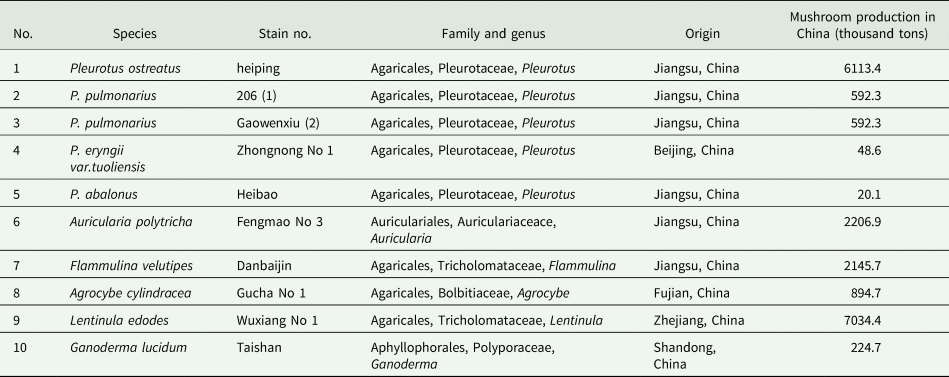
Nine mushroom species with 10 varieties were chosen: P. ostreatus, P. pulmonarius, P. eryngii var. tuoliensis, P. abalonus, A. polytricha, F. velutipes, A. cylindracea, L. edodes, and G. lucidum. The information for the mushroom strains used in the experiment is shown in table 1.
The edible mushroom strains used in this study

All the data of mushroom production in China by species (2021) was provided by China Edible Fungi Association.
Two weeks prior to the experiments, the mycelia of these strains were inoculated onto a potato dextrose agar medium in 70-mm-diameter Petri dishes. The methods of mushroom inoculation and culture were as previously described (Qu et al., Reference Qu, Luo and Ma2018).
Developmental times of immature stages
Under an S8APO dissection microscope (Leica, Germany), newly laid (one-day-old) mite eggs were collected and separated using a hairbrush and were placed in a six-well cell culture plate containing punched mycelia of the test strains (diameter 20 mm). Fifteen eggs of the same age were placed in each well and kept in SPX-2501C type artificial climate boxes (Suzhou Jiangdong Precision Instrument Co., Ltd.) at seven different temperatures, that is, 16, 19, 22, 25, 28, 31, and 34 ± 1°C, and 80 ± 5% RH in the dark. Six replicates per mushroom strain were used to determine the developmental times of immature stages with total 3780 eggs of the same age using an S8APO dissection microscope (Leica, Wetzlar, Germany). The method of daily observations, data recording, and calculations followed the same technique as reported by Qu et al. (Reference Qu, Li, Ma, Song, Hou and Lin2015). The length of time required to pass each stage was likewise included in the daily observations.
Host selection of H. feroniarum
A dual-port Y-tube glass olfactometer (stem, 45 mm; ports, 45 mm at a 60° angle from the stem; internal diameter, 6 mm) (Beidi Experimental Instrument, Jiangsu, China) was used to evaluate and compare the mushroom strain host preferences of the mite. The base of the stem was connected to a digital flowmeter generating purified air (0.33 ml s−1). One of the two arms of the Y-tube was empty, which was used as the blank control, and the other arm contained 0.2 g of each of the 10 different mushroom strains. Adult mites (20 mites) were transferred inside the glass chamber using a 0# brush left in the middle of the stem (Hsueh et al., Reference Hsueh, Gronquist, Schwarz, Nath, Lee, Gharib, Schroeder and Sternberg2017). The movement of H. feroniarum covering half of the arm's length within 20 min without returning was considered its choice of the host under the dissection microscope (Hsueh et al., Reference Hsueh, Gronquist, Schwarz, Nath, Lee, Gharib, Schroeder and Sternberg2017). Before the next test, two arms were sterilized with 70% ethanol, rinsed with sterile water, and dried by evaporation for 10 min. Each mushroom host was tested at least in quadruplicate. The trapping rate was calculated as follows: (number of trapped mites per mushroom strain/the total number of the tested mites) × 100%.
Data analysis
Six replicates per mushroom strain were used to conduct a one-way analysis of variance (ANOVA) on the duration variance associated with the time it took for 90 freshly laid eggs of H. feroniarum to develop from egg to adult. This analysis was followed by a Student-Newman-Keuls (SNK) test (P = 0.05) using IBM SPSS Statistics 20.0 software. We compared the variance of growth times when the mite was reared on the same host at seven different temperatures and on ten different mushroom types at the same temperature, respectively. A two-way ANOVA was used to assess the effect of both temperature and mushroom host type on development times, followed by an SNK test (P = 0.05) (Ma et al., Reference Ma, Jia, Hong and Wang2005; Qu et al., Reference Qu, Li, Ma, Song, Hou and Lin2015).
Results
Effect of temperature on the development times of immature stages
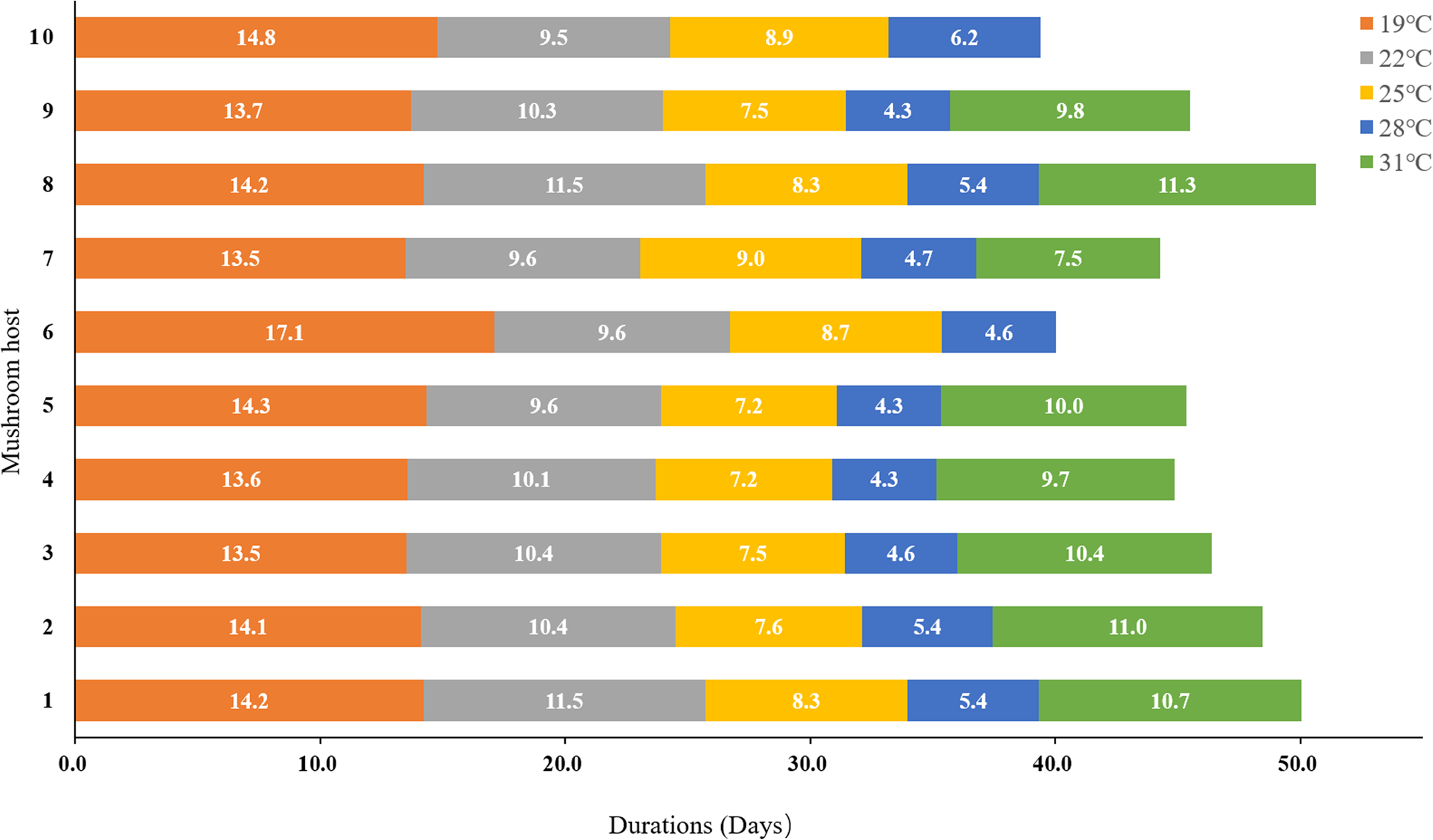
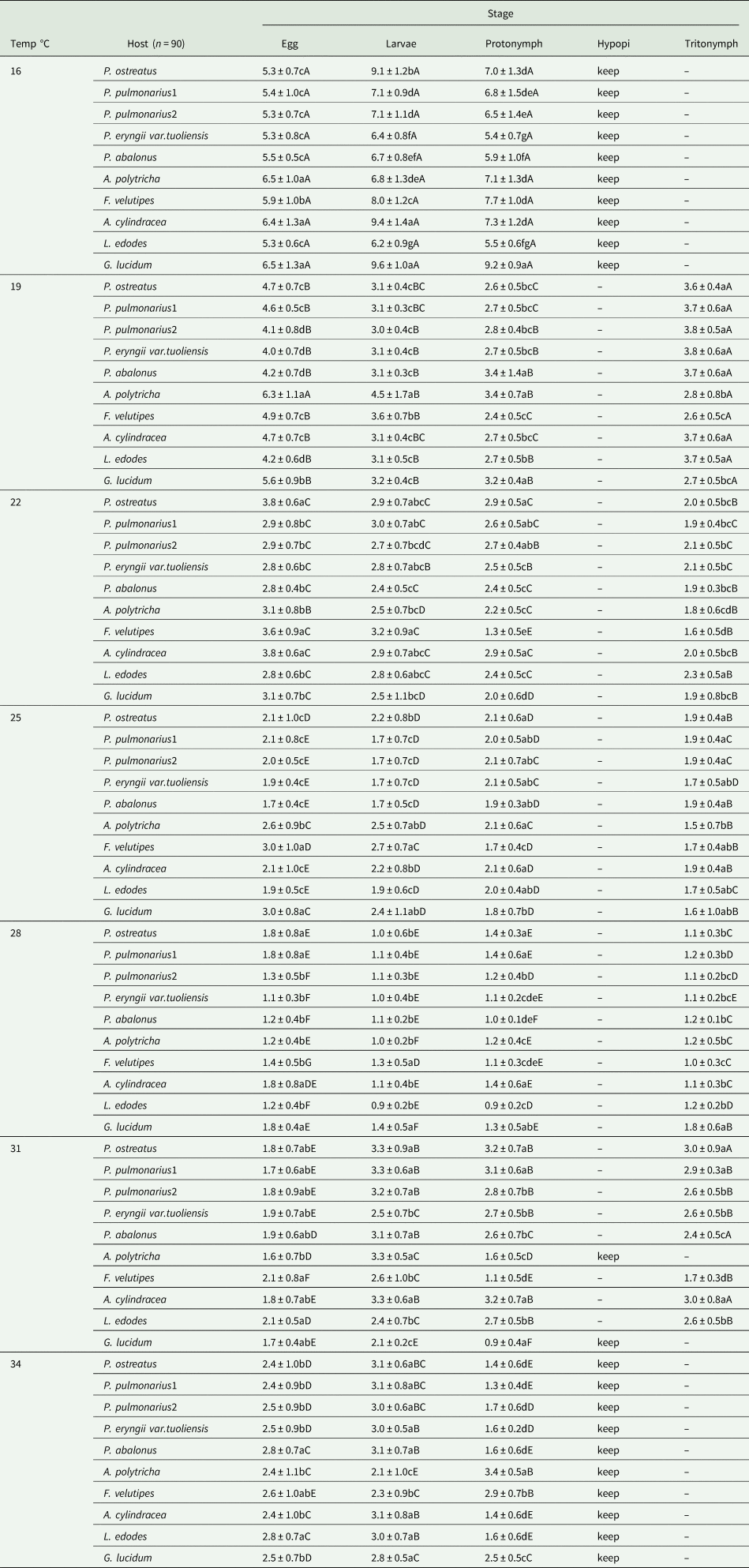
In temperatures between 19 and 31°C, H. feroniarum reared on ten mushrooms successfully developed from egg to adult with five life stages (table 2). Temperature significantly affected the developmental time required for immature stages (F = 175.819, df = 6, 479, P < 0.0001). As the temperature increased, the total developmental time of immature stages decreased, reaching a minimum development time at 28°C. Developmental time of the immature stages ranged from 4.3 ± 0.4 days (reared on P. eryngii var. tuoliensis at 28°C) to 17.1 ± 2.3 days (reared on A. polytricha at 19°C) (fig. 1). Hypopi appeared at 16 and 34°C and remained at the hypopus stage throughout the experiment in these temperature conditions. None of these hypopi developed into the tritonymph stage. Specifically, the larval and protonymph stages were sensitive to temperature, occurring on 6.2 ± 0.9 to 9.4 ± 1.4 days at 16°C, 3 ± 0.4 to 4.5 ± 1.7 days at 19°C, and approximately one day at 28°C (table 2). In the immature stage, all 10 types of mushrooms showed a long duration of the egg stage at temperatures between 19 and 31°C, with the shortest egg stage occurring at 28 and 31°C (table 2).
The total development durations (d) for H. feroniarum reared on different mushroom hosts at different temperatures. Mushroom host represent: 1, Pleurotus ostreatus; 2, P. pulmonarius; 3, P. pulmonarius; 4, P. eryngii var.tuoliensi; 5, P. abalonus; 6, Auricularia polytricha; 7, Flammulina velutipes; 8, Agrocybe cylindracea; 9, Lentinula edodes; 10, Ganoderma lucidum. Error bars correspond to SEs. Different small letters are significantly different for different hosts at the temperature using IBM SPSS Statistics 20.0 software (IBM, Somers, NY), followed by the SNK test (P < 0.05).

Developmental durations (days) of H. feroniarum on different mushrooms at seven temperatures (80%RH)

n, number of mites tested
Values are presented as mean ± SE.
Means within the same column followed by the different small letters are significantly different for different hosts at the same temperature by One-way ANOVA analysis (SNK test: P < 0.05).
Means within the same column followed by the different capital letters are significantly different for the same host at different temperatures by One-way ANOVA analysis (SNK test: P < 0.05).
Effect of mushroom strains on the development times of immature stages
Different mushroom strains displayed significant differences (P < 0.0001) in the development of immature stages at 19 to 31°C temperature conditions (fig. 1). At the same temperature, the development times were shorter for ‘Gaowenxiu’ of P. pulmonarius, ‘Zhongnong No. 1’ of P. eryngii var. tuoliensis, and ‘Wuxiang No. 1’ of L. edodes (table 2 and fig. 1). The type of host mushrooms affected the production of hypopi. At 31°C, the mites developed into the tritonymph stage except those reared on the host ‘Fengmao No. 3’ of A. polytricha and ‘Taishan’ of G. lucidum (table 2).
On the same mushroom strain, the developmental times of different immature stages of H. feroniarum were shortened with increasing temperature, and when the temperature reached above 28°C, the development slowed (table 2). For all temperatures, four mushroom species of Pleurotus showed differences in developmental times of the mite, for those fed on P. ostreatus, the developmental duration was longer than the others.
Effect of temperature and mushroom species on the development times of immature stages
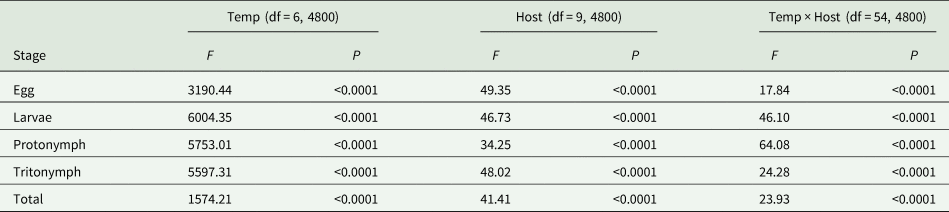
Based on the two-way ANOVA, both temperature and type of host fungus affected the immature development periods of H. feroniarum (table 3). There was also a significant interactive effect (P < 0.0001) between temperature and type of mushroom species on the immature development times from egg to adult of H. feroniarum.
Two-way ANOVA statistics for main effects and interactions of temperature and mushroom hosts

Host selection
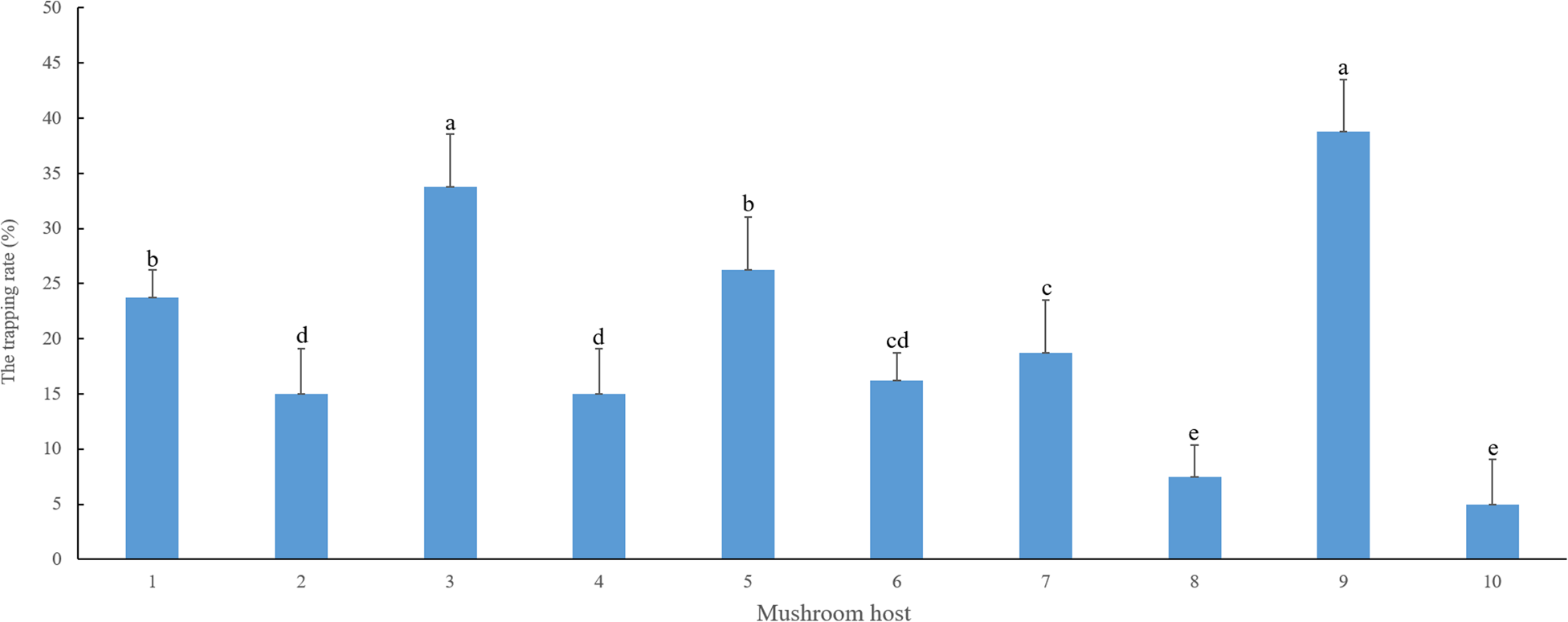
H. feroniarum had considerable trapping rates in the 10 different mushroom strains. The behavioral responses of adult mites to the different hosts varied (fig. 2). The fungivorous astigmatid mite was strongly attracted to ‘Gaowenxiu’ of P. pulmonarius and ‘Wuxiang No. 1’ of L. edodes, while ‘Gucha No. 1’ of A. cylindracea and ‘Taishan’ of G. lucidum were least preferred. The mite showed preference for five Pleurotus strains. The highest preference was for ‘Gaowenxiu’ of P. pulmonarius, followed by ‘Heiping’ of P. ostreatus and ‘Heibao’ of P. abalonus, and finally ‘206’ of P. pulmonarius and ‘Zhongnong No. 1’ of P. eryngii var. tuoliensis (fig. 2).
The trapping rates of H. feroniarum in ten different mushroom hosts. Mushroom host represent: 1, P. ostreatus; 2, P. pulmonarius; 3, P. pulmonarius; 4, P. eryngii var.tuoliensi; 5, P. abalonus; 6, A. polytricha; 7, F. velutipes; 8, A. cylindracea; 9, L. edodes; 10, G. lucidum. Error bars correspond to SEs. Significant differences of the trapping rate were detected by one-way analysis of variance (ANOVA) using IBM SPSS Statistics 20.0 software (IBM, Somers, NY), followed by the SNK test (P < 0.05).

Discussion
A number of fungivorous astigmatid mite species, including Tyrophagus putrescentiae Schrank, R. robini, Acarus siro L., and H. feroniarum, have been reported to cause severe yield losses if not appropriately managed. Fungivorous astigmatid mites frequently establish large populations in various types of food, and they are naturally adapted to nutrient-rich but short-lived habitats (e.g., mushrooms, food caches of rodents, decomposing vegetation, flower bulbs and cereals) (Hubert et al., Reference Hubert, Jarošík, Mourek, Kubátová and Ždárková2004; Qu et al., Reference Qu, Li, Ma, Song, Hou and Lin2015, Reference Qu, Luo and Ma2018). Under suitable conditions, these mites complete their entire life cycle in about 10 days. When reared on mushrooms, the total immature stages of T. putrescentiae and R. robini are only 7.06 ± 0.2 days and 9.45 ± 1.8 days at 31°C, respectively. Temperature and host-related factors are important environmental factors, affecting mite population growth, fecundity and development (Qu et al., Reference Qu, Li, Ma, Song, Hou and Lin2015, Reference Qu, Luo and Ma2018).
In China, the mushroom cultivation industry is valued at over $50 billion, within the top five crops after grain, vegetables, fruit and edible oil, and valued above sugar, cotton and tobacco (Li and Xu, Reference Li and Xu2022). China exports approximately 60,000 tons of 100 varieties of mushroom to 137 countries annually (China Edible Fungi Association). However, 5–30% of the yield of the 30 most common mushroom varieties is lost to fungivorous mite attacks (Lan et al., Reference Lan, Lu and Fan2012). Understanding the biological parameters of these fungivorous mite pests on different mushroom species and cultivars is therefore important for promoting biological pest control and further development of the edible fungi industry. In this study, nine species and 10 cultivars of mushrooms were evaluated for the selective preference of H. feroniarum, taking into consideration the developmental durations of the mite at varying temperatures. Significant differences in host preference and development times were observed in different strains of the same mushroom species between 19 and 31°C, indicating that the type of mushroom cultivar has an important impact on these biological parameters, which confirms the findings of previous research. For example, when T. putrescentiae was reared on nine different P. ostreatus cultivars, the cultivars had a significant impact on its host preference, immature stage, female fertility, and reproductive lifespan. The resistance of edible mushroom cultivars to fungivorous astigmatid mites is among the most important factors governing the relationship between mite damage and mushroom yield (Hou et al., Reference Hou, Liu, Li, Luo, Ma and Qu2022).
A few studies on the development of H. feroniarum have been published. Zou and Gao (Reference Zou and Gao1987) reported that the period of completion of one generation of the mite fed on A. bisporus at 25°C was 3–4 days. H. feroniarum occurs frequently in high moisture mushroom beds and in decaying culture material. When food is scarce or the environment is dry, the mites produce large quantities of hypopi and are dispersed by insects (Yong et al., Reference Yong, Ning, Zeng and Li2016; Chai et al., Reference Chai, Guo, Tao and Li2017). Previously reported findings have showed that edible mushroom species and cultivars significantly affect the growth, development and reproduction of T. putrescentiae and R. robini (Qu et al., Reference Qu, Li, Ma, Song, Hou and Lin2015, Reference Qu, Luo and Ma2018). In addition, L. edodes was highly suitable for the complete development of R. robini, and F. velutipes was highly suitable for T. putrescentiae development. Some mushroom species or cultivars were unsuitable for T. putrescentiae growth. For example, larval mortality was approximately 100% on Po62 cultivar of P. ostreatus (Hou et al., Reference Hou, Liu, Li, Luo, Ma and Qu2022). Mites produced hypopi at 16 and 34°C, and they remained at this stage throughout the experiment. The hypopus stage also occurred at 31°C when reared on the host ‘Fengmao No. 3’ (A. polytricha) and ‘Taishan’ (G. lucidum). These findings indicate that temperature and individual mushroom species have a major influence on the growth of H. feroniarum. Specifically, the larval and protonymphal stages are sensitive to temperature, and the developmental times depend on the type of mushroom they are reared on.
It is true that mites are sensitive to moisture, but edible mushrooms are equally sensitive, and both require high levels of humidity to grow and develop (Aspaly et al., Reference Aspaly, Stejskal, Pekár and Hubert2007). Mites can successfully grow and propagate within a short developmental period in the cultural environments of edible fungi that maintains a generally constant warmth (20–30°C) and high humidity (80–95%) (Li, Reference Li2011). This study demonstrates that different mushroom species and varieties exhibit differing degrees of pest mite resistance/tolerance, the extent of which depends also on temperature. These findings provide guidance for the selection of temperatures and mushroom species for the low cost and effective control of pest mite populations for increased yield in mushroom cultivation.
Acknowledgements
We thank Charlesworth Author Services (https://www.cwauthors.com) for its linguistic assistance during the preparation of this manuscript.
Author contributions
Conceived and designed the experiments: S. X. Q.; Performed the experiments: J. C. Z., J. X. L., and X. L.; Analyzed the data: H. P. L. and L. M.; Writing – original draft preparation: S. X. Q.; Writing – review and editing: Q. W. and K. P. C.
Financial support
This work was financially supported by China Agriculture Research System (No. CARS-20), and the Jiangsu Agriculture Science and Technology Innovation Fund of Jiangsu Province [No. CX (21)2021].
Conflict of interest
None.