Holy ivory
There never was an Ivory Tower. It was always a figure of speech. There are towers and there is ivory, both quite real; it is their combination in the idea of an Ivory Tower which is both imaginary and consequential. Physical towers had both mundane and symbolic aspects. Affording their inhabitants an overview, towers might be defensible fortified structures. Rising above the normal surface of things, they could also be spaces of contemplation, expressive gestures at closeness to the divine and practical ways of distancing inhabitants from mundane human affairs. Conceived as human-made sacred mountains, towers could be approved as concrete displays of religious aspiration or condemned as symbols of overweening human pride and folly. Ivory was, however, symbolic all the way through: it was always fantastically expensive, a luxury good from parts of animals themselves so rare and exotic that ivory has traditionally had its cultural being in the worlds of art, ornamentation and aesthetics: something real out of which you might make almost mythic real objects – layered myth. Ivory was so costly that virtually its only use was to be turned into art or aids to worship. Christian religious statues, the reliquaries holding sacred objects and the covers of codexes were often made of ivory.
The fact that we talk about Ivory Towers has a lot to do with old history, but the deep historical and the present-day references of Ivory Towers are very different. This essay charts those changing meanings: it tracks some consequential changes in how we think about the nature of knowledge; the conditions for the production, maintenance and transmission of knowledge; the proper agency of knowledge-making; and the relations between knowledge and virtue, both individual and political. These sorts of things could be, and have been, addressed abstractly and programmatically, but there is some interest in tracing change through the history of a phrase used to express ideas about the relationships between knowledge and value.Footnote 1
The Ivory Tower can be tracked back to antiquity and to biblical sources. ‘Thy neck is as a tower of ivory; thine eyes like the fishpools in Heshbon’ (Song of Songs 7:4).Footnote 2 In the Odyssey (Bk 19, 560–569), Penelope, dreaming of the return of her husband, says, ‘Those dreams that pass through the gate of sawn ivory deceive men, bringing words that find no fulfilment. But those that come forth through the gate of polished horn bring true issues to pass.’ The Aeneid (Bk 6, 893–896) closely followed the form.Footnote 3 So ivory seems classically to have been associated with the notion of fantasy, illusion, if not delusion – anyway, something closely linked to the idea of the imaginatively unreal – where classicists say that the Greek word for ivory (elephas) played upon the word meaning to cheat or deceive (elephairo).Footnote 4 The artist deceives you, takes you away from the real, but that was not necessarily considered a bad thing.
From the twelfth century, and perhaps drawing on Old Testament usage, the figure of the Ivory Tower (turris eburnea) became closely associated with the figure of Mary, mother of Jesus. In the Litany of the Blessed Virgin Mary (the Litany of Loreto), approved by the Pope in 1587, the many names of the Virgin's glory are intoned:
The Mariological usage remained familiar through the nineteenth century and the early twentieth: Cardinal Newman referred to it in his ‘The Mystical Rose’ of 1874: ‘therefore she is called the Tower of Ivory, to suggest to us, by the brightness, purity, and exquisiteness of that material, how transcendent is the loveliness and the gentleness of the Mother of God’.Footnote 6 In James Joyce's Portrait of the Artist (1916), Stephen Dedalus, recalling his father's view of a ‘spoiled nun’, says,
She [Dante] did not like him to play with Eileen because Eileen was a protestant and when she was young she knew children that used to play with protestants and the protestants used to make fun of the litany of the Blessed Virgin. Tower of Ivory, they used to say, House of Gold! How could a woman be a tower of ivory or a house of gold?Footnote 7
A decisive shift in the semantics of the figure came in the middle third of the nineteenth century. The Ivory Tower changed its locus from religion to aesthetics, and, as it changed, so its usage in the culture expanded. The nineteenth-century shift was largely owing to the writings of Charles Augustin Sainte-Beuve (1804–1869), a French literary critic and author, and especially to a poem he wrote in 1837 called ‘Pensées d'août, à M. Villemain’. That was the historical origin of the Ivory Tower's emergence into a secular figure during the course of the nineteenth and twentieth centuries. Here, Sainte-Beuve wanted to criticize another French poet, Alfred de Vigny (1797–1863), for being too aloof: Vigny's marriage was not good, his mistress cheated on him, and he bitterly broke off relations with his former literary associates in the Romantic movement. In 1838 Vigny left off publishing and, withdrawing from the ‘muddle and littleness of the world’, retired to his estate in Angoulême, though he apparently continued to write poetry ‘of the inner life’. So Sainte-Beuve – who in 1837 must have seen this coming – wrote chidingly, ‘Et Vigny, plus secret, / Comme en sa tour d'ivoire, avant midi rentrait’.Footnote 8 (And Vigny, more discreet, As if in his ivory tower, retired before noon.) It was said to be Sainte-Beuve's most famous phrase; it reverberated in both French and anglophone culture at the turn of the century; and many encyclopedias, reference works and surveys of French literature alluded to it. Every educated person in the French- and English-speaking worlds appears to have been familiar with it.Footnote 9
That remained the case until about the 1930s and 1940s. In the 1930s, some literary intellectuals seem to have known the tag – most usually appearing surrounded by quotation marks – as part of their general cultural equipment, while others saw the need to remind readers of its source. In America, the phrase was then in wide circulation, while in Britain it was not nearly so common and did not become so until the post-Second World War period. I have not sought rigorously to establish this difference through systematic search but it is a strong impression supported by comparative scans through, for example, the New York Times and The Times of London in the first decades of the twentieth century. I also have the impression that, when the tag did become more common in post-war British usage, it passed into currency by way of much more intensive American usages. I suggest that Americans appropriated the tag in the first part of the twentieth century as and when it became an understood way of expressing anti-elitist sentiments, sentiments which have traditionally found a more favourable cultural and political audience in the States than in Britain. The globalization of the tag, including the increasing frequency of British usage, in the decades after the Second World War can be regarded as a rough index of the spread of culturally demotic, as well as market-orientated, sentiments from the US to other parts of the world.
Literary ivory
By the 1950s, and especially outside literary circles, few people evidently knew where the tag came from, and even some educated people had to chase it up in reference works. As early as 1940, a writer in the Chicago Tribune claimed – though it may not be true – that a ‘search for its origin stood the entire English faculty of Yale university on its head, a few years ago’,Footnote 10 and a bit earlier Irwin Edman, a distinguished Columbia University philosopher, confessed that until he looked it up, he ‘had not the slightest idea where the label came from’.Footnote 11 Its incomplete penetration into general American culture is signed by a Texas newspaper's Q & A column in 1939 which fielded a query from a reader who simply wanted to know what in the world the phrase meant.Footnote 12 So just as the usage became a commonplace, it seems to have drifted free of its historical origins, which is much what one would expect, both as a result of the passage of time and because its semantics were then undergoing rapid change.
It is a very crude metric, but you can generate on Google News a historical bar graph representing frequency of usage in news articles over time. There is only one in the 1860s (an explicit reference to Vigny); then no metaphorical uses at all until the 1900s (at least in the States): this is in a New York Times criticism of Arthur Balfour's ‘intellectual habits cultivated in that ivory tower of philosophical abstraction’).Footnote 13 The frequency of usages in newspapers shows a basically flat pattern until the 1930s, when there is a marked up-tick (for reasons to be discussed), and then an accelerating rise through the end of the twentieth century and to the present.Footnote 14
An unfinished Henry James novel called The Ivory Tower was posthumously published in 1917 and that really did give the phrase a new jolt of prominence in the English-speaking world, even though ivory-towerness had little to do with the themes of the book. (The tower in James's novel was an expensive tchotchke, not a figure of speech, though James did know the figure: ‘Isn't it an ivory tower’, a character says, referring to the object, ‘and doesn't living in an ivory tower just mean the most distinguished retirement? I don't want yet awhile to settle in one myself – though I've always thought it a thing I should like to come to …’Footnote 15).
At the end of the nineteenth century and the beginning of the twentieth, the Ivory Tower was invoked largely – though not exclusively – in saying things about artistic creations and the appropriate posture of the artist. Writers were summoning up the specific idea of artistic retreat and its value – and all the sensibilities attached to the closely linked notions of imagination and solitude, withdrawal, and disengagement. Sainte-Beuve criticized Vigny for withdrawing to his Ivory Tower, but that sort of retreat, and the intensified imaginative freedom obtainable there, were widely understood. Retreat could be a bad thing but it could also be a good thing, and whether it was deemed bad or good proceeded from the notions you might have about artistic creation; the resulting artistic product; the person of the artist; the conditions in which imaginative artists could acquit their goals; and the responsibility – or lack of responsibility – that the artist had to himself, to his art, and, possibly, to society. In the 1850s, Gérard de Nerval, rejecting ‘worldly ambitions’ and ‘the greedy scramble for honours’, wrote, ‘The sole refuge left to us was the poets’ ivory tower – which we climbed higher and higher, in order to isolate ourselves from the crowd.’Footnote 16 Later, Flaubert wrote to Turgenev, in a widely quoted remark, that ‘I have always tried to live in an ivory tower, but a tide of shit is beating at its walls, threatening to undermine it’.Footnote 17 Flaubert's sentiment was known even in Kansas City, where in 1900 the local newspaper unfavourably contrasted French artistic ivory-towerism to what it identified as the manly social engagement of the British and the Americans, typified by William Morris: ‘The ivory tower idea does not appeal strongly to the restless, vigorous Anglo-Saxon temperament.’Footnote 18 Some years later, Flaubert was slammed by a Marxist literary critic for pitching his artistic dwelling in this sort of place: ‘Having chosen the ivory tower, he had to justify its existence. Hating life, he had to be convinced that literature was also indifferent to it.’Footnote 19
In 1934, Wallace Stevens was rude to his friend William Carlos Williams in the preface to the latter's Collected Poems, 1921–1934:
What, then, is a romantic poet now-a-days? He happens to be one who still dwells in an ivory tower, but who insists that life would be intolerable except for the fact that one has, from the top, such an exceptional view of the public dump and the advertising signs of Snider's Catsup, Ivory Soap, and Chevrolet Cars; he is the hermit who dwells alone with the sun and moon, but insists on taking a rotten newspaper.Footnote 20
And, most influentially in literary circles, there was Edmund Wilson's dissection of the Symbolists around the figure of Axel's castle – a place of escape, renunciation and disengagement, tracing back to Vigny. Yeats, Valéry, Eliot, Proust and other so-called Symbolists were all condemned for withdrawal.Footnote 21 ‘There is a difference’, Wilson wrote, ‘between Proust's cork-lined bedroom and Alfred de Vigny's ivory tower’, and the difference is that the post-Romantic has ‘lost touch with [the] world so completely that he no longer knows precisely what it is like’.Footnote 22 Those are the sorts of thing that references to the Ivory Tower allowed you to say about art and the artist, to stipulate what was good and what bad, and to draw upon well-entrenched cultural sensibilities in doing so.
But even in the first decades of the twentieth century the Ivory Tower, understood as a place of disengagement, was already escaping the specifically religious–artistic reference of the nineteenth century, and was being invoked in a range of contexts in which people just wanted to say something about the worth of all sorts of disengagement. The Ivory Tower still belonged primarily to commentators on art and literature, and it still allowed you to say that disengagement was either good or bad for art, but it was too useful and too vivid to belong to any one context of use. In 1914, an English translation of Henri Bergson's work on laughter noted,
Each member [of society] must be ever attentive to his social surroundings; he must model himself on his environment; in short, he must avoid shutting himself up in his own peculiar character as a philosopher in his ivory tower. Therefore society holds suspended over each individual member, if not the threat of correction, at all events the prospect of a snubbing …Footnote 23
In 1925, a story in the Washington Post, celebrating New York as the ‘most civilized spot’ in the world, noted that only Europeans living in ‘ivory towers’ – that is, just disengaged and out of touch – had not noticed how Americanized the Old World had already become.Footnote 24 In London, advertisements run by Selfridge's in The Times in the mid-1920s announced that ‘in this House of Business we have no use for ivory towers’: business was part of life in the way that art was not.Footnote 25 Advertisements for the New York and Philadelphia department store Wanamaker's in the late 1930s said, ‘Our decorators aren't mere theorists camping in ivory towers’,Footnote 26 and later announced summer store closures: ‘Our employees will have sixty-seven hours in their private ivory towers.’Footnote 27 A notable user of the term was the great New York urban planner Robert Moses: he repeatedly objected to the interventions of people with little practical experience, ‘ivory tower planners who have no background of experience’.Footnote 28 If these theorists were in fact any good at all, they ‘would have been absorbed into our big public construction program long ago and would have been at work earning a living instead of sitting up in an ivory tower drawing pretty pictures and telling busy officials how to do their work.’Footnote 29
As I shall indicate, the attachment of Ivory Tower language to science and its institutional habitat only took hold in the period spanning the Second World War, but in 1937 a Columbia University morphologist writing in Science magazine, and urging his colleagues to take up unaccustomed experimental methods and techniques from the physical sciences, criticized those who would leave the morphologist ‘in the ivory tower of his phylogenies and his life histories’.Footnote 30
The artistic attachment of Ivory Tower talk remained strong through the 1920s and 1930s, but what was changing was the strength of the sentiment – not unopposed but increasingly vigorous – that artists living in the Tower were doing a disservice to the character and quality of art and, notably, to the society which had an interest in their productions or which might even support them. In 1934, the English composer Arthur Bliss, who was soon to write the score for the film Things to Come, based on the science fiction book by H.G. Wells, delivered a swingeing attack on composers – and indeed all artists – disengaged from their audiences:
Shut up in his ivory tower each [musician] writes for himself alone. Having little or no function to fulfil in the social world of his time, he has lost touch altogether with an audience, and retreats into seclusion, where introspection sets in, and often a distorted individualism results.
Ivory Tower musical compositions were solipsistic and self-destructive: ‘Very often the modern music emanating from the ivory-tower seclusion is not free natural æsthetic experience, but music written to illustrate and defend a personal theory … It is what might be called music of the laboratory’. The genuine artist is, and must be, ‘a real child of his age’. The Ivory Tower encouraged and permitted music that was drily intellectual, while the authentic foundation of music was human emotion, animating the composer and summoned up in a real audience.Footnote 31
This resonated with the aesthetics of R.G. Collingwood, published a few years after Bliss's outburst, though there is no evidence of specific influence. Reared under the influence of his father's friend John Ruskin, Collingwood's 1938 Principles of Art had an entire section called ‘The curse of the ivory tower’, which vigorously argued not only that disengagement from the concerns of the wider community was immoral but also that it was bad for art. It was a disengagement that had become worse since the end of the nineteenth century. Sometime in the last century, Collingwood said, ‘The corporate life of the artistic community became a kind of ivory tower whose prisoners could think and talk only of themselves, and had only one another for an audience.’ This was pathologically self-referential. But more recently the collective Ivory Tower became individualized: the artist at the turn of the century came ‘to live, that is to say, in a world of his own devising, cut off not only from the ordinary world of the common people but even from the corresponding worlds of other artists … In these ivory towers art languished.’Footnote 32
Ivory goes to war
Through the 1930s, the use of the Ivory Tower trope in relation to art and the artist became more common, more salient, and much more politically charged. Where once the Ivory Tower figured in stipulations about the nature and value of art, now, while still mobilized to say things about artistic productions, it sat astride the greatest political and ideological fault lines of the twentieth century. The issues gestured at by talk of the Ivory Tower were not merely abstract and programmatic; they were concrete and specific. In the liberal West, the question was whether the creative artist had an absolute responsibility to take part in the struggle against fascism and Nazism and to shape artistic productions which could aid in that struggle. However, the fascists had beaten the liberals to it. In 1927, the former medievalist Pietro Fedele, then minister of public instruction in Mussolini's government, was seeking to align the work of Italian painters and sculptors with the interests of the Fascist regime, ‘curbing the “show-offy” tendency of artists as manifested in their claim to absolute freedom’. Reported by the Washington Post, Fedele announced that the government ‘intends to make art an integral element of national activity, removing it from the hands of private individuals and forcing it to descend from its ivory tower [torre d'avorio] into direct contact with the soul of the entire people.’Footnote 33
At a widely reported 1937 meeting of over five hundred members of the American Writers' Congress at the New School for Social Research, ‘The ivory tower as a safe place for writers was ridiculed’, and writers were told that they had a political, moral and artistic obligation to commit, to descend from their Ivory Tower, to fight fascism in their work.Footnote 34 The Communist Party-linked League of American Writers was committed to that sentiment and to the figure expressing it.
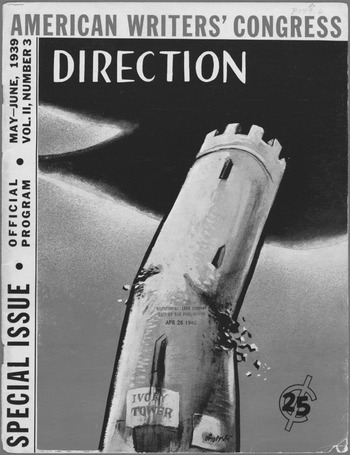
In 1939, the cover of its magazine, Direction, featured the first twentieth-century pictorial representation of an Ivory Tower I have seen – a crenulated, crumbling structure (see Figure 1). Direction expressed editorial satisfaction in seeing ‘the so-called “Intellectuals” climb down, in increasing numbers, from their ivory towers’, and it contained an essay titled ‘Ivory tower’ which retailed the figure's nineteenth-century literary origins and commended active ‘participation in the life of [the writer's] day … It is the writer's sin against the Holy Ghost to make a novel, a play, or story or poem about a trifle when the world's heart is sick over tremendous issues’.Footnote 35 The artist should get off the fence and out of the Tower: the choice was either to go to Spain or to shape art to fight fascism – better art because better fitted to oppose art- and freedom-destroying political forces. If you lived in America, that argument was hard to oppose, not least because it was directed to an artistic community which had already been substantially enlisted in such New Deal programmes as the Works Progress Administration and its Federal Art Project.
An Ivory Tower, virtuously damaged and about to fall down, depicted on the cover of the summer 1939 number of Direction, a periodical publication of the left-wing, anti-Fascist American Writers' Congress. Source: Harvard College Library, Widener Library, P 149.6.

With the outbreak of war in 1939, artists were streaming out of their supposed Ivory Towers, partly pulled by an impulse to do their bit, partly pushed by widespread public and governmental sentiment that this was no time for self-indulgent and self-referential disengagement. The critic Brooks Atkinson, celebrating in the New York Times in 1940 the theatre's new political engagement, wrote, ‘All the ivory towers were blasted years ago.’Footnote 36 A year after Pearl Harbor, the Chicago Tribune declared the contest over: ‘Perhaps there was a time when writers stayed in their ivory towers during a war, and a country in which they did so. But nothing could be more untrue of America today.’ Even before the war, most writers ‘were already signed up for action in one group or another’.Footnote 37
The Ivory Tower defended
So it is quite true that the artistic Ivory Tower was increasingly being pictured as a pathological place – a site from which only bad art could be produced by badly motivated people and having bad consequences – but it was not true that at any time in the run-up to the war, and even during it, the Ivory Tower was without its defenders. You could still intelligibly say either that the Ivory Tower was the only place from which proper art could emerge, that the Tower was a necessary intermittent refuge from impossible conditions, or even that it was precisely because of the terrible times in which we now lived that artistic disengagement was obligatory. It had indeed become much harder to defend the Ivory Tower but that defence was then neither impossible nor unknown. You could intelligibly and permissibly say that it was either a good or a necessary place for the production of art or knowledge.
Artists were urged to abandon their Ivory Towers, but some said that that would be a mistake, ultimately bad for artists, for art, and for the society to which artists were said to have a moral obligation. Less than a year after the American Writers' Congress declared the Ivory Tower unfit for artistic habitation, the Nobel Prize-winning novelist Sinclair Lewis, speaking to a luncheon of the American Booksellers Association in New York, appealed ‘for preservation of the “ivory tower,” far from the world and its cares, where learning might be sought.’ The New York Times reported on the event: ‘Too many persons, [Lewis] suggested, attempt to make thinkers feel “guilty” and so drive them into the world of events … [T]hose who wanted to live in the ivory tower should be allowed to stay there and produce literature or verse or mathematical formulae or whatever they wished.’Footnote 38 Lewis had already played with the tension between scientific disengagement and responsiveness to human needs in his 1925 novel Arrowsmith, and he had paid his dues with the 1935 anti-fascist It Can't Happen Here:
All right. Hell with this country, if it's like that. All these years I've worked – and I never did want to be on all these committees and boards and charity drives! – and don't they look silly now! What I always wanted to do was to sneak off to an ivory tower – or anyway, celluloid, imitation ivory – and read everything I've been too busy to read.Footnote 39
His second wife, the great journalist Dorothy Thompson, was a vigorous anti-Nazi, who in 1934 had the honour of being the first American journalist to be expelled from Nazi Germany. But commentators in the late 1930s found Lewis's measured defence of the Ivory Tower remarkable: the New York Times contrasted him unfavourably with his one-time collaborator, the microbiologist Paul de Kruif. Lewis, the Times wrote, ‘has just returned to the ivory tower where he wrote his last novel’, while de Kruif was continuing to fight the good fight:
Of course the view from the tower of ivory is probably much prettier than some of the things Mr de Kruif has to show you in [the obstetric epic] ‘The Fight for Life.’ He is writing about the men and women who have decided to stay out of the ivory towers precisely because they want to do something for human beings in desperate suffering.Footnote 40
In Britain – apparently far less given to Ivory Tower talk in the pre-Second World War period – a meeting of the Royal Society of Literature in June 1939 heard a lecture which described and worried about the undue current preoccupation of imaginative literature with politics: ‘Poets, dramatists, and novelists … [appear] to-day to be increasingly anxious to play the role of tractarians and pamphleteers … In many places literature was replaced by her flashy sister, propaganda, always given to meretricious devices and ready to sell herself to the highest bidder.’ But neither was the speaker advocating ‘the seclusion of the ivory tower for the writer or artist’, blandly hoping that ‘it was possible for politics and literature to be happily married’. If the marriage was unhappy, and if ‘literature was forced to wear the ready-made garments of propaganda, she would soon lose her beauty and spirit’, and indeed her ability to be literature and to fulfil art's imaginative role.Footnote 41
The most eloquent and systematic case in favour of the Ivory Tower came from E.M. Forster in a 1938 essay in the London Mercury – and reprinted shortly thereafter in the Atlantic Monthly.Footnote 42 After reminding readers of Sainte-Beuve's authorship, Forster complained about current ‘derogatory’ usage, which simply equated the notion with culpable ‘escapism’. The critics, and especially those of the ‘younger generation’,
have come to the conclusion that it is wrong for the mind to escape. They argue that the duty of everyone, be he an engineer or a statesman, or a creative or a mere reader, is to the community and to the community as a whole; they condemn the private life as selfish, and they would pull down all Ivory Towers.
They were wrong, Forster said: the case for the Ivory Tower was just the case against the herd instinct and the case for individualism. The person seeking an Ivory Tower
may be getting a clearer view of the world, or thinking out a social problem, or developing his spirit, or creating a poem … As far back as history stretches we can see men trying to retire into their Ivory Towers and there to resist or to modify the instinct which they possess as members of the herd.
The disengaged man benefits, knowledge benefits, the herd itself benefits. If current complainers about the Ivory Tower wanted some telling examples of those who inhabited it, Forster offered them Marcus Aurelius, Machiavelli, John Milton and, tellingly, the occasional lyric poet Karl Marx. And Forster reminded left-wing critics that it was not just the communists but the Nazis and the fascists who wanted to do away with the Ivory Tower. In fact, Forster considered neither place for the production of art or knowledge legitimate in its pure form: disengagement in the Ivory Tower was just the necessary condition for getting perspective and looking anew at the specific predicaments of the civic condition. Both engagement and Ivory Tower detachment ‘contribute to civilization’, and to deny the legitimacy of the disengaged life was to deny its fruits to civil society: ‘When the public and the private can be combined, and place can be found in the industrial and political landscapes for those symbols of personal retreat, Ivory Towers, the foundations of a New Humanity, will have been laid.’
Other commentators at the time probed the existential status of the Ivory Tower even further. It was not just that the proper position was circulation between disengagement and commitment; the Ivory Tower was rightly to be considered an evaluative trope, a stipulation about a relationship between ideal-types, an encouragement to live and produce knowledge in one way rather than another – not a type of place people could inhabit, even if they wanted to. ‘Ultimately, the man in the ivory tower and the man in the street’, a literary scholar wrote in 1936, recognizing ‘the fact that these are both largely mythical creatures … meet upon common ground, often in the same individual. One man's ivory tower is another man's playground; my playground may be, for my fellow, a dungeon.’Footnote 43 A few years later, the English drama critic Harold Child indicated that he was fed up with careless criticisms of the Ivory Tower then proliferating. The Ivory Tower was, he said, a rhetorical way of making supposedly concrete what was really the private space of any human soul – as ineliminable as it was necessary. There are regions of human life that can neither be legislated nor policed, and ‘these regions hold no less reality … than those claimed by the realists’. Free society was indeed then facing disaster and what was needed to protect it was precisely those ‘useless’ and disengaged activities that were now being condemned by pejorative invocations of the Ivory Tower: ‘To surrender these activities to the urgency of practical needs would be to shorten the stature of the human soul.’ The realists, ‘the scoffers at ivory towers’, forget that not even ‘the most fastidious escapist’ can live a totally disengaged life. He is in the military, he patrols the streets, he sits on political committees and, indeed, ‘he is likely to do all the better work on those levels for the spirit which buoys his soul above them’.Footnote 44
Ivory and ivy: the university as tower
It was also in the years just before the Second World War that Ivory Tower usage, notably in the United States, began its systematic drift away from art and the artist towards an identification, first, with a particular type of cultural institution and, second, with a form of culture to which the Ivory Tower figure had scarcely ever been previously attached. By the second part of the twentieth century it became natural to think of the Ivory Tower as the university or at least as some version of what a university was or might be, but that is a quite recent historical association. Indeed, by the time American universities generally became linked with the idea of Ivory Towers, a number of commentators were impelled to point out that they never had been Ivory Towers, that they had always been sites of power and of service to Church or state. Just after the end of the war, Harvard's James Bryant Conant recounted the important contributions of universities to the life of their times in the past, perceptively noting that ‘the idea that a university is some kind of an ivory tower seems to me a pure myth that has grown up only in recent times’.Footnote 45
There were several reasons why the Ivory Tower then began to be associated with the idea of the American university, and, particularly, with the idea of the university as a defective institution, needing correction and reform. Major American universities were caught up in the same political tensions as those bearing upon imaginative artists. The mobilization of artists in the New Deal, and, later, discussions about whether universities ought to be either detached free spaces or armouries of ideological opposition to fascism and Nazism, were framed during the 1930s by general debates over disengagement versus commitment. These tensions initially affected some academic disciplines more than others – the arts, the social sciences and the humanities experienced them more acutely than the natural sciences, engineering and the professional schools – but they also bore upon the symbolic and practical positioning of the universities themselves. Should the undergraduate curriculum be guarded against politicization or should students be encouraged to face the relationship between the world crisis and what and how they studied? Should universities as a whole take a stand against the Nazi attack on academic freedom and tolerance or should they stand as beacons of free inquiry by refusing to be drawn into political conflict?
Universities in American democratic society were always disposed to favour engagement over detachment, but the events of the 1930s tipped the balance still further, and the flourishing of Ivory Tower talk elsewhere in the culture was available to give academic disengagement a vivid rhetorical figure. Addressing the two-hundredth anniversary celebrations of the University of Pennsylvania in 1940, President Roosevelt made it clear that special circumstances had decided the case against academic disengagement:
This is no time for any man to withdraw into some ivory tower and proclaim the right to hold himself aloof from the problems, yes, and the agonies of his society. The times call for bold belief … that the world can be changed by man's endeavor … No man can sever the bonds that unite him to his society simply by averting his eyes.Footnote 46
The Ivory Tower tag had in fact been used intermittently in the 1930s to describe, defend or take positions of other sorts about the proper nature of the American university – but not often and not with the far-reaching political and cultural resonances such usages later acquired.Footnote 47 It was, again, the looming threat of fascism that was the context for criticism – and, to a small extent, defence – of universities as Ivory Towers. In 1938, the Columbia philosopher Irwin Edman wrote that a university situated in New York City could not possibly be described as an Ivory Tower:
There are no dreaming spires at Columbia, nor stately pleasure domes, nor is it easy to attain aesthetic or philosophic detachment in a place of higher learning that has contributed brain trusts to help the government and edify the humorists, that maintains a school of journalism, and that has a school of philosophy which, under the inspiration of John Dewey, holds philosophy itself to have social origins and social consequences.
Yet even at Columbia, Edman wrote, ‘the free mind can keep its quiet’, that degree of detachment deemed necessary for the free mind to do its proper work.Footnote 48
At Harvard, President Conant was also one of the first to refer to the university as an Ivory Tower, albeit one with ambiguous valences. Speaking at the 1939 Harvard graduation, Conant identified the necessity of ‘balancing within a university the quiet privileges of the ivory tower against the outside world’. Both political judiciousness and the essential nature of a university supported Conant's aim ‘to hold the balance even’.Footnote 49 Universities were not Ivory Towers, Conant repeatedly insisted, but they had that aspect within them. The Ivory Tower was not a place; it was a phase, a moment in the making of knowledge and virtue. The pure forms of engagement and disengagement were pathological; their careful institutional juxtaposition was virtuous.Footnote 50 Even during the war, commentators envisaged the nature of the academic institutions that would emerge after its end. Again, the preferred notion was some sort of balance. That judicious form became routine: by 1954 President Dwight David Eisenhower – himself a former president of Columbia University – addressing a Columbia dinner, assured his audience that a central purpose of the American university was the ‘pursuit of truth, its preservation and wide dissemination’, while insisting that it was not ‘an ivory tower where visionaries are sheltered from the test of practice’.Footnote 51
But that balanced position was more unstable than Conant could have recognized. A month after America joined the war, Robert M. Hutchins, president of the University of Chicago, told its professors and students that war meant a definitive end to business as usual for residents of the supposed Ivory Tower: ‘When war has been declared, long run activities must be sacrificed to the short run activity of winning the war. We have stood for liberal education and pure research. What the country needs now is vocational training and applied research.’ ‘American educational institutions’, the newspaper report concluded, ‘must prepare to become instruments of total war’.Footnote 52 Within that year, the first nuclear pile went live beneath the stands of the University of Chicago's football stadium.
Though the vast majority of academics mobilized for the Second World War did indeed flock back to the universities as soon as they could, they returned to institutions fundamentally and permanently reconfigured both by the war and by the Cold War following hard upon it. In America, the mobilization of university research and training never returned to its pre-war state and scale. The GI Bill opened up access to higher education as never before, and the continuation of the Federal contract and grants system devised during the war for the support of defence-relevant university research ushered in the era of ‘big science’, whose defining feature President Eisenhower called the ‘military–industrial complex’ and Senator J. William Fulbright later rightly renamed the ‘military–industrial–academic complex’. Where once there were real doubts that university research had much to contribute to industrial or military activities, now the great American research universities were transformed into suppliers of goods that government and industry wanted – both practical knowledge (or knowledge deemed likely to become practical) and trained personnel. If the Ivory Tower never captured the realities of universities’ social role, the universities now were increasingly regarded as Cold War arsenals. Clark Kerr, the greatest Cold War commentator on the new character of the American research university, noted, ‘The ivory tower of old has become an arm of the state and an arm of industry, and the students inside reach out toward the labor market and toward political influence.’Footnote 53
Within the post-war American academy, not all of its members were in the same position with respect to Ivory Tower talk. And here the pertinent consideration was whether there were alternative postures, and alternative sites, for practitioners to do their work. You could invoke the Ivory Tower as a place knowledge- or art-producers ought not to inhabit, or, far less commonly from the 1930s, as the proper place for artists or thinkers. But if you were using the figure as a criticism, you usually had some idea of where else, in what mood, and with what sort of social and cultural relations, knowledge ought to be produced. Given the expansion of American higher education after the war, an increasing proportion of humanists were plying their trade in academia, and there were few institutional alternatives for them as secure and comfortable. Humanists could engage more actively by supplying the popular market – though the structure of the academic career increasingly worked against this – but the university, and self-contained academic cultures, more and more were just where humanistic, artistic and many forms of social scientific knowledge were made and evaluated. Critics might, and did, condemn all of these things for their Ivory Tower uselessness, making rude noises about whether there was any reason for medievalists, for example, to be on the payroll, but you could not plausibly tell medievalists to do their work in the civic state – to climb down from their Ivory Towers – just because it was understood that they plied their trade there and could do so (for all practical purposes) nowhere else. So after the war there was some attachment of the Ivory Tower to humanistic inquiries – just because the figure had become thoroughly familiar as a pejorative stipulation about disengagement, irrelevance or snootiness – but not much: Ivory Tower talk was moving elsewhere.
Science in an Ivory Tower?
Prior to the vast expansion of the scale of American science in the Cold War era, scarcely anyone had referred to science happening in an Ivory Tower – for good or ill.Footnote 54 True, there were tensions within industrial science that led some executives and managers to identify less ‘applied’ researchers as harbouring Ivory Tower aspirations, said to be illegitimate within a corporate setting.Footnote 55 And the 1937 annual meeting of the American Association for the Advancement of Science passed a timely resolution on the ‘Promotion of Peace and Intellectual Freedom’, noting that science and its applications were powerfully transforming material and cultural realities and that, for this reason, all nations' scientific societies should ‘cooperate not only advancing the interests of science but also in promoting peace among nations and intellectual freedom in order that science may continue to advance and to spread more abundantly its benefits to all mankind’.Footnote 56 Reporting this resolution, a Chicago newspaper announced, ‘Science stepped out of its ivory tower today to bring a new influence upon distracted human affairs.’ Science, it was said, left its Ivory Tower, but it did so to protect the disengagement and autonomy necessary to science.Footnote 57
The Second World War changed everything for the scientific enterprises of all the Allied nations. Scientists who been involved in building the atomic bomb and developing radar knew that they had entered into a new, powerful, and durable compact with political power. That knowledge marked their responses to the new order, whether or not they approved of it. It was pointed out, in a telling example, that the tower at Alamogordo which held the first atomic bomb was ‘not made of ivory’.Footnote 58 The scientists were fast coming to understand this, and so too were some of their academic humanistic and social-scientific colleagues. Bertrand Russell appreciated that the scientists were now in a special position, and that the special power they had created endowed them with special responsibilities:
As the world becomes more technically unified, life in an ivory tower becomes increasingly impossible. Not only so; the man who stands out against the powerful organizations which control most of human activity is apt to find himself no longer in an ivory tower, with a wide outlook over a sunny landscape, but in the dark and subterranean dungeon upon which the ivory tower was erected. To risk such a habitation demands courage. It will not be necessary to inhabit the dungeon if there are many who are willing to risk it, for everybody knows that the modern world depends upon scientists, and, if they are insistent, they must be listened to.Footnote 59
Philosophers could and should support engaged scientists' moral and political work, but the philosophers could only play a supporting role. ‘The future of mankind’, Russell wrote, ‘more and more absorbs my thoughts … [I]n a world such as we now live in, it becomes increasingly difficult to concentrate on abstract matters. The everyday world presses in upon the philosopher and his ivory tower begins to crumble’.Footnote 60 The philosopher had to leave his study and join the CND march. The American philosopher and educator Paul Arthur Schilpp agreed. Philosophers had been going about their academic business ‘without the slightest awareness of the impending doom’. While ‘the “ivory tower” is still a very necessary place for the philosopher’, impending nuclear Armageddon was forcing the great moral issues of the Cold War into the tower. Here too the philosopher must follow and learn from the scientist.Footnote 61
The abruptness and the magnitude of the changes affecting the scientific community led to a certain amount of historical reflection. In 1944, Harvard's James Bryant Conant addressed the American Philosophical Society on the post-war future of American universities. How to retain the valuable social and political responsiveness of the wartime universities while maintaining the traditions of free inquiry that had been the crucible of their material value? Here Conant reviewed recent Marxist and anti-Marxist historiography of science. Was science – as Boris Hessen, J.D. Bernal and G.N. Clark supposedly said – merely ‘a response to utilitarian stimuli’? Was it, as Weber and Merton contended, sensitive to religious currents, or was it, as Michael Polanyi argued, essentially a form of self-organizing free inquiry? The lesson of history, Conant judged, is that science was always and everywhere embedded in its social context. If we view scientific change ‘over a considerable span of time, the ivory tower seems conspicuous by its absence’, but Conant made a distinction between the categories of utility and relevance. Science ‘must be relevant not only to man's physical and social needs but to his highest hopes and aspirations. Relevance, not utility … is the touchstone to test the vitality and validity of a scholarly enterprise – relevance to the future as we envision it’.Footnote 62
The Ivory Tower figured in many post-war attempts to understand what had happened to the scientific enterprise and to say what scientists ought to do about their new circumstances. Scientists could, of course, embrace their new compact with the military and the state, and, despite the inordinate amount of attention historians have given to the critics, that is just what most American scientists did. In 1955, the mathematician John von Neumann observed with clear satisfaction that the atomic scientists ‘are no longer free to carry on their research in isolated “ivory towers” completely free from the need for accounting for the possible uses of their discoveries’.Footnote 63 A few years later, the so-called father of the H-bomb, Edward Teller, noted with distaste, ‘The modern scientist has often been associated with the idea of an ivory tower’, exempting colleagues like von Neumann – and presumably himself – from any such charge.Footnote 64 The physicist Hans Bethe, whose attitudes to the post-war development of nuclear weapons were complicated, invoked the Ivory Tower tag in pointing out how much had changed and how difficult it was to pronounce upon what scientists should and should not do. He was a realist, not a purist:
It is no longer possible for all scientists to return to the ‘golden years’ of the 20's, to the ivory tower of pure research. Some of them can do so, and should do so, to the extent that ‘big science’ can live in the confines of an ivory tower. Others have to work on weapons.Footnote 65
Other influential commentators, not notably well informed, even reckoned that pure science had so spectacularly demonstrated its civic utilities that scientists were now, finally, free to do whatever they wanted. In 1953, the author Philip Wylie, famous for the pop cultural commentary A Generation of Vipers (1942), summarized his odd view of historical change in science–society relations: ‘In the last century … science surely has progressed far enough to note that its “ivory tower” attitude has served its purpose: science today is permitted to proceed in any direction without human interposition and it is able to “think” as abstractly as it can.’Footnote 66
Those attitudes, aligning scientists with the civic virtues, grew stronger through the post-war decades. It was said that science no longer lived in an Ivory Tower; it had been drawn out of the Tower by wartime necessities and by the continuing mobilization of the Cold War; that state of affairs was likely to be permanent; and this was widely judged a very good thing. But the tag could also be used to support the opposite position. The Bulletin of Atomic Scientists circle invoked the Ivory Tower, for example, in ways that paralleled pre-war injunctions that intellectuals and artists must enlist in the struggle against fascism. One of the earliest issues of the Bulletin advertised the journal as a venue in which scientists could understand, engage with, and act politically in their changed circumstances. The atomic bomb had destroyed both Hiroshima and scientists' traditional disengagement: it ‘shattered the scientists’ “ivory tower” of detachment from the social and political implications of their discoveries’.Footnote 67 A few American scientists accounted the loss of the Ivory Tower a disaster. The biochemist Erwin Chargaff, writing in the early 1960s and enjoying fewer of the material benefits that had been bestowed on the physicists, bitterly equated the crumbling of the Tower to the loss of intellectual as well as moral integrity:
Many of us, when we were young, thought that it was the task of the natural scientist to understand the ways of nature. But it has come about in our times that what man desires – or at any rate what some men desire – is to change these ways. It all started as a search for truth; but hundreds of thousands, at Hiroshima, at Nagasaki, paid with their lives for such lovable inquisitiveness. What an ivory, what a tower!Footnote 68
Many concerned and socially responsible scientists were more measured. The physicist James Franck, famous for trying to prevent the use of the atomic bomb against Japan, invoked the Ivory Tower in 1947 to reflect on recent historical change and to warn against a coming era of scientists' complacency and complicity. He posed three questions to his colleagues: ‘Why did we hide in the so-called ivory tower, why did we leave it, and what are we planning to do now that we have left it?’ Remarkably excluding any sort of applied researcher from the designation ‘scientist’, Franck reckoned that scientists were temperamentally drawn to disengagement. They picked soluble problems and avoided the complexities that make up the predicaments of real life: ‘we took the easiest way out and went into hiding in our ivory tower’. But having accepted military mobilization, ‘We stepped out of our ivory tower, though with dread and apprehension.’ The scientists had built the bomb, and the bomb was a decisive and irreversible intervention in real life. They could not now pretend that things were the same, and so the Ivory Tower must be abandoned. The difference was that, for physicists like Franck, one left the Ivory Tower to do hard moral and political work to prevent a weapons race and to secure the internationalization of the atom, while physicists like Teller used the tag to remind scientists of their moral and political responsibilities in the fight against communism.Footnote 69 There were alternatives – you could do science with no clear links to power, profit or human welfare – but it was just this conception of science that was thought to be, and was, on its way out.
The disciplines and the Tower
The war propelled scientists into a new order, and it also made the scientists different from their colleagues in other disciplines. Although some social-scientific and even humanistic inquiries also developed substantial ties with the military during the Cold War, it was immediately understood that it was the natural scientists and engineers who had departed the Ivory Tower en masse, leaving the humanities and most of the human sciences behind. Cold War American academic scientists and engineers functioned within the vast Federal contract and grant system that kept them on tap for military and commercial purposes. The scientists and engineers – or at least very many of them – now lived in a world in which there were always alternatives to the university, construed as a free space for disinterested inquiries. The scientists could design and build weapons – or consult for those who did; they could devise the chemical reactions which would, in other hands, turn into herbicides, synthetic fibres, flavouring agents and pharmaceuticals; they could model how sound waves propagated through fluid media, and make those models available to the military concerned with submarine warfare; they could investigate the comprehension of language fragments – whose results would engage Air Force concerns with pilot–ground communication. The outcome, as the Cold War proceeded, was a fault line in the academy – between those whose inquiries had major constituencies outside the university and those whose inquiries did not.Footnote 70 The natural sciences, the engineering disciplines, and the practices of most of the professional schools (divinity, possibly, exempted) were most likely to have those external constituencies, or to experience the benefits and problems of external material interest in academic inquiries. But this never was, and is not now, a straightforward ‘Two Cultures’ business: some academic natural-scientific inquiries are of no interest whatever to government or industry, while some modes of human science, philosophy and linguistics have well-developed external clients and have been enlisted wholesale in the projection of state power or the making of profit.
So the Ivory Tower figured largely in addressing not only the proper relations between ‘science and society’ but also the relations between disciplines and subdisciplines. The ability to invoke the Ivory Tower with such different valences, and in such politically charged settings, enhanced the value of the tag and powered its institutionalization in post-war culture, just as the internationalization of the changes affecting the scientific community assisted the rapid spread of the tag from its pre-war American native habitat. As many contemporary commentators realized, the Ivory Tower was fast becoming an unambiguous pejorative.Footnote 71 Yet, even at the height of the Cold War, it was still just possible to say something good about the Tower and to worry about its crumbling, even in the context of science. The British physicist and radar pioneer Sir Robert Watson-Watt, for example, understood very well that absolutely pure physics almost certainly no longer existed, but he eloquently defended Ivory Tower disengagement as a scientific norm:
There is no one of us in the community of science who is unaware that the capital of our intellectual state, the holy place of our scientific consciences, the Parthenon of our aesthetic fulfillment in science, is the Walled City of the Ivory Towers. We know that the soaring pinnacles of the ivory towers are the symbols of our greatness, of the audacious, indomitable, insatiable curiosity about the ‘go of things’ that makes the scientific life worth living.
If the Ivory Tower norm was worth retaining, the condition of its having any consequences for scientific conduct was knowing and acknowledging its limits:
we believe in informed and responsible academic freedom. We ask only that the walls of the City of Ivory Towers be not so blindly defensive that they leave no windows from which its always fortunate and often inspired citizens can look down on the plains below, no openings through which they can hear the voice of the world around them.Footnote 72
Robert Merton, describing the regulative ‘norms of science’ in 1942, saw those norms as under threat and worried about the consequences for the integrity of science: ‘A tower of ivory becomes untenable when its walls are under prolonged assault.’Footnote 73 Writing after the war, the Dutch-American Harvard astronomer Bart Bok was also anxious about the autonomy of science. The traditional freedom of science could no longer be assumed, Bok cautioned. Scientists have to be vigilant in fighting for their autonomy and integrity: ‘We are not living in a benevolent utopia in which the scientist, in his traditional ivory tower, has his freedoms handed to him on a silver platter.’Footnote 74 In the mid-1950s, the journalist and social commentator William H. Whyte wrote in The Organization Man that the systematic destruction of the scientific Ivory Tower, and the regimentation of its inhabitants into ‘teamwork’, were self-defeating tendencies: if a society wanted its scientists to be useful, then it had to learn to respect not just individual eccentricity but institutional disengagement. Post-war American policymakers were foolishly learning the wrong lesson: ‘We don't really need any more ivory-tower theorizing; what we need is more funds, more laboratory facilities, more organization.’Footnote 75
Blow up the Ivory Tower!
But the remaining American defenders of the Ivory Tower were fast losing the fight. By the late 1970s, the Ivory Tower was judged to be an almost incontestably Bad Place, and its badness – in the United States and, increasingly, elsewhere – was taken more and more for granted by the end of the twentieth century. If you had a constituency outside academia, or if you wanted to advertise yourself as having such a constituency – not necessarily the same thing – then the Ivory Tower was the figure you used to bash your backward colleagues or to devalue tendencies to bound, distinguish or disengage academic practices from those of external patrons, clients or critics. The scientists; the applied social scientists; the policy wonks; the business school faculty; the proponents of a vocational, ‘labour-market’ conception of university education; and – in a different mood – the advocates of diversity and community engagement took the lead, but the genre of the ‘leaning Ivory Tower’ was becoming an institution, and the figure was available for a very wide range of people wanting to identify what was wrong with academic disengagement.
And so even as the university became more enfolded in civic, commercial and military life, even as access to it was greatly expanded, the Ivory Tower – in its now characteristic academic construal – was presented as a pretty dusty place. In 1940, H.G. Wells announced, ‘We want a Minister of Education who can … electrify and rejuvenate old dons or put them away in ivory towers, and stimulate the younger ones.’Footnote 76 It was a place you should move ‘beyond’; you should ‘get out’ of it and into the streets, into civic reality. The excluded should ‘scale’ its walls so as to bring in a little fresh air; it needed to be aired out, greened up, and connected with real life and real values. If you have the wit and moral fibre, you should ‘escape’ from it, leave it, get a life. There are ‘cracks’ or ‘dry rot’ in it; it ‘leans’, is ‘trembling’, ‘crumbling’ or ‘tumbling.’ Some say there is no point in shoring it up; unlike the Pisan leaning tower, this one should be allowed, or even encouraged, to come down. Its doors and defences should be ‘knocked down’ or, despairing of repair or ventilation, it should be ‘demolished’ or ‘blown up’. At a minimum, the Ivory Tower should be ‘bridged, ‘breached’, ‘renovated’ or ‘modernized’.Footnote 77 In Britain, where one might suppose that those bent on the destruction of academic independence would by now look on a job well done, the apparatchiks of New Labour and their Tory–Lib Dem successors continue to figure their charges as useless baubles in an ancient cabinet of curiosities: ‘Universities are not islands’, said the secretary of the wonderfully, and multiply, renamed Department for Business, Innovation and Skills which has the universities in its care, ‘they are not ivory towers, they have to respond to the world around them’.Footnote 78
Within the university, the Ivory Tower is invoked by some practitioners against others, and by universities of some types and tendencies against others. The engineering and business schools look with distaste on the Ivory Tower tendencies of the philologists and the philosophers. In the medical school, translational researchers despair at colleagues' lack of commitment to getting ideas into pills and then into patients. The tech transfer office fears that even the engineers secretly harbour Ivory Tower tendencies. The MIT tech transfer office distances itself from Harvard's tech transfer office: ‘Harvard, if you go way back, was quite ambivalent about whether they should be doing this kind of stuff – soiling the ivory tower with the grubby fingerprints of industry.’Footnote 79 The Federal Bayh-Dole Act of 1980, widely credited with stimulating a surge in academic commercialization, is said to have been designed ‘to bring ideas out of the ivory tower and into the marketplace’.Footnote 80
Today, almost no one has anything good to say about the Ivory Tower and specifically about the university in its supposed Ivory Tower mode. Those who might be supposed to value a degree of disengagement largely keep their heads down, or, if they wish to limit the continuing enfolding of the university in civic economies, invoke the Ivory Tower in what must be ironic tones: the Ivory Tower as leased, sold, sold for thirty pieces of silver, sold out, needing to be reclaimed, in escrow – that same Ivory Tower which those fighting a rearguard action must know never existed but whose violated purity can in no way be better expressed.Footnote 81
We do not need to be reminded of current usages of the Ivory Tower, just because we are among the heaviest users – academics, our administrative masters, our critics. The history of a figure of speech throws current usages into relief, removes them for a moment from the taken-for-granted, and directs attention to their transformations and translocations over fairly short periods of time. That momentary removal from self-evidence and banality can be especially interesting if, as I have tried to show, following the figure of the Ivory Tower is tracing the historical trajectory of schemes linking knowledge and the polity, epistemic and social virtue.
Note the changing cultural reference of the Ivory Tower. It started as a religious figure, which it remained until nineteenth-century writers respecified it in an artistic context. Its subsequent mobilization to say something about what a university was and should be, and the conditions the university provided for the production of knowledge, largely happened during and after the Second World War, as did its relocation from comment on the imaginative arts to those practices which had the potential to produce materially useful goods – the sciences, engineering and the knowledges of the professional schools in particular. You could say that the cultural geography of Ivory Tower usages tracks changes in the recognized social value of different intellectual practices. Our public arguments are more and more about the Ivory Tower status of science because we care less and less about the worth of art. The series going from religion to art to science is suggestive of many stories about modernization, secularization, democratization and the commodification of culture, just as the attachment of the Ivory Tower to universities in the middle of the twentieth century seems to acknowledge the rise of the research university as modern society's all-purpose storehouse of real and potential value.
Then note the place or posture historically opposed to the Ivory Tower. That too has changed. When the Ivory Tower was a sacred or spiritual place, it was juxtaposed to the secular, the mundane or the material; when it was a place where artistic imagination was said to thrive, the opposed posture was engagement first with the concerns either of ‘the people’ or of the generality of artists, and then, by the 1930s, specifically with political struggle, putting art at the service of political virtue. And when the Ivory Tower came to be specifically associated with the idea of the university and academic knowledge, it was paired with a notion of knowledge produced with the sole or major purpose of improving the material welfare of society. The university was, or was said to be, an Ivory Tower, and the paired opposition to that was not political struggle, or even political engagement in any ideological sense: it was, rather, the market and engagement with commercial concerns. The market belongs to the civic condition, and when you say that inquiry should connect itself to the market you are indeed doing something recognizably similar to the 1930s plea for political engagement and social responsibility. But where the market was once one civic locus among others, in current criticisms of the university and intellectual practices it now appears as almost the only place. The market is treated as if it were the civic state; there is no space which is not part of the market; refusing assimilation to the market, the Ivory Tower is made to seem unsociable.
Finally, the texture of the argument over the Ivory Tower seems to have changed. So let us give Ivory Tower talk its proper cultural-historical name: it is a modern instantiation of the ancient religious and secular debate over the active and contemplative lives, negotium and otium: is it better, more virtuous, more authentically human to be engaged with civic affairs or is it better – from time to time or always – intentionally to live apart from the polis?Footnote 82 Following the recent history of the Ivory Tower figure is a way of appreciating our connection to the long cultural tradition of debates over the relative merits – moral and intellectual – of the private and public lives. It situates us; it helps us to realize where our present categories and sensibilities have come from; it gives us a sense of belonging. And one thing that this historical sensibility throws into relief is that – I suggest – there has never been a historical moment in which the debate has been so one-sided. The finely poised classical conversation has turned into a monologue, even a rant.
In the past, while you might express a preference for the one or the other, practically everyone acknowledged that both engagement and disengagement were necessary moments in human life and in the making of knowledge. It was recognized that neither could be wholly dispensed with, that there was moral and intellectual virtue in both. It could be said that you might, even should, come out of the Tower, but the injunction to leave the Tower at the same time identified its value. The modern monologue finds no worth in the Ivory Tower. The story it tells is historically uninformed and the institutional projects in which the monologue is embedded count as a grand experiment in the production and justification of knowledge which its projectors, and future generations, may come to regret.