1. Introduction
The development and use of clean technologies is considered a useful means of mitigating global warming. Although many developing countries have become major emitters of greenhouse gases (GHGs), they rarely invent and own the relevant clean technologies such as those prevalent in developed nations of the United States (US), Japan, or European countries. Thus, developing countries have been collaborating to promote technology transfers under the United Nations Framework Convention on Climate Change (UNFCCC),Footnote 1 arguing that the intellectual property (IP) regime related to such technologies should be tailored to their needs and especially considering that the compulsory licensing of clean technologies can alleviate the common threat posed by global warming.
Unsurprisingly, most private sectors in possession of such technologies have been unhappy with this approach and offered the counterclaim that the weak protections extended to intellectual property right (IPR) holders in developing countries obstruct technology transfers and that tariff and non-tariff barriers are stronger impediments to the transfer of technologies.Footnote 2 Furthermore, regarding compulsory licenses, they suggest that such a move would undermine the future progress of these technologies and reduce incentives to invest in ongoing research and development (R&D).
This study aims to examine the legal issues and barriers associated with granting compulsory licenses for clean technologies. The legal analysis consists mainly of two aspects. The first addresses possible international norm making in relation to the agenda. The second discusses the challenges and barriers facing national authorities in granting such licenses. The Doha Declaration on TRIPS and Public Health adopted by the World Trade Organization (WTO) in 2001Footnote 3 constitutes an international consensus regarding the flexible interpretation and implementation of the TRIPS Agreement, including the compulsory licensing of patented medicines. This article will first examine, from a law-making perspective, the question of whether the Doha format can be duplicated in creating a potential ‘Declaration on TRIPS and Climate Change’. According to the Vienna Convention on the Law of Treaties (VCLT), the presumed text would amount to a subsequent agreement that would take into account concerning the interpretation of relevant texts of the TRIPS Agreement.Footnote 4 Undoubtedly, the realization of a new TRIPS declaration would enhance the legitimacy of granting compulsory licensing for certain technologies.
Secondly, I analyze the legal challenges associated with authorizing such licenses by reviewing relevant TRIPS obligations and practices. Apart from compulsory licenses for patented medicines,Footnote 5 relatively few compulsory licenses have been granted at the national level since the TRIPS agreement came into effect. No challenges concerning the legality of authorizing compulsory licenses and the subsequent use of the licensed patents concerned have yet been brought to the WTO dispute settlement mechanism. In part, there may be a lack of political will to dispute such measures that promote access to medicines because of the influence of the Doha Declaration.Footnote 6 Regardless of the possible illegality of invoking compulsory licenses for public-health purposes under the TRIPS Agreement, de Carvalho observes that resorting to the WTO seems less likely.Footnote 7
India's recent granting of compulsory licenses for cancer drugs, however, resulted in tension with pharmaceutical companies and pushed their countries to protest. The German company Bayer decided to challenge the decision of India's authorities in local courts.Footnote 8 Meanwhile, in February 2014, the National Association of Manufacturers, which represents nearly 50 US business groups, asked the United States Trade Representative (USTR) to designate India as a Priority Foreign Country in its 2014 report. The status would have labeled India as one of the most severe violators of IPRs and set the stage for possible trade sanctions targeted at India.Footnote 9 India's officials insisted that India's IP laws complied with WTO obligations and threatened to use the WTO's dispute settlement mechanism against the US if India was deemed a Priority Foreign Country.Footnote 10 In the 2014 Special 301 report, which was published in April 2014, India remained on the Priority Watch List. However, the USTR has decided to use an out-of-cycle review to address the concerns of the US over India's IP laws.Footnote 11 Thus far, it seems that the US is more interested in seeking a solution through government-to-government engagement; the dispute has yet to evolve into a WTO-level dispute.
In 2004, the Dutch company Philips, the patent owner of CD-R technology, and a Taiwanese CD-R maker failed to reach an agreement regarding reasonable commercial terms. The Taiwanese authorities thus granted compulsory licenses for the Philips' CD-R patents to the local company, thus giving the company legal access to the patents in question.Footnote 12 This decision provoked severe protests and concerns, not only from the Dutch company but also the European Commission (EC). The Dutch company engaged in long-running administrative and judicial proceedings against the governmental decisions in Taiwan,Footnote 13 while the EC responded to the company's request for a trade-barrier investigation by issuing a report accusing Taiwan of being in violation of its TRIPS obligations and threatening to take the matter to the WTO dispute settlement mechanism should Taiwan fail to rectify the law and decisions related to the dispute.Footnote 14 The EC investigation as a whole was written in the format of a complaint submitted to the WTO. The dispute was almost brought to the WTO and would have become the first case regarding the legality of granting compulsory licensing.
In reviewing such transnational disputes over the compulsory licensing of CD-R products, this study helps identify the obstacles facing competent national authorities when issuing compulsory licenses. It can be difficult for national authorities to fully comply with TRIPS requirements in question. Consequently, an examination of these experiences can elucidate the barriers of potentially applying compulsory licensing to climate-related technologies.
Section 2 of this paper emphasizes the vital role of climate-related technologies in combatting global warming. Section 3 reviews the appeal of developing countries for invoking compulsory licenses to secure access to these technologies. In Section 4, the challenges facing national authorities in granting licenses are analyzed. The conclusion is presented in Section 5.
2. The significance of clean technologies to global warming mitigation
Containing GHGs effectively is a complex challenge that demands concerted global actions. One feasible approach is to establish clearly defined obligations for all nations for controlling emissions, such as those that the Kyoto Protocol requires of parties listed in Annex I.Footnote 15 Under the doctrine of common but differential responsibility,Footnote 16 most developing countries, including the emerging economic powers, China, India, and Brazil, are not legally obligated to control GHG emissions.
Under the UNFCCC, certain international cooperative mechanisms have been established to help parties achieve their targeted GHG reductions, such as a clean development mechanism, emissions trading, and joint implementation. Irrespective of the effectiveness of the means, both developed and developing countries are increasingly cognizant of the importance of engaging in R&D of clean technologies and of the promise of a low-carbon economy in the future.
Mitigation technologies are instrumental in reducing the emissions from GHGs effectively; they have a clear impact on the alleviation of global warming. The technologies comprise two major areas: renewable energy and control of CO2 emissions. Renewable energy, including wind, solar, and geothermal power as well as hydropower and various forms of biomass energy, is continually replenished and emits no, or few GHGs when generating power.Footnote 17 Technologies for controlling CO2 involve using carbon capture and sequestration to prevent the emission of GHGs into the atmosphere.Footnote 18
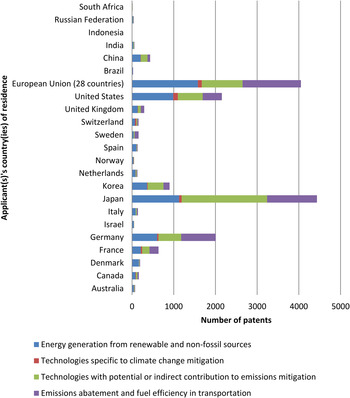
As these technologies require substantial investments in R&D, most clean technologies are owned by firms in developed countries, whose governments undoubtedly use IP law to protect their industrial interests against foreign competitors.Footnote 19 According to data from the Organisation for Economic Cooperation and Development (OECD), most applicants for IPRs, mainly patents and trade secrets, are nationals of major developed countries (Figure 1).Footnote 20 Although some developing countries, such as China, Brazil, and India, are determined to develop clean technologies, their firms remain unable to compete with developed countries.Footnote 21
Patent applications filed under the Patent Cooperation Treaty in 2012

3. Developing countries' approaches to accessing clean technologies: compulsory licenses and the responses of affected private companies
The UNFCCC, at its inception, sensed the technological gap between developed and developing countries and urged the developed countries to ‘take all practicable steps to promote, facilitate and finance, as appropriate, the transfer of, or access to, environmentally sound technologies and knowledge to other Parties, particularly developing country Parties, to enable them to implement the provisions of the Convention’. In this process, they are also required to ‘support the development and enhancement of endogenous capacities and technologies of developing country Parties'.Footnote 22 To advance this goal, the climate regime established a subsidiary organ, the Technology Executive Committee (TEC).Footnote 23 However, the TEC confines its present efforts to data collection and information compilation,Footnote 24 and has not as yet achieved any fruitful or tangible outcomes.
Technology transfer is not offered free of charge or without obligation. The agenda cannot be effective without the cooperation of the owners of IPRs and technology. Many companies in developing countries find accessing environmentally sound technologies extremely difficult or costly because IP owners tend to be unwilling to license their technologies to potential competitors or may demand excessively high royalties or unreasonable terms in licensing negotiations. For instance, Zhuang observes the difficulty that Chinese companies experienced in using wind-power technologies, of which patents are mostly owned by firms in developed countries.Footnote 25 Barton reveals that IPRs have the potential to hinder the emerging economies of Brazil, China, and India from accessing solar photovoltaic systems and biofuel and wind power technologies.Footnote 26 Thus, IPRs may constitute a barrier, among others, to the transfer of climate-related technologies.Footnote 27
During recent UNFCCC negotiations, developing countries advocated for the removal of all barriers to technological transfer. In particular, they urged that the obstacles posed by IPRs be resolved. Full use of the flexibility built into TRIPS has been vigorously promoted, which covers, among others, the granting of compulsory licenses for climate-related technologies. At the UNFCCC Bali summit in December 2007, Brazil proposed adopting a ‘Declaration on IP and climate change’, which would have mirrored the 2001 WTO Doha Declaration on TRIPS and Public Health.Footnote 28 The 2001 WTO document explicitly affirms that the flexibility of TRIPS should be applied in the pursuit of social policies.
Prior to the Copenhagen summit in 2010, one of the ‘Options of Negotiating Text’ proposed by developing countries focused on effectively ensuring the availability of climate-related technologies for them.Footnote 29 The use of compulsory licensing was clearly placed on their list of options, although eventually it was not incorporated into the final text of the Copenhagen Accord.Footnote 30 In preparing a draft decision for the Climate Conference of Parties at Doha in 2012, developing countries again emphasized the right to grant compulsory licenses and the freedom to determine the grounds for making such a grant.Footnote 31 If the agenda eventually prevails, it could provide justification for applying compulsory licensing of climate-related technologies. In particular, emerging markets beginning to invest heavily in green technologies can employ compulsory licensing as a leverage to pressure patent holders into negotiating a fairer licensing deal.
The concept of developing countries granting themselves compulsory licenses and gaining access to climate-related technologies was an unwelcome, or even disturbing, proposal for developed countries and their resident companies who hold the IPRs for these technologies.Footnote 32 They disagreed with the statement that an IPR constitutes a barrier to technology transfer and instead argued that poor IPR enforcement and high tariffs on environmental products should be blamed for the stalemate on transfers.Footnote 33 On the basis of various promising instances in which Western companies have transferred clean technologies to and deployed them in emerging markets, Lane remains skeptical of the rhetoric that claims IPRs to be an obstacle to technology transfer and dissimilation.Footnote 34
Thus far, the compulsory licensing of clean technologies seems not to have occurred, despite strong appeals by developing countries for the use of this mechanism. Although the UNFCCC does not have applicable rules specifically pertaining to the use of compulsory licenses per se, the WTO/TRIPS forum appears eligible to govern them, especially regarding the negotiation of a new agenda and law enforcement.
4. Challenges and barriers regarding the authorization of compulsory licenses for clean technologies from a WTO/TRIPS perspective
The UNFCCC is the major global forum through which developing countries have consistently proposed using compulsory licenses as one means, among others, of gaining access to clean technologies. However, the climate regime does not specify any binding rules or disciplines for regulating the application of such a measure. Instead, the WTO/TRIPS is the competent regime governing the use by national authorities.Footnote 35 In effect, all WTO members must guarantee that their national laws and measures relating to compulsory licenses are in compliance with the TRIPS obligations in question.Footnote 36
During the mid-1990s, under the threat of economic sanctions resulting from US Section 301, the GATT Uruguay Round negotiations finally resulted in crafting comprehensive and multilateral protection for IPRs, which operates with an effective dispute settlement mechanism.Footnote 37 The effectiveness of the TRIPS Agreement represents a triumph for developed countries, particularly the US, which have long called for strong global IP protection.
The TRIPS Agreement specifies a minimum threshold of IP protection and enforcement by WTO members.Footnote 38 To balance the rights of IP owners, most of whom are from developed nations, with the interests of general users and developing countries and to pursue members' legitimate public objectives, certain measures limiting the prerogatives of IP owners are permissible, especially regarding their monopoly rights. A patentee may prevent others from using a patented technology before the patent expires.Footnote 39 However, Article 30 of the TRIPS Agreement provides for exceptions to this right. In addition, patentees who are not using the patent themselves may authorize others to make use of their protected subject matter by voluntarily signing a licensing agreement.Footnote 40 The freedom of contract that individuals and firms have in choosing their partners and deciding the content of deals would be constrained by the governmental authorization of compulsory licenses to other users. Article 31 of the TRIPS Agreement specifies the rules for implementing such licenses.Footnote 41
An analysis of the structure of Article 31 of the TRIPS Agreement indicates that the provision does not explicitly provide grounds on which compulsory licenses can be basedFootnote 42 but simply specifies the 12 conditions with which WTO members ought to comply. All conditions are obligatory. Although the incorporation of compulsory licenses into the TRIPS Agreement is part of a balancing act for countering the predominant power of patentees, such a move should not be interpreted merely for the convenience of developing countries.Footnote 43 The use of compulsory licenses is not intended to be a ‘free lunch’ because the challenges associated with observing the requirements are quite severe and the costs of implementing the collateral duties may be relatively high.
The following sections first examine whether a new declaration or similar document is likely to be finalized to underpin developing countries' proposal. The focus is then on the legal challenges in, and obstacles to, complying with the TRIPS obligations with reference to the compulsory licensing of Philips CD-R patents, which can serve as a benchmark practice.
4.1 Is a declaration on TRIPS and climate-related technologies possible?
4.1.1 Background and implications of the Doha Declaration on compulsory licensing to promote access to medicines
In response to the HIV/AIDS health crises affecting many developing countries, the WTO adopted the Declaration on TRIPS Agreement and Public Health at its 2001 Fourth Ministerial Conference in Doha. The conclusion of the agreement exemplified how the global IP regime can support, rather than hinder, access to the affordable medicines, most of which are covered by IPRs. Regardless of its legal status,Footnote 44 the Declaration provides developing countries with powerful leverage and flexibility when interpreting and implementing their TRIPS obligations.
The flexibilities elaborated by the Declaration consist of compulsory licenses. First, the right to grant compulsory licenses and the freedom to determine the grounds on which to do so are recognized.Footnote 45 Second, the Declaration confirms the right of WTO members to define the circumstances that constitute a national emergency and explicitly equates public health crises to national emergencies.Footnote 46 Third, because many members have insufficient manufacturing capacities, the Declaration requested that the TRIPS Council sort out a solution that makes compulsory licenses more effective for these countries.Footnote 47 Overall, the flexible approach streamlines the compulsory licensing with a view to promoting access to essential drugs.
4.1.2 Can the Doha scenario be duplicated for clean technologies?
The Doha's position on global IP enforcement presents an opportunity for balancing private property rights with other societal values, such as human rights and environmental protection. The mandate on IP and public health signals that multilateral trade negotiations and law-making processes can accommodate the interests of developing countries when their demands are on strong moral and legal grounds. The successful experience in Doha provides momentum for developing countries to pursue other similar goals. Although the appeal for adopting a TRIPS declaration on IP and climate-related technologies seems acceptable, at least morally, the feasibility of concluding a similar text as for public health, especially in the WTO community, remains in doubt.
From the perspective of international politics, the WTO members' lack of political will to earnestly negotiate seems unchanged.Footnote 48 In addition, as opposed to the mandate of the Doha Declaration, most free trade agreements (FTAs) concluded by the US after 2001 have constrained the use of compulsory licenses.Footnote 49 The prevalence of alleged TRIPS-plus arrangements in US-initiated FTAs heralds greater difficulties ahead for adopting a new declaration on TRIPS-related social concerns at the WTO. Without the support of the US, it would be difficult to achieve a result that facilitates access to climate-related technologies in multilateral trade negotiations.
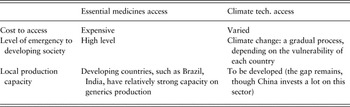
Discrepancies between access to medicine and access to clean technologies and their products may create obstacles for constructing a new declaration. The possible discrepancies can be divided into three parts (Table 1). First, accessing patented drugs appears unaffordable for the public in developing countries, but whether climate-related technologies are too expensive is uncertain. Second, regarding emergency levels, there are strong moral and legal grounds for protecting people from public health crises by, among other approaches, using compulsory licenses as flexibly as possible. Without access to essential drugs, millions of people could die. However, climate change, despite its considerable impact on human society, is a gradual process and not an emergency similar to that of HIV/AIDS.Footnote 50 In addition, the effective use of compulsory licenses depends on the presence of a competitive local production capacity. Given the relative infancy of climate-related technologies,Footnote 51 manufacturing capacities for these products may be more insufficient or entirely absent in many developing countries. This limitation could make granting compulsory licenses less fruitful.Footnote 52
Comparison between essential medicines and climate-related technology access

By comparing the distinctive features of pharmaceutical and clean technologies, McManis and Contreras emphasize that market and patent coverage factors may considerably diminish the effects of green compulsory licensing as opposed to that of essential medicines.Footnote 53 Thus, they are skeptical that ‘an international accord modeled on the Doha Declaration is achievable or desirable in the area of clean technologies'.Footnote 54
4.2 Difficulties in and barriers to compliance with TRIPS requirements on using compulsory licenses
The authority to grant compulsory licenses lies with governments but is subject to a number of conditions that each WTO member is required to observe. The requirements, listed under Article 31 of the TRIPS Agreement, impose strict discipline on the members and provide competent national authorities with limited discretion. Observing the obligations is a twofold task: first, national authorities must determine the grounds on which such licenses are granted; second, they must fulfill each of the listed conditions, which begin with an appeal for granting the licenses in question and end on their termination.
4.2.1 Do any grounds justify the compulsory licensing of clean technologies?
Article 31 does not explicitly regulate the right of members to stipulate the grounds for resorting to a compulsory license, nor does it provide definite parameters for determining the scope of the grounds, apart from the grounds for semiconductor technology.Footnote 55 Such an omission causes ambiguity concerning the legality of the grounds chosen by national authorities under the TRIPS Agreement.
During the Uruguay Round negotiations, most developed countries, including the US, favored a restrictive approach allowing only for matters of anti-trust, public non-commercial use, and national emergencies to legally trigger such licenses.Footnote 56 In contrast, developing nations argued for an open approach under which there would not be any constraints regarding setting the grounds. In the end, the proposal to limit the grounds for issuing a compulsory license was not adopted. Instead, the final text on compulsory licenses focused on procedural matters and the substantial conditions to be observed.Footnote 57 The TRIPS preparatory work may support the assertion that the drafters had no definite intention of limiting the scope of the grounds.Footnote 58
Subsequent developments regarding the interpretation of the TRIPS Agreement, particularly evident in the 2001 Doha Declaration, endorse the views of developing countries. However, the controversy regarding the legal status of the Doha text persists, and no judicial decisions have yet been made by the WTO relating to its legal authority. The US considers the Declaration to be a political statement that lacks any binding power on WTO members.Footnote 59 By contrast, because the Declaration was adopted by consensus, developing countries claim that it represents a genuine and legitimate expectation among WTO members. Despite this disagreement, many academics consider the Declaration as a subsequent agreement that facilitates the interpretation of the TRIPS provisions in question.Footnote 60 Irrespective of its function for treaty interpretation, debate continues regarding whether the Doha document can shape fields beyond the contexts of IP and public health.
Countries in the midst of public health crises may encounter fewer challenges when availing themselves of the TRIPS flexibilities; however, when addressing situations that do not clearly represent public emergencies or that lack nearly uniform public support, a government's selection of grounds may be severely questioned.
Certain grounds specified in the patent laws of many developing countries are applied to balance the prerogatives of patent owners, such as their refusal to deal, failure to produce locally, and failure to obtain licenses under reasonable terms.Footnote 61 The legality of invoking such grounds appears quite controversial. De Carvalho is strongly skeptical of the contention that countries are free to decide any grounds or can grant licenses on frivolous grounds.Footnote 62 Considering that the use of compulsory licenses constitutes an exception to the normal exercise of patent rights, he argues that the grounds should be confined to exceptional or critical situations, such as national emergencies and public non-commercial use.Footnote 63 According to de Carvalho's argument, compulsory licenses should not be pursued to remedy individual benefit at the expense of eroding patentees' right to license voluntarily (i.e., ‘say no to third parties').Footnote 64 Therefore, commercial disputes between licensees and patent owners, such as disputes over a refusal to license or failure to reach reasonable commercial deals, should not constitute a sufficient cause.Footnote 65
After a Taiwanese business failed, after a considerable amount of time, to obtain licensing under reasonable commercial terms and conditions from Philips, the Taiwan Intellectual Property Office (TIPO) decided to grant compulsory licenses of the Philips CD-R patents to the local company. The action incited the critical complaints of both the patentee and the EC. The CD-R technologies and correlated patents were owned by Philips, which had acquired patent protection from the Taiwan Intellectual Property Office (TIPO) during the late 1980s.Footnote 66 By the 1990s, CD-R production in Taiwan had increased considerably, with most production being licensed by Philips.Footnote 67 However, Gigastorage, a Taiwanese CD-R manufacturer, was unable to reach a licensing deal with the patentee because of a disagreement over royalty rates.
TIPO reviewed the appeal of Gigastorage for compulsory licensing of Philips' five patents and determined the situation facing Gigastorage matched the grounds in question. TIPO's interpretation as to what amounted to a reasonable commercial term was mainly subject to alleged suitable royalty rates. After reviewing the opinions and findings of public officials and professional institutions, TIPO concluded that Philips' offer was not a fair and reasonable royalty arrangement.Footnote 68 Because Gigastorage had spent almost a year engaging in negotiations with Philips, TIPO was satisfied that the period of negotiations had been considerable.
In July 2004, according to Taiwan's Patent Act,Footnote 69 the decision of TIPO to grant the compulsory licenses was rendered.Footnote 70 The EC protested that the reason used for triggering the compulsory licenses was a violation of the TRIPS agreement. The EC's argument was largely based on a textual analysis and was offered with a view to preserving the patentee's right to license voluntarily.
First, the EC argued that Taiwan's granting of compulsory licenses based on a failure to reach reasonable terms would diminish the protection extended to patent holders and that this effect conflicted with the essence of Article 28 of the TRIPS Agreement. In analyzing Article 28, the EC contended that the provision bestows on patent owners a freedom to license, which inherently carries with it a right to refuse to negotiate.Footnote 71 Furthermore, the EC emphasized that Article 28 does not obligate patentees to engage in a licensing agreement but rather clearly states that patent owners have a right to do so.Footnote 72
Second, the alleged ‘failure to obtain reasonable commercial terms' was strictly categorized by the EC as a procedural condition as opposed to a substantial condition, which is one of the grounds for granting compulsory licenses. Because such a condition is explicitly specified in the first sentence of paragraph (b) of Article 31 as a procedural rule to be observed prior to an authorization of compulsory licenses, the EC insisted that it fell outside of what might be considered substantial grounds. The second sentence of the same paragraph stipulates that the obligation of WTO members to obtain licenses (voluntarily) under reasonable commercial terms in advance may be waived in the event of a national emergency or for public non-commercial use. According to paragraph (k), the members' obligation to observe such conditions can also be waived when addressing an anti-trust situation. Reading the text restrictively, the EC insisted that Article 31 embodies the intent to distinguish such procedural elements from substantial grounds.Footnote 73 Thus, the EC concluded that Taiwan's allowance of Gigastorage's failure to obtain licenses under reasonable commercial terms as grounds for issuing compulsory licenses was illegitimate.
Climate change is a grave global concern; however, as mentioned previously, it may not, in terms of national emergencies, be universally recognized as equivalent to a global public health crisis because it affects countries differently and the problem persists over a long time frame. Some nations, such as small Micronesian island states, are obviously more vulnerable to the effects of climate change, whereas particularly well-developed countries can prove more resilient and adaptive to the challenges. Thus, most developed countries may not be persuaded by the arguments of developing countries and rising powers such as China and India, which attempt to equate the threat of climate change with more immediate national emergencies.
Of course, the restrictive European approach toward establishing convincing grounds is open to dispute. In addition, whether a refusal to license or intransigence in negotiations on the part of rights holders constitutes sufficient reason to grant compulsory licenses remains controversial. It has been observed that the practice of refusing licensing for climate-related technologies may grow more common as companies find it profitable to invest in the technologies and ‘thus seek to maintain their competitive advantage’.Footnote 74 As tensions between developing countries (including their local companies) and climate-related technology owners increase, undercutting those IP rights by resorting to compulsory licenses under the guise of mitigating global warming will certainly provoke serious complaints from the governments of developed countries.
4.2.2 Can the conditions of article 31 of the TRIPS Agreement be fulfilled satisfactorily by national authorities?
Developed countries will not always ignore the granting of compulsory licenses on technologies critical to their industries and may opt for further legal action. The challenges to Taiwan's authorization of the use of the Philips CD-R patents, as mentioned previously, could have become an international litigation brought to the WTO mainly because the format of the EC's trade barrier report nearly constituted a complaint submitted to the WTO. More importantly, the proceedings that occurred both locally and internationally as a whole provide a vivid example of how difficult it is for a WTO member to satisfy the requirements for issuing compulsory licenses under the TRIPS Agreement.
In addition to challenging the legality of the grounds applied by Taiwan patent law, the EC, among others, claimed that the move violated conditions (b) and (f) of Article 31 of the TRIPS Agreement. The most difficult task for national authorities in implementing paragraph (b) was deciding whether the pursuit of reasonable commercial terms and conditions within a reasonable period of time had been satisfied. In most cases, there is no fixed formula for setting the royalties in licensing contracts. Whether the duration of negotiations can be considered adequate should be a case-by-case matter. An optimal determination by national authorities on the problem demands a high level of technical professionalism. The local authorities may only possess limited knowledge on the technologies, and the local companies may not be as professional as the IP owners. In effect, it would be difficult to defeat the argument of the IP owners at this point. Moreover, in terms of judicial remedy, any decisions regarding the alleged ‘reasonable commercial terms' could be challenged by either party at a local venue or in a global forum.
Another difficulty concerning the application of paragraph (b) is determining the severity at which a critical situation experienced by a WTO member constitutes a national emergency that justifies waiving the obligation to ensure that voluntary licensing under reasonable commercial terms and conditions has been pursued. It can be disputed whether the challenges and problems of climate change constitute a national emergency for all countries, because the severity of these challenges and problems varies according to the vulnerability and resilience of each country. For emerging markets such as China, India, and Brazil, which may be interested in invoking the compulsory licensing of clean technologies, it seems unjustifiable for them to exempt themselves from the procedural mandate required before grants are invoked.
The general understanding concerning the export limitations required in paragraph (f) is that the volume of the patented goods for exportation shall not exceed 50% of the total production.Footnote 75 The critical concern is determining how to define the extent and scope of the oversight duty imposed on national authorities after a compulsory license is granted.
Philips accused Gigastorage of breaching the 50% restriction and requested termination of the licenses. The matter raised questions regarding whether the efforts of the authority in Taiwan were sufficient regarding satisfying its TRIPS mandate. In response to the complaint by Philips, TIPO actually did not exhaust all means to investigate whether the user had complied with the requirement but simply rejected the credibility of the information submitted by Philips. Unsurprisingly, the EC, because it holds a restrictive view on the implementation of paragraph (f), claimed the TIPO response to be a failure to effectively monitor the user's exportation.
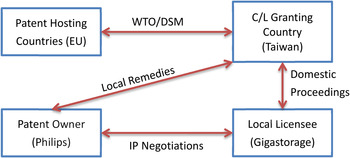
The compulsory licensing of the Philips patents shows how complex fulfilling the conditions specified in Article 31 of the TRIPS Agreement can be. A functional roadmap of the remedial process involves multiple stakeholders and litigants, and competent national authorities naturally become the main targets of complaints and encounter multiple legal challenges, locally or globally (Figure 2).
Remedies following the grant of compulsory licenses among interested parties

The compulsory licensing of Philips' patents indicated that the private sectors of a local licensee and a patent holder, would initiate negotiations to establish commercial terms for voluntary licenses. Should they fail to reach an agreement, the prospective user may request that a competent local authority grant compulsory licenses in accordance with domestic applicable laws.
Legal proceedings between national authorities and patentees can occur following the grant of a compulsory license because any decision concerning the authorization of such licenses and the remuneration paid to licensees is subject to judicial review.Footnote 76 Upon the grant of compulsory licenses to Gigastorage, Philips appealed the decision of TIPO to the Ministry of Economic Affairs in Taiwan, the next highest authority. After the appeal was rejected, the company filed a suit at the Taiwan Higher Administrative Court claiming that the TIPO Decision was unlawful.Footnote 77
Finally, if local remedies have been exhausted, then a WTO member hosting patent owners can submit a case against the granting member to the WTO dispute settlement mechanism. In the Philips case, the EC threatened to resort to the WTO dispute mechanism if Taiwan declined to amend and rectify relevant measures and laws adverse to Philips.Footnote 78
The Philips case reveals that the implementation of Article 31 can place a relatively heavy load on the granting authority. Indeed, many countries could be incapable of fulfilling the requirements in a satisfactory manner without being challenged. Unlike gaining access to essential drugs, which elicits less political and legal pressure, granting compulsory licensing of clean technologies is associated with heavy administrative burdens and high legal costs; therefore, developing countries should be cautious when granting compulsory licenses for clean technologies.
5. Conclusion
Climate change has become a severe global challenge, and resolving it requires concerted action. Clean technologies can facilitate mitigating global warming, but most climate-related technologies are privately owned and under IPR protection. The appeal by developing countries for using compulsory licenses to address the climate challenge would certainly displease the owners of the technologies and their host countries; however, there are laws in place for regulating such licensing. All stakeholders are bound by the rules.
The WTO/TRIPS remains the major forum for judging the legality of using compulsory licenses, although vocal appeals for streamlining its use continue at the UNFCCC. This article suggests that the Doha's episode regarding ‘IPRs and Public Health’, which introduced flexibilities in granting compulsory licenses, is difficult to replicate for climate change. Thus, easing access to clean technologies by adopting a declaration on ‘IPRs and Climate Change’ can hardly recur in the WTO forum.
The experience of authorizing the use of the Philips patents shows how difficult and costly it can be for national authorities to meet the TRIPS requirements and how vigorously the countries hosting the patent holder may respond. Indeed, other alternatives for promoting the dissemination of clean technologies are not infeasible. Developing countries may not use compulsory licensing as a solution because it clearly has high political risks and legal costs. Therefore, this paper maintains that the agenda to apply compulsory licenses to clean technologies may simply be the most useful as a leveraging tool that developing countries can employ to pressure patent owners into ensuring, among others, fair licensing deals or into pursuing the equitable sharing of clean technologies with them.