Introduction
This article is concerned with three questions: Who provides care to frail or ill older people in Indonesia? To what extent do actual care arrangements align with older people's preferences? And what are the implications of care dependence for older people's wellbeing and status? Physical care, also referred to as personal or intimate care, comprises assistance with basic activities of daily living (ADLs), like washing, bathing, feeding, helping to the toilet or getting around the house. The intimate nature of care differentiates it from other forms of support in later life, such as material or practical support, which may be provided by a wide range of kin and non-kin. When it comes to personal care, acceptable sources are few and choices tightly circumscribed by moral injunctions and gendered preferences. This means that in order to understand older people's access to care, the reliability of that care and the identity of elders vulnerable to care failures, it is necessary to examine not only actual care arrangements but also the norms surrounding care provision and the meanings of dependence.
Conversely, the care of dependent adults provides a powerful lens through which societies may be scrutinised. By examining the distribution of responsibilities for care, the values attached to different care relationships and the treatment of dependent persons, insights may be gained into the logic of kinship, sociality and personhood. Comparative analysis across different cultural settings throws these issues into sharper relief. Care-giving is so revealing of wider social facts because personal care is quite literally extra-ordinary. As Julia Twigg has put it,
Personal care involves nakedness, touch and the management of human wastes. … As such it transgresses normal social relations. Indeed personal care can be defined in terms of those things that an adult would normally do for himself or herself: washing, dressing and excreting. … Personal care thus marks the boundary of the wholly personal and individual in modern life. Having to receive help in such areas transgresses social boundaries and undermines one's status as an adult. (2006: 122)
It is in the act of transgression of normal behaviour or relations that boundaries are often made explicit (Barth Reference Barth and Barth1969; Douglas Reference Douglas1970 [1966]). To anticipate an example from this article: the dominant, everyday discourse in the Javanese village we studied is that ‘everyone is the same’, everyone is ‘family’, and that there is no difference between blood kin and kin by marriage. However, when it comes to the provision of intimate care, this inclusive discourse gives way to marked distinctions between categories of kin. These distinctions reveal a different truth about belonging in this community and lay bare the deleterious consequences of lacking access to care from normative sources.
The aims of this article are thus both gerontological and sociological. In a departure from the vast majority of studies on care which focus on Europe and North America, we examine care preferences and practices in a non-Western context. By uncovering how care is negotiated in rural Indonesia, we try to counterbalance the ethnocentric view of care dependence as uniquely problematic in the West. We argue that while the treatment of dependent elders is culturally variable, their marginalisation and denial of full personhood are also found in non-Western societies. Moreover, in societies where the state does not relieve care burdens on families and communities, frail elders’ loss of respect and autonomy may result in poor quality care and the hastening of death. The broader sociological aim of this article is to illustrate how an analysis of care-giving preferences and practices can yield a deeper understanding of kinship, personhood and sociality in a given society. For Indonesia, this reveals that kinship predominates over other types of relationship, that independence is central for conceptions of full personhood, at least on Java, and that norms of sexual propriety may override deep-seated cultural discourses of daughter preference.
The literature on care-giving
The literature on care of frail or ill older people in developing countries is scant and our overview of it consequently brief. Instead we then draw heavily on research into care-giving in Europe and North America to contextualise our research and findings. We confine our review to the implications of dependence for personhood and status, the patterning of physical care provision by gender and kinship, and the existence of different preference structures concerning the identity of carers.
Care-giving in developing countries
The past few decades have witnessed increasing interest in old-age support in developing countries (e.g. Cowgill and Holmes Reference Cowgill and Holmes1972; Goldstein, Schuler and Ross Reference Goldstein, Schuler and Ross1983; Sokolovsky Reference Sokolovsky2009). Much of the literature has confirmed the importance and resilience of informal networks for older people's support and wellbeing. Once older people no longer work, they tend to rely on a wide range of identities for material support, children often being the most important (Biddlecom, Chayovan and Ofstedal Reference Biddlecom, Chayovan, Ofstedal and Hermalin2003; Knodel and Debavalya Reference Knodel and Debavalya1997). Relatives outside the immediate family (e.g. nephews, nieces, siblings, grandchildren), as well as neighbours and community institutions, also play a role in material support, especially where elders are childless or de facto childless (Agree, Biddlecom and Valente Reference Agree, Biddlecom and Valente2005; de Jong et al. Reference de Jong, Roth, Badini-Kinda and Bhagyanath2005; Indrizal Reference Indrizal, Kreager and Schröder-Butterfill2004a; Marianti Reference Marianti, Kreager and Schröder-Butterfill2004; Schröder-Butterfill Reference Schröder-Butterfill, Kreager and Schröder-Butterfill2004a; Schröder-Butterfill and Kreager Reference Schröder-Butterfill and Kreager2005).
Much less research on developing countries has investigated physical care in old age. There are several reasons for this neglect. Firstly, the numbers of elders requiring care are typically low. Unpublished data from our health survey in three rural communities in Indonesia found between 2 and 5 per cent of elders unable to undertake basic ADLs unaided (Indrizal Reference Indrizal2004b). These figures increased to 6–7 per cent among survivors re-surveyed five years later. The scant published evidence suggests prevalences of well under one in ten elders in developing countries requiring physical care at any given time (cf. Barker Reference Barker and Sokolovsky2009; Chen and Jones Reference Chen and Jones1989: 82; Ikels Reference Ikels and Sokolovsky1997: 455; Kabir et al. Reference Kabir, Parker, Szebehely and Tishelman2001). That said, many more elders experience a period of intense care needs prior to death. The incidence of care dependence is therefore much higher than the prevalence, making an understanding of the vulnerabilities around care provision a significant policy concern.
A second, related reason for a lack of research on care-giving is the heavy reliance on surveys in gerontological research in developing countries. Given the low prevalence of care needs, cross-sectional surveys capture few cases of physically incapacitated elders; this in turn makes it uneconomical to ask follow-up questions about care. Surveys that have covered care-giving have tended to produce bland results, for example identifying broad categories such as ‘children or children-in-law’, ‘friend, neighbour or other’ as typical care-givers (cf. Chen and Jones Reference Chen and Jones1989: 87ff.).
Thirdly, the intimate nature of care provision and the burden often experienced by long-term carers make it a sensitive subject for study. Understanding the complexity and dynamics of care arrangements, the norms, preferences and negotiations underlying them, and the implications of arrangements for people's wellbeing requires long-term, in-depth research, during which issues may be probed and statements supplemented through observations. Examples of such ethnographic approaches include van Eeuwijk's (Reference van Eeuwijk2003, Reference van Eeuwijk2006) study of health and long-term care in North Sulawesi (Indonesia), Wong's (Reference Wong2005) research on intimate care-giving to elderly parents in Hong Kong, van der Geest's (Reference van der Geest2002) work on care for elders in Ghana, and Shaibu and Wallhagen's (Reference Shaibu and Wallhagen2002) exploration of family care-giving in Botswana.
Care, dependence and personhood
The term ‘care’ has warm, affectionate connotations (Hockey and James Reference Hockey and James1993: 104ff.; Twigg Reference Twigg2004; Ungerson Reference Ungerson1987). The physical intimacy of care is nevertheless unwelcome, and the surrender of autonomy over bodily care usually experienced as shameful and disempowering. Indeed, a preference for maintaining independence in the fulfilment of personal care is likely to be universal (Arber and Evandrou Reference Arber and Evandrou1997; Rose and Bruce Reference Rose, Bruce, Arber and Ginn1995; van Eeuwijk Reference van Eeuwijk2006). Even at considerable levels of disability or frailty people strive to continue to undertake activities like bathing, going to the toilet or dressing independently, while tasks such as shopping or cooking are more readily delegated. Dependence on care has been portrayed as particularly problematic in Western cultures due to characteristically Western conceptions of personhood. One definition of personhood is the identity of being ‘of social significance’ (La Fontaine 1985, cited in Hockey and James Reference Hockey and James1993: 47). Historically, women, children and slaves were often denied recognition as a person, and personhood remains culturally specific (Barker and Mitteness Reference Barker and Mitteness1994: 234; Luborsky Reference Luborsky1994). In the West it has become linked to competence, autonomy and reciprocity (Herskovits and Mitteness Reference Herskovits and Mitteness1994; Lawton Reference Lawton1998; Twigg Reference Twigg2004: 66; Vatuk Reference Vatuk and Lynch1990). Hockey and James (Reference Hockey and James1993: 54–5) have put it thus: ‘to be a “person” in Britain – and indeed in many other Western cultures – means being independent, and … in contrast to the experience of members of other cultures, dependency may therefore bring with it the denial of personhood.’ This quote overstates the case by implying that dependent persons are not persons at all – a notion which disabled or incapacitated people will find offensive. What is instead at issue are the requirements for being recognised as a fully adult person. This notion is captured well by Luborsky (Reference Luborsky1994: 239): ‘[b]eing unable to fully perform normatively valued activities and roles in the workplace, home and community challenges an individual's core identity as a full adult person.’ Personhood in the West depends on the acquisition of a range of competencies in the transition from childhood to adulthood. The loss of such competencies undermines a person's status and accounts for the infantilising practices observed vis-à-vis dependent elders (Hockey and James Reference Hockey and James1993). Certain afflictions, such as incontinence and dementia, are particularly damaging to a person's status as they transgress central values of mastery, cleanliness, social participation and productivity (Herskovits and Mitteness Reference Herskovits and Mitteness1994).
The implications of physical dependence arising from a conceptual equation of bodily capacity with adult personhood have been portrayed as overwhelmingly negative. They include social marginalisation, spatial separation from society through the sequestering of the infirm and gossip (Lawton Reference Lawton1998). For a dependent person, their bodily (in)capacities may come to dominate their definition of self, overshadowing all other aspects of identity (Hockey and James Reference Hockey and James1993: 83ff.; Twigg Reference Twigg2004: 64ff.). To quote Luborsky (Reference Luborsky1994: 248) again, ‘The basis of one's social identity switches from achievements, roles and identities to the fact of physical inability so the impairments become a “master identity” … subordinating all abilities.’
The identity of carers
One of the most robust and cross-culturally consistent findings has been the observation that care-giving is under much tighter normative control than other types of support (Fischer, Rogne and Eustis Reference Fischer, Rogne, Eustis, Gubrium and Sankar1990; Niehof Reference Niehof, Butijn, Groot-Marcus, Linden, Steenbekkers and Terpstra2002). This point is made well by Keating et al. (Reference Keating, Otfinowsky, Wenger, Fast and Derksen2003: 120) who distinguish between ‘social networks’, ‘support networks’ and ‘care-giving networks’ and argue that ‘the care network is not equivalent to the support network but, rather, a functional subset’. Not only are care networks significantly smaller than support networks, they include a much smaller range of identities (Connidis and Kemp Reference Connidis and Kemp2008; Shaibu and Wallhagen Reference Shaibu and Wallhagen2002). Care is typically sought first from genealogically close network members, with more distant members only drawn on where close kin are lacking (Kahn and Antonucci Reference Kahn, Antonucci, Baltes and Brim1980; Szinovacz and Davey Reference Szinovacz and Davey2008).
Most personal care to older people is provided by informal carers, especially family members, rather than the state and market. Indeed, one of the predictors of institutionalisation in later life is lack of access to family care (Brewer Reference Brewer2001; Grundy Reference Grundy2006; Wenger Reference Wenger, Gubrium and Sankar1990). However, people make distinctions within their pool of kin as to who is deemed the most appropriate source of care. The preferences are difficult to generalise, as they depend on the nature of task, gender of care recipient, family constellation and culture. It is therefore better to think of care preferences as a complex, negotiated and shifting hierarchy rather than a set of rules (Finch and Mason Reference Finch and Mason1990; Silverman and Huelsman Reference Silverman, Huelsman, Gubrium and Sankar1990). The literature shows two dimensions – gender and kinship – as particularly significant in shaping preferences and practices. These dimensions sometimes reinforce each other, sometimes operate in conflict.
In the West personal care provision is heavily gendered, with carers both in the formal and informal sector predominantly female (Abel Reference Abel, Gubrium and Sankar1990; Arber and Ginn Reference Arber and Ginn1995; Brewer Reference Brewer2001; Stone, Cafferata and Sangl Reference Stone, Cafferata and Sangl1987). Reasons for this include women's weaker attachment to the labour market and their presumed association with caring and nurturing across the lifecourse (Evandrou and Glaser Reference Evandrou and Glaser2003; Ungerson Reference Ungerson1987). It is widely assumed that caring comes naturally to women (Silverman and Huelsman Reference Silverman, Huelsman, Gubrium and Sankar1990; Twigg Reference Twigg2004). Additionally, there are often powerful cultural norms around sexuality, incest and gender which make women more acceptable carers than men, while cross-gender taboos around intimate care sometimes give rise to preferences for same-sex care (Pillemer and Suitor Reference Pillemer and Suitor2006; Ungerson Reference Ungerson1987). Taboos tend to operate more strictly between female recipients and male carers than between male recipients and female carers (Szinovacz and Davey Reference Szinovacz and Davey2008). Indeed, the strong association of women with caring means that men's preference for care by a woman may override any cross-gender taboo (Twigg Reference Twigg2000a). Men tend to act as carers where they are the most proximate network member – especially as co-resident spouse – and where the more ‘normative’ solution of care by a woman is difficult to achieve (e.g. where daughters are lacking) (Arber and Ginn Reference Arber and Ginn1995; Brewer Reference Brewer2001; Calasanti and Bowen Reference Calasanti and Bowen2006; Campbell and Martin-Matthews Reference Campbell and Martin-Matthews2003).
Aside from gender preferences, there is considerable variation in the degree to which particular kin are preferred. For England and Wales, Wenger has suggested the following pattern:
Expectations of care are … associated with the degree of relationship. It is expected that spouses will provide personal care unless the spouse is disabled. Personal care from children may be expected if they live near enough, but expectations are greater for care from daughters than from sons, and constraints exist on burdening children when caring becomes long-term. Personal care from siblings or friends is only expected for a short-term illness, but sisters may provide care under special circumstances – when, for example, the dependent sibling is childless. (1990: 146)
The quote captures well the contingent and negotiated nature of care-giving within kin networks. A key difference between more- and less-developed countries centres on the role of adult children as carers. As the quote by Wenger testifies, overreliance on children is regarded as problematic in the West. By contrast, dependence on children or other younger kin is often normative in developing countries, with variation primarily around the strength of preference for a particular child and around the acceptability of affinal or distant kin. Many of the largest and most well-researched cultures in the developing world, like the Chinese and many Indian groups, are patrilineal with strong son preference (Ebenstein and Leung Reference Ebenstein and Leung2010; Vatuk Reference Vatuk and Lynch1990). Despite this son preference, care-giving remains a female domain that traditionally falls on daughters-in-law in these societies (Cong and Silverstein Reference Cong and Silverstein2008: 600; Wong Reference Wong2005). The cultures reported on in this article are unusual, as they comprise matrilineal and bilateral kinship systems. In both we shall find a preference for care by a daughter, but to differing degrees and with different practical outcomes.
Compared with care by close kin, care by more distant kin is rare, unless a special bond between care-giver and recipient has evolved (Wenger Reference Wenger2001). Reliance on friends and neighbours for physical care is also uncommon in most societies, as such ties tend to be characterised by balanced exchanges and a lack of normative obligations (Fischer, Rogne and Eustis Reference Fischer, Rogne, Eustis, Gubrium and Sankar1990; Keating et al. Reference Keating, Otfinowsky, Wenger, Fast and Derksen2003; Litwak and Szelenyi Reference Litwak and Szelenyi1969). Elders without children and spouses are therefore significantly more vulnerable to a deficit in informal care. In the West, this means they are more likely to enter a nursing home (Grundy Reference Grundy2006; Wenger Reference Wenger1997). In developing countries, where formal care is still rare, a lack of family can lead to care failures, as examples below will attest.
The present article contributes to the literature on care as briefly reviewed here in the following ways. Firstly, we add to the narrow empirical base on care-giving in developing countries. Secondly, we question the view that dependence is only problematic in Western cultures. Thirdly, we link observations concerning the impact of dependence to the identity of care providers to argue that who cares has implications for how damaging dependence is for the recipient of care. Finally, we explore the implications of lacking normative informal care for the wellbeing and status of dependent elders in contexts in which state provision is largely absent.
Research setting and methodology
The material presented in this article was collected in 1999–2000 and 2004–05 as part of a comparative, longitudinal project into older people's support and care networks in three Indonesian rural communities. In this article we report findings from two of the villages. Research combined ethnographic and quantitative data collection. Ethnography entailed long-term residence in the study communities, lasting ten months in the first instance, then three periods of two months during follow-up fieldwork. Data were collected using semi-structured interviews, day-to-day conversations, kin mapping and observation. In East Java, interviews were conducted in Bahasa Indonesia by the first author and in Javanese by her assistants, who then wrote them up in Bahasa Indonesia. The second author undertook interviews in West Sumatra in Bahasa Minangkabau. Interviews covered older people's life histories, household arrangements, kin and community networks, livelihoods, support flows, care arrangements, daily activities, health, values and preferences. These topics were pursued in greater depth as familiarity with certain respondents increased.Footnote 1 During the first fieldwork phase (1999–2000) all resident elders, defined as aged 60 and over, were interviewed at least once (N = 206 for East Javanese village, N = 101 for West Sumatran village). Just over a third of respondents were male, and almost 80 per cent were aged under 75. Roughly a third of older villagers were interviewed repeatedly and their family members also spoken to, thereby yielding rich case study material. These villagers were selected to capture the full range of experiences in terms of wealth, availability of children and support arrangements. Most surviving elders were revisited in 2004–05, giving rise to longitudinal data on support network dynamics. Around one-third of the original respondents had died between the two fieldwork phases, but we succeeded in interviewing family members of approximately one-third of deceased elders concerning the elderly person's end of life. At the end of each major fieldwork phase, two randomised surveys collected data on older people's health and health-care use, and household economy and inter-household exchange. With the exception of Table 2, which is based on the household economy survey, we rely on our qualitative data for this article, as details about care-giving were collected through in-depth interviews and observation.
Indonesia belongs to the world's most rapidly ageing populations (Arifin and Ananta Reference Arifin and Ananta2009). Currently around 8.2 per cent of the nation's 240 million people are aged over 60, but this figure is set to increase to 25 per cent by 2050 (United Nations 2010). Formal old-age care provision in Indonesia is minimal. There are virtually no public nursing homes, and the few extant private homes tend to be located in cities. The vast majority of older people in Indonesia today, as well as in the foreseeable future, will have to remain reliant on their informal networks for old-age care. Research locations were selected to capture some of Indonesia's ethnic and cultural diversity, while also focusing on regions with advanced ageing profiles. The village Koto Kayo is in West Sumatra, home to the matrilineal Minangkabau. West Sumatra has 4.8 million inhabitants, of whom 8.1 per cent are aged 60 and over. The village of Kidul lies in East Java with 37.5 million inhabitants, of whom 10.4 per cent are aged 60 and over (Badan Pusat Statistik 2010). The Javanese have nuclear, bilateral kinship systems. Both villages are well connected via public transport to nearby towns.Footnote 2
Preferences surrounding care in old age
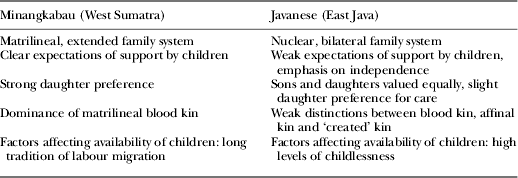
The Minangkabau of West Sumatra are one of the world's largest matrilineal groups (Sanday Reference Sanday2002). Their social organisation is based on the extended matrilineal family. Descent is traced through the female line, and property is held by the women occupying a common ancestral home (rumah gadang). Houses have traditionally accommodated married sisters and their children. Men, when in the village, divide their time between their sisters' and their wife's home, where they are only ever ‘honoured guests’ (Indrizal, Kreager and Schröder-Butterfill Reference Indrizal, Kreager, Schröder-Butterfill and Sokolovsky2009). Most of the year most men are away on labour migration (rantau). In recent decades women have increasingly also migrated. The net effect is that three-quarters of elderly respondents' children are away from the community (Kreager Reference Kreager2006: 46). There are nonetheless strong expectations that children should support their elderly parents, with sons expected to provide monetary support and daughters to provide care (see Table 1).
Key differences between Minangkabau and Javanese cultures

By contrast, the Javanese have a family system not dissimilar from that common in Western Europe and North America. They have nuclear families embedded in bilateral kinship networks (Geertz Reference Geertz1961). Relatives are traced through male and female lines, and inheritance passes to sons and daughters. Villagers promote an ideology of equality, with distinctions between sons and daughters, kin and non-kin, or between kin by marriage or descent downplayed. Children are ideally expected to set up independent households, and family networks rarely operate as wider economic units. Expectations by elderly parents towards children are weak and do not distinguish between sons and daughters, although some people indicate a preference for care by daughters (see Tables 1 and 2).
Non-elderly people's expectations about future source of care in illness in old age
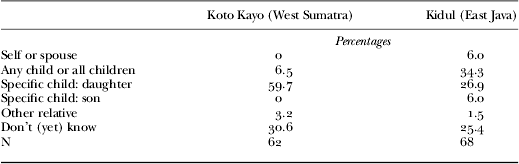
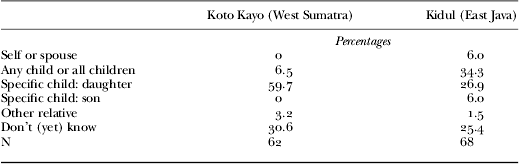
Notes: Questions about future expectations concerning support and care in old age were addressed to adult survey respondents who were not yet aged 60 and over. Responses grouped under ‘any child or all children’ include those who just vaguely indicated ‘child or children’, those who said they hoped for help from all children, and those who said from their only child.
Source: Authors' household survey, 2005.
In both communities demographic forces create gaps in local kin networks. Among the Minangkabau it is primarily the long tradition of labour migration; additionally 7 per cent of older people are childless (Indrizal Reference Indrizal, Kreager and Schröder-Butterfill2004a). In the East Javanese village, involuntary childlessness affects one-quarter of elders (Schröder-Butterfill and Kreager Reference Schröder-Butterfill and Kreager2005). This lack of children is compounded by outmigration, with almost half of elderly people's children no longer resident in the community. The communities also differ in religious terms: Koto Kayo (Sumatra) is 100 per cent Muslim, and Islam plays an important social and cultural role. Kidul (East Java) has Hindu (10%) and Christian (2%) minorities, and within Islam there are variations: many villagers combine Islamic and Javanese mystical practices, others adhere to a ‘purer’ interpretation of the faith and a small minority profess a fundamentalist reading of Islam (cf. Beatty Reference Beatty1999).
The cultural and religious differences between the Minangkabau and Javanese give rise to differences in people's expressed norms and preferences around care provision in old age. This is reflected in Table 2 which summarises the answers that non-elderly survey respondents gave to the question: If later you are ill or frail in old age, who do you hope will care for you?
Table 2 underlines the fact that in Indonesia adult children, as opposed to spouses, are considered the most important source of care in old age. Both communities identify daughters (rather than sons) as preferred care providers, but the strength of that preference varies. In Koto Kayo, the matrilineal village, almost two-thirds of elders identify daughters as favoured carers, compared to just over one-quarter in East Java. Moreover, in Koto Kayo alternatives to reliance on a daughter remain largely unarticulated, and the vast majority of respondents who answered ‘don't (yet) know’ lacked a daughter at the time of survey. This stresses the centrality of daughters in people's preferences around care-giving. By contrast, in Kidul the expectation that it is necessarily a daughter who will care is much weaker, with one-third indicating that they hope ‘a child’ or ‘all children’ will care. Reliance on a spouse or a son also emerges as a preference. The quarter who answered ‘don't (yet) know’ include many who have children (including daughters), yet do not presume to rely on them.
People's expressed preferences reflect the cultural norms of their respective societies, and perhaps the particular demographic and affective constellations of their families. But they do not tell us what actually happens when the need for personal care arises. After all, preferences are not always attainable. Moreover, in answering hypothetical questions about future care, people may not visualise the hands-on care that far-reaching dependence entails. When the eventuality of requiring physical care arises, there may be other norms which stand in conflict with stated ideals, necessitating compromises to be made. Not all compromises are equally acceptable and, as we shall see, some entail dramatically lower quality of care and reputational damage.
Care preferences and compromises among the matrilineal Minangkabau
Minangkabau culture is characterised by strong norms on appropriate interactions and relationships, and straying outside these norms may entail ostracism (Indrizal, Kreager and Schröder-Butterfill Reference Indrizal, Kreager, Schröder-Butterfill and Sokolovsky2009). Therefore dependence on the right kind of identities is important for a person's and a family's standing. Moreover, the logic of the matrilineal kinship system creates tensions between different norms and preferences. These tensions only emerge when concrete care arrangements are examined. Then the seemingly straightforward and pervasive daughter preference begins to fracture and more complex hierarchies of preferences emerge; these differ for elderly men and women.
Older women's care preferences and compromises in Koto Kayo
For elderly women care by a daughter was traditionally assured via the practice of extended family living within one ancestral home (rumah gadang). With migration nowadays affecting daughters almost as much as sons, merely half of elderly women in Koto Kayo co-reside with a daughter. Those whose daughters are all away (32%) and those who lack daughters altogether (9%) are forced to negotiate alternative, less preferred care options. The following two cases illustrate better and worse alternatives.
Case Study 1: In 2000 Darminah, an elderly woman from a well-to-do family, was living alone. All of her nine children, including her two daughters, had moved away. Once a year Darminah visited her daughters in their migration sites. These visits never lasted long; soon the urge to return to the village, where Darminah was overseeing the family's rice lands and ancestral home, would gain the upper hand. Darminah pleaded with one of her daughters to return to Koto Kayo, but the daughter was disinclined to leave her well-paid job. Over the years Darminah became senile and frail. Her daughter invited her to live with her in the city, but Darminah was unwilling to leave her home. A son therefore returned, and he and his wife provided food and practical help. When her health deteriorated to the point of necessitating physical care, this solution was no longer considered tenable: a son cannot provide intimate care to his mother, and a daughter-in-law is a ‘stranger’ belonging to a different lineage. Darminah was therefore taken to her daughter's in the migration destination. She is now being cared for by her daughter and her daughter's paid help.
Case Study 2: Fatimah has no daughters, only sons. In 2000 she was living in her large rumah gadang together with her widowed brother, a great-niece and a more distant matrilineal relative. She enjoyed a close relationship with the great-niece, caring for her young children in exchange for practical help. Her sons provided regular material support. Five years on her health was very poor, and she was no longer able to look after herself. Her great-niece had moved away and her brother had died, leaving her with only the distant relative in the same house. For Fatimah there is now no good solution to her growing care needs. She is reluctant to depend on her relative, as the kinship link is distant and the relationship between the two women poor. Moving in with a son is not an option: it never is for the matrilineal Minangkabau. Care in her own home by a daughter-in-law is also an inferior solution.
Daughters are the normative source of care for older mothers in Minangkabau culture. However, as the case of Darminah shows, increasingly this care is conditional on the mother moving in with a daughter, away from the village. Elderly women's reluctance to do so is not trivial: presiding over a rumah gadang and rice fields is a role which conveys status and respect. In a daughter's house in the migration site a mother does not have a commensurate identity. Moreover, leaving the village without having ensured the matriline's local continuity by passing responsibility for house and lands to a local daughter means failure and uncertainty about the future of the matriline. For Fatimah, the demise of her immediate matriline is already realised, as she has no daughters. Her great-niece provided an acceptable source of care and one that according to Minangkabau custom is certainly preferable to reliance on a son and daughter-in-law. The great-niece's departure left her highly vulnerable. While her co-resident relative is likely to care for her, dependence on such a distant relative will entail shame and loss of status for Fatimah.
Older men's care preferences and compromises in Koto Kayo
Closer examination of men's structural position within matrilineal society, along with consideration of Islamic concepts of pollution, reveal that elderly men's apparent preference for care by a daughter is circumscribed by competing norms and demographic contingencies. As noted above, a Minangkabau man is merely an ‘honoured guest’ in the house his wife and daughters live in. Primary authority in that house rests with the wife and her brothers, while the man himself occupies a position of authority in his sisters' house and vis-à-vis their children. Should a man's wife pre-decease him, or worse, should the couple divorce, then his foothold in his daughter's house is severely weakened; after all, she belongs to a different lineage. The man will feel awkward in the presence of his son-in-law and will often prefer to return to his own ancestral home.
Case Study 3: Isnari spent most of his life away on labour migration, but returned to Koto Kayo in old age. He moved in with his wife and only daughter. His three sons were all away. After his wife died, Isnari developed signs of stress and ill temper, conditions often ascribed to a widower's ambiguous position in his wife's home. He rowed with his daughter and returned to his ancestral home, which was occupied by a cousin and her family. This cousin henceforth cooked, cleaned and washed for Isnari, while he continued receiving material support from his children. Soon after he experienced a severe stroke leaving him bed-bound.
The case of Isnari illustrates that men's preference for care by a daughter may be overridden by the tension, inherent in the Minangkabau kinship system, between men and their affinal relatives. Reliance on relatives from their own matriline may then be preferable. We observed several cases where elderly men lived with a sister and relied on her for instrumental support. An alternative solution is remarriage, and there were several such cases in Koto Kayo (Indrizal Reference Indrizal, Kreager and Schröder-Butterfill2004a).
Isnari's stroke, leaving him in need of intense physical care, revealed a further limitation to daughters’ ability to care for their fathers, which is glossed over when people articulate care preferences (cf. Table 2). When men talk of wanting to be cared for by a daughter, they really mean care in terms of food preparation, housekeeping, laundry, aid with mobility and companionship. Any act of intimate care, such as washing, bathing or accompanying to the toilet, which involves the exposure or touching of a person's private parts by someone of the opposite sex (spouses excluded) is in fact strictly taboo. Such acts fall into the Islamic category of being haram (forbidden, polluting, sinful), as do the eating of pork or drinking of alcohol. A similar taboo against cross-gender intimate care, related to notions of incest and sexuality, was observed by Wong (Reference Wong2005) in Hong Kong. In her study – unlike in Koto Kayo – respondents did occasionally provide cross-gender care to elderly parents, but the act was experienced as deeply embarrassing (see also Barker and Mitteness Reference Barker, Mitteness, Gubrium and Sankar1990). In Koto Kayo, the taboo against cross-gender care means that elderly men, even if they live with daughters or female matri-kin, need to look to male relatives for intimate care. There were no instances of cross-gender care, except among spouses.
Case Study 3 (continued): With all of Isnari's sons and nephews living away from Koto Kayo, an alternative carer had to be found. A distant relative and an unrelated man took on the task, for which they were paid. They bathed, dressed and accompanied him to the toilet, while the cousin continued to cook for him and feed him. When Isnari was admitted to hospital his intimate care was still provided by his two carers. Even hospital nurses in West Sumatra feel uncomfortable providing cross-gender intimate care, and gladly delegate tasks to a same-sex family member. The fact that Isnari's family ended up paying someone for his care was kept a secret in the village: admitting to it would have brought disgrace on the family for failing in its duty.
Our research thus revealed that older men's expressed preferences for care provision may in fact be made unattainable as a result of cultural avoidance prescriptions or the sheer lack of daughters. Moreover, when it comes to intimate care, reliance on a daughter is anything but preferred, as such care transgresses Islamic propriety. Recourse to a spouse or male relative then becomes imperative. It is likely that wealthy Minangkabau will increasingly fall back on paid help, especially where outmigration makes the preferred solution of care by a son or nephew impossible. Use of paid help for domestic and care tasks is already widespread in Indonesian cities (van Eeuwijk Reference van Eeuwijk2006). At present, this solution is still considered shameful in the village context, and knowledge of it would result in a family's loss of face. Therefore villagers relying on paid help either keep the payment secret or present it as ‘kin care’ by invoking a distant or non-existent kin link. As we shall now see, such attempts at normalising care solutions that are not entirely ‘proper’ are also found on Java.
Care preferences and compromises on Java
Table 2 indicated greater latitude in care-giving preferences on Java than Sumatra. Closer examination of actual care arrangements, on the one hand, confirms flexibility in the handling of care in old age, including the permissiveness of cross-gender care, and on the other hand, reveals subtle hierarchies in the acceptability of different arrangements. In particular, the rhetoric of equivalence among kin gives way to the valuing of blood kin over affinal kin and a clear gendering of care in practice. Particularly where care needs are long term, the inclusive vision of all children being responsible is replaced by a severe narrowing of care networks to one or two carers, with adverse consequences for care quality and carer burden. Let us elaborate on these points in turn.
In the course of fieldwork we encountered 20 cases of elderly women and 12 cases of elderly men in the Javanese study community requiring physical care over a period of at least several weeks. Twelve of the 20 women were primarily cared for by daughters; there were also instances of care by a spouse, a son, neighbours, a granddaughter or daughter-in-law. Among the elderly men, four were primarily cared for by a spouse, three by a daughter, two by a sister and three by a distant relative or neighbour. Clearly, a range of identities are observed providing physical care for elderly Javanese people, although daughters and spouses predominate. Unlike the more strictly Islamic Minangkabau, the Javanese tolerate cross-gender care-giving and deal with it pragmatically.Footnote 3 In fact, all of the men experienced care by a woman, in many cases not just by a spouse. Evidently in Javanese culture, women's association with the domestic and caring realm overrides any unease around inappropriate intimate care. Although rarer than among men, there were four instances of cross-gender care among the elderly women, involving a spouse in two cases, a son and a male nurse in two further cases. This pragmatism means that older people have a greater range of options should they require care, although we shall see that the quality and implications of different care arrangements differ.
Despite villagers' avowal that relatives by marriage are commensurate with blood relatives, when it comes to the intimate sphere of care and food provision, in-laws are considered more distant.Footnote 4 One rich elderly widower, who has six sons and one daughter, explained his decision to live with his only daughter thus: ‘With a daughter [as opposed to daughter-in-law] I need not feel like a stranger (asing), nor awkward (sungkan) about asking her to do my laundry or cook my favourite food.’ While circumstance may necessitate reliance on a daughter-in-law, if pressed on the matter many elders admitted that ideally they would be cared for by a daughter. We encountered several cases where a distant daughter returned to provide care in illness, thereby avoiding care by a local daughter-in-law.
A further, significant indication of the fact that care networks are smaller, selective subsets of people's social and support networks, and consequently that relatives are not interchangeable or equivalent (as the bilateral logic may suggest), can be found in the extreme narrowing and gendering of people's supportive networks as care needs intensify (Keating et al. Reference Keating, Otfinowsky, Wenger, Fast and Derksen2003). The following case study illustrates this.
Case Study 4: When we first met Pipah she was living with her married son, daughter-in-law and two grandchildren. Her two married daughters and a sister lived close by, a further son lived in a neighbouring village. Pipah suffered from rheumatism. In 2001 her co-resident son moved away, leaving Pipah living alone. Her two daughters took it in turns to provide her with cooked food. Both sons visited and gave her money. By 2004 Pipah was no longer able to walk any distance. Her children therefore built a one-room extension to her elder daughter's house. This allowed Pipah to see her family but gave her some privacy and independence. The two daughters continued to provide food, while a son paid for medical care. Her sister and sister's children often visited. On our return to the village in 2005 we were prevented from meeting Pipah. Her daughter was adamant that we would be unable to stand the smell in Pipah's room. In conversation with the daughter it emerged that Pipah had been bed-bound for the past few months. Both daughters prepared easily digestible food for her and fed her whenever she was too weak to eat herself. A special commode had been built, but often Pipah simply urinated in bed. Every two days the two daughters carried her to the bathroom and bathed her. The sons continued to visit, but their supportive role was now much diminished.
Pipah's case portrays typical support network dynamics as more intensive care needs arise. The circle of active kin narrows, becomes more heavily gendered and more strongly biased towards close and nearby kin (cf. Szinovacz and Davey Reference Szinovacz and Davey2007; Wenger Reference Wenger, Gubrium and Sankar1990). Pipah's family's response to her changing needs is unusual in that all children continue to play some part. In many other cases the division of labour became highly uneven, and caring then fell almost exclusively on a co-resident female relative, typically a daughter, while other children and relatives faded into the background (cf. Schröder-Butterfill Reference Schröder-Butterfill2006; Silverman and Huelsman Reference Silverman, Huelsman, Gubrium and Sankar1990; van Eeuwijk Reference van Eeuwijk2006). For example, one woman complained that since her co-resident mother had become bed-bound, her siblings hardly visited, let alone helped. They apparently found the smell emanating from the elderly woman offensive and were frustrated if she did not recognise them. As a result of the extreme burden of caring single-handedly for her mother, the woman had become depressed and the mother's quality of care was very poor. Her clothes were dirty, she had no access to medical care, she apparently often missed meals (‘if I forget to feed her, she never complains’) and was locked into her room whenever the daughter had to go out. These observations of declining care quality and increasing care-giver burden echo the findings by van Eeuwijk in North Sulawesi, Indonesia:
Older people who suffer from persistent chronic illness … are likely … to be vulnerable to … increasingly inadequate support. … This is because there is a tendency for care-givers to reduce their care effort with the increasing deterioration of the health of the elderly sufferer, which in turn is often a function of the duration of the illness and the growing physical, economic, social and psychological burdens. … The fewer the support givers, the less comprehensive is the care provided, and the heavier are the burdens for the remaining care-giver(s). This ‘constriction of care’ occurs as the frail care-recipients grow ever more dependent on their care-givers. (2006: 76)
All in all our data suggest that if an elderly frail person has children, care is typically forthcoming although it may entail reliance on a non-preferred provider of physical care, such as a daughter-in-law or a son. Moreover, it may lead to severe imbalances in care provision within family networks which work to the detriment of women and may undermine quality of care.
Care compromises and failures
Real vulnerability to care failure in old age emerges in cases where preferred carers, notably children and spouses, are lacking altogether. One-quarter of elderly people in Kidul have no surviving children, a third have no child locally. While most elderly men still have a spouse (87%), among women only a minority do (28%). For such elders the negotiation of care is uncertain. According to the Javanese kinship system, there are limited obligations for support and care among kin beyond the immediate family (spouses, children, siblings) (Geertz Reference Geertz1961: 26–7). In this they differ from the Minangkabau, where the logic of extended kinship allows people, at least in theory, to look to ever more distant circles of matrilineal kin for assistance (Indrizal Reference Indrizal, Kreager and Schröder-Butterfill2004a). On Java, nephews, nieces or grandchildren will not automatically step in if closer kin are lacking. Instead, close, supportive relations with a particular relative have to be created. This is clear in the case of Haji Lina.
Case Study 5: Haji Lina's three marriages remained childless, but with her third husband she adopted two sons and a daughter. By the time she was old and going blind, one son had died and her daughter had established a successful career elsewhere, leaving only a married son close by. Unwilling to rely on her daughter-in-law, she used her wealth to extend her house and offered the extension to a granddaughter in exchange for care. She normalised the essentially contractual relationship by henceforth referring to the granddaughter as adopted daughter (anak angkat). That way less attention was drawn to the fact that Lina, a woman of immense standing, was not being cared for by her daughter, as ought ideally to happen. Following a stroke, Haji Lina had to be fed, washed, bathed and turned, tasks primarily undertaken by the granddaughter. Lina's son was company to his mother at night when she couldn't sleep or wished to pray. Lina's daughter occasionally visited, but on account of the odour merely talked to her mother from the doorway.
Lina is fortunate in that she has wealth and status to compensate through adoption for her lack of normative source of care. For elderly people without any children (own or adopted) there are few options for acceptable and reliable care. Not surprisingly, childless respondents often refused even to discuss the eventuality of ill health. As one woman put it, ‘It's best not to even think about it! I pray that I will die quickly!’
The severe vulnerability of ‘familyless’ elders to care failure is an outcome of the fact that relatives and neighbours, who are often happy to provide a little money or a plateful of food, typically draw the line at providing intimate care.Footnote 5 The final case study provides a sobering illustration of the limits of informal care-giving where close family members are lacking and where there is no formal safety net.
Case Study 6: Putih was an impoverished childless widow in her seventies who lived alone in a tiny shack which had been erected for her by a group of neighbours. These neighbours were quick to emphasise Putih's general dependence on community charity: ‘If she's not given it by neighbours, she doesn't have anything to eat!’ Poor health prevented her from working. Putih's two children had died. Her only surviving relatives were a brother and some nephews in another village. The brother had cheated her out of an inheritance, and as a result Putih had cut ties with him. Several months into our fieldwork Putih fell ill. Although her neighbours still brought her water and food, they openly gossiped about her, complaining about her smell and apparently huge appetite. Soon Putih was collected by a nephew, the son of her estranged brother. Someone had let him know that she was ill and needed taking away. Within weeks the elderly woman died in her nephew's house, far from her familiar surroundings and contacts. She was not buried in Kidul, and by pulling down her shack her neighbours quickly erased any trace of her former existence.
Intimate care-giving is rarely a pleasant task. Close family members will nonetheless usually undertake it, be it out of obligation, affection, reciprocity or guilt. More distant kin and neighbours are not bound by a similar sense of duty or fondness, and once an exchange relationship becomes heavily imbalanced by the over-dependence of one party on the other, the commitment to help can quickly dissolve. The result can be sequential shifts in the identity of carers, as the ‘caring capacity’ of network members is exhausted (cf. Keating et al. Reference Keating, Otfinowsky, Wenger, Fast and Derksen2003), and ultimately the breakdown of a person's care arrangement and their untimely, degrading death. Putih's case is dramatic, but not unique.Footnote 6 We encountered several cases where affinal kin or neighbours refused to provide intimate care and instead forcibly delegated responsibility to the person they considered the more ‘appropriate’ carer – typically the closest blood relative – even if that person had no relationship history with the elder (cf. Marianti Reference Marianti, Kreager and Schröder-Butterfill2004). In other cases affines or created kin were happy to provide care on account of enjoying a close relationship with the elder, but more influential blood relatives stepped in, supposedly out of concern for the relative, yet more likely to maintain appearances.
The unravelling of care arrangements of poor, childless elders thus reveals an important truth about Javanese people's perceptions of the boundaries of kinship and belonging. Although much emphasis is placed in daily rhetoric on ‘everyone being relatives’ (semua sama saudara), on mutual neighbourly help (gotong royong) and on the potential of creating kin through adoption or marriage, when it comes to the bodily domains of caring and feeding, blood relations carry greater weight. This is mirrored both in elderly parents’ preference for care by a daughter, rather than daughter-in-law, and in people's assignment of care duties on behalf of frail elders to blood kin, rather than neighbours, friends or created kin.
Care dependence and personhood
The case of Putih reveals a further important point about Javanese sociality, namely one concerning the personhood and status of dependent elders. Being physically dependent entails severe loss of status, exclusion from participation and decision-making, and treatment as an inferior human being. Older people in Kidul consistently voiced aversion to dependence in later life, be that material, residential or practical dependence. Several dependent elderly people sadly summed up their social roles along the lines of: ‘I can't work, I can still eat, I only sit and keep my mouth shut.’ The Javanese display keen awareness of imbalances in their social relationships, and this includes sensitivity to imbalances in exchange relations (C. Geertz Reference Geertz1960, H. Geertz Reference Geertz1961). Relationships lacking at least an element of reciprocity elicit unease, and dependence is therefore experienced as undermining of relationships and of social status. By contrast, elderly Minangkabau respondents bragged about the support they were receiving from children, and incapacitated elders in Koto Kayo were treated respectfully. Clearly, our material points to cultural differences in the handling of dependence, with the Javanese being rather close to what we consider ‘Western’ evaluations of dependence and its implications for personhood (cf. Barker and Mitteness Reference Barker and Mitteness1994; Hockey and James Reference Hockey and James1993; Luborsky Reference Luborsky1994).
Putih's removal from her home is merely an extreme manifestation of the profound disempowerment and exclusion which frail Javanese elders experience. Just as Twigg (Reference Twigg2004) observed for elderly Britons requiring care, in Java, too, a person's need for help with simple bodily functions undermines their status as fully adult person. A person's social death may then long precede their actual death (cf. Lawton Reference Lawton1998). One woman, when asked about her mother's last months of life, made a telling throw-away comment: ‘Oh whatever, she was already old (ya wis, sudah tua)!’ Other common examples of the stripping away of frail persons' social identity and respect are gossiping about their smell, appetites, bodily functions or senility; judging their dependence to be punishment for earlier misdeeds; talking on their behalf, rather than allowing them a voice; and excluding them from social life by sequestering them away. Even formerly respected village elders quickly found themselves sinking into obscurity upon becoming frail, no longer consulted or even visited. There is thus resonance in our material with the observation, mentioned earlier, by Luborsky (Reference Luborsky1994) that incapacity can become a person's ‘master identity’.
Conclusions
This article has examined care-giving to older men and women in rural Indonesia. Old-age care is a neglected topic in developing countries, and consequently little is known about the reliability of existing care and the identity of those most at risk of poor quality care. The present analysis has taken a comparative, ethnographic approach to understanding care in two distinct cultural contexts. Our aims were to identify who provides care to frail or ill older people in Indonesia, to examine how actual arrangements depart from expressed preferences and what constraints operate on the attainment of preferences, and to study the implications of dependence for older people's quality of care, status and personhood.
Our research confirmed the strongly gendered nature of care provision repeatedly documented for Europe and North America. Compared with the West, there is a stronger preference for care by a daughter (as opposed to a spouse) in Indonesia, with daughter preference most pronounced in the matrilineal society we studied. Both communities manifest acceptable but inferior alternatives to care by a daughter, with the bilateral Javanese community showing greater flexibility around permissible carers. Closer scrutiny revealed the existence of powerful taboos against cross-gender physical care, especially in the more orthodox Islamic setting, resulting in reliance on identities not otherwise privileged in local cultural discourse and practice. Often different social norms and preferences come into conflict, forcing people to make trade-offs in their care arrangements. Some compromises merely detract from older people's subjective wellbeing – as when having to be cared for away from home or by an ‘adopted’ daughter rather than daughter – others are more damaging to a person's status and affect their quality of care by virtue of involving identities that have little actual commitment to the dependent elder.
At the outset we argued that the care of frail or ill persons can act as a lens through which broader social relations may be viewed. Because care-giving entails the ‘invasion’ of others into what is normally a highly personal domain, people are prompted to articulate deeply held notions about propriety, belonging and reputation (Twigg Reference Twigg2000b). For Indonesia, this has revealed that kinship is a much more powerful tool of social differentiation and boundary drawing than more mundane social interactions would suggest. In the morally charged arena of physical care we found distinctions being made not only between kin and non-kin, but also between blood kin and affines, lineal kin and non-lineal kin. The tight social control that care is under makes it a key marker of a family's reputation and solidarity. Like the management of intimate relations more generally, the handling of care relationships is a means for groups to negotiate their social positions and maintain their boundaries (Douglas Reference Douglas1970 [1966]; Kreager Reference Kreager, Coleman and Schofield1986: 136). We found that the fear of disgrace befalling families for failing to provide appropriate care at times motivates the negotiation of (outwardly) acceptable solutions, even if this involves dissimulation or the concealment of neglect.
The social exclusion and loss of status, autonomy and respect which accompany physical decline in Java are striking. They confirm the centrality of independence and mutuality to people's understanding of full personhood in Javanese culture. Contrary to what is sometimes assumed in the literature on care and dependence, the close interconnection between physical and mental mastery and full personhood is not uniquely Western, but is also found in certain non-Western societies. Whether this interconnection is in part a function of family system is a matter for further comparative study; certainly the matrilineal family system in our study did not show the same intolerance of dependence as the nuclear system.
What are the implications of our findings for care quality and vulnerability to care failures? If, as we have shown, the range of identities deemed acceptable for care provision is narrow, many older people will be vulnerable to suboptimal care. This is especially the case in settings where demographic constraints, like migration or childlessness, combine with a lack of formal care provision for older people. In the matrilineal society older men emerged as particularly vulnerable, due to the awkward structural position they have vis-à-vis the lineage they have married into and due to the strong taboo on cross-gender care which prevents daughters from providing physical care for their fathers. On Java, prohibitions against cross-gender care are muted and the kinship system more flexible. However, this flexibility masks a lack of obligations for care provision beyond the immediate family, which means that childless and spouseless elders are extremely vulnerable to a lack of care unless they have succeeded in creating alternative kin links earlier in life. For both elders with and without close kin, long-term care dependency entails a constriction of the care network over time. The quality of care provision typically declines with the length of an elderly person's dependence and the resultant concentration of the care burden on one or two carers. Our findings add to the small but growing corpus of knowledge on care-giving in developing countries and point to serious constraints to families' and communities' capacity to provide reliable and acceptable care to all older members. It is time to open up the policy focus in developing countries and in international development discourse to include care provision in programmes of social protection.
Acknowledgements
The research project, ‘Ageing in Indonesia 1999–2007’, was directed by Philip Kreager at Oxford University and was a collaboration with Universitas Indonesia and Universitas Andalas in Indonesia. The authors are grateful for the generous financial support of this research by the Wellcome Trust, the Economic and Social Research Council (via a doctoral studentship) and the British Academy (via a postdoctoral research fellowship). None of the funding bodies had a role in the design or execution of the study. Vita Priantina Dewi, Edi Indrizal, Haryono and Philip Kreager contributed to the discussions resulting in this paper, and Stephen Butterfill, Aravinda Guntupalli, Rebekah Luff and two anonymous reviewers provided invaluable feedback on an earlier draft.