1. INTRODUCTION
Plasma expansion into vacuum is a basic physical problem with a variety of applications, ranging from space to laboratory scales (Sack & Schamel, Reference Sack and Schamel1987; Itina et al., Reference Itina, Hermann, Delaporte and Sentis2002; Leubner, Reference Leubner2004; Hau & Fu, Reference Hau and Fu2007; Huang et al., Reference Huang, Duan, Lan, Wang, Tang and He2008). Caused generally by electron pressure, it serves as an energy transfer mechanism from electrons to ions. The expansion process is often described under the assumption of Maxwellian electrons with velocities in local thermal equilibrium, known to be isotropically distributed around the average velocity. This assumption easily fails with a lack of collisions. Indeed, in many cases of astrophysical and laboratory plasmas expansion, the electron distribution functions are non-Maxwellian and exhibit more complex shapes showing high-energy tails, as in the weakly collisional corona and solar wind acceleration region (Shoub, Reference Shoub1983). The fundamental reason is that fast electrons collide much less frequently than slow ones. Indeed their free path is very large since proportional to  $v_e^4 $, where
 ${v_e}$ is the electron velocity, and cannot relax to a Maxwellian. The energetic electrons could have a significant effect on ionization and expansion of the plasma (Beilis, Reference Beilis2012). As reported by many authors (Gurevich et al., Reference Gurevich, Anderson and Wilhelmsson1979; Reference Gurevich and Meshcherkin1981; Bennaceur-Doumaz & Djebli, Reference Bennaceur-Doumaz and Djebli2010; Kiefer et al., Reference Kiefer, Schlege and Kaluza2013), in expanding plasma produced by laser plasma experiments, the high mobility light electrons escape faster into vacuum compared to heavier particles, thus generating a self-consistent ambipolar electric field that accelerates the ions and slows electrons. Ions are accelerated by non-Maxwellian electron distribution enriched with fast particles. Increasing the laser energy increases the role of the accelerated ions. Therefore, the electron velocity distribution function is non-Maxwellian.
Initially, the non-thermal electrons were modeled by the Cairns distribution which was first introduced by Cairns et al. (Reference Cairns, Mamum, Bingham, Boström, Dendy, Nairn and Shukla1995) to study the effect of non-thermal electrons on the nature of ion sound solitary structures observed in the upper ionosphere. They have considered a non-thermal plasma model and shown the existence of structures very like those observed by the Freja and Viking satellites. They introduced a distribution designed to model enhanced high-energy tails that are frequently observed in space plasmas and showed that the nature of ion sound solitary structures can change in the presence of non-thermal electrons, producing nonlinear solitary waves that may have either enhanced or depleted density.
Later, Mamun (Reference Mamun1997) and Tang and Xue (Reference Tang and Xue2004) also considered the non-thermal electrons and warm ion effects on ion acoustic waves. In fact, it has been shown here that for given values of the non-thermal parameter, cylindrical and spherical Korteweg-de Vries (KdV) equations can be invalid and one has to consider the modified KdV equation. The deviation from a Maxwellian distribution inherent to the expansion leads to the acceleration of the ion-acoustic velocity (Hakimi Pajouh & Abbasi, Reference Hakimi Pajouh and Abbasi2002; Alinejad et al., Reference Alinejad, Sobhanian and Mahmoodi2006). In laser plasma, the deviation from Maxwell distribution, at the earlier stage, is attributed to the existence of an electron emission relaxation region. The accelerated electrons provide an additional heating source to the plasma (Beilis, Reference Beilis2007).
Recently, the development of high intense lasers allows exploration of fundamentally new non-linear regimes in laser plasma interaction In the framework of laser fusion experiments, we can cite Mora and Grismayer (Reference Mora and Grismayer2009) who investigated the collisionless expansion into vacuum of a thin plasma foil using non-Maxwellian electron distribution functions.
Among the effects that might be involved in making the electron distribution functions non-Maxwellian is electron trapping which is due to the nonlinear resonant interaction of ion-acoustic potential well and electrons in plasma. In fact, in this case, propagation of high frequency waves in plasma can generate longitudinal (potential) waves in which some of the plasma particles as electrons can be trapped and interact strongly with the wave during its evolution in the plasma (Hakimi Pajouh & Abbasi, Reference Hakimi Pajouh and Abbasi2002).
Consequently, the electrons are separated into two categories: the free electrons and the trapped electrons. Starting with the work of Bernstien et al. (Reference Bernstein, Green and Kruskal1957) trapping was considered directly by the wave itself. However trapping as a microscopic process was considered by Gurevich (Reference Gurevich1968) where the solution of the Vlasov equation along with Maxwell's equations was used.
Theoretically, several authors have studied the combination of the two effects: non-thermality and trapping, on plasma evolution and most of the results concerned its influence on the existence and the propagation of ionic acoustic solitons in the plasma. For example, Volosevich et al. (Reference Volosevich, Meister and Zhestkov2006), Alinejad (Reference Alinejad2010), and Islam et al. (Reference Islam, Bandyopadhyay and Das2010) have studied the effect of the presence of non-thermal electrons, modeled by the distribution of Cairns et al. (Reference Cairns, Mamum, Bingham, Boström, Dendy, Nairn and Shukla1995), and trapped electrons, modeled by the distribution of Schamel (Reference Schamel1979), on the evolution of plasmas. They have shown the importance of the presence of the two effects on the existence and propagation of ion acoustic waves. Abbasi and Hakimi (Reference Abbasi and Hakimi2008) and Ahmadihojatabad et al. (Reference Ahmadihojatabad, Abbasi and Hakimi2010) made similar studies but with supra-thermal electrons modeled by Kappa distribution (generalized Lorentzian) (Hau, Reference Hau and Fu2007) and trapped electrons modeled by the distribution of Schamel.
In the same way, throughout this work, we studied these two effects on the self-similar expansion of plasma created by lasers, enough powerful to excite nonlinear effects such as plasma waves. The energetic electrons are supposed to follow the Cairns function distribution whereas the electrons trapped by the potential wells created by the plasma waves are modelled by the function of distribution of Gurevich.
These two phenomena are observed by many applications that may arise during the acceleration mechanisms of electrons and ions, in the context of laser-plasma acceleration (Passoni, Reference Passoni, Bertagna and Zani2010). Their influence on ion acceleration and production of well collimated multi-MeV ion beams is a very active and interesting topic in laser and plasma physics (Macchi, Reference Macchi2013).
2. DESCRIPTION OF THE MODEL
The present study of plasma expansion is deduced from high-intensity laser-matter interactions (I > 1018 W/cm2). The most interesting and efficient one for applications is the electrostatic acceleration at the rear-side of a thin dense target. In this case, electrons heated by the laser at the front surface of the target propagate through the solid material and form a space charge cloud in vacuum at the rear surface. The static electric field induced by this electron cloud is strong enough to fully ionize the material and accelerate ions perpendicularly to the rear surface up to multi-MeV energies. Depending on the intensity temperatures of around 1 MeV are obtained.
At first the stationary situation of a plasma slab of fixed ions and a hot electron population is studied. The metal target is supposed unlimited and is a homogeneously filled negative half space. At time t = 0, the target surface involved in the experiments is located at x = 0, and the target is in x < 0 region. Laser radiation is switched on in the -x direction and the plasma starts expanding. Due to the expansion, the plasma density will decrease and hence a rarefaction wave will propagate in the -x direction (Cheng et al., Reference Cheng, Perrie, Wub, Tao, Edwardson, Dearden and Watkins2009).
Ions are cold and initially at rest with density n i = n i0, (n i0 ≈ 1019cm −3) for x < 0 and n i = 0 for x > 0 with a sharp boundary (see Fig. 1). At t > 0, plasma begins to expand into vacuum (Mora, Reference Mora2003).
(Color online). Initial conditions of densities before plasma expansion, x = 0 is the semi-infinite border of the target.

3. BASIC EQUATIONS
3.1. Electron Function Distribution
The purpose of the present work is to study one-dimensional, non-relativistic, collisionless expansion into a vacuum of semi-infinite plasma in the presence of both trapped and non-thermal electrons and their influence on the ion dynamics. The approximation of a one-dimensional description of the expansion is justified as long as lateral heat conduction can be neglected.
We suppose the existence of a population of high energetic electrons following Cairns DF:
 $${\,f_e}\left({{{\rm \nu}_e}} \right)= \displaystyle{{{n_{e0}}} \over {\sqrt {2{\rm \pi} {\rm \nu}_{eth}^2 } }}\displaystyle{{\left({1 + {\rm \alpha} {\rm \nu}_e^4 /{\rm \nu}_{eth}^4 } \right)} \over {\left({3{\rm \alpha} + 1} \right)}}\exp \left({ - {\rm \nu}_e^2 /2{\rm \nu}_{eth}^2 } \right).$$
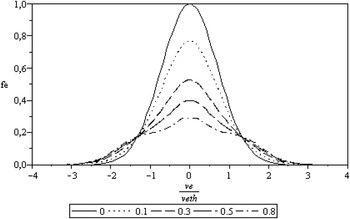
Where n e0 is the unperturbed electronic density, 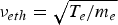 ${{\rm \nu}_{eth}} = \sqrt {{T_e}/{m_e}} $ is the average electron thermal velocity, T e is the electron temperature in the absence of non-thermal effects. α is an arbitrary non-thermal parameter that measures the deviation from the Maxwellian distribution function and defines the shape of the distribution. It indicates the population of the fast electrons. It is clear that Eq. (1) expresses the isothermally distributed electrons when α = 0. The shape of the function distribution is given for different values of α in Figure 2 showing the energetic tails of the distributions relatively to the Maxwell distribution.
Normalized Cairns electron distribution function as function of the parameter α.

Propagation of high frequency waves in plasma can generate the longitudinal (potential) waves in which some of the plasma particles as electrons can be trapped and interact strongly with the wave during its evolution in the plasma (Hakimi Pajouh & Abbasi, Reference Hakimi Pajouh and Abbasi2002; Shorokhov, Reference Shorokhov2006).
We assume the existence of potential wells in the plasma U(x) = −eφ(x) large enough to trap a certain proportion of electrons following Gurevich distribution. It is in fact the study of the effect of trapping electrons on the plasma expansion, in the case of the presence of energetic electrons. The distribution of electrons in the presence of non-zero potential is expressed mathematically by replacing νe2 / νeth2 by νe2 / νeth2 − 2φ in the Cairns distribution to calculate the total density of free and trapped electrons.
We write the density of free non-thermal electrons, with a total positive energy ε > 0, and density of trapped electrons, with a total negative energy ε < 0, as follows (Landau & Lifshitz, Reference Landau and Lifshitz1981; Bennaceur-Doumaz et al., Reference Bennaceur-Doumaz, Bara and Djebli2011):
 $${n_e} = 2\int_{{{\rm \nu}_1}}^\infty {{\,f_e}\left({{{\rm \nu}_e}} \right)d{{\rm \nu}_e}} + 2\int_0^{{{\rm \nu}_1}} {{\,f_e}\left(0 \right)d{{\rm \nu}_e}}.$$
With ν1 = (2|U| / m e)1/2, |U| = |eφ| and ε = m eνe2 / 2 + U(x). The factors 2 take account of particles with ν1 > 0 and νe < 0.
Using Cairns distribution (1) with the effects of potential in Eq. (2) and after integration by parts of the resulting equation, we find the normalized density as:
 $$\eqalignno{&{\tilde n_e} = {n_e}/{n_{e0}} = \displaystyle{2 \over {3{\rm \alpha} + 1}} \left({2{\rm \alpha} {\Phi ^2} - 2{\rm \alpha} \Phi + \displaystyle{{3{\rm \alpha} + 1} \over 2}} \right)\cr & \quad \left\{{{e^\Phi }\left({1 - erf\left({\sqrt {\left\vert \Phi \right\vert } } \right)} \right)+ 2\displaystyle{{\sqrt {\left\vert \Phi \right\vert } } \over {\sqrt {\rm \pi} }}} \right\}.}$$
Setting  $b = 4{\rm \alpha} /\left({3{\rm \alpha} + 1} \right)$, the electron density normalized to its initial value is given as follows:
 $${\tilde n_e} = \left({b{\Phi ^2} - b\Phi + 1} \right)\left\{{{e^\Phi }\left({1 - erf\left({\sqrt {\left\vert \Phi \right\vert } } \right)} \right)+ 2\displaystyle{{\sqrt {\left\vert \Phi \right\vert } } \over {\sqrt {\rm \pi} }}} \right\}$$
|Φ| = |eφ| / T e is the normalized electrostatic potential.
If we put b = 0, that is to say in the absence of non-thermal electrons, we find the case of trapping of Gurevich (Landau & Lifshitz, Reference Landau and Lifshitz1981).
 $${\tilde n_e} = {e^\Phi }\left({1 - erf\left({\sqrt {\left\vert \Phi \right\vert } } \right)} \right)+ 2\displaystyle{{\sqrt {\left\vert \Phi \right\vert } } \over {\sqrt {\rm \pi} }}.$$
3.2. Ion Motion Modelling
The plasma is considered as a non-dissipative and non-heat-conductive fluid and the ions with density n i and velocity νi are described by the following Euler continuity and momentum fluid equations, respectively:
 $$\displaystyle{{\partial {n_i}} \over {\partial t}} + \displaystyle{{\partial \left({{n_i}{v_i}} \right)} \over {\partial x}} = 0\comma \;$$
 $$\displaystyle{{\partial {v_i}} \over {\partial t}} + {v_i}\displaystyle{{\partial {v_i}} \over {\partial x}} + \displaystyle{1 \over {{m_i}{n_i}}}\displaystyle{{\partial {P_i}} \over {\partial x}} + \displaystyle{e \over {{m_i}}}\displaystyle{{\partial {\rm \varphi} } \over {\partial x}} = 0\comma \;$$
m i is the mass of the plasma particles. Eqs. (6) and (7) are closed by the ideal gas equation of state such that plasma pressure is given by P i = n iT i, where T i is the ion temperature.
The electron thermal conductivity in the hot expanding plasma is considered sufficiently high so that the plasma tends to be isothermal which means T e and T i are assumed to remain constant during the plasma expansion (Pearlman & Morse, Reference Pearlman and Morse1978; Sack & Schamel, Reference Sack and Schamel1987).
3.3. Quasi-neutrality of Charge
The equations of plasma dynamics allow a considerable simplification for phenomena in which the characteristic scales of length and time satisfy the following conditions (Landau & Lifshitz, Reference Landau and Lifshitz1981): (1) The characteristic dimension L of inhomogeneities in the plasma is assumed large compared with the plasma Debye length λei: λei / L≪1. (2) The rate of the process is assumed to be governed by the motion of the ions, so that the characteristic scale of speed is given by νith, which is small in comparison with the electron speeds. (3) The motion of the ions causes a slow change in the electric potential that is adiabatically followed by the electron distribution.
The potential of the electric field due to the charges is determined by Poisson's equation: Δφ= 4πe(δn i − δn e), δn e and δn i are the changes in the electron and ion densities in the perturbed plasma. In order of magnitude, Δφ = φ / L 2, hence 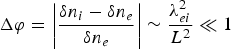 $\Delta {\rm \varphi} = \left\vert {\displaystyle{{{\rm \delta} {n_i} - {\rm \delta} {n_e}} \over {{\rm \delta} {n_e}}}} \right\vert \sim \displaystyle{{{\rm \lambda} _{ei}^2 } \over {{L^2}}} \ll 1$.
This inequality remains valid for a strong perturbation, with eφ ~ T e. Thus the uncompensated charge density due to the perturbation is small compared with the perturbations of the electron and ion charge densities separately; such plasma is said to be quasi-neutral. For the range of phenomena under consideration, this property enables the potential distribution in the plasma to be determined from just the “equation of quasi-neutrality,” that is to say: n e = n i during all the expansion.
During the expansion of hot plasma under vacuum, the most energetic ions originate from the non-neutral region of the plasma sheath and can reach velocities that are several times the initial speed of sound in the plasma (Mora, Reference Mora2003; Reference Mora2005). However, a sizable fraction of the beam energy is carried by the quasi-neutral region of the expanding plasma. In this region, the quasi-neutrality condition guarantees the validity of self-similar solutions, motivating the interest of the present paper in these types of solutions.
4. SELF-SIMILAR THEORY AND NUMERICAL CALCULATION
In the presence of free boundary associated to plasma expansion, it is a hard task to solve hydrodynamic equations describing the expansion numerically. But under certain assumptions, these partial differential equations can be reduced to ordinary differential equations that greatly simplify the problem. This transformation is based on the assumption that we have a self-similar solution, i.e., every physical parameter distribution preserves its shape during expansion and there is no scaling parameter (Sack & Schamel, Reference Sack and Schamel1987; Zel'dovich & Raizer, Reference Zel'dovich and Raizer1966).
Self-similar solutions usually describe the asymptotic behavior of an unbounded problem and the time t and the space coordinate x appear only in the combination of (x/t). It means that the existence of self-similar variables implies the lack of characteristic lengths and times. Indeed, this is justified when we deal with the assumption of charge quasi-neutrality in the plasma. The Debye length then, loses its importance as a characteristic length in the plasma.
The one-dimensional self-similar solution of Eqs. (6) and (7) with quasi-neutrality assumption can be constructed by using the ansatz defined as  ${\tilde n_i} = {n_i}/{n_{i0}}$,
 ${\tilde {\rm \nu}_i} = {{\rm \nu}_i}/{c_s}$, c s is the ion sound velocity given by c 2s = T e/m i and n i0 is the initial density of the plasma. By using the dimensionless self-similar variable ξ = x/c st, we obtain the following set of normalized ordinary equations:
 $$\left({{{\tilde {\rm \nu}}_i} - {\rm \xi} } \right)\displaystyle{{d{{\tilde n}_i}} \over {d{\rm \xi} }} + {\tilde n_i}\displaystyle{{d{{\tilde {\rm \nu}}_i}} \over {d{\rm \xi} }} = 0\comma \;$$
 $$\left({{{\tilde {\rm \nu}}_i} - {\rm \xi} } \right)\displaystyle{{d{{\tilde {\rm \nu}}_i}} \over {d{\rm \xi} }} + \displaystyle{{\rm \delta} \over {{{\tilde n}_i}}}\displaystyle{{d{{\tilde n}_i}} \over {d{\rm \xi} }} + \displaystyle{{d\Phi } \over {d{\rm \xi} }} = 0.$$
The ion motion is modelled by the cold ion approximation where δ = T i/T e≪1.
Differentiating Eq. (4) and using the condition of quasi-neutrality of charge, we obtain
 $$\displaystyle{{d{{\tilde n}_i}} \over {d{\rm \xi} }} = H\left(\Phi \right)\displaystyle{{d\Phi } \over {d{\rm \xi} }}.$$
Where  $ H = 2\left({2b\Phi - b} \right)\left({\displaystyle{{\sqrt {\left\vert \Phi \right\vert } } \over {\sqrt {\rm \pi} }}} \right)+ \left({b{\Phi ^2} - b\Phi + 1 - b} \right){e^\Phi }$
 $erfc\left({\sqrt {\left\vert \Phi \right\vert } } \right)$. The equation of ion motion (9) becomes:
 $$\left({\displaystyle{{\rm \delta} \over {{{\tilde n}_i}}} + \displaystyle{1 \over H}} \right)\displaystyle{{d{{\tilde n}_i}} \over {d{\rm \xi} }} + \left({{{\tilde {\rm \nu}}_i} - {\rm \xi} } \right)\displaystyle{{d{{\tilde {\rm \nu}}_i}} \over {d{\rm \xi} }} = 0.$$
If we treat the entire derivative terms as independent variables and the resulting set of equations as algebraic ones, then the nontrivial solution to the system of Eqs. (5) and (8) requires that the determinant of their coefficients must vanish (Yu, Reference Yu and Luo1995), i.e., while choosing the positive solution corresponding to an expansion in the +x direction and a velocity increasing with increasing x:
 $${\tilde {\rm \nu}_i} = {\rm \xi} + \sqrt {{\rm \delta} + \displaystyle{{{{\tilde n}_i}} \over H}}.$$
Differentiating (12) and using Eqs. (8) and (9) we found the system of equations to solve for the density and electrostatic potential
 $$\displaystyle{{d{{\tilde n}_i}} \over {d{\rm \xi} }} = \displaystyle{{ - {{\tilde n}_i}\sqrt {{\rm \delta} + {{\tilde n}_i}/H} } \over {\left({{\rm \delta} + 1.5{{\tilde n}_i}/H - 0.5\tilde n_i^2 L/{H^3}} \right)}}\comma \;$$
 $$\displaystyle{{d\Phi } \over {d{\rm \xi} }} = \displaystyle{{ - {{\tilde n}_i}\sqrt {{\rm \delta} + {{\tilde n}_i}/H} } \over {H\left({{\rm \delta} + 1.5{{\tilde n}_i}/H - 0.5\tilde n_i^2 L/{H^3}} \right)}}\comma \;$$
where  $L = {e^\Phi }erfc\left({\sqrt {\left\vert \Phi \right\vert } } \right)\left({b{\Phi ^2} - b\Phi + 1 - b} \right)+ 4b\left({\displaystyle{{\sqrt {\left\vert \Phi \right\vert } } \over {\sqrt {\rm \pi} }}} \right)- \left({\displaystyle{{b{\Phi ^2} - b\Phi + 1} \over {\sqrt {\rm \pi} \sqrt {\left\vert \Phi \right\vert } }}} \right)$.
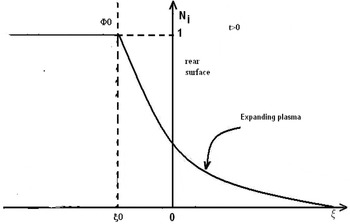
The plasma under consideration is expanding into vacuum at t > 0. The initial time t = 0 in our case corresponds to an unperturbed plasma with initial parameters  ${\tilde n_0} = 1$ and
 ${\tilde {\rm \nu}_0} = 0$ (Ivlev, Reference Ivlev and Fortov1999). As a consequence, we require that there should exist a point ξ0 at t ≤ 0 for which the plasma is unperturbed and at rest, such that
 $\tilde {\rm \nu}\left({{{\rm \xi} _0}} \right)= 0$,
 $\tilde n\left({{{\rm \xi} _0}} \right)= 1$ and Φ(ξ0) = Φ0 (see Fig. 3).
Plasma expansion at rear surface of target in the direction of the laser.

The system of Eqs. (13) and (14) is solved numerically with Runge-Kutta method. Densities, velocities, and plasma potential are deduced according to the variable ξ, and depend on the initial conditions of the plasma expansion.
5. INFLUENCE OF ELECTRON TRAPPING AND ENERGETIC ELECTRONS ON THE PLASMA EXPANSION
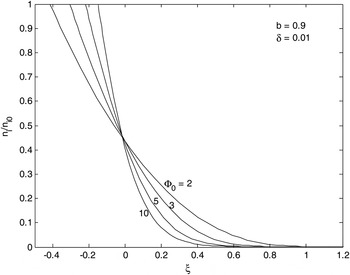
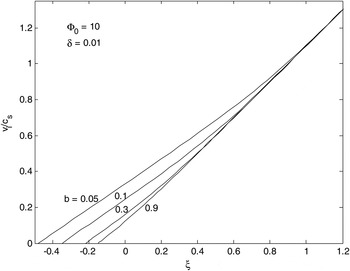
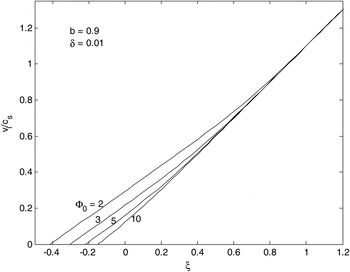
The plasma dynamics is governed by ion motion. To study self-similar expansion of the plasma, we present, in Figures 4–7, ion densities normalized to their initial values and ion velocities normalized to the sonic velocity as functions of the self-similar variable ξ for different values of the parameter b at a given initial potential Φ0 (Figs. 4 and 6), and for different values of the initial potential well Φ0 at a given value b (Figs. 5 and 7). Assuming that ions are modeled by cold approximation and are much colder than electrons, the temperature ratio δ is arbitrary taken equal to 0.01. It is important to note that the obtained profiles for the limit b = 0 in the density expression (4) are the same than those which are derived using the distribution of Gurevich.
Ion densities normalized to their initial values as functions of ξ for different values of b.

Ion densities normalized to their initial values as functions of ξ for different values of Φ0.

Ion velocities normalized to the sonic velocity as functions of ξ for different values of b.

Ion velocities normalized to the sonic velocity as functions of ξ for different values of Φ0.

The curves are plotted using conditions at ξ0 corresponding to zero initial velocity, instead of ξ = 0, showing that initial conditions depend strongly on physical parameters like temperatures, initial potentials, and non-thermal effects. Figure 4 shows that for a large enough initial potential well: Φ0 = 10, and for different population ratios of energetic electrons, between 5 and 90%, two behaviors of the density are observed relatively to the intersection point ξ0. A large enough initial potential is required to have electron trapping; the value Φ0 = 10 is chosen arbitrary finding this value numerically suitable to have non-negligible trapping (Bennaceur-Doumaz et al., Reference Bennaceur-Doumaz, Bara and Djebli2011).
The two limits values of b have been chosen in order to handle both the case of very small number of non-thermal electrons (b = 0.05) and the case where almost all the electrons are energetic (b = 0.9). Near the source (ξ < 0), from the early stages of expansion, not only the effect of pressure is observed but also the potential well influences the plasma expansion: as b is decreasing, the expansion is slowing down. This effect is much more efficient beyond the point of intersection. In fact, for ξ > 0, for large values of b (for example b = 0.9) where the majority of electrons are energetic, the behavior of the density decreases very rapidly comparatively to that for small values of b (example b = 0.05) where the decrease in density is much slower. So, the presence of an important number of non-energetic trapped electrons in the plasma potential wells has the effect of slowing down the expansion, these electrons have not enough energy to go across the potential well and remain trapped and oscillating in it; whereas the phenomenon of presence of energetic electrons makes the influence of trapping effect on the self-similar expansion very weak.
On the other hand, we can make the following remarks concerning Figure 5 where density is represented for different potentials wells for a large value of b parameter. The figure shows that when the population of energetic electrons is dominant (b = 0.9), as the potential increases, the trapping effect on these particles has another role. It seems that the energetic particles trapped in the potential gained energy from the waves where they are in resonance with them, making the plasma expansion more accelerated. The case of smaller potential Φ0 = 2 is approaching the case of Cairns function distribution with zero initial potential, without trapping.
In Figures 6 and 7, the represented ion velocities are approximately linear as functions of the self-similar variable ξ. In Figure 6, for Φ0 = 10, for all values of b, the velocities are increasing until reaching the same value. We point out that the expansion velocity is increasing slowly when b is decreasing. We can see this phenomenon in the decrease of the expansion acceleration (Δν/Δξ) when b decreases: this is due to the influence of electronic trapping that is to slow down the expansion, especially in the presence of a minimum population of energetic electrons (example Δν/Δξ = 0.962s for b = 0.9 and 0.773c s for b = 0.05). The very slow electrons cannot exchange energy with the wave and cannot remain in phase with it because the wave exceeds them very quickly.
In Figure 7, the same phenomenon is observed for the behavior of velocity as a function of ξ for different values of the potential and for b = 0.9 where it is shown that the acceleration is less pronounced for little values of the potential. This is due to the acceleration of energetic electrons that are trapped by the potential. There is a population of electrons which can be in phase or resonance with the plasma wave, and then, can be trapped. The resonant interaction only takes place for those electrons that have a velocity close to the ion-acoustic velocity.
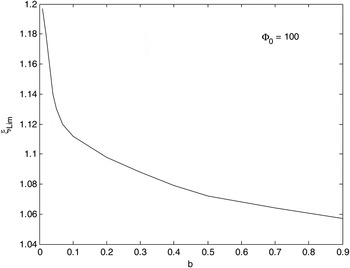
Figure 8 tracing the limit of self-similar ξLim expansion as a function of b for a well of Φ0 = 100 shows that the self-similar expansion is more extended and the plasma lifetime increases when the parameter b is decreasing (example: ξLim = 1.111 for b = 0.9 and ξLim = 1.654 for b = 0.05). The limit of self-similar expansion is nearly constant especially for very large electrostatic potentials, and the expansion is much slower for b = 0 than for b ≠ 0 even in the case of a very small number of energetic electrons (b = 0.05). For example, for Φ0 = 10, if b = 0.05, ξLim = 1.654 and if b = 0, ξLim = 5.179, showing the slowing down of expansion even in the presence of a very small number of energetic electrons. The obtained self-similar solution shows that when the population of the energetic electrons is dominant, it is the phenomenon of acceleration due to these electrons which overrides the trapping in the expansion of plasma.
Limit of the self-similar variable as function of b.

6. CONCLUSION
The expansion of a laser created plasma is studied in the presence of energetic electrons as well as electrons trapped by the potential wells created by plasma waves. Cairns distribution function for the non-thermal electrons and Gurevich distribution function for the trapped electrons were used. The self-similar solution obtained shows that for ion (plasma) behavior, from the early stages of expansion and later, the presence of an important number of non-energetic trapped electrons in the plasma potential wells has the effect of slowing down the expansion, whereas the phenomenon of presence of energetic electrons makes the influence of trapping effect on the self-similar expansion very weak even in the case of a very small number of energetic electrons.
The last few years have seen a rapid expansion of interest in devising ways of controlling large amplitude waves in plasmas to make them useful for the acceleration of electrons and ions to high energies. The accelerated particles must all be submitted to the same accelerating field so they acquire the same speed and the same direction. This allows in particular obtaining mono-energetic and collimated beams, useful for technology applications, such as thin film deposition, processing surfaces, medicine, etc. (Daido, Reference Daido, Nishiuchi and Pirozhkov2012).