A widely shared understanding portrays decentralized political structures as important causes of smaller governments, a less-developed welfare state, and, consequently, higher levels of inequality. According to this common view, decentralized political institutions work to perpetuate inequality because “decentralized redistribution is self-defeating.”1
Prud'homme 1995, 202.
See, among others, Huber, Ragin, and Stephens 1993; Peterson and Rom 1990; Peterson 1995; and Prud'homme 1995, as well as the insights from institutional economic history in Alston and Ferrie 1999. On the role of federalism in the development of the American welfare state, see Alesina, Glaeser, and Sacerdote 2001. For arguments elaborating on the efficiency gains associated with federalism, see Oates 1999; Buchanan 1995; Prud'homme 1995; Inman and Rubinfeld 1997; Weingast 1995; and Qian and Weingast 1997. For positive analyses of the impact of federalism on the economy, see Wibbels 2005; Rodden 2006; and Cai and Treisman 2005.
Recent institutional developments, such as the process of European integration or the process of political decentralization in Spain, have reopened the question of the distributive consequences associated with the degree of centralization of fiscal structures. In this context, recent scholarship on federalism shows that not all decentralized political systems work to foster inequality by constraining the size and scope of welfare state policies. Contrary to the dominant view, decentralized political systems show significant levels of variation in the organization of their fiscal structures, as well as in the scope of their efforts to prevent the spread of inequality.3
In fact, the design of fiscal structures is critical to understand the distributive consequences of federalism and decentralization, as it determines whether the institutional setting induces or reduces inequality.4Linz and Stepan 2000.
This question speaks directly to a second puzzle concerning the institutional articulation of the European Union (EU). The issue of whether social policy integration should parallel market and economic integration has been present since the early days of the union. Recent neofunctionalist accounts have argued that, insofar as social policy plays a role in labor markets, the mismatch between an integrated European market and a fragmented system of social protection is a short-term anomaly.5
As Mattli puts it, “economic integration is likely to raise questions as to how the winners will compensate the losers. The ensuing need for compensatory mechanisms is bound to widen the fiscal responsibility of the central authority in a region.”6Mattli 1999, 39.
In grappling with these questions, I follow in the footsteps of a recent literature on the political economy of integration.8
Within this general framework, this article models and examines empirically the endogenous relationship between fiscal structures, in particular the degree of decentralization of the welfare state, and the distribution of income. A full understanding of this link is critical to illuminate both the politics behind the selection of fiscal institutions and the workings of redistribution in multitiered systems.In what follows I argue that the (de)centralization of fiscal policy has distributive effects that are contingent on the existing structure of inequality. Aware of this contingency, political actors evaluate alternative institutional designs on the basis of their expected distributional consequences. As a result, the territorial structure of inequality becomes a determinant of the fiscal structure itself, which explains why some fiscal structures are more integrated than others. In particular, this article identifies two mechanisms linking the territorial structure of inequality to preferences for the political integration of solidarity: differences in the demand for redistribution associated with interregional income differences, and differences in the demand for social insurance associated with the incidence of labor market risks. The empirical analysis yields a good deal of support to the prediction that the decentralization of redistributive policy is a function of the regional patterns of income inequality and labor market risks.
This argument advances existing knowledge in several ways. First, it advances current accounts of the causal logic connecting the territorial structure of inequality and the decentralization of the welfare state. In analyzing this linkage, previous accounts have focused on two dimensions. The first one, namely the size of the tax base, leads to a rather intuitive prediction: rich regions prefer decentralization whereas poorer ones always prefer a centralized fiscal regime. In turn, the seminal work by Bolton and Roland9
Bolton and Roland 1997.
Second, the article challenges the conventional wisdom on the relationship between decentralization and the welfare state. Contrary to the dominant view,11
See note 2.
Third, the article also makes a significant contribution to the empirical literature on decentralization. Previous accounts of the determinants of fiscal decentralization have systematically overlooked the role of the territorial structure of inequality in shaping fiscal structures.12
This article corrects this omission by providing robust evidence that the territorial structure of inequality does affect the level of decentralization. This result expands existing understandings of the empirical correlates of fiscal decentralization, while offering at the same time the first direct evaluation, using purposefully constructed indicators, of the theory of endogenous political integration.The remainder of the article is structured as follows. The next section develops a model linking the territorial structure of inequality with preferences about the decentralization of redistributive policy. The second section discusses measurement issues as well as the empirical specification of the relationships hypothesized in the model. I then present the main findings of the empirical analysis, based on a time-series cross-sectional data set for fourteen Organization for Economic Cooperation and Development (OECD) countries over the period 1980–2000. The following section elaborates briefly on the implications of the analysis for the understanding of the fiscal structure of the EU. The final section concludes.
Inequality and the Territorial Fragmentation of Solidarity
What makes the decentralization of redistributive policy endogenous to income inequality? In addressing this question, I apply the median voter model of redistribution13
to a union with several layers of government. Within this framework the amount of redistribution, defined as a linear tax with an intercept, is a function of the relative position of the median voter on the income scale: the larger the distance between the income of the median voter and the average (mean) income in the society, the larger the preferred amount of redistribution. Redistribution can be either centralized or decentralized. Decentralized redistribution refers to a system in which subnational political entities (regions, states, provinces) are allowed to make their own policy choices.14Admittedly, this is an oversimplification of the actual politics of redistribution in any given territory. Yet its predictions are similar to those emerging from more realistic models of the redistributive implications of the strategic interaction between different levels of government in federations; see Dixit and Londregan 1998. Thus, in this particular case, there is little loss of generality in using a median voter framework.
This basic setup allows one to define three hypothetical unions that help explore the link between decentralization and income inequality. Let subscript r = 1…,r denote each of the regions in the union, and subscript u denote the union level. Regions are assumed to be of equal size. Define Yr and Yu, respectively, as the average pretax income at the regional and national levels. Likewise, define tr and tu as the levels of redistribution at the regional and national levels. Finally, let superscript m define the median voter's pretax income either at the regional (Yrm) or national level (Yum).


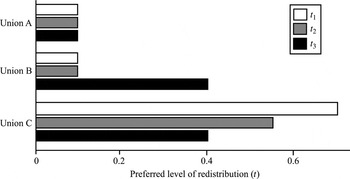
The first union (A) defines the characteristics of a nation in which the structure of inequality, that is, the distance between the income of the median voter and the mean income in each demos, is identical for the two regions (r) and the national level (u). Under these circumstances the level of decentralization bears no salience for redistribution and inequality.15
Obviously, this does not necessarily imply that decentralization has no consequences in other realms, such as efficiency gains in the provision of public goods. See Oates 1999.

Redistribution by different levels of government under different distributions of income
In the case of union B, the structure of inequality is similar across regions, but, since Yr ≠ Yu, the distance between the mean and the median voter's income is no longer the same at the national level as at the regional level. The point to note here is that, even in the rather unlikely case that the structure of inequality is similar across different regions, a change from decentralization to centralization (or vice versa) would imply a change in the preferred level of redistribution. As with union A, Figure 1 helps illustrate this point. In the case of union B, the distribution of income is given by h1 = {1,3,6} and h2 = {4,12,24}. Both regions have the same median to mean ratio, that is, Y1m/Y1 = Y2m/Y2 = 9/10. However, the ratio at the union level, that is to say pooling the six households together, is a different one, namely Yum/Yu = 15/25. In these circumstances, an institutional change from centralization to decentralization would alter upwards the preferred level of redistribution without introducing interregional differences (from t1 = t2 = 0.1 to tu = 0.4). However, given the conditions specified in B, a shift from decentralization toward centralization would imply no equalization in the levels of redistribution (t) across regions.
Finally, in the far more realistic union C, regions differ not only in their average income levels, but also in their internal distribution of income. As a result, they show different preferences for redistribution. In contrast to union B, a shift toward decentralization would impose a change in the scale of redistribution that would be specific to each region. Conversely, a switch toward centralization would imply not only a change in the scale but also the homogenization of t across regions. Again, Figure 1 provides a helpful numerical example. The distribution of income in union C is given by h1 = {1,1,8} and h2 = {4,6,30}. Note that the ratio at the union level is similar to the one in union B, namely 15/25. Yet, given the structure of regional inequalities (Y1m/Y1 < Y2m/Y2 < Yum/Yu), a change from centralization toward decentralization would lead both regions to increase their levels of redistribution in relation to the union (t1 > t2 > tu).
Because preferences are defined as a function of the internal structure of inequality in a specific territorial unit and not as a direct reflection of its level of income/wealth, the distributive consequences of decentralization cannot be established ex ante. It is certain that decentralization has an effect. Yet such an effect need not work always in the same direction since, in the presence of unequal regions, the institutional design modifies the preferences for redistribution.16
Consider an example in which Y1 > Y2 and Y1m/Y1 > Y2m/Y2. Under these conditions t1 > t2, that is, the rich region is more redistributive than the poor one. If redistribution were to be centralized, citizens in region one would support a smaller t since a majority of them would become net contributors whereas a majority of citizens in region two would become net recipients. For an argument applied to different policy issues where the process leading to a change in preferences is formally depicted, see Rose-Ackerman 1981.
On this basis it is reasonable to assume that political actors, when deciding about decentralizing redistribution, are aware of the structure of inequality within the different territories, from which they derive an expectation about the level of redistribution associated with specific institutional designs. Thus, by deciding on the latter, political actors are also making a choice about income redistribution, opening a political process according to which the structure of inequality shapes the levels of fiscal decentralization. The next hurdle is to establish how the structure of inequality determines the incentives of actors to centralize/decentralize fiscal policy.
In what follows, I build on Bolton and Roland's 1997 model to argue that the preferences for the degree of decentralization of fiscal policy are primarily a function of two factors: (1) income differences between regions (as highlighted in Bolton and Roland's model), and (2) the differences in terms of the labor market risks profiles of regional economies, an extension I develop on the basis of the literature on the role of fiscal policies as an insurance mechanism.17
See Alesina and Perotti 1998; Atkinson 1995; Mares 2003; Moene and Wallerstein 2001; Iversen and Soskice 2001; Sinn 1995; and Varian 1980.
To analyze the role of these two factors, consider a model in which the relevant actors face the problem of

where Ud(c) denotes the value of consumption under decentralization and Uc(c) denotes the value of consumption under a centralized design of redistribution. The model assumes a closed economy with two regions in which redistribution is performed by a linear tax with an intercept, and where neither citizens nor endowments are allowed to move between regions in response to the nature of different redistributive policies.18
Alesina and Perotti 1998 show how the presence of external shocks creates incentives to centralize fiscal redistributive policies. Assuming a closed economy is equivalent to imposing the restriction that all EU countries are similarly exposed to external shocks. While this is empirically not the case, the adoption of the euro, and the fact that a large share of EU countries' international trade occurs within the union, make this assumption plausible. Moreover, the development of the model with or without external shocks does not affect my predictions about the effects of income differences and risks associated with economic specialization. In turn, the assumption of no mobility simplifies the analysis by freezing the strategic interaction between regions. For an analysis of the implications of external shocks and labor mobility for the regional preferences about political integration or the (de)centralization of fiscal policy, see Bolton and Roland 1996; and Beramendi 2006.
Each region is assumed to have two sectors: β and λ. β represents the share of the population who derive their income from work, with an after-tax income given by β(1 − t)wi. In turn, λ represents the nonworking population, whose income comes from the share of aggregate output per capita (y) that has been taxed (yt). Thus, (t − t2/2)y defines the income of the people ending up in the λ sector, where t2/2 captures, conventionally, the deadweight losses of redistribution.
Risks imply uncertainties about income. In the case of β, the uncertainties derive from the risk profile of the regional labor force: the higher the levels of economic specialization, the less portable the skills, and therefore, the higher the risks. Taken together, these assumptions imply that the utility function of any given territorial level must be defined as a function of: (1) the incidence of individual specific risks; and (2) the fact that the tax base and the tax rate affecting both sectors are also a function of the risk profile of the region. More formally:

where zi captures the incidence of unknown individual risks associated with the degree of economic specialization. The model is solved by evaluating the differential in utility obtained by the regional median voter across the two policy designs, centralization and decentralization. This requires calculating the relevant tax rates for the region and the union, substituting them into the utility function and evaluating the differences between the two. Once these steps are taken (details in Appendix 1), the following expression is obtained:19
Notation: the absence of a subscript implies reference to the regional level. Subscript u indicates reference to the union level. So, for instance, wi represents the pretax income of an individual of the region whereas wui represents the pretax income of an individual of the union. Similarly, wm represents the pretax income of the median voter of the region whereas wum represents the pretax income of the union's median voter.

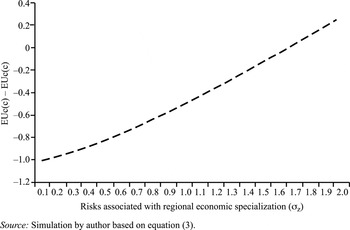
where θ = 2β(wm)2(1 + σz2) and θu = 2β(wum)2(1 + σzu2) are, respectively, the terms capturing the incidence of economic risks at the regional and the union level. Since the solution to the model is not self-evident, the comparative statics are best presented graphically. On the basis of expression (3), Figure 2 presents a simulation under the following conditions: the region and the union have similar shares of dependent population (λ = λu), but the union is richer than the region (y < yu). The y-axis represents the differential in utility between decentralized and centralized redistribution (E [Udm(c)] − E [Ucm]), whereas the x-axis captures the incidence of region specific economic risks (θ = 2β(wm)2(1 + σz2)). Recall from equation (1) that positive values in E [Udm(c)] − E [Ucm] reflect a preference for decentralization, whereas negative values indicate a preference in favor of centralization.

Preferences for democratization as a function of income and labor market risks: Gains in utility from remaining decentralized for a region poorer than the union
Figure 2 illustrates the way in which income and risks differences shape the preferences for fiscal decentralization. Concerning income differences, a decision about fiscal decentralization implies a decision about the tax base. Intuitively, poor regions have a strong incentive to opt for centralization since, under such a policy design, they are able to capture part of the income of their wealthier partners. Consistent with this intuition, Figure 2 shows that for a large range of values of σz2, the poor region prefers centralized redistribution. On the other hand, wealthier regions would have no incentive to centralize at all, as given by the term ½(y − yu) in equation (3).
In turn, when it comes to labor market risks, a decision about fiscal decentralization is effectively a decision about the preferred level of insurance in any given territory. The incidence of labor market risks is a function of the degree of economic specialization of the regional economy. The more specialized a regional economy is, the less portable the skills of the labor force, and therefore the higher the incidence of economic risks. These in turn are reflected into preferences for more provision of social insurance. This insight follows directly from calculating the tax rate that maximizes the utility of the regional median voter in expression (2) (see Appendix 1 for details):

As tm* increases in σz2, poor regions face a trade-off between the interregional income transfers implicit to centralization and their capacity to maintain their preferred policy choice in order to cope with their own specific labor market risks.20
The positive relationship between labor market risks and preferences for redistribution in equation (4) is a well-established result in comparative political economy. See Estevez-Abe, Iversen, and Soskice 2001; Iversen and Soskice 2001; and Mares 2003. In addition, this link is strengthened by the fact that economic specialization limits factor mobility. In the presence of specialization, perfect factor mobility is no longer in place. Specialized capital and labor are, overall, less mobile, which in turn increases even further their exposure to risk. See Wildasin 1995; and Boix 2003.
The preferences of wealthier regions become more complex once one considers the implications of large levels of undesired immigration. See Beramendi 2006.
By illuminating the interplay between the regional distribution of labor market risks and the level of decentralization of the welfare state, the model brings up an overlooked dimension of the territorial structure of inequality. Risks concern the probability of a future loss of income. As this probability varies across regional income distributions, regions will also diverge in their preferred level of insurance. Incorporating this dimension broadens one's ability to explain cases that otherwise would remain puzzling, thereby increasing the predictive power of the theory. The contribution is particularly visible in terms of understanding why some poor regions opt for decentralized fiscal structures. To illustrate this point, consider the resistance of Southern Democrats to centralize unemployment insurance during the negotiations of the Social Security Act in 1935. The South was relatively poorer than the rest of the union and would have benefited from a massive transfer from wealthier parts of the country. Also, in pure distributional terms, these transfers would have been welcome by a majority of the southern citizens as the South was also very unequal. Yet, despite these facts, southern elites vetoed centralized unemployment insurance in the Senate in order to not disrupt the race-based patronage system that characterized their regional political economy.22
This case exemplifies how the need to adopt a public insurance system that minimizes disruption to the regional economy may overturn other considerations solely based on redistributive concerns. Indeed, arguments exclusively based on the size of regional tax bases or income redistribution, such as the Bolton and Roland model, fall short of exhausting analytical predictions, as reflected by the failure to account for what is probably the single most important decision regarding the decentralization of the American welfare state. Similar examples can be found across space and time, including today's EU.23Alesina, Angeloni, and Etro 2005 study the trade-off between integration and policy autonomy in what they call “international unions,” paying particular attention to the EU experience. This model generates important insights on how the interplay between preferences for public good provision and the management of economic externalities affects the size and design of the union. While these insights speak to and complement my argument, both the focus and the approach are clearly different. Alesina, Angeloni, and Etro explore how alternative institutional designs (rigid unions, flexible unions) are selected to cope with economic externalities, given an underlying distribution of preferences for public good provisions. In contrast, the model developed in this section studies how different dimensions of the territorial structure of inequality shape the preferences for a specific type of public good (insurance/redistribution), and thereby the preferences on the level of fiscal decentralization. In other words, what they take as given is the main concern of this article. Comparing the assumptions on which the models are built further highlights the differences in focus. While I assume away economic externalities (such as factor mobility) to concentrate on the effect of different dimensions of the income distribution (level, distribution, risk), Alesina, Angeloni, and Etro assume income homogeneity to concentrate on the interplay between economic externalities and different institutional arrangements for public good provision.
In conclusion, given a political procedure in which constituent regions have veto power over the decision to (de)centralize fiscal policy, the choice of a particular territorial design of redistribution depends on the internal composition of the union in terms of regional incomes and risk structures. If two regions have a similar degree of exposure to external shocks (0 in this case) and economic specialization, and their distributions of income are structured similarly, centralization is the expected institutional choice. Alternatively, if regions show different degrees of labor market risks, and there are significant income disparities between them, their income distributions will be more heterogeneous. In turn, as the shape of the distribution of income differs across regions, so does the nature of redistributive preferences. As a result, higher levels of decentralization of redistributive policy are to be expected. This argument offers a compelling logic to understand variation in fiscal structures across multitiered systems. I turn now to evaluate its general empirical validity and discuss in detail its implications for one's understanding of the EU's fiscal structure.
Statistical Model and Measurement Issues
The empirical evaluation of the hypothesis that the levels of decentralization of redistributive policy are a positive function of the interregional differences in the shape of the (regional) income distributions brings up a number of measurement issues concerning both variables of interest.24
Appendices 3 and 4 present the summary statistics and sources of the variables used in this section.
Decentralization of Redistributive Policy (DRPit)
Measuring DRPit is far from straightforward as the indicators conventionally at use, such as the regional share of public expenditures or revenues based on International Monetary Fund (IMF) data, suffer from important limitations concerning the attribution of political capacities across policy fields.25
Rodden 2004.
- A measure of welfare transfers decentralization (ITHit), that is, of the decentralization of direct income transfers to households in OECD countries. Transfers decentralization is defined as 100 minus the percentage of direct transfers to households by consolidated central governments. This indicator ranges between 0 and 100.
- A measure of revenue autonomy (RAit), that is, of the extent to which subnational governments depend on their own resources to effectively perform income transfers. This indicator is based on the assumption that to the extent that regions rely on their own resources, they will have more discretion to design their redistributive policies, and therefore, the degree of decentralization of redistributive policy will be higher. This measure ranges between 0 and 1 and is defined, on the basis of IMF data, as the proportion of the region's own generated revenues out of total regional revenues.
- An indicator of legislative leverage by subnational governments (LLit). The welfare state is not territorially fragmented if subnational levels of government tax and spend according to provisions established exclusively by the national parliament. This type of administrative decentralization, largely at work in Scandinavian countries, should not be mistaken for the actual decentralization of redistributive policy. To prevent such misconception this indicator takes the value of one in those cases in which subnational governments either have autonomy to legislate or a direct input into the (national) policy-making process, and 0 otherwise. Thus, the existence of some legislative leverage is taken to be a prerequisite for the ability to tax and spend to actually reflect a territorial fragmentation of the welfare state.
These three dimensions are combined in a single scale measuring the overall decentralization of redistributive policy that is defined as DRPit = (ITHit − RAit)/LLit. This summary indicator continues to range between 0 and 100.
Interregional Differences in the Incidence of Income Inequality (Ineqitir)
Ineqitir is meant to capture the territorial structure of inequality, that is to say the regional variation in the incidence of inequality.26
Superscript ir stands for interregional.
In some European country/years I have complemented the LIS data with other sources such as the European Community Household Panel. In these cases (Spain and Denmark), I have used the same income variables and equivalence scales in calculating the inequality measures.
While LIS includes a few surveys on Ireland and Switzerland, the data sets do not allow to decompose market inequality by region in these two countries. Because Ireland has a centralized economy and Switzerland is among the few federations in the OECD, this constrains the variation in the data, thereby rendering the empirical tests a more conservative exercise.
All equivalized income measures are calculated using the LIS equivalence scale (0.5 + 0.25*(n − 1)), where n is the number of members in the household.
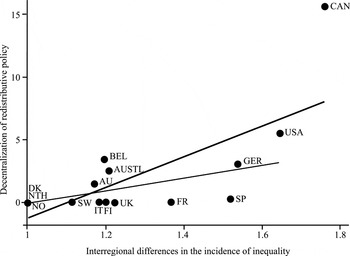
Figure 3 provides an overview of the degree of variation in the territorial fragmentation of solidarity according to the measure adopted in this article. The welfare state remains either fully centralized or scarcely decentralized in countries such as France, the United Kingdom, Sweden, or Spain, where it shows moderate to large levels of territorial fragmentation in Austria, Australia, Germany, the United States, and Canada. Figure 3 also offers a first cut of the association between the decentralization of redistributive policy and the range of regional differences in incidence of inequality. The association between them is clearly positive (r = 0.71) and strong. Figure 3 also displays the linear relationship between the two variables when Canada, a clear outlier, is excluded from the analysis. Even though the range of variation declines, the correlation remains positive and reasonably strong (r = 0.61). However suggestive, though, Figure 3 falls short of providing enough basis to accept the central hypothesis predicated by the model, namely that the territorial structure of inequality drives the degree of decentralization of the welfare state.

Decentralization of redistributive policy and regional variation in inequality (1980–2000: period averages)
One obvious concern is reversed causality. While the argument developed in this article highlights the causal mechanisms through which inequality shapes decentralization, there are reasons to believe that the preexisting levels of territorial fragmentation of the welfare state could feedback on the regional patterns of income inequality, for instance through the provision of different levels of benefits generosity across regions. This reciprocity between inequality and decentralization has important implications for the estimation in that the empirical evaluation of the determinants of the decentralization of redistributive policies faces a potential problem of endogeneity.30
There is a problem of endogeneity when “the values of our explanatory variable are sometimes the consequence, rather than the cause, of our dependent variable;” King, Keohane, and Verba 1994, 185. More technically, endogeneity refers to the fact that an independent variable is potentially a choice variable, correlated with unobservables in the error term; see Greene 2000.
Baltagi 1995.

The term

indicates that its values are predicted by a set of factors of the territorial structure of inequality other than DRPit itself. To the extent that the exogenous variables (instruments) have no effects on DRPit other than those working through Ineqitir, the estimates of equation (5) are not biased by reversed causality. In searching for instruments, the goal is to find a good predictor of Ineqitir that is unrelated to the decentralization of redistributive policy. In this quest, I turn to international markets, more specifically to the evolution of world oil prices. In dealing with oil, domestic economic and political actors are price takers. To the extent that regional economies diverge in their ability to export oil or in their dependency on it, the international price of oil has a direct impact on the income differences between regions. Thus, differences across regions in the exposure to world oil markets have a direct impact on the territorial structure of inequality. At the same time, it is safe to assume that previous levels of decentralization of social security bear no impact on the level or evolution of international oil prices.
32To illustrate the validity of this instrument, consider the relationship between Norway and the European Union. If world oil prices plummeted, Norway would be much less advantaged vis à vis other European economies, and thus would have less to fear from further political and economic integration with the EU.

.
33The instrument is defined as ΔCV(GDPir)/Δ(WOP), where the numerator represents the change in the coefficient of variation in regional GDP per capita and the denominator represents the change in the levels of world oil prices.
Boix 2003.
Hiscox and Rickard 2002.

in the first equation of the two-stage instrumental variable approach (Table 1 below).
Determinants of the territorial structure of inequality, 1980—2000

In addition, the empirical evaluation of the effect of the territorial structure of inequality on the decentralization of redistributive policy requires controlling for a number of “usual suspects” in the literature on fiscal decentralization. The log of country size (lCSi), a time invariant covariate, is included to consider the argument that the need for multilevel government structures increases with the size of the country. total taxation (TTit) as a percentage of gross domestic product (GDP) introduces a control for the possible association between the size of government and the levels of fiscal decentralization.36
The inclusion of a control for ethnic fractionalization (EFi) follows from the well-established link between the existence of multiple cultural, linguistic, and/or religious identities and the use of decentralized political arrangements to accommodate them.37 Put briefly, decentralized/federal polities are more likely to emerge in ethnically, linguistically, and/or culturally fragmented social contexts. Thus, a positive impact of ethnic fractionalization on the decentralization of redistributive policy is theoretically plausible and ought to be controlled for. I also include a measure of national economic growth (ΔGDPit), as some studies have found a positive and significant relationship between economic prosperity and fiscal decentralization around the world.38Panizza 1999.
While for the sake of simplicity the presence of external shocks has been held constant in the development of the theoretical model, it still needs to be controlled for in the empirical estimations. The need to control for the exposure to international trade fluctuations and their impact on the choice of decentralization of redistributive policy derives as well as from previous contributions in the field. Indeed, the expectations regarding the effects of this variable are not univocal. Some scholars have argued that a higher degree of openness is associated with higher levels of fiscal centralization because international competition leads citizens to demand more protection from the government.39
This argument is compelling on the assumption that a common exposure to international competition affects all regions equally. However, if the effects of economic internationalization vary across regions with different economic structures and risk profiles, the scope of risk sharing between regions as defined in the model would decrease. Under such conditions, the expected relation between openness and decentralization would be positive due to an increase in the heterogeneity of preferences.40Alesina and Spolaore 2003 advance a different argument to support this expectation. More integrated international markets increase the bargaining leverage of wealthier, technologically advanced regions. As a result, the latter are able to renegotiate the fiscal contract and increase their autonomy.
Finally, I include two additional controls capturing relevant differences in terms of both economic and political institutions. First, redistributive policy is likely to be more centralized in those countries in which the welfare state is part of nationwide corporatist agreements between unions, employers, and the governments. Thus, a control for the level of wage bargaining centralization (WBCit) is in order.41
Kenworthy 2001.
Ibid.
In both stages of the analysis, I address robustness concerns by using several estimations, including ordinary least squares (OLS) with robust standard errors, OLS with panel-corrected standard errors (PCSE), and a Prais-Winsten regression with panel-corrected standard errors.44
Beck and Katz 1995.
Findings
Tables 1 and 2 report the estimates of the first-stage equation, namely the one used to instrument the territorial structure of inequality. The estimation results bring up two important implications for my argument. First, the results offer an empirical validation of the theoretical premises on the basis of which the relationship between inequality and decentralization of redistribution has been theorized. Consistent with the mechanisms identified in the model, larger differences across regions in terms of income and labor market risks (as captured by the coefficient of variation in regional unemployment rates) translate into larger interregional differences in the shape of the income distribution. In turn, higher levels of mobility work to reduce these differences. On the assumption that labor mobility rates are strongly and negatively correlated with the degree of specialization of the labor force, the estimates reported support the premise that differentiated risks levels associated with specialization are reflected in the territorial structure of inequality.
45It should be noted, however, that the effects of both the coefficient of variation in regional unemployment rates and the mobility rates are not robust to the presence of first order serial correlation in the data.

, as reflected by the fact that its effects are positive and significant even in the presence of first-order serial correlation in the data. As a result, together with the fact that world oil prices do not depend on previous levels of decentralization of redistribution (restriction assumption), these estimates provide assurance of the appropriateness of the instrument selected. On these grounds, I turn now to discuss the estimates of the main equation.
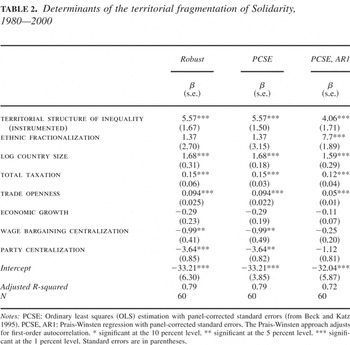
Determinants of the territorial fragmentation of Solidarity, 1980—2000

The analysis produces findings that strongly support the central argument of the article. The territorial structure of inequality

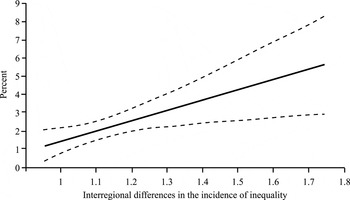
, the variable of primary theoretical interest in the main equation, shows very consistent effects that support my theoretical priors. The larger the differences among subnational units in terms of the incidence of economic inequality, the lower the levels of centralization of redistributive policy (DRPit), even after correcting for the possibility of reversed causality. To give a sense of the magnitude of the effects, Figure 4 displays, with a 95 percent confidence interval, the predicted level of decentralization of redistributive policy across the range of values of the variable measuring the territorial structure of inequality

.
46Predictions are calculated using the following values in the range: 1, 1.1, 1.2, 1.3 … up to 1.9.

Predicted levels of decetralization of redistributive policy (95 percent confidence interval)
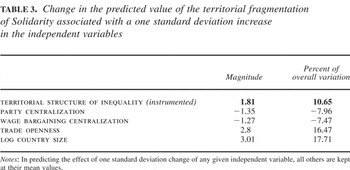
These are sizeable effects that compare well to other factors previously identified in the literature. The first column of Table 3 displays the change in the predicted value of the decentralization of redistributive policy (DRPit) associated with a one standard deviation increase in the territorial structure of inequality

, the levels of party and wage bargaining centralization (PCit and WBCit), trade openness (TOit), and country size (lCSi). The second column of Table 3 displays the effect of one standard deviation change as a percentage of the total range of variation in the dependent variable. While two other variables show even stronger effects, the territorial structure of inequality clearly makes a substantial contribution in accounting for the overall variation in the levels of territorial fragmentation of solidarity (for example, a one standard deviation increase accounts for 1.8 percent increase in the absolute levels of decentralization, which amounts to about 11 percent of the total variation).
Change in the predicted value of the territorial fragmentation of Solidarity associated with a one standard deviation increase in the independent variables

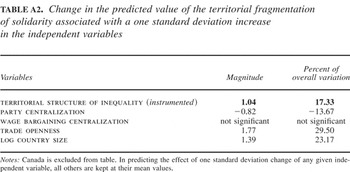
Before turning to the substantive discussion of the results, I shall address a couple of methodological concerns. First, Figure 3 indicates that Canada is an outlier that could potentially be driving the results. To address this issue, Appendix 2 replicates the analyses reported in Tables 2 and 3 after excluding Canada from the data set. While the estimates of some of the control variables (size of the public sector, ethnic fractionalization, and wage bargaining centralization) appear to be sensitive to the inclusion/exclusion of Canada in the analysis, the rest of the findings are clearly robust. Indeed, with Canada excluded a one standard deviation increase in the territorial structure of inequality accounts for a larger share of the total range of variation in the levels of decentralization of redistributive policy (about 17 percent). Second, Figure 3 also raises a potential issue regarding the distributional shape of the dependent variable. Because in fully centralized countries the welfare state is not fragmented territorially, about half the observations of the dependent variable are 0. This may affect the results in that OLS estimations do not incorporate the probability of a value being left-censored in the calculation of the coefficients.47
Greene 2000, 908–19.
I turn now to discuss how these findings speak to the literature. To begin with, the effects of several control variables confirm well-established results. Consistent with the expectation that larger and more diverse societies face stronger pressures to decentralize,48
the estimates of country size and ethnic fractionalization are positively associated with the degree of decentralization of the welfare state. However, while Table 3 shows that country size is indeed strongly associated with the territorial fragmentation of solidarity, the effect of ethnic fractionalization is not robust to different specifications. Likewise, the estimated effects of the size of the public sector appears to suggest that larger public sectors tend to specialize policy provision through decentralization. This finding, however, is not robust either, which suggests that the association between the fragmentation of political power and the size of government is at best weak, if not absent, as indicated by previous research.49 The lack of significant effects of economic growth also aligns with previous findings. Wallis and Oates show that economic growth leads to fiscal decentralization, except in advanced industrial societies.50 Finally, a word on institutional effects is in order. The expectation, directly derived from the welfare state literature,51 that more integrated economic institutions limit the territorial fragmentation of the welfare state also receives empirical support, even though the effects are not consistent across specifications. In contrast, regarding the structure of the party system, Tables 2 and 3 identify a robust, strong, and inverse relationship between party centralization and the territorial fragmentation of solidarity. This result directly complements previous research efforts on the linkages between the organization of the party system and federal fiscal structures.52 Indeed, more integrated party systems are associated with less-fragmented welfare states.In turn, the noticeable effects of trade openness speak to the empirical debate between those who see economic internationalization as a source of fiscal centralization due to the increase in the demand for government protection53
and those who see it as a new context facilitating the institutionalization of heterogeneous policy preferences.54 As far as the territorial organization of the welfare state is concerned, the estimated effects support the latter view.55The process of European integration and its interaction with trade-openness may shed some light on why this is the case. The EU has undoubtedly raised openness but, at the same time, it has also reduced risks for its constituent units. Given the large number of OECD countries that actually belong to the EU, this may account for the fact that, concerning the direction of the effect, trade openness emerges as a factor enhancing the decentralization of social expenditures. By insuring against region-specific risks, the EU would reduce the potential costs that the Member States would incur if they decided to decentralize redistribution, thereby allowing the underlying diversity of preferences to emerge. In addition, it should be noted that this study focuses only on advanced industrial societies, which limits considerably the comparability of the results with other analyses focusing on both developed and developing nations.
Finally, the finding that the regional patterns of income inequality shape the level of centralization of fiscal redistributive policies constitutes a novel and important addition both to the (mostly theoretical) literature on endogenous fiscal structures and to the empirical literature on fiscal decentralization. In showing how inequality shapes the level of centralization of redistributive policies in advanced economies, this article highlights the importance of distributive tensions and structural constraints for the design of fiscal structures. To the best of my knowledge, no previous study has systematically examined the effect of the territorial structure of inequality on the levels of decentralization of the welfare state. The findings reported in Table 3 help fill this gap, thereby broadening one's understanding of the political processes behind fragmented fiscal structures. Moreover, the general logic behind these findings applies as well to many other historical instances of political integration. In the next section, I elaborate in detail how the territorial structure of inequality shapes the politics of social policy integration in the EU.
Limits to Fiscal Policy Integration in the European Union
The EU does not have an integrated fiscal policy that directly redistributes income among its citizens. Instead, the largest share of the EU budget (about 1 percent of GDP) is spent in transfers of resources between countries (Structural Actions).56
I refer here to the Structural and Cohesion Funds, accounting by 2000 for about one-third of total EU expenditure (European Commission 2000).
In 2005, 45 percent of agricultural expenditures were direct transfers to farmers. Data for the period 1992–2004 suggest that these recipients are heavily concentrated in countries such as Germany (18 percent) and France (22–23 percent). See European Commission 2004.
The argument developed in this article offers an explanation. The institutional design of the EU fits closely with the assumptions of the model on the basis of which the relationship between inequality and social policy integration has been specified. As a political union that unfolds by agreement of its sovereign members, no major alteration of the status quo in the area of fiscal redistribution occurs without the unanimous consent of its constituent members. According to the theoretical argument developed above, insofar as the territorial structure of inequality in Europe conditions preferences on the levels and types of redistribution, any given proposal toward the centralization of fiscal redistributive policies is politically unfeasible. As a result, contrary to what follows from neofunctionalist accounts,59
Mattli 1999.
The history of the EU is rich in attempts to develop a social dimension of the integration project. The best developed of all, namely the open method of coordination (OMC), was put forward at the Lisbon summit in March 2000.60
The OMC was established in the Maastricht Treaty for the coordination of economic policies, and expanded in the Amsterdam Treaty to labor market policies. In turn, during the Lisbon summit, the Council agreed to apply it to social policy issues. See Scharpf 2002; and Vandenbroucke 2002.
Atkinson 2002.
Scharpf 2002.
Vandenbroucke 2002.
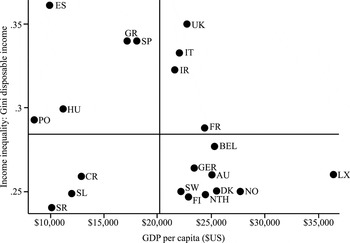
To gather a sense of the distributive tensions emerging from the territorial structure of inequality in today's Europe, Figure 5 plots the levels of GDP per capita in 2001 against a standardized measure of income inequality, namely the Gini coefficient for disposable income inequality around 2000/2001 as calculated by the Luxembourg Income Study (LIS).64
Because of data limitations, I include only twenty of the twenty-five members of the Union. These are Austria (AU), Belgium (BEL), Czech Republic (CR), Denmark (DK), Estonia (ES), Finland (FI), France (FR), Germany (GER), Greece (GR), Hungary (HU), Ireland (IR), Italy (IT), Luxembourg (LX), Netherlands (NTH), Poland (PO), Slovak Republic (SR), Slovenia (SL), Spain (SP), Sweden (SW), and United Kingdom (UK).

Distributive tensions in the European Union
On the assumption that existing levels of disposable income inequality capture, even if partially, domestic preferences on the levels of fiscal redistribution and insurance (t in the model above), Figure 5 conveys the picture of a very heterogeneous union. Moreover, European countries not only differ in their preferences about redistribution, but also on their level of economic resources (y in the model). In fact, using the average levels of income inequality and resources as cutting points, the variation along these two dimensions can be broken into four subgroups. Spain, Greece, Estonia, and to a lesser extent Hungary and Poland, are countries that are both relatively poorer and more unequal. In turn, Slovenia, the Czech Republic, and Slovakia, while in 2007 being among the poorest of the twenty-five members of the EU, show moderate levels of income inequality. In contrast, the Benelux countries, together with Germany, Austria, and Scandinavia are relatively richer and fairly egalitarian societies. Finally, France, Ireland, Italy, and the United Kingdom, while still well off in terms of resources, show much higher levels of income disparities.
Given these patterns of inequality, the adoption of a hypothetical centralized redistributive policy would imply: (1) a transfer of resources, inherent to the transfers between individuals, from relatively wealthier to relatively poorer countries; (2) a necessary reduction in the levels of redistribution enjoyed by lower-income citizens of the richer and more egalitarian countries (most notably, Scandinavia); and (3) an unwelcome disruption of the systems of redistribution at work in relatively poorer societies. In political terms, these effects work to facilitate the formation of several coalitions of interests opposing any change toward a more centralized redistributive system.
As long as political contentions within the EU remain dominated by country (as opposed to income and class divisions), the incumbents of relatively richer countries have incentives to block any additional transfer of resources to poorer countries. In fact, they face heavy electoral constraints. Upper-income citizens of wealthier countries are the likely net payers of any integrated system. Their first preference is fiscal independence. In turn, poor citizens of rich countries have no incentives to share their transfers with poorer citizens of poorer countries. On the contrary, they have incentives to coalesce with their wealthier fellow nationals to prevent any loss of resources from which they benefit the most. Indeed, these incentives will be stronger the more generous and egalitarian the domestic welfare state is.65
Lower-income citizens of a wealthier state would support the centralization of redistributive policy only if the levels of generosity they benefit from are extended to the overall union. However, the budgetary effects of such policy would galvanize the opposition of wealthier and less egalitarian societies, thereby rendering it politically unfeasible.
Sánchez-Cuenca 2000.
Consistent with this mapping of preferences, the possibility of expanding the role of EU institutions in the realm of social policy was rejected by an overwhelming majority of member states governments during the recent Constitution-making process. According to DOSEI data, nineteen of the twenty-six cabinets involved during 2003–2004 in the drafting of the constitutional project opted to preserve the status quo regarding the role of EU institutions in social policy.67
These data were generously provided by Thomas König from the Domestic Structures and European Integration Project (DOSEI). The DOSEI data document actors' positions in the EU constitutional process. Data are from the fall of 2003, after the European Convention had drafted its proposal for a European Constitution and shortly before the Intergovernmental Conference discussed the proposal. The data set includes official governmental positions of the twenty-five EU member states, plus the position of the Spanish government after the governmental change in March 2004, as well as the positions of the European Commission and the European Parliament. For a description of the project and its sources, see König 2005.
These findings complement recent accounts of the stagnation of the process of European integration. Alesina, Angeloni, and Etro have argued that, in the presence of economic externalities and given a preexisting set of preferences for public good provision, a commitment to centralize only those policies with strong spillovers is a prerequisite for a successful enlargement of the union.68
Alesina, Angeloni, and Etro 2005.
Conclusions
Decentralization of fiscal authority has become increasingly common during the past decades. This article has analyzed its interplay with the politics of inequality and redistribution, showing how distributive tensions derived from the territorial structure of inequality shape the choice of fiscal structures. I have argued that decentralization has distributive consequences that are contingent on the existing structure of inequality. Therefore, the regional incidence of inequality and risk attached to patterns of economic specialization shape the choice to decentralize fiscal redistribution. The empirical analysis offers a good deal of support for the prediction that, controlling for feedback processes, the level of decentralization of redistributive policy is a function of the territorial structure of inequality. Herein lies an important key to understanding why some federations have more centralized welfare states than others, and ultimately why some federations redistribute more than others.69
Applying the argument to a more contemporary case, I have shown that it is the scope of distributive tensions existing within the EU, and not the fact that it is a federation in the making, that explains the lack of fiscal policy integration in the EU.By implication, these findings, obtained for the specific relationship between decentralization and inequality, suggest a more general revision of the relationship between political institutions and social outcomes. The impact of political institutions must be clearly differentiated from the conditions under which these institutions came into existence in the first place. Otherwise, one runs the risk of interpreting as exogenous “effects” what effectively are processes of historical self-selection.70
Finally, this article is not without limitations. These relate to some of the assumptions on which the model has been built and point to complementary lines of research. First, the scope of labor mobility is likely to mute cross-regional differences in terms of labor market risks, thereby creating conditions for higher levels of fiscal centralization. Thus, while assuming away geographical mobility proved useful for the purposes of this article, future efforts ought to incorporate the implications of factor mobility into the relationship between territorial politics, redistribution, and inequality. Second, the assumption that the political decision is made by unanimity is clearly restrictive. While, once again, it proves helpful to isolate the dimensions of interest in this article, it is clear that choices about fiscal decentralization can be made under many alternative procedures.71
Much work is still needed to understand the interplay between regional income distributions and different political and institutional contexts.Appendix 1: Formal Presentation of the Argument
In any given regional economy, an individual's expected utility function is defined as follows:

Income risks are modeled using a quadratic utility function of the following form (Varian 1980).72
For the sake of simplicity, the model assumes that the people in the working (β) sector have different degrees of specialization across regions, and that risks are directly associated to economic specialization. In this context the use of a quadratic utility function is plausible. While this can be potentially problematic, it does not determine the basic predictions of the model in that adopting alternative functional forms generates similar predictions.

where

and

where zi depicts the unknown incidence of individual specific risks. Substituting equation (9) into (6) yields,

Any given individual will choose the tax rate that maximizes his or her after-tax income. The relevant partial derivative becomes:

The solution to the resulting first order condition follows:

Similarly, it is possible to define the tax rate of an individual of a union (u) in which one sector of the working population is exposed to a certain degree of individual specific risks, while the other sector of the population consists of the dependent population. Note that,

which is to say that the relative weight of the economically specialized sector in the union is not necessarily similar to the one in the region. Nor is, as a result, the incidence of individual specific risks for workers in βu. By analogy, the tax rate chosen by any member of the union is the one that maximizes the union's members after-tax income, that is,

From equation (12) it is straightforward to see that the larger the dependent population, the larger the preferred tax rate. In addition, consistent with previous insights,73
expression (12) also shows that when the risk inherent to the people working in the specific sector increases, the preferred tax rate also increases, paralleling the demand for insurance. And this holds for any given territorial unit under consideration. Other things being equal, an increase in σ leads to a reduction in (1-t) and therefore to an increase in t. This holds for all territorial demarcations.At this point, following the models by Bolton and Roland and Alesina and Perotti,74
assuming that redistribution is performed via a linear tax with an intercept simplifies the problem. In this context (1) the equilibrium tax rate is the tax rate chosen by the median voter in both the union and the region and, equally, (2) the decision to centralize/decentralize will be driven by the evaluation of the difference between the expected utility of the median voter under decentralization and the expected utility of the median voter under centralization, that is, when the tax implemented is the one chosen by the union's median voter. In other words, the regional median voter is the relevant actor facing the problem of Max{Ud(c),Uc(c)}, as depicted by expression (1).The development of such comparison requires substituting the relevant tax rates of the two policy designs into the utility function of the regional median voter. The utility function of the regional median voter can be generally defined as:

whereas the relevant tax rates are:

and

By substituting (16) and (17) into (15), the utilities of the regional median voter under the two regimes are obtained. Thereafter, one is in a position to evaluate the differences between the two. Once these calculations are made, the following expression is obtained:

where θ = 2β(wm)2(1 + σz2) and θu = 2β(wum)2(1 + σzu2) are, respectively, the terms capturing the individual specific risks at the regional and the union level.
Appendix 2
Robustness Checks

Change in the predicted value of the territorial fragmentation of solidarity associated with a one standard deviation increase in the independent variables

Appendix 3: Summary Statistics

Appendix 4: Data Sources