Described as a digital resource for the study of architecture, urbanism, and interior design, Bloomsbury architecture library (https://www.bloomsburyarchitecturelibrary.com/) offers a fully revised edition of Sir Banister Fletcher's A history of architecture supplemented by carefully curated digital content and an interactive interface.
Although a key reference work for architectural students throughout the 20th century, Sir Banister Fletcher's A history of architecture had become outdated, and criticised for its western emphasis. In its lifetime, the book has changed considerably – originally titled A history of architecture on the comparative method for students, craftsmen & amateurs – it was not until the 19th edition in 1987 that a new structure was introduced; different architectures, periods and places were replaced with background chapters, setting the architecture in its social, economic and political context. The last edition was published in 1996 so it was high time for a new edition, now appropriately renamed Sir Banister Fletcher's global history of architecture, to take account of its new worldwide coverage.
The 2-volume work, under the general editor, Murray Fraser, has been completely restructured and rewritten by over 100 experts to balance the world-view of the book, drawing on the latest architectural scholarship. The new edition covers pre-history to the present day: Volume 1 covers the period c. 3500 BCE to 1500 CE, whilst Volume 2 covers 1500 CE to the present day. There are seven parts, and 102 chapters that divide 5,500 years of architectural history with descriptions of major buildings accompanied by over 2,200 photographs, drawings and plans, including much new and original material.
The online version of the publication generally follows that of the printed book. Although each chapter follows the same format – with sections on ‘History and geography’, ‘Culture and society’, ‘Architecture’, ‘Key buildings’ and ‘Further reading’, contributors have been able to determine their own approach based on their original research and knowledge (Figure 1).
Global history of Architecture Chapter. Screen capture from the Bloomsbury architecture library.

This digital edition as well as the other material of the wider Bloomsbury architecture library have fully searchable text allowing for cross-references to illustrations, the glossary, key buildings and personal names. Some text, e.g. on individual architects or building terms, displays as ‘features’ text on a grey background to distinguish it from the rest of the page. Additionally, page numbers are indicated when hovering the cursor over text – helpful when navigating the text and when making citations.
When reading a chapter of the book, facets cover ‘Subjects’ (‘Content type’, ‘People’, ‘Cultures and religions’, ‘Period’, ‘Place’, ‘Subjects and styles’), as well as links to ‘Related content’ and ‘Building’, with links to the ‘Building pages’ part of the wider online resource. It also displays links to your recently viewed material. When signing in with a personal account, one can save books, chapters, images or other items to view later; organise saved items into folders; email and export citations; and save searches and receive search alerts.
Apart from the new text, the illustrations deserve special mention as the book has been published for the first time in full colour, which will especially attract students. All types of architectural representation are used, not just drawings and photographs but models, maps, prints and even postcards. I was pleased to see some of the original line drawings by Banister Fletcher had been repurposed from earlier editions, augmenting the new colour photography and other images.
The database most importantly includes the new edition of Sir Banister Fletcher's Global history of architecture but also comprises, amongst other things, an eBook collection of books published by Bloomsbury. The collection currently includes over 40 recently published titles such as The Banham lectures. The eBook content will increase to include publications by I.B. Tauris acquired by Bloomsbury in 2018Footnote 1. The ebooks are not available as PDFs, which can put off some readers, but reading is user friendly on the smallest of devices. It is important to note that Bloomsbury Publishing complied with Web Content Accessibility guidelines creating this digital platform.
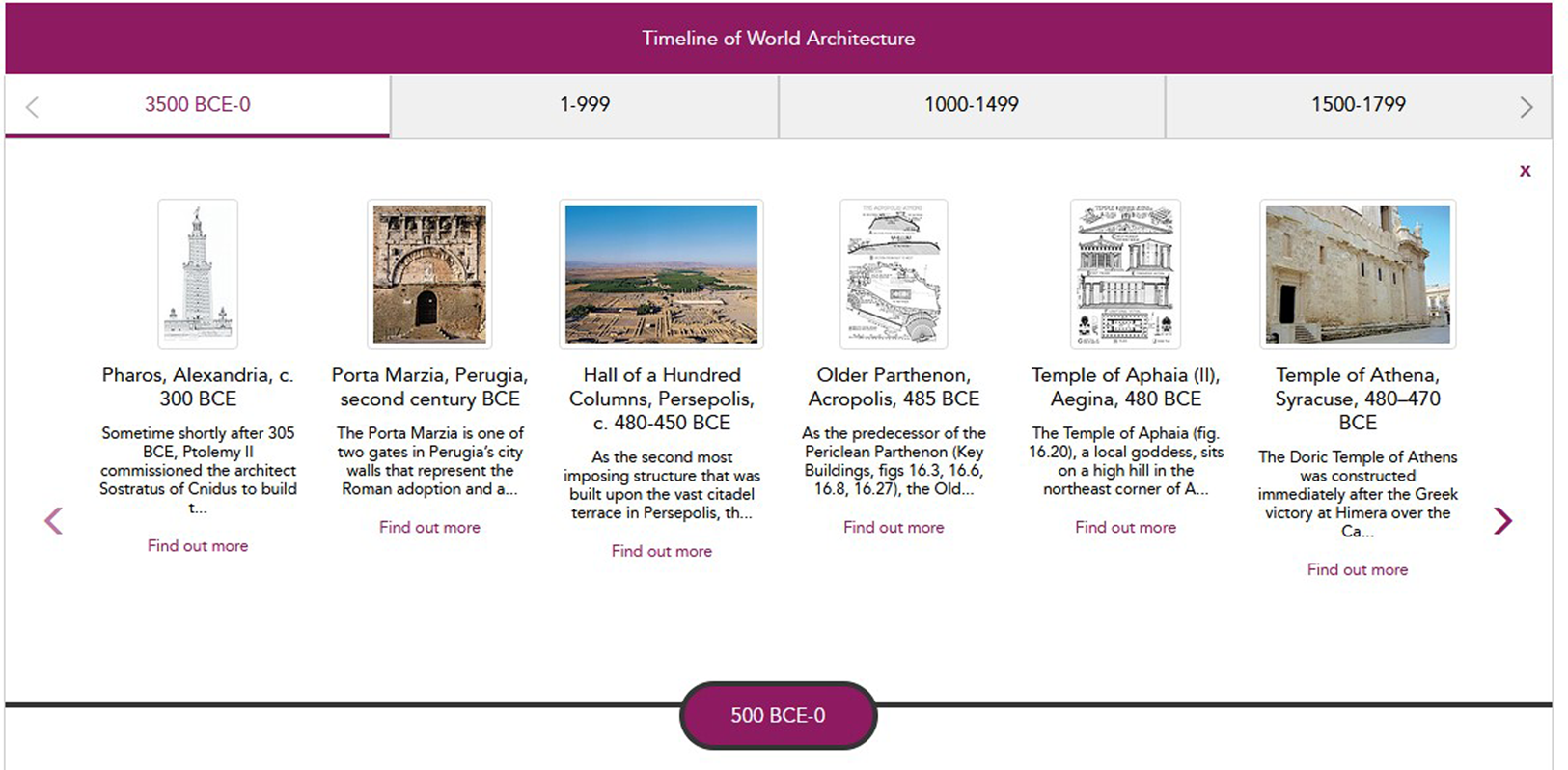
Further content includes a library of 700 key buildings, conveniently discoverable through an interactive timeline (Figure 2). In fact, the database feels like it is very much designed for exploring and browsing with the aptly named ‘Explore’ and ‘Browse’ content menus. An entry for a ‘Key building’ for example will include its location in the world, images, a short description and related content – all of which is cross-referenced to other entries in the database. The cross-referencing can uncover even more interesting content, and this is an aspect of the database that will certainly improve as available material increases. A very enjoyable aspect of the database is the clickable architectural terms with pop-up definitions from Sir Banister Fletcher's glossary.
Interactive Timeline of World Architecture. Screen capture from the Bloomsbury architecture library.

The image library is diverse and includes photography, artistic works, and architectural drawings with around 2300 images. Keywords in the main search of the database retrieves images alongside references in book chapters of both the Sir Banister Fletcher history (including dictionary entries) and the ebooks. The facets allow for an easy sifting of the results by content type, period as well as subjects and styles. The facets do not, however, allow for narrowing results by ‘creator’, although this can be done via the advanced search.
The world map is convenient but could be more interactive, but it does have its uses as the map search retrieves more content regarding a region than a simple keyword search for that same region. The map also reveals the Western bias of the content, which will undoubtedly improve as the database develops. The upcoming Encyclopedia of vernacular architecture of the world, 2nd edition, will be a welcome addition.
The Architectural Association Library conducted a small survey of its users whilst trialling the Bloomsbury architecture library and feedback was generally positive. The new edition of Sir Banister Fletcher's history was the main attraction as well as the eBooks, but as reviewed above, the popular consensus reaffirmed that content needs to increase for the interactive aspects of the database to come alive. The feedback highlighted that no other database currently offers the global and historical coverage the Bloomsbury architecture library is offering.