Introduction
New Guinea is one of the main centres of diversity for Begonia, and the genus is represented there by Begonia sects Baryandra, Diploclinium, Oligandrae, Petermannia and Symbegonia, covering a total of 84 species (Hughes, Reference Hughes2008; Rubite et al., Reference Rubite, Hughes, Alejandro and Peng2013; Hughes & Takeuchi, Reference Hughes and Takeuchi2015; Hughes et al., Reference Hughes, Barber, Heatubun and Gagul2015–). The species within each section are generally poorly known, and the sections themselves have never been revised. Symbegonia was initially described as a genus by Warburg (Reference Warburg, Engler and Prantle1894), but molecular data indicate that it is deeply nested within Begonia sect. Petermannia (Thomas et al., Reference Thomas, Hughes, Phutthai, Ardi, Rajbhandary, Rubite, Twyford and Richardson2012), and it is currently recognised at the sectional level (Forrest & Hollingsworth, Reference Forrest and Hollingsworth2003).
Begonia sect. Symbegonia is characterised by having the female tepals fused into a distinctive tubular corolla, the male tepals sometimes also partially fused and the stamens on an often elongated column (Sands, Reference Sands2009). In addition, species of the section have unique anther endothecial cells (Tebbitt & MacIver, Reference Tebbitt and MacIver1999). However, many of the species within the section are difficult to delimit. It is tempting to speculate that the large amount of highly dissected yet fairly continuous montane habitat on New Guinea has promoted rapid yet incomplete diversification in this group, leading to difficult species complexes. The tubular flowers are very different from those in other sections of the genus, and hence the pollination syndrome is likely to differ also. Increased population connectivity may also contribute to the persistence of widespread species complexes, which would otherwise fragment into different taxa in the absence of gene flow (Hughes & Hollingsworth, Reference Hughes and Hollingsworth2008). In addition to this biological complexity, Begonia sect. Symbegonia is difficult to interpret because the species have been described separately over the decades, many without reference to existing taxa and hence without comparative diagnoses. Consequently, this revision has proved to be difficult, with the difficulty further compounded by the fact that Begonia species tend to make poor herbarium specimens, and male and female flowers as well as fruits rarely occur all on the same specimen.
This paper presents a revision of the currently known species in Begonia sect. Symbegonia, and in addition we have described five new taxa that were possible to delimit with reasonable confidence. However, there remains a considerable residue of unidentified material, and much work remains to be done.
Prior to the current revision, a total of 13 species of sect. Symbegonia were recorded for New Guinea (Tebbitt, Reference Tebbitt2005; Hughes, Reference Hughes2008; Sands, Reference Sands2009; Hughes et al., Reference Hughes, Barber, Heatubun and Gagul2015, Reference Hughes, Moonlight, Jara, Tebbitt, Wilson and Pullan2015–); here we describe 5 new species, bringing the total to 18. Images of most of the cited specimens are available online (Hughes et al., Reference Hughes, Barber, Heatubun and Gagul2015–).
For species descriptions, observations were made using the naked eye and light microscopy on dried material held at B, BM, BO, BRI, E, K, L, LAE, MAN, NY, P, SING and UPNG, and on living material in the field and in cultivation at the Royal Botanic Garden Edinburgh. Dried material was rehydrated by boiling with a small amount of detergent. Measurements were made with a ruler or microscope eyepiece graticule, using herbarium specimens or living material (Begonia arfakensis and B. yapenensis only). Information on plant growth habit and size, colour of fresh floral parts and fruit, habitat and locality were taken from the collector's notes recorded on the herbarium label and from field observations by the authors. All specimens cited, including the types, have been seen by the authors.
Taxonomic Treatment
Begonia sect. Symbegonia (Warb.) L.L.Forrest & Hollingsw., Pl. Syst. Evol. 241: 208 (Reference Forrest and Hollingsworth2003). – Symbegonia Warb., Nat. Pflanzenfam. 3(6a): 149, pl. 52 (Reference Warburg, Engler and Prantle1894), emend. Irmsch., Bot. Jahrb. Syst. 50: 381 (1913). – Type: Begonia fulvo-villosa Warb., Bot. Jahrb. Syst. 13: 386 (1891).
Habit: erect or sprawling often sympodially branching herbs. Stem: internodes up to 5 cm, usually villose. Stipules persistent, cuspidate, usually glabrous, sometimes with hairs on the keel. Leaves: petiole sessile to 1(–3.5) cm long; lamina symmetric, subsymmetric or asymmetric, lanceolate, oblanceolate, obovate, ovate or rhomboid, colour uniform or variegated, glabrous to densely hairy above, with hairs on the veins below; base cuneate to oblique or cordate, basal lobe sometimes overlapping the petiole; margins subentire, sinuate, denticulate, dentate to bidentate, biserrate, sometimes laciniate to deeply dissected; venation pinnate to palmate; tip shortly acute to acuminate. Inflorescence: unisexual or bisexual, usually terminal, sometimes confined to the uppermost axils; bracts persistent, sometimes markedly conspicuous, oblong to ovate-lanceolate. Male flower: tepals 2, free or fused at the base, orbicular to ovate-lanceolate; androecium: stamens few to many, arranged on a thin or thick column, or sometimes on a short torus; anthers globose to ellipsoid, dehiscing through lateral slits. Female flower: corolla cupuliform, with 5 lobes; ovary with 3 equal to subequal wings, styles 3, elongate, bifid, stigmatic surface twice spirally twisted. Fruit on a short, stiff pedicel, glabrous to hairy, wings slightly extending along the pedicel in most species, capsule ellipsoid or globose, wings arcuate, extending apically above the ovary, or subtruncate.
Distribution
Endemic to New Guinea and widely distributed throughout the island.
Ecology
Occurs from 50 to 3000 m altitude, near streams, along riverbanks and in wet shaded places in primary and secondary mid- to upper-montane forests.
Key to species of Begonia sect. Symbegonia
1a. Leaves deeply dissected to near the midrib_______________2
1b. Leaves not deeply dissected___________________________5
2a. Leaves small, < 2.5 cm long_______________5. B. erodiifolia
2b. Leaves large, > 2.5 cm long___________________________3
3a. Leaves with a distinct amplexicaul basal lobe___7. B. mimikaensis
3b. Leaves without a distinct amplexicaul basal lobe___________4
4a. Leaf lobes usually > 6 pairs, stamens on a torus____________________12. B. symgeraniifolia
4b. Leaf lobes usually < 6 pairs, stamens on a thin column____________________4. B. asaroensis
5a. Leaves small, < 1 cm wide_______________15. B. symparvifolia
5b. Leaves large, > 1.5 cm wide_______________________6
6a. Leaves subentire or denticulate_____________________7
6b. Leaves dentate or dentate-denticulate_______________9
7a. Leaf lamina rhomboid___________________10. B. strigosa
7b. Leaf lamina broadly ovate__________________________8
8a. Leaf tip not attenuate, stamens on a torus, flowers white__________________________13. B. symhirta
8b. Leaf tip attenuate, stamens on a thin column, flowers deep pink-red (rarely white)_________________________16. B. symsanguinea
9a. Inflorescence with showy persistent white bracts similar in size to the tepals__________________________11. B. symbracteosa
9b. Inflorescence with bracts smaller than the tepals, persistent or deciduous, white or pale green________________________10
10a. Leaf lamina conspicuously hairy on the upper surface_______________ 11
10b. Leaf lamina glabrous above or with sparse evenly spaced bristles____________ 14
11a. Leaf lamina with a silver margin__________3. B. argenteomarginata
11b. Leaf lamina without a silver margin_________________________ 12
12a. Leaf lamina length c.3 times the width___________6. B. fulvovillosa
12b. Leaf lamina length < 2.5 times the width___________________ 13
13a. Inflorescence c.7 cm long, stamens c.15_________14. B. sympapuana
13b. Inflorescence 3–5 cm long, stamens 6–9_________18. B. yapenensis
14a. Venation palmate-pinnate, pronounced amplexicaul basal leaf lobe________8. B. mooreana
14b. Venation pinnate, absent or indistinct amplexicaul basal leaf lobe__15
15a. Stamens exerted beyond the tepals at anthesis, on an elongate column_______________________________17. B. vinkii
15b. Stamens not exerted beyond the tepals, on a short torus or elongate column______________________________16
16a. Leaves up to 6.5 cm long, similarly dentate from base to apex_________________________2. B. arfakensis
16b. Leaves 6–15 cm long, teeth in lower half of leaf less pronounced__17
17a. Stamens c.40 on a column____________________1. B. arauensis
17b. Stamens 9–12 on a short torus__________________9. B. pulchra
Species descriptions
1. Begonia arauensis M.Hughes sp. nov.
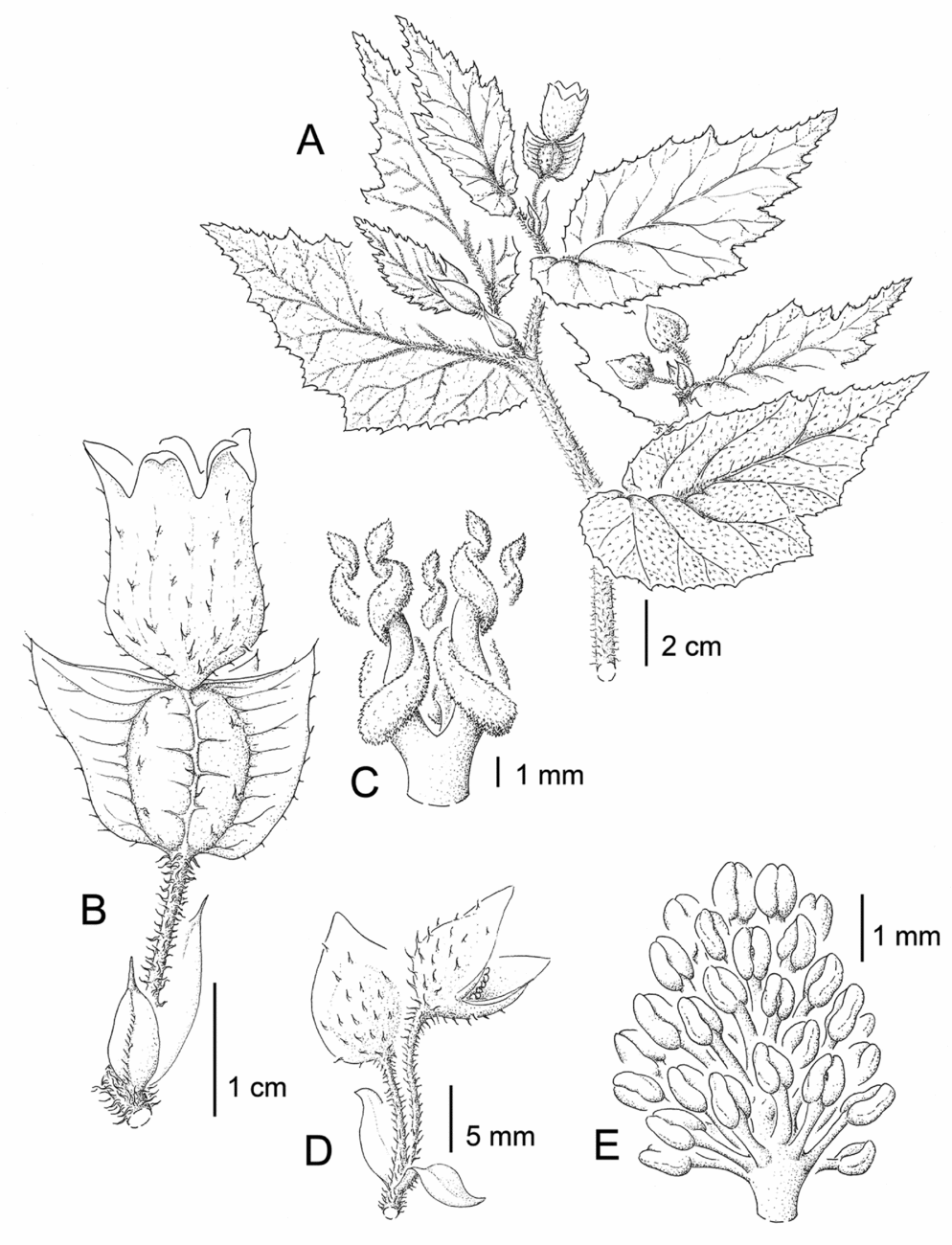
Closest to Begonia pulchra and B. vinkii in leaf shape. It is distinguished from the former through having stamens on a column, not a torus, and from the latter in having a more distinct basal lobe in the leaf lamina. Begonia arauensis is further distinct from both through the larger size of its leaves (8.5–15 × 3.5–6.5 cm versus 6–12.5 × 2.5–5 cm) and flowers (female flowers 2.5 cm long, male flowers 13 mm long, versus female flowers 12 mm long, male flowers 6 mm long). – Type: Papua New Guinea, Eastern Highlands District, Arau, 10 x 1959, Brass 32000 (holo K [K000607855]; iso BO, L, NY). Figs 1, 2.
Begonia arauensis M.Hughes. A, Habit; B, female flower; C, style and stigmas; D, male flowers and bracts; E, androecium. Drawn from Brass 32000.

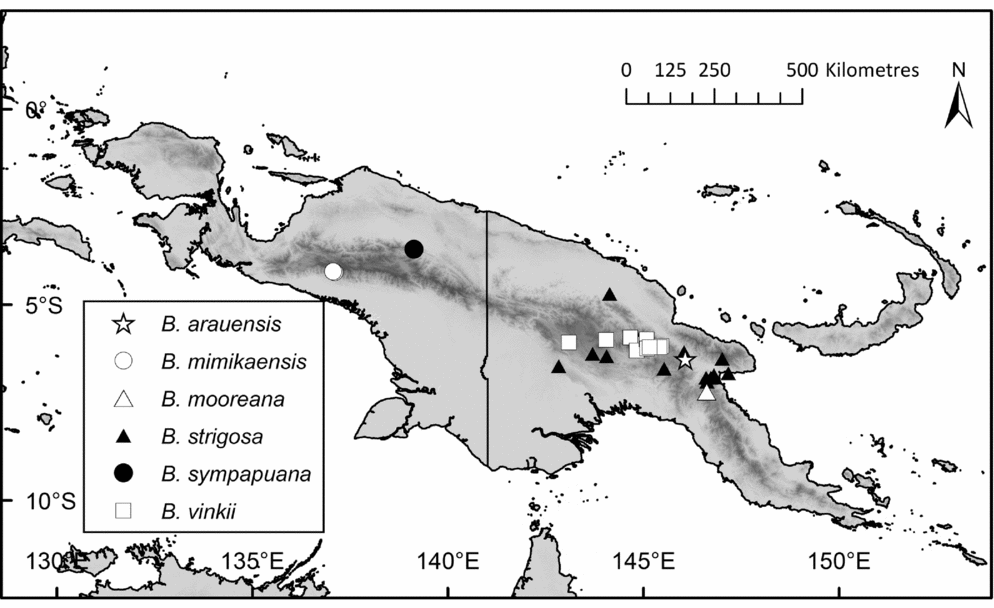
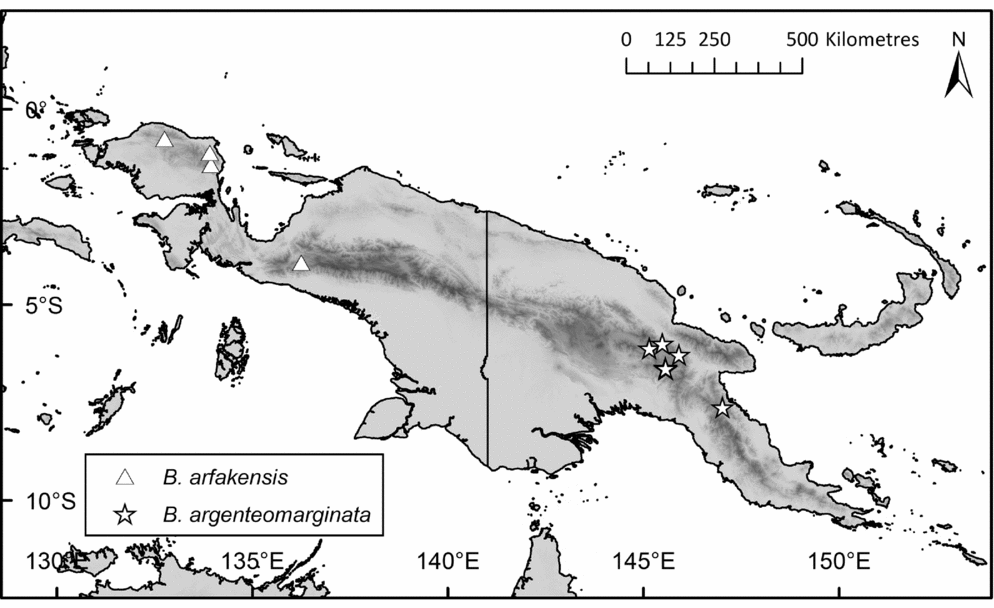
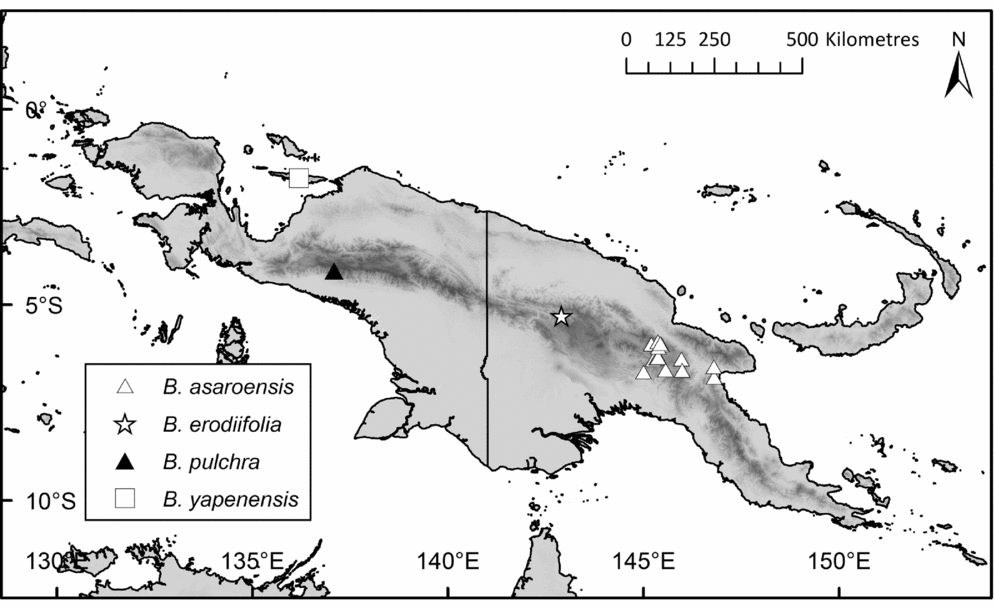
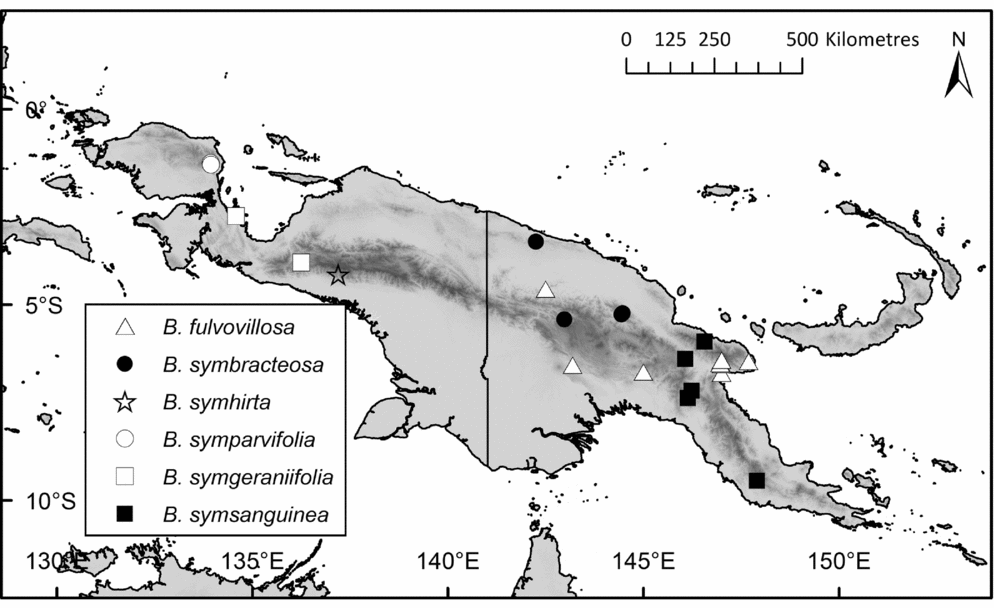
Map of New Guinea and surrounding islands, showing species distributions based on georeferenced herbarium records.

Erect herb 40–60 cm high. Stem stout, densely villose with 1.5 mm long hairs, internodes 3.5–7 cm long. Stipules caducous, lanceolate, 17 × 8 mm, keel villose, shortly cuspidate. Leaves: petiole 3–8 mm long, villose; lamina green, asymmetric, ovate-lanceolate, 8.5–15 × 3.5–6.5 cm, with scattered short 0.5 mm long stiff hairs evenly spaced between the veins above, the underside villose on the veins and with the same scattered bristles as the upper surface; base cordate, slightly oblique, basal lobe overlapping the petiole, 5–15 mm long; margin broadly dentate-denticulate; venation pinnate; tip acute. Inflorescence c.5 cm long, unisexual, terminal, female flowers solitary, male flowers c.2; bracts ovate-lanceolate 9–15 × 4–9 mm, larger on the female inflorescence, shortly cuspidate, with scattered hairs on the keel. Male flowers on a 5- to 10-mm pedicel with short 0.5-mm hairs; tepals 2, fused for 5 mm, ovate, c.13 × 10 mm, with scattered 1 mm long hairs denser towards the base, tip acute; androecium on a narrowly conical 5 mm long column, stamens c.40, filaments and anthers both 1 mm long, anthers elliptic, tip rounded. Female flower: pedicel c.2 cm long, villose; ovary 17 × 22 mm including wings, capsule subglobose, 12 × 10 mm, wings 3, subequal, 17 mm wide, extending apically slightly; corolla 2.5 cm long, sparsely villose, lobes 5, 5 mm long; styles 3, elongate, 12 mm long, bifid, stigmatic surface twice spirally twisted. Fruit not seen.
Additional specimen examined
Papua New Guinea. Eastern Highlands District, Arau, 6 x 1959, Brass 31904 (K, L).
Distribution and ecology
Papua New Guinea, endemic to the type locality of Arau. Described by Brass as “gregarious in ravines in Castanopsis-oak forest”; the leaves are “flat, shining above, nerves deeply impressed”. The two collections are both from c.1400 m altitude.
IUCN category
Data Deficient. The type locality could not be accurately georeferenced.
One of the larger species, in stature and also leaf and flower size. The epithet is derived from the type locality of Arau.
2. Begonia arfakensis (Gibbs) L.L.Forrest & Hollingsw., Plant Syst. Evol. 241: 208 (Reference Forrest and Hollingsworth2003). – Symbegonia arfakensis Gibbs, Fl. Arfak. Mts 149 (1917). – Type: Indonesia, West Papua, Vogelkop, Arfak Mts, Anggi Lakes, xii 1913, Gibbs 5953 (lecto BM [BM000901364] here designated). Figs 3, 4.
Begonia beccarii Irmsch. Webbia 9: 507 (1953); Begonia symbeccarii (Irmsch.) L.L.Forrest & Hollingsw., Plant Syst. Evol. 241: 208 (Reference Forrest and Hollingsworth2003). – Type: Indonesia, West Papua, Vogelkop, Arfak Mts, 1875, Beccari HB 4504 (lecto B [B100471344] here designated, isolecto FI [FI008017]) syn. nov.
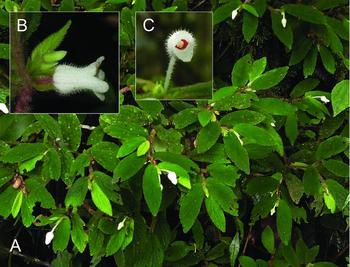
Begonia arfakensis (Gibbs) L.L.Forrest & Hollingsw. A, Habit; B, female flower; C, male flower. Photographed from a living plant in cultivation at the Royal Botanic Garden Edinburgh (accession no. 20090808), collected from near Minyambou in the Arfak Mountains.
Map of New Guinea and surrounding islands, showing species distributions based on georeferenced herbarium records.

Erect herb 30–40 cm high. Stem slender, wiry, with a few long suberect hairs, internodes to c.5 cm long. Stipules persistent, lanceolate, 10 × 4 mm, glabrous, shortly cuspidate, reddish brown. Leaves: petiole less than 3 mm; lamina green, subsymmetric, ovate-lanceolate, up to 6.5 × 3 cm, uniformly green, glabrous or with scattered minute bristles between the veins above, with reddish hairs on the veins below; basal lobe slightly oblique, sometimes slightly crossing the petiole; margin biserrate; venation pinnate; tip acute. Inflorescence 5 cm long, unisexual, male flowers 10–15, terminal, female flowers usually solitary, axillary or terminal; bracts 7 × 6 mm, broadly elliptic, margin minutely fimbriate, apex obtuse, shortly caudate, white, glabrous. Male flower: pedicel up to 12 mm, sparsely puberulous, tepals 2, partly fused at the base, ovate, c.8 × 8 mm, tip acute, sparsely puberulous; androecium arranged on a thin white column, stamens 11–17; filaments 1 mm, anthers 0.75 mm, ellipsoid, white. Female flower: pedicel c.5 mm, sparsely puberulous, ovary pale green with pale pink wings, 11 × 18 mm including wings, capsule suborbicular to ellipsoid, 8 × 5 mm, wings 9 mm wide at apex, sparsely puberulous, apex truncate to deeply arcuate; corolla 15 mm long, with 5 lobes each 4 mm long, styles 3, elongate, c.6 mm long, bifid with stigmatic surface twice spirally twisted. Fruit: pedicel c.1 cm long; shape as for the ovary, enlarging to c.15 × 20 mm, apex variable but usually markedly arcuate.
Additional specimens examined. Indonesia. West Papua Province: Vogelkop, Arfak Mts, Anggi Lakes, 9 x 1948 – 22 x 1948, Kostermans 2061 (BO, L); ibid., 9 x 1948 – 22 x 1948, Kostermans 2273 (BO); Vogelkop, Arfak Mts, Minjambau, 19 v 1962, Koster BW 13859 (L [2 sheets]); Vogelkop, Ije River Valley, 8 xi 1961, van Royen & Sleumer 7789 (BO, K, L); Wissel Lakes, 11 iv 1939, Eyma 4848 (BO).
Distribution and ecology
Indonesia, West Papua Province, in the Arfak Mountains and near Wissel (Enarotali) Lakes. Terrestrial herb of the forest floor occurring from 900 to 1750 m altitude.
IUCN category
Least Concern. Quite widespread in montane forests in West Papua.
Begonia symbeccarii (Irmsch.) L.L.Forrest & Hollingsw. is reduced here, because there are no characters to distinguish it from Gibbs's earlier name and the type is from the same locality; Irmscher made no mention of Begonia arfakensis in his publication, and it would appear that he overlooked Gibbs's earlier work. The collection number of Gibbs's type was misprinted as ‘6953’ in the protologue; the number on the sheet is ‘5953’. Gibbs (1917) mentioned that the fruit wings may be unequally developed, and this is reflected in the fruit apex shape variation seen on the type collection, which ranges from concave to arcuate; further variation is represented by van Royen & Sleumer 7789, which has fruit with very concave apices. Gibbs also observed a 4-winged fruit, but this is likely to be the result of a developmental aberration. In cultivation, the male flowers are produced prolifically, but female flowers appear very sporadically. The measurements in the above description were taken from living material.
3. Begonia argenteomarginata Tebbitt, Edinburgh J. Bot. 61: 98 (2005). – Type: Papua New Guinea, Simbu Province, Chuave District, Mt Elimbari, 2000 m, xii 1981, Reeve 595 (holo E; iso K, L, UPNG). Figs 4, 5.
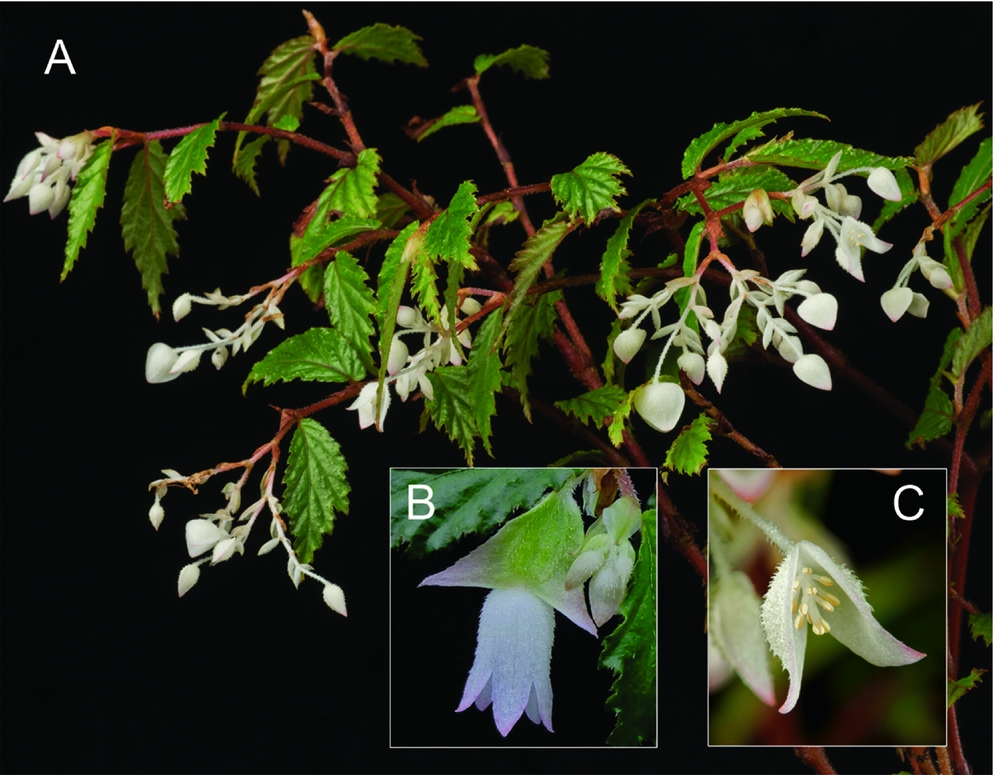
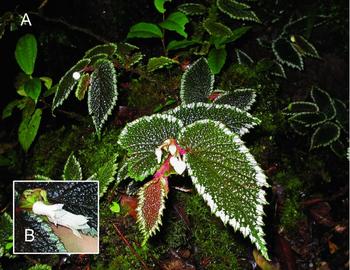
Begonia argenteomarginata Tebbitt. A, Habit; B, female flowers. Photographed in Gahavisuka Provincial Park, Eastern Highlands Province, Papua New Guinea, at 2070 m altitude. Voucher: Gagul 609 (UPNG).

Sympodially branching herb to 30 cm high. Stem c.5 mm wide, with long reddish pink glandular hairs, internodes c.5 cm long. Stipules persistent, lanceolate, 0.7–1 × 0.4–0.5 mm, green becoming brown when dry, cuspidate, generally glabrous, sometimes with hairs on main vein. Leaves: petiole up to 2 cm long, villose; lamina green with a silver margin, asymmetric, ovate, 5–11 × 2.2–4.5 cm, bullate above with evenly spaced short stiff hairs, green to bronze-green with silvery white or pink spots near the leaf margin of young leaves, which usually are merged to form a single band, dense villose indumentum on the veins below; basal lobe slightly oblique; margin serrate-ciliate to biserrate; venation palmate-pinnate; tip acute. Inflorescence c.3 cm long, terminal, sometimes in uppermost axils, male flowers 2–10, female 1 or 2; bracts 4–7 × 2–3 mm, ovate, pale green, villose on the keel and tip, apex shortly caudate. Male flower: pedicel 3–11 mm long, with short reddish pink hairs; tepals 2, fused for 1–2 mm at the base, ovate, c.1 × 1 cm, white, with short white hairs at the base, apex obtuse; androecium on a thick column; stamens 15–18, filament 0.5 mm long, anther 0.75 mm long, ellipsoid, reddish brown. Female flower: pedicel c.5 mm long, villose; ovary 11 × 16 mm including wings, capsule ellipsoid, c.9 × 6 mm, wings c.5 mm wide at apex, sparsely villose, apex truncate; corolla c.15 mm long, sparsely villose, with 5 lobes each 4 mm long; styles 3, elongate, bifid, white, stigmatic surface twice spirally twisted. Fruit: shape as for the ovary, enlarging to c.15 × 20 mm.
Additional specimens examined. Papua New Guinea. Eastern Highlands Province: Mt Gahavisuka Provincial Park, 30 vi 2011, Gagul 609 (UPNG); Sosointenu, between Yonki and Kainantu, 1800 m, xii 1981, Reeve 594 (K).
Distribution and ecology
Papua New Guinea, in the Eastern Highlands Province. In secondary wet montane forests at 1800–2000 m altitude.
IUCN category
Data Deficient. Only a small population of the species exists within the Gahavisuka Provincial Park, but there are scattered populations elsewhere. The delimitation of the species and its distribution needs further work.
There are further collections (Eastern Highlands Province: Henty NGF 49160 & 49260, Brass 31597, Gagul 610 [see Fig. 13D], Womersley 17644; Morobe Province: Kairo 414), which are potentially near to Begonia argenteomarginata, because they have leaves with a silver margin. However, the leaf shape differs slightly, being more lanceolate and sometimes with a less distinct basal lobe. The specimen Reeve 594 is intermediate between the type and these collections. More collections are required to understand the variation within Begonia argenteomarginata and whether these collections represent a new taxon. Begonia symsanguinea has variants (or possibly hybrids) with silver blotches on the margin, and appears to be closely related to B. argenteomarginata, which differs in having more dentate leaves and sparser bristles above with the glossy lamina visible between.
4. Begonia asaroensis J.Gagul sp. nov.
Similar to Begonia symgeraniifolia, but leaves are not dissected to the midrib in the lower third of the lamina; the sinuses between the lobes are narrower; and the stamens are on a thin column, not a short torus. – Type: Papua New Guinea, Mt Michael, Eastern Highland Province, c.2600 m, 27 x 1986, Argent & Sandham 86/82 (holo E [E00841603]). Figs 6, 7.
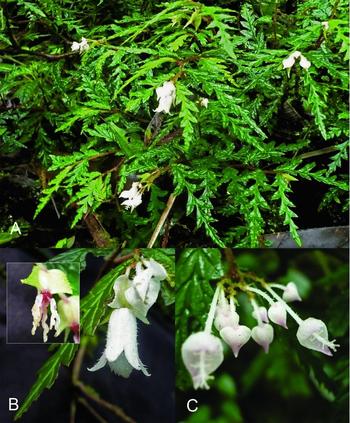
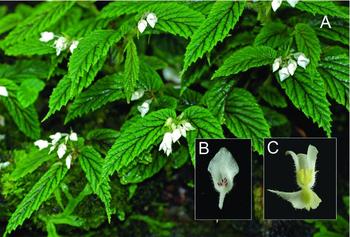
Begonia asaroensis J.Gagul, in Eastern Highland Province, Papua New Guinea. A, Habit, photographed in Gahavisuka Provincial Park (Gagul 611, UPNG); B, female flower and stigmas (inset), photographed in Namta, Asaro Subdistrict (Gagul 607, UPNG); C, male flowers, photographed in Ganaveroka, Daulo (Gagul 604, UPNG).

Map of New Guinea and surrounding islands, showing species distributions based on georeferenced herbarium records.

Erect branching herb c.40 cm high. Stem: slender, sometimes becoming woody, with short stiff hairs, glabrescent, internodes up to 7 cm long, becoming shorter (1–2 cm) distally. Stipules persistent, up to 5–7 × 3 mm, lanceolate, cuspidate, glabrous. Leaves: petiole 1–4(–6) mm long, with short stiff hairs; lamina green, subsymmetric, lanceolate, (2.5–)3.5–5(–8) cm long, usually glabrous, sometimes with minute sparse bristles above, lower surface with appressed short hairs on the veins, basal lobe absent or up to 2 mm long; margin dissected into no more than 6 lobes, more so towards apex, to within 2 mm of the midrib, venation pinnate, tip acute. Inflorescence c.3 cm long, bi- or unisexual, terminal, male flowers 2–12, female flowers solitary; bracts c.4 mm long, lanceolate, glabrous, tip caudate. Male flower: pedicel up to 1 cm long, sparsely puberulous, tepals 2, slightly fused at the base, ovate, c.6 mm long, whitish pink, sometimes with a red patch at the base, glabrous, sparsely puberulous at the base, tip acuminate; androecium arranged on a thin column, with c.20 stamens, anthers usually extending beyond the tepals at anthesis, filaments c.0.5 mm long; anthers 0.5 mm long, suborbicular, apex slightly retuse. Female flower: pedicel 4–6 mm long, sparsely puberulous; ovary c.12 × 14 mm including wings, capsule ellipsoid, c.8 × 4 mm, wings 6 mm wide at apex, sparsely villose, apex arcuate; corolla 10 mm long, sparsely villose, with 5 lobes each 3 mm long, styles 3, elongate, c.6 mm long, bifid, white, stigmatic surface twice spirally twisted. Fruit: shape as for the ovary, enlarging to c.15 × 20 mm.
Additional specimens examined. Papua New Guinea. Eastern Highlands Province: Above Goroka, 17 xi 1954, Womersley & Floyd NGF 6117 (LAE); Aiyura-Lae Road, 2 ix 1966, Millar 22722 (L, LAE); Ganaveroka, Daulo, 27 vi 2011, Gagul 604 (UPNG); Kainantu sub-dist., Mt Piora foothills, 12 vi 1972, Coode NGF 46286 (L, LAE); Kainantu to Okapa road, 25 v 1972, Hartley 13697 (L, LAE [2 sheets]); Kortumi, 22 xi 1954, Floyd & Womersley NGF 6714 (L, LAE); ibid., 23 xi 1954, Floyd & Womersley NGF 6775 (L, LAE, SING); Lufa, 21 iv 1977, Mege & Johns 1857 (LAE); Mt Gahavisuka, iv 1983, Cruttwell 2313 (L, LAE); ibid., 26 x 1987, Cruttwell 2180 (LAE); ibid., 27 ix 1982, Cruttwell 2116 (LAE); ibid., 30 vi 2011, Gagul 611 (UPNG); ibid., 12 xii 1983, Kerenga & Cruttwell LAE 56669 (K, L, LAE); Mt Hozeke, 29 xi 1984, Kerenga & Baker 56892 (L, LAE); Mt Michael, 25 viii 1959, Brass 31152 (L, LAE); ibid., 10 ix 1959, Brass 31500 (K, L, LAE); ibid., 13 ix 1959, Brass 31582 (L, LAE); ibid., xi 1977, Hoover 58 (L, B, E, LAE); ibid., 13 vi 1979, Sohmer et al. LAE 75415 (LAE); ibid., 2 ix 1959, Womersley NGF 11367 (BM, L, SING, LAE); Mt Otto, 7 viii 1959, Brass 30875 (L, LAE); ibid., 5 viii 1959, Brass 30834 (LAE); ibid., 11 i 1958, White NGF 9650 (L, LAE [2 sheets]); ibid., 26 i 1970, Johns & Noble NGF 47121 (LAE); Namta, Asaro Subdistrict, 29 vi 2011, Gagul 607 (UPNG); Okapa, Purosa, 22 ix 1959, Brass 31665 (L, LAE, NY); ibid., xi 1977, Hoover 62 (LAE); West of Omaura, 5 vii 1963, Hartley 11979 (L, LAE); Wonatabe, iv 1963, Womersley NGF 17670 (L, LAE). Simbu Province: Crater Mt Wildlife Management area, 21 vii 1998, Takeuchi 12321 (L, LAE).
Distribution and ecology
Papua New Guinea, widespread throughout the Eastern Highlands Province, particularly around Mount Michael, Mount Otto and the Okapa area. It also occurs in Crater Mountain Wildlife Management Area in Simbu Province. It is common in montane forests along riverbanks and streams in wet, shaded places. The type was collected from a cliff in mossy submontane rain forest, with other collections found in Castanopsis/Nothofagus forest on shady banks, and in subalpine forests, at 1500–3400 m altitude.
IUCN category
Least Concern. Widespread across Eastern Highlands Province around Mount Michael, Mount Otto and Mount Gahavisuka; sometimes noted as common on specimens.
This species differs from Begonia symgeraniifolia in having leaves that are less divided, particularly in the lower third of the lamina. The distributions of the two species are exclusive, with Begonia asaroensis being restricted to the highlands of Papua New Guinea and B. symgeraniifolia being endemic to Papua Province in Indonesian New Guinea. See also notes under Begonia mimikaensis, which also has lobed leaves. The epithet is derived from the distribution of the species, centred around the Asaro River area.
5. Begonia erodiifolia Sands sp. nov.
Differs from all other species in Begonia sect. Symbegonia with incised leaves in having a smaller lamina (less than 2.6 cm long) and 3-lobed tepals in the male flowers. – Type: Papua New Guinea, Enga Province, Porgera District, Bealo, xii 1981, Reeve 596 (holo K; iso E [E00841604], L, LAE). Figs 7–9.
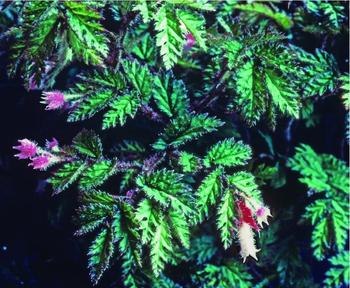
Begonia erodiifolia Sands, photographed from a living plant in cultivation at the Royal Botanic Garden Edinburgh (Reeve 596, type collection).

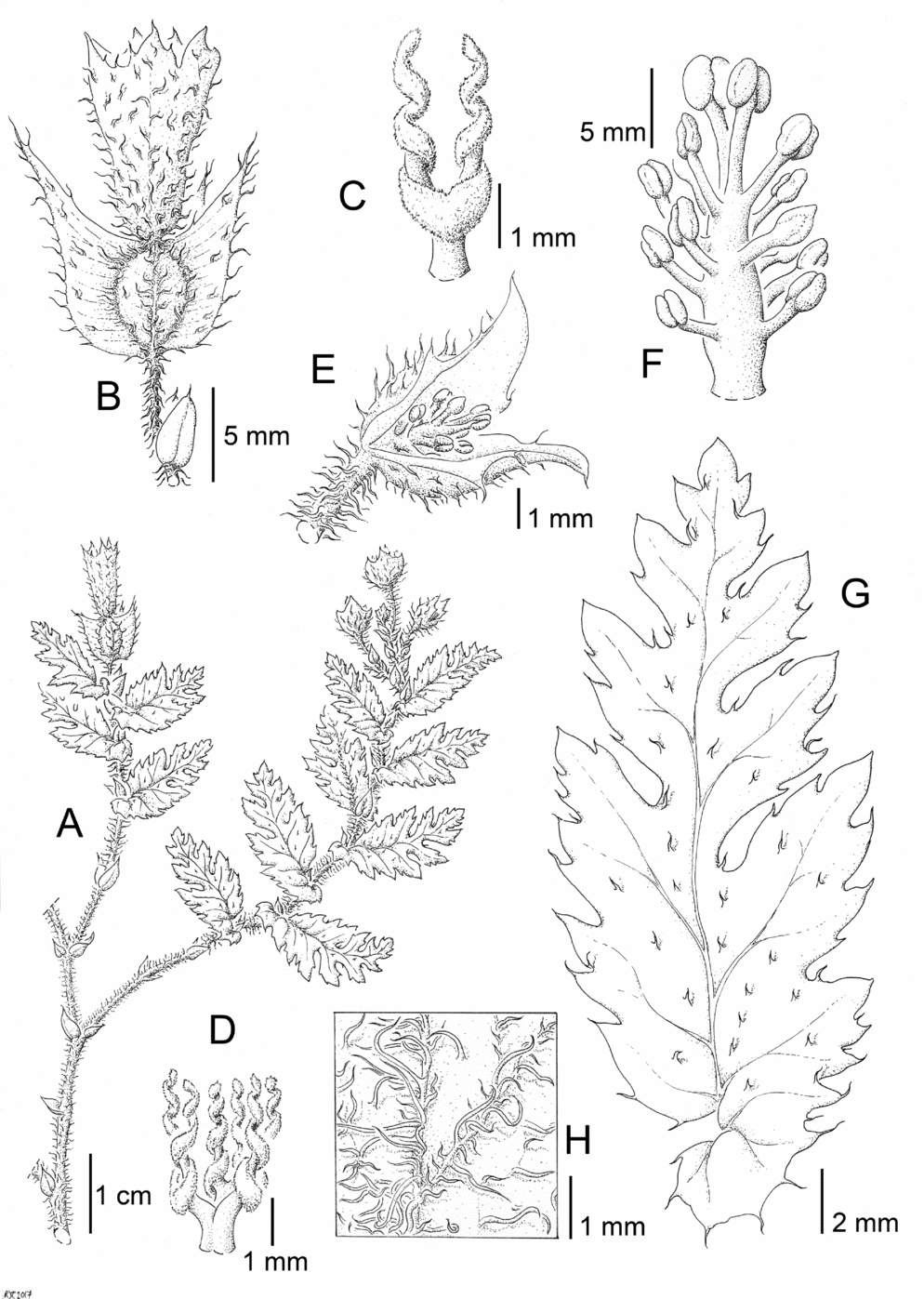
Begonia erodiifolia Sands. A, Habit; B, female flower; C, stigma detail; D, style; E, male flower; F, androecium; G, leaf lamina; H, detail of leaf underside. Drawn from Reeve 596.

Erect much-branched herb up to 30 cm high. Stem: slender, villose, hairs 1 mm long, internodes up to 5 cm long, becoming shorter at the apex. Stipules persistent, c.5 × 3 mm, ovate, sometimes with sparse hairs on the keel, cuspidate. Leaves subsessile; lamina green, subsymmetric, narrowly ovate, 1.5–2(–2.5) × 0.7–1.2 cm, upper surface with sparse bristles, green with pink-red veins and margins, lower surface villose; basal lobe 1–2 mm, oblique; margin dissected in the apical half to within 1 mm of the midrib, lobes serrulate-ciliate, venation pinnate; tip acute. Inflorescence c.2 cm long, often unisexual, sometimes bisexual, usually terminal, female flowers usually solitary, male flowers 3–5; bracts 3–4 × 1.5 mm, ovate-lanceolate, glabrous, shortly cuspidate. Male flower: pedicel 4–7 mm long, villose, tepals 2, fused two-thirds of the length, c.6 × 5 mm, villose, each with 3 acute lobes c.2 mm long, pink to white; androecium arranged on a thin column, with c.16 stamens, filaments c.0.5 mm long, anthers less than 0.5 mm, obovate, white. Female flower: pedicel c.3 mm long, villose; ovary c.10 × 10 mm including wings, capsule ellipsoid, c.7 × 3 mm, wings 5 mm wide at apex, sparsely villose, apex arcuate; corolla 10 mm long, sparsely villose, with 5 lobes each 2–3 mm long, styles 3, elongate, c.5 mm long, bifid, stigmatic surface twice spirally twisted. Fruit: shape as for the ovary, enlarging to c.15 × 15 mm.
Distribution and ecology
Papua New Guinea, Enga Province, Porgera District. In wet shaded places, 1800 m altitude. Known only from the type collection.
IUCN category
Data Deficient. Known only from the type, on which it is described as ‘uncommon’.
The small, divided leaves make this a very distinct species. The acute lobes in the tepals of the male flowers give the illusion of a 6-tepalled corolla. The epithet is derived from the similarity of the leaf outline to some species of Erodium.
6. Begonia fulvovillosa Warb., Bot. Jahrb. Syst. 13: 386 (1891); Irmscher, Bot. Jahrb. Syst. 50: 381 (1913); L.L Forrest & Hollingsw., Plant Syst. Evol. 241: 208 (Reference Forrest and Hollingsworth2003). – Symbegonia fulvo-villosa (Warb.) Warb., Nat. Pflanzenfam. 3(6a): 149 (Reference Warburg, Engler and Prantle1894); Warburg, Fl. Deutsch. Schutzgeb. Südsee 459 (1901). – Type: Papua New Guinea, Morobe Province, Sattelberg, Warburg 20476 (lecto B [B100471346] here designated, isolecto A [A00068325]. Fig. 10.
Map of New Guinea and surrounding islands, showing species distributions based on georeferenced herbarium records.

Sympodially branching herb up to 1 m high. Stem: slender, becoming woody, villose with reddish brown, 2 mm long hairs, internodes c.5–7 cm long, becoming shorter nearer the apex. Stipules persistent, lanceolate, 0.5–1.2 cm long, keel and tip villose, cuspidate with tip extending 3–4 mm. Leaves: petiole 0.5–1 cm; lamina dark olive-green, asymmetric, lanceolate to nearly oblanceolate, c.6–9 × 2–3.5 cm, venation palmate pinnate, upper surface with appressed hairs, lower surface with red hairs on veins; base oblique, rounded; margin biserrate, becoming more prominently so towards the apex; venation pinnate-palmate, tip acute. Inflorescence c.3 cm long, uni- or bisexual, terminal, female flowers solitary male flowers 1–3; bracts c.8 × 3 mm, ovate, shortly caudate, apex slightly villose. Male flower: pedicel 5–15 mm long, villose, tepals 2, fused halfway, ovate-orbicular, c.10 × 7 mm, white, villose, tip rounded; androecium arranged on a stout column; stamens c.15, anthers subsessile, ellipsoid. Female flower: pedicel up to 3 mm long, villose; ovary 10 × 12 mm including wings, capsule broadly ellipsoid, c.8 × 3 mm, wings c.6 mm wide at apex, subtruncate to arcuate at the apex, sparsely villose; corolla c.11 mm long, white, sparsely villose, 5-lobed, each lobe 3 mm long; styles 3, elongate, bifid, stigmatic surface twice spirally twisted. Fruit: shape as for the ovary, enlarging to c.14 × 18 mm.
Additional specimens examined. Papua New Guinea. Morobe Province: Lae, Musom Village, 19 vi 1978, Katik LAE 70830 (K, L, LAE); Mumeng, Wagau, 11 vi 1964, Millar 23383 (L, LAE); Rawlinson Range, Woods 2151 (K); Rawlinson Range, Kopsanik Village, 21 ii 1963, van Royen NGF 16097 (BO, K, L); Sattelberg, 5 iii 1936, Clemens, J & M.S. suppl. (B); ibid., 11 xii 1893, Karnbach 70 (B); ibid., 23 vi 1899, Nyman 511 (B); ibid., 1889–1891, Weinland 327 (B); Yunzaing, 17 vii 1936, Clemens, J & M.S. 4493 (B); Zatari, 23 ii 1963, van Royen & Millar NGF 15661 (BO, K, L, LAE). Simbu Province: Crater Mt Wildlife Management area, 15 vii 1998, Takeuchi 12029 (LAE); ibid., 17 vii 1998, Takeuchi 12154 (L, LAE); ibid., 16 vii 1998, Takeuchi 12086 (LAE); Kaiser-Wilhelmsland, 3 i 1889, Hellwig 237 (B [2 sheets], BO, K); ibid., 8 ix 1889, Hellwig 517 (B). Southern Highlands Province: Ebenda, 21 vii 1961, Schodde 1547 (L, LAE); Mendi Valley, above Kiburu, 1 vii 1961, Schodde 1379 (K, L, LAE); Mt Bosavi, 27 x 1973, Jacobs 8880 (L); Waro airstrip, 13 x 1973, Jacobs 9196 (L, LAE).
Distribution and ecology
Papua New Guinea, common in Morobe, Simbu and Southern Highlands Provinces. In secondary forests, 500–2000 m altitude.
IUCN category
Least Concern. Reasonably widespread across the highlands of Papua New Guinea, especially in Simbu, Southern Highlands and Morobe Provinces.
Warburg's epithet fulvo-villosa (meaning with tawny or yellowish brown hairs) seems inappropriate when compared to the type and to his notes in the protologue: “The reddish brown, spreading, coarse hairs make the young twigs appear shaggy”. Begonia fulvovillosa is very close to B. mooreana, but the leaves are hairier above. The specimens cited above include some smaller-leaved plants (Takeuchi 12154, Schodde 1379 & 1547), which we consider to be part of the variation within Begonia fulvovillosa, but further study, including molecular work, would be valuable.
7. Begonia mimikaensis Sands sp. nov.
Similar to Begonia symgeraniifolia, but differs in having leaves with a distinct amplexicaul basal lobe, rather than a cuneate base, and male flowers with free tepals (not fused halfway). – Type: Indonesia, Papua Province, Mimika Regency, Utekini Valley, 18 viii 1998, 4°10′S, 137°6′E, 18 viii 1998, Beaman 12264 (holo K). Figs 2, 11.
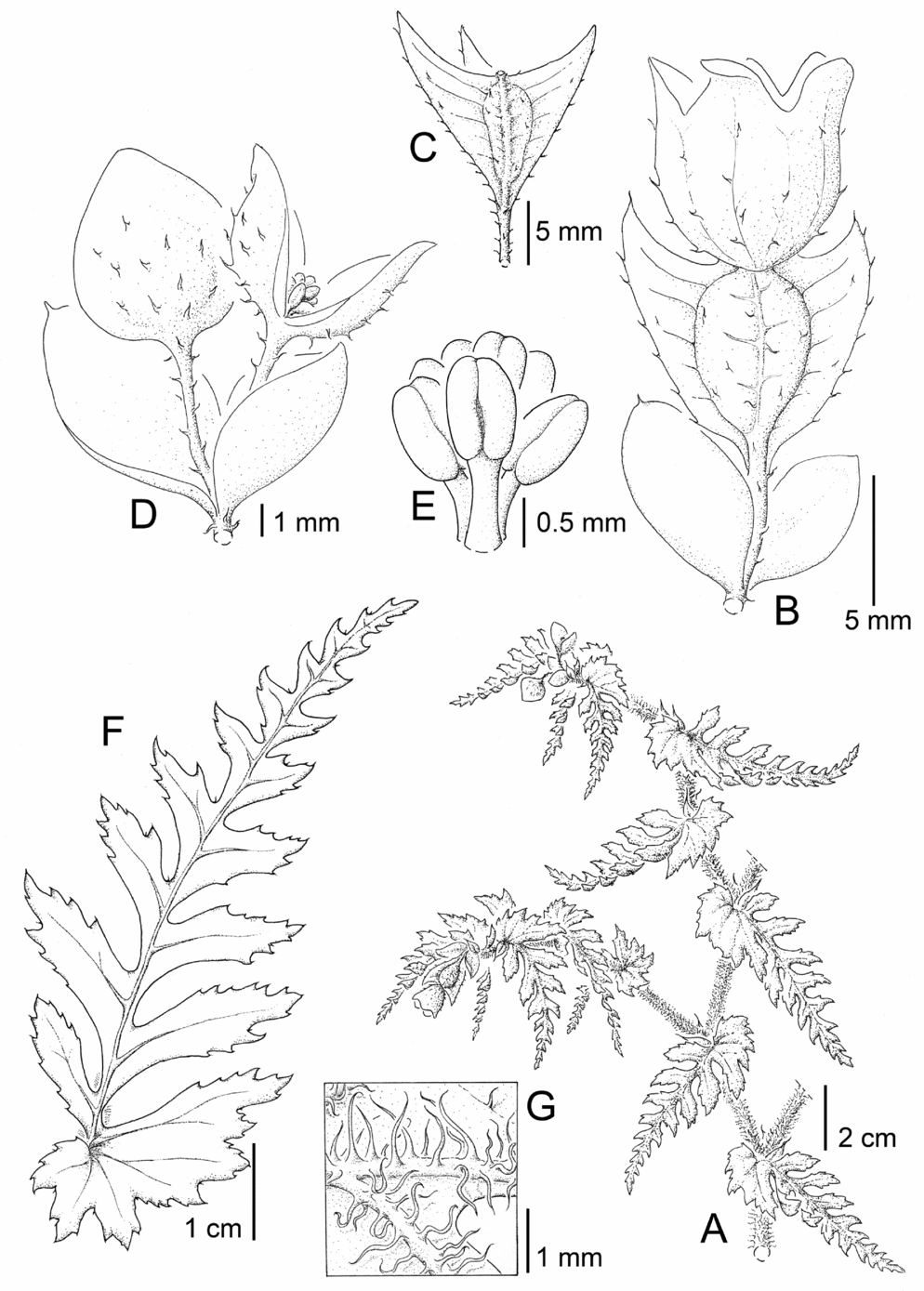
Begonia mimikaensis Sands. A, Habit; B female flower subtended by bracts; C, fruit; D, male flowers subtended by bracts; E, androecium; F, leaf lamina; G, detail of leaf underside. Drawn from Beaman 12264 (A, B, D, F and G), Cook 199 (C) and Utteridge 235 (E).

Sympodially branching herb up to 70 cm high. Stem: slender, with hairs, more dense towards the apex, internodes 2–6 cm long, becoming shorter near the apex. Stipules persistent, lanceolate, cuspidate, glabrous, 8–12 × 5 mm. Leaves: petiole subsessile to 5 mm long, villose; lamina green, asymmetric, lanceolate, 5.5–7.8 cm × (1.5–)2.5–4 cm, glabrous above, hairy on main veins below; basal lobe 0.8–1.2 cm long, crossing the petiole; margin dissected to 2 mm or less from the midrib, lobes serrate; venation pinnate, tip acute. Inflorescence c.2.5 cm long, uni- or bisexual, terminal, female flowers solitary or subtending 3–7 male flowers; bracts conspicuous, 8–10 × 8 mm, broadly ovate, glabrous, apex acute. Male flower: pedicel c.5 mm long, sparsely puberulous, tepals 2, free, white, ovate-orbicular, 8 × 7 mm long, sparsely puberulous, tip obtuse; androecium on a short torus: stamens c.10, anthers subsessile to being borne on a 1-mm filament in the centre of the androecium, anthers c.1 mm long, ellipsoid. Female flower: pedicel 4 mm long, sparsely villose; ovary 15 × 15 mm including wings, capsule ellipsoid, 10 × 4 mm, wings 7 mm wide at apex, sparsely villose, apex arcuate; corolla up to 10 mm long, sparsely villose, with 5 lobes each up to 4 mm long; styles 3, elongate, bifid, stigmatic surface twice spirally twisted. Fruit: shape as for the ovary, enlarging to c.15 × 18 mm.
Additional specimens examined. Indonesia. Papua Province: Mimika Regency, Utekini Valley, 2005, Cook 199 (E); ibid., 7 xii 1996, Sands 7300 (K, SING); ibid., 3 iii 1999, Utteridge 235 (K, L).
Distribution and ecology
Indonesia, Papua Province, Utekini Valley, Mimika area. In disturbed lower montane and mid-montane forests, 1600–2750 m altitude.
IUCN category
Least Concern. One of the collections is from a heavily disturbed area (Utteridge 235), indicating the species has some tolerance of non-primary forests. However, it is known only from the Freeport Concession Area, and any large-scale forest clearance will probably result in Begonia mimikaensis becoming threatened.
This species differs from the two other species in sect. Symbegonia with divided leaves of a similar size (Begonia asaroensis and B. symgeraniifolia) in having a pronounced amplexicaul basal leaf lobe, rather than leaves that narrow towards the base, lacking a basal lobe. The epithet is derived from the type locality of the Mimika regency.
8. Begonia mooreana (Irmsch.) L.L.Forrest & Hollingsw., Plant Syst. Evol. 241: 208 (Reference Forrest and Hollingsworth2003). – Symbegonia mooreana Irmsch., Bot. Jahrb. Syst. 50: 381 (1913). – Type: Papua New Guinea, Ibo Mts, 28 v 1908, Schlechter 17800 (lecto B [B100217772]). Fig. 2.
Symbegonia fulvo-villosa auct. non. Warb.: Sprague, Bot. Mag. (1911) t. 8409.
Sympodially branching herb. Stem: slender, internodes c.5 cm long becoming shorter towards the apex, appressed-villose. Stipules persistent, ovate lanceolate, c.10–15 × 3–4 mm, glabrous, cuspidate. Leaves: petiole subsessile to 5 mm long, villose; lamina green, asymmetric, lanceolate-acuminate, c.5.5–8.5 × 2–3.5 cm, upper surface sparsely puberulent, lower surface shortly villose on the veins; basal lobe slightly oblique, sometimes overlapping the petiole; margin biserrate to laciniate; venation palmate-pinnate; tip acuminate. Inflorescence c.2 cm long, uni- or bisexual, terminal, few-flowered, female flowers solitary or subtending 2 male flowers; bracts 15 × 4 mm, lanceolate, glabrous, cuspidate. Male flower: pedicel 10–15 mm, sparsely puberulous, tepals 2, fused for 2 mm at the base, ovate, 15 × 10 mm, white, sparsely puberulous at the base; androecium on a thick column, stamens c.13, subsessile, anthers ellipsoid. Female flower: pedicel c.5 mm long, sparsely puberulous; ovary 8 × 10 mm including wings, capsule globose-ellipsoid, c.7 × 5 mm, wings c.5 mm wide at apex, sparsely puberulous, apex arcuate; corolla 10 mm long, sparsely puberulous, with 5 lobes each c.3 mm long; styles 3, elongate, bifid, stigmatic surface twice spirally twisted. Fruit: shape as for the ovary, enlarging to c.14 × 18 mm.
Additional specimen examined. Papua New Guinea. Bololo, 10 ix 1907, Schlechter 16541 (B, P).
Distribution and ecology
Papua New Guinea, Bololo, Ibo Mountains, c.1000 m altitude.
IUCN category
Data Deficient.
This species is most similar to Begonia fulvovillosa, and indeed has been confused with that species (Sprague, Reference Sprague1911). Irmscher described it as distinct owing to its having leaf margins that are slightly lobed; also, comparison of the types of both species shows Begonia mooreana to have a slightly larger and more auriculate basal lobe, and it also has an almost glabrous upper leaf surface. However, florally the two species appear identical, and as they become better known it may be feasible to recognise them as one taxon if collections with intermediate leaf forms are found. The duplicate of Schlechter 17800 in P (P019007690) has leaves that are conspicuously shortly hairy above, and less lobed than the sheet in B; we consider this not to be a duplicate and probably referable to Begonia fulvovillosa.
9. Begonia pulchra (Ridl.) L.L.Forrest & Hollingsw., Plant Syst. Evol. 241: 208 (Reference Forrest and Hollingsworth2003). – Symbegonia pulchra Ridl., Trans. Linn. Soc. London, Bot., II 9: 62 (1916). – Type: Indonesia, Papua Province, Otakwa River, Camp IX–X, 26 i 1913, Kloss s.n. (lecto BM here designated; isolecto BM, K [K000739911]). Fig. 7.
Sympodially branching herb to 60 cm high. Stem: slender, villose, internodes c.5 cm long. Stipules persistent, ovate lanceolate, 14 × 7 mm, glabrous, shortly cuspidate. Leaves: petiole 2 mm long, with short hairs; lamina glossy green with scarlet venation, asymmetric, basal lobe extending down the petiole slightly, occasionally becoming auriculate, lanceolate, 6–12.5 × 2.5–5 cm, venation pinnate, upper surface glabrous, lower surface with hairs on veins, margin bidentate, major teeth larger, more angular and opposite in the apical half of the lamina. Inflorescence 3–7 cm long, terminal, uni- or bisexual, larger ones with a distinct central axis and appearing racemose, female flowers solitary or in pairs, male flowers c.10, occasionally more; bracts 7 × 4 mm at the base of the inflorescence, becoming smaller towards the apex, ovate, white, glabrous, apex acute. Male flower: pedicel 1 cm long, glabrous; tepals 2, fused at the base, ovate-orbicular, 6 × 7 mm, white, villose at the base, tip obtuse; androecium on a short torus, with 9–12 stamens, basal ones subsessile, central ones on a c.1-mm filament, anthers ellipsoid, apex slightly retuse. Female flower: pedicel c.1 cm long, subglabrous; ovary 12 × 20 mm including wings, capsule ellipsoid, c.10 × 5 mm, wings 9 mm wide at apex, sparsely puberulous, apex arcuate; corolla 12 mm long, sparsely puberulous, with 5 lobes each 4 mm long, styles 3, elongate, bifid, stigmatic surface twice spirally twisted. Fruit: shape as for the ovary, enlarging to c.15 × 20 mm.
Additional specimens examined. Indonesia. Papua Province: Mt Jaya, 5 iv 1999, Edwards et al. 4394 (K [2 sheets], L); ibid., 1 viii 1998, Sands 7033 (K, SING); ibid., 25 iv 2000, Triono et al. 158 (K); ibid., 26 iii 1999, Utteridge et al. 191 (K, SING); ibid., 26 iii 1999, Utteridge et al. 194 (K); Otakwa River, Camp 6a, i 1913, 17 i 1913, Kloss s.n. (BM [BM000901260]); Otakwa River, Camp 7–8, i 1913 Kloss s.n. (BM, K [000739909]); Otakwa River, Camp XI–IX, ii 1913, Kloss s.n. (BM [000901261], K [K000739908]).
Distribution and ecology
Indonesia, Papua Province, Otakwa River and Mount Jaya. In humus-rich soils along stream edges, c.2000 m altitude. Described as common (Edwards 4394).
IUCN category
Least Concern. The forests in the region of the type locality are intact and inaccessible, and the species was collected from several localities during the Wollaston Expedition (Ridley, Reference Ridley1916) and so does not appear to be especially restricted in distribution or altitude.
The leaves are glossy above with claret red veins (Utteridge 191), or green with reddish flushing around the margin (Edwards 4394).
10. Begonia strigosa (Warb.) L.L.Forrest & Hollingsw., Plant Syst. Evol. 241: 209 (Reference Forrest and Hollingsworth2003). – Symbegonia strigosa Warb., Fl. Deutsch. Schutzgeb. Südsee 324 (1905). – Type: Papua New Guinea, Kaiser-Wilhelmsland, Bismark Mtns, i 1902, Schlechter 14019 (lecto B [B100365258] here designated; isolecto BO, K [K000739906]). Figs 2, 12.
Begonia strigosa (Warb.) L.L.Forrest & Hollingsw., photographed on Mount Hagen, Western Highlands Province, Papua New Guinea. A, Habit; B, female flower; C, male flower (not vouchered).

Sympodially branching herb, to 30 cm high. Stem slender, becoming woody, with 3–5 mm long yellowish brown hairs, internodes c.5 cm long. Stipules persistent, c.12 × 4 mm, villose on the keel and tip, cuspidate. Leaves: petiole c.5 mm long, villose; lamina green, asymmetric, lanceolate-rhomboid; 7–11 × 3–4 cm, upper surface villose between the veins, lower surface villose on the veins; basal cuneate, oblique, overlapping the petiole slightly; margin subentire or denticulate; venation pinnate-palmate; tip acute. Inflorescence c.3 cm long, terminal, uni- or bisexual, female flowers solitary or subtending c.5 male flowers; bracts lanceolate, 10 × 4 mm, glabrous, tip acute. Male flower: pedicel 10–15 mm, villose; tepals 2, c.13 × 8 mm, fused for two-thirds of the length, white, villose and bulbiform at the base, lobe tips rounded; androecium on a stout column with c.10 stamens, anthers subsessile, ellipsoid. Female flower: pedicel c.2 mm long, villose; ovary c.13 × 12 mm including wings, capsule broadly ellipsoid, c.10 × 5 mm, wings c.6 mm wide at apex, sparsely villose, apex arcuate; corolla c.12 mm long, villose, with 5 lobes each 4 mm long, styles 3, elongate, bifid, stigmatic surface twice spirally twisted. Fruit: shape as for the ovary, enlarging to c.14 × 18 mm.
Additional specimens examined. Papua New Guinea. Eastern Highlands Province: 4 miles N of Okapa, 28 ix 1959, Brass 31778 (K, L, LAE); Kassam, 11 i 1968, Henty & Coode NGF 29253 (L, LAE); Lehmfluss (Clay River), 25 v 1913, Ledermann 11573 (B [2 sheets]); Obura, Kainantu, 8 iv 1972, Hays 293 (LAE); Waisa, 25 ix 1964, Hartley TGH 13116 (L, LAE). Morobe Province: Aseki Valley, 25 iv 1966, Schodde 5041 (L, LAE); Bupu, 4 iii 1964, Millar NGF 23330 (L, LAE); Kasanombe, 27 viii 1973, Katik & Taho LAE 56394 (L, LAE); Menyamya, Oiwa–Benula Track, 24 xi 1970, Streimann & Kairo NGF 42487 (LAE [2 sheets]); Mt Shungol, 10 xii 1963, Hartley TGH 12467 (K, L, LAE); ibid., 14 xi 1970, Stevens 50475 (BO, K, L, LAE); Mumeng, Wagau, 22 xi 1967, Millar & Dockrill NGF 12081 (L, LAE); ibid., 3 xi 1963, Womersley NGF 17871 (K, L, LAE). Simbu Province: Kerowagi distr., Koronigi River, 27 viii 1968, Millar 37798 (L, LAE).
Distribution and ecology
Papua New Guinea, common in Morobe, Eastern Highlands and Simbu Provinces, 760–2260 m altitude.
IUCN category
Least Concern. Widespread in the Central Range of Papua New Guinea.
The type material is rather poor; the subentire sinuate-ciliate margin seems to be distinctive. Although widespread, not a well-understood species, and it is not inconceivable that the specimens above relate to more than one taxon, once better observations based on living material are available.
11. Begonia symbracteosa (Warb.) L.L.Forrest & Hollingsw., Plant Syst. Evol. 241: 208 (Reference Forrest and Hollingsworth2003). – Symbegonia bracteosa Warb., Fl. Deutsch. Schutzgeb. Südsee 323 (1905). – Type: Papua New Guinea, Kaiser Wilhelmsland, Torricelli Mtns, iv 1902, Schlechter 14369 (lecto B B100217775] here designated; isolecto B, BM [BM000901236], BO, G [G00237341, G00237342], K [K000739916], P [P01900774]). Fig. 10.
Erect branching herb. Stem slender, becoming woody, villose, with hairs c.4 mm long, internodes c.5 cm long. Stipules persistent, c.12 × 4 mm, glabrous, cuspidate. Leaves: petiole c.5 mm long, hairy; lamina green, slightly asymmetric, oblanceolate, widest in the apical half, 5–8 × 2–3 cm, glabrous above, paler green below often with red veins, reddish pubescent on the veins; base oblique, basal lobe overlapping the petiole; margin biserrate, with long sparse hairs between the teeth and at the tips of lobes; venation pinnate-palmate; tip acuminate. Inflorescence c.5 cm long, usually bisexual, terminal, single female flower subtending 20–30 male flowers; bracts conspicuous, broadly ovate, 12 × 8 mm, white, glabrous, tip acute. Male flower: pedicel up to 1 cm long, sparsely villose; tepals 2, fused at the base, sparsely villose at the base, broadly ovate, c.8 × 8 mm, white, tip acuminate; androecium with c.10 stamens, arranged on a thin column, filaments 0.5 mm long, anther ellipsoid, 0.5 mm. Female flower: pedicel c.5 mm long, glabrous; ovary c.15 × 15 mm including wings, capsule ellipsoid, c.8 × 4 mm, wings 7 mm wide at apex, apex deeply arcuate; corolla 12 mm long, sparsely puberulous, with 5 lobes each 5 mm long, styles 3, elongate, bifid, stigmatic surface twice spirally twisted. Fruit: shape as for the ovary, enlarging to c.20 × 20 mm.
Additional specimens examined. Papua New Guinea. Enga Province: Paiela, 6 xi 1981, Rees & Reeve 345 (K). West Sepik Province: Kaiser-Wilhelmsland, Torricelli Mtns, Mt Somoro, 31 viii 1961, Darbyshire 310 (K, L, LAE); ibid., 17 ix 1961, Darbyshire 462 (LAE); Mt Amdutakin, 17 ix 1966, Kalkman 5307 (K, L, LAE).
Distribution and ecology
Papua New Guinea, in Enga Province and West Sepik Province, Torricelli Mountains. In primary dense to secondary forests, 2000–2350 m altitude.
IUCN category
Data Deficient. Further information is needed on the three rather isolated locations.
Begonia symbracteosa is distinguished by its showy, white glabrous bracts.
12. Begonia symgeraniifolia (Ridl.) L.L.Forrest & Hollingsw., Plant Syst. Evol. 241: 208 (Reference Forrest and Hollingsworth2003). – Symbegonia geraniifolia Ridl., Trans. Linn. Soc. London, Bot. II 9: 61 (1916). – Type: Papua, Otakwa River, Camp 7–8, i 1913, Kloss s.n. (lecto BM [BM000944676] here designated, isolecto K [K000739915]). Fig. 10.
Erect branching herb. Stem: slender, villose, internodes up to 5 cm long. Stipules persistent, lanceolate, 8 × 3 mm, glabrous, tip acute. Leaves: petiole less than 2 mm long, villose; lamina green, subsymmetric, lanceolate, 4–7 × 1.5–2.5 cm, glabrous above, with short dense hairs on the veins below; margin pinnately dissected almost to the midrib, into 6 or more lobes, the pinnae in the lower two-thirds of the lamina being further dissected; base rounded to cuneate, slightly oblique; venation pinnate; tip acuminate. Inflorescence c.2 cm long, unisexual, terminal, female flowers solitary, male flowers 1–5; bracts ovate, 7 × 4 mm, white, glabrous, tip acute. Male flower: pedicel 5–10 mm long, sparsely villose, tepals 2, ovate, 10 × 7 mm, fused halfway, sparsely villose at the base; androecium on a torus with c.6 stamens, filaments free, anthers ellipsoid. Female flower: pedicel 5 mm long, villose; ovary 10 × 12 mm including wings, capsule ellipsoid, 7 × 5 mm, wings 6 mm wide at apex, apex truncate to arcuate; corolla 10 mm long, sparsely villose, with 5 lobes each 3 mm long; styles 3, elongate, bifid, stigmatic surface twice spirally twisted. Fruit: shape as for the ovary, enlarging to c.12 × 15 mm.
Additional specimen examined: Indonesia. Papua Province: Wandammen Peninsula, 8 vii 1928, Mayr 292 (B, BO).
Distribution and ecology
Indonesia, Papua Province, Wandammen Peninsula and the foothills of Mount Jaya.
IUCN category
Data Deficient. Further distribution information is needed.
See notes under Begonia mimikaensis for similar species.
13. Begonia symhirta (Ridl.) L.L.Forrest & Hollingsw.Plant Syst. Evol. 241: 208 (Reference Forrest and Hollingsworth2003). – Symbegonia hirta Ridl., Trans. Linn. Soc. London, Bot. II 9: 61 (1916). – Type: Papua, Camp 8–9, i 1913, Kloss s.n. (lecto BM [BM000901263] here designated). Fig. 10.
Sympodially branching herb. Stem: c.4 mm wide, villose, internodes c.5 cm long. Stipules persistent, ovate, 10 × 8 mm, keel villose, shortly cuspidate. Leaves: petiole up to 1 cm long, villose; lamina green, asymmetric, broadly ovate, c.4–6 × 5 cm, sparsely villose between the veins above, villose on veins below with scattered hairs between; base cordate, basal lobe markedly overlapping the petiole; margin subentire-denticulate; venation palmate-pinnate; tip shortly acute. Inflorescence: c.5 cm long with a distinct axis, unisexual, terminal, 10–15 male flowers, white; bracts 4 × 3 mm, oblong, glabrous, tip obtuse. Male flower: pedicel c.7 mm long, sparsely villose, tepals 2, fused at the base, ovate, c.8 × 6 mm, sparsely villose at the base, tip obtuse; androecium on a short torus, stamens c.20, filaments up to c.1 mm long, anther ellipsoid. Female flower not seen. Fruit not seen.
Distribution and ecology
Indonesia, Papua Province, Otakwa River, from 1480 to 1670 m altitude.
IUCN category
Data Deficient.
A poorly understood species. Ridley (Reference Ridley1916) noted “There are two forms of the plant, both gathered in the same district; in one the leaves are obliquely ovate with short petioles, in the other they are almost reniform and symmetrical with longer petioles.” Here we have typified using the short-petioled form, and consider the material with long petioles in K [K000739914] to be very likely to represent a different taxon, although the material is not sufficient to furnish a description.
14. Begonia sympapuana (Merr. & Perry) L.L.Forrest & Hollingsw., Plant Syst. Evol. 241: 208 (Reference Forrest and Hollingsworth2003). – Symbegonia papuana Merr. & L.M. Perry, J. Arnold Arbor. 24: 59 (1943). – Type: Indonesia, Papua Province, Idenburg River, i 1939, Brass 12161 (lecto A [A00068355] here designated; iso BM [BM000901262], BO, BRI [BRI-AQ0333170], L [L0530904, L0530905]). Fig. 2.
Sympodially branching herb up to 50 cm high. Stem c.5 mm wide, villose; internodes c.5 cm long. Stipules persistent, lanceolate, 10 × 6 mm, shortly villose on the keel, shortly cuspidate. Leaves: petiole 0.5–2 cm long, villose; lamina green, asymmetric, ovate-lanceolate, c.9–12 × 3.5–5 cm, upper surface sparsely villose between the veins, lower surface with short hairs on the veins; base oblique, overlapping the petiole slightly; margin dentate-denticulate; venation palmate-pinnate; tip shortly acuminate. Inflorescence c.7 cm long, bisexual, terminal, with (1 or) 2 female flowers subtending c.10–15 male flowers; bracts broadly ovate, 6 × 4 mm, glabrous, tip acute. Male flower: pedicel c.4 mm long, villose, tepals 2, fused at base, ovate-elliptic, c.10 × 8 mm, villose at the base, tip rounded; androecium on a short torus, stamens c.15, subsessile, anthers ellipsoid. Female flower: pedicel 5 mm long, puberulous; ovary c.15 × 18 mm including wings, capsule ellipsoid, c.12 × 5 mm, wings 9 mm wide at apex, sparsely puberulous, apex subtruncate; corolla 15 mm long, sparsely puberulous, with 5 lobes each 5 mm long, styles 3, elongate, bifid, stigmatic surface twice spirally twisted. Fruit: shape as for the ovary, enlarging to c.15 × 18 mm.
Distribution and ecology
Indonesia, Papua Province, Idenburg River. In rain forest gullies, 550–1750 m altitude.
IUCN category
Data Deficient. Known only from the type.
The truncate apex to the fruits is distinctive, differing from the all the other species, which are arcuate at the apex to some extent.
15. Begonia symparvifolia (Gibbs) L.L.Forrest & Hollingsw., Plant Syst. Evol. 241: 208 (Reference Forrest and Hollingsworth2003). – Symbegonia parvifolia Gibbs, Fl. Arfak. Mts 150 (1917). – Type: Indonesia, West Papua, Vogelkop, Arfak Mts, Koebre Mt, xii 1913, Gibbs 5644 (lecto BM [BM000901271] here designated). Fig. 10.
Erect much-branched herb. Stem: slender, shortly villose, glabrescent, internodes c.5 cm long at the base, becoming shorter toward the apex. Stipules persistent, 5 × 2 mm, glabrous, shortly cuspidate. Leaves: petiole nearly absent; lamina green, subsymmetric, lanceolate, up to 3 × 0.9 cm, upper surface with sparse glandular hairs, lower surface with reddish short hairs on the veins and scattered between; base rounded to cuneate, slightly oblique; margin dentate; venation pinnate; tip acuminate. Inflorescence c.2 cm long, unisexual, terminal, male flowers c.5, female flowers solitary; bracts ovate-lanceolate, 4 × 3 mm, glabrous, tip acute to shortly caudate. Male flower: pedicel c.3 mm long, puberulous; tepals 2, fused at the base, orbicular-ovate, c.7 × 5 mm, glabrous, tip acute, stamens on a thin column, c.10, subsessile, anthers ellipsoid. Female flower: pedicel c.2 mm long, puberulous; ovary c.9 × 9 mm including wings, capsule broadly ellipsoid, c.8 × 3 mm, wings 5 mm wide at apex, sparsely puberulous, apex arcuate; corolla 9 mm long, sparsely puberulous, with 5 lobes each 3 mm long, styles 3, elongate, bifid, stigmatic surface twice spirally twisted. Fruit: shape as for the ovary, enlarging to c.12 × 7 mm.
Additional specimens examined. Indonesia. West Papua Province: Manokwari, Iraiweri, 8 vi 1991, Widjaja EAW 4271 (L); Vogelkop, Arfak Mts, Anggi Lakes, 11 i 1962, Sleumer & Vink BW 14089 (L, LAE); ibid., 22 vi 1961, Vink BW 11478 (LAE).
Distribution and ecology
Indonesia, West Papua Province, in the Arfak Mountains at around 2000 m altitude, along stream-sides.
IUCN category
Data Deficient.
This species appears to be very close to Begonia arfakensis, differing mainly in its smaller leaves with a cuneate base and a more deeply dentate margin. The specimen from Mount Tidjei (Sleumer & Vink BW 14310) is somewhat intermediate between the two species.
16. Begonia symsanguinea (Warb.) L.L.Forrest & Hollingsw., Plant Syst. Evol. 241:208 (Reference Forrest and Hollingsworth2003); Tebbitt, Begonias 220 (Reference Tebbitt2005). – Symbegonia sanguinea Warb., Fl. Deutsch. Schutzgeb. Südsee 323 (1905). – Type: Papua New Guinea, Bismarck Mts, i 1902, Schlechter 13979 (lecto B [B100217769] here designated; isolecto B [B100217770], BO, K [K000739907]). Figs 10, 13.
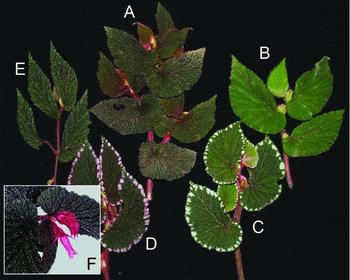
Begonia symsanguinea (Warb.) L.L.Forrest & Hollingsw., photographed in Gahavisuka Provincial Park, Eastern Highlands Province, Papua New Guinea. A (Gagul 613, UPNG), a plant resembling the type form; B (Gagul 612, UPNG), a green form, and C (not vouchered), a variegated form, both morphologically similar to A; D (Gagul 610, UPNG) and E (not vouchered), forms with more lanceolate leaves than the type and possibly different taxa; F, a cultivated plant at the RBGE from Mount Dayman, Milne Bay Province, Papua New Guinea (accession no. 19682364).

Sympodially branching sprawling herb. Stem: fleshy when young, villose, glabrescent, internodes c.5–7 cm long. Stipules: persistent, ovate, 10 × 5 mm, sparsely villose on the keel, shortly cuspidate. Leaves: petiole c.5 mm long, villose; lamina deep reddish green, asymmetric, broadly ovate to ovate, 7–12 × 3.5–6 cm, rugose and villose above, villose on the veins below; base oblique, basal lobe markedly overlapping the petiole; margin irregularly denticulate-ciliate; venation palmate-pinnate; tip acute. Inflorescence c.5 cm long, uni- or bisexual, terminal, 1 or 2 female flowers and 5–10 male flowers, deep pink-red (rarely white); bracts ovate, c.8 × 5 mm, glabrous, apex shortly caudate. Male flower: pedicel c.1.5 cm long, puberulous; tepals 2, deep pink-red, fused halfway, ovate, 12–14 × 8 mm, puberulous, tip acute; androecium on a short column, anthers 10–15, filaments c.0.25 mm, anthers ellipsoid. Female flower: pedicel 10 mm long, puberulous; ovary c.24 × 20 mm including wings, capsule ellipsoid, c.9 × 4 mm, wings c.10 mm wide at apex, villose, apex arcuate; corolla c.20 mm long, deep pink-red, sparsely puberulous, with 5 lobes each 3 mm long; styles 3, elongate, bifid, stigmatic surface twice spirally twisted. Fruit not seen.
Additional specimens examined. Papua New Guinea. Central Province: 11 viii 1968, Cruttwell 1476 (L, LAE). Eastern Highlands Province: Arau, 7 x 1959, Brass 31911 (K, L, NY); Mt Gahavisuka Provincial Park, 30 vi 2011, Gagul 612 & 613 (UPNG). Milne Bay Province: Dumora, ix 1953, Cruttwell 1653 (K, LAE). Morobe Province: Menyama, Aiwa, 18 v 1968, Streimann & Kairo 39020 (K, L, LAE); ibid., 24 xi 1970, Streimann & Kairo NGF 42477 (K, LAE); Skindewai, 9 i 1956, Womersley & Millar NGF 8474 (K, L, LAE). Simbu Province: Yumebenden (Yumenigle), Mingendi, 24 vi 2011, Gagul 601 & 603 (UPNG).
Distribution and ecology
Papua New Guinea, Morobe, Eastern Highlands, Central, Simbu and Milne Bay Provinces. Montane forests on limestone ridges and also in Castanopsis forests, 300–2400 m altitude.
IUCN category
Least Concern. Widespread, and covers a considerable altitudinal range.
In the protologue, Warburg erroneously described this species as having leaves that are glabrous above. The name is derived from the deep-red colour of the young leaves and flowers, although pale variants of the species have recently come to light; it forms either a species complex or a hybrid swarm in the Mount Gahavisuka area with Begonia argenteomarginata and possibly other unnamed taxa (Fig. 5). It seems to be a rather fleshy, succulent species, because it makes terrible herbarium specimens. The collection Reeve 592 from Enga Province is close to Begonia symsanguinea but is a very woody plant, considered here as aff. B. symsanguinea.
17. Begonia vinkii Sands sp. nov.
Allied to Begonia symbracteosa, but differs in having the androecium exceeding the corolla at anthesis, and brownish ovate-lanceolate bracts (not white broadly ovate). – Type: Papua New Guinea, Western Highlands, Kubor Range, Uinba, Nona–Minj divide, 9 ix 1963, Vink 16533 (holo K, iso LAE). Figs 2, 14.
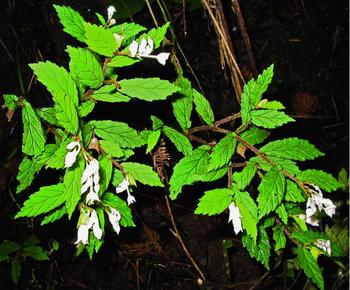
Begonia vinkii Sands, photographed in Yumebenden, Mingendi, Simbu Province, Papua New Guinea, 2252 m altitude. Voucher: Gagul 600 (UPNG).

Sympodially branching herb to 60 cm high. Stem: c.3 mm wide, villose, internodes 1.2–3(–7) cm long. Stipules: persistent, lanceolate, 8 × 4 mm, glabrous, cuspidate. Leaves: petiole c.1–2 mm long, villose; lamina green, slightly asymmetric, lanceolate, 3.5–7.5(–10) × 1–2.5(–4) cm, glabrous above, villose on the veins below; base slightly oblique, overlapping the petiole; margin dentate, more so towards the apex; venation pinnate; tip acute. Inflorescence c.3 cm long, uni- or bisexual, female flowers solitary, subtending 10–15 male flowers; bracts brownish ovate-lanceolate 5 × 2 mm, becoming smaller towards the terminal flowers, glabrous, tip shortly cuspidate. Male flower: pedicel 0.3–1.4 cm long, puberulous; tepals 2, fused one-third of the length, ovate, 5–7 × 5 mm, puberulous, tip acute; androecium on an elongate thin column, exceeding the corolla at anthesis, stamens 15–20, filaments c.1 mm, anthers ellipsoid. Female flower: pedicel 4–8 mm long, sparsely puberulous; ovary c.13 × 13 mm including wings, capsule ellipsoid, 9 × 4 mm, wings c.6 mm wide at apex, sparsely puberulous, apex arcuate; corolla c.10 mm long, sparsely villose, with 5 lobes each 3 mm long; styles 3, elongate, bifid, stigmatic surface twice spirally twisted. Fruit: shape as for the ovary, enlarging to c.15 × 18 mm.
Additional specimens examined. Papua New Guinea. Eastern Highlands Province: Asaro–Mairifutica divide, 30 viii 1957, Pullen 399 (L, LAE); Daulo Chuave Road, 21 xi 1954, McKee 1307 (L); Daulo Pass, 7 xi 1968, Millar NGF 40630 (L, LAE); ibid., 26 viii 1970, Millar NGF 48629 (LAE [2 sheets]); ibid., 20 v 1966, Womersley NGF 24722 (K, L, LAE); ibid., 20 v 1956, Womersley NGF 24732 (BO); Engwegl, 22 xi 1960, E. Borgmann 385 (B, LAE); Ganaveroka, Daulo, 27 vi 2011, Gagul 605 (UPNG); Kanawyroka Creek, 30 viii 1963, Millar & van Royen 15978 (BO, K, L, LAE); Malu, 21 xii 1912, Ledermann 10381 & 10382 (B); Marafunga Sawmill, 17 v 1971, Grubb & Edwards 218 (LAE); Obura, Kainantu, 27 viii 1971, Hays 004 (LAE); Warrapuri River, 2 ix 1963, van Royen 18117 (BO, K, L, LAE). Madang Province: Simbai, Cruttwell 1533 (K, LAE). Simbu Province: Bomkane Village, xi 1977, Hoover 72 (L, LAE); Chimbu (Simbu) Divide, 22 xi 1954, McKee & Floyd 6377 (LAE); Gembogl, 10 x 1980, Sterly 80–319 (L); ibid., 10 x 1980, Sterly 80–320 (E, L); Keglsugl, 20 iv 1967, Wade ANU 7641 (BO, K, L, LAE); Koge Mission, Sinasina, 7 x 1972, Hide 224 (LAE); Kumul Mission, 12 i 1962, Womersley NGF 14134 (E, K, L, LAE); ibid., 12 i 1962, Womersley NGF 14141 (LAE); Mingendi, Yumebenden (Yumenigle), 24 vi 2011, Gagul 600 (UPNG); Road to Nilguma, 19 x 969, Millar NGF 38376 (L, LAE). Southern Highlands Province: West of Mt Ne, 20 viii 1966, Frodin NGF 28408 (BO, K, L). Western Highlands Province: Al River, 3 iv 1953, Womersley NGF 4834 (BM, BO, K, L); ibid., 7 ix 1953, Womersley NGF 5334 (K, L,LAE); Kubor Range, Minj Nona Divide, 26 viii 1963, Pullen 5261 (BO, K, L, LAE); Mazmal, 1 ix 1963, Millar & van Royen NGF 18573 (BO, K, L, LAE); Nondugl, 20 iv – 15 v 1950, Gilliard s.n. (LAE [sheet 223456]); ibid., 20 iv – 15 v 1950, Gilliard s.n. (LAE [sheet 223476]); ibid., 20 iv – 15 v 1950, Gilliard s.n. (LAE [sheet 223481]); ibid., 20 iv – 15 v 1950, Gilliard s.n. (LAE [sheet 223482]); ibid., iv 1951, Womersley 4374 (BO); ibid., 5 vii 1956, Womersley & Jones NGF 8796 (LAE); Mt Hagen vicinity, xii 1977, Hoover 75 (B, L, E, LAE); ibid., 4 vii 1957, Robbins 190 (LAE); Mur Mur Pass, 17 vi 1984, Kerenga & Symon LAE 56818 (L, LAE); Mur Mur Pass along road from Mt Hagen City to Tambul Village, 22 viii 1994, Regalado & Katik 1229 (B, NY); Mur Mur Pass – Mt Hagen, 1 x 1963, Vandenberg et al. NGF 39909 (BO, K, L, LAE); ibid., 19 vi 1979, Sohmer et al. LAE 75525 (LAE); Upper Kaugel, Kurupili, Kepaka, 5 ii 1969, Bowers 633 & 634 (LAE).
Distribution and ecology
Widespread in the highlands of Papua New Guinea, in montane forests, as a terrestrial or stream-side herb, 1700–2790 m altitude.
IUCN category
Least Concern. Widespread in the highlands of Papua New Guinea, covering a considerable altitudinal range.
The flowers are white with a red spot near the style base (Frodin NGF 28408) or the base of the androecium (Millar & van Royen NGF 15978). The epithet honours the collector of the type, Dutch botanist Willem Vink, whose collections have enabled much insight into the flora of New Guinea.
18. Begonia yapenensis M.Hughes, Eur. J. Taxon 119: 1–6 (Reference Hughes, Barber, Heatubun and Gagul2015). Cultivated collection 20 viii 2014, Barber SBAR 86 (holo BO; iso E, MAN). Cultivated in the Royal Botanic Garden Edinburgh from vegetative material collected in the wild (accession no. 20090830: Indonesia, Papua Province, Yapen Island, Ambaidiru, 1000 m, 18 ii 2009, Argent, Barber, Ensoll & Galloway ABEG 211). Figs 7, 15.
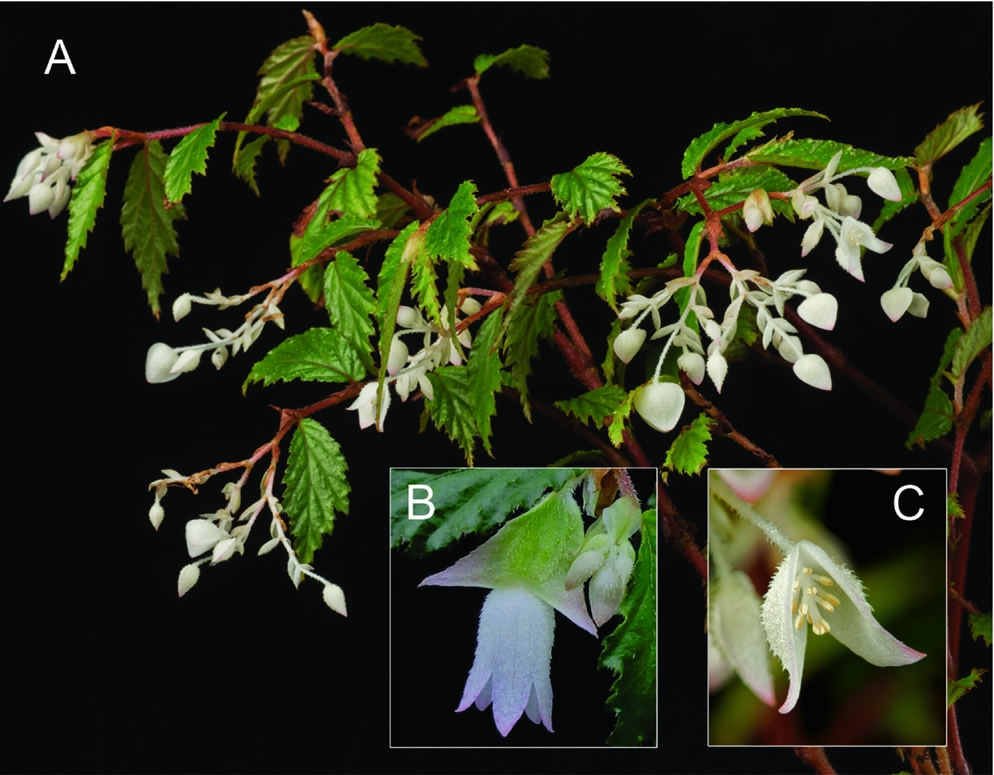
Begonia yapenensis M.Hughes, photographed from a living plant in cultivation at the Royal Botanic Garden Edinburgh (accession no. 20090830), collected from Yapen Island. A, Habit; B, male flower; C, female flower. The type specimens were derived from this accession.

Sprawling much-branched herb to 30 cm high. Stem becoming woody at the base, pilose with 3 mm long white hairs, internodes 3–5 cm long. Stipules persistent, lanceolate, c.15 × 4 mm, glabrous, shortly cuspidate. Leaves: petiole c.5 mm long, pilose; lamina green with purple venation, asymmetric, lanceolate, 8–10 × 2.5–4 cm, upper surface rugose, shortly hispid between veins, underside paler than upper surface, shortly hispid on veins only; base cordate, lobes not overlapping; margin biserrate; venation pinnate palmate, tip acute. Inflorescence terminal, total length 3–5 cm, cymose, compressed at first and becoming more elongate at maturity, unisexual or bisexual, protogynous, female flowers solitary or in pairs, basal, male flowers c.10–15; primary peduncle 3–13 mm long, shortly hispid; secondary peduncles shorter and glabrous; bracts 7–11 × 2–4 mm, linear-lanceolate, apex acute, white, glabrous. Male flower: pedicel 4–12 mm long, white, shortly hispid; tepals 2, fused just under halfway, rhombic-ovate, 10–13 × 8–10 mm, white, shortly hispid at base, base bulbiform, apex acute; androecium with 6–9 stamens, basal 5 subsessile, remainder on a thick 1 mm long column; filaments 0.5 mm long, white; anthers 1 mm long, burgundy, ellipsoid, pollen white. Female flower: pedicel 4–7 mm long, pale green, shortly hispid, ovary whitish green, total size 10 × 19 mm including wings, capsule ellipsoid, 8 × 5 mm, wings c.10 mm wide at apex, sparsely hispid, apex arcuate; corolla c.18 mm long, with 5 lobes each 4 mm long, shortly hispid, hairs denser near the base; stigmas 3, on a 1-mm style, length 7 mm, forked for two-thirds of the length, spirally twisted twice, pale yellow. Fruit: shape as for the ovary, enlarging to c.11 × 21 mm.
Distribution and ecology
Indonesia, known only from the type locality in central Yapen Island. Collected in the forest around Ambaidiru village, away from disturbed areas on relatively unspoilt steep mountain sides with orange clay soil and large limestone boulders, near the top of the mountain at c.1000 m altitude, in an Agathis grove showing signs of tapping for resin on the trunks. Understorey vegetation in the area consists of Marattia, Angiopteris, Laportea, Zingiberaceae, Aeschynanthus, Begonia, Cyrtandra, Pandanus, Davallia and Selaginella.
IUCN category
Data Deficient (Hughes et al., Reference Hughes, Barber, Heatubun and Gagul2015).
Begonia yapenensis appears to be closest to B. sympapuana, which shares the rugose leaves with reddish veins and broadly similar inflorescences and flowers. Begonia yapenensis differs in being a smaller, lower-growing plant with shorter internodes and a white indumentum (not reddish); the leaves having shorter petioles (c.5 mm, not 1–1.5 cm); male flowers with tepals fused halfway (not shortly fused at the base) and fewer stamens (6–9, not c.15), which are arranged along a short column (not arising from a low torus); and fruits that have more attenuate wings. Plants of Begonia yapenensis in cultivation in deep shade show a blue iridescence of the upper leaf surface.
Index of Exsiccatae
1. Begonia arauensis M.Hughes
2. Begonia arfakensis (Gibbs) L.L.Forrest & Hollingsw.
3. Begonia argenteomarginata Tebbitt
4. Begonia asaroensis J.Gagul
5. Begonia erodiifolia Sands
6. Begonia fulvovillosa Warb.
7. Begonia mimikaensis Sands
8. Begonia mooreana (Irmsch.) L.L.Forrest & Hollingsw.
9. Begonia pulchra (Ridl.) L.L.Forrest & Hollingsw.
10. Begonia strigosa (Warb.) L.L.Forrest & Hollingsw.
11. Begonia symbracteosa (Warb.) L.L.Forrest & Hollingsw.
12. Begonia symgeraniifolia (Ridl.) L.L.Forrest & Hollingsw.
13. Begonia symhirta (Ridl.) L.L.Forrest & Hollingsw.
14. Begonia sympapuana (Merr. & Perry) L.L.Forrest & Hollingsw.
15. Begonia symparvifolia (Gibbs) L.L.Forrest & Hollingsw.
16. Begonia symsanguinea (Warb.) L.L.Forrest & Hollingsw.
17. Begonia vinkii Sands
18. Begonia yapenensis M.Hughes
Argent & Sandham 86/82 (4); Barber 86 (18); Beaman 12264 (7); Borgmann 385 (17); Bowers 633 (17), 634 (17); Brass 12161 (14), 30834 (4), 30875 (4), 31152 (4), 31778 (10), 31500 (4), 31582 (4), 31597 (aff. 3), 31665 (4), 31904 (1), 31911 (16), 32000 (1); Clemens 4493 (6); Coode 46286 (4); Cook 199 (7); Cruttwell 1476 (16), 1533 (17), 1653 (16), 2180 (4), 2116 (4), 2313 (4); Darbyshire 310 (11), 462 (11); Edwards et al. 4394 (9); Eyma 4848 (2), 5250 (12); Floyd & Womersley 6714 (4), 6775 (4); Forrest 145 (3); Frodin 28408 (17); Gagul 600 (17), 601 (16), 603 (16), 604 (4), 605 (17), 607 (4), 609 (3), 610 (aff. 3), 611 (4), 612 (16), 613 (16); Gibbs 5644 (15), 5953 (2); Grubb & Edwards 218 (17); Hartley 11979 (4), 12467 (10), 13116 (10), 13697 (4); Hays 004 (17), 293 (10); Hellwig 237 (6), 517 (6); Henty 49160 (aff. 3); Henty & Coode 29253 (10); Hide 224 (17); Hoover 58 (4), 62 (4), 72 (17), 75 (17); Jacobs 8880 (10), 9196 (6); Johns & Noble 47121 (4); Kairo 414 (aff. 3); Kalkman 5307 (11); Karnbach 70 (6); Katik 70830 (6); Katik & Taho 56394 (10); Kerenga & Baker 56892 (4); Kerenga & Crutwell 56669 (4); Kerenga & Symon 56818 (17); Koster 13859 (2); Kostermans 2061 (2), 2273 (2); Ledermann 10381 (17), 10382 (17), 11573 (10); Mayr 150 (2), 292 (12); McKee 1307 (17); McKee & Floyd 6377 (17); Mege & Johns 1857 (4); Millar 22722 (4), 23330 (10), 23383 (10), 37798 (10), 38376 (17), 40629 (17), 40630 (17); Millar & Dockrill 12081 (10); Millar & van Royen 15978 (17), 18573 (17); Nyman 511 (6); Poulsen et al. 10003 (16); Pullen 399 (17), 5261 (17); Rees & Reeve 345 (11); Reeve 592 (aff. 16), 594 (3), 595 (3), 596 (5); Regaldo & Katik 1229 (17); Robbins 190(17); van Royen 16097 (6), 18117 (17); van Royen & Millar 15661 (6); van Royen & Sleumer 7789 (2); Sands 7033 (9), 7300 (7); Schlechter 13979 (16), 14019 (10), 14369 (11), 16541 (8), 17800 (8); Schodde 1379 (6), 1547 (6), 5041 (10); Sleumer & Vink 14089 (15), 14310 (cf. 15); Sohmer et al. 75415 (4), 75525 (17); Sterly 80–319 (17), 80–320 (17); Stevens 50475 (10); Streimann & Kairo 39020 (16), 42477 (16), 42487 (10); Takeuchi 12029 (6), 12086 (6), 12154 (6), 12321 (4); Triono et al. 158 (9); Utteridge 235 (7); Utteridge et al. 191 (9), 194 (9); Vandenberg et al. 39909 (17); Vink 11478 (15), 16533 (17); Wade 7641 (17); Warburg 20476 (6); Weinland 327 (6); White 9650 (4); Widjaja 4271 (15); Womersley 4374 (17), 4834 (17), 5334 (17), 11367 (4), 14134 (17), 14141 (17), 17670 (4), 17644 (aff. 4), 17871 (10), 24722 (17), 24732 (17); Womersley & Floyd 6117 (4); Womersley & Jones 8796 (17); Womersley & Millar 8474 (16); Woods 2151 (6).
Acknowledgements
The M.L. MacIntyre Begonia Trust, the Bentham-Moxon Trust, the EU-ACP and the Centre for International Forestry Research are acknowledged for funding. The staff of the Biological Sciences Division of UPNG, and herbaria B, BM, BO, E, K, L, LAE and SING are thanked for their assistance. A special mention to Rogier de Kok, Robert Johns, Tim Utteridge, John Tan, Ruth Kiew, Hannah Wilson, Patrick Blanc, Melanie Thomas, Daniel Thomas, Pius Piskaut, Dan Kundun, David Bickford and Reuben Clements for their support in various ways. Expeditions were supported by the University of Papua New Guinea Science Research Committee, World Wildlife Fund for Nature (WWF-PNG Program), Association of Australian Begonia Society and International Conservation Biodiversity Group (ICBG-PNG Program). The Royal Botanic Garden Edinburgh is supported by the Scottish Government's Rural and Environment Science and Analytical Services Division. We thank Rebecca Camfield for bringing the new species to life with her beautiful artwork, and two reviewers for their careful and constructive comments.