Introduction
Mothers substantially contribute to the early language development of children. Most child-environment interactions are shaped and supported by mothers who help their children adapt to the world (Bruner, Reference Bruner1981). Early language delay is a common developmental issue, affecting 8–12% of pre-schoolers (Reilly, Wake, Ukoumunne, Bavin, Prior, Cini, Conway, Eadie & Bretherton, Reference Reilly, Wake, Ukoumunne, Bavin, Prior, Cini, Conway, Eadie and Bretherton2010; Tomblin, Records, Buckwalter, Zhang, Smith & O'Brien, Reference Tomblin, Records, Buckwalter, Zhang, Smith and O'Brien1997), with variation in this figure dependent on linguistic input, cultural group, and socio-economic status. Children with early language delay subsequently experience more literacy and academic difficulties than their typically developing counterparts, which has ongoing implications for academic achievement, employment opportunities, and social relationships later in life (Clegg, Hollis, Mawhood & Rutter, Reference Clegg, Hollis, Mawhood and Rutter2005). Given the possible long-term consequences of early language delay, exploring the factors that affect children's language development is critical (Falkus, Tilley, Thomas, Hockey, Kennedy, Arnold & Pring, Reference Falkus, Tilley, Thomas, Hockey, Kennedy, Arnold and Pring2016; Marshall & Lewis, Reference Marshall and Lewis2014), especially if these factors are modifiable.
Maternal beliefs about the child developmental process and maternal interactive style are two of the significant factors that influence children's language development. Maternal beliefs about child development, defined as a mother's beliefs and cognitions about her child's development and parenting in global terms (Sigel & McGillicuddy-Delisi, Reference Sigel and McGillicuddy-Delisi2002), play a significant role in the way mothers respond to children's behaviours and how they interact with them (Bornstein, Cote & Venuti, Reference Bornstein, Cote and Venuti2001). Mothers with accurate beliefs about child development are able to regulate their interactions with their children so that their interactions continue to align with their children's language skill, which in turn fosters language development (Rowe, Reference Rowe2008).
It therefore follows that maternal interactive style, defined as the approach mothers use to communicate with their children (Gardner & Forrester, Reference Gardner and Forrester2009), contributes to children's language development. Different interactive styles have been associated with different developmental outcomes. For example, responsivity, characterised by a mother's attempts to interpret her child's signals and respond to him/her appropriately (Paavola, Kunnari & Moilanen, Reference Paavola, Kunnari and Moilanen2005) supports language development (Landry, Smith, Miller-Loncar & Swank, Reference Landry, Smith, Miller-Loncar and Swank1997; Tamis-LeMonda, Chen & Bornstein, Reference Tamis-LeMonda, Chen and Bornstein1998). In contrast, a directive style, characterised by a mother's attempts to regulate, direct, and control their child's attention and behaviours (Flynn & Masur, Reference Flynn and Masur2007), typically has a negative impact on children's language development (Masur, Flynn & Eichorst, Reference Masur, Flynn and Eichorst2005).
One group that has been observed to be at greater risk of language delay or language difficulty is children who were born prematurely (Stolt, Korja, Matomaki, Lapinleimu, Haataja & Lehtonen, Reference Stolt, Korja, Matomaki, Lapinleimu, Haataja and Lehtonen2014). Due to advances in neonatal care, the survival rate of premature infants has increased by 70–80% in the past decade (Saigal & Doyle, Reference Saigal and Doyle2008). The prevalence of developmental difficulties, such as behavioural, cognitive, and linguistic issues in this population continue to be of significant concern (Bhutta, Cleves, Casey, Cradock & Anand, Reference Bhutta, Cleves, Casey, Cradock and Anand2002). Language delay, including delayed development of vocabulary and syntactic structure, is one of the most common and significant developmental difficulties experienced by pre-term children (Adams-Chapman, Bann, Carter, Stoll & Network, Reference Adams-Chapman, Bann, Carter, Stoll and Network2015; Sansavini, Guarini, Savini, Broccoli, Justice, Alessandroni & Faldella, Reference Sansavini, Guarini, Savini, Broccoli, Justice, Alessandroni and Faldella2011; Stolt, Haataja, Lapinleimu & Lehtonen, Reference Stolt, Haataja, Lapinleimu and Lehtonen2009).
Higher risk of language delay in pre-term children has been attributed to a mixture of neurobiological, perinatal, and environmental factors (Foster-Cohen, Friesen, Champion & Woodward, Reference Foster-Cohen, Friesen, Champion and Woodward2010). These factors include the length of hospital stay, infant's condition after birth (Apgar score – used as a means of evaluating the physical conditions of newborns) (Apgar, Reference Apgar2015), infant irritability and maternal interactive style. The roles of maternal interactive beliefs and interactive style are among the most controversial of the various factors proposed to influence the language development of pre-term children. Pre-term birth has been reported to be a significant contributor to the quality of maternal interactive style (Muller-Nix, Forcada-Guex, Pierrehumbert, Jaunin, Borghini & Ansermet, Reference Muller-Nix, Forcada-Guex, Pierrehumbert, Jaunin, Borghini and Ansermet2004). Mothers of pre-term children have been observed to be less sensitive, less responsive, and more controlling and intrusive in interaction with their children (Forcada-Guex et al., Reference Forcada-Guex, Pierrehumbert, Borghini, Moessinger and Muller-Nix2006; Ionio et al., Reference Ionio, Lista, Mascheroni, Olivari, Confalonieri, Mastrangelo, Brazzoduro, Balestriero, Banfi, Bonanomi, Bova, Castoldi, Colombo, Introvini and Scelsa2017; Laing et al., Reference Laing, McMahon, Ungerer, Taylor, Badawi and Spence2010). Increased maternal intrusiveness and less reciprocal interaction between mother and infants has also been reported in interactions between mothers and their four-month old pre-term infants, compared to mothers interacting with full-term infants (Feldman, Reference Feldman2007).
There are many reasons why maternal interactive style may differ in mothers of pre-term and full-term children. Pregnancy gives mothers time to develop mental representations of being a mother; however, an early birth may interrupt this process. In this way, the maternal interactive style of pre-term children may be influenced by the psychological impact of a pre-term birth on the mother (Last, Schuengel, Kok, Houtzager, Wassenaer & Potharst, Reference Last, Schuengel, Kok, Houtzager, Wassenaer and Potharst2012), such as birth complications or ante- and postnatal medical interventions (Korja, Ahlqvist-Björkroth, Savonlahti, Stolt, Haataja, Lapinleimu, Piha & Lehtonen, Reference Korja, Ahlqvist-Björkroth, Savonlahti, Stolt, Haataja, Lapinleimu, Piha and Lehtonen2010). Pre-term birth is typically unexpected, comes with high risk of death, illness, and/or disability, and in some cases is experienced by both mother and infant as traumatic. Mothers of pre-term children are thus at greater risk of experiencing high levels of emotional distress in the first few months after birth (Feeley, Gottlieb & Zelkowitz, Reference Feeley, Gottlieb and Zelkowitz2007). They also show a higher number of depressive symptoms (Lee, Grantham, Shelton & Meaney-Delman, Reference Lee, Grantham, Shelton and Meaney-Delman2012) and higher levels of stress and anxiety than mothers of full-term children, which are conditions that could affect maternal interactive style, and, consequently, child development (Ionio, Colombo, Brazzoduro, Mascheroni, Confalonieri, Castoldi & Lista, Reference Ionio, Colombo, Brazzoduro, Mascheroni, Confalonieri, Castoldi and Lista2016; Ionio & Di Blasio, Reference Ionio and Di Blasio2014), even independently of the inherent developmental risk to the child of being born pre-term.
Language development and maternal interactive style in pre-term children
Around 19% of two-year-old children born pre-term experience language delay (Zubrick, Taylor, Rice & Slegers, Reference Zubrick, Taylor, Rice and Slegers2007). Maternal interactive style influences language development in pre-term children. A study investigating the correlation between mother-child interactions and neurocognitive outcomes in extremely low gestational age children found that better quality mother-child interaction was positively associated with better neurocognitive outcomes for children (Rahkonen, Heinonen, Pesonen, Lano, Autti, Puosi, Huhtala, Andersson, Metsaranta & Räikkönen, Reference Rahkonen, Heinonen, Pesonen, Lano, Autti, Puosi, Huhtala, Andersson, Metsaranta and Räikkönen2014). Children whose mothers were more sensitive and responsive in their interaction achieved higher scores on both cognitive and language subscales of the Bayley Scales of Infants and Toddler Development (BSID), 3rd Edition (Rahkonen et al., Reference Rahkonen, Heinonen, Pesonen, Lano, Autti, Puosi, Huhtala, Andersson, Metsaranta and Räikkönen2014). Several intervention studies also showed that improving the quality of mother-child interaction had a positive impact on the neurocognitive development of pre-term children, such as their receptive and expressive language and cognitive ability (Achenbach, Howell, Aoki & Rauh, Reference Achenbach, Howell, Aoki and Rauh1993; Newnham, Milgrom & Skouteris, Reference Newnham, Milgrom and Skouteris2009; Nordhov, Rønning, Dahl, Ulvund, Tunby & Kaaresen, Reference Nordhov, Rønning, Dahl, Ulvund, Tunby and Kaaresen2010).
Another study examined the relationship between maternal interactive style and children's language development using the Receptive and Expressive Emergent Language Scale-3 (REEL-3) in 9–15-month-old full-term and pre-term children (Imgrund, Reference Imgrund2013). Full-term children were matched to the pre-term children with respect to gender, age, and mother's education. The study found that mothers of pre-term children were more intrusive and directive than mothers of full-term children. Moreover, a negative correlation was found between maternal intrusiveness and children's language development in pre-term children. A longitudinal study (Stolt et al., Reference Stolt, Korja, Matomaki, Lapinleimu, Haataja and Lehtonen2014), that examined the quality of mother-child interaction using the Parent-Child Early Relational Assessment method in both pre-term and full-term children supported the findings of the Imgrund (Reference Imgrund2013) study, whereby a higher quality of mother-child interaction at six months was associated with better language development when the children were two years old.
There is some evidence to suggest that different maternal interactive styles may affect language development in different ways for pre-term versus full-term children. Full-term children might be more in tune with the linguistic environment in which they are participating and therefore do not require high levels of support from their mothers to communicate (Paavola et al., Reference Paavola, Kunnari and Moilanen2005; Wulbert, Reference Wulbert1975). In contrast, pre-term children show fewer communicative and emotional signals (Forcada-Guex et al., Reference Forcada-Guex, Pierrehumbert, Borghini, Moessinger and Muller-Nix2006) and might require more guidance to complete goals or activities; supportive directiveness, whereby mothers provide direction that accords with the child's ongoing activities or focus of attention, could therefore be a better means of encouraging language development in this group.
Furthermore, according to the differential susceptibility theory, due to behavioural (Belsky, Bakermans-Kranenburg & Marinus, Reference Belsky, Bakermans-Kranenburg and Marinus2007), biological (Obradovic, Bush, Stamperdahl, Adler & Boyce, Reference Obradovic, Bush, Stamperdahl, Adler and Boyce2010), or genetic (Kochanska, Kim, Barry & Philibert, Reference Kochanska, Kim, Barry and Philibert2011) characteristics, some children are more influenced by negative interactive experiences, but at the same time are more positively influenced by supportive interactive experiences. For example, some research has shown that pre-term children are more influenced by their mothers’ interactive style than full-term children (Landry, Smith & Swank, Reference Landry, Smith and Swank2006; Landry, Smith, Swank, Assel & Vellet, Reference Landry, Smith, Swank, Assel and Vellet2001). In one study, both full-term and pre-term children were found to have better cognitive growth when mothers were responsive in interactions with them; however, this association was stronger in pre-term children (Landry et al., Reference Landry, Smith, Swank, Assel and Vellet2001). Additionally, improving maternal responsiveness through an intervention program was associated with improvement in children's social and cognitive skills in pre-term and full-term children, but this effect was, again, greater in the pre-term group (Landry et al., Reference Landry, Smith and Swank2006). Based on this evidence, the current research aims to investigate whether language development is differentially predicted in pre-term versus full-term children with regard to the role of maternal interactive beliefs and style.
Dual-risk model and differential susceptibility
One significant hypothesis in developmental psychology is that environmental experiences influence the development of individuals. The diathesis-stress model (Monroe & Simons, Reference Monroe and Simons1991) is one of the dominant theoretical models explaining the relationship between risk factors and adaptation. This theory suggests that poor environmental experiences (e.g., low quality maternal interactive style) are more likely to influence the development of vulnerable individuals (e.g., pre-term children) and less likely to have an impact on typically developing individuals. However, Belsky et al. (Reference Belsky, Bakermans-Kranenburg and Marinus2007) introduced the differential susceptibility theory to broaden the conceptualisation of the relationship between risk factors and adaptation. According to this theory, some factors of vulnerability (e.g., pre-term birth) may not only increase the risk of negative outcomes in the context of a poor maternal interactive style, but also increase the likelihood of positive outcomes under conditions of a high-quality maternal interactive style (Belsky et al., Reference Belsky, Bakermans-Kranenburg and Marinus2007).
The differential susceptibility model suggests that “some vulnerability or risk factors (e.g., difficult temperament, genetic disposition to difficult behaviour) can be conceptualized as plasticity factors because they not only increase risk for negative outcome in the context of poor caregiving experiences (as in the diathesis-stress model), but also increase the probability of positive outcome under high-quality caregiving environments” (Belsky et al., Reference Belsky, Bakermans-Kranenburg and Marinus2007, p. 38). That is, the differential susceptibility model postulates that some individuals are more susceptible to environmental experiences, both at higher or lower ends of the spectrum (Belsky et al., Reference Belsky, Bakermans-Kranenburg and Marinus2007). For example, in one study, infants with high levels of negative emotions were poorly self-regulated when their mothers were unresponsive during interactions with them but became highly self-regulated when their mothers were responsive. In contrast, there was no association for infants with low negative emotions between maternal responsiveness and infant self-regulation (Kim & Kochanska, Reference Kim and Kochanska2012).
Association between maternal education, child gender and child language development
Previous research has shown that, when considering the associations between maternal interactive style and children's language development, some key co-variates need to be accounted for. One important factor, for example, is maternal education. Mothers who are more educated have consistently been found to have children with greater vocabulary skills than less educated mothers (Arriaga, Fenson, Cronan & Pethick, Reference Arriaga, Fenson, Cronan and Pethick1998; Hoff & Naigles, Reference Hoff and Naigles2002). Research has postulated that children with less well-educated mothers experience a different interactive environment than children with more educated mothers. Rowe (Reference Rowe2008) found that mothers with more education talk more with their children, produce more varied vocabulary and longer sentences, and are less directive in their interactions with their children than less well-educated mothers.
Existing research has also reported that gender influences child language development during early childhood. Language milestones, such as starting to use words, typically appear earlier in girls than boys, with girls being more eager to start verbal communication, demonstrating more abilities in grammatical rules, and making their speech more cohesive than boys (Swaroop, Nanda & Kang, Reference Swaroop, Nanda and Kang2001). Gender differences in vocabulary have also been identified using standardised instruments. Eriksson, Marschik, Tulviste, Almgren, Pereira, Wehberg and Gallego (Reference Eriksson, Marschik, Tulviste, Almgren, Pereira, Wehberg and Gallego2012) studied gender differences in ten non-English language communities using the MacArthur Communicative Development Inventory for Infants (Fenson, Pethick, Renda, Cox, Dale & Reznick, Reference Fenson, Pethick, Renda, Cox, Dale and Reznick2000). These researchers found that girls obtained higher scores than boys on this measure's expressive vocabulary scale and began to combine words earlier than boys (Eriksson et al., Reference Eriksson, Marschik, Tulviste, Almgren, Pereira, Wehberg and Gallego2012).
There are several hypotheses to explain possible gender differences in child language development. Biological and sociocultural factors are regarded as two of the significant contributors to differences in language development in boys and girls. Biological factors such as differences in neurological maturation (Bornstein, Hahn & Haynes, Reference Bornstein, Hahn and Haynes2004) or differences in brain function (Kimura, Reference Kimura1993) may drive gender differences in language development (Bouchard, Trudeau, Sutton, Boudreault & Deneault, Reference Bouchard, Trudeau, Sutton, Boudreault and Deneault2009). Since brain maturation is faster in girls than boys, language skills may also develop faster in girls than boys (Bornstein et al., 2004). Sociocultural factors, such as different language experiences and exposure to different language opportunities while language is developing, might be other explanations for language differences between girls and boys (Maccoby & Jacklin, Reference Maccoby and Jacklin2015). In light of the findings regarding the potentially important influences of both maternal education and gender on language development, both variables were included as co-variates in the current research.
Current study
The current review of literature identified that, despite the high prevalence of language delay among children born pre-term, few studies have investigated the possible differences in maternal interactive beliefs and style between mothers of pre-term and full-term children, or of how these may differentially predict language development in these two groups. An understanding of these relationships could contribute, however, to interventions that specifically target children at risk of language delay. This research can shed light on how to prevent language delay in children and improve mother-child interactions that contribute to language development, which may in turn improve language development in vulnerable children, pre-term children in particular.
Although previous research suggests that pre-term children might be more influenced by their mothers’ interactive style than full-term children (Landry et al., Reference Landry, Smith, Swank, Assel and Vellet2001; Landry et al., Reference Landry, Smith and Swank2006), the variations in association between different domains of maternal interactive style (i.e., responsive, supportive-directive, intrusive-directive) and language development in pre-term and full-term children has yet to be investigated. Furthermore, the role of maternal interactive beliefs as predictors of language development has not been simultaneously examined for pre-term versus full-term children. The current study aimed, therefore, to expand on existing research connecting maternal interactive style and children's language development in pre-term children by considering how language development may be differentially predicted in pre-term versus full-term children on the basis of mothers’ interactive beliefs and interactive style. The following hypotheses were investigated:
1. Mothers of pre-term children would have more directive beliefs and display more intrusive-directiveness than mothers of full-term children
2. Interactive beliefs and style would predict language development in different ways in pre-term versus full-term children
Method
Participants
One hundred and six Iranian mothers with their 2- to 3-year-old children were originally recruited to participate in the current study. Ten children (two full-term and eight pre-term) were excluded from the study because they did not meet the threshold level of cognitive development required for inclusion. The final sample consisted of 51 full-term children (56% female) and 45 pre-term children (42% female); both groups had a mean age of 32 months. The age range of children included in the current study was selected as it represents a critical time with respect to children's development of language and related skills, and neurological evidence suggests that 80% of the brain's capacity is shaped before the age of 3 years (Grantham-McGregor, Cheung, Cueto, Glewwe, Richter & Strupp, Reference Grantham-McGregor, Cheung, Cueto, Glewwe, Richter and Strupp2007). All participants were matched in terms of cognitive development using the Bayley Scales of Infant and Toddler Development, 3rd Edition (Bayley, Reference Bayley2006).
Participants in the pre-term group were recruited from the Neonatal Intensive Care Unit of Hospital, Tehran, Iran. To be included in the study, it was a requirement that pre-term children be born after 30 completed weeks of gestation but not later than 37 weeks. Exclusion criteria were: major cerebral damage (i.e., intra-ventricular haemorrhage, hydrocephalus and respiratory distress syndrome), congenital malformation, indication of visual or hearing impairment, and intellectual impairment. The ages of pre-term children were matched with the typically developing children by calculating the corrected age for the pre-term group: that is, by subtracting the number of weeks the child was premature from the child's chronological age in weeks.
Participants in the full-term group were recruited from four childcare centres in the same area as the pre-term children. Full-term births were considered as those that occurred after 37 weeks gestation, and typically developing children with no history of developmental delays were included in this study. The mother's level of education was collected categorically: high school diploma (N = 23), Bachelor's degree (N = 53), Master's or Doctoral degree (N = 20). The demographic characteristics of participants according to birth status are displayed in Table 1.
Descriptive Characteristics of the Sample (N = 96)

Note. Working mothers: mothers who had paid full-time or part- time work; Unemployed mothers: mothers who did not have paid work.
Procedure
To recruit full-term children, the principal investigator visited all childcare centres in the targeted district to request distribution of recruitment flyers by the centre manager. After providing information about the study, interested mothers contacted the principal investigator, and they were given a time to attend a one-hour session at a university laboratory for participation. Mothers of pre-term children were recruited from a list of mothers who had previously agreed to be contacted for research. They were then contacted via phone or email and were given a time to attend the session.
The laboratory was equipped with a variety of age-appropriate toys, including two dolls, three puppets, a tea set, a toy car, a ball, one large chair, and one small chair. Mothers were first instructed to play with their child as they would normally do during a typical day. All mothers used these toys to play with their children, though the level of the mother's contributions differed. Ten minutes of mother-child interaction were videotaped.
Following this play session, mothers were asked to complete the Persian version of the Maternal Interactive Beliefs Questionnaire (MIBQ) (Johnston & Wong, Reference Johnston and Wong2002), which measures maternal interactive beliefs (supportive and directive beliefs), as well as the Persian version of the MacArthur Communicative Development Inventories (Fenson, Dale, Reznick, Thal, Bates, Hartung, Pethick & Reilly, Reference Fenson, Dale, Reznick, Thal, Bates, Hartung, Pethick and Reilly1991) to assess their child's vocabulary. Demographic information was also collected during this phase of the data collection. To evaluate the child's language and cognitive abilities, a trained research assistant administered the cognitive and language scales of the third edition of the Bayley Scales of Infant and Toddler Development (Bayley, Reference Bayley2006). Ethics approval for the current study was granted by the XXXFootnote 1 Human Research Ethics Committee (Approval No: 1600000486).
Measures
Maternal interactive beliefs
Maternal interactive beliefs (supportive and directive) were evaluated using a modified, Persian version of Johnston and Wong's (Reference Johnston and Wong2002) Maternal Interactive Beliefs Questionnaire (MIBQ). The original questionnaire was developed in consultation with child-language experts, speech and language pathologists, and social workers. It comprises 32 items, with 20 examining beliefs about the independence of children's learning, the nature of language learning, and early language milestones, each rated on a 5-point Likert-type scale ranging from 1 = strongly disagree to 5 = strongly agree. The remaining 12 items focus on the frequency of parents’ use of different strategies when talking with their children. Items are rated on a 4-point Likert-type scale ranging from 1 = hardly ever to 4 = almost always. The total score for the scale is obtained by summing the scores across all 32 items. Higher scores indicate more evidence-based beliefs about child language development and verbal interaction practices.
Psychometric properties of the Persian translation of the MBIQ used in the current study have been previously evaluated by Younesian, Sullivan, Gilmore and Yadegari, (Reference Younesian, Sullivan, Gilmore and Yadegari2018) and found to be satisfactory. These authors conducted a principal components analysis of the measure that revealed two components or subscales. The first of the two components (accounting for 14.5% of the variance), labelled “maternal supportive beliefs about child language development”, includes eight items that reflect the degree to which a mother believes that she should interact with her child as a potentially equal conversational partner. Mothers with high scores on this subscale are likely to support their children's independence with regard to early developmental skills, such as verbal competence. The second of the two components (accounting for 7.6% of the variance), labelled “maternal directive beliefs about verbal interaction practices”, includes eight items that measure maternal behaviours such as asking children to repeat new words and sentences and using picture books or flash cards to teach their children new words. Mothers with high scores on this subscale are expected not only to teach children what is right and wrong, but also to actively instruct them (Younesian et al., Reference Younesian, Sullivan, Gilmore and Yadegari2018).
Maternal interactive style
Observations of maternal interactive style were coded for supportive and intrusive directiveness using a global 5-point Likert-type coding method adapted from Flynn and Masur (Reference Flynn and Masur2007). For responsiveness, a global 5-point Likert-type rating scale was used based on definitions of responsive mothers by Marfo (Reference Marfo1992), Mahoney, Boyce, Fewell, Spiker and Wheeden, (1998), and Bornstein, Tamis-LeMonda, Hahn and Haynes (Reference Bornstein, Tamis-LeMonda, Hahn and Haynes2008). All of the videos were coded by the first author. Participating children typically needed a short while to settle into the interactions and were sometimes fussy and impassive at the end of the ten minutes of interactions. To avoid this having an effect on the analysis, maternal interactive styles were coded from the commencement of the second minute to the end of the ninth minute of the recording. A total of eight minutes of each interaction was therefore coded for each recording.
Responsiveness is defined as the extent to which a mother responds promptly and contingently to the child's cues and signals, using facial expressions, vocalisation, gestures, signs of discomfort, body language, demands, and intentions. In this coding system, which is based on Marfo (Reference Marfo1992), Mahoney et al. (Reference Mahoney, Boyce, Fewell, Spiker and Wheeden1998), and Bornstein et al.'s (Reference Bornstein, Tamis-LeMonda, Hahn and Haynes2008) definitions, a mother's prompt and contingent responses to the child's signals were coded as responsiveness. Unresponsive mothers often ignore even the most obvious invitations from their child, while highly responsive mothers usually respond promptly and appropriately to child-initiated behaviours.
Supportive-directiveness was classified as conduct by mothers that: 1) involved directive and structuring acts that related to their child's focus and/or goal; and 2) was appropriate for the situation and the developmental level of their child. In this coding system, which is derived from the work of Flynn and Masur (Reference Flynn and Masur2007), maternal behaviours are used to direct the child's focus to specific parts of an object or to keep the child engaged (e.g., “Mr. Potato Head has red feet”), and maternal behaviours that structure an activity for a child (e.g., “Put the edge pieces on the puzzle first”) were identified as a supportive-directive style.
Intrusive-directiveness is defined as any behaviour, verbal or nonverbal, that constrains or redirects the child's behaviour or attention away from an activity initiated by the child, leading to the imposition of the maternal agenda. According to Flynn and Masur (Reference Flynn and Masur2007), any maternal intervention (e.g., comments, suggestions) that disrupts or interferes with a child's ongoing activity, leading to the inhibition or disorganisation of the child's original activity, is considered intrusive-directiveness. Detailed descriptors of maternal interactive style ratings are presented in the Appendix.
In order to assess the reliability of the maternal observations, 20% of the data was coded by a trained research assistant. An interclass correlation coefficient (ICC) was calculated, which measures the degree of agreement between the two coders for responsiveness, intrusive, and supportive-directiveness scales. In all interactive styles coding, there was high agreement between the two coders, r = .92 (95% Ci: 0.87–0.98) for the responsiveness scale, r = .94 (95% Ci: 0.90–0.98) for the supportive-directiveness scale, and r = .94 (95% Ci: 0.91–0.97) for the intrusive-directiveness scale.
Children's language development
To assess aspects of children's language development, the current study used both self-report and observational instruments. Self-report tools, such as the MacArthur Communicative Development Inventory (MCDI), offer reliable and valid means of assessing language abilities across a variety of settings and contexts (Heilmann, Weismer, Evans & Hollar, Reference Heilmann, Weismer, Evans and Hollar2005), but rely solely on parents’ perspectives. In contrast, observational methods provide a direct and comparable assessment of young children's language development but tend to rely on short observations in limited settings and may therefore not provide a true representation of everyday language skills.
MacArthur Communicative Development Inventory (MCDI)
The MacArthur Communicative Development Inventory for Infants (Fenson et al., Reference Fenson, Pethick, Renda, Cox, Dale and Reznick2000) is frequently used as a measure of expressive and receptive vocabulary. The MCDI is a parent-report questionnaire assessing children's early language and social communication. The words and sentence version of this measure which evaluates a child's vocabulary production and was used in the current study. This version includes 630 vocabulary items, and the mother indicates whether or not her child produces each item (Fenson et al., Reference Fenson, Pethick, Renda, Cox, Dale and Reznick2000). A reliability index of 0.74 was reported for the MCDI by Fenson et al. (Reference Fenson, Pethick, Renda, Cox, Dale and Reznick2000). Kazemi, Stringer and Klee (Reference Kazemi, Stringer and Klee2015) translated this scale into Persian and evaluated psychometric properties of the MCDI in an Iranian population. This Persian version of the MCDI was used in the current study.
The Bayley Scales of Infant and Toddler Development, 3rd edition (Bayley, Reference Bayley2006)
The Bayley Scales of Infant and Toddler Development, 3rd edition (Bayley, Reference Bayley2006) is a standardised, diagnostic developmental assessment instrument for infants and young children aged between one and 42 months. In the current study, the Bayley's Language Scale, comprising receptive and expressive communication, was used as an outcome measure of language competence.
The cognitive development items were administered to determine children's eligibility for inclusion in the final sample. Of the 106 mother-child dyads who were originally recruited to the study, 96 were included in the current analyses. Ten children (two full-term and eight pre-term) were excluded from the study because they scored below the range of borderline delay on the Bayley Scales (Mental Development Index lower than 84).
English-version test instruments were used in the current study with the trained research assistant converting both the test items and the participants’ responses into Persian as testing occurred. These responses in Persian (or Farsi) were then translated back into English at the point of entering data into an SPSS database for screening and analysis.
Results
Statistical analyses for the current study were conducted using the Statistical Package for Social Sciences (SPSS) program version 23.0 for Windows. Descriptive characteristics of the sample explored in the current study are presented in Table 1. There were no significant differences between the full-term and pre-term groups in terms of maternal education level: X2 (2, N = 96) = .69, p =.71, nor were there significant differences in gender composition [X2 (1, N = 96) = .69, p =.71] or maternal employment status [X2 (1, N = 96) = 2.05, p =.15].
Hypothesis 1: Mothers of pre-term children report more directive beliefs and display more intrusive-directiveness than mothers of full-term children
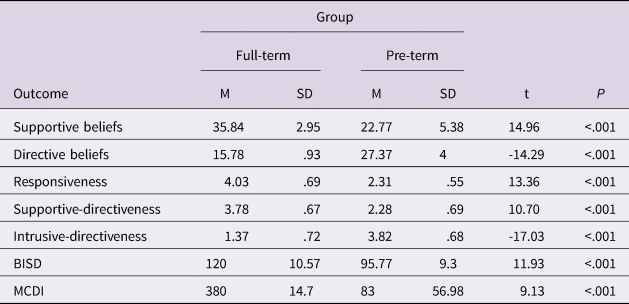
Independent t-tests were run to determine whether any significant group differences between pre-term and full-term groups were present in the current sample with regards to maternal interactive beliefs, style, and children's language development (Table 2). Mothers of pre-term children had significantly higher scores on the directive beliefs subscale, and lower scores on the supportive beliefs subscale, than mothers of full-term children. With regards to interactive style, mothers of pre-term children displayed significantly higher scores on the intrusive-directiveness subscale, and lower scores on the indices of responsiveness and supportive-directiveness. Finally, pre-term children had a lower level of language development than full-term children, as measured by both the Bayley scales and MCDI.
Independent T-tests of Differences Between Pre- and Full-term Groups on Measures of Maternal Interactive Beliefs, Style, and Children's Language Development

Note. BSID = Bayley Scales of Infant Development; MCDI = MacArthur Communicative Development Inventory; *p < .05, **p< .01, ***p< .001.
Hypothesis 2: Interactive beliefs and style predicts language development in different ways in pre-term versus full-term children
Regression analyses were used in the current study to investigate associations between maternal interactive beliefs and language development, and between maternal interactive style and language development. Separate analyses were conducted for pre-term and full-term children, and for the two different indices of language development (MCDI and Bayley Scales). Child's gender and maternal education level were entered as covariates at Step 1 of each equation. Neither of the covariates (maternal education, child gender) were found to be significant predictors of language development in the current study apart from two exceptions: child gender predicted pre-term children's MCDI scores in the regression equation assessing effects of maternal interactive beliefs, and full-term children's MCDI scores in the regression equation assessing effects of maternal interactive style. In both instances, girls’ MCDI scores were higher than boys’. In all four of the models tested, a significant degree of variance in child language was accounted for once all independent variables were entered into the equation. Inspection of individual predictors revealed some important differences, however, in the aspects of maternal interactive beliefs and interactive style predicting language development in pre-term versus full-term children. Interestingly, the effects of maternal beliefs and interactive style were largely the same regardless of which index of language was used as the outcome variable.
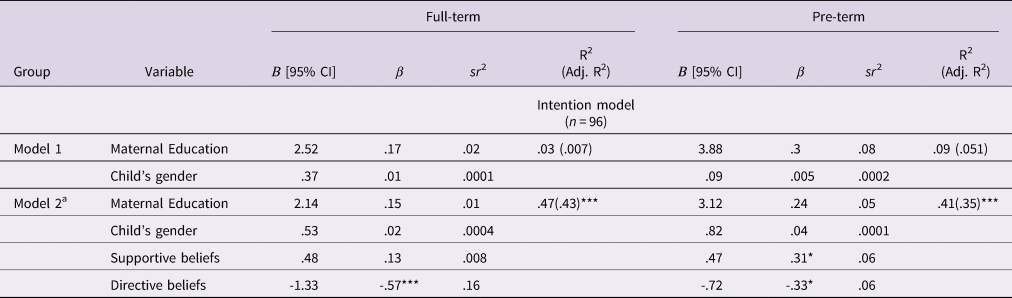
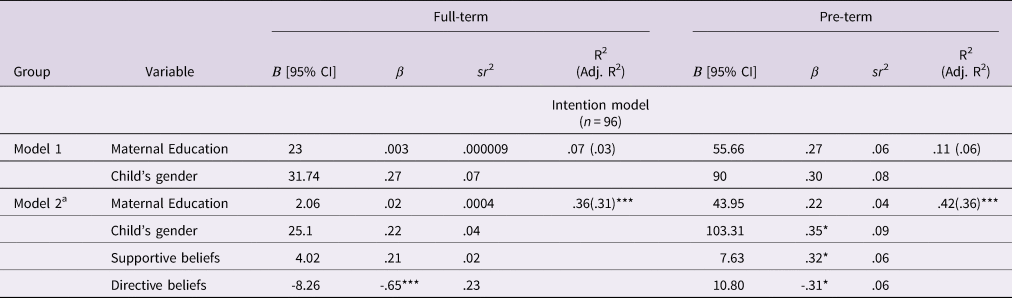
Tables 3 and 4 show the results of the regression equations designed to test whether maternal interactive beliefs predicted language scores for full-term and pre-term children on the Bayley Scales and MCDI, respectively. In both cases there was a significant increment in variance explained by the tested model when the predictor variables were added to the equation at Step 2. Among the full-term children, maternal endorsement of directive beliefs significantly and negatively predicted language as measured by both the Bayley scales and MCDI. In the pre-term group, more advanced language development – measured by both Bayley scales and MCDI – was also significantly and negatively associated with maternal endorsement of directive beliefs, but was additionally associated, positively, with maternal endorsement of supportive beliefs.
Hierarchical Regressions Testing Associations Between Maternal Interactive Beliefs, and Children's Language Development (BSID) in Full-term and Pre-term Groups, Separately

Note. BSID = Bayley Scales of Infant and Toddler Development; Β = unstandardised coefficients; β = standardised coefficients; sr 2 = squared semi-partial correlations; ***p < 001; a. R2 change: F (2, 48) = 19.58, p < .001 and F (2, 42) = 10.88, p < .001for full-term and pre-term analyses, respectively.
Hierarchical Regressions Testing Associations Between Maternal Interactive Beliefs and Children's Language Development (MCDI) in Full-term and Pre-term Groups, Separately

Note. MCDI = The MacArthur Communicative Development Inventory; Β = unstandardised coefficients; β = standardised coefficients; sr 2 = squared semi-partial correlations; ***p < 001; a. R2 change: F (2, 46) = 10.59, p = <.001 and F (2, 42) = 10.90, p = <.001 for full-term and pre-term analyses, respectively.
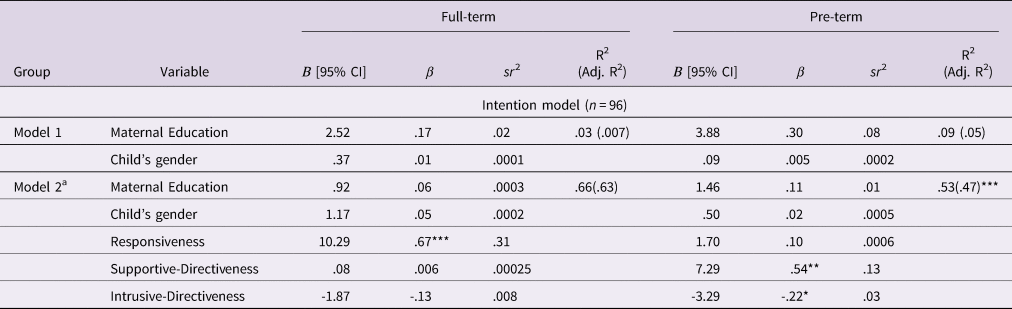
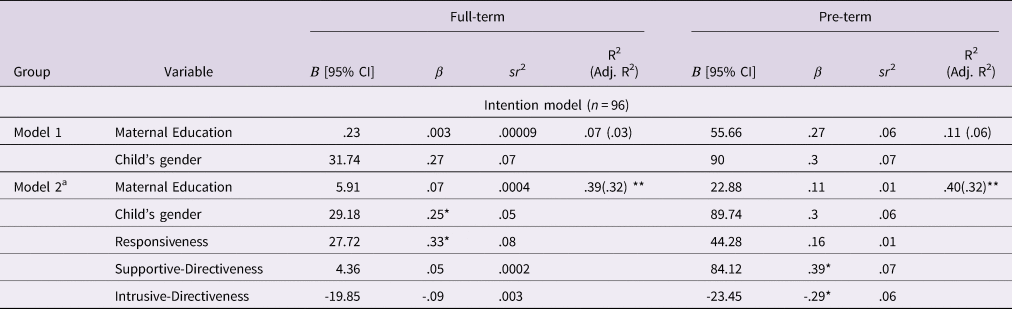
Results of regression analyses conducted to investigate associations between maternal interactive style and language, using scores from the Bayley Scales and MCDI, are presented in Tables 5 and 6, respectively. Once again, significant increases in explained variance occurred once the interactive style variables (responsiveness, supportive-directiveness and intrusive-directiveness) were entered into the equations. For full-term children, maternal responsiveness was found to significantly and positively predict children's language development according to both the Bayley scales and MCDI. Although there was a positive relationship between maternal supportive-directiveness and children's language development and a negative relationship between intrusive-directiveness and children's language development, these associations were not statistically significant. Conversely, in the pre-term group, mothers’ supportive-directiveness, but not responsiveness, was a significant predictor of higher language scores on both the Bayley scales and MCDI; whilst mothers’ intrusive-directiveness was a significant predictor of lower language scores among pre-term children, according to both outcome measures.
Hierarchical Regressions Testing Associations Between Maternal Interactive Styles and Children's Language Development (BSID) in Full-term and Pre-term Groups, Separately

Note. BSID = Bayley Scales of Infant and Toddler Development; Β = unstandardised coefficients; β = standardised coefficients; sr 2 = squared semi-partial correlations; *p < .05, **p< .01, ***p< .001. a. R2 change: F (2, 48) = 28.80, p <.001 and F (2, 42) = 12.43, p < .001 for full-term and pre-term analyses, respectively.
Hierarchical Regressions Testing Associations Between Maternal Interactive Styles and Children's Language Development (MCID) in Full-term and Pre-term Groups, Separately

Note. MCDI = The MacArthur Communicative Development Inventory; Β = unstandardised coefficients; β = standardised coefficients; sr 2 = squared semi-partial correlations; *p < .05, **p< .01, ***p< .001; a. R2 change: F (2, 48) = 7.73, p = <.001 and F (2,42) = 6.47, p = <.001 for full-term and pre-term analyses, respectively.
Discussion
The current study examined the differences between mothers of pre-term and full-term children in terms of interactive beliefs and style and assessed the contribution of maternal interactive beliefs and style on children's language development. This research revealed two main findings. First, significant differences were found between mothers of pre-term and full-term children with regards to maternal interactive beliefs and style. Second, language development was significantly predicted by maternal interactive beliefs and style in both full-term and pre-term children. However, significant predictors differed for full-term versus pre-term children: maternal directive beliefs were identified as a significant predictor of poorer language development in full-term children, while both maternal supportive and directive beliefs predicted language development in pre-term children, with supportive beliefs positively predicting language development and directive beliefs negatively predicting language development. In terms of maternal interactive style, only responsive style positively predicted language development in full-term children; while supportive and intrusive-directiveness predicted language development in pre-term children, with supportive-directiveness positively predicting language development and intrusive-directiveness negatively predicting language development in this group.
Differences between mothers of pre-term and full-term children regarding maternal interactive beliefs
It was hypothesised that, in the current study, significant differences would exist in maternal beliefs and style as a function of birth. As expected, group differences were found between mothers of pre-term and full-term children regarding maternal interactive beliefs. Mothers of pre-term children endorsed more directive and fewer supportive beliefs than mothers of full-term children. Although the contribution of mothers’ beliefs about child development on the development of pre-term children has been previously established (Greenberg, Carmichael-Olson & Crnic, Reference Greenberg, Carmichael-Olson, Crnic, Friedman and Sigman's1992), far fewer studies have investigated maternal interactive beliefs with regards to pre-term children, or compared these beliefs to those of mothers of full-term children. To the best of the current authors’ knowledge, only one other study has compared maternal beliefs in mothers of full-term versus pre-term children – a study that examined the relationship between maternal beliefs about the power of environmental influences in child development and maternal questioning strategies – and this study reported similar maternal beliefs in mothers of full-term and pre-term children (Donahue, Pearl & Herzog, Reference Donahue, Pearl and Herzog1997). However, this study did not examine maternal interactive beliefs.
Group differences between mothers of pre-term and full-term children regarding maternal interactive style
In the current study, mothers of pre-term children displayed more intrusive-directiveness and less supportive-directiveness and responsiveness than mothers of full-term children. These findings are consistent with previous research suggesting that mothers of pre-term children are more directive than mothers of full-term children (Forcada-Guex et al., Reference Forcada-Guex, Pierrehumbert, Borghini, Moessinger and Muller-Nix2006; Ionio et al., Reference Ionio, Lista, Mascheroni, Olivari, Confalonieri, Mastrangelo, Brazzoduro, Balestriero, Banfi, Bonanomi, Bova, Castoldi, Colombo, Introvini and Scelsa2017; Laing et al., Reference Laing, McMahon, Ungerer, Taylor, Badawi and Spence2010). However, it is important to note that, in the current study, directiveness was examined in both its supportive (following the child's focus of attention) and intrusive (interfering the child's focus of attention) forms. Mothers of the pre-term children in the current study particularly tended to engage in more intrusive-directiveness than mothers of the full-term children, meaning that they were more likely to redirect their child's attention and focus.
These observed differences in maternal interactive beliefs and style might be attributable to psychological impacts of the pre-term birth on the mother and the child's prematurity. Previous research has shown that levels of stress and anxiety are higher in mothers of pre-term children compared with mothers of full-term children (Lee et al., Reference Lee, Grantham, Shelton and Meaney-Delman2012), which could in turn affect maternal interactive beliefs and style in the pre-term group. Muller-Nix et al. (Reference Muller-Nix, Forcada-Guex, Pierrehumbert, Jaunin, Borghini and Ansermet2004) found that high-stressed mothers of pre-term children were more controlling and less sensitive than mothers of full-term children and low-stressed mothers of pre-term children. On the other hand, according to more transactional understandings of child development, skills such as language are influenced and facilitated by means of reciprocal interactions between a child and her/his caregiver. Maternal interactive style might therefore be influenced by the pre-term children's characteristics and language skills. When the child is not able to initiate communication and respond to the mother, the mother will not be given the opportunity to respond to the child, and may therefore appear more intrusive than responsive.
There is another possibility regarding differences in maternal interactive beliefs and styles in mothers of pre-term children. While some pre-term mothers have previously been described as being more stimulating and intrusive in interactions with their children, others have been described as unresponsive and insensitive (Minde, Perrotta & Marton, Reference Minde, Perrotta and Marton1985; Muller-Nix et al., Reference Muller-Nix, Forcada-Guex, Pierrehumbert, Jaunin, Borghini and Ansermet2004). These differences in the interactive style of pre-term mothers have been perceived as either an adaptive response to the specific difficulties observed in pre-term children (Crnic, Ragozin, Greenberg, Robinson & Basham, Reference Crnic, Ragozin, Greenberg, Robinson and Basham1983), or as a problematic stimulating, intrusive, and controlling style, which might be detrimental to the pre-term children's developmental skills (Lipsitt, Reference Lipsitt1980). Importantly, mothers of pre-term born children might deliberately choose to engage in interactive strategies – intrusive directive – that they believe will more actively and pointedly assist their children to overcome potential developmental delay. This means that these mothers might be making deliberate decisions regarding their interactive style to support the language development of their children rather than this just being an adaptive response to their child's interactive behaviours, or a ‘passive’ response to their stress and anxiety.
Maternal interactive beliefs and style differentially predicted language development in pre-term versus full-term children
It was also hypothesised in the current study that maternal interactive beliefs and style would differentially predict language development in pre-term versus full-term children. As hypothesised, interactive beliefs and style predicted language development in different ways for pre-term versus full-term children. Maternal directive beliefs negatively predicted language development in full-term children, yet both supportive and directive beliefs predicted language development in pre-term children: with supportive beliefs positively predicting language development and directive beliefs negatively predicting language development in this group. In terms of maternal interactive style, responsiveness was the only predictive variable for language development in full-term children, while maternal supportive and intrusive-directiveness predicted language development in pre-term children: supportive-directiveness was positively associated with more advanced language development, and intrusive-directiveness was negatively associated with more advanced language development.
The findings of the current study seem to provide support for the differential susceptibility theory (Belsky et al., Reference Belsky, Bakermans-Kranenburg and Marinus2007), whereby vulnerable children are more influenced by poor caregiver interaction, such as a directive style, but at the same time are more positively influenced by a supportive interactive style. Previous research has demonstrated that the relationship between maternal interactive style and language development is different in children with language difficulties, such as pre-term children (Barrett, Harris & Chasin, Reference Barrett, Harris and Chasin1991; Landry et al., Reference Landry, Smith, Miller-Loncar and Swank1997; Menyuk, Liebergott & Schultz, Reference Menyuk, Liebergott and Schultz1995). Pre-term children demonstrate lower attention spans, poorer self-regulation, and poorer emotional and behavioural regulation (Brown, Doyle, Bear & Inder, Reference Brown, Doyle, Bear and Inder2006; Woodward, Clark, Pritchard, Anderson & Inder, Reference Woodward, Clark, Pritchard, Anderson and Inder2011) than full-term children. Pre-term children who present with low self-regulation abilities might be both more dependent on, and more responsive to, high quality interaction with their mothers to support their regulation; they may also need more, and benefit more from, guidance to complete goals and activities. A supportive directive style, whereby mothers provide direction that follows the child's ongoing activities or focus of attention, could therefore help pre-term children to successfully regulate themselves and to benefit further from the interaction by way of better language development.
In the current research, an unfavourable effect of an intrusive directive style on language development was also found only in pre-term children. In pre-term children, who have potentially low self-regulation abilities, a maternal intrusive style might be a distraction from the development of self-regulation and prevent interaction with their mothers of the kind most likely to foster language development. In contrast, amongst full-term children, who often demonstrate more effective self-regulation skills, their mother's intrusive style might have a less detrimental effect on their language development. Moreover, full-term children might be in tune with the linguistic environment in which they are participating, and therefore do not need as much support from their parents to communicate (Paavola et al., Reference Paavola, Kunnari and Moilanen2005; Wulbert, Reference Wulbert1975). A responsive style, whereby mothers respond appropriately to the child's cues and signals, might be sufficient to support language in these children.
Children who are more vulnerable to language delay, such as children who are born prematurely (Zubrick et al., Reference Zubrick, Taylor, Rice and Slegers2007) or who already demonstrate language delay, are also more disadvantaged by an intrusive directive interaction style, insofar as they are given less opportunity to improve their language via strategies, such as language scaffolding. In contrast, children who are less vulnerable to language delay are more robust with regards to their developmental processes, and hence more resilient to any breaches in their attentional processes; that is, they are not as dependent on language scaffolding, and therefore require a scaffold with fewer steps to develop normally with regards to language development. These factors may also be reflected in the findings of the current study.
The most important and the unique finding of the current research was that maternal interactive styles differentially predicted language development in pre-term versus full-term children. A supportive directive style positively predicted language development in pre-term children and an intrusive directive style negatively predicted language development in pre-term children, while a responsive style positively predicted language development in full-term children. These findings highlight the importance of applying specific mother-child interaction intervention for different groups of mothers and children. A maternal interactive style that supports language development in a group of typically developing children might have not a positive influence on language development in a group of children with higher risk of language difficulties, such as pre-term children. However, the current study was a cross-sectional study, and mother-child interaction was observed on one occasion only, and with only one child; thus, it is difficult to be sure whether maternal interactive style is a consistent style or a situation/child dependent one. Longitudinal studies observing maternal interactive style with pre-term children at different ages, comparing mothers’ styles of interacting with their pre-term and full-term children, and investigating the role of children's interactive style are all required to confirm and extend the results of the current research.
Association between maternal education, child gender and child language development
Maternal education is one of the main elements of socioeconomic status that is correlated with children's vocabulary skills during early childhood (Hoff, Reference Hoff2003). LeVine, LeVine, Schnell-Anzola, Rowe, and Dexter (2012) found that maternal education predicted maternal responsiveness: more educated mothers were more responsive in interaction with their 10 and 15 month old infants than less educated mothers. More highly educated mothers may be more knowledgeable about child development generally, and hence more likely to endorse supportive beliefs about children's language development than less well-educated mothers, as well as more likely to interact in responsive and supportive-directive ways with their children in order to promote language development. These hypotheses are supported by the relatively low endorsement of both directive beliefs and intrusive directive interactional style amongst the current sample. Highly educated mothers might also place a higher value on language development in early childhood, and thus be more motivated to investigate and develop effective strategies to support it. It is unlikely that the inclusion of more mothers from less educated backgrounds would have made a marked difference to the findings of the current research given that the associations between maternal style and language outcomes would presumably remain. However, it is acknowledged that the effect of socio-economic status (SES) on the findings cannot be known and that a sample representing a more diverse range of SES would have been desirable in order to enhance both the generalisability and validity of the findings.
Existing research has reported that gender influences child language development during early childhood. Girls demonstrate better language skills than boys (Bornstein et al., 2004). However, it is unlikely that gender differences would have made a noticeable difference to the findings of the current research given that there were not a significant difference between the number of boys and girls in both preterm and full-term groups.
Strengths and limitations
The current research contributes to existing knowledge about mother-child interaction and language development in pre-term and full-term children. This research exhibits a number of methodological strengths, including a reliable observational coding system to evaluate maternal interactive style, and the inclusion of different dimensions of interactive style (responsiveness and supportive versus intrusive directiveness). Additionally, children's language development was evaluated using both parental report (MCDI) and a well-known standardised observational scale (Bayley scales, Bayley, Reference Bayley2006). This research involved observing 96 mother-child dyads, a substantial sample size for an observational study.
It must be acknowledged, however, that the current research is limited in its scope in a number of ways. The mothers who were included in the study samples were highly educated, at a level above the Iranian national average. This demographic feature of the research may limit the generalisability of its findings. Research has shown that highly educated mothers have children with greater vocabulary skills than less educated mothers (Arriaga et al. Reference Arriaga, Fenson, Cronan and Pethick1998; Fernald, Marchman & Weisleder, Reference Fernald, Marchman and Weisleder2013; Hoff & Naigles, Reference Hoff and Naigles2002). Maternal educational level has been reported to be positively associated with both expressive and receptive language skills in children at age 36 months (Dollaghan, Campbell, Paradise, Feldman, Janosky, Pitcairn & Kurs-Lasky, Reference Dollaghan, Campbell, Paradise, Feldman, Janosky, Pitcairn and Kurs-Lasky1999) and negatively associated with specific language impairment later on (Tomblin et al., Reference Tomblin, Records, Buckwalter, Zhang, Smith and O'Brien1997). Moreover, it has been hypothesised that highly educated mothers have greater knowledge of child language than less educated mothers, which influences maternal interactive style and children's language development (Levine et al., Reference LeVine, LeVine, Schnell-Anzola, Rowe and Dexter2012).
Another significant aspect of the study, that invites caution, is the cross-sectional nature of the research design. There was no capacity in the current research to track the language development of the children in the study, or the beliefs and interactional style of the mothers. Perhaps more importantly, there was no representation, quantitative or qualitative, of how the dyadic processes of mother-child interaction appeared and operated over time. Employing a longitudinal approach in future research will be important for increasing understanding of the relationships between maternal interactive style, responsiveness, and directiveness, and how these are transacted between mother and child as both the child and the relationship develops.
Furthermore, the mothers who were included in the current study were recruited from Iran. This cultural context may limit the generalisability of the study's findings. In Iran, where collectivistic cultural practices are dominant (Ghorbani, Bing, Watson, Davison & LeBreton, Reference Ghorbani, Bing, Watson, Davison and LeBreton2003), family beliefs are more important than individual personal goals, and mothers expect children to endorse maternal decisions and forgo their individual needs and preferences (Behzadi, Reference Behzadi1994; Rudy & Grusec, Reference Rudy and Grusec2001). Compared with Western mothers, there are greater societal expectations that Iranian mothers will teach children to respect their elders, to avoid expressing disagreements with adults, and to be respectful and obedient to family beliefs and values (Frank, Plunkett & Otten, Reference Frank, Plunkett and Otten2010; Ghorbani et al., Reference Ghorbani, Bing, Watson, Davison and LeBreton2003).
In collectivist cultures such as Iran, interpersonal relationships and family preferences are of major importance (Rudy & Grusec, Reference Rudy and Grusec2001), and mothers are more likely to be classified as authoritarian compared with mothers from more individualistic cultures. Mothers with authoritarian beliefs are often characterised as highly controlling and as emphasising obedience in their interactions with the child (Alizadeh & Andries, Reference Alizadeh and Andries2002). Authoritarian mothers can be less responsive to their children's thoughts and feelings (Alizadeh & Andries, Reference Alizadeh and Andries2002). Interestingly, in many Asian countries, an authoritarian interactive style is categorised as supportive, whereas in the European-American context, this style is considered controlling and demanding (Chao, Reference Chao2001).Thus, it is possible that the cultural or social context is a contributing factor to the relationship between maternal interactive beliefs, interactive style, and children's language development. That is, mothers from different cultural or social contexts may have different beliefs about child development, and these beliefs could influence their maternal interactive style (Harkness & Super, Reference Harkness and Super1996), which in turn influences children's language development.
Finally, it is acknowledged that the observations reported on in the current study may not have been naturalistic due to the presence of a camera and the participants’ knowledge that their interactions were being filmed. Mothers in the study may have engaged in a way of interacting that was not fully representative of their normal pattern. Leslie E. Zegiob, Susan Arnold and Rex Forehand (Zegiob, Arnold & Forehand, Reference Zegiob, Arnold and Forehand1975) examined the effects of an observer's presence on maternal interactive behaviours and found that mothers structured their children's activities more during the informed than uninformed observation conditions. Whilst this issue is not unique to the present study, we accept that the limitations of the procedures used may have had a potential influence on the study's findings.
Future directions
To better contextualise the constructs of maternal beliefs and interactive style, research is required to consider other factors that might impact mother-child interactions, such as children's interactive styles. In the current research, only maternal interactive styles were evaluated and showed that mothers of pre-term children were more directive than mothers of full-term children. However, whether a directive maternal style negatively contributes to a child's language development, or whether this style is an appropriate maternal adaptation to the child's characteristics is indeterminate. There may be some characteristics of children that influence maternal style, in particular amongst children who were born pre-term. Mothers may tailor their interactive style to the interactive characteristics of their children. Research is required to understand whether there are interactive characteristics of children that may enhance or impede their mothers’ level of responsiveness or directiveness.
Other factors needing to be considered in future research are the intrapersonal characteristics of the children (e.g., temperament, timely achievement of developmental milestones, potential risk from birth complications or trauma, potential risk of disability or impairment from genetic causes etc.), and the relationship between a mother and a particular child (e.g., birth order of child, mother's mental health pre- and post-birth, access of mother to information and support regarding child development, mother's history of being parented herself, etc.). Furthermore, there is value in re-constructing the notion of mother-child interaction from one that is unilateral or even bilateral (interactional), to one that is transactional. Research that is able to capture these complexities of mother-child transactions with regards their meaning for children's early language development is a worthy direction for future research.
Conclusion
The results of the current research suggest that: a) maternal beliefs need to be separated into the dimensions of supportive and directive in order to give a more nuanced understanding of their role in the way mothers engage with their children to promote language development; and b) there appear to be different conditions under which the mother's style of interaction predicts better language development in children born full-term versus pre-term. These findings could serve to guide programs devised to enhance mother-child interactions in the context of language development by encouraging practitioners to consider that different interactive styles may have different risks and benefits for children according to their level of language development vulnerability. Such programs could integrate these findings to: a) educate mothers about different interactive styles and research on the potential impact of different styles on language development in typically and atypically developing children; and b) help mothers to identify and practise the style of interaction that is best suited to the individual needs of their child.
Acknowledgements
The Authors acknowledge the mothers and children who participated in this study.
Appendix
Detailed Descriptors of Maternal Interactive Style Ratings.