Since the initial implementation of the Fontan operation in 1971, multiple modifications have been described in the literature. What is now referred to as the “classic Fontan” originally consisted of a direct anastomosis between the right atrial appendage and the main pulmonary artery.Reference Sprindzuk1 The classic Fontan technique fell out of favour due to long-term complications, most notably massive right atrial dilation resulting in recurrent atrial arrhythmia, heart failure, and thrombus formation. Plastic bronchitis and varying degrees of liver failure including hepatic congestion, cirrhosis, and protein losing enteropathy have also been identified.Reference Mavroudis, Backer and Deal2, Reference Poh, Zannino and Weintraub3 While all Fontan patients require specialised long-term care, the new surgical standard, the modified Fontan procedure, comprised of a total cavo-pulmonary connection, using either a lateral caval tunnel or an extracardiac conduit, offers superior long-term results.Reference Schilling, Dalziel and Nunn4
As early as the 1990s, there were descriptions of Fontan conversion, from the classic to the modified Fontan being performed to treat failing single ventricle physiology. Mavroudis et al have reported the largest single centre series of 140 patients, with post-operative improvements in cardiac function, arrhythmia – when performed in conjunction with a MAZE procedure – and regression of the end-organ diseases secondary to Fontan physiology.Reference Mavroudis, Deal and Backer5 Other centres have demonstrated similar experiences in the adult CHD population, with improvement in hospital admissions for heart failure, incidence of cardioversion, need for anti-arrhythmic therapy, and NYHA functional status classification.Reference Sridhar, Giamberti and Foresti6–Reference van Melle, Wolff and Horer15 There is a wide range of reported mortality for this procedure, from 5.7 to 21.9%, but evidence would point to better outcomes with earlier intervention and combined anti-arrhythmic procedures at the time of Fontan conversion.Reference Sridhar, Giamberti and Foresti6–Reference van Melle, Wolff and Horer15 This paper describes a large, single institution experience with Fontan conversion surgery and demonstrates good outcomes when Fontan conversion is pursued at the early onset of arrhythmias or heart failure symptoms.
Methods
Retrospective chart review was performed for all patients between January, 1999 and June, 2017 who underwent conversion from classic Fontan, or other atrio-pulmonary connection, to intra- or extracardiac total cavo-pulmonary connection within our institution.
Pertinent pre-operative characteristics, testing, and diagnoses leading to Fontan conversion were collected. Heart failure was defined as NYHA class ≥ II or ventricular dysfunction with systemic ventricular ejection fraction < 55%. Ventricular dysfunction was categorised as systemic ventricular ejection fraction of <55% based on guidelines for bi-ventricular hearts. Medical management for heart failure was defined as therapy with at least one of the following: a diuretic, beta-blocker, angiotensin receptor blocker, Angiotensin-converting enzyme (ACE) inhibitor, or digoxin. Medical management for atrial arrhythmia included therapy with at least one anti-arrhythmic drug, beta blockers, and/or calcium channel blockers. In cases where liver biopsy was not performed, diagnoses of cirrhosis or fibrosis were based on radiographic demonstration via ultrasound, CT, or MRI. Results of pre-operative testing were included for cardiac catheterisation, CT or MRI, and exercise stress test if they had been performed within 3 years, 10 years, or 1 year of Fontan conversion, respectively.
Continuous variables are represented by the mean, and categorical variables are represented by the number of patients and percentage of the total. Mortality was identified using the institutional records of Indiana University School of Medicine.
Results
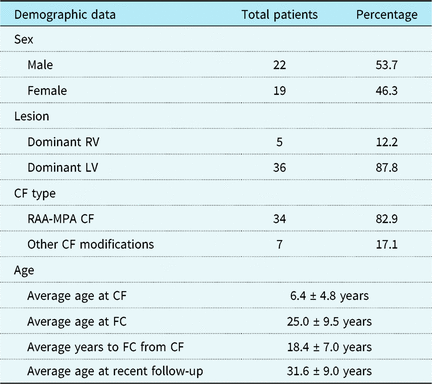
A total of 41 patients were identified, of which 37 had a classic Fontan (right atrial appendage and the main pulmonary artery) anastomosis and the remaining four had an alternative atrio-pulmonary anastomosis. Mean age at original Fontan was 6.4 ± 4.8 years. The majority of patients, 36/41 (87.8%), were left ventricular dominant. Pre-operative characteristics are further described in Table 1.
Demographic characteristics of the FC population.

CF = classic Fontan; FC = Fontan conversion; LV = Left ventricle; RAA-MPA = right atrial appendage-main pulmonary artery; RV = Right ventricle
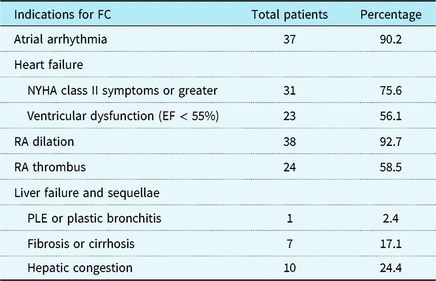
Atrial arrhythmias, identified in 38/41 (92.7%) patients, and right atrial dilation, identified in 33/41 (80.5%) patients, were the dominant reasons for pursuing Fontan conversion in this series (Table 2). Prior to Fontan conversion, 25/41 (61.0%) patients required electrical cardioversion. A cardiac rhythm device was implanted prior to Fontan conversion in 15/41 (36.5%) patients – 10/41 (24.3%) had a pacemaker and 15/41 (36.6%) had an automatic internal cardio-defibrillator. A history of an ablation procedure prior to Fontan conversion was recorded in 13/41 (31.7%) patients (Table 3). Of 41 patients, 24 (58.5%) had thrombus identified pre-operatively or at the time of Fontan conversion.
Indications for FC.

EF = ejection fraction; FC = Fontan conversion; PLE = protein losing enteropathy; RA = right atrium
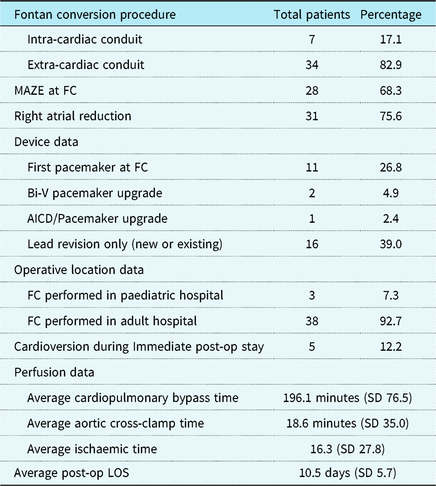
Intraoperative and peri-operative characteristics of FC.

AICD = automatic internal cardiac defibrillator; Bi-V = bi-ventricular; FC = Fontan conversion; LOS = length of stay; SD = standard deviation
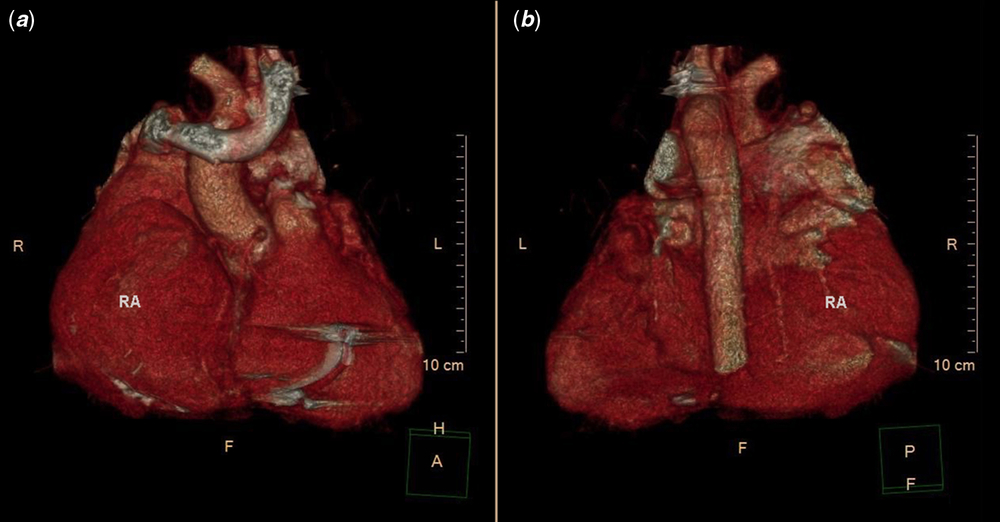
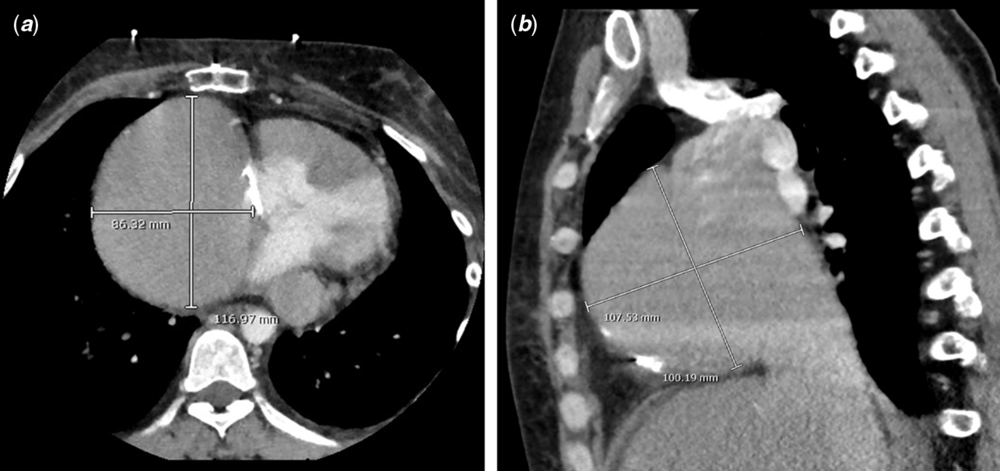
The mean ejection fraction pre-Fontan conversion was 50 ± 11%. Qualitatively, normal ventricular function was identified in 15/41 (36.6%) patients, whereas 15/41 (36.6%), 8/41 (19.5%), and 2/41 (4.9%) had mild, moderate, or severe diminished ventricular function, respectively. Pre-operative evidence of right-sided congestive heart failure was identified in 39/41 (95.1%) patients, with 33/41 (80.5%) demonstrating right atrial dilation, 12/41 (29.2%) with evidence of cirrhosis, fibrosis, or ascites, and 1/41 (2.4%) each with protein losing enteropathy or plastic bronchitis (Figs 1 and 2). Pre-operative evidence of left-sided congestive heart failure was identified in 21/41 (51.2%) patients. NHYA classification, class I through IV, was seen in 9/41 (22%), 18/41 (43.9%), 12/41 (29.3%), and 1/41 (2.4%) patients, respectively. Systemic atrioventricular valve regurgitation was classified as moderate to severe in 4/41 (9.8%), while 26/41 (63.4%) patients had no discernible systemic atrioventricular regurgitation.
CT three-dimensional reconstruction demonstrating massively dilated right atrium in a patient status post a CF operation from (a) anterior and (b) posterior view points. CF = classic Fontan.

CT (a) axial and (b) sagittal images demonstrating massively dilated right atrium in a patient with a CF. CF = classic Fontan.

In terms of pre-operative evaluation, 21/41 (51.2%) patients had a cardiac catheterisation prior to Fontan conversion. For patients who had a cardiac catheterisation prior to Fontan conversion, mean pulmonary artery pressure was 13.7 mmHg (SD 4.46). Pre-operative imaging with CT or MRI was available for 22/41 (53.7%) patients, and 8/41 (19.5%) patients underwent exercise stress testing prior to Fontan conversion. All patients had echocardiography performed pre-operatively.
Mean age at Fontan conversion was 25.0 ± 9.5 years, with 19/41 (46.3%) patients being less than 25 years old at Fontan conversion. There were 34/41 (82.9%) patients who underwent extracardiac Fontan at the time of Fontan conversion, with the remainder undergoing conversion to lateral caval tunnel Fontan. Mean time for cardiopulmonary bypass was 196.1 ± 76.5 minutes, with cross clamp and ischaemic times of 18.6 ± 35.0 minutes and 16.3 ± 27.8 minutes, respectively. Not all patients required aortic cross clamp or ischaemic arrest at the time of conversion. Further operative details are described in Table 4.
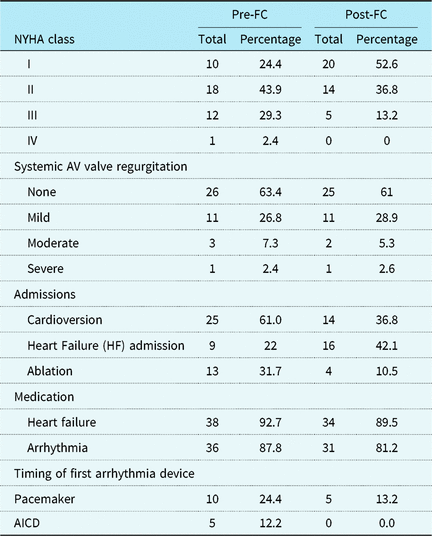
Patient status and admissions pre-FC and post-FC.

AICD = automatic internal cardiac defibrillator; AV = atrioventricular; FC = Fontan conversion
There were 28/41 (68.3%) patients who underwent concomitant MAZE at the time of Fontan conversion, with 24/41 (85.7%) being right sided and the remainder being bilateral MAZE procedures. A new epicardial pacemaker was placed at the time of Fontan conversion in 11/41 (26.8%) patients, while 4/41 (9.8%) had a revision of their prior pacemaker. Pacemaker leads were placed at the time of Fontan conversion in 16/41 (39.0%); of these 4/41 (25.0%) went on to have a pacemaker implanted within 30 days of Fontan conversion. A total of eight patients (19.5%) and six patients (14.6%) developed sick sinus syndrome or atrioventricular block, respectively, at the time of Fontan conversion and 1/41 (2.4%) required a new automatic internal cardio-defibrillator at Fontan conversion as a result.
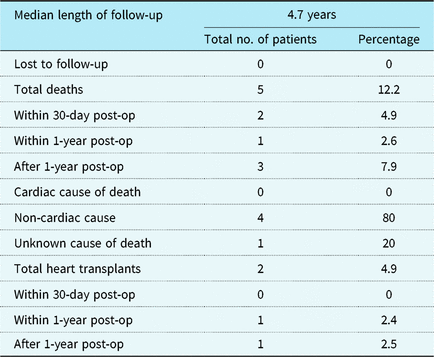
There were a 30-day mortality rate in 3/41 (7.3%) and a 1-year mortality rate in 4/41 (9.8%) in this series. Causes of death in the acute post-operative period include cerebral infarction and hyper-carbic respiratory failure. One patient died at 1.2-month post-Fontan conversion secondary to complications from a cerebrovascular accident. Within the 2-year post-operative period, the distribution of NYHA class I through IV was 71.8% (n = 28), 25.6% (n = 10), and 2.6% (n = 1), respectively. There were no patients with NYHA class IV symptoms during the first two post-operative years. Mean systemic ventricle ejection fraction within the first three post-operative years was 56 ± 10%. Normal systemic ventricular function was identified in 26/41 (68.4%) patients, with 11/41 (28.9%), 2/41 (5.2%), and 1/41 (2.6%) having mild, moderate, and severe diminished ventricular function, respectively.
The mean follow-up time was 6.4 ± 4.9 years. Total mortality rate for this series was 5/41 (12.2%) with a mortality in 3/41 (7.6%) for those surviving greater than 30 days. One patient died at 4.7-year post-Fontan conversion due to prior complications from co-existing mitochondrial disease, cerebral palsy, and chronic respiratory illness. The other patient died unexpectedly at 8.3-year post-Fontan conversion with an unknown cause of death and was referred as a medical examiner case for further investigation at an outside institution.
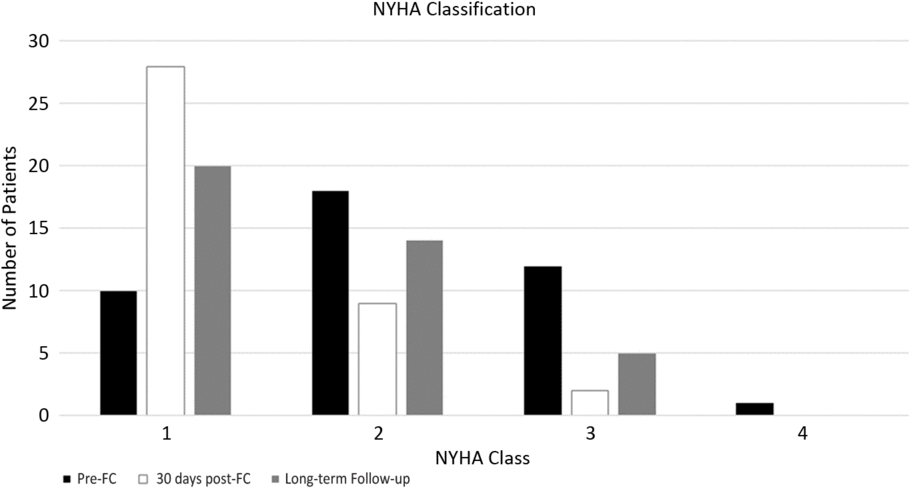
As of the last follow-up, 20/41 (52.6%) patients were NYHA class I, 14/41 (36.8%) patients were NYHA class II, and 5/41 (13.2%) were NYHA class III. There were no patients in the NYHA class IV category. There was no atrioventricular valve regurgitation in 25/41 (65.8%) patients, with 11/41 (28.9%), 2/41 (5.3%), and 1/41 (2.6%) having mild, moderate, or severe regurgitant atrioventricular valves, respectively. Similarly, 23/41 (60.5%) patients had normal qualitative ventricular function. Mild, moderate, and severe diminished function was seen in 12/41 (31.6%), 2/41 (5.3%), and 1/41 (2.6%), respectively. Right-sided congestive heart failure symptoms were seen in 10/41 (26.3%) patients, and 10/41 (26.3%) had evidence of cirrhosis, fibrosis, or ascites post-operatively (Table 2). Left-sided congestive heart failure requiring hospital admission post-Fontan conversion occurred in 16/41 (42.1%) patients. Of all surviving patients, 11/41 (28.9%) have undergone post-operative cardiac catheterisation and 11/41 (28.9%) patients underwent post-operative exercise stress testing. For patients who underwent catheterisation both before and after Fontan conversion, systemic ventricular end diastolic pressure was a mean of 8.8 mmHg pre-Fontan conversion and 11.0 post-Fontan conversion. Mean pulmonary artery pressure was 13.7 mmHg pre-Fontan conversion and 10.2 mmHg post-Fontan conversion.
There were 27/41 (65.8%) patients who experienced a recurrence of arrhythmias after Fontan conversion, with 19/41 (50%) experiencing clinically significant episodes of recurrence. Cardioversion after Fontan conversion was performed in 14/41 (36.8%) patients, and another 4/41 (10.5%) patients required an electrophysiology study with catheter ablation after Fontan conversion. There was new atrioventricular block in 2/41 (5.2%) and sick sinus syndrome in 5/41 (13.1%) patients. A new pacemaker was placed in 5/41 (13.1%) patients in the follow-up period. There were no patients who required implantation of a new automated internal cardioverter-defibrillator. A thrombus developed in 6/41 (15.8%) patients after Fontan conversion.
Transplant evaluation was performed in 5/41 (13.2%) patients post-Fontan conversion, with 2/41 (5.2%) going on to cardiac transplantation. Among patients evaluated but not accepted for transplantation, systemic end diastolic pressure and mean pulmonary artery pressure were 13 mmHg and 13.7 mmHg, respectively. Of note, the three patients turned down for transplantation remain alive as of this writing. Mean follow-up for patients who were rejected for transplant is 9.43 years (range 6.8–14.1 years). The range for time to transplantation was 0.5–5.3 years. One patient required transplantation due to dilated cardiomyopathy resulting in ventricular tachycardia and liver failure. The second patient developed severe congestive heart failure and atrial fibrillation which required transplantation. One of these patients went on to undergo a re-transplantation because of transplant vasculopathy and dilated cardiomyopathy in the transplanted heart. Complete follow-up data are described in Table 5.
Follow-up after FC including death and heart transplant.

FC = Fontan conversion
Discussion
All the classic Fontan patients experienced arrhythmias, and atrial arrhythmias were the most common indication for Fontan conversion. Presence of significant atrial arrhythmias prior to Fontan conversion was identified by either ambulatory ECG recording, device interrogation, inpatient admission, or other acute treatment for atrial arrhythmias. The decision to proceed with Fontan conversion was driven primarily by symptoms and documentation of an enlarged right atrium and/or presence of persistent or permanent atrial flutter, rather than based on more formal testing.
Other pre-operative diagnoses leading to Fontan conversion were right atrial dilation, which was also found in all patients, right atrial thrombus, and an NYHA functional class of II. Low cardiac output from ventricular dysfunction was also included in this patient population; however, it should be noted that there is no current published normal value for single ventricle physiology. NYHA class II symptoms or greater was demonstrated in 31/41 (75.6%) patients prior to Fontan conversion, and 23/41 (56.1%) patients had some form of ventricular dysfunction pre-operatively. Specific NYHA class assignments both pre- and post-Fontan conversion, as well as rates of heart failure admissions, and medication requirements are listed in Table 3. Overall, there was a step down in NYHA classification and decreased rates of cardioversion or ablation after Fontan conversion (Fig 3).
Bar graph demonstrating the total number of patients prior to FC, 30 days after FC, and on long-term follow-up, classified as NYHA class I, II, III, and IV, respectively. FC = Fontan conversion.

A non-statistically significant number of patients could stop heart failure or anti-arrhythmic medications completely after Fontan conversion; however, their continued treatment with these medications may be necessitated by their single ventricle anatomy and lack of long-term natural history data.Reference Wilson, Iyengar and Winlaw16 It was noted that the rate of heart failure admissions increased post-Fontan conversion; however, this again could be attributable to increasing patient age and natural progression of their disease course rather than as a complication of Fontan conversion.
Regarding pre-operative liver disease, patients were identified with either documented fibrosis or cirrhosis based on liver biopsy, liver ultrasound, or abdominal CT before Fontan conversion (Table 2). One patient had protein losing enteropathy prior to Fontan conversion and had complete normalisation of albumin levels within 1-year post-Fontan conversion.
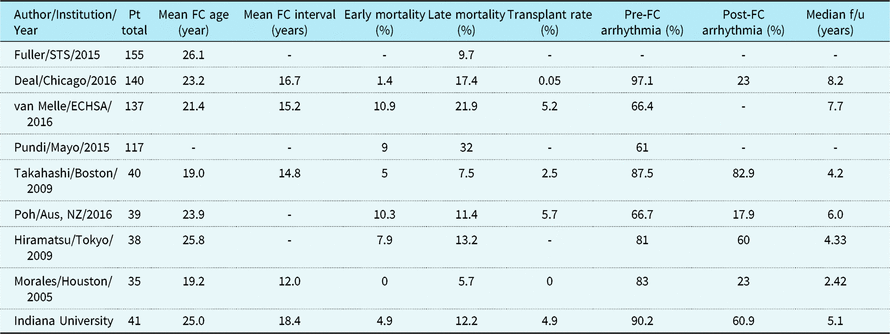
Long-term results in this institution are like those previously established in the literature.Reference Mavroudis, Deal and Backer5 Table 6 provides a summary of the larger case series describing Fontan conversion and their outcomes. Of the patients included in this series, five were evaluated for transplantation, and two progressed to heart transplantation. No transplantation was required within the immediate 30-day post-operative period. Only one patient required cardiac transplantation within 1-year post-Fontan conversion and subsequently went on to receive a second heart transplant within 5 years. One patient required late cardiac transplantation at 5.3-year post-Fontan conversion due to ongoing complications from liver failure. No patients required heart–liver transplant.
FC literature summary.

FC = Fontan conversion
Overall, our institution has employed a more aggressive strategy favouring early intervention for the management of classic Fontan patients. There was no discrete time for adoption of this institutional policy, which makes comparison within this cohort relatively difficult. However, this policy overall was found in the promising literature published by other groups.Reference Mavroudis, Backer and Deal2 In total, our centre performed a total of 68 classic Fontan operations and the majority have had Fontan conversion. Some of the Fontan conversion patients described had the initial Fontan at other centres. In general, our institutional trend has favoured Fontan conversion in patients with documented right atrial dilation after an initial episode of sustained atrial arrhythmia rather than waiting for more significant episodes or symptoms. Only a minority of patients in our centre have undergone electrophysiology studies with attempts at a catheter ablation rather than Fontan conversion. In most cases, these were patients who were lost to specialised adult CHD follow-up care and instead managed by a general adult cardiologist. The change in follow-up care, namely the access to cardiologists with specialised knowledge of the Fontan and appropriate post-operative care, is another key facet of our institutional model.
Our data show that while a smaller number of patients in our series had pre-operative evaluation including cardiac catheterisation and formal liver testing prior to progression to Fontan conversion, our mortality data are comparable to centres employing a more exhaustive pre-operative workup.Reference Deal, Costello, Webster, Tsao, Backer and Mavroudis17 The limited use of pre-operative evaluations and interventions, such as ablations, evolved initially from provider preference into an institutional pattern. We hypothesise that an earlier, more aggressive approach prior to onset of more serious symptoms can lead to better outcomes, as has been postulated in transplantation protocols for these patients as well.Reference Backer, Russell and Pahl18
This study was limited by the availability of retrospective data and lack of documentation regarding specific NYHA classification, other than symptomatology in clinical notes. Additionally, not all patients had the same pre-operative testing consisting of cardiac CT or MRI, cardiac catheterisation, and exercise stress test. Lastly, not all patients had formal hepatology testing beyond standard liver function tests pre- and post-operatively, thus the number of individuals with liver disease and specifically cirrhosis may be underestimated. Perfusion data records were unavailable for 7 patients, and cardiopulmonary bypass data represent the total available data for the remaining 34 patients. Finally, death records were not available for one patient in our series, thus that patient’s cause of death remains unknown.
In conclusion, these data demonstrate that a strategy of early surgical treatment of atrial arrhythmia in classic Fontan patients can be pursued, with a low post-operative mortality rate, improvement in patient status, and improved quality of life in terms of arrhythmia burden, heart failure, and risk of thrombus recurrence.
Author ORCIDs
Adam C. Kean 0000-0003-3966-4261
Conflicts of Interest
The authors have no conflicts of interest to disclose.
Ethical Standards
The authors assert that all procedures contributing to this work comply with ethical standards and with the Helsinki Declaration of 1975, as revised in 2008, and has been approved by the Indiana University School of Medicine institutional review board.