Constant progress in surgical treatment of congenital heart defects in the last decade has significantly improved the prognosis for children with hypoplastic left heart syndrome.Reference Januszewska, Kozlik-Feldmann and Kordon 1 However, morbidity and mortality remain relatively high. Owing to specific anatomy and haemodynamics, complications still pose a serious challenge in the treatment of patients with hypoplastic left heart syndrome.Reference Barron, Kilby, Davies, Wright, Jones and Brawn 2 – Reference Heinemann, Breuer, Steger, Steil, Sieverding and Ziemer 4 Modern interventional procedures complement or occasionally replace surgical treatment.Reference Moszura, Mazurek-Kula and Dryzek 5 – Reference Bacha and Hijazi 7 They can be successfully applied either before, during, or after various stages of palliative treatment. The purpose of this paper is to report our 10 years of experience of interventional treatment of patients with hypoplastic left heart syndrome and to focus on the frequency, type, and results of percutaneous interventions during all the stages of palliation, considering the different techniques, devices, and complications.
Materials and methods
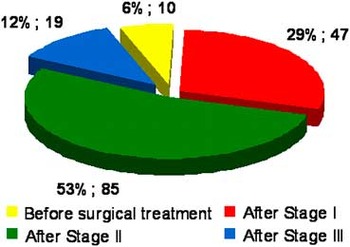
Between January, 2001 and December, 2010, 161 percutaneous interventions were performed in 88 patients with hypoplastic left heart syndrome. Patients were divided into four groups: (a) before the first surgical treatment including hybrid approach, (b) after first-stage Norwood operation, (c) after second-stage bidirectional Glenn operation, and (d) after third-stage Fontan operation (Fig 1). After obtaining vessel access, the patients received heparin (100 IU/kg), and after the intervention low-molecular-weight heparin (100 IU/kg) for 3 days and aspirin (3 mg/kg) indefinitely.
Distribution of percutaneous interventions in patients with hypoplastic left heart syndrome with reference to the stage of surgical palliation (no. of interventions, %).

Before the surgical treatment
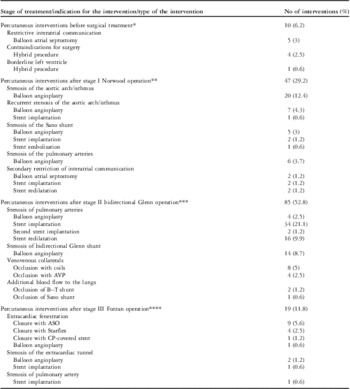
As initial treatment of hypoplastic left heart syndrome, 10 interventions were performed (Table 1). Owing to significant restriction of interatrial communication, five of the patients had isolated balloon atrial septostomy, and in the next five patients joint decisions with cardiac surgeons were made for a hybrid procedure.
Percutaneous interventions in patients with hypoplastic left heart syndrome at all stages of palliation.

AVP = Amplatzer Vascular Plug; ASO = Amplatzer Septal Occluder; CP = Cheatham-Platinum. Mean body weight 3.2 kg (2.2–4.3)*, 7.5 kg (4.1–14.2)**, 18 kg (6.3–35.5)***, 39.2 kg (19.5–97)****
Restrictive interatrial communication was diagnosed prenatally in three patients, and in the remaining two patients the diagnosis was made after birth. All newborns required immediate intubation and mechanical ventilation in the delivery room owing to low arterial oxygen saturation – the saturations ranged between 33% and 63%. There were two patients with the lowest O2 saturation (<50%) and acidosis who received constant infusion of catecholamines in addition to prostaglandin-E1.
In four patients with contraindications for surgery with extracorporeal circulation – sepsis, asphyxia, multi-organ failure with coagulation disorders, and severe coexisting congenital anomalies – a hybrid procedure was performed.
In one patient with critical aortic stenosis, small mitral valve annulus, and left ventricle, a combined treatment was performed. On the 1st day of life, after surgical cut-down of the right carotid artery, balloon valvuloplasty of the aortic valve was performed. Despite successful intervention, reduction of pressure gradient, and increase in contractility of the left ventricle, catecholamine support could not be weaned off because of retrograde flow in the aortic arch. Bilateral pulmonary artery banding was performed with subsequent stent implantation in the patent ductus arteriosus. To stimulate growth of the left ventricle, restriction of the interatrial communication was left untreated.
Hybrid procedures were performed on 14th to 54th day of life. After prior surgical bilateral pulmonary artery banding, patients were transferred to the catheterisation laboratory, where stent implantation of patent ductus arteriosus was performed combined with concomitant balloon atrial septostomy. Early in our experience, balloon-expandable Palmaz–Genesis (Cordis, Johnson and Johnson, Bridgewater, New Jersey, United States of America) stents were used, and later on self-expandable Zilver (Cook, Bloomington, Indiana, United States of America) stents were used.
After stage I Norwood operation
After stage I Norwood operation, 38 patients underwent 47 percutaneous interventions (Table 1).
Stenosis of the aortic arch and isthmus was treated in 20 patients ranging in age between 2 and 9 months. In 15 patients, intervention was performed through femoral arterial access, and in the remaining five patients via venous access. Both low-pressure (Tyshak – NuMed Inc., Hopkinton, New York, United States of America) and high-pressure (Advance – Cook, Opta – Cordis) balloons were used. The size of the balloon was chosen according to the diameter of the descending aorta below the stenosis and was equal to or at most 2 mm larger.
In eight patients with stenosis of right ventricle-to-pulmonary artery (Sano) shunt, all interventions were performed as emergency procedures. The patients ranged in age from 1.5 to 5 months, and O2 saturations measured while on mechanical ventilation with 100% oxygen ranged from 28% to 67%. The minimal diameter of the stenosis was 1.5–3 mm. Interventional treatment involved the use of low- or high-pressure (Advance) balloon angioplasty and stent implantation (Palmaz–Genesis).
In all, six patients, ranging in age from 4 to 7 months, with proximal stenosis of the left (4) or the right (2) pulmonary artery, had balloon angioplasty with low-pressure Tyshak (4) or high-pressure Aqua (2, Cordis) balloons. The catheter was advanced directly through the Sano shunt without using a long guiding sheath. All patients were heparinised before the intervention.
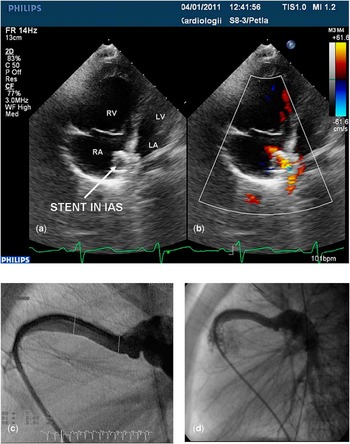
Secondary restriction of interatrial communication was the indication for an intervention in four infants aged 6 between 12 months. The pressure gradient ranged from 8 to 15 mmHg and the mean left atrial pressure from 15 to 24 mmHg. Restriction of interatrial flow appeared despite creation of a wide communication during the stage I Norwood operation. At this stage, owing to secondary elevation of pulmonary artery pressures, patients were excluded for the next stage of treatment – bidirectional Glenn operation. In two of the patients, static balloon atrial septostomy was performed. In two patients, restrictive interatrial communication was treated with stent implantation (Palmaz–Genesis, Cordis, Fig 2a, b). The indication for this intervention was the presence of a thick (>2 mm) septum on echocardiography. The intervention was monitored with trans-oesophageal echocardiography.
Rescue interventional procedures. Palmaz–Genesis stent implanted to the interatrial septum, ( a ) modified four-chamber view, ( b ) with colour Doppler. Critical, proximal stenosis of the Sano shunt, ( c ) angiographic view before the intervention, ( d ) after Palmaz–Genesis stent implantation. IAS = interatrial septum; LA = left atrium; LV = left ventricle; RA = right atrium; RV = right ventricle.

After bidirectional Glenn operation
The biggest number of interventions was performed after the second stage of surgical treatment. In all, 64 patients received 85 interventions (Table 1). These included balloon angioplasty and stent implantation of stenosed pulmonary arteries in 38 patients, balloon angioplasty of stenosed bidirectional Glenn shunt in 14, closure of venovenous collaterals in nine, of a Blalock–Taussig shunt in two, and of Sano shunt in one. A total of 19 patients had more then one intervention, the most frequent being a combination of stent implantation and closure of venovenous collaterals or closure of venovenous collaterals and Sano or systemic-to-pulmonary artery shunt.
Isolated balloon angioplasty of pulmonary arteries was performed in four patients with localised discrete stenosis at the bifurcation, and 34 patients had stent implantation. The patients ranged in age from 10 to 66 months. In the majority of patients (15), the stenosis was localised at the proximal segment of the left pulmonary artery, at the bifurcation at the site of connection of the Sano shunt in nine, proximal left and right pulmonary artery in six, and right pulmonary artery between the pulmonary artery bifurcation and the Glenn shunt in four. Stents were redialated in 16 patients, and in another two patients implantation of the second stent was performed.
A total of 14 patients, ranging in age from 5 to 44 months, had stenosis of the bidirectional Glenn shunt. Low-pressure balloons (Tyshak) were used to relieve the obstruction in all patients except one, in whom a high-pressure balloon (Opta) was used. In 12 patients, the stenosis occurred in relation to a right-sided superior vena cava, and in the remaining two with bilateral Glenn shunts, in the dominant vein.
Venovenous collaterals causing arterial desaturation were occluded in nine patients ranging in age from 18 to 55 months. In three patients, additional sources of pulmonary blood flow, one Sano shunt and two systemic-to-pulmonary shunts, were also occluded. The interventions were performed with Amplatzer Duct Occluders and Amplatzer Vascular Plugs (St. Jude Medical Inc., Minnesota, United States of America).
After third-stage surgery – Fontan operation
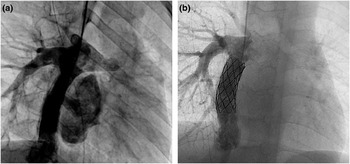
In patients aged between 30 and 101 months, after the completion of the Fontan operation 19 interventions were performed (Table 1). These included closure of extracardiac fenestration in 14 patients, widening of the stenosed extracardiac tunnel with balloon angioplasty in two or Cheatham-Platinum stent implantation in one (Fig 3a, b), and self-expandable stent implantation in a stenosed left pulmonary artery in one. There was one patient, with signs of failing Fontan, who required interventional widening of extracardiac fenestration.
Standard ( a ) and rotational angiography ( b ) in the patient after Fontan operation with patent fenestration and distal stenosis of the extracardiac tunnel ( a ). Image after implantation of Cheatham Platinum stent to the extracardiac tunnel ( b ).

Statistical analysis
Systolic, diastolic, and mean pressure levels, pressure gradients, diameter of the stenosis, O2 saturation before and after interventions, and patients’ age were described with mean and standard deviation or medians and ranges. Accordance of the aforementioned variables with normal distribution was checked using the Shapiro–Wilk test. For parameters consistent with normal distribution, the Student t-test was applied; otherwise, the non-parametric Wilcoxon test was used. A p-value < 0.05 was considered statistically significant. Calculations were performed with STATISTICA, StatSoft, Inc. (2007) v 8.0.
Results
Before the surgical treatment
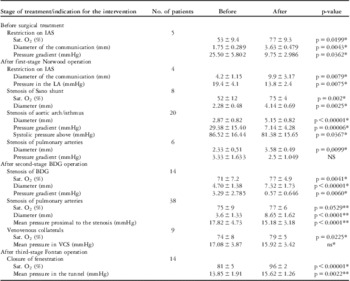
In this group of five newborns with restriction of interatrial communication, interventional treatment was successful in four (Table 2). In a newborn with intact interatrial septum, cardiac arrest occurred several times directly after birth and in the catheterisation laboratory. Attempts to create an interatrial communication failed and the baby died. At autopsy, hypoplastic left heart syndrome with intact atrial septum was confirmed. In three patients, intervention allowed for clinical and haemodynamic improvement, and they underwent stage I Norwood operation on the 10th, 13th, and 17th day of life, and one neonate died because of intractable generalised infection with multi-organ failure.
Results of percutaneous interventions in patients with hypoplastic left heart syndrome at all stages of palliation.

BDG = bidirectional Glenn; IAS = interatrial septum; ns = non-statistical; sat. = saturation; VCS = vena cava superior
*Student's t-test
**Wilcoxon's test
Hybrid treatment performed in five newborns allowed for haemodynamic improvement and cessation of prostaglandin-E1 infusion. In the 3rd and 4th month of life, two patients died because of coexisting disease: one patient because of hepatic cirrhosis during the course of long treatment of resistant sepsis, and because of progressive nephropathy with several other congenital anomalies in the other.
Combined balloon dilation of the aortic valve with stent implantation into a patent ductus arteriosus and bilateral pulmonary artery banding led to haemodynamic improvement in a patient with aortic stenosis and borderline left ventricular size. During a follow-up of 18 months, a gradual increase in the ejection fraction and the left ventricular end-diastolic dimension occurred. The patient was subsequently suitable for a Ross operation combined with ductal stent excision.
After stage I Norwood operation
In nine patients, the systolic pressure gradient after the intervention was < 5 mmHg, in four patients between 5 and 10 mmHg, and in seven higher than 10 mmHg, and so was the indication for balloon angioplasty before the next step stage treatment (Table 2). In one patient, rapid recurrence of the stenosis was the indication for Palmaz–Genesis (7 × 18 mm) stent implantation.
Of the eight patients with severe stenosis of the Sano shunts, percutaneous treatment was successful in seven (Table 2). There were five patients who required only balloon angioplasty and the remaining two had stent implantation (Fig 2c, d). In one patient, the stent embolised to the right ventricle during withdrawal of the balloon catheter. The guidewire was left in place through the stent and the patient was transferred to the operating theatre; the stent was removed and bidirectional Glenn operation was successfully performed.
Balloon angioplasty of the stenosed proximal pulmonary arteries was successful in all six patients (Table 2).
In all patients with secondary restriction of interatrial communication, an increase in the diameter of the communication was achieved with a decrease in the mean left atrial pressure (Table 2). In 50% of the patients, static atrial septostomy was sufficient, whereas the remaining two patients required stent implantation in the septum. In two patients, because of the recurrence of the restriction, the stents were successfully redilated 6 and 8 months later.
After bidirectional Glenn operation
In the largest group of patients with stenosis of pulmonary artery branches, stent implantation resulted in a statistically significant widening of the stenosis, an increase in O2 saturations, a decrease in the pressure gradient through the stenosis and pulmonary artery pressure proximal to the obstruction (Table 2).
In the group of 14 patients with stenosis of bidirectional Glenn shunt, balloon angioplasty resulted in a statistically significant increase in O2 saturations, reduction of pressure gradient, and widening of the stenosis (Table 2). In two patients with elevated superior vena cava pressure, concomitant attempt to close the Sano shunt was also undertaken. In one patient, closure of the shunt resulted in desaturation to 77%, and in the second patient trial occlusion of the shunt caused a significant decrease in O2 saturations to 62%, and thus the shunt was left open.
In all, nine patients had successful closure of venovenous collaterals. The increase in O2 saturation was statistically significant, with a secondary decrease of pressure in the superior vena cava (Table 2).
After third-stage surgery – Fontan operation
In the group of 14 patients, closure of extracardiac fenestration resulted in a statistically significant increase in O2 saturation. Immediately after the intervention, complete occlusion of the right-to-left shunt was achieved in five patients (Qp/Qs = 1:1), and in seven patients the shunt was trivial (Qp/Qs > 0.9:1). In one patient with venous collaterals to pulmonary veins, right-to-left shunt persisted (Qp/Qs = 0.85:1). A decrease in Rp/Rs and an increase in mean pressure in the extracardiac tunnel were statistically significant (Table 2). There was one patient, with distal stenosis of the extracardiac tunnel, who had implantation of a covered Cheatham-Platinum stent, resulting in complete closure of the fenestration and normalisation of the tunnel diameter. There was one patient who died as a result of coronary artery embolism.
In two patients, balloon angioplasty of the stenosed extracardiac tunnel was performed, and in one patient a Cheatham-Platinum stent was implanted. Complete normalisation of the tunnel dimensions and a decrease in pressure gradient were achieved.
In one patient, stent implantation of the left pulmonary artery resulted in widening of the stenosis and a decrease of venous pressure in the tunnel from 17/14, mean of 15 mmHg to 15/14, mean of 13 mmHg.
There was one patient, with a failing Fontan circulation, who required widening of the fenestration, resulting in a decrease of venous pressure in the tunnel from 24/19, mean of 22 mmHg to 18/17, mean of 16 mmHg, and a decrease in symptoms, urine loss of protein and ascites, together with significant desaturation from 88% to 73%.
Complications
Complications directly related to the interventions occurred in 4.3% (7/161) cases.
In four children, complications were related to stent implantation to the bifurcation and proximal segment of left pulmonary artery. Stent fracture and fragmentation occurred in two patients, compression of the left main bronchus in one, and compression of the native aorta and coronary vessels during stent redilatation in the left pulmonary artery with a long balloon catheter in one.
In one patient, the stent embolised to the right ventricle during an attempted implantation into a proximally stenosed Sano shunt.
Transient complete heart block occurred in one patient during introduction of the balloon catheter from antegrade venous approach to a stenosed aortic arch.
In one patient, a fatal embolus to coronary arteries occurred after closure of extracardiac fenestration.
Discussion
In the management of patients with hypoplastic left heart syndrome, the most challenging ones are those in whom surgical treatment may not be optimal and the resulting different complications force additional percutaneous or surgical interventions.Reference Barron, Kilby, Davies, Wright, Jones and Brawn 2 , Reference Moszura, Mazurek-Kula and Dryzek 5
Before the surgical treatment
Restriction of interatrial communication in patients with hypoplastic left heart syndrome may contribute to adverse outcome after surgical treatment.Reference Barron, Kilby, Davies, Wright, Jones and Brawn 2 In our group of patients, decompression of the left atrium was achieved by either static balloon atrial septostomy or stent implantation. The former method may be more effective when the atrial septum is thin; however, the final result and especially the diameter of the interatrial communication is difficult to predict, whereas the latter method is performed in patients with a thick septum.Reference Pedra, Neves and Pedra 8 – Reference Stumper, Gewillig and Vettukattil 10 The Park blade atrial septostomy catheter was not used in our neonatal patients, because of the higher reported rate of complications.Reference Gewillig, Boshoff and Mertens 9 , Reference Stumper, Gewillig and Vettukattil 10
Neonatal critical aortic stenosis is currently an accepted indication for percutaneous balloon valvuloplasty in the first few hours of life, and the results are comparable with surgical valvotomy.Reference McCrindle, Blackstone and Williams 11 Our group of patients included one newborn with aortic stenosis with a small mitral valve, endocardial fibroelastosis, and right ventricle forming the apex and a borderline left ventricular size. Although the patient underwent a successful balloon valvuloplasty, the left ventricle could not provide high enough systemic flow.Reference Rhodes, Colan, Perry, Jonas and Sanders 12 , Reference Schwartz, Gauvreau and Geva 13 Therefore, a hybrid procedure was performed without atrial septostomy to encourage mitral flow and growth of the mitral valve and the left ventricle. After 2 years, the diameters and function of the left ventricle have normalised and the patient was referred for a Ross operation with excision of the ductal stent.
In five of our patients, a hybrid treatment with bilateral pulmonary artery banding, stent implantation in patent ductus arteriosus, and balloon atrial septostomy were performed. There are several papers describing a hybrid approach and comparing it with the conventional surgical approach.Reference Akintuerk, Michel-Behnke and Valeske 6 , Reference Bacha and Hijazi 7 In our institution, the Norwood operation is the preferred first-stage treatment for hypoplastic left heart syndrome, and the hybrid approach is reserved for those patients who are deemed unsuitable for surgery with extracorporeal circulation.
After stage I Norwood operation and stage II bidirectional Glenn operation
The Sano modification of the Norwood operation – right ventricle-to-pulmonary artery shunt – may reduce mortality after the first stage of surgical treatment.Reference Januszewska, Stebel and Malec 14 However, the development of critical stenosis of the Sano shunt may be life threatening. In these patients, we usually recommend an initial balloon angioplasty, and then depending on the outcome may consider implanting a stent in the Sano shunt.Reference Muyskens, Nicolas, Foerster and Balzer 15
The largest number of interventions were in two types of complications of multi-stage treatment: stenosis of the aortic arch/isthmus and stenosis of the pulmonary arteries. These separate anatomical and haemodynamic situations may be interlinked.Reference Dasi, Sundareswaran and Sherwin 16 On measurements from computed tomographic reconstructions, Dasi et al hypothesised that more extensive reconstruction of the aortic arch may limit growth of the pulmonary artery. An aggressive approach is recommended for intervention in those patients in whom the gradient across the aortic arch is greater than 10 mmHg.Reference Moszura, Mazurek-Kula and Dryzek 5 , Reference Chessa, Dindar and Vettukattil 17 , Reference Moszura, Mazurek-Kula, Dryżek, Moll, Moll and Sysa 18
In patients with hypoplastic left heart syndrome, as in other patients with univentricular physiology, it is important for successful surgical treatment to achieve optimal morphologic and haemodynamic parameters of the pulmonary arteries.Reference Douglas, Goldberg, Mosca, Law and Bove 19 After the Norwood operation, the geometry of the pulmonary arteries is changed and proximal stenosis may occur in 42–58% of patients, especially when the Sano modification is applied.Reference Nakano, Fukae and Sonoda 3 Isolated balloon angioplasty is rarely successful in patients with stenosis of pulmonary arteries and hypoplastic left heart syndrome. We used balloons to assess the compliance and spatial configuration of pulmonary arteries before the intended stent implantation. Changes in the ST segments on electrocardiography were also observed during balloon inflation, because of possible compression of the native ascending aorta.
Haemodynamically significant venovenous collaterals, causing a decrease in O2 saturation, may be related to elevated blood pressure in the pulmonary arteries.Reference Heinemann, Breuer, Steger, Steil, Sieverding and Ziemer 4 , Reference Moszura, Mazurek-Kula and Dryzek 5 , Reference Moszura, Mazurek-Kula, Dryżek, Moll, Moll and Sysa 18 , Reference Ruiz, Gamra, Zhang, García and Boucek 20 Stenosis of the bidirectional Glenn shunt is one of the reasons for increased pressure in upper body systemic venous system. Balloon angioplasty is usually sufficient and results in total widening of the stenosis with improved flow to both the pulmonary arteries. In our patients, this approach was successful in all patients, including infants in whom the stenosis occurred soon after the operation.
In those patients with venovenous collaterals, percutaneous embolisation was performed with both coils and Amplatzer Duct Occluder or Vascular Plug. The latter are important in patients with large collaterals.Reference Moszura, Mazurek-Kula and Dryzek 5 , Reference Moszura, Mazurek-Kula, Dryżek, Moll, Moll and Sysa 18
After third-stage surgery – Fontan operation
Surgical creation of a fenestration between the extracardiac or lateral tunnel and the right atrium may decrease early mortality and morbidity, especially in high-risk patients. Decompression of the systemic venous circuit may result in a significant reduction of protein loss and effusions, with augmentation of cardiac output.Reference Kopf, Kleinman, Hijazi, Fahey, Dewar and Hellenbrand 21 , Reference de Leval 22 However, the presence of a fenestration carries the risk of paradoxical embolism and desaturation, and may require an intervention to close it. During longer follow-up, small fenestrations tend to close spontaneously. In the remainder, an increase of O2 saturation <90% during trial occlusion may be considered an indication for percutaneous closure.Reference Goff, Blume, Gauvreau, Mayer, Lock and Jenkins 23
With fenestrations, we have mainly used Amplatzer Septal Occluders because of the need for smaller introducing sheaths and easy repositioning of the device before final release. Alternatively, a fenestration can be closed with implantation of a covered stent. This eliminates any protruding material in the right atrium. This may be important in patients with coagulation disorders, and in addition the stenosed tunnel can be widened at the same time, if needed. The disadvantages of using a covered stent include limited possibility to reposition an already deployed stent and large profile introducing sheaths. When there is a trivial right-to-left shunt through the device, this closes spontaneously within 1 month.Reference Alva, David, Ortegón, Sánchez, López and Ledesma 24
Complications
In our patients, complications occurred in 4.3% of interventions and were related mainly to stent implantation in stenosed pulmonary arteries.Reference Moszura, Mazurek-Kula, Dryzek and Sysa 25 The complications related to percutaneous interventions are similar in the literature, with technical challenge, not patient's age and general condition, being the most important predisposing factor.Reference Agnoletti, Bonnet and Boudjemline 26 In a retrospective analysis of 805 consecutive interventions in our catheterisation laboratory, the number of complications was lower at 3.6%.Reference Moszura, Świątnicka-Lucińska and Dryżek 27
Fracture and fragmentation of Palmaz–Genesis stents occurred in two patients after implantation in a severe tubular stenosis of the proximal left pulmonary artery. The first patient presented with bradycardia and severe desaturation after extubation and required cardiac massage, which was probably responsible for the fracture of the stent. A second patient required implantation of an additional stent, but fracture and fragmentation of both stents occurred.
Such complications are relatively rare; however, stent fractures without fragmentation are not uncommon.Reference McElhinney, Bergersen and Marshall 28 Central location of the stenosis and possible compression by the reconstructed aorta may predispose to stent fracture. In both our patients, broken stents were treated with a Cheatham-Platinum stent, which is more resistant to fracture. A computed tomography of the chest was performed before stent implantation to evaluate the relations of the left main bronchus, aorta, and the fractured stent. Apart from fragmentation, recurrence of tight stenosis was an indication for intervention.Reference Knirsch, Haas, Lewin and Uhlemann 29 Compression of the left main bronchus occurred after implantation of the second stent with no clinical symptoms after the first implantation. Therefore, before stent redilatation, it is reasonable to perform additional diagnostic tests to recognise potential sites of compression. Compression of the bronchus resulted in an increase in the need for mechanical ventilation, which then had a negative impact on the pulmonary blood flow in the patient after bidirectional Glenn shunt. Balloon dilation of the left main bronchus was performed, although it may only be partially effective and there is a risk of restenosis.Reference Antón-Pacheco, Cabezalí and Tejedor 30
The only fatal complication in our patients was related to the formation of thrombus on the left-sided disc of the Starflex device. At autopsy, one of the legs of the devices was not apposed to the septum on the left atrial side. When properly deployed and apposed to the septum, thrombus formation on the left-sided disc is rare and may occur with older types of devices. In the literature, thrombus formation was described before closure of the fenestration rather than afterwards.Reference Pihkala, Yazaki and Mehta 31
Conclusions
Patients with hypoplastic left heart syndrome require additional percutaneous interventions between different stages of surgery, with the largest number of interventions being performed in those patients after bidirectional Glenn shunt and before Fontan operation.
Percutaneous interventions may result in haemodynamic stability and reduction in the number of operations. They may result in significant changes in pulmonary artery pressures, vessel diameters, O2 saturation, and a low rate of complications, which are mainly related to stent implantation in the pulmonary arteries. Non-standard, emergency interventions such as stenting of critically stenosed Sano shunts or restrictive interatrial communications can be performed successfully and safely in critical patients.