Introduction
Rapid tranquillisation (RT) is often regarded as a high-risk clinical intervention. Defined as the use of medication to rapidly calm the severely agitated or aggressive patient, medication should initially be offered orally, but if this is refused or inappropriate to the situation it should be administered parenterally (National Institute for Health and Clinical Excellence, 2005). Parenteral administration will often involve restraint, resulting in this intervention carrying both medication and non-medication related risks.
Medication related risks will be dependent on what is administered. Cardiac effects, extrapyramidal effects (EPSEs), respiratory depression, seizures, sedation progressing to loss of consciousness, hypotension and neuroleptic malignant syndrome can all be associated with some or all of the medicines commonly used for RT. The risk of these adverse effects may be compounded by other patient-related factors including pre-existing medical conditions, neuroleptic naivety and other medications that are co-prescribed.
Non-medication related risks tend to centre on the process of restraint. Recommendations from an independent enquiry into the death of a detained patient emphasised the importance of improved physical safety measures (Blofeld et al. Reference Blofeld, Sallah, Sashidharan, Stone and Struthers2003). Adverse effects of medicines used in RT, excited delirium, prolonged struggling and exhaustion have been cited as enhancing the possibility of positional asphyxia occurring (Police Complaints Authority, 2002; Joint Committee on Human Rights, 2004).
In recent years the NHS Litigation Authority (NHSLA) has targeted practice surrounding this intervention. This special health authority plays an important role in the UK healthcare system by indemnifying the NHS and providers of NHS care against claims for negligence. Simultaneously, they work to improve risk management practices by assessment using a series of risk management standards (NHS Litigation Authority, 2012). There is a financial incentive for healthcare providers to perform well in these assessments. Those attaining a higher level of assessment secure a substantial decrease in the annual contribution premium they pay to the NHSLA. With a risk management standard devoted solely to RT, many healthcare providers have recently sought to strengthen their systems around RT. Much of this attention has focused on the healthcare provider's RT documents, post RT physical health monitoring and actively auditing to ensure that this occurs in clinical practice.
Despite this, recent work has highlighted wide ranging and concerning variations that exist with regards to recommendations set out in RT documents in the UK. This variation applies to the drugs being recommended, what clinical situations these should or shouldn't be used in, and what physical monitoring should be carried out after RT (Innes and Iyeke, Reference Innes and Iyeke2012; Innes & Sethi Reference Innes and Sethi2013). Furthermore, in a recent national survey less than a third of trusts approached could provide evidence that post RT physical health monitoring was occurring. Even when the evidence from those trusts that could provide it was reviewed, the number of times recommended observations were actually performed gave cause for concern (Loynes et al. Reference Loynes, Innes and Dye2013).
Ultimately, the processes and procedures that are used before, during and after RT must be evidence-based, patient-centred and above all relevant to the risk. In this study we aim to quantify this risk by looking at medication-related RT patient safety incidents (PSIs) reported to the National Reporting and Learning System (NRLS) over the course of one year. Whilst there is currently no standardised method for recording RT, PSIs on incident reporting systems in the UK (PSIs may be reported under a number of categories that include medication incidents), we believe our decision to choose medication PSIs provides a logical starting point in attempting to gauge the clinical risk associated with this intervention.
Aim
To identify and analyse medication PSIs occurring following RT that were reported to the NRLS over the course of one year.
Method
The National Health Service Commissioning Board (NHSCB), who currently hold the NRLS, were contacted on the 20 November 2012 requesting access to the following information:
-
1. A list of all the medication incidents stored on the NRLS related to RT occurring between 1 August 2010 and 31 July 2011;
-
2. The nature of the trusts where these PSIs originated;
-
3. The free text associated with each of the incidents identified in this list to allow further categorisation of the incidents.
The above information was received on 18 December 2012.
Results
Thirty-two medication related PSIs were extracted from the NRLS relating to RT, occurring between 1 August 2010 and 31 July 2011.
Four of the incidents were unrelated to RT, but had been extracted because they included the words ‘rapid tranquillisation’ in the free text of the completed incident form.
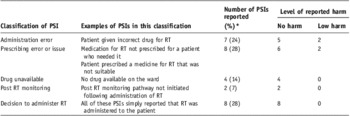
Of the remaining 28 PSIs, 25 (89%) originated from mental health trusts, 2 (7%) from general or acute trusts and 1 (4%) from a social care facility. None of these PSIs related to any adverse effects or harm following the administration of RT. They could instead be classified into five categories, which are listed in Table 1.
Breakdown of extracted medication PSIs relating to RT from NRLS

*n = 29 as one incident was counted twice as both a prescribing and administration error occurred
Discussion
The NRLS is a dynamic reporting system that exists to enable learning in the NHS, containing in excess of 4 million PSIs. In April 2010 it became mandatory for all NHS organisations to report all PSIs that resulted in severe harm or death to the NRLS. Consequently, there is a wealth of data that is stored in this database and we felt that this was the most appropriate target for investigating medication PSIs relating to harm or adverse effects following RT.
By searching for incidents between August 2010 and July 2011 we ensured that we were looking at a time period during which it was mandatory for trusts to report PSIs that resulted in severe harm or death to the NRLS. Simultaneously, this gave a sufficient length of time to allow PSIs to be reported to the database.
Despite searching for all medication related PSIs linked to RT over a one-year period, the number of incidents extracted from the NRLS was low. Twenty-eight PSIs, that mostly originated from mental health trusts, could be categorised into administration errors, prescribing errors or issues, unavailability of medicines, failure to implement post RT monitoring and the decision to implement RT. However, no incidents were related to adverse effects or harm encountered post administration of RT.
Whilst no data exists on the frequency of use of RT, it is well documented that the NHS encounters violent behaviour on a regular basis. In 2012 a total of 59,744 violent incidents were reported and these were over three times more likely to occur in mental health services than in other NHS services (NHS Protect, 2012). Given that RT is the next recommended step after failed de-escalation (National Institute for Health and Clinical Excellence, 2005), it can safely be assumed that this is an intervention that will be commonly used and is likely to be repeated in the thousands over a year's period in the UK.
The results of this study therefore demonstrate that either there were no clinical complications following RT, or that our data is not representative of all post RT complications occurring during the time period examined. The answer is most certainly the latter.
The caveats associated with this study are numerous and also apply to the entire reporting system for RT as a whole. When a patient develops an adverse effect following RT, at what point does it stop being classified as a predictable adverse outcome and start being classified as a PSI? Many minor complications will not be reported at all, whilst some may be via the healthcare provider's incident reporting system and/or the Medicines Healthcare Regulatory Agency yellow card adverse drug reaction reporting system. Even when PSIs are reported on the healthcare provider's incident reporting system, there is no standardised system to attribute the incident as being related to RT. Instead, the member of staff completing the incident form is required to select another category that they feel is most appropriate to the incident; in some incident reporting systems there are in excess of 50 of these. This leads to numerous issues when attempting to investigate incidents related to RT on the NRLS. The investigator has to pre-select a ‘best fit’ category that will relate to RT. In this study we elected for ‘medication incident’. They are then forced to employ a free text search of incident report forms for the words ‘rapid tranquillisation’ which is of course dependent on what the reporter wrote in this section of the form and how they spelt the term itself. Another caveat applies, but this time related to the process in which incident forms are sent to the NRLS. Currently, is it only mandatory for Trusts to report to the NRLS PSIs that resulted in serious harm or death to the service user. Therefore, it cannot be assured that the data on the NRLS is completely representative of all PSIs involving RT.
With such a fragmented system for reporting RT related PSIs, the task of examining such incidents in their entirety is neither easy nor simple. In this study we describe a single search strategy that produced extremely limited results. Consequently this data cannot be generalised and it is not possible to establish clinical risk associated with this intervention.
This information in itself is very interesting. RT generates all sorts of reactions from patients and clinicians, as it is often used in association with physical restraint. Its inclusion by the NHSLA as a risk management standard has cemented its status as a ‘high-risk’ clinical intervention. It has also had a profound effect for many NHS healthcare providers as they have targeted practice around this intervention by upgrading RT documents as well as improving post RT physical health monitoring. Yet despite this, little is known about the frequency and severity of PSIs following RT. The results of this study indicate that this information would be extremely difficult to determine.
We suggest that incident reporting systems should contain a sub-category for RT and that an incident form should be completed after every occurrence of RT being used. This would enable a better understanding of the frequency with which this intervention is employed and provide more conclusive information on the incidence and severity of post RT complications.
Conclusions
In this study we have undertaken a single search strategy of the NRLS that has produced limited results. While the system for reporting RT related PSIs remains fragmented, examining such incidents in their entirety will be neither easy nor simple. Our work indicates that there needs to be a more relevant, reliable and robust system for reporting incidents related to RT. This would be in the interests of the patient, clinical staff and healthcare organisation, as it would enable providers to tailor post RT support more specifically to this intervention and thereby do a better job of fulfilling national priorities.