

INTRODUCTION
The global environment currently supports nearly 7 billion people through a range of ecosystem services that include food production, water supply and sanitation. By 2050, the global population is projected to grow by another 2 to 4 billion (FAO, 2006), and with it will come greater stresses on the natural environment. The challenges of limited resources and food security are further complicated by climate change. Even beyond the hundreds of millions of small-scale farmers, livestock keepers and fishermen, whose livelihoods depend on continued food production, end consumers will feel the effects of food supply shortages and price shocks, as occurred in the recent East Asian rice crisis in 2008 (Balfour, Reference Balfour2008) and Russian grain crisis in 2010 (Economist, 2010).
Agricultural and food systems are complex and dynamic. Many may now face climate variability beyond the current ‘coping range’. Increasingly frequent and intense extreme weather events, exacerbated by climatic variability within and between seasons, create stresses on agriculture. Longer-term changes heighten concerns for food security, particularly for populations reliant on smallholder rainfed farming systems in the drier (i.e. sub-humid to arid) tropics (Easterling et al., Reference Easterling, Aggarwal, Batima, Brander, Erda, Howden, Kirilenko, Morton, Soussana, Schmidhuber, Tubiello, Parry, Canziani, Palutikof, van der Linden and Hanson2007; Parry et al., Reference Parry, Rosenzweig and Livermore2005). The Inter-governmental Panel on Climate Change (IPCC) anticipates with high confidence that projected longer-term changes in the climate baseline, i.e. increased average temperatures and changes in rainfall regimes, will have further and significant consequences for food and forestry production (IPCC, 2007).
The IPCC predicts an approximate 50% decrease in yields from rainfed agriculture by 2020 in some countries (Working Group II, 2007), while other studies show an aggregate yield decline of 10% by 2055 for smallholder rainfed maize in sub-Saharan Africa, Central America and South America, representing an economic loss of about US$2 billion each year (Jones and Thornton, Reference Jones and Thornton2003). Likewise, more than half of the Indo-Gangetic Plains (IGP), currently a major wheat producing area, may become too heat-stressed for the crop by 2050 (Ortiz et al., Reference Ortiz, Sayre, Govaerts, Gupta, Subbarao, Ban, Hodson, Dixon, Iván Ortiz-Monasterio and Reynolds2008). In short, despite significant uncertainties in the science, there is an emerging consensus that global food security is under threat from climate change.
Smallholder and subsistence farmers, pastoralists and fisherfolk are likely to be vulnerable to these impacts. Furthermore, limited empirical evidence suggests that in rainfed farming systems the costs are disproportionately borne by the poor (Rosenzweig and Binswanger, Reference Rosenzweig and Binswanger1993; Zimmerman and Carter, Reference Zimmerman and Carter2003). Agricultural researchers and rural development practitioners therefore need to develop strategies and frameworks to address climate change threats to food security. Strategies will include no-regret, win-win solutions that have the immediate benefits of higher incomes, improved livelihoods, better food security and greater environmental health. However, other solutions will require careful analysis of trade-offs. The unprecedented speed and extremity of predicted changes will require tough decision-making, preparatory policies and enabling incentives – employed in an environment of uncertainty and trade-offs.
This paper outlines an adaptation and mitigation framework for agriculture and food security in developing countries. The framework has been developed as the road map for further agricultural research through the Consultative Group of International Agricultural Research (CGIAR) Research Program on Climate Change, Agriculture and Food Security (CCAFS), a research for development collaboration between the CGIAR and the Earth System Science Partnership. As an overview, it places climate risk management, the focus of this special issue in the broader, integrated context of what needs to be done to tackle the agricultural challenges of climate change.
AN ADAPTATION AND MITIGATION FRAMEWORK
A multi-pronged approach is required to address the challenges of climate variability and climate change to food security. Taking this into account, we propose an adaptation and mitigation framework based on four principles:
1. In the short term, we must address and manage risk due to climate variability and its effects on food security.
2. We must explore how climate risk management can then develop into longer-term adaptation to changes in climate baselines.
3. We must exploit the potential for emissions mitigation and carbon sequestration in developing country agriculture, while acknowledging that mitigation should not compromise food security or economic development.
4. Both adaptation and mitigation efforts feed back into the earth system hence benefits of, and trade-offs between, likely adaptation and mitigation actions must be analysed and considered together.
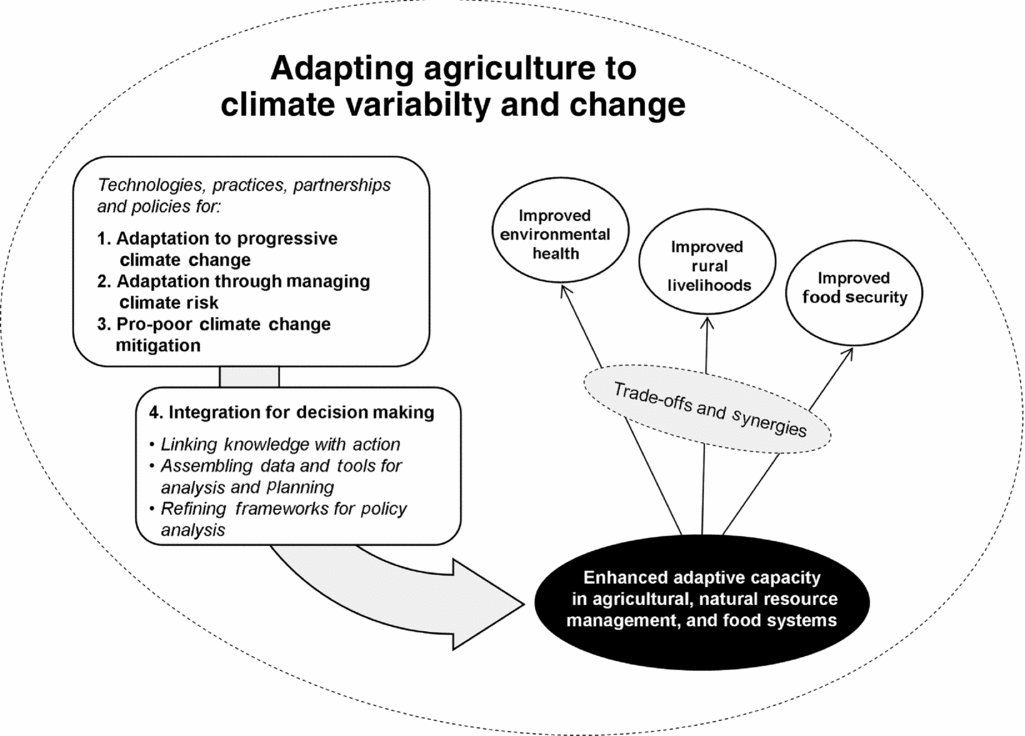
An adaptation and mitigation framework based on these principles is outlined in Figure 1. The framework is discussed overall in this section, and subsequent sections address the four primary research thrusts outlined.
CCAFS framework for adaptation and mitigation research.
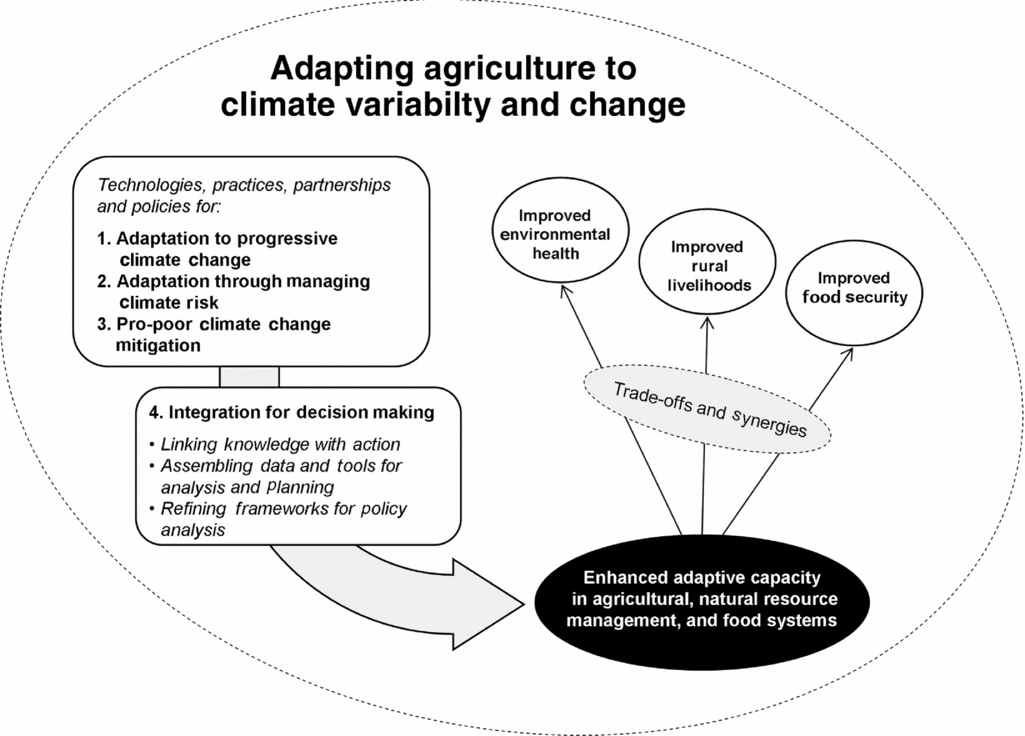
The overall goal of the framework is to convert agricultural and food systems into resilient and sustainable structures capable of confronting global change at multiple spatial and temporal scales and reducing the impact of agriculture on climate change. To do so, we divide the agenda into four primary research thrusts, the first three of which focus directly on interventions on the ground and the last of which promotes uptake of research results to maximize impact. The proposed interventions must then be trialled and evaluated holistically, noting trade-offs and feedbacks in terms of the three principle developmental and environmental goals: improved environmental health, improved rural livelihoods and improved food security.
Interventions can be divided into three interacting categories – climate risk management, progressive adaptation and mitigation of net emissions – between which exist synergies and trade-offs. The dividing line between climate risk management and progressive adaptation is largely temporal – i.e. climate risk management refers to short-term strategies to cope with impacts, which may be insufficient in dealing with climate change further down the line. The difference can also be one of scale, as often long-term adaptation requires larger, more systemic and transformational change. Drawing from distinct bodies of knowledge, these three research themes form the backbone of effective adaptive agriculture – identifying and developing the instruments, technologies, practices, partnerships and integrated strategies necessary to prepare rural communities for a variable and changing climate.
The fourth research thrust, ‘Integration for Decision Making’, grounds science and analysis in the global policy environment, via engagements with rural communities, policy-makers and relevant institutions. Effective and sustained communication with stakeholders is critical to building understanding of opportunities and constraints, as well as to developing the capacity to diagnose vulnerabilities, identify appropriate interventions and to assess their relative effectiveness.
MANAGING RISK: THE CHALLENGES OF CLIMATE VARIABILITY
In response to climate variability, risk-averse small producers often employ conservative coping strategies ex-ante – sacrificing appropriate investment, intensification and adoption of innovation to protect against the threat of shocks (reviewed in Barrett et al., Reference Barrett, Barnett, Carter, Chantarat, Hansen, Mude, Osgood, Skees, Turvey and Ward2007; Hansen et al., Reference Hansen, Baethgen, Osgood, Ceccato and Ngugi2007) – and in turn causing rural poverty to persist. Moreover, despite hedging against risk, farmers are still exposed to uninsured climate shocks such as droughts or floods, whose damage to health, productive assets and infrastructure can affect livelihoods long after the stress has ceased (Dercon, Reference Dercon2004; McPeak and Barrett, Reference McPeak and Barrett2001). Without effective intervention, projected increases in climate variability can be expected to intensify the cycle of poverty, natural resource degradation, vulnerability and dependence on external assistance. Managing current climate risk, the specific focus of this special issue, is therefore integral to a comprehensive strategy for adapting agriculture and food systems to a changing climate. Given pressing current development challenges and a 2015 deadline for the Millenium Developments Goals, management of current climate risk also offers attractive win-win opportunities for developing countries to contribute to articulated immediate development priorities, while reducing vulnerability to a changing climate.
Climate risk management is emerging as a promising framework for engaging climate in development. It includes systematic use of climate information in planning and decision making, climate-informed technologies that reduce vulnerability to climate variability, and climate-informed policy and market-based interventions that reduce risk to vulnerable rural populations. In doing so, it aims to address the full range of variability, balancing protection against climate-related hazards with efforts to capitalize on opportunities arising from more favourable climatic seasons. Climate risk management also requires serious attention to the policy and institutional environment in which information is used and adaptations are made.
Where they are skilful, seasonal climate predictions appear to offer substantial potential to improve risk management, but seldom reach poor smallholder farmers in a usable form, i.e. within a comprehensive package of information and support (Hansen et al., Reference Hansen, Challinor, Ines, Wheeler and Moron2006; Reference Hansen, Baethgen, Osgood, Ceccato and Ngugi2007; Reference Hansen, Mason, Sun and Tall2011, this issue; Patt et al., Reference Patt, Ogallo and Hellmuth2007; Vogel and O'Brien, Reference Vogel and O'Brien2006). If historical precedent is indicative, the potential benefits of such systems are enormous. In Mali, where the national meteorological service was launched some 25 years ago, farmers receive three-tiered information packages including seasonal forecasts, forecasts for the next three days and ten-day bulletins with agriculture-specific information. Participating farmers have benefited from significantly higher yields and incomes of up to 80% more than non-participants (Moorhead, Reference Moorhead2009). Such examples exemplify how better use of historic and monitored weather data, combined with agricultural simulation models (for example Dixit et al., Reference Dixit, Cooper, Rao and Dimes2011, Gathenya et al., Reference Gathenya, Mwangi, Coe and Sang2011, Stern and Cooper, Reference Stern and Cooper2011, all this issue), can permit the ex ante quantification of climate-induced risk and give decision-makers the tools to prioritize the interventions with higher probabilities of success. Further research can also be done to monitor and predict the spread of pests and diseases affecting plants (see Farrow et al., Reference Farrow, Musoni, Cook and Buruchara2011, this issue), livestock and humans.
Recent agricultural economics literature on poverty traps (see Barrett et al. Reference Barrett, Bezuneh and Aboud2001; Carter and Barrett, Reference Carter and Barrett2006; McPeak and Barrett, Reference McPeak and Barrett2001; Santos and Barrett, 2005) describes bifurcated wealth dynamics: households fall into one of two different ‘clubs’, separated by threshold lines above which asset accumulation occurs and below which a cycle of poverty reigns.
Poverty traps explain why climate variability more strongly impacts households in the lower, structurally poor club, both before and after weather shock. Ex-ante, risk aversion can minimize asset accumulation. Ex-post, the biophysical effects of the shock itself, as well as the coping mechanisms of farmers (e.g. liquidating assets to smooth consumption), can push vulnerable households back under the critical asset threshold and into the poverty trap (Barrett et al., Reference Barrett, Barnett, Carter, Chantarat, Hansen, Mude, Osgood, Skees, Turvey and Ward2007).
As such, poverty traps demonstrate the need for providing:
1) Low-risk liquidity (e.g. certain microfinance programmes) to those in the poverty trap, allowing poor households to accumulate assets, take advantage of returns to scale and overcome minimum barriers to entry for creating added value (e.g. cheese derived from milk) (Barrett et al., Reference Barrett, Bezuneh and Aboud2001).
2) Risk transfer products (e.g. rainfall-indexed insurance) to all vulnerable populations to prevent households from slipping or falling further into the poverty trap (Santos and Barrett, Reference Santos and Barrett2006).
These financial instruments can help farmers overcome long-standing information asymmetries and show promise for addressing risk-related constraints to adoption of new technologies, rural poverty reduction and food security. The rapid resurgence of interest in such products is therefore justifiable, but important knowledge gaps regarding the logistics of implementation still exist (Barrett et al., Reference Barrett, Barnett, Carter, Chantarat, Hansen, Mude, Osgood, Skees, Turvey and Ward2007).
Risk can also be reduced through non-financial means. There is substantial scope for using climate information to better target engineering projects (e.g. irrigation systems and flood-protective coastal walls); manage grain storage, trade and distribution (e.g. Arndt and Bacou, Reference Arndt and Bacou2000; Hill et al., Reference Hill, Mjelde, Love, Rubas, Fuller, Rosenthal and Hammer2004); and better target external assistance for emerging food crises (Haile, Reference Haile2005). Research should address critical knowledge gaps related to: targeting, package design, institutional challenges to implementation at scale, managing basis risk and implications of advance information. In all cases, investment in resources is necessary to test, improve and refine the proposed risk management approaches.
ADAPTATION TO PROGRESSIVE CLIMATE CHANGE
Food systems naturally evolve and adapt, responding to short-term dynamics such as climate variability. In this way, many of the projected impacts of climate change are amplifications of the substantial challenges that climate variability already imposes. The risk management measures detailed above simply improve upon traditional knowledge and conventional adaptation strategies. However, the key challenge for both food security and the agricultural economy is to accelerate food system adaptation enough to anticipate and keep up with progressive climate change. Accomplishing this task requires a multi-pronged strategy: analysis of farming systems; generation and use of new technologies; and changes in agricultural practices including diversification of production systems, improved institutional settings, enabling policies and infrastructural improvements (Beddington, Reference Beddington2010; Tubiello et al. Reference Tubiello, Schmidhuber, Howden, Neofotis, Park, Fernandes and Thapa2008). In sum, accelerated adaptation requires larger, structural changes.
Future farming and food systems will have to be better adapted to a range of abiotic and biotic stresses to cope with the direct and indirect consequences of a progressively changing climate, e.g. higher temperatures, altered precipitation patterns and rising sea levels. Germplasm improvement, natural resource management, advanced agrichemicals and enhanced agro-biodiversity have a proven track record of decreasing susceptibility to individual stresses and will offer increasingly important solutions for adapting to progressive climate change (Jackson et al., Reference Jackson, Pascual and Hodgkin2007). However, technical innovations will not be sufficient on their own. Strengthening the adaptive capacities of farmers and other land users requires a variety of strategies ranging from altering the crop calendar to diversifying production systems, all of which must be reinforced by enabling institutional settings. Adaptive management to continually refine these strategies will be required and can be supported by the predictive capacity of downscaled global climate models, e.g. forecasts on precipitation, coupled with more effective communication with end users.
Intensively managed cropping systems offer a variety of entry points to adjust to projected climate change (Aggarwal and Mall, Reference Aggarwal and Mall2002; Butt et al., Reference Butt, McCarl, Angerer, Dyke and Stuth2005; Challinor et al., Reference Challinor, Wheeler, Craufurd, Ferro and Kassam2007; Easterling et al., Reference Easterling, Chhetri and Niu2003; Howden et al., Reference Howden, Soussana, Tubiello, Chhetri, Dunlop and Meinke2007; Travasso et al., Reference Travasso, Magrin, Baethgen, Castaño, Rodriguez, Pires, Gimenez, Cunha and Fernandes2006). Breeding and marker-assisted selection have been important mechanisms for achieving yield improvements for most crops as long as suitable mega-varieties are available that can be used for introgressing improved genes (Bennett, Reference Bennett, Kijne, Barker and Molden2003). In natural resource management, conservation agriculture offers resource-poor farmers a set of possible options to cope and adapt to climate change (Thomas et al., Reference Thomas, de Pauw, Qadir, Amri, Pala, Yahyaoui, El-Bouhssini, Baum, Iñiguez and Shideed2007). Improved water management will represent the key adaptation strategy in both irrigated and dryland agriculture. Emphasis will also be given to crop production systems located in the delta regions, e.g. IGP mega-deltas, to sustain high production potentials under sea level rise (Wassmann and Dobermann, Reference Wassmann and Dobermann2007).
Adaptations for livestock production include a variety of management options ranging from adjusted stocking rates to supplementary feeds, e.g. climate-tolerant legumes (Adger et al., Reference Adger, Huq, Brown, Conway and Hulme2003; Howden et al. Reference Howden, Soussana, Tubiello, Chhetri, Dunlop and Meinke2007). For pastoralists, however, adaptation options are very limited and mobility is an important strategy to cope with climate variability. This will remain an important feature in the future (Oba, Reference Oba2001), although mobility in many places may suffer because of other pressures such as population increase and land rights issues (see Ouma et al., Reference Ouma, Mude and van de Steeg2011, this issue). Aquaculture is an important, high-protein food source in many developing countries and may become even more important as a form of agricultural diversification and a means to improve food security and nutrition (Allison and Horemanns, Reference Allison and Horemans2006; Allison et al., Reference Allison, Andrew and Oliver2007).
Several adaptation strategies have been suggested for managed forests, but large areas of forests in developing countries receive minimal direct human management, which limits adaptation opportunities (FAO, 2000). Even in more intensively managed forests where adaptation activities may be more feasible, the long lag times between planting and harvesting trees will complicate decisions, as adaptation may take place at multiple times during a forestry rotation (Working Group II, Reference Parry, Canziani, Palutikof, van der Linden and Hanson2007).
In places where changes in climate are extreme and agriculture becomes impossible despite adaptation strategies, support and training will be necessary to help smallholders and farm workers take up off-farm employment. Where these are large populations, policy-makers should draft ex-ante local or regional strategies for economic adaptation. On the flip side, warmer and wetter climates may transform some currently non-arable landscapes into potentially productive croplands, especially in places at higher altitudes and latitudes. Taking advantage of these emerging agricultural opportunities will require a wide range of tools: technology and financial transfer, preparation for potential migration corresponding to geographical shifts in suitable areas, co-operation and co-ordination, among others.
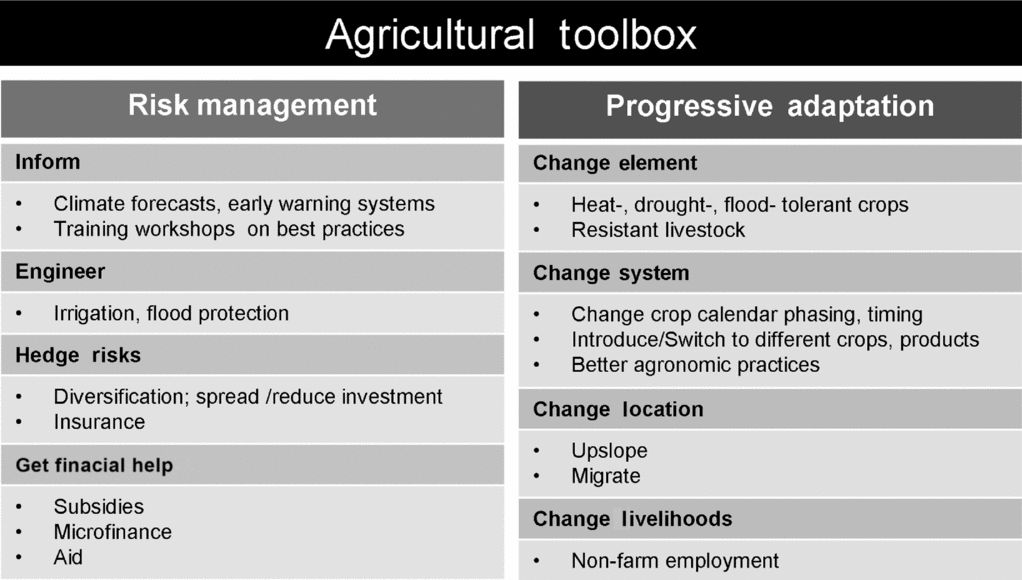
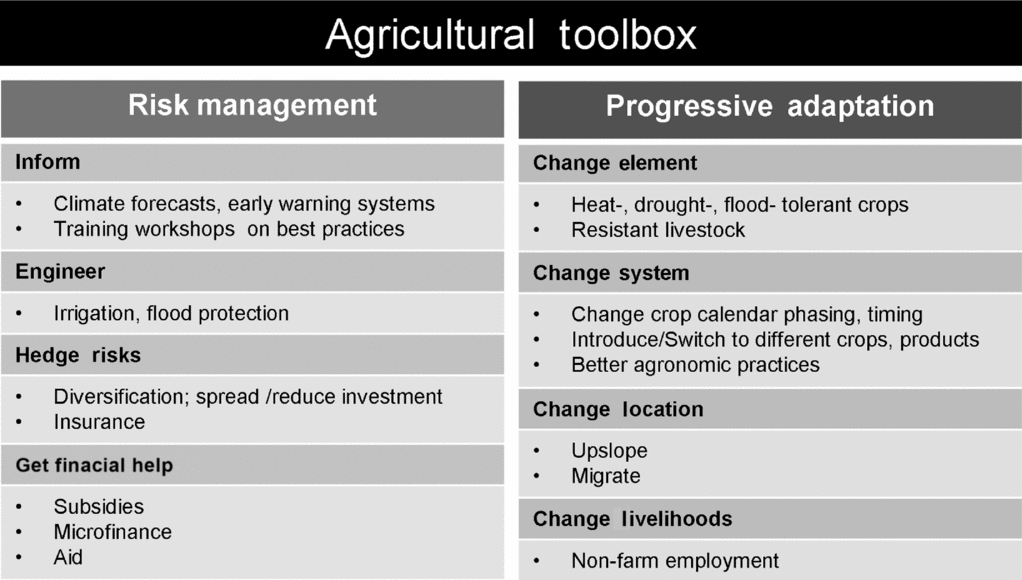
In all, a holistic approach to adaptation to progressive climate change still needs to be developed – one that considers the interactions of different technical, institutional and policy sectors, and the potential need for incentives or aid. This would allow for the development of adaptation options that go beyond sector-specific management and lead to more systemic changes in resource management and allocation, such as targeted diversification of production systems and livelihoods (Howden et al., Reference Howden, Soussana, Tubiello, Chhetri, Dunlop and Meinke2007). Some examples of adaptation options are provided in Figure 2.
Basic options for risk management and progressive adaptation.
MITIGATION THAT CONTRIBUTES TO ADAPTATION
Poor smallholders can hardly be held accountable for climate change, but agriculture does contribute 10–12% of total global anthropogenic emissions of greenhouse gases (Verchot, Reference Verchot2007). For the non-CO2 greenhouse gases (GHGs) (principally methane and nitrous oxides), emissions are highest in developing countries and expected to grow rapidly in the coming decades (Smith et al., Reference Smith, Martino, Cai, Gwary, Janzen, Kumar, McCarl, Ogle, O'Mara, Rice, Scholes, Sirotenko, Howden, McAllister, Pan, Romanenkov, Schneider, Towprayoon, Wattenbach and Smith2008; Verchot, Reference Verchot2007). Furthermore, the pressures to expand agriculture in many developing countries contribute to carbon emissions through deforestation and unsustainable land management practices. Smith et al. (Reference Smith, Martino, Cai, Gwary, Janzen, Kumar, McCarl, Ogle, O'Mara, Rice, Scholes, Sirotenko, Howden, McAllister, Pan, Romanenkov, Schneider, Towprayoon, Wattenbach and Smith2008) estimated that mitigation interventions, many of which can enhance on-farm productivity and contribute to poverty alleviation, are able to offset up to 24–84% of global agricultural emissions (which account for 5.1–6.1 gigatons yr−1).
Natural resource management can thus have both mitigation and adaptation potential, e.g. by improving nitrogen use efficiency or reducing water dependence. Precision fertilizer use, for example, can raise yield-to-emission ratios (Pretty et al., Reference Pretty, Low, Ellis and Hine2003), while Wassman et al. (Reference Wassman, Hosen, Sumeth and Nelson2009) report that mid-term drainage and intermittent irrigation of rice paddies may reduce methane emissions by over 40% without compromising yields. Soil carbon sequestration via management of crop residues can also improve resilience by boosting water retention, as well as soil fertility and stability (Lal, Reference Lal2004). Silvo-pastoral systems decrease methane production, while often improving feed use efficiency and ensuring ample feed availability in the face of climate variability (Murgueitio et al., Reference Murgueitio, Zoraida, Uribe, Calle and Solorio2010). Incentive-based mechanisms such as the Clean Development Mechanism (CDM) and the new UN initiative Reducing Emissions for Deforestation and Forest Degradation (REDD+), as well as growing voluntary carbon markets, provide opportunities for smallholder farmers to reduce GHG emissions and move to more sustainable land management practices. These new market opportunities also offer farmers a means to bolster their food and livelihood security through diversified income sources. In this way, community forestry or agroforestry can produce income, ensure wood supply and conserve ecosystems. However, in many cases, monitoring, reporting and verification tools must be improved and applied more extensively to qualify for international payment schemes (Eriksen, Reference Eriksen2009; Negra and Wollenberg, Reference Negra and Wollenberg2011). Smallholders in developing countries may also not be able to afford the up-front costs of project development, data may not be available or sufficient, and land rights or boundaries may be communal or unclear.
Smaller local programmes with lower transaction costs may warrant research and financial support. One example is Socio Bosque in Ecuador, which pays individual landowners or indigenous communities annual monetary sums for each hectare of forest they voluntarily pledge to protect. Such programmes use neither close vigilance nor exact calculations of carbon sequestered. Regardless, their apparent efficacy merits greater attention. Other emerging market opportunities may exist for certifying products as water-efficient, sustainable or organic.
Critical evaluations of these win-win situations have been largely neglected (Klein et al., Reference Klein, Huq, Denton, Downing, Richels, Robinson, Toth, Parry, Canziani, Palutikof, van der Linden and Hanson2007), as the adaptation and mitigation communities have tended to operate in isolation. Therefore, research is needed that explores and exploits these synergies, while also analysing the inevitable trade-offs between environmental and livelihood benefits (Stoorvogel et al., Reference Stoorvogel, Antle, Crissman and Bowen2004). The identification and promotion of best management options require an integrated, systems-level framework on agriculture and climate change. The food security externalities of large-scale biofuel production is one such example where careful evaluation is required.
INTEGRATION FOR DECISION MAKING
It is essential that knowledge generation through research on risk management, progressive adaptation and pro-poor mitigation is linked with a sound diagnostic and decision making structure that will enable and ensure on-the-ground change. Targeting food security, poverty reduction and sustainable natural resource management interventions that are robust in the face of a changing and uncertain climate requires a strong ex-ante analytical capacity to diagnose points of vulnerability and assess the impacts and trade-offs between socioeconomic and environmental goals associated with alternative strategies. A strong analytical and diagnostic framework, grounded in the global change policy environment and supported by effective engagements with rural communities and institutional and policy stakeholders, is therefore essential. This implies engagement in the dialectic discourse between global policy and science – through which the political climate increasingly shapes the opportunities for and constraints to local- and national-scale action, but can also be responsive to and influenced by sound scientific evidence, e.g. the outputs from the other research themes. Responding to climate change and improving food security requires that stakeholders develop their capacity to anticipate and plan for uncertain and changing conditions. Successful mitigation and adaptation will entail not only individual behavioural changes, but also changes in technology, institutions, agricultural and socio-economic systems. These changes cannot be achieved without improving interactions between scientists and decision-makers at all levels of society, to better match supply and demand of information, to develop and share appropriate adaptation tools, and to continually assess and address the need for new resources and information (Moser and Dilling, Reference Moser and Dilling2007). Vogel et al. (Reference Vogel, Moser, Kasperson and Dabelko2007) note that the attempt to produce ‘useful’ science often occurs separately from the study of the science-practice interface. Consequently, decision-makers and managers do not receive or use the information that is produced, and vulnerability to environmental change may remain high, despite new scientific knowledge. These authors point to the need for improved communication and engagement, because both the science and the practices change as the result of increased researcher-stakeholder interactions, ‘sometimes in unexpected or unintended ways’ (Vogel et al., Reference Vogel, Moser, Kasperson and Dabelko2007, p. 351). Strategies may include participation, integration, social learning and negotiation. An important point emphasized by van Kerkoff and Lebel (Reference van Kerkhoff and Lebel2006, p. 445) is that ‘the unique contribution of research-based knowledge needs to be understood in relation to actual or potential contributions from other forms of knowledge’.
Given the complex, dynamic and uncertain nature of climate change and its interactions with other social, economic and political processes driving agricultural development and food security, innovative methods and tools need to be developed to improve communication between researchers and stakeholders. An example of such a tool is the ‘learning wheel’, developed as part of the Integrated Natural Resource Management (INRM) task force of the CGIAR (Campbell et al., Reference Campbell, Jürgen, Sayer, Ann, Richard and Wollenberg2006a; Reference Campbell, Jürgen, Sayer, Ann, Richard and Wollenbergb). This tool is based on principles and operational guidelines that present a new way of approaching research and development. Research must further develop and apply such approaches given the novel challenges that climate change introduces to resource management. This should draw upon experiences of how farmers and communities already adapt to climate variability and extreme events and assess the role and relevance of such local and traditional knowledge. In a similar vein, communication and exchange with stakeholders in the food system must take into account the diversity of cultural and cognitive frameworks for understanding climate change, including how they relate to different beliefs, values and worldviews (Orlove et al., Reference Orlove, Broad and Petty2004; Roncoli, Reference Roncoli2006). Osbahr et al., (Reference Osbahr, Dorward, Stern and Cooper2011, this issue) and Rao et al. (Reference Rao, Ndegwa, Kizito and Oyoo2011, this issue) illustrate the importance of this point through case studies from Uganda and Kenya which examine farmers’ perceptions of climate risk and change compared with the outputs of climate risk and trend analyses of long-term historical weather data from nearby recording stations. A focus on communication and understanding the information needs of stakeholders is a minimum requirement for ensuring that research results are used by decision-makers, as stakeholders will only utilize information that they find credible, legitimate and relevant to the problems they face.
SYNERGIES, TRADE-OFFS AND TRANSITIONS
Production systems will need to transition from managing risk of climate variability to adapting to long-term climate change and reducing net emissions, yet little is known on whether this transition occurs naturally, or whether some risk management strategies progressively become less capable of adapting to progressive changes in the baseline and in extreme cases may even contribute to maladaptation. In some instances, mitigation activities can act as a vehicle to effectively bridge short-term management and long-term adaptation. We postulate that there are three basic scenarios, which provide a framework for analysing synergies and trade-offs among adaptation, risk management and mitigation.
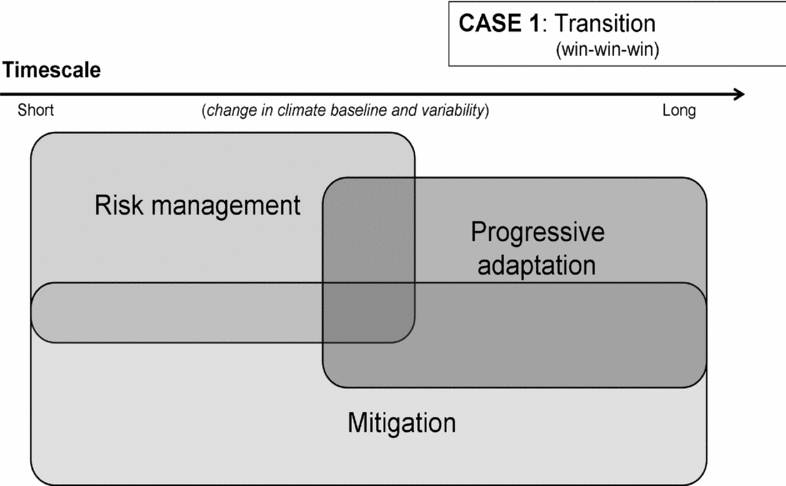
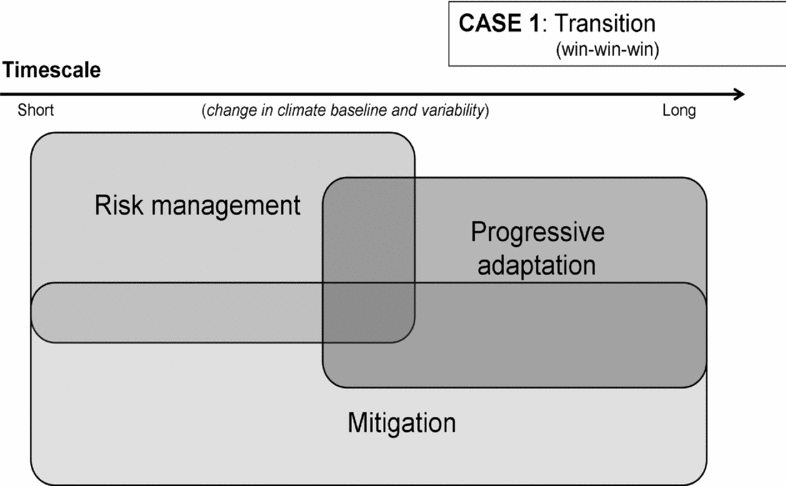
Case 1. Transition (win-win-win)
This is the best-case scenario in which risk management strategies smoothly contribute to progressive adaptation, all the while mitigating climate change (Figure 3). There are no real trade-offs. An example would be payments for carbon sequestration-related ecosystem services (PES), which reduce risk by offering immediate financial capital relief, mitigate by increasing carbon storage, and adapt by creating incentives and opportunities to diversify and further invest in agricultural and non-agricultural income sources.
The triple win transition case, whereby risk management, progressive adaptation and mitigation all provide synergies.
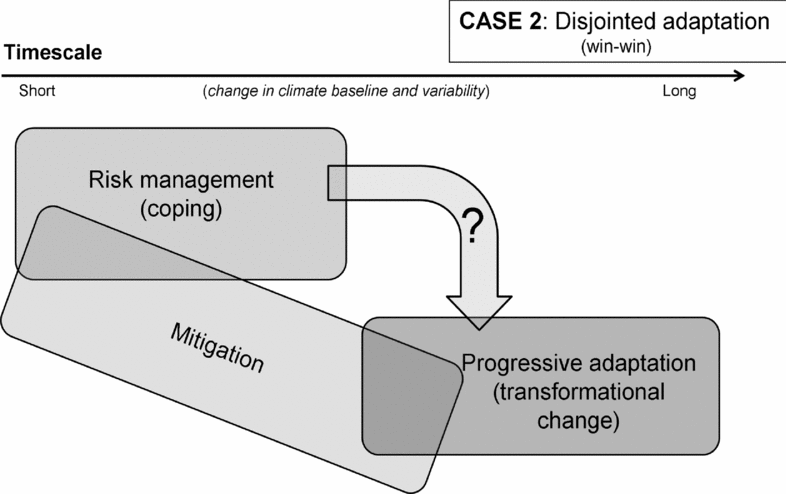
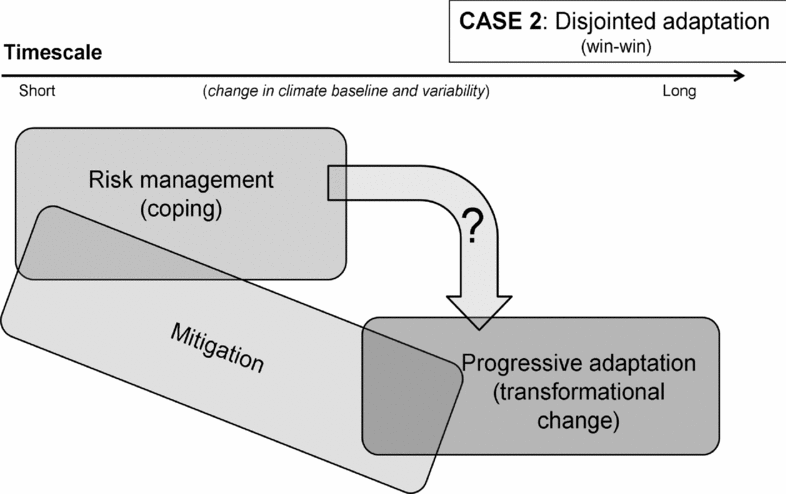
Case 2. Disjointed adaptation (win-win)
In this case, risk management does not easily transition into transformational adaptation, but there are synergies between each of these and mitigation (Figure 4). As a result, it is possible that mitigation strategies can act as a bridge. Sometimes this situation can be self-supporting, for instance in the case of silvo-pastoral systems, where climate-tolerant legumes provide additional fodder (risk management), biomass sequesters carbon (mitigation) and the landscape is transformed into an improved natural resource base (adaptation). In other cases, the situation precariously hinges on continued political and institutional support: for example, subsidies conditional on eco-friendly agriculture (mitigation) can supply immediate liquidity (risk management) but not necessarily help farmers prepare for changed climate baselines (adaptation).
The first case of disjointed adaptation with opportunities of transitioning systems through mitigation actions.
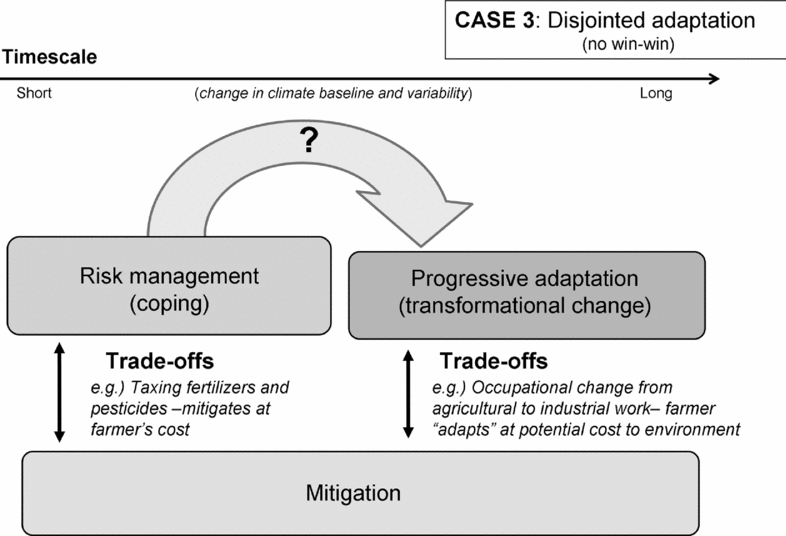
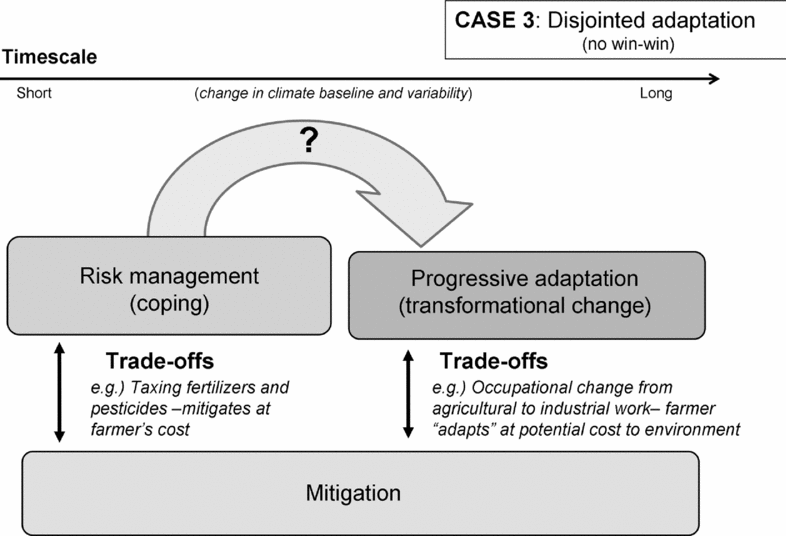
Case 3. Disjointed adaptation (no win-win)
This is the worst-case scenario, in which there are always trade-offs, no opportunities for win-win, and no smooth transition from risk management to progressive adaptation (Figure 5). For example, a small producer farming on land that will become unsuitable for agriculture in 2050 might have no clear long-term adaptation strategies. He/she might therefore move location, thus deforesting land for his crops or logging to make his non-farm livelihood. External aid and incentives are therefore necessary to help affected parties and encourage them to adapt in sustainable ways.
The second case of disjointed adaptation where all potential interventions require careful analysis of trade-offs.
The interface between risk management, adaptation to progressive change and mitigation is a priority area of research with many knowledge gaps. What causes a farming system to fall into one of the three cases is likely to be a combination of existing resource endowments, institutional and scientific support, together with the willingness of stakeholders to change behaviour. In this sense, underlying both adaptation and mitigation research, as well as Integration for Decision Making, must be a framework and strategy to overcome behavioural path dependence in individuals and institutions.
OVERCOMING BEHAVIOURAL INERTIA AND EFFECTING CHANGE
The drivers of behavioural change represent yet another important knowledge gap. The IPCC fourth assessment reverts to basic theory (e.g. Raiffa, Reference Raiffa1968) to explain the process of making decisions under uncertainty. A more robust way of looking at this is to ask: If the need for adaptation is so obvious, why does it not happen? Further, are societies adapting quickly enough? Accelerated adaptation risks an initial capital investment but ultimately yields benefits. Slow or non-adaptation avoids early investment but ultimately exhausts capitals as productivity remains consistently below potential.
Parry et al. (Reference Parry, Canziani, Palutikof, Van Der Linden, Hanson, Parry, Canziani, Palutikof, van der Linden and Hanson2007) list five impediments to behavioural change, and in the context of climate change adaptation and mitigation, we re-work these into four umbrella constraints:
1. Uncertainty about outcomes of different decisions, rooted in ignorance about the scale, distribution and production impacts of climate change (e.g. as a scientist with limited ability to predict or as a farmer with little access to such information), and inability to manage variability of projections or information;
2. Cognitive problems and differing perceptions of vulnerability or risk, resulting from poor resilience science that can analyse socio-ecological processes in conjunction, myopia in terms of time (thinking short-term) or space (thinking locally), disagreement between agents, cultural barriers to change and translational difficulties, e.g. between scientists, policy-makers and farmers;
3. Lack of compelling motive or incentives, due to lack of ecosystem valuation, inadequate or unfavourable market value chain links and risk aversion, especially to investment in new technologies in the context of climate variability; and
4. Lack of capacity, related to an inadequate asset base to invest, lack of organizational capacity at any/all scales and institutional failure, i.e. their absence, incompetence/poor fit and/or perceived illegitimacy.
The challenge for the research community, then, is to identify which behaviours inhibit or support adaptive change, scan for the institutions involved, look for ‘instruments’ of change (e.g. technologies, policy, law) and, finally, strategize as to how science can support or improve those instruments to encourage accelerated adaptation. As an example, Figure 6 shows how various components in this scheme can be linked to enable PES.
Dotted boxes show the behaviours, institutions, instruments and science that can be linked to enable ecosystem service payment schemes.

TAKING A FOOD SECURITY PERSPECTIVE
At its most simplified level, food security generally refers to the sufficient production of food for the world population. However, the more nuanced definition of food security includes four key dimensions, only one of which is availability (production); the other three are stability, access and utilization (Schimidhuber and Tubiello, Reference Schmidhuber and Tubiello2007). Agricultural adaptation to climate change therefore must guarantee stable production, which in turn feeds rural incomes and gives people adequate resources to access and purchase food. Where there is insufficient food for a household due to climate change impacts, utilization may also be affected, as certain members (e.g. men) within a family are often prioritized (Lambrou and Nelson, Reference Lambrou and Nelson2010). On a global scale, this is obviously true as well: adequate production for the world population does not mean all sub-populations can acquire and allocate food properly. As areas of suitability change and mobility becomes a potential adaptation strategy, adequate support must be given to the access side of food security as well, with all the relevant policy implications (e.g. regarding global trade, national subsidies, food relief, conditional cash transfer, gender- or vulnerable population-focused programmes, etc.). In many cases, ensuring food security may also require further data collection on household priorities and decision-making processes, which can then be applied as inputs for bio-economic, farm-level vulnerability mapping.
CLOSING KNOWLEDGE GAPS
The research agenda for climate change adaptation and mitigation is as complex as it is important. Scientists must build integrated models reflecting biophysical, socioeconomic and behavioural factors, which together can reasonably predict tipping points in food systems and develop science-based plans and strategies to prevent or overcome climate-related constraints. In formulating recommendations, scientists, policy-makers and farmers alike must take advantage of institutional learning, including traditional knowledge of coping mechanisms and adaptation strategies. Indeed, knowledge sharing will be an important strategy as climate zones migrate.
There are also considerable uncertainties regarding the magnitude and direction of climate change, particularly at the downscaled, local level. Going forward, researchers must continue to refine these projections using a range of approaches and relate them to agricultural productivity. In doing so, scientists should clearly indicate the levels of comprehensiveness and probability for all projections, as well as acknowledge the inevitability of unanticipated effects. This in turn presents challenges in the communication of scientific research results to broader stakeholder groups and decision-makers.
In addition to the climate-based uncertainties are the complex human geographies of food systems, with all their cross-cutting externalities, positive and negative, and feedback loops that extend far beyond the agricultural realm. Intensification of food production methods may have repercussions on consumers’ health (Global Environmental Change and Human Health, 2007; Matson et al., Reference Matson, Parton, Power and Swift1997). Migration of displaced farmers may lead to political disputes. It is in this somewhat unpredictable sociopolitical space that truly integrated adaptation pathways must be developed.
These uncertainties and trade-offs, however, do not preclude the necessity of acting despite all unknowns. Indeed, they provide greater incentive for ensuring that we construct the most flexible, durable and climate-resilient food systems possible. Adaptation, like the processes of climate change and the moving parts of food systems, must be dynamic.
CONCLUSIONS
This paper has outlined a framework for research on climate change and food systems from a pro-poor perspective. The inherent complexities and inter-relations between the climate system and food security means that science must make a great effort to take a holistic view to adaptation and mitigation research, and make significant effort to understand the trade-offs and synergies involved in interventions aimed at addressing the climate crisis. The research agenda outlined forms the road map for the CGIAR Research Program on Climate Change, Agriculture and Food Security, a major collaboration between the CGIAR centres and the Earth System Science partnership.