Introduction
A long tradition in medicine views somatic and psychological states as deeply interconnected (Thayer & Lane, Reference Thayer and Lane2009) and a crucial node in the interplay between psyche and soma in maintaining individuals' health is represented by the autonomic nervous system (ANS).
The ANS function depends on the opposite effects of sympathetic and parasympathetic outputs over various structures, including the sino-atrial node controlling heart rate. Under resting conditions, the parasympathetic tone is dominant, guaranteeing an energy balance that favours conservation. In order to maintain this balance, the parasympathetic system is sensitive enough to produce very quick and subtle responses to modifications in external and internal environmental conditions, within 1 s. Sympathetic output acts at a slower rate (Malliani, Reference Malliani2000), and heart rate variability (HRV) therefore is often used as a convenient and non-invasive index of ANS activity. The parasympathetic branch activity produces changes in heart rate at a higher frequency than the sympathetic and thus can be mapped by variations in the high frequency (HF) bandwidth of heart rate. While it is not possible to determine the absolute degree of autonomic activity from HRV measurements, HF-HRV is widely accepted as representing the flexibility of the vagal (parasympathetic) tone and the general capacity of the ANS to respond to changing environmental conditions in an adaptive way (Levy, Reference Levy1990; Malik, Reference Malik1996). There is good evidence that a loss of flexibility in the ANS function is associated with risk for cardiovascular disease (Nolan et al. Reference Nolan, Batin, Andrews, Lindsay, Brooksby, Mullen, Baig, Flapan, Cowley, Prescott, Neilson and Fox1998; Bruyne et al. Reference Bruyne, Kors, Hoes, Klootwijk, Dekker, Hofman, van Bemmel and Grobbee1999) and overall mortality (Dekker et al. Reference Dekker, Schouten, Klootwijk, Pool, Swenne and Kromhout1997; Thayer & Sternberg, Reference Thayer and Sternberg2006; Thayer & Lane, Reference Thayer and Lane2007).
Emotional information often signals change in the environment and can be used to guide individuals' behaviour. Consistent with this idea, a decrease in regulation of emotional responses is often related to reduced adaptability to life's demands and poor psychological well-being, in particular, anxiety and negative affect. These conditions, in turn, seem to predispose to a wide range of pathologies (Smith et al. Reference Smith, Glazer, Ruiz and Gallo2004; Suls & Bunde, Reference Suls and Bunde2005; Smith & MacKenzie, Reference Smith and Mackenzie2006), including an increased risk and impact of cardiovascular disease (Penninx et al. Reference Penninx, Beekman, Honig, Deeg, Schoevers, van Eijk and van Tilburg2001; Grippo & Johnson, Reference Grippo and Johnson2009, Watkins et al. Reference Watkins, Blumenthal, Babyak, Davidson, McCants, O'Connor and Sketch2010).
Recent studies have proposed that the relationship between negative affective states and increased morbidity could be mediated by a dysregulation of ANS function and a reduced flexibility of vagal tone (Thayer & Brosschot, Reference Thayer and Brosschot2005; Åhs et al. Reference Åhs, Sollers, Furmark, Fredrikson and Thayer2009). This hypothesis is strengthened by data showing an overlap of neural structures involved in ANS function and emotional regulation, including frontolimbic networks. Moreover, lower HF-HRV has been reported in conditions of deficient emotional regulation, such as high trait anxiety (Mujica-Parodi et al. Reference Mujica-Parodi, Korgaonkar, Ravindranath, Greenberg, Tomasi, Wagshul, Ardekani, Guilfoyle, Khan, Zhong, Chon and Malaspina2009), negative affect (Hughes & Stoney, Reference Hughes and Stoney2000; Bleil et al. Reference Bleil, Gianaros, Jennings, Flory and Manuck2008) and depression (de Jonge et al. Reference de Jonge, Rosmalen, Kema, Doornbos, vVan Melle, Pouwer and Kupper2010; Taylor, Reference Taylor2010), while the opposite – more vagal flexibility – in conditions of greater control of emotional responses (Ingjaldsson et al. Reference Ingjaldsson, Laberg and Thayer2003).
The personality trait neuroticism is characterized by higher anxiety and negative affect and increased response to external stressors. Interestingly, high neuroticism has not only been linked to increased risk for psychopathology (Khan et al. Reference Khan, Jacobson, Gardner, Prescott and Kendler2005; Malouff et al. Reference Malouff, Thorsteinsson and Schutte2005), but it also appears to predispose to a number of physical illnesses (Smith & MacKenzie, Reference Smith and Mackenzie2006) and thus to be a general risk factor for poor psychophysical well-being (Lahey, Reference Lahey2009). Subjects with high neuroticism present negative biases in emotional processing (Chan et al. Reference Chan, Goodwin and Harmer2007; Canli, Reference Canli2008) and altered neural responses to emotional stimuli in frontolimbic areas that overlap with the networks responsible for emotion and ANS regulation (Haas et al. Reference Haas, Omura, Constable and Canli2007; Chan et al. Reference Chan, Norbury, Goodwin and Harmer2009). However, so far, no study has directly investigated emotion regulation and correlated parasympathetic function in this population.
The aim of our study was to assess if subjects with high neuroticism present less autonomic flexibility in response to a specific emotion regulation task where they were requested to either respond spontaneously or to down-regulate their emotional reaction when presented with negative pictures. In particular, we chose HF-HRV as an index of both ANS flexibility and emotion regulation function and we hypothesized that subjects high on neuroticism would be less successful at down-regulating negative emotion, showing higher negative affect ratings and lower HF-HRV compared to subjects low on neuroticism.
Method
Volunteers and design
The local ethics committee approved the study and all participants gave written consent. Altogether, 44 subjects (18 male; mean age=28.93±7.7 years) were recruited from the general population. Potential volunteers responding to the study advertisement completed an online version of the Eysenck Personality Questionnaire (Eysenck & Eysenck, Reference Eysenck and Eysenck1975) and those presenting either low (⩽6) or high (⩾16) scores on the neuroticism scale were invited to take part in the study. Before the experiment subjects were screened for Axis I disorders using the Structured Clinical Interview for DSM-IV (Spitzer et al. Reference Spitzer, Williams and Gibbon2002) and completed the following questionnaires: the State-Trait Anxiety Inventory (Spielberger et al. Reference Spielberger, Gorsuch and Lushene1983); Beck Depression Inventory (Beck et al. Reference Beck, Ward, Mendelson, Mock and Erbaugh1961); Dysfunctional Attitude Scale (Weisman & Beck, Reference Weisman and Beck1978); Emotion Regulation Questionnaire (ERQ) (Gross & John, Reference Gross and John2003); visual analogue scales rating happiness, sadness, hostility, alertness, anxiety and calmness. Five subjects were excluded due to previous or current history of depression and data from another six subjects were left out from the final analysis due to bad quality of the electrocardiogram (ECG) recording. Thus, the final sample constituted of 30 subjects (14 male, mean age=28.59±7.3 years), of which 20 subjects had low neuroticism scores (eight male, mean n=2.50±1.5) and 10 subjects had high neuroticism scores (six male, mean n=18.08±7.9).
Experimental task
The emotion regulation task was adapted from (Phan et al. Reference Phan, Fitzgerald, Nathan, Moore, Uhde and Tancer2005). As described in the original paper, the emotion regulation protocol employed two main conditions: ‘maintain’; ‘suppress’. During the maintain blocks, subjects were instructed to attend to and experience naturally (without trying to alter) the emotional state elicited by the pictures. During the suppress blocks, they were instructed to decrease voluntarily the intensity of their negative affect by using the cognitive strategy of reappraisal, which is to reinterpret the content of the picture so that it no longer elicits a negative response. The pictures selected for the two experimental conditions were matched for general content and balanced on subjective valence and arousal (mean (±s.d.) valence and arousal values on a 9-point scale for the pictures selected were: maintain pictures, valence=2.80±1.70, arousal=6.01±2.15; suppress pictures, valence=2.74±1.71, arousal=6.04±2.17). Before the experiment, participants were thoroughly instructed on how to use cognitive reappraisal strategies, were asked not to look away from the pictures and were given a chance to try out the task with the assistance of the experimenter on some practice trials.
The stimulus set consisted of 40 highly aversive and arousing pictures based on normative ratings from the International Affective Picture System (Lang et al. Reference Lang, Bradley and Cuthbert1997). Pictures were presented for 5 s each in blocks of five and alternated within each block with a 1 s image of a white fixation cross on a grey scale background (total block duration 30 s); each block was preceded by the instructions ‘maintain’ or ‘suppress’, in a counterbalanced order, randomized among participants, presented for 4 s and was followed by a slide asking participants to rate their affect on a 1–4 scale (from completely neutral to completely negative) by pressing a button on the keypad. The affect rating was then followed by a 30 s image of a white fixation cross on a grey scale background before the next block started, in order to allow the heart rhythm to go back to resting levels before the next stimuli block and so avoid carry-over effects from one block to the following (Supplementary Fig. S1, available online). Eight blocks (four per each condition maintain or suppress) were presented in pseudo-randomized order. After being instructed and having practised the task, 1 min ECG was recorded while subjects were sitting still in front of the computer before the task was started (‘pre-task’ recording).
Stimuli were presented using E-Prime version 2.0 software and affect ratings and reaction times (RTs) were recorded.
After the task, subjects were asked to write down, next to reproductions of some of the presented pictures, examples of how they reappraised the pictures in the down-regulation condition. Subjects who failed to report more than two different strategies were scored as ‘insufficient regulators’.
During the task, an ECG was recorded using a Spacelabs Healthcare CardioNavigator System (USA), sampled at 500 Hz. Heart beats were timed at the instants of R-wave peaks in the ECG signal and heart rate was measured as the inverse of consecutive R-wave to R-wave (RR)-interval periods. R-wave peak detection was achieved using a custom automated analysis program – adapted from (Western et al. Reference Western, Taggart and Hanson2010) – with each beat verified manually. For each patient, a time-series was constructed to reveal heart rate varying over the course of the experiment. The frequency components of this variation were identified by the application of an autoregressive (AR) model: AR spectral analysis is preferable to the Fourier Transform when only a small number of data points are available because the frequency resolution of the AR spectrum is not dependent on signal length (Parati et al. Reference Parati, Saul, di Rienzo and Mancia1995).
In this study, the length of the RR-interval sequences to be analysed was limited to the length of the experiment task blocks, 30 s. Ordinarily, it is recommended that spectral HRV analysis be conducted on a sequence of 2 min duration to achieve a reliable impression of the lower end of the frequency spectrum; however, shorter duration recordings are acceptable for HF analysis, which was our variable of interest (Malik, Reference Malik1996). To improve robustness in the measurement taken from our 30-s RR-interval sequences, spectra were calculated for four separate instances of a particular condition (‘suppress’, ‘maintain’, ‘fixation before suppress’ or ‘fixation before maintain’) then averaged together to produce a mean spectrum representative of the state induced by that condition.
The AR model fitted to each 30-s sequence was calculated according to the Yule–Walker method after resampling using L=128 points (equivalent to a sample rate of 4.23 Hz). Following the recommendation of Kay (Reference Kay1999), several model orders were tested in the range L/3 to L/2 and required to pass a prediction-error whiteness test. The optimal model order for each sequence was then chosen as that which minimized Akaike's Information Criterion (Akaike, Reference Akaike1974). The frequency spectrum was then calculated from the coefficients of the optimal model and spectra from equivalent experiment conditions were averaged together for each subject. The HF-HRV for each condition and for the 1 min ‘pre-task’ period was calculated by integrating the spectral power across the bandwidth 0.15–0.4 Hz; normalized HF and low frequency (LF) values (HFn and LFn, respectively) were also calculated by dividing the HF-HRV and LF-HRV by the total power in the range above 0.04 Hz (‘normalization power’), as recommended by Malik (Reference Malik1996).
Statistical analysis
Behavioural data (mean affect rating and mean RT) were analysed using repeated measures analyses of variance (ANOVA), with group (high versus low neuroticism) as the between-subject variable and task condition (maintain versus suppress) as the within-subjects variable. ECG data (HF-HRV) were analysed using a repeated measures ANOVA, with group (high versus low neuroticism) as the between-subject variable and task condition (maintain versus suppress) as the within-subjects variable and HF-HRV recorded during the pre-task period was entered as a covariate. This allowed controlling for potential confounding effects of off-task differences in HRV on differences observed during emotion regulation. Independent samples t tests were performed to clarify significant interactions, as well as to examine group differences in mood, anxiety and personality ratings, and in HRV during the pre-task period. Given previous literature, the chosen primary outcome measure was HF-HRV; however, in order to also check for confounding effects of differences in other heart rate spectrum bandwidths the same repeated measures ANOVA was also conducted on HFn. Moreover, for exploratory purposes, the same analyses were conducted on LF-HRV and LFn and simple HR measures and analyses were also run without including pre-task measures as covariates (Supplementary online material).
Correlational analysis was also run to check for relationships between changes in HRV and changes in affect during the different task conditions.
Results
Personality and affect ratings
The high and low neuroticism groups differed significantly on measures of state and trait anxiety, depressive symptoms, dysfunctional attitudes and affect ratings reported on visual analogue scales immediately before testing (all p<0.050), except for alertness and calm ratings. Consistent with the definition of neuroticism, highly neurotic subjects presented higher trait anxiety and endorsed more dysfunctional attitudes than low neurotics and also reported higher levels of depressive symptoms, state anxiety, sadness, hostility and lower levels of happiness. By contrast, there were no significant differences between the two groups in emotion regulation styles tendencies measured by the ERQ (Supplementary Table S1, online).
Emotion regulation task
Affect rating and behavioural performance
A main effect of task condition on the ratings of affect across the whole sample was observed (affect rating: task condition×group ANOVA; main effect of task condition: F 1,31=61.16, p=0.000). Consistent with what was expected given the task instructions, all subjects reported more negative affect after blocks when they had to maintain the emotion compared with after blocks when they had to down-regulate it.
There were no significant differences between the groups in either RTs or subjective rating of affect during the emotion regulation task (affect rating, task condition×group ANOVA: F 1,31=0.421, p=0.521; RT, task condition×group ANOVA: F 1,31=0.069, p=0.794) (Supplementary Table S2, online).
Heart rate variability
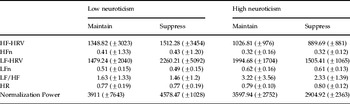
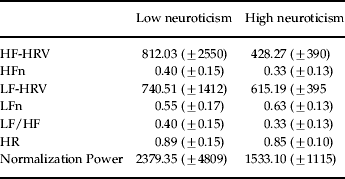
Mean HRV measures in the two groups are reported in Table 1 (during different task conditions) and Table 2 (during the pre-task period).
Mean HRV measures during different task conditions

HRV, Heart rate variability; HF, high frequency; HFn, normalized HF; LF, low frequency; LFn, normalized LF; HR, heart rate.
Values are shown as means (±s.d.) expressed in ms2.
Mean HRV measures during pre-task baseline period

HRV, Heart rate variability; HF, high frequency; HFn, normalized HF; LF, low frequency; LFn, normalized LF; HR, heart rate.
Values are shown as means (±s.d.) expressed in ms2.
No significant between groups differences were observed on any of the HRV variables recorded during the pre-task resting period (all p>0.1).
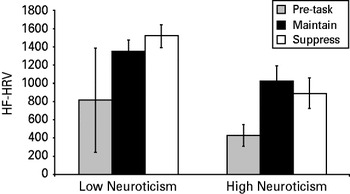
In the task condition×group ANOVA on HF-HRV with pre-task HF-HRV as a covariate, a significant interaction between task and group condition was observed (HF-HRV task condition×group ANOVA, main effect of group: F 1,31=0.184, p=0.671; task condition×group: F 1,31=6.569, p=0.016). This interaction seemed to be driven by subjects with low neuroticism presenting significantly higher HF-HRV during the suppress condition compared with the maintain condition (F 1,28=5.47, p=0.027), while subjects with high neuroticism did not present a significant difference in HF-HRV between the two task conditions (F 1,28=2.14, p=0.155) (Fig. 1). No significant interaction was found in the task condition×group ANOVA on normalized frequency values (HFn task condition×group ANOVA, main effect of group: F 1,31=0.923, p=0.345; task condition×group: F 1,31=0.383, p=0.541).
High frequency heart rate variability (HF-HRV) variability during an emotion regulation task in subjects with high and low neuroticism scores.

No significant correlation was found between changes in affect and changes in HF-HRV between the two task conditions.
Excluding subjects who presented with extreme difficulties in reappraisal strategies (‘insufficient regulators’ see Method section) did not change our results (ANOVA task condition×group: F 1,27=8.848, p=0.006).
Discussion
The results from this study show reduced HF-HRV during a negative emotional challenge in high neuroticism. In particular, while successful emotion regulation is accompanied by an increase in HF-HRV compared to passive exposure to negative stimuli in subjects with low neuroticism, this was not apparent in subjects with high neuroticism. Such findings may indicate reduced flexibility in the parasympathetic cardiovascular tone during cognitive regulation of negative emotional stimuli.
These data expand our understanding of how neurotic personality traits could be underpinned by alterations in the neurobiological correlates of emotion processing. For example, high neurotic subjects have been previously shown to present aberrant neural responses to negative facial expressions and self-referential words (Haas et al. Reference Haas, Omura, Constable and Canli2007, Reference Haas, Constable and Canli2008; Chan et al. Reference Chan, Harmer, Goodwin and Norbury2008, Reference Chan, Norbury, Goodwin and Harmer2009). The evidence of lower HF-HRV during cognitive reappraisal efforts supports the hypothesis that high neurotic subjects might be less capable of regulating their response to negative stimuli. Although this may not be subjectively evident in an experimental setting (see limitations discussed below), it remains to be investigated whether such differences in cardiovascular responses may still show an impact on emotion regulation in more critical naturalistic challenges.
Our findings are consistent with studies that have shown how individuals presenting some of the facets of neuroticism, such as greater levels of trait anxiety or worrying, also report lower resting HF-HRV, correlated to an uncoupling between cortical prefrontal and limbic areas in response to emotional stimuli (Mujica-Parodi et al. Reference Mujica-Parodi, Korgaonkar, Ravindranath, Greenberg, Tomasi, Wagshul, Ardekani, Guilfoyle, Khan, Zhong, Chon and Malaspina2009) and reported both during and after a stressful cognitive task (Verkuil et al. Reference Verkuil, Brosschot, de Beurs and Thayer2009). One previous study was unable to find a direct correlation between neuroticism as a whole and HRV, while neuroticism predicted the presence of stressful and negative outcomes in daily life only in subjects with lower baseline HRV (Ode et al. Reference de Jonge, Rosmalen, Kema, Doornbos, vVan Melle, Pouwer and Kupper2010). It is possible that our design, using HRV recordings during a direct emotional challenge rather than at rest and sampling a population with extreme neuroticism scores, was more sensitive to individual differences in psychophysiological measures related to personality types (Shinba et al. Reference Shinba, Kariya, Matsui, Ozawa, Matsuda and Yamamoto2008).
Our data suggest that alterations in HRV may not be limited to the HF bandwidth, but that subjects with low and high neuroticism present a different LF–HF balance (Table 1), which explains the presence of significant results from HF-HRV but not HFn measures that include LF. Interestingly, the comparison of HFn parameters shows a significant difference between the two groups across the task conditions, driven by lower HFn in high neurotics, but only when not including off-task effects (see Supplementary material for more detail). This observation should be considered as preliminary as it is limited by the absence of an off-task ECG recording during real resting conditions of longer duration (our pre-task measurement could have been influenced by anticipatory anxiety levels while subjects were expecting the task to start) (Malik, Reference Malik1996; Waugh et al. Reference Waugh, Panage, Mendes and Gotlib2010) and possibly also by a high inter-subject variability. Future experimental paradigms, with more robust LF acquisition parameters and larger samples, will need to confirm if variations in the LF bandwidth may rather account for baseline differences between subjects with low and high neuroticism. Overall, our data suggest that different HRV alterations in relation to different phases of emotion regulation (rest, exposure, regulation, recovery) could coexist in high neuroticism. Further studies will need to extend our observations, in order to confirm whether parasympathetic rigidity expressed by low HF-HRV might signal a distinct impairment in cognitive inhibitory responses over negative affect, in subjects with high neuroticism.
Our study presents a number of limitations. First, in the present study, highly neurotic subjects showed a reduction in a physiological index of self-regulation (HF-HRV) but not higher negative affect compared with non-neurotic subjects. Hence, we cannot be sure that the differences in responding to and reappraising negative emotional pictures identified at a cardiovascular level would correspond to relevant conscious negative biases in emotion. However, a growing body of evidence suggests that autonomic modulation and cognitive emotional control are strongly interconnected functions (Butler et al. Reference Butler, Wilhelm and Gross2006; Volokhov & Demaree, Reference Volokhov and Demaree2010). For example, increases in vagal responsivity have been directly linked to efforts in self-regulation of emotions during an interpersonal stress (Butler et al. Reference Butler, Wilhelm and Gross2006) and simultaneous recordings of cardiovascular activity and cerebral blood flow have shown correlations between HRV and neural activity in brain areas involved in emotion processing and cognitive control (Critchley et al. Reference Critchley, Mathias, Josephs, O'Doherty, Zanini, Dewar, Cipolotti, Shallice and Dolan2003; Gianaros et al. Reference Gianaros, van der Veen and Jennings2004; Napadow et al. Reference Napadow, Dhond, Conti, Makris, Brown and Barbieri2008; Åhs et al. Reference Åhs, Sollers, Furmark, Fredrikson and Thayer2009; Lane et al. Reference Lane, McRae, Reiman, Chen, Ahern and Thayer2009; Wager et al. Reference Wager, Waugh, Lindquist, Noll, Fredrickson and Taylor2009b ). Therefore, alterations in HRV seem to represent a reliable marker of emotional regulation functionality, possibly able to capture variations in emotion regulation at a neurophysiological level that are too subtle to be reported by subjective affect ratings. It is possible that more arousing stimuli than those used in our task are needed to elicit an effect on subjective affect ratings. Alternatively, as other studies have also reported, an absence of correlation between heart rate and affect reactivity could be secondary to biases in self-report of negative affect related to subjects' tendencies to suppress emotional expression (Wager et al. Reference Wager, van Ast, Hughes, Davidson, Lindquist and Ochsner2009a ).
Second, given the absence of measures indicating that subjects actively engaged in the task, other than their self-report of the regulatory strategies used, it cannot be excluded that some simply distracted themselves or that low and high neurotics may have adopted different approaches, which could confound the interpretation of our results. Future studies could include eye-movement tracking to verify, for example, which features in the pictures draw the subjects' attention and any differences in the pattern and duration of pictures' visual scanning between the two groups.
Third, future studies could also collect other physiological parameters of sympathetic activity (such as skin conductance recordings, pre-ejection period or salivary α amylase) in order to verify further what is indexed by HRV measures, in particular, when differences in affect ratings are absent.
For the same reason, another limitation in the study is the absence of effort ratings. As HF-HRV has also been implicated in general cognitive functions (Mauss et al. Reference Mauss, Wilhelm and Gross2003; Gramer & Saria, Reference Gramer and Saria2007; Nugent et al. Reference Nugent, Bain, Thayer, Sollers and Drevets2011), it cannot be excluded that, in our sample, lower HF-HRV during negative affect suppression in the highly neurotic group was determined by differences in the cognitive effort unrelated to emotional aspects and this should be controlled for in future experiments.
As the parasympathetic system mediates autonomic signs of emotional arousal and the return to homeostasis (Levy, Reference Levy1990; Thayer & Lane, Reference Thayer and Lane2009), it could be speculated that subjects with a less flexible system could be more easily overwhelmed by emotional stimuli. Some recent studies point in such direction, reporting a correlation between intensity of emotional experience LF/HF (Wallentin et al. Reference Wallentin, Nielsen, Vuust, Dohn, Roepstorff and Lund2011) and how reduced parasympathetic responsivity to oxytocin administration was related to higher self-reported loneliness (Norman et al. Reference Norman, Cacioppo, Morris, Malarkey, Berntson and Devries2011). An impairment in ANS flexibility to emotional challenges could represent one of the potential neurophysiological mechanisms that contribute to a higher risk for psychopathology in subjects with high neuroticism (Kendler & Myers, Reference Kendler and Myers2010), an idea supported by evidence of HF-HRV dysfunction in panic disorder (Friedman, Reference Friedman2007), children with familial risk for depression (Gentzler et al. Reference Gentzler, Santucci, Kovacs and Fox2009) and alcohol abusers (Ingjaldsson et al. Reference Ingjaldsson, Laberg and Thayer2003). Interestingly, these transdiagnostic data on HF-HRV are in line with high neuroticism being a rather non-specific risk factor for psychiatric disorders – including anxiety, mood disorders and schizophrenia (Khan et al. Reference Khan, Jacobson, Gardner, Prescott and Kendler2005) – and also for those physical illnesses more susceptible to a psychosomatic component (Smith et al. Reference Smith, Glazer, Ruiz and Gallo2004; Suls & Bunde, Reference Suls and Bunde2005; Smith & MacKenzie, Reference Smith and Mackenzie2006; Lahey, Reference Lahey2009). Moreover, our data directly support the hypothesis that a specific physiological mechanism – a lower parasympathetic response to emotion regulation efforts – could explain the pathway leading to a higher prevalence of sudden cardiac death in temperamentally anxious and depressed subjects (Critchley et al. Reference Critchley, Taggart, Suttom, Holdright, Batchvarov, Hnatkova, Malik and Dolan2005).
In summary, we have found that subjects high on neuroticism scores present a lower parasympathetic flexibility during emotion regulation. This confirms the validity of exploring the combination of ANS reduced flexibility, emotional dysregulation and neuroticism as different facets of a common somatic and psychological vulnerability factor for psychopathology and beyond. Further studies will need to clarify to what extent this is related to manifestations of negative affect and anxiety in naturalistic contexts. Moreover future longitudinal research could investigate if alterations in HRV as an index of emotional dysregulation can be modified by treatment or could represent a marker of potential relapse or recovery.
Note
Supplementary information accompanies this paper on the Journal's website (http://journals.cambridge.org/psm).
Acknowledgements
This work was supported by a Medical Research Council grant to Dr C. Harmer. The study was done at Psychopharmacology and Emotions Research Lab, Department of Psychiatry, Warneford Hospital, Warneford Lane, Oxford OX3 7JX, UK.
Declaration of Interest
C.J.H. has served as a consultant for P1vital, GlaxoSmithKline, Servier, Astra Zeneca, Johnson & Johnson, Lundbeck and is on the advisory board and holds shares of P1vital.