INTRODUCTION
In South Asia, cotton (Gossypium hirsutum L.)–wheat (Triticum aestivum, L.) (CW) is a well-established crop production system of the north-western plains of the Indian sub-continent and adjoining areas of Punjab and Sindh provinces of Pakistan. Cotton–wheat is the second most important cropping system after rice–wheat in these countries, and is practised on about 4.02 Mha (Mayee et al., Reference Mayee, Monga, Dhillon, Nehra and Pundhir2008). In addition, there are pockets of CW systems in Madhya Pradesh, Gujarat and Maharashtra states of India. The uniqueness of the CW system is the combination of grain plus cash cropping, which improves the economy of farmers through the cultivation of cotton as an industrial commodity and wheat as a component of food security. The system got further impetus with the introduction of dwarf wheat cultivars giving good germination at lower temperature than for the traditional tall Indian and Pakistani wheat varieties. The optimum time of sowing of wheat in the region is between the fourth week of October and the second week of November, and delay in its sowing causes marked reduction in yield (Bajwa, Reference Bajwa2011). For example, Nasrullah et al. (Reference Nasrullah, Cheema and Akhtar2010) found that yield was reduced by 1.0–1.5% per day delay in sowing beyond 20th of November. Wheat planting after cotton harvest is generally delayed by about one month beyond the optimum date due to late pickings of cotton and subsequent tillage and field operations prior to wheat planting. On an average, productivity of wheat in the CW system is lower (about 3.2 t/ha) than the wheat productivity of about 4.7 t/ha in the rice–wheat system in Indian Punjab mainly due to late planting of wheat by about 30 days under the CW system.
No tillage and reduced tillage in wheat after rice following partial or complete burning of residue is gaining popularity in the north-west Indo-Gangetic Plain (IGP) (Grover and Sharma, Reference Grover and Sharma2011; Hobbs and Gupta, Reference Hobbs, Gupta, Ladha, Hill, Duxbury, Gupta and Buresh2003; Ladha et al., Reference Ladha, Yadvinder-Singh, Erenstein and Hardy2009), with reported irrigation water saving of 20–30% (Humphreys et al., Reference Humphreys, Kukal, Christen, Hira, Singh, Yadav and Sharma2010). Direct drilling reduces tillage costs and also allows timely establishment and therefore higher yields when rice is harvested late relative to the optimum time for land preparation for wheat, or where preparation for wheat is delayed due to wet soil conditions after rice harvest. In the CW system, early picking of cotton for timely sowing of wheat seems impossible due to the indeterminate nature of cultivars. Therefore, a new innovation to overcome the problem of delayed wheat planting in the CW system is warranted. In comparison with the rapid spread of mechanization in the rice–wheat system of South Asia, the development of machinery for early planting of wheat in the CW system has not yet taken place. Early sowing of wheat after cotton without disturbing the cotton crop is possible only by relay cropping of wheat. From a two-year study, Khan and Khaliq (Reference Khan and Khaliq2005) reported higher grain yield from relaying wheat by manual surface seeding in cotton than conventional sowing after cotton harvest. However, none of the present mechanical planters are capable of seeding wheat into standing cotton stubbles. The aim of the present study was to develop and evaluate a seeding machine capable of direct drilling of wheat into standing cotton stubbles for the CW system in South Asia.
MATERIAL AND METHODS
Site characteristics
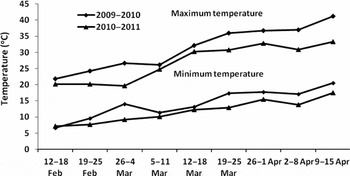
Field trials were conducted on loamy sand to sandy loam soils during 2009–2010 and 2010–2011 in the CW area of Punjab, India. The soils in the 0–15 cm depth were non-saline (electrical conductivity ranging from 0.28–0.31 dS/m) with pH ranging from 8.2 to 8.6 (soil–water ratio is 1:2) and organic carbon content varied from to 2.8 to 3.2 g kg−1 soil. The climate of the region is subtropical, semi-arid. Under average climatic conditions, the area receives about 460 mm of rainfall during the cotton season (April–November) and 75 mm during the wheat season (November–April). Temperature data during March and February–April were recorded from the climate observatory of the Regional Research Station, Punjab Agricultural University, Bathinda, India. The experiments were located within a radius of less than 10 km from the climate observatory. The mean daily minimum and maximum temperatures during the cotton season range from 10.4 to 24.1 °C and 28.4 to 40.4 °C respectively, compared with 4.4–18.2 °C and 19.6–35.5 °C during the wheat season. The minimum and maximum temperatures recorded from February to April for two years are given in Figure 1.
Minimum and maximum temperatures observed during grain filling stage (February–April) in wheat during 2009–2010 and 2010–2011.

Machine development
A prototype machine was developed for relay seeding of wheat into the standing cotton, with the objective of sowing wheat and placing fertilizer in between the cotton rows with no prior tillage. Following are the functional requirements of the machine:
1. It should be a self-propelled unit, able to pass between two cotton rows (67.0-cm apart) and open a small strip in front of a zero till furrow opener for seed and fertilizer placement without affecting the standing cotton.
2. It should have a special attachment (separator) to push cotton branches to the side for clearing the path for the ease of movement of the machine and sowing tynes.
3. The seeding unit should have proper metering system for seed and fertilizer, and during seeding it should have capability of easy on/off while turning (not seeding) to enter into next rows.
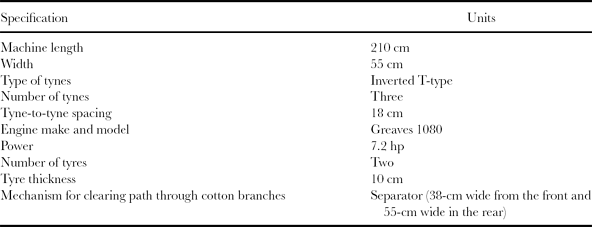
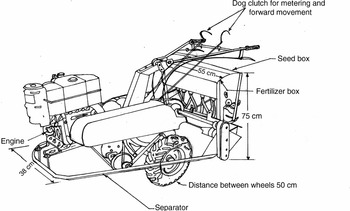
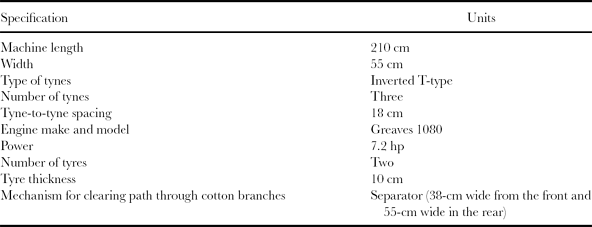
A two-wheel self-propelled relay seeder was developed in 2008 by the Cereal Systems Initiative for South Asia (CSISA)–CIMMYT team in collaboration with Amar Agro Industries, Ludhiana, India. The relay seeder has the capability of opening narrow strip (25–35 mm) using straight steel blades mounted on a rotor in front of each zero till furrow opener to facilitate placement of seed and fertilizer and help in keeping the machine in straight position. A fluted roller seed-metering mechanism is used for both seed and fertilizer application. A special dog clutch is also provided to turn off/on the seed and fertilizer metering while turning to enter into the next cotton rows. The dog clutch is the simplest form of clutch in which projections on one part fit into recesses on the other. This is used for engaging and disengaging of power to relay seeder wheels for forward movement and controlling seed and fertilizer metering mechanisms. The separator to push cotton branches is made of 25-mm steel pipe, and is narrower (380 mm) from the front side and increasing in width up to 550 mm towards the end of the relay seeder. The relay seeder is powered by a 7.2-HP air-cooled diesel engine, and the net weight of the machine is 150 kg. The major components of the relay seeder are shown in Figure 2 and specifications are provided in Table 1.
Specifications of self-propelled relay seeder.
Line sketch of a two-wheel drive self-propelled relay seeder.

This self-propelled walk-behind seeder can seed three rows at 18-cm spacing between the two rows of standing cotton along with fertilizer application, and can be easily controlled by an operator. The relay seeder can plant about 0.6 ha wheat per day.
Experimental layout and treatments
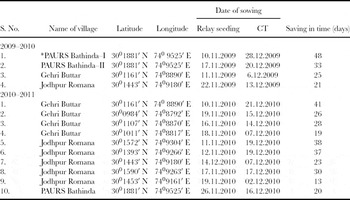
The relay-seeder was evaluated for the sowing of wheat in standing cotton during 2009–2010 and 2010–2011 (Table 2). Replicated on-farm trials were laid out with four treatments at four locations during 2009–2010 and with three treatments at 10 locations during 2010–2011. Each farmer was considered as a single replicate, and treatments were randomly applied in adjacent sections of one field on each farmer. Plot size varied from 400 to 500 m2. Following were the four treatments:
Details of the experiment conducted during 2009–2010 and 2010–2011.

*PAURS: Punjab Agricultural University Regional Station.
T1: Relay seeding of wheat in the standing cotton crop after the third picking, using the self-propelled relay-seeder without prior tillage (R-ZTSPS). Three rows of wheat, 18-cm apart, were sown in between two cotton rows.
T2: Relay seeding of wheat in standing cotton crop after the third picking, using a manual seed drill without prior tillage (R-ZTMD). This treatment was not included during 2010–2011 because it was not practically feasible due to scarcity of labour and low efficiency. The row-to-row distance was same as under T1.
T3: Broadcast relay seeding of wheat in the standing cotton crop after the third picking, following light manual tillage using a long handle hoe (R-MTB).
T4: Seeding of wheat crop after cotton harvest. Irrigation was applied to standing cotton three to four days before stalk pulling. Seedbed preparation involved one discing followed by two comb harrowings and two plankings. Wheat was sown at a row-to-row distance of 20 cm, using a conventional four-wheel tractor drawn seed–fertilizer drill (CT).
Wheat crop management
All treatments were sown with the same variety DWR 17 at a rate of 100 kg/ha. Agronomic practices were as recommended by the Punjab Agricultural University, Ludhiana (Bajwa, Reference Bajwa2011), and were the same for all the treatments except for the method of seeding. A uniform dose of nutrients (120 kg/ha N, 26 kg/ha P and 25 kg/ha K) was applied – P as DAP and K as muriate of potash were broadcast at the time of seeding, and 50% of N (as urea) was drilled at seeding and the remaining 50% was applied before the first post-sowing irrigation.
Cotton crop management
After the harvest of wheat in mid-April, Bt cotton (variety RCH 134) was planted in the second fortnight of April with a line to line spacing of 67.5 cm and plant to plant spacing of 75 cm. After the second picking of cotton, the last irrigation to cotton was applied in the first week of November, and in relay treatments the wheat was sown into the residual moisture. The last picking of cotton occurred 14–30 days after relay seeding. In the relay sown treatments the cotton stalks were manually pulled out after applying first post-sowing irrigation at 21–25 days after planting. In the conventional wheat treatment (T4), pre-sowing irrigation was applied in standing cotton three to four days before stalk pulling, and the first post-sowing irrigation was applied at four weeks after sowing.
Plant observations
Cotton
Seed cotton yield was recorded after each picking from the whole of the plot area and the total yield is the sum of the three pickings from CT and four pickings from the relay-seeded treatment. The cotton crop with the relay seeding remained in the main field for 45–55 days more than the CT. This allowed the immature and unopened bolls to mature and the fourth picking was made before pulling out the cotton stalks in relay-seeded plots.
Wheat
Plant density after establishment, yield components and yield were measured in 2009–2010, and only yield was measured in 2010–2011. The number of wheat plants that had emerged through the soil was counted at 14–15 days after seeding in 2010–2011. Spike density and number of grains/spikes were recorded at maturity. Both plant density and spike density were measured in two randomly selected locations within each plot from three 1.50-m long adjacent rows (0.67 m) in T1–T2, and 1 m × 1 m area in T3 and T4. The plant height and number of grains per spike were recorded from 10 randomly selected spikes in each plot at maturity. Grain yield was determined on an area of 15 m2 in the middle of each plot and reported on the basis of air-dry weight. Based on the data from other field experiments by the authors, straw yield of wheat was calculated assuming straw–grain ratio of 1.2:1. However, harvest index in wheat generally increases in delayed sowing (Stapper and Fischer, Reference Stapper and Fischer1990). Average grain weight (dry) was determined on 1000 grains randomly sampled from the large-area harvest.
Economic analysis
The variable cost of growing wheat in each treatment was calculated by taking into account the costs of inputs (seed, fertilizers and biocides (herbicides and pesticides)), tillage (discing, cultivator and planking), seeding under different treatments (seed-cum-fertilizer drill, broadcast seeding and self-propelled relay seeder), hiring of manual labour, custom hire for machinery operations, transport and marketing. Hiring charges for combine harvester and straw chopper/trolley were included for calculating harvesting and threshing costs. Canal water was used as a source of irrigation in cotton. Since the canal water is supplied free of cost to the farmers, the cost of irrigation included the cost of labour involved in applying irrigation water. The cost of a 50-kg bag of urea, DAP and muriate of potash was taken as Rs. 269, 1000 and 450 respectively. The charges for human labour hiring were taken as Rs. 17/h. The cost of labour for fertilizer application, pesticide spray and irrigation was included for each of these operations. The charges for discing, cultivators and planking were taken as Rs. 750/ha, 550/ha and 250/ha respectively. The cost of seeding was considered as Rs. 500/ha for conventional sowing, Rs. 3375/ha for zero till manual seeding (R-ZTMD) and Rs. 3900/ha for manual till broadcast seeding (R-MTB). The cost of relay seeder, including engine, was taken as Rs. 75,000 and its fuel consumption is 1 L/h. The relay seeder can seed wheat on 0.6 ha in a day with a working window of 30 days in a year and its life was taken as 10 years. The cost sowing of wheat with the relay seeder was calculated as Rs. 1545/ha by taking into account depreciation, repair and maintenance, bank interest, housing, insurance, operator cost and fuel and lubricant costs. The market price of wheat grain was taken as Rs. 11,300/t and of that straw as Rs. 2000/t for calculating gross income. The market price of seed cotton was taken as Rs. 28,500/t. Straw yield of wheat was calculated on the basis of straw–grain ratio of 1.2:1. This assumes that harvest index was the same regardless of establishment method, which may not be the case. However, as the value of straw is much less than the value of grain, this would only have a small bearing on the results of economic analysis.
The data on variable cost for the cultivation of cotton for the year 2010–2011 were obtained from the Department of Economics and Sociology, Punjab Agricultural University, Ludhiana, India. The variable cost was similar under different treatments, except the additional cost for manual picking of cotton under relay planting treatments. The cost of cotton picking was taken as Rs. 4/kg of seed cotton. The value of increased cotton yield in relay planting treatments (T1–T3) was also included while calculating gross income. The gross and net incomes were calculated by subtracting total variable costs from the gross income.
Statistical analysis
For statistical analysis, locations were considered as replications and the data for each year were subjected to analysis of variance in a randomized complete block design. The differences between two treatment means were considered significant only when p ≤ 0.05.
RESULTS AND DISCUSSION
Time saving under relay planting of wheat
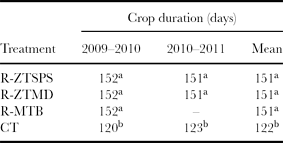
Relay sowing of wheat into the standing cotton crop advanced sowing of wheat by 13 to 48 days compared with conventional practice of wheat cultivation after cotton harvest (Table 2). On average, relay seeding advanced the sowing of wheat by 31.8 and 27.5 days compared with conventional practice during 2009–2010 and 2010–2011 respectively. This wide range in advancement of time was due to the fact that the self-propelled relay seeding machine could only be used at one site per day, the timing of last irrigation to cotton, which depended on the availability of canal water, and the date of cotton harvest, which was determined by the date of cotton sowing and availability of manual labour for picking. In south-western Punjab (India), sowing dates of cotton in the CW system are staggered from the last week of April to mid May depending upon the surface water supply from the canal system, as the ground water is not fit for pre-sowing irrigation (Jalota et al., Reference Jalota, Buttar, Sood, Chahal, Ray and Panigrahy2008). With early sowing of wheat under relay seeding, the crop duration (seed to maturity) was around 30 days longer each year with conventional sowing (Table 3).
Crop duration under relay cropping vis-a-vis conventional planting of wheat.
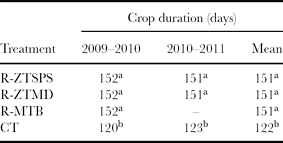
Within a column, means followed by the same superscript letters are not significantly different at p ≤ 0.05 by the Duncan's multiple range test.
Effect on cotton
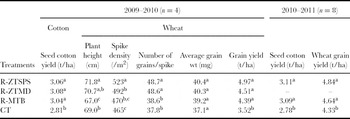
Seed cotton yield was significantly higher in relay seeding compared with CT (Table 4). In CT, the lower seed cotton yield was due to the presence of immature bolls, which remained unopened on the plants at the time of last picking. However, in the case of relay planting treatments, majority of immature bolls were fully open by the time of pulling out of cotton stalks and thus provided more seed cotton yield. However, Khan and Khaliq (Reference Khan and Khaliq2005) reported no significant effect of relay cropping systems on yield components of cotton. This deviation could be due to the type the cotton cultivars used in the two studies with different ripening behaviour.
Seed cotton yield and growth and yield attributing characters of wheat during 2009–2010 and grain yield of wheat during 2009–2010 and 2010–2011 as influenced by different planting methods in cotton–wheat system.

Within a column, means followed by the same superscript letter are not significantly different at p ≤ 0.05 by the Duncan's multiple range test.
Yield contributing characters and yield of wheat
Plant density after establishment was significantly higher in relay seeder (R-ZTSPS) and CT plots (120–122 plants/m2) compared with R-ZTMB (100 plants/m) in 2010–2011. The reduction in plant density in R-ZTMD was possibly due to poor seed–soil contact and less availability of soil moisture caused by fast drying of the surface layer. Fischer et al. (Reference Fischer, Aguilar, Maurer and Rivas1976) found a wide range in optimum plant density (80–200 plants/m2, provided that plant density was even) for maximum yield for a range of irrigated spring wheat varieties grown under climatic conditions fairly similar to those of north-west India, suggesting adequate plant population in all establishment methods in our experiment. Wheat plants at maturity were slightly but significantly taller under relay seeding than in conventional sowing (Table 4). Spike density was significantly (p < 0.05) higher in relay seeding treatments (R-ZTSPS and R-ZTMD) compared with CT. Reduction in spike density in wheat sown after cotton harvest (T4) might be attributed to low temperature under delay in sowing. Each stage of development was progressively reduced with delay in sowing, which reduced spike density (Khan and Khalq, Reference Khan and Khaliq2005). Among relay seeding treatments, spike density was significantly more in R-ZTSPS than in R-ZTMD. The lower spike density in R-ZTMD than in R-ZTSPS was possibly due to less nutrient availability, particularly P, to wheat plants from surface broadcast application of fertilizers. A fewer number of grains/spikes in the crop sown after cotton harvest (T4) was attributed to a higher temperature at anthesis and grain development stages and less time for grain formation as compared with wheat relayed in cotton (Khan and Khaliq, Reference Khan and Khaliq2005). The relay-seeded wheat crop passed through all growth stages at normal temperature optima and each development stage was completed in normal duration that resulted in a greater number of grains/spikes.
Average grain weight of wheat sown after cotton harvest (CT) was 7.2% lower compared with that of wheat relayed in cotton; however, the differences were not significant (Table 4). These results are in accordance with those of Khan and Khaliq (Reference Khan and Khaliq2005), who reported a non-significant decrease in 1000-grain weight of wheat sown after cotton harvest compared with that relayed in cotton. Contrary to this, Green et al. (Reference Green, Paulson and Ivins1985) and Jan et al. (Reference Jan, Hammed and Muhammad2000) reported that 1000-grain weight decreased significantly with delay in sowing.
Relay planting of wheat (T1–T3) produced significantly higher yield compared with conventional planting after cotton harvest in both the years (Table 4). Grain yield of wheat (averaged over two years) sown with innovative relay seeder was 24.9% higher compared with CT (Table 4). Wheat yield under R-ZTMD and R-MTB was at par with R-ZTSPS (Table 4). The early sowing of wheat by about 30 days under relay seeding compared with CT increased the spike density and the number of grains/spikes compared with CT leading to higher wheat yield. This is consistent with the observation made by Khan and Khaliq (Reference Khan and Khaliq2005), who reported 69.4% higher grain yield from relay planting of wheat by surface seeding compared with CT after cotton harvest. Yield gains in wheat with relay seeder (R-ZTSPS) compared with CT were more (41.2%) in 2009–2010 than that in 2010–2011 (11.8%). In 2009–2010, wheat crop under CT was more prone to the adverse effect of terminal heat than that in early sown wheat using relay seeder. On the other hand, favourable temperature conditions observed during the reproductive and grain-filling stages in 2010–2011 resulted in lower yield gains with relay seeding treatments compared with CT (Figure 1). Gupta et al. (Reference Gupta, Gopal, Jat, Jat, Sidhu, Minhas and Malik2010) reported wheat yield loss of over 22% in CT wheat in the CW system due to adverse effects of terminal heat in this south-western region of Punjab (India) in 2009–2010.
Economic analysis
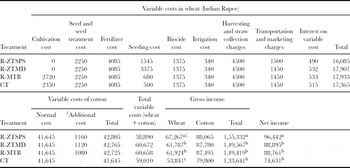
The data presented in Table 5 revealed significantly lower variable costs for planting wheat with self-propelled relay seeder due to lower cultivation and seeding costs compared with the three other methods of wheat establishment. The highest variable costs were recorded for relay seeding of wheat in standing cotton as broadcast with minimum tillage (R-MTB) and zero-till manual drill (R-ZTMD). Gross income with R-ZTSPS was significantly higher due to additional yield of seed cotton and higher wheat yields of grain and straw compared with the three other methods of crop establishment. The economic analysis (average of two years) indicated significantly higher gains in net income (Rs. 21,811/ha; an increase of 29.2%) with relay seeding of wheat using self-propelled relay seeder in the CW system due to higher gross income and lower variable costs compared with conventional planting (Table 5). The net income (Rs. 88,761–88,895/ha) in the CW system with manual seeding of wheat either as broadcast or drilling into standing cotton crop was similar but significantly higher compared with conventional planting (Table 5). Ram et al. (Reference Ram, Yadvinder-Singh, Saini, Kler, Timsina and Humphreys2012) have previously recorded higher net income in direct drilling of wheat compared with conventional till.
Variable costs, gross income and net income (in Indian Rupees/ha) under different crop establishment methods in cotton–wheat system.

‡Within a column, means followed by the same superscript letter are not significantly different at p ≤ 0.05 by the Duncan's multiple range test.
†Additional cost is for manual picking of seed cotton in relay planting treatments.
One Indian Rupee (Re. 1) = US$0.0224; a loaf of bread costs Indian Rs. 20, that is about US$0.40.
CONCLUSION
The results from the current study showed both yield and economic benefits of adopting relay seeding of wheat using self-propelled seeder in the CW system of north-west India. The new technology has a potential of contributing significantly in food security in South Asia. For medium to large size farmers (>4 ha) adopting the CW system, work is in progress to develop high clearance platform for a four-wheel tractor in collaboration with Rajar Agriculture Works, Ludhiana, India, Department of Farm Machinery and Power Engineering, PAU, Ludhiana, India and John Deere.
Acknowledgements
Authors are thankful to Bill & Melinda Gates Foundation and USAID, Washington International Centre for the funding support to project on Cereal Systems Initiative for South Asia (CSISA) being implemented by International Rice Research Institute (IRRI) and International Centre for Maize and Wheat (CIMMYT) through which the ‘Self-Propelled Relay Seeder’ is developed and evaluated.