





1. Introduction
The global consensus on universal health coverage (UHC) centres on the principle that everyone should have access to quality health services without facing financial hardship. Two classical models have long guided efforts to achieve this goal. The Beveridge model, exemplified by the United Kingdom, relies on general taxation to finance publicly provided care, ensuring access free at the point of use (Bhattacharya et al., Reference Bhattacharya, Hyde and Tu2013). The Bismarck model, used in countries such as Germany and France, is based on employment-linked social insurance, with services delivered primarily by private providers (Bhattacharya et al., Reference Bhattacharya, Hyde and Tu2013). However, these models were developed in high-income settings with strong fiscal capacity, formal labour markets, and mature administrative systems – conditions that differ significantly in developing countries. Constrained fiscal capacity challenges the expansion of fully tax-funded systems, and large informal sectors limit the feasibility of payroll-based social insurance. Administrative fragmentation further complicates coverage expansion and service provision. As a result, UHC is rarely achieved through the direct adoption of classical models in their pure forms in developing countries.
This paper examines how developing countries pursue UHC under these constraints through a comparative analysis of Brazil, Rwanda, and China. These countries offer representative examples from South America, sub-Saharan Africa, and Asia – home to a substantial global population with pressing health needs and limited financial resources. Brazil established a tax-funded public system that guarantees free access at the point of use, although limited public financing has allowed a sizable private sector to operate alongside it (Marten et al., Reference Marten, McIntyre, Travassos, Shishkin, Longde, Reddy and Vega2014). Rwanda extends coverage primarily through a subsidised community-based health insurance (CBHI) system to reach informal and low-income populations under strong central stewardship (Nyandekwe et al., Reference Nyandekwe, Nzayirambaho and Baptiste Kakoma2014). China combines payroll-funded insurance for formal-sector workers with publicly subsidised residence-based schemes covering the broader population, implemented through a decentralised administrative structure under central planning in which local governments play a central role (Burns and Liu, Reference Burns and Liu2017).
These cases suggest that UHC in developing countries is shaped less by the adoption of established models than by what we term institutional assembly under constraints – a process in which health systems are constructed through selective borrowing from classical frameworks combined with institutional innovation rooted in historical legacy, bounded by fiscal capacity, labour-market structure, and administrative reach. While these approaches can expand coverage, they also generate lasting tensions, such as segmentation, sustainability pressures, and uneven service delivery, that each health system continues to manage.
2. UHC progress and evaluation
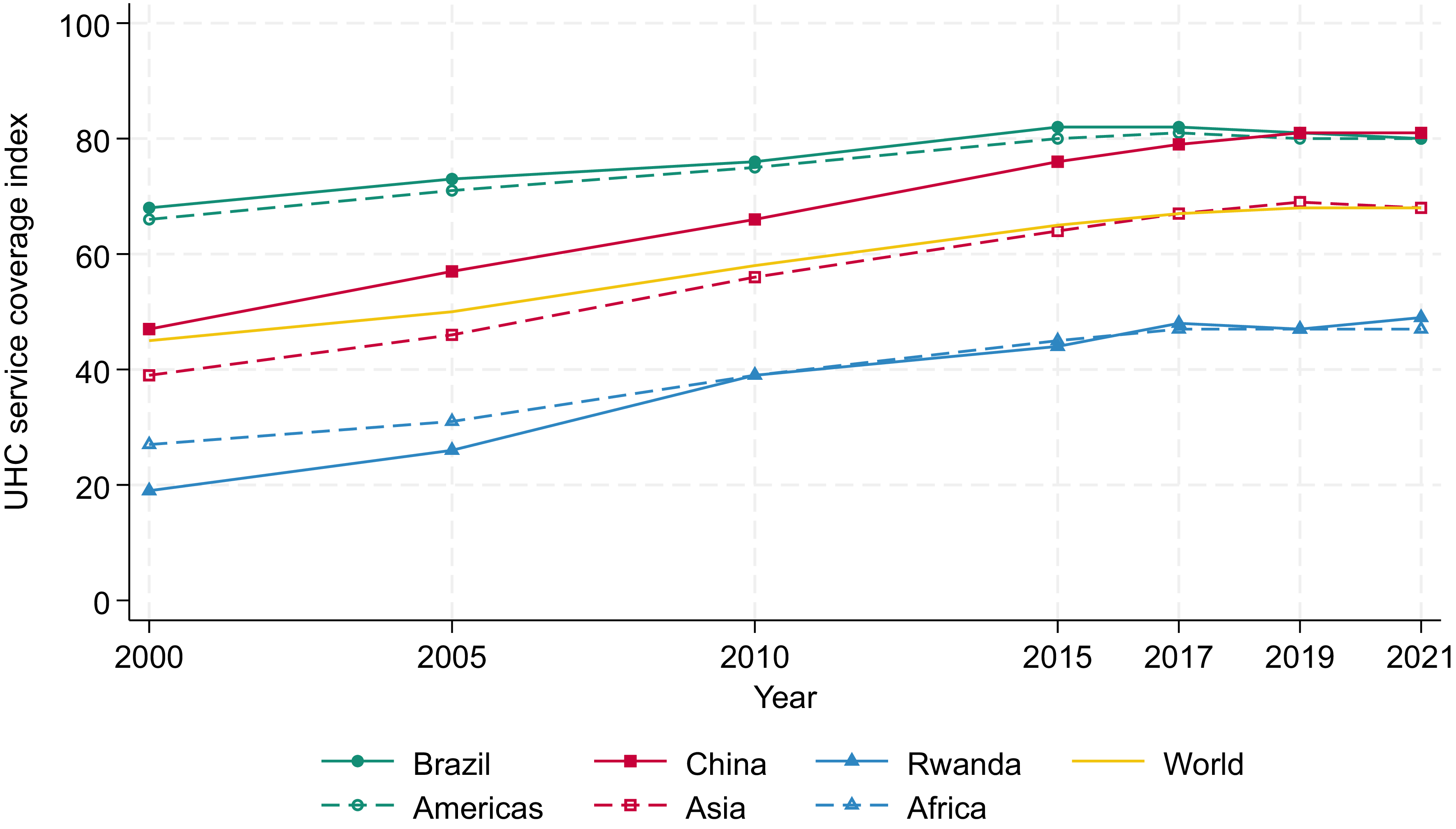
Figure 1 presents the progress of UHC service coverage from 2000 to 2021, using the index from the World Health Organization (WHO). Brazil consistently scores the highest: its modern health system, established in the late 1980s, guarantees free care for all citizens. China and Rwanda began major reforms around a decade later but have experienced more substantial growth, especially China. China’s service coverage has expanded significantly over the past two decades, surpassing the Asian regional average and ultimately catching up with Brazil by 2021. Rwanda, similarly, shows marked progress in coverage, particularly since the early 2000s.
UHC Service Coverage Progress in Brazil, Rwanda, and China. Notes: This figure shows the UHC Service Coverage Index from 2000 to 2021 for Brazil, Rwanda, and China, as well as the world average and the regional averages for the Americas, Africa, and Asia. UHC Service Coverage Index is a composite measure developed by the WHO to track coverage of essential health services across 14 tracer indicators, including reproductive, maternal, and child health, infectious and non-communicable diseases, and service capacity and access. Data Source: https://data.who.int/indicators/i/3805B1E/9A706FD.

Figure 1. Long description
A line chart plots the UHC Service Coverage Index (vertical axis, 0 to 100) against year (horizontal axis: 2000, 2005, 2010, 2015, 2017, 2019, 2021). Seven series are shown: three countries (Brazil, China, Rwanda) as solid lines, and four benchmarks (the world average and the Americas, Asia, and Africa regional averages) as dashed lines. All series rise over the period. Brazil is highest throughout, rising from 68 in 2000 to a peak of 82 in 2015–2017, then easing to 80 in 2021, and tracks just above the Americas average. China rises most steeply, from 47 in 2000 to 81 in 2021, starting near the Asia average but climbing well above it and converging with Brazil and the Americas by 2021. The Americas average rises from 66 to 80, and the world average from 45 to 68; the world average sits a little above the Asia average early on and converges with it over time. Rwanda starts lowest, at 19 in 2000, climbing to 48 by 2017 and ending at 49 in 2021, slightly above the Africa average, which rises from 27 to 47 and which Rwanda tracks closely throughout.
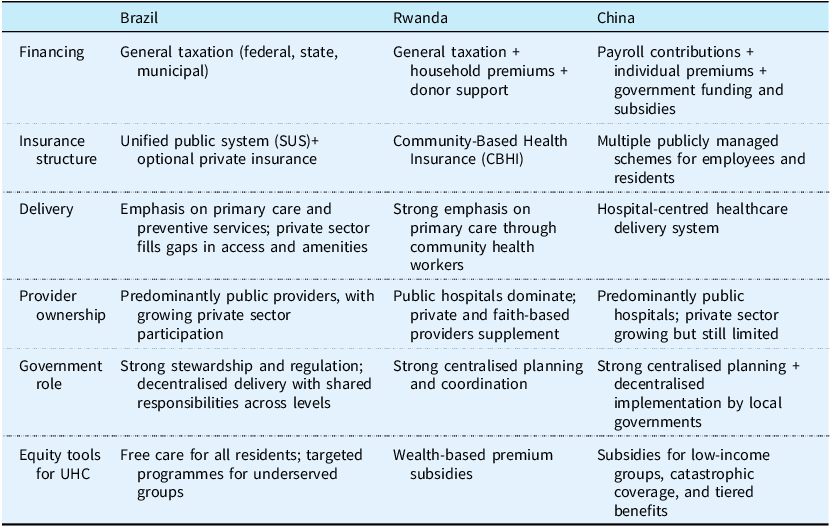
While these advancements are notable, it is important to recognise that service coverage alone does not provide a complete picture of a health system’s effectiveness. A holistic evaluation must also account for financial risk protection, health improvement, and public satisfaction, which are widely recognised as core goals of health systems and are reflected in major health system performance frameworks (Roberts et al., Reference Roberts, Hsiao, Berman and Reich2008; WHO, 2000). The following sections examine in detail both the organisational structures of these systems and how they have achieved, or fallen short of, their shared objectives. Table 1 previews the key features of the three health systems.
Key features of health systems in Brazil, Rwanda, and China

Table 1. Long description
A table with three columns (Brazil, Rwanda, China) and six rows comparing health system features. Financing: Brazil relies on general taxation across federal, state, and municipal levels; Rwanda combines general taxation, household premiums, and donor support; China uses payroll contributions, individual premiums, and government funding and subsidies. Insurance structure: Brazil has a unified public system (SUS) plus optional private insurance; Rwanda uses Community-Based Health Insurance (CBHI); China has multiple publicly managed schemes for employees and residents. Delivery: Brazil emphasises primary care and preventive services, with the private sector filling gaps in access and amenities; Rwanda strongly emphasises primary care through community health workers; China has a hospital-centred delivery system. Provider ownership: Brazil is predominantly public with growing private participation; Rwanda is dominated by public hospitals, supplemented by private and faith-based providers; China is predominantly public hospitals, with a growing but still limited private sector. Government role: Brazil has strong stewardship and regulation with decentralised delivery and shared responsibilities across levels; Rwanda has strong centralised planning and coordination; China combines strong centralised planning with decentralised implementation by local governments. Equity tools for UHC: Brazil provides free care for all residents plus targeted programmes for underserved groups; Rwanda uses wealth-based premium subsidies; China provides subsidies for low-income groups, catastrophic coverage, and tiered benefits.
3. Brazil
Brazil’s health system draws heavily on Beveridge-style elements – tax-based financing, government stewardship, and a strong public service delivery platform – while also accommodating a sizable private sector. Before the late 1980s, Brazil’s health system primarily served the formally employed through contracts with private sector providers, leaving the majority reliant on an inconsistent mix of public and charitable services (Couttolenc et al., Reference Couttolenc, Gragnolati and Lindelow2013). The establishment of the Brazilian Unified Health System (Sistema Único de Saúde; SUS) under the 1988 Constitution marked a pivotal shift in the country’s efforts towards UHC. Embedded in the constitutional framework, SUS redefined health from an employment-linked benefit into a universal right of citizenship and a state responsibility, guaranteeing free health services at all levels of care for everyone upon delivery (Marten et al., Reference Marten, McIntyre, Travassos, Shishkin, Longde, Reddy and Vega2014). It is publicly administered, with federal, state, and municipal governments sharing responsibility. This decentralised design of the system enables localised control and service provision, but its effectiveness is constrained by limited public funding: the government’s contribution to total health spending remains much lower than that observed in OECD countries and many middle-income peers (Araujo et al., Reference Araujo, Medici and Lobo2022).
In practice, while SUS establishes universal entitlement to care, variations in service quality and access persist across regions and facilities, driving higher-income households to seek private healthcare alternatives (Pacheco Santos et al., Reference Pacheco Santos, Millett, Rasella and Hone2018). Operating in parallel with SUS, the private sector offers services not covered by the public system and generally provides faster access and better amenities. The younger and wealthier profile of private health plan enrollees contributes to the substantial role of private healthcare financing.
This dualised structure shapes performance across financial risk protection, health improvement, and public satisfaction. Despite progress toward UHC, financial protection remains a major challenge in Brazil, with many households still burdened by high out-of-pocket (OOP) spending. Medications, primarily purchased from the private sector, account for most of these expenses, especially among poorer households (Araujo and Coelho, Reference Araujo and Coelho2021). Meanwhile, SUS has improved health outcomes with the expanded healthcare infrastructure and access, including large increases in medical consultations and primary care utilisation, which helped reduce unnecessary hospitalisations (Couttolenc et al., Reference Couttolenc, Gragnolati and Lindelow2013; de Abreu et al., Reference de Abreu, César and França2007; Macinko and Lima-Costa, Reference Macinko and Lima-Costa2012; Malta et al., Reference Malta, Duarte, Escalante, Almeida, Sardinha, Macário, Monteiro and Morais Neto2010). However, quality of care remains a concern due to the high rate of preventable adverse events and frequent adverse drug reactions (Mendes et al., Reference Mendes, Martins, Rozenfeld and Travassos2009). According to a global survey conducted in 2023, only 43% of Brazilians trust the health system to provide the best care, below the global average of 51% (IPSOS, 2023a). The public dissatisfaction is partly rooted in weak incentives to improve care quality and persistent inequalities between public and private services (Paim et al., Reference Paim, Travassos, Almeida, Bahia and Macinko2011).
These patterns suggest that while a Beveridge-style commitment to free, tax-funded access can guarantee broad coverage, its effectiveness depends on the state’s fiscal and administrative capacity to deliver consistent service quality. Brazil’s experience illustrates how such a commitment, when implemented under persistent fiscal constraint, can sustain universal entitlement in principle while triggering segmented provision and reinforcing unequal access in practice.
4. Rwanda
Rwanda’s health system draws selectively on the Beveridge model, adopting strong state stewardship while financing care through subsidised community-based insurance and donor support. In the aftermath of the 1994 genocide, the system was severely underfunded and heavily reliant on donor funding and OOP payments, resulting in poor service quality and low utilisation, particularly in rural areas. The government therefore prioritised health as a pillar of national reconstruction but faced two structural constraints: a large informal sector that limited the feasibility of payroll-based social insurance, and low fiscal capacity that constrained the expansion of a fully tax-funded public system.
Rwanda’s response was the CBHI (or Mutuelles de Santé), which became mandatory in 2006 and covers over 90% of the population (Nyandekwe et al., Reference Nyandekwe, Nzayirambaho and Baptiste Kakoma2014). Rather than relying on general taxation, the system is built on insurance-based pooling with household contributions complemented by government subsidies and donor support. It therefore departs from classical Beveridge financing while preserving strong state stewardship over contribution structures, implementation, and service oversight. Premiums have been scaled by wealth since 2010, with loan packages or full subsidies provided to the lower-income households. In 2015, the insurance management was centralised to enhance risk pooling and financial stability. As of 2022, Rwanda’s healthcare expenditure outpaced that of neighbouring countries, with per capita spending of 76.8 USD, accounting for 7.9% of its GDP – considerably higher than the 2.9–4.4% observed in Tanzania, Uganda, and Ethiopia (The World Bank, 2025).
Rwanda’s CBHI system has enhanced financial protection by reducing catastrophic health expenditures and OOP payments for households (Shimeles, Reference Shimeles2010). The system has also improved equity through stratified premiums and generated broader socioeconomic benefits, including better educational outcomes for children in insured families (Chirwa et al., Reference Chirwa, Suhrcke and Moreno-Serra2021; Strobl, Reference Strobl2017; Woode, Reference Woode2017). Beyond financial protection, the CBHI system has contributed to substantial gains in life expectancy and reductions in infant mortality – achievements UNICEF has described as “one of the most significant in human history” (Newey, Reference Newey2019; The World Bank, 2025). This progress results from increased healthcare utilisation and improved service quality facilitated by CBHI, though socioeconomic disparities in healthcare access persist (Kpienbaareh et al., Reference Kpienbaareh, Atuoye, Ngabonzima, Bagambe, Rulisa, Luginaah and Cechetto2019; Liu et al., Reference Liu, Subramanian and Lu2019; Saksena et al., Reference Saksena, Antunes, Xu, Musango and Carrin2011; Shimeles, Reference Shimeles2010). Public trust in healthcare has also risen markedly, with citizens reporting the highest level of confidence in their healthcare facilities worldwide (Wellcome Global Monitor 2018, 2019).
Yet these achievements are accompanied by emerging challenges to the long-term sustainability of Rwanda’s model. The system’s reliance on external financing creates structural vulnerability, as recent disruptions to donor flows have increased pressure on domestic resources to sustain coverage. At the same time, Rwanda faces an epidemiological transition toward non-communicable diseases, which require sustained long-term management and place additional demands on service capacity. Rwanda therefore illustrates that a state-coordinated, subsidised insurance model can achieve broad inclusion under constraints, but remains vulnerable to long-term sustainability risks in financing and adapting to evolving health needs.
5. China
China’s health system has expanded through a set of schemes covering different population groups, built on centralised guidance with decentralised financing and administration. These schemes combine Bismarck-style payroll financing for formal-sector workers with publicly subsidised, residence-based insurance for the broader population. Prior to the 1990s, coverage was fragmented and tied to work units in urban areas and rural collectives, much of which collapsed during economic reforms, leaving large segments of the population uninsured (Burns and Liu, Reference Burns and Liu2017). Rebuilding coverage in a country of China’s scale and regional diversity made uniform centralised implementation infeasible. In response, the central government pursued a strategy of national policy direction combined with local implementation, allowing schemes to be financed, administered, and adapted to local fiscal and administrative conditions.
Over the following two decades, China launched a sequence of insurance reforms (Gruber et al., Reference Gruber, Lin, Yang and Yi2025). The Urban Employee Basic Medical Insurance was introduced in 1998 for formal-sector urban workers, funded through payroll contributions. Coverage expanded to rural residents through the New Cooperative Medical Scheme (NCMS) in 2003, and to the remaining uncovered urban residents through the Urban Resident Basic Medical Insurance (URBMI) in 2008. NCMS and URBMI were financed by individual premiums and government subsidies, with gradual rollout across counties of varying fiscal capacity (Burns and Liu, Reference Burns and Liu2017). Beginning in 2016, China launched a nationwide reform to gradually integrate NCMS and URBMI into the Urban and Rural Residents Basic Medical Insurance (Milcent, Reference Milcent2018). The national coverage rate of social health insurance increased from less than 30% in 2003 to over 95% since 2011, achieving near-universal health insurance coverage (Yip et al., Reference Yip, Fu, Chen, Zhai, Jian and Xu2019).
As health coverage expanded, OOP spending declined and the risk of catastrophic health expenditures fell, while enhanced outpatient and medication coverage improved the management of chronic conditions (Liu et al., Reference Liu, Liu, Nicholas and Wang2021; Shi et al., Reference Shi, Yang and Yuan2025; Zhang and Zhu, Reference Zhang and Zhu2024). The reforms similarly contributed to substantial improvements in population health (Gruber et al., Reference Gruber, Lin and Yi2023; Huang and Gan, Reference Huang and Gan2017; Lei and Lin, Reference Lei and Lin2009; Li and Zhang, Reference Li and Zhang2013; Lu et al., Reference Lu, Liu and Shen2012). Furthermore, China has experienced rising public satisfaction and perceived fairness in healthcare, driven by improved financial protection and accessibility (Zhu et al., Reference Zhu, Li, Wu and Fu2022).
However, the same institutional features that facilitated rapid expansion have also generated persistent fragmentation within the system. Because insurance schemes are administered and financed at the local level, considerable variation remains in benefit design, reimbursement rates, and service availability across regions. In addition, the system remains heavily hospital-centred, with weaker development of primary care services. Although insurance expansion has narrowed gaps in some health outcomes across provinces (Meng et al., Reference Meng, Mills, Wang and Han2019), expanded coverage has not uniformly translated into access to high-quality and continuous care, and disparities across regions and socioeconomic groups persist (Jian et al., Reference Jian, Figueroa, Woskie, Yao, Zhou, Li, Li, Yao and Yip2019; Li et al., Reference Li, Guo, Liu and Yao2025). China’s experience therefore suggests that decentralised, insurance-based expansion can achieve near-universal coverage, but may produce uneven service delivery when system integration and quality improvement lag behind coverage growth.
6. Discussion
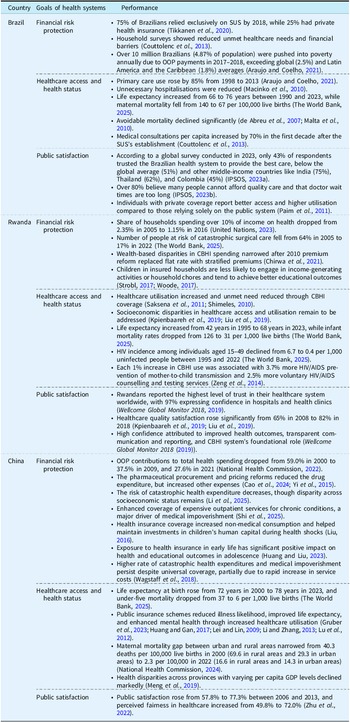
This paper examines how Brazil, Rwanda, and China have pursued UHC through distinct processes of institutional assembly under constraints. Rather than adopting classical health system models, each country has produced a system shaped by its own structural conditions and historical legacies. These paths reflect different ways of negotiating fundamental trade-offs (Bhattacharya et al., Reference Bhattacharya, Hyde and Tu2013). Policymakers must navigate the health system trilemma – the tension among health, wealth, and equity – where progress in one dimension often comes at the cost of another. As countries move beyond the initial stages of universal coverage expansion, managing these tensions becomes increasingly critical. This requires robust evidence on institutional and financial arrangements that can contain costs without compromising quality or fairness, such as risk-pooling mechanisms, strategic provider payment reforms, and regulated market-based approaches. Table 2 provides an evidence-based overview of how these systems perform against the shared goals of financial risk protection, health improvement, and public satisfaction.
Performances of health systems in Brazil, Rwanda, and China

Table 2. Long description
See <Table 2>_long-desc.docx
The varied experiences of Brazil, Rwanda, and China suggest that the wholesale adoption of traditional models is rarely feasible, and pinpointing a single correct trajectory towards UHC is unlikely, particularly given countries’ differing political contexts, policy priorities, and the specific challenges they are facing. Three implications follow from this comparison. For health policy, these cases highlight that effective coverage expansion depends on designing policies that align with existing fiscal capacity, labour-market structure, and administrative arrangements. When policies exceed these constraints, they often fall short of their intended goals. For health systems development, these cases suggest that fragmented and decentralised starting points need not be viewed only as obstacles. They can also serve as pragmatic building blocks for expanding coverage, with consolidation and integration pursued gradually as administrative and fiscal capacity develop. For institutional theory on health systems, this analysis suggests that the classical Beveridge–Bismarck typology, while useful for organising comparative inquiry, has limited explanatory power in developing-country contexts. The concept of institutional assembly under constraints offers a complementary framework by shifting attention from classifying health systems to explaining how they are constructed: countries selectively combine elements of classical frameworks with inherited institutional arrangements under fiscal, administrative, and labour-market constraints.
Recognising that successful strategies are context-specific, future research should adopt a comparative framework that builds on the concept of institutional assembly under constraints and captures a wider array of national experiences. This can help identify reform pathways that align with local governance institutions, fiscal realities, demographic profiles, and the evolving role of the private sector. Furthermore, building institutional learning systems through routine data collection, transparent performance evaluation, and adaptive policy feedback will be essential to support iterative, evidence-informed progress toward sustainable UHC.
Financial support
Mengyun Lin acknowledges financial support from the National Natural Science Foundation of China (Grant No. 72404230), Humanities and Social Sciences Research Foundation of Ministry of Education of China (Grant No. 24YJC790107), and Social Science Foundation of Fujian Province (Grant No. FJ2024C090). Hanmo Yang acknowledges financial support from the Big Data and Responsible Artificial Intelligence for National Governance, Renmin University of China. Junjian Yi acknowledges financial support from the National Natural Science Foundation of China (Grant No. 72595871, 72533001). The funders had no role in the preparation of this article or the decision to submit it for publication.
Competing interests
The authors declare no competing interests.

 Open access

