1. Introduction
The major Palaeoproterozoic orogenic mobile belts in India surrounding Archaean cratons extend from the northwest to the east through the central part of the Indian peninsula. They preserve a broad history of metamorphism, magmatism and sedimentation (Naqvi & Rogers, Reference Naqvi and Rogers1987; Valdiya, Reference Valdiya2010). The Diwani hill granulites lie in the southern part of the Aravalli–Delhi Mobile Belt, which is an important crustal feature in the northwestern part of India and preserves a polyphase deformational history (Prakash et al. Reference Prakash, Kumar, Rai, Singh, Singh, Yadav, Jaiswal, Srivastava, Yadav, Bhattacharjee and Singh2021). Textural (textural relationships between minerals and zoning patterns) and structural studies of the rocks from such an orogenic belt that has suffered multiple phases of tectonic disturbances would aid in delineating the P–T–t–d path it has travelled in the due course of its evolutionary phases (Triboulet & Audren, Reference Triboulet and Audren1985; Schulz, Reference Schulz1990; Cho et al. Reference Cho, Kim and Ahn2007; St-Onge et al. Reference St-Onge, Rayner, Palin, Searle and Waters2013; Gomez-Rivas et al. Reference Gomez-Rivas, Butler, Healy and Alsop2020; D’Souza et al. Reference D’Souza, Prabhakar, Sheth and Xu2021).
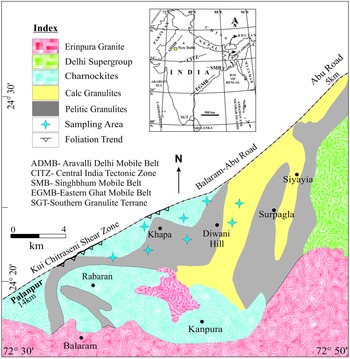
The Balaram–Abu Road area is situated in the northern part of Gujarat state and extends to some southern parts of Rajasthan state, India. Petrologically, the entire landscape around the Balaram area (Fig. 1) consists of granulite-facies metamorphic rocks deformed during the Delhi orogeny and, later, intruded by the Erinpura granite (Srikarni et al. Reference Srikarni, Limaye and Janardhan2004; Singh et al. Reference Singh, De, Karmakar, Sarkar and Biswal2010; Prakash et al. Reference Prakash, Kumar, Rai, Singh, Singh, Yadav, Jaiswal, Srivastava, Yadav, Bhattacharjee and Singh2021). The occurrence of granulite-facies rocks in the Balaram–Abu Road area was first reported by Desai et al. (Reference Desai, Patel and Merh1978). Charnockites, norites–metanorites, pelitic granulites, calc-granulite, granite gneiss and granite are the most common rock types in the Balaram–Abu Road area (Desai et al. Reference Desai, Patel and Merh1978). Pelitic granulites in the area show gneissic structures and are composed of minerals such as spinel, cordierite, garnet, sillimanite, hypersthene, feldspar, quartz, biotite and plagioclase segregated in the coarse dark- and light-coloured bands. The dark bands are predominantly rich in cordierite with reddish brown garnets strewn throughout, while the light bands are composed of quartzo-feldspathic material (Prakash et al. Reference Prakash, Kumar, Rai, Singh, Singh, Yadav, Jaiswal, Srivastava, Yadav, Bhattacharjee and Singh2021).
Map showing different tectonic elements and sample location of the study area (map modified after Prakash et al. Reference Prakash, Kumar, Rai, Singh, Singh, Yadav, Jaiswal, Srivastava, Yadav, Bhattacharjee and Singh2021).

These granulites provide information related to the chemical, petrological and tectonic evolution of the Earth’s middle and lower crust (Singh et al. Reference Singh, De, Karmakar, Sarkar and Biswal2010; Prakash et al. Reference Prakash, Kumar, Rai, Singh, Singh, Yadav, Jaiswal, Srivastava, Yadav, Bhattacharjee and Singh2021). Therefore, they play a crucial role in understanding the crustal petrogenesis as well as tectonometamorphic evolution of a region. Fluid and redox potential (oxidation state) play essential roles in the recrystallization and development of mineral phases during granulite-facies metamorphism. Except for a few preliminary works, no significant effort had been made previously in the area to understand the role of fluid activity and oxidation conditions during the granulite-facies metamorphism in the Diwani hills. In the present work, an attempt has been made to quantify the oxidation conditions and carry out pseudosection modelling and monazite dating to understand the tectonometamorphic evolution of the Diwani hill area of the Aravalli–Delhi Mobile Belt. The current approach encompasses study of textural and microstructural relationships, mineral chemistry, P–T–X pseudosection modelling, oxidation state and geochronology of the pelitic granulites from the Diwani hill area.
2. Geological outline of the study area
The Aravalli–Delhi Mobile Belt is a vital crustal morphotectonic unit of northwestern India which represents ∼3.2 Ga (Roy & Kröner, Reference Roy and Kröner1996) and trends in a NE–SW direction (Hazarika et al. Reference Hazarika, Upadhyay and Mishra2013). The oldest rock unit of the craton (Mewar) is represented by a Meso- to Neoarchaean Banded Gneissic Complex (BGC), which may easily be found exposed in the central and southern parts of the terrane as granulite- to amphibolite-facies ortho-gneisses and/or supracrustal metasediments (Gupta, Reference Gupta1934; Heron, Reference Heron1953; Mahadani et al. Reference Mahadani, Biswal and Mukherjee2015). The entire BGC may be further classified into two parts as BGC I and BGC II. Multiple episodes of Neoarchaean granitic emplacement, viz. the Untala, Gingla, Berach, Ahar River, Jahazpur and Malola granites, occurred within the rocks of the BGC (D’Souza et al. Reference D’Souza, Prabhakar, Xu, Sharma and Sheth2019). Based on the metamorphic ages and rock types, Sinha-Roy et al. (Reference Sinha-Roy, Malhotra, Guha, Sinha-Roy and Gupta1995) reclassified the BGC II into two parts: the Sandmata complex and the Mangalwar complex. Buick et al. (Reference Buick, Allen, Pandit, Rubatto and Hermann2006) suggested an age for the Sandmata complex of 1720 Ma, which is in agreement with the age suggested by Bhowmik et al. (Reference Bhowmik, Bernhardt and Dasgupta2010) (Proterozoic) who established the isotopic zircon metamorphic age of the Sandmata complex as 1700 Ma. The metamorphic age of the Mangalwar complex has been suggested as 970–930 Ma by Buick et al. (Reference Buick, Clark, Rubatto, Hermann, Pandit and Hand2010). Rocks of the BGC are overlain by regional Palaeo- to Mesoproterozoic sequences, termed the Aravalli Supergroup, which, in turn, are overlain by the youngest rocks of the region called the Delhi Supergroup, represented by Meso- to Neoproterozoic metasedimentary sequences which were deposited in the Delhi Basin that opened up at ∼1.6 Ga and later closed at 0.9 Ga (Raja Rao, Reference Raja Rao1976; Gupta et al. Reference Gupta, Arora, Mathur, Iqbaluddin, Sahai, Sharma and Murthy1980).
The Diwani hill granulites are part of the Aravalli–Delhi Mobile Belt situated in the Banaskantha district of Gujarat’s northern part. Rock records of amphibolite and granulite facies, as well as certain obducted ophiolites, basement gneisses and blueschists are available in different parts of the Balaram Road area (Volpe & Macdougall, Reference Volpe and Macdougall1990; Tobisch et al. Reference Tobisch, Collerson, Bhattacharya and Mukhopadhyay1994; Biswal et al. Reference Biswal, Gyani, Parthasarathy and Pant1998 a,b; Srikarni et al. Reference Srikarni, Limaye and Janardhan2004; Bhowmik et al. Reference Bhowmik, Bernhardt and Dasgupta2010; Mukhopadhyay et al. Reference Mukhopadhyay, Chattopadhyay and Bhattacharyya2010; Prakash et al. Reference Prakash, Kumar, Rai, Singh, Singh, Yadav, Jaiswal, Srivastava, Yadav, Bhattacharjee and Singh2021). Charnockites, and a gabbro-norite-basic granulite suite, occur as shear zone bounded lensoidal bodies (Mahadani et al. Reference Mahadani, Biswal and Mukherjee2015). Charnockites, basic granulites and gneisses are found as enclaves within granite gneiss. Different sets of fold axes (as F1, F2 and F3 reported by Singh et al. Reference Singh, De, Karmakar, Sarkar and Biswal2010; Prakash et al. Reference Prakash, Kumar, Rai, Singh, Singh, Yadav, Jaiswal, Srivastava, Yadav, Bhattacharjee and Singh2021) are present in the rocks of the Diwani hills, which suggests their conformable relationship with the regional-scale tectonic deformation in the Aravalli–Delhi Mobile Belt.
3. Oxidation condition and mineral chemistry
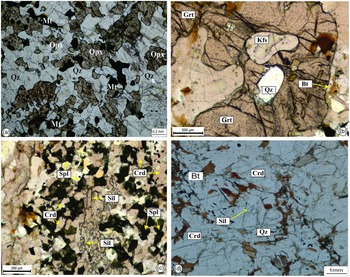
Pelitic granulites are dark in colour, medium (2–5 mm) to coarse (>5 mm) grained, and firm and compact. Despite the fact that foliation is not readily apparent at the macro level, microscopic analysis of biotite and orthopyroxene reveals a preferred orientation. The dominant mineral constituents of pelitic granulites are garnet, cordierite, K-feldspar, quartz, plagioclase, biotite, orthopyroxene and spinel. The textural features (Fig. 2a) of magnetite, orthopyroxene and quartz indicate an oxidation reaction during granulite metamorphism, which may be expressed in the balanced form as:
 $$3{\rm{Ferrosilite}} + {{\rm{O}}_2} \rightleftharpoons 2{\rm{Magnetite}} + 6{\rm{Quartz}}$$
(a) Photomicrographs showing co-existence of magnetite (Mt) with orthopyroxene (Opx) and quartz (Qz). (b) Photomicrographs showing garnet (Grt) with inclusions of quartz and alkali-feldspar (Kfs) (in plain polarized light, PPL). (c) Photomicrographs showing spinel (Spl) and cordierite (Crd) grains separated by sillimanite (Sil) (in PPL). (d) Biotite (Bt), sillimanite and quartz symplectite along with cordierite (in PPL).

The mineral compositions of typical rock types from the Diwani hills were analysed using the CAMECA SXFive electron probe microanalyser (EPMA) instrument coupled with SXFive software at the DST-SERB National Facility, Centre of Advanced Study in Geology, Institute of Science, Banaras Hindu University. The polished thin-sections were used for electron probe microanalysis using the LEICA-EM ACE200 apparatus for carbon coating. With a LaB6 source in the electron gun, electron beams were produced at an accelerating voltage of 15 kV and a beam current of 10 nA. For routine calibration, acquisition, quantification and data processing, CAMECA’s SxSAB version 6.1 and SX-Results software were used. The precision of the analyses produced is better than 1 % for major-element oxides and 5 % for trace elements.
3.a. Garnet
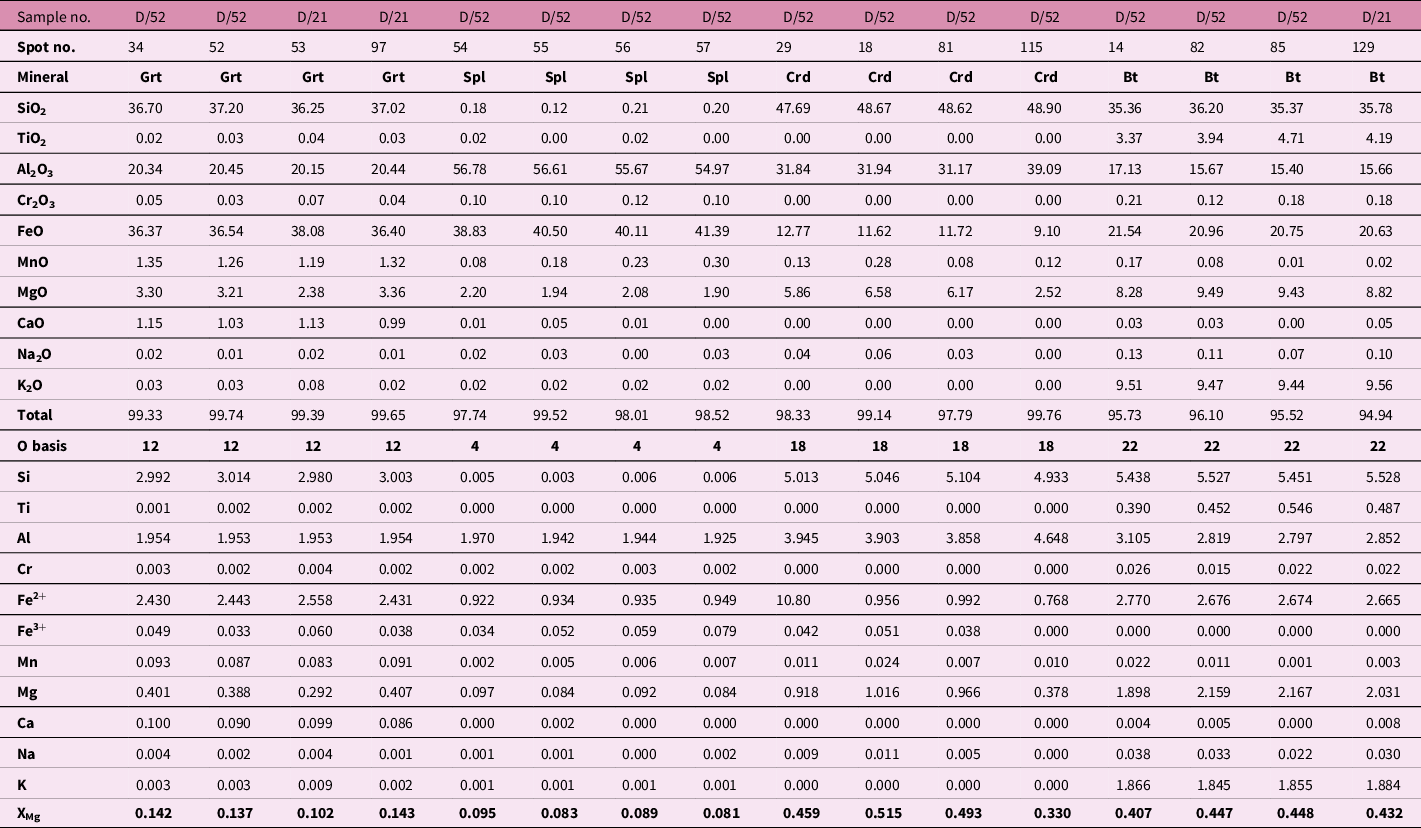
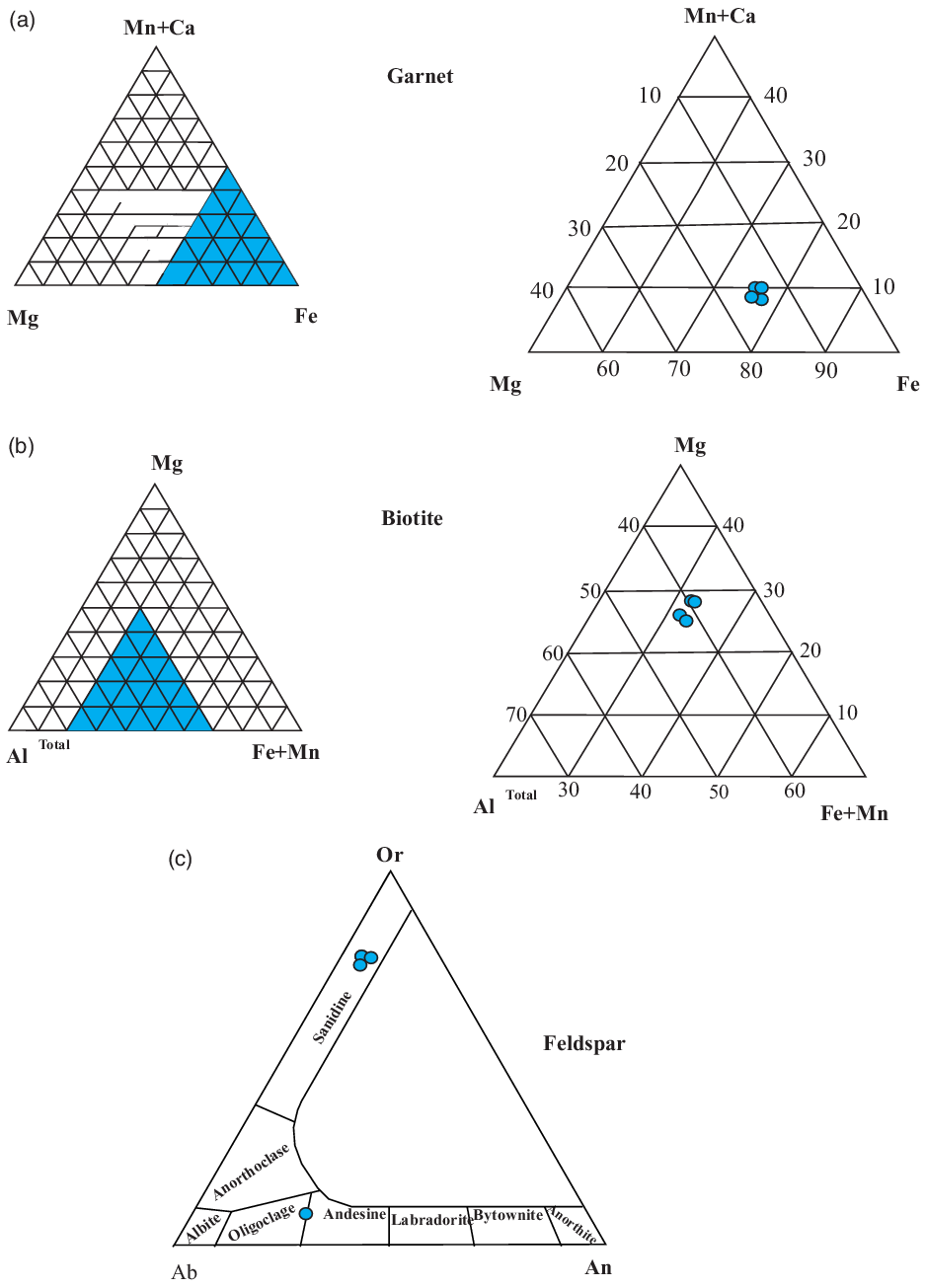
Table 1 shows the electron microprobe data and structural formulae of garnet based on 12 oxygen atoms per formula unit (apfu) from the pelitic granulites. The XMg (= Mg/(Mg + Fe2+)) in the studied garnet grains ranges from 0.102 to 0.143. As seen in Figure 3a, the bulk of the garnets are solid solutions among the four end-members: almandine, pyrope, grossularite and spessartite. The composition data of the analysed garnets plotted on an Fe–Mg–(Ca + Mn) ternary diagram show a concentration in the almandine and pyrope regions (Fig. 3a). The garnets are relatively poor in manganese (0.083–0.093 apfu) and calcium (0.086 to 0.100 apfu).
Representative electron microprobe analyses and structural formulae of garnet, spinel, cordierite and biotite

XMg = Mg/(Mg + Fe2+).
(a) Ternary diagram showing the variation in (spessartite + grossular)–almandine–pyrope end-member compositions in the garnet. (b) A plot of biotite on Mg–AlTotal–(Fe + Mn) diagram. (c) Ternary plot of feldspar showing alkali-feldspar and plagioclase compositions.

3.b. Spinel
The investigated spinel is a solid solution of spinel (Mg) and hercynite (Fe2+). Spinel found in the rock is mostly hercynite (Fe2+Al2O4), with XMg values ranging from 0.081 to 0.095. Al2O3 (up to 56.78 wt %) and FeO (41.39 wt %) are both abundant in the spinel (Table 1).
3.c. Cordierite
The microprobe examinations of cordierite, on average, demonstrate low anhydrous sums of oxides, i.e. 97–99 % (Table 1), implying the existence of roughly 1–3 wt % of a hydrous component (H2O and/or CO2) retained inside structural channels. The XMg content of the cordierite varies from 0.330 to 0.515. Cordierite contains trace levels of sodium, potassium and to a lesser extent, calcium. Na2O, K2O and CaO are commonly found at concentrations of 0.03, 0.01 and 0.02 wt %, respectively.
3.d. Biotite
The structural formulae (based on 22 oxygen apfu) and microprobe investigations of biotite show a wide range of XMg values (Table 1), ranging from 0.407 to 0.448. The biotite has an Al concentration ranging from 2.797 to 3.105. The amount of Ti in the biotite ranges from 0.390 to 0.546. The concentration of TiO2 is found to lie between 3.37 and 4.71 wt% in the biotite from the pelitic granulites of the studied area. Al content is more than that of Mg in the biotite, as shown in the ternary diagram (Fig. 3b).
3.e. Sillimanite
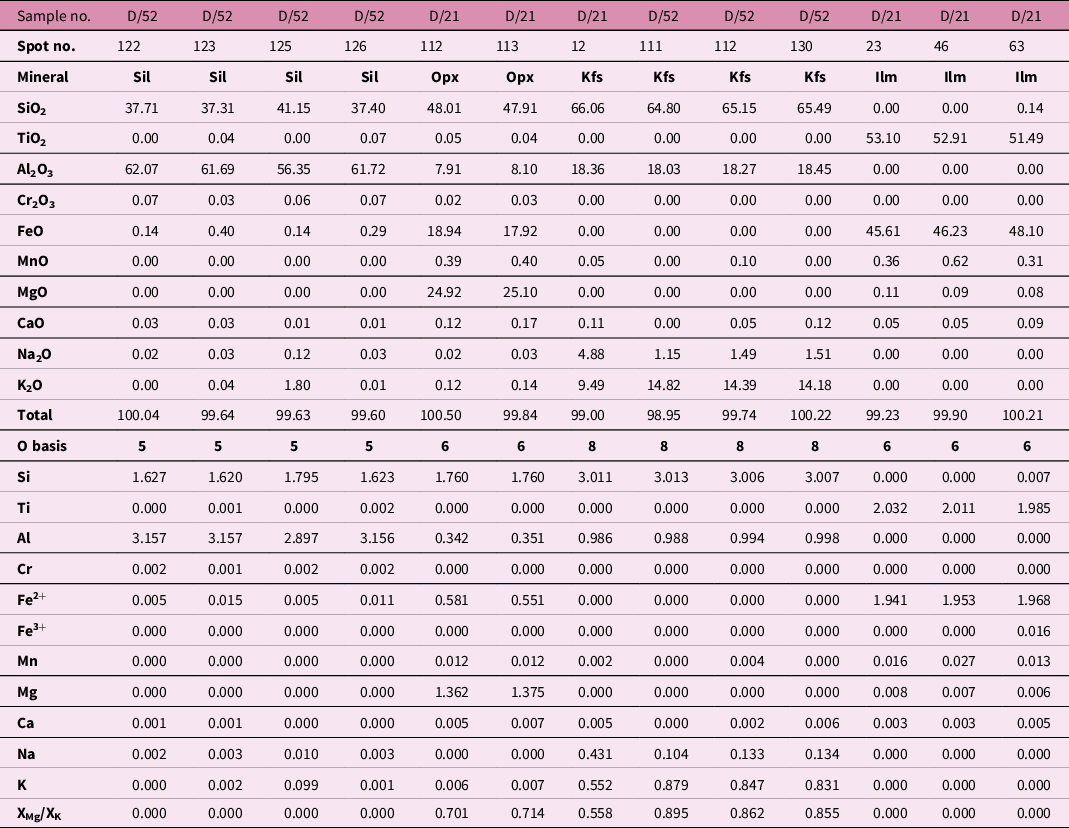
In the pelitic granulites, the Al2SiO5 polymorph sillimanite is found. Table 2 shows that the Al concentration ranges from 2.897 to 3.157. Ferric iron is the most common element that replaces aluminium in the sillimanite structure, but other elements viz. Ti, Cr, Ca, K, Na and Mn are also present in minor proportions.
Representative electron microprobe analyses and structural formulae of sillimanite, orthopyroxene, K-feldspar and ilmenite

XMg = Mg/(Mg + Fe2+); XK = K/(K + Na + Ca).
3.f. Orthopyroxene
The Al2O3 content of the orthopyroxene in the pelitic granulites ranges from 7.91 to 8.10 wt %. The XMg in the orthopyroxenes shows variation (Table 2) from 0.701 to 0.714, and the Fe2+ content is as high as 0.581.
3.g. Feldspar
The structural formulae of the analysed plagioclase are identical to the ideal formula (Table 2). The ternary NaAlSi3O8–KAlSi3O8–CaAl2Si2O8 diagram is used to map feldspars from the area (Fig. 3c). Cr, Ti, Fe, Mn and Mg are present in trace amounts. XK values range from 0.558 to 0.895.
3.h. Ilmenite
Total Fe and Fe2+ have been measured in ilmenite. The absence of Fe3+ at the Ti-site or the presence of more than two divalent cations (based on six oxygens) indicate that Fe3+ is present in minor proportions (Table 2). FeO content in the sample goes up to 48.10 wt %.
4. Metamorphic conditions
In granulite-facies metamorphism, oxidation potential plays an important role in the stability and development of transition metal containing minerals, as well as limiting the occurrence and type of a C–O–H fluid phase (Newton, Reference Newton, Walther and Wood1986; Lal et al. Reference Lal, Thomas and Prakash1998).
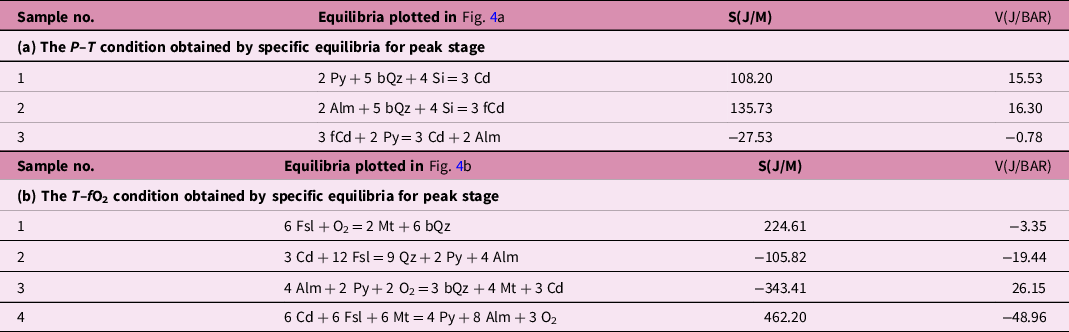
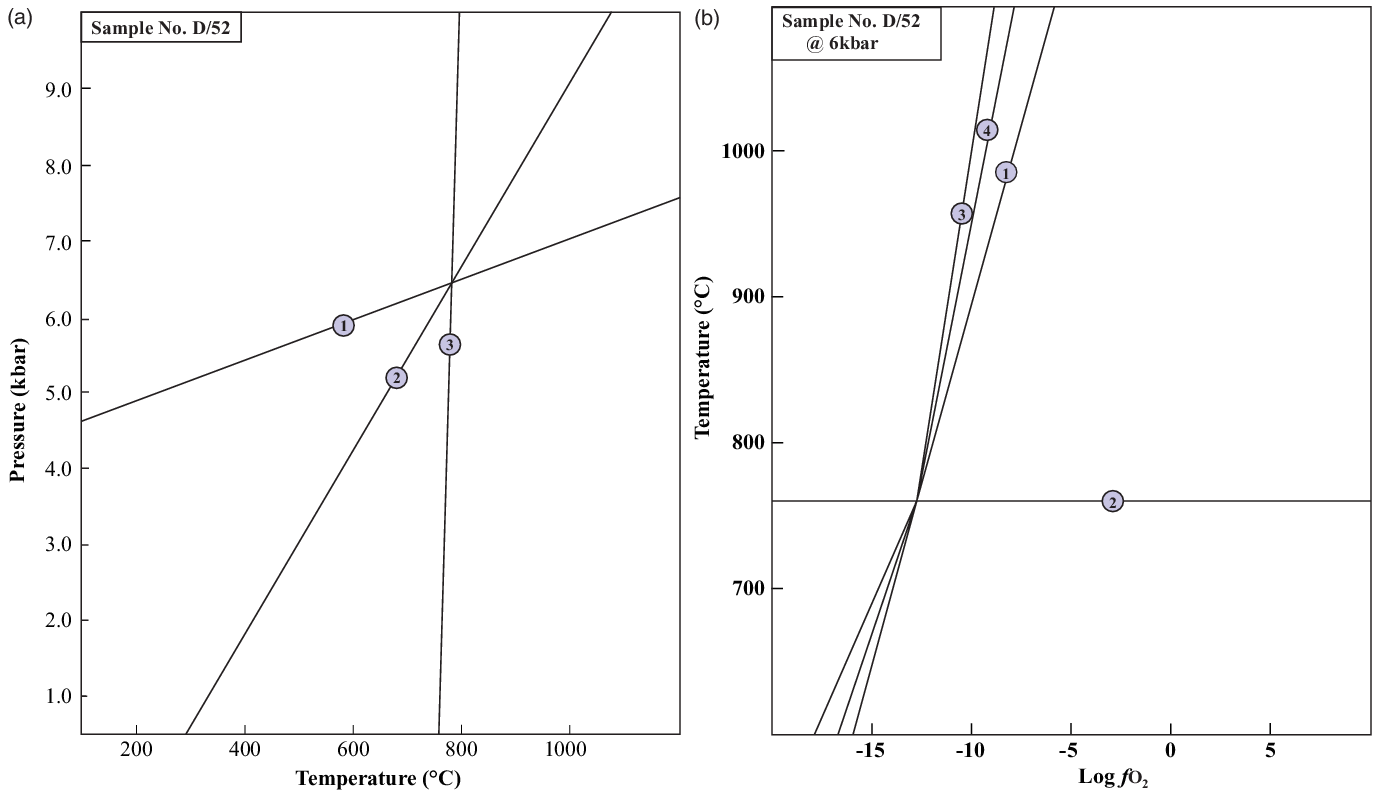
In the present work, the pressure–temperature (P–T) and oxygen fugacity (log fO2) conditions of the pelitic granulites were calculated simultaneously using Rob Berman’s (Reference Berman2006) ‘winTWQ’ computer program (version 2.32). P–T pseudosections relevant to the mineral assemblages preserved in these rocks are presented to constrain the peak metamorphic history of the pelitic granulites from the Diwani hills section. The location of reaction equilibria in P–T and oxygen fugacity (log fO2) spaces is calculated using Berman & Aranovich’s thermodynamic data (Reference Berman and Aranovich1996, updated December 2006) for the end-member phases. Almandine, pyrope, cordierite, sillimanite and beta-quartz are the end-member phases used in the winTWQ calculation for core compositions. For the selected end-member phases, three possible equilibria can be written (Table 3). The calculated P–T and (log fO2) conditions for the pelitic granulites (sample no. D/52) are shown in Table 3 and Figure 4a, b. For the sample, the P–T obtained with the winTWQ program suggested near-thermal peak conditions of granulite-facies metamorphism of >770 °C at 7.6 kbar (Fig. 4a). At 6 kbar, the oxygen fugacity (log fO2) versus temperature calculations yielded log fO2 values of −13.0 and 770 °C, respectively (Fig. 4b).
Calculation of pressure–temperature and oxygen fugacity conditions at peak stage (sample no. D/52) by winTWQ program

(a) Results of the simultaneous calculations of pressure (P) and temperature (T) obtained using the winTWQ program with the intersection of specific equilibria for sample no. D/52 (data input from Tables 1, 2). (b) The intersection of specific equilibria for sample no. D/52 has been calculated simultaneously with the oxygen fugacity (fO2) condition using the winTWQ tool (data input from Tables 1, 2).

The strong oxidation environment during granulite metamorphism in the area is indicated by the log fO2 value (−13.0). According to the electron microprobe investigation, ilmenite in the sample includes limited Fe3+ concentration, i.e. 1–2 % of the haematite component, as assessed by charge balance considerations. Because of its sensitivity to changes in oxidation during metamorphism, graphite is commonly employed for log fO2 measurement in granulite terranes. Graphite, on the other hand, is rare in the current area, which could be due to the strong oxidation conditions experienced during the metamorphism and subsequent exhumation of the Diwani hill granulites.
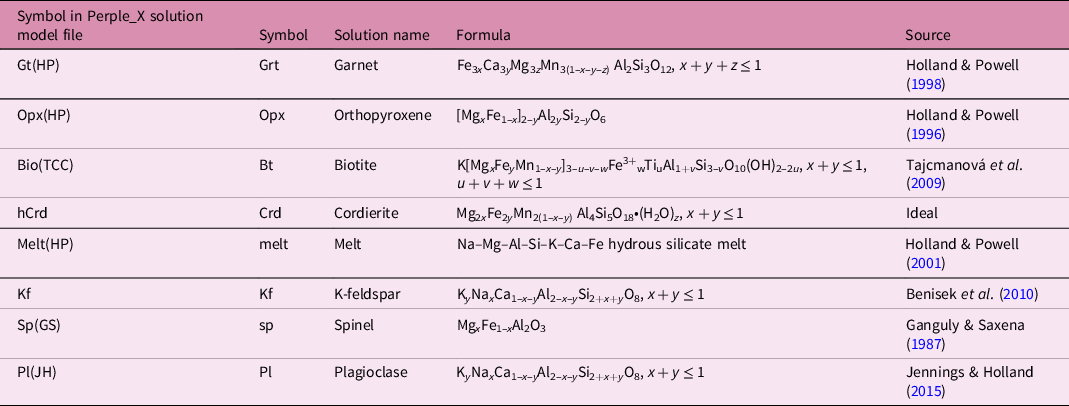
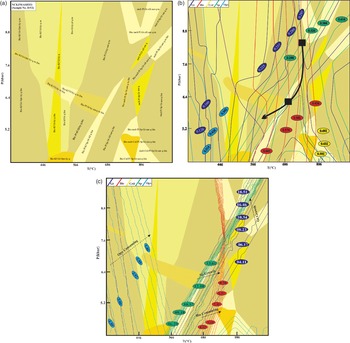
X-ray fluorescence (XRF) analyses of representative rock samples from the study area were performed on a Siemens SRS-3000 (WD-XRF) at the Wadia Institute of Himalayan Geology’s X-ray Fluorescence Laboratory in Dehradun, India. The pseudosection depicts the various mineral assemblages in their respective stability fields derived from the specific bulk rock composition over a range of P–T conditions. The P–T pseudosection was built using the Perple_X program (version 6.8.7), which is based on Gibbs free energy minimization (Connolly & Petrini, Reference Connolly and Petrini2002; Connolly, Reference Connolly2009). The pseudosections were constructed with the help of an internally consistent thermodynamic dataset and the equation of state for H2O from Holland & Powell (Reference Holland and Powell1998). Table 4 contains the solution models’ precise formulae, notation and sources. Mineral abbreviations used in this work are after Kretz (Reference Kretz1983). To constrain the history of the pelitic granulites of the studied area, P–T pseudosections relevant to the mineral assemblages preserved in these rocks have been presented in Figure 5a. The pseudosection for the pelitic granulites (sample no. D/52) is contoured with the compositional isopleths of XMg garnet, XMg biotite, XMg cordierite, XMg orthopyroxene and XMg spinel (Fig. 5b). The P–T conditions derived from the intersection of XMg isopleths of garnet, biotite and spinel give a peak temperature of ∼770 °C at 8.6 kbar.
Solution notation, formulae and model sources for phase diagram calculation

Bulk composition in wt % is Na2O = 0.85; MgO = 3.73; MnO = 0.12; Al2O3 = 16.09; SiO2 = 61.61; K2O = 5.70; CaO = 0.19; TiO2 = 1.13; FeO = 8.14; O2 = 0.48; H2O = 1.96.
(a) Calculated P–T pseudosection for the pelitic granulites (sample no. D/52) in the model system NCKFMASHTO (Na2O–CaO–K2O–FeO–MgO–MnO–Al2O3–SiO2–H2O–TiO2–O2). (b) Calculated P–T pseudosection for sample no. D/52 is contoured with calculated XMg (= Mg/(Mg + Fe2+)) isopleths of garnet, cordierite, orthopyroxene, spinel and biotite. (c) Distribution of the calculated modal isopleths of different minerals for the calculated pseudosection (sample no. D/52): garnet (Grt), biotite (Bt), spinel (Spl), cordierite (Crd) and orthopyroxene (Opx). Black dotted arrow represents growth and consumption of different minerals.

5. Monazite geochronology
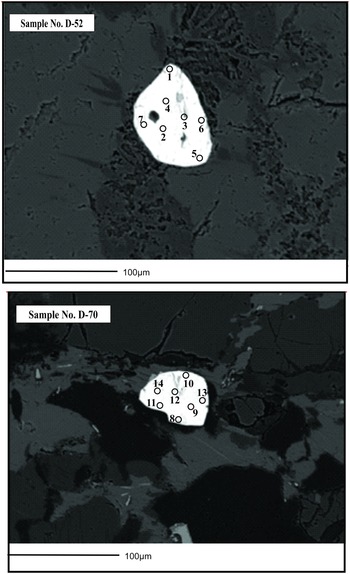
The EPMA monazite geochronology was used to determine the age and evolutionary history of the southern section (Diwani hills) of the Aravalli–Delhi Mobile Belt. Electron microprobe dating can be a very useful instrument for determining the age of metamorphism and deformation history of a rock. After systematic electron microprobe – backscatter electron (EPMA–BSE) imaging, two samples (D/52 and D/70) were selected for microprobe dating that had grain sizes ranging from 83 to 115 microns and a uniform mineral composition (Fig. 6). In the BSE images, the monazite grains exhibit uniform compositional domains. Monazite grains range in shape from anhedral to subhedral or rounded, and in size from small (30–80 μm) to large (80–115 μm). They can be found as an inclusion within garnet and as the matrix. In the present study, monazite grains occur as inclusions in garnet porphyroblasts and have a lower yttrium (Y) elemental composition at the rim than the core. The partitioning of Y in monazite is directly related to the growth or consumption of peritectic garnet (Spear & Pyle, Reference Spear and Pyle2010; Bhowmik et al. Reference Bhowmik, Wilde, Bhandari and Basu Sarbadhikari2014). The monazite exhibits compositional variation between Th (Ca and Si) and Y (heavy rare earth elements), and it reflects the various substitutions. The SiO2 content of all the monazite grains seemed to be negligible.
Back-scattered electron (BSE) images of monazite grains (D/52 and D/70) from the Diwani hills.

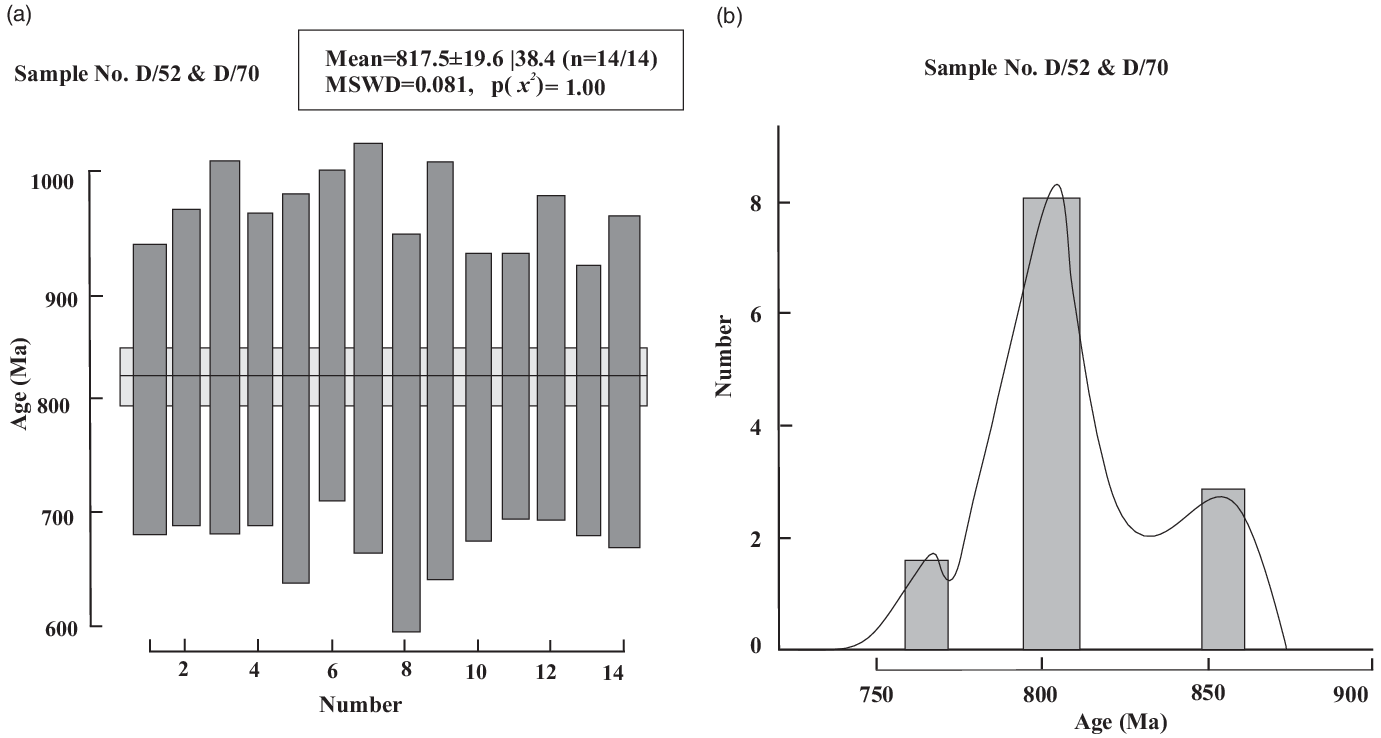
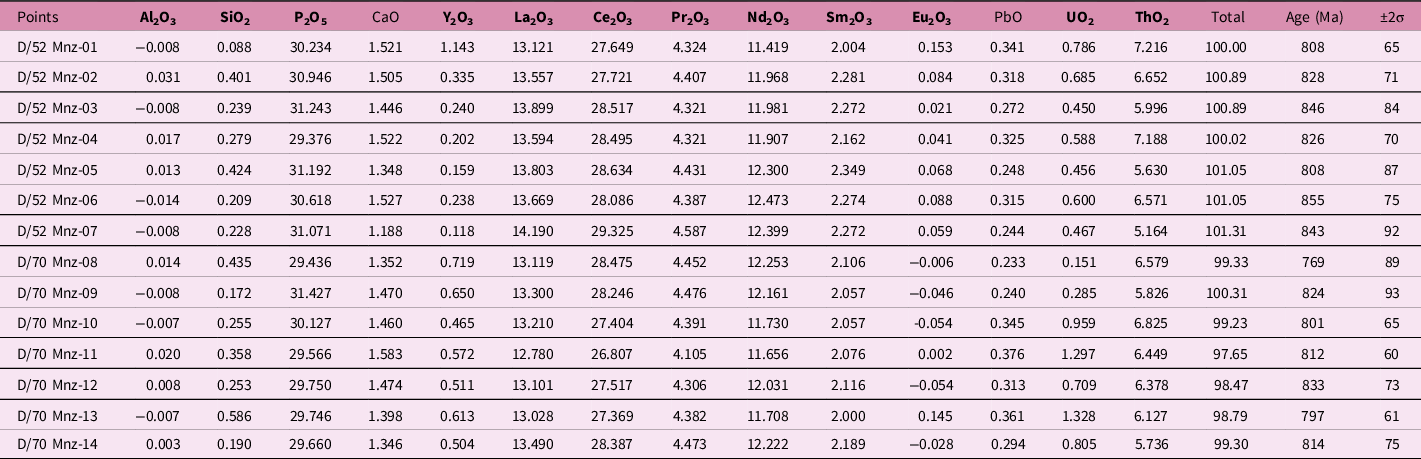
The isotopic data (Fig. 7a; Table 5) of the monazite grains have been interpreted to date the metamorphic event in the Diwani hills as Neoproterozoic (817 ± 19 Ma). Figure 7b shows the probability density peaks of monazite ages from different samples, as well as a probability density plot of spot dates with a single peak at ∼810 Ma.
(a) The weighted average of mean ages from monazite in the sample (D/52 and D/70). (b) A probability density plot of spot dates reveals a single peak at ∼817 Ma.

EPMA dating age of monazite crystals of pelitic granulites (sample no. D/52 and D/70)

The results of the monazite geochronology in this study provide the current understanding that the enclave granulite-facies domain in the Balaram area is the result of a widespread Neoproterozoic (817 ± 19 Ma) tectonothermal event.
6. Discussion
Based on the petrographic analysis, mineralogical criteria, oxygen fugacity, pseudosection modelling and geochronological data, an attempt was made to determine the tectonometamorphic evolution of the Diwani hill area. The calculated metamorphic P–T conditions clearly show that the investigated area followed an isothermal decompressional path (with a pressure change of ∼2.4 kbar). Graphite, one of the most oxidation sensitive minerals, is very common in the granulites of southern India. However, graphite is typically absent in the studied rock samples of the current area, which could be attributed to the high-oxidation conditions (log fO2 up to −13) during metamorphism and subsequent exhumation of the granulite of the Diwani hills. The granulites in the study area lack any exsolution textures and corona textures, so there lies a possibility of high CO2 flux catalysing retrograde reactions, in the absence of which these inequilibrium textures could else have been preserved. CO2 is the only volatile that could be abundant enough to dilute and carry off H2O sufficiently to consume hydrous phases, and evidence of high oxygen fugacities also suggests that there could be a high-pressure CO2-rich phase during metamorphism (Newton, Reference Newton, Walther and Wood1986). Although some previous workers have attempted to determine the isotopic age of the rocks of the Diwani hill region, controversy over the age of these granulites still exists. According to Singh et al. (Reference Singh, De, Karmakar, Sarkar and Biswal2010), metamorphism of the Diwani hill granulites took place between c. 860 and 800 Ma, while exhumation through thrusting along multiple ductile shear zones took place at c. 800–760 Ma. Biju-Sekhar et al. (Reference Biju-Sekhar, Yokoyama, Pandit, Okudaira, Yoshida and Santosh2003) used electron microprobe dating of monazite and zircon in granites and estimated a 1.8−1.7 Ga Palaeoproterozoic magmatic event in the Aravalli–Delhi Mobile Belt.
Previous work, based on SHRIMP U–Pb chronological studies, yielded ages corresponding to a metamorphic overprint between 780 and 680 Ma, and ages corresponding to detritus derived from a magmatic source between 1591 and 1216 Ma (Singh et al. Reference Singh, De, Karmakar, Sarkar and Biswal2010; Prakash et al. Reference Prakash, Kumar, Rai, Singh, Singh, Yadav, Jaiswal, Srivastava, Yadav, Bhattacharjee and Singh2021). However, in the present study, we only obtained a metamorphic overprint date (769 to 855 Ma).
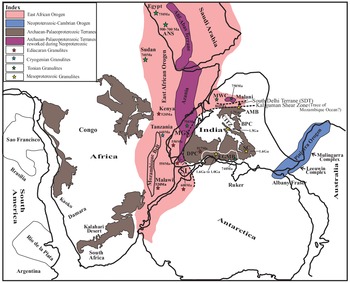
Around 800 Ma or a little earlier, as evident by the magmatism and metamorphic history, the existence of the proposed Malani supercontinent consisted of India, the Arabian Nubian Shield (ANS), Madagascar and China (Kochhar, Reference Kochhar2008). It has been inferred that the present NW India was adjacent to the East African Orogen on its eastern margin (Vijaya et al. Reference Vijaya, Prasad, Reddy and Tewari2000). The South Delhi Terrane (SDT) is the part of NW India (Fig. 8).
Reconstruction of part of Gondwana showing various cratonic blocks modified after Prakash et al. (Reference Prakash, Kumar, Rai, Singh, Singh, Yadav, Jaiswal, Srivastava, Yadav, Bhattacharjee and Singh2021). ANS – Arabian Nubian Shield; AMB – Aravalli Mobile Belt; BPC – Bundelkhand Protocontinent; CITZ – Central India Tectonic Zone; DPC – Dharwar Protocontinent; EGMB – Eastern Ghats Mobile Belt; MGS – Madagascar; MWC – Marwar Craton; SC – Singhbhum Craton; SGT – Southern Granulite Terrane; SL – Sri Lanka.

The SDT is regarded as a suture zone between the western component of Gondwana (including East Africa, Madagascar and the ANS, and oceanic arcs such as the Bemarivo Belt of northern Madagascar and the Seychelles) and the eastern component of Gondwana (including the Dharwar–Marwar Craton and the Aravalli Mobile Belt – Bundelkhand Protocontinent). The SDT is characterized by multiple phases of folding episodes, high-grade metamorphism and a related orogeny between 1.7 Ga and 0.8 Ga (Choudhary et al. Reference Choudhary, Gopalan and Sastry1984; Volpe & Macdougall, Reference Volpe and Macdougall1990; Tobisch et al. Reference Tobisch, Collerson, Bhattacharya and Mukhopadhyay1994; Deb et al. Reference Deb, Thorpe, Krstic, Corfu and Davis2001). This has been marked as a suture zone owing to similarity in the terrane components (Prakash et al. Reference Prakash, Kumar, Rai, Singh, Singh, Yadav, Jaiswal, Srivastava, Yadav, Bhattacharjee and Singh2021 and references therein). On the basis of existing evidence, it has been suggested that the South Delhi basin may represent a remnant of the proto-Mozambique Ocean in NW India which was closed during subduction. As a result of this subduction, sediments metamorphosed to granulite-facies and were exhumed via thrusting during Neoproterozoic times.
As the Diwani hills represent part of the Aravalli–Delhi Mobile Belt, the present study attempted to determine the age and evolutionary history of the metamorphism of the Diwani hill granulites of the Aravalli–Delhi Mobile Belt with the help of the EPMA monazite (present as an inclusion within garnet and as the matrix in pelitic rocks) geochronology. In accordance with Singh et al. (Reference Singh, De, Karmakar, Sarkar and Biswal2010) and Prakash et al. (Reference Prakash, Kumar, Rai, Singh, Singh, Yadav, Jaiswal, Srivastava, Yadav, Bhattacharjee and Singh2021), there existed a palaeo-subduction zone known as the Kaliguman Shear Zone (which demarcates the boundary suture between the SDT and the Aravalli–Bhilwara terrane) in the Aravalli–Delhi Mobile Belt along which the South Delhi basin might have been closed (Sugden et al. Reference Sugden, Deb, Windley and Naqvi1990; Biswal et al. Reference Biswal, Gyani, Parthasarathy and Pant1998 a). Based on the interpretation of the monazite geochronology, the present study infers that a metamorphic event occurred in the Diwani hill area at ∼817 ± 19 Ma due to subduction. This finding further strengthens the previous model (Singh et al. Reference Singh, De, Karmakar, Sarkar and Biswal2010; Prakash et al. Reference Prakash, Kumar, Rai, Singh, Singh, Yadav, Jaiswal, Srivastava, Yadav, Bhattacharjee and Singh2021) which argued that a subduction-related compressional tectonic regime might have been responsible for granulite-facies metamorphism of rocks in the Diwani hill area.
7. Conclusions
The pelitic granulites from the Balaram area follow a clockwise P–T path of metamorphic evolution with 2.4 kbar of decompression, linked to simultaneous subduction and/or collisional tectonic processes. The calculated high-oxidation conditions for peak stages, as well as the absence of exsolution textures and spinel trellis textures, indicate that the granulite-facies metamorphism was highly CO2 fluxed. The absence of graphite in the pelitic granulites is due to high log fO2 values. The geochronological study of monazite grains demonstrates a metamorphic age of the Diwani hill granulites as Neoproterozoic (817 ± 19 Ma).
Acknowledgements
We extend our thanks to DST-SERB research project (P-07/704) to D.P. and JRF (CSIR) to M. Kumar for the financial help in the form of a fellowship. The authors thank anonymous reviewers for constructive comments that led to substantial improvements to the manuscript.