Dear Editor,
Obsessive-compulsive disorder (OCD) affects 10% of the adult clinical population and its treatment remains a challenge. In the last 10 years, insight emerged as a potential explanation for the limited success of pharmacotherapy and psychotherapy in OCD, with inefficacy rates of 20–25%, which prompted the need for more research on this topic (Eisen et al., Reference Eisen, Rasmussen, Phillips, Price, Davidson, Lydiard, Ninan and Piggott2001). Moreover, attention has been drawn to the different factors influencing insight, and, among them, the brain-derived neurotrophic factor (BDNF) was linked to the pathogenesis of several neuropsychiatric disorders, including OCD. This molecule is expressed by neurons, astrocytes, glial cells and oligodendrocytes. BDNF protein levels are altered in patients with depressive disorders: an increase in BDNF can usually be seen after initiation of antidepressant therapy, and those in whom this does not occur tend to be resistant to therapy (Polyakova et al., Reference Polyakova, Schlögl, Sacher, Schmidt-Kassow, Kaiser, Stumvoll, Kratzsch and Schroeter2015). An association between low-peripheral BDNF and a poor response to treatment has also been observed in panic disorder and generalised anxiety disorder (Suliman et al., Reference Suliman, Hemmings and Seedat2013). To invite more researchers to focus on BDNF, we hereby present our arguments in favour of the role played by this neurotrophin in OCD, based on some of our most recent findings.
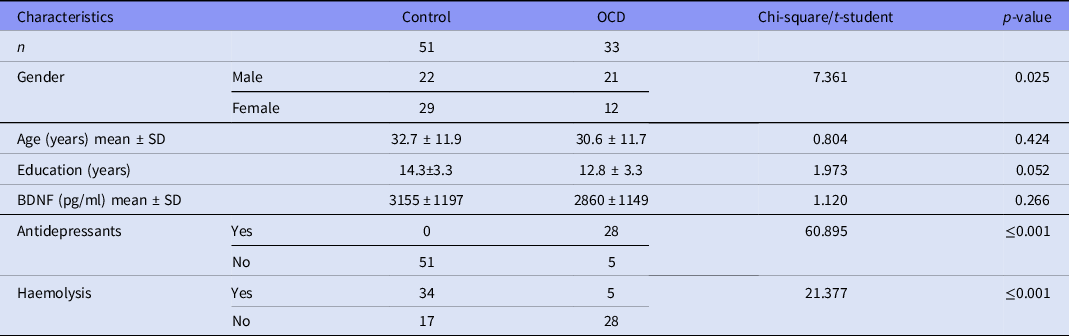
While developing a research project on insight in OCD, we found, through a search in Pubmed online, that there are very few articles concerning BDNF levels in OCD. In light of this, we decided to make a preliminary measurement of BDNF in OCD patients. To do so, we collected a sample of 33 outpatients (21 men and 12 women) with OCD, according to Diagnostic and Statistical Manual of Mental Disorders IV edition text-revised (DSM-IV TR). All patients had ages between 18 and 65 and could give the informed consent. We only included patients whose main diagnosis was OCD and with no history of other pathologies (through evaluation with Mini International Neuropsychiatric Interview — M.I.N.I. 4.0). Thrombopathies were also excluded from the study. The control group comprised the 51 medical students (n = 10) and blood donors (n = 41) from the Portuguese Blood Institute who best matched the clinical sample. From the total control participants, the outliers were removed and the remaining participants were included. The differences found between the two groups, regarding the variables gender, education, ‘antidepressants’ and ‘haemolysis’, were, for this reason, later controlled using Analysis of Covariance (ANCOVA) (see Table 1). All controls were free from any psychiatric or other medical diseases/conditions.
Table 1.
Socio-demographic and clinical characteristics
If we consider the p-value as a criterion, the variables gender, education, antidepressants and haemolysis were statistically significant at p = 0.05. Considering this criterion, we controlled these variables using Analysis of Variance (ANOVA). However, if we did a control of the false discovery rate according to the method of Benjamini and Hochberg (FDR), only the use of antidepressants and hemolysis would be significant. These last two variables were also controlled at ANCOVA.
Insight was evaluated using the Brown Assessment of Beliefs Scale (BABS), as it is the most widely used scale to measure insight and, as such, the best way to compare results with those of other researchers. As in other studies (3) on insight using BABS, the cut-off score was defined so as to allow for the identification of two groups of OCD patients: poor-insight (BABS score ≥ 12) and good-insight (BABS score < 12) patients. Obsessive-compulsive symptoms were evaluated by the Y-BOCS scale. The main result is expressed in Figure 1.
Figure 1.
Estimated Marginal Means of BDNF in control, good insight and poor insight groups.
As the figure shows, BDNF (pg/mL) was compared among the three study groups (control, good and poor insight). After the ANOVA, we conducted an ANCOVA to control for antidepressant use and gender, and excluded the variables with p ≤ 0.05. After eliminating gender and education, a new ANCOVA was conducted to control for antidepressants and haemolysis, with p = 0.0286.
Our work has shown that plasma BDNF differed in important ways between the studied groups. The BDNF values of the poor-insight group were lower than those of the good-insight and control groups. Note that these differences are due to the poor-insight patients, who exhibited the lowest BDNF concentrations. Accordingly, when poor-insight patients were removed from the analysis, the BDNF difference between OCD patients and controls disappeared.
The use of haemolysis as a co-variate was based on the p-value found (p ≤ 0.001), but also on the literature, which points out that samples exposed to temperatures above –80°C for a long period or a longer centrifugation can lead to BDNF variations. The interference of antidepressant use in plasma BDNF was already reported in different psychiatric disorders (Björkholm & Monteggia, Reference Björkholm and Monteggia2016).
Poor insight is associated to a more severe presentation of OCD and to a higher treatment resistance (Visser et al., Reference Visser, Megen, Oppen, Hoogendoorn, Glas, Neziroglu and Balkom2017). As far as we know, no previous study has shown that patients with poor insight have a lower BDNF than their good-insight counterparts. Whether insight in OCD patients can be improved by psychological therapies targeting poor insight remains to be determined. Moreover, few studies have focused on the correlation between BDNF and OCD severity. In other psychiatric disorders, reduced BDNF was linked to treatment resistance. A possible explanation for our findings is that poor-insight patients are a distinctive group, with poorer prognosis and a less favourable molecular profile. Patients with a lower BDNF (and hence neurobiological disfunction) may respond better to more biological treatments (medications, deep brain stimulation). If so, BDNF may be a promising target for the research on OCD patients’ therapeutic resistance.
Although these findings are the preliminary results of a wider research effort, to be further developed, we would like this work to act as a stimulus for more studies on this issue. In particular, we hope the present contribution can help guide future research on the neurobiological aspects of insight in OCD and improve our understanding of the role played by BDNF in OCD in general, and in insight in particular. In our view, future studies should include a larger samples and other characteristics often found in poor-insight patients, such as treatment resistance and psychopathology severity. Moreover, they should also focus on other therapeutic targets and a wider array of prognostic tools.






 You have
Access
Dear Editor,
Obsessive-compulsive disorder (OCD) affects 10% of the adult clinical population and its treatment remains a challenge. In the last 10 years, insight emerged as a potential explanation for the limited success of pharmacotherapy and psychotherapy in OCD, with inefficacy rates of 20–25%, which prompted the need for more research on this topic (Eisen et al., Reference Eisen, Rasmussen, Phillips, Price, Davidson, Lydiard, Ninan and Piggott2001). Moreover, attention has been drawn to the different factors influencing insight, and, among them, the brain-derived neurotrophic factor (BDNF) was linked to the pathogenesis of several neuropsychiatric disorders, including OCD. This molecule is expressed by neurons, astrocytes, glial cells and oligodendrocytes. BDNF protein levels are altered in patients with depressive disorders: an increase in BDNF can usually be seen after initiation of antidepressant therapy, and those in whom this does not occur tend to be resistant to therapy (Polyakova et al., Reference Polyakova, Schlögl, Sacher, Schmidt-Kassow, Kaiser, Stumvoll, Kratzsch and Schroeter2015). An association between low-peripheral BDNF and a poor response to treatment has also been observed in panic disorder and generalised anxiety disorder (Suliman et al., Reference Suliman, Hemmings and Seedat2013). To invite more researchers to focus on BDNF, we hereby present our arguments in favour of the role played by this neurotrophin in OCD, based on some of our most recent findings.
While developing a research project on insight in OCD, we found, through a search in Pubmed online, that there are very few articles concerning BDNF levels in OCD. In light of this, we decided to make a preliminary measurement of BDNF in OCD patients. To do so, we collected a sample of 33 outpatients (21 men and 12 women) with OCD, according to Diagnostic and Statistical Manual of Mental Disorders IV edition text-revised (DSM-IV TR). All patients had ages between 18 and 65 and could give the informed consent. We only included patients whose main diagnosis was OCD and with no history of other pathologies (through evaluation with Mini International Neuropsychiatric Interview — M.I.N.I. 4.0). Thrombopathies were also excluded from the study. The control group comprised the 51 medical students (n = 10) and blood donors (n = 41) from the Portuguese Blood Institute who best matched the clinical sample. From the total control participants, the outliers were removed and the remaining participants were included. The differences found between the two groups, regarding the variables gender, education, ‘antidepressants’ and ‘haemolysis’, were, for this reason, later controlled using Analysis of Covariance (ANCOVA) (see Table 1). All controls were free from any psychiatric or other medical diseases/conditions.
Socio-demographic and clinical characteristics
BDNF, brain-derived neurotrophic factor; SD, standard deviation.
If we consider the p-value as a criterion, the variables gender, education, antidepressants and haemolysis were statistically significant at p = 0.05. Considering this criterion, we controlled these variables using Analysis of Variance (ANOVA). However, if we did a control of the false discovery rate according to the method of Benjamini and Hochberg (FDR), only the use of antidepressants and hemolysis would be significant. These last two variables were also controlled at ANCOVA.
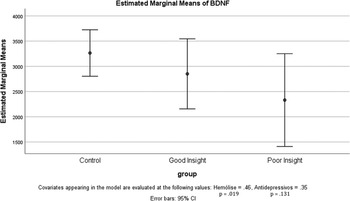
Insight was evaluated using the Brown Assessment of Beliefs Scale (BABS), as it is the most widely used scale to measure insight and, as such, the best way to compare results with those of other researchers. As in other studies (3) on insight using BABS, the cut-off score was defined so as to allow for the identification of two groups of OCD patients: poor-insight (BABS score ≥ 12) and good-insight (BABS score < 12) patients. Obsessive-compulsive symptoms were evaluated by the Y-BOCS scale. The main result is expressed in Figure 1.
Estimated Marginal Means of BDNF in control, good insight and poor insight groups.
As the figure shows, BDNF (pg/mL) was compared among the three study groups (control, good and poor insight). After the ANOVA, we conducted an ANCOVA to control for antidepressant use and gender, and excluded the variables with p ≤ 0.05. After eliminating gender and education, a new ANCOVA was conducted to control for antidepressants and haemolysis, with p = 0.0286.
Our work has shown that plasma BDNF differed in important ways between the studied groups. The BDNF values of the poor-insight group were lower than those of the good-insight and control groups. Note that these differences are due to the poor-insight patients, who exhibited the lowest BDNF concentrations. Accordingly, when poor-insight patients were removed from the analysis, the BDNF difference between OCD patients and controls disappeared.
The use of haemolysis as a co-variate was based on the p-value found (p ≤ 0.001), but also on the literature, which points out that samples exposed to temperatures above –80°C for a long period or a longer centrifugation can lead to BDNF variations. The interference of antidepressant use in plasma BDNF was already reported in different psychiatric disorders (Björkholm & Monteggia, Reference Björkholm and Monteggia2016).
Poor insight is associated to a more severe presentation of OCD and to a higher treatment resistance (Visser et al., Reference Visser, Megen, Oppen, Hoogendoorn, Glas, Neziroglu and Balkom2017). As far as we know, no previous study has shown that patients with poor insight have a lower BDNF than their good-insight counterparts. Whether insight in OCD patients can be improved by psychological therapies targeting poor insight remains to be determined. Moreover, few studies have focused on the correlation between BDNF and OCD severity. In other psychiatric disorders, reduced BDNF was linked to treatment resistance. A possible explanation for our findings is that poor-insight patients are a distinctive group, with poorer prognosis and a less favourable molecular profile. Patients with a lower BDNF (and hence neurobiological disfunction) may respond better to more biological treatments (medications, deep brain stimulation). If so, BDNF may be a promising target for the research on OCD patients’ therapeutic resistance.
Although these findings are the preliminary results of a wider research effort, to be further developed, we would like this work to act as a stimulus for more studies on this issue. In particular, we hope the present contribution can help guide future research on the neurobiological aspects of insight in OCD and improve our understanding of the role played by BDNF in OCD in general, and in insight in particular. In our view, future studies should include a larger samples and other characteristics often found in poor-insight patients, such as treatment resistance and psychopathology severity. Moreover, they should also focus on other therapeutic targets and a wider array of prognostic tools.
Acknowledgements
We would like to thank Prof. Ana Sebastião Lab and, in particular, to Prof. Maria José Diógenes for the scientifical collaboration provided. The third author wishes to thank the support of the Foundation for Science and Technology (FCT), through IDMEC, under LAETA, project UIDB/50022/2020. We also thank to Vanda Carneiro (Hospital de Santa Maria) and to Dr. Leonilde Outerelo (Portuguese Blood Institute) for their support in sample collection.