The Vinča culture and the tell of Vinča-Belo Brdo: endings
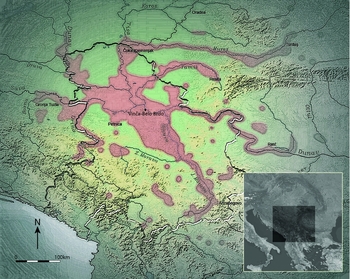
The Vinča culture of Serbia and neighbouring countries (Figure 1) emerged in the later sixth millennium cal BC, following initial settlement of the region in the late seventh millennium cal BC. It presents key developments including: changing materiality; the expansion of material networks; the spread, consolidation and diversification of settlement, involving the formation of large settlements and tells; the intensification of subsistence and the emergence of both larger communities and distinctive households within them (Chapman Reference Chapman1981, Reference Chapman2000; Kaiser & Voytek Reference Kaiser and Voytek1983; Tringham & Krstić Reference Tringham, Krstić, Tringham and Krstić1990; Orton Reference Orton2010). These developments occurred over a timescale of several centuries, but were not to last for ever; they were succeeded by a much more dispersed and often less archaeologically visible pattern of settlement. Not least among the many questions that the Vinča phenomenon raises are the timing and circumstances of its demise in the middle of the fifth millennium cal BC (Parzinger Reference Parzinger1993; Schier Reference Schier and Draşovean1996; Link Reference Link2006; Borić Reference Borić, Kienlin and Roberts2009; Orton Reference Orton2012).
Map showing the distribution of Vinča culture (in red) with the location of Vinča-Belo Brdo.

As well as extensive cross-dating within a cultural-historical perspective (Garašanin Reference Garašanin and Benac1979; Parzinger Reference Parzinger1993), informal inspections of radiocarbon dates have led to varying estimates of the end date of Vinča culture across its wide distribution. These dates are spread across the middle and later part of the fifth millennium cal BC (Link Reference Link2006). Two recent papers offer Bayesian chronological models for a selection of Vinča culture sites (Borić Reference Borić, Kienlin and Roberts2009: 235–36, fig. 47; Orton Reference Orton2012), suggesting that many of them end in the forty-seventh century cal BC. Bayesian models for the chronology of Vinča-Belo Brdo itself have been presented by Schier (Reference Schier and Draşovean1996: fig. 10) and Borić (Reference Borić, Kienlin and Roberts2009: fig. 45); in both cases, however, only three radiocarbon dates came from above a relative depth of 4.5m. This paper models 34 dates from a relative depth of 1.3–2.4m.
Explanations of the radical transformations involved in the demise of the Vinča culture have varied considerably, from migrations within the culture-history framework (e.g. Tasić et al. Reference Tasić, Srejović and Stojanović1990: 32–33), to the increasing importance of individual households and competitive social relations (Tringham & Krstić Reference Tringham, Krstić, Tringham and Krstić1990). There remains, however, a lack of chronological precision for all the sites in question, and fine-resolution chronology may offer further, more detailed insight into both site-based and wider histories. This paper focuses on the tell of Vinča-Belo Brdo, overlooking the Danube near Belgrade (Tasić et al. Reference Tasić, Vukadinović and Kapuran2006).
Investigations of Vinča-Belo Brdo
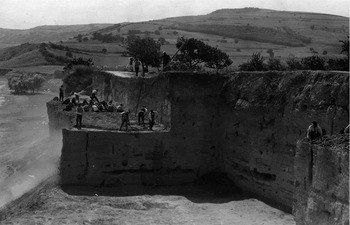
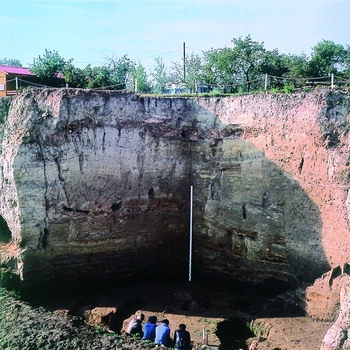
Since its initial investigation between 1908 and 1934 (Vasić Reference Vasić1936; Figure 2), Vinča-Belo Brdo has served as a yardstick for the relative chronology of Late Neolithic cultures of its region (e.g. Childe Reference Childe1929; Milojčić Reference Milojčić1949; Garašanin Reference Garašanin1951; Parzinger Reference Parzinger1993; Schier Reference Schier and Draşovean1996), and has often been regarded as synonymous with the Vinča culture as a whole. Subsequent excavations by Nikola Tasić and Jovan Todorović (1978–1983), and then Dragoslav Srejović (1983–1986), stripped a part of the site and revealed a new profile (Figure 3). Above the Starčevo material, which occupies the deepest layers of the site, lie over 8m of Vinča culture deposits, with a series of horizons from c. 9m up to c. 1.3m. Copper Age and Middle Bronze Age deposits follow these. The top of the site is occupied by a large necropolis, from the ninth to the twelfth centuries AD (Marjanović-Vujović Reference Marjanović-Vujović and Ćelić1984). Further excavations since 1998 by Nenad Tasić have unearthed the uppermost of the Late Neolithic deposits in sector II and revealed three, or possibly four, late Vinča culture structural horizons (Tasić Reference Tasić, Nikolova, Fritz and Higgins2005; Tasić & Ignjatović Reference Tasić, Ignjatović and Nikolić2008).
The 1933 Vasić excavations at Vinča (photograph: Faculty of Philosophy, Belgrade).

Excavations by Nikola Tasić in 1981, designed to check Vasić's methodology and showing a fresh vertical section of Vinča-Belo Brdo (photograph: Faculty of Philosophy, Belgrade).

Structural horizons and features from the uppermost Vinča culture levels at Belo Brdo
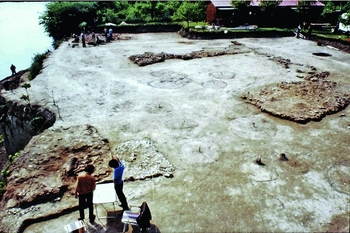
The top of the Neolithic deposits suffered damage during later occupation and through the creation of a medieval cemetery. Four inhumations of the Copper Age Bodrogkeresztúr culture were at the level of the uppermost house rubble of the Vinča culture, with grave 2 (see Figure 5) lying directly on a small daub surface (Tasić Reference Tasić and Ćelić1984: 75; Borić in press). Several dozen postholes belonging to later constructions (best seen in house 6) cut the same rubble layer; these were of similar orientation and size to the buildings described below, and might represent yet another horizon of the final Vinča culture settlement, damaged by post-Neolithic occupation.
Excavations in 1982 showing the uppermost burnt house horizon at the end of the Neolithic at Vinča (photograph: Faculty of Philosophy, Belgrade).

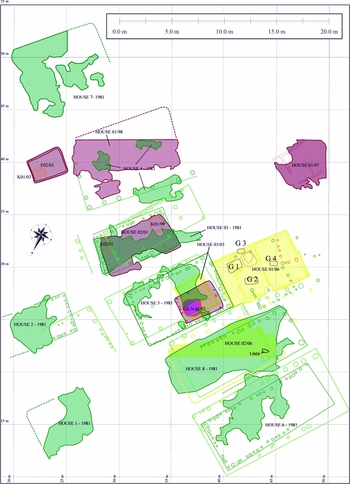
Plan of several houses excavated in sector II in 1978–1986 and 1998–2007; those in the lower burnt structural horizon are shown in yellow; those in the unburnt horizon in mauve; and those in the upper burnt structural horizon in dark green. The unlabelled houses outlined in light green may constitute an uppermost unburnt final horizon of Vinča culture occupation; G = Bodrogkeresztúr graves.

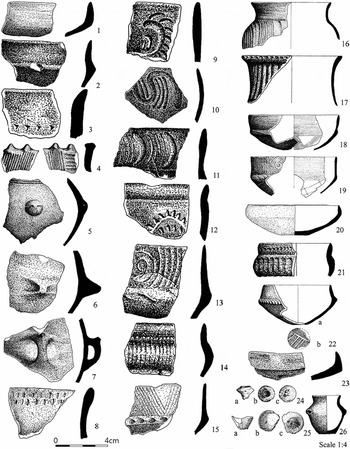
All the other structural horizons described in this paper belong to Vinča D. The last certain Vinča culture-structural horizon (Figures 4 & 5), investigated between 1981 and 1986, survives at a relative depth of 1.3–1.8m and comprises houses 1–9. The chronological coherence of this horizon is supported by the shared orientation and layout of a series of closely set buildings, along what appears to be an alley or street, and by the fact that they were all destroyed by a large fire. Samples have been dated from two of these burnt structures: houses 6 and 8 (Figure 5). A selection of pottery in the latest Vinča D style (Milojčić Reference Milojčić1949; Garašanin Reference Garašanin1951), from the levels immediately below houses 3, 6 and 9, is shown in Figure 6.
Typical Vinča culture pottery from the excavations 1998–2007, from immediately below the uppermost burnt horizon (photograph: Faculty of Philosophy, Belgrade).

Beneath and alongside house 3, the unburnt house 02/01 was identified; this building yielded no samples. Under house 5 (adjacent to house 8), there was an atypical circular kiln (K01/02). The remains of this kiln were located in a small rectangular structure that appears to have been abandoned and then collapsed, showing no traces of burning. Three samples associated with the kiln have been dated. The kiln overlay and partially cut the top levels of rubble of burnt house 03/03. The base of the structure surrounding the kiln also partially truncated the north wall of house 03/03.
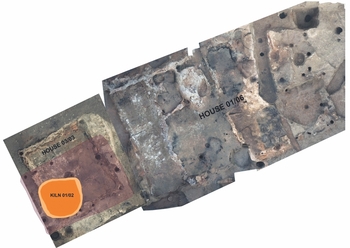
House 03/03 is very unusual within the range of Vinča culture structures (Tasić Reference Tasić2007). It is almost square in shape (2.7 × 3.2m), without any internal subdivision or oven, and may have been used for storage (Figure 7).
Orthogonal photograph showing the relationships between house 03/03, house 01/06 and kiln 01/02 (photograph: Faculty of Philosophy, Belgrade).

Within the same horizon (Figures 5 & 7), to the south of house 03/03, a larger burnt structure, house 01/06, was divided into three rooms. Several of the dated samples originate from the second and third rooms of this house. To the west of houses 03/03 and 01/06, the south-east corner of another structure was defined as house 02/06, just underlying the southern edge of house 8. This was never excavated in full, but several dating samples were obtained from its rubble. This structure also appeared to have been burnt.
In the empty space between houses 01/06 and 02/06, the remains of an adult woman (over 21 years of age and probably around 30) were discovered buried by the rubble of the western wall of house 01/06. Her skull had been smashed by a large piece of daub from the collapsed wall of house 01/06 and her bones were heavily burnt, probably post-mortem in the fire that destroyed the house (unpublished specialist report by Sofija Stefanović). Again, the burning of a group of adjacent houses from this horizon (03/03, 01/06 and 02/06; at a relative depth of 2–2.4m) supports the interpretation of their contemporaneity. There are other excavated houses belonging to this extensively burnt lower structural horizon, including 02/03 and 01/03 to the east and north (Figure 5).
Radiocarbon dating and chronological modelling
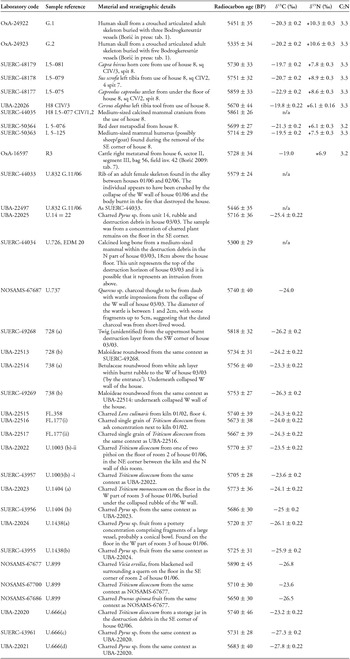
A total of 34 radiocarbon results are available from this sequence (Table 1). Samples were pre-treated, combusted, graphitised and dated by Accelerator Mass Spectrometry, as described in the references provided by Bayliss et al. (Reference Bayliss, van der Plicht, Bronk Ramsey, McCormac, Healy, Whittle, Whittle, Healy and Bayliss2011: tab. 2.3). The stable isotopic ratios reported in Table 1 were obtained on aliquots of the combusted gas by Isotope Ratio Mass Spectrometry.
Radiocarbon measurements and stable isotopic values from sector II at Vinča-Belo Brdo.

The radiocarbon dating programme for Vinča was conceived from the outset within a Bayesian statistical framework. This allows its chronology to be formally estimated, using an explicit statistical methodology, from both the radiocarbon dates and the sequence revealed by archaeological excavation. Given that this approach combines more than one type of chronological information, it provides date estimates that are not only formal, but also more robust and precise than those reliant on only one element of the available information. This approach is potentially particularly useful at Vinča because of the deep stratigraphic sequence (cf. Bayliss et al. Reference Bayliss, Farid, Higham and Hodder2014).
The dating of the deposits in sector II concentrated on determining when the Neolithic occupation of the Belo Brdo tell ended, and estimating the duration of occupation of specific structures. Suitable material for dating was restricted, partly because very few deposits of primary rubbish were discovered, and partly by the lack of environmental sampling for charred plant remains before 2001. For this reason, sampling for dating concentrated on charred material from ovens and the destruction of houses, and from animal bone left on the floors of abandoned structures.
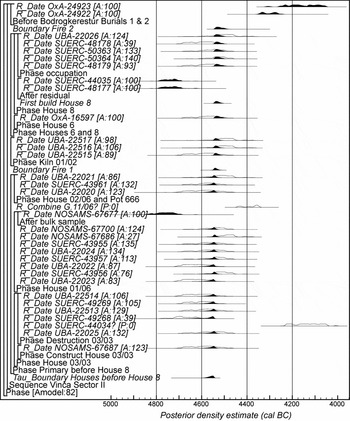
The chronological modelling has been undertaken using OxCal v4.2 (Bronk Ramsey Reference Bronk Ramsey2009) and IntCal13 (Reimer et al. Reference Reimer, Bard, Bayliss, Beck, Blackwell, Bronk Ramsey, Buck, Cheng, Edwards, Friedrich, Grootes, Guilderson, Haflidason, Hajdas, Hatté, Heaton, Hoffmann, Hogg, Hughen, Kaiser, Kromer, Manning, Niu, Reimer, Richards, Scott, Southon, Staff, Turney and van der Plicht2013). The algorithms in the models are defined exactly by the brackets and OxCal keywords shown in Figure 8 and in Supplementary Figure S1 (Oxford Radiocarbon Accelerator Unit n.d.). The posterior density estimates output by the models are shown in black, with the unconstrained calibrated radiocarbon dates shown in outline. The other distributions correspond to aspects of the models. For example, the distribution fire 1 is the posterior density estimate for the time when houses 01/06, 02/06 and 03/03 were destroyed. The highest posterior density intervals of the posterior density estimates are given in italics.
Probability distribution of dates from sector II at Vinča-Belo Brdo.

The model shown in Figure 8 interprets the excavated sequence from sector II as continuous occupation, with houses 03/03, 01/06 and 02/06 all being destroyed in the same fire. The narrow alleyway between houses 01/06 and 02/06 contains burnt debris and the body of the woman (G.11/06) apparently killed in the fire, although the boundary between houses 01/06 and 03/03 was truncated by a later, 0.6m-wide foundation trench. In such a densely packed settlement, fire would have surely spread readily. These buildings are earlier than kiln 01/02 and unburnt house 02/01, which are in turn earlier than houses 1–9. The samples for kiln 01/02 and houses 6 and 8 appear to derive from the entire periods of use of those structures and so are modelled using uniform distributions. Those for houses 03/03, 01/06 and 02/06, however, are biased towards material that was in these houses when they were destroyed by fire, and so we use an exponential distribution to allow for the fact that most of the dated material in these structures will be close in date to the time of destruction. The dates on two samples have been excluded from the model (marked with a ‘?’ in Figure 11 and Supplementary Figure S1). Two statistically inconsistent measurements (Table 1: UBA-22497 and SUERC-44033; T’ = 9.8, T’(5%) = 3.8, df = 1; Ward & Wilson Reference Ward and Wilson1978) have been produced on the burnt skeleton found between houses 01/06 and 02/06. The high carbon content of this sample, and that dated by SUERC-44034, suggests that these bones were insufficiently calcined for reliable dating. In addition, three samples are interpreted as providing only termini post quos for their contexts: SUERC-44035 and SUERC-48177, disarticulated animal bones from house 8 that seem to have been reworked; and NOSAMS-67677, a bulk sample of Vicia ervilia from the destruction of house 01/06 that may have been contaminated by the surrounding soil (Table 1).
This model has good overall agreement (Amodel: 82; Figure 8), which suggests that the radiocarbon dates are compatible with the reading of the stratigraphy described above. This model suggests that the fire which destroyed houses 03/03, 01/06 and 02/06 occurred in 4560–4510 cal BC (95% probability; fire 1; Figure 8), probably in 4550–4525 cal BC (68% probability). After the brief use of kiln 01/02, house 8 was constructed in 4550–4505 cal BC (95% probability; build house 8; Figure 8), probably in 4545–4520 cal BC (68% probability). This building was also destroyed by fire, in 4550–4485 cal BC (95% probability; fire 2; Figure 8), probably in 4545–4505 cal BC (68% probability).
By calculating the difference between build house 8 and fire 2, we can estimate that house 8 was in use for up to 40 years (95% probability; use house 8; Figure 9), probably for up to 15 years (68% probability). Taking the difference between our estimates for the dates of fire 1 and fire 2, we can calculate that two major fires occurred within a period of up to 55 years (95% probability; fire frequency; Figure 9), probably within a period of up to 25 years (68% probability).
Probability distributions for the number of years during which various activities occurred at Vinča-Belo Brdo, derived from the model defined in Figure 8.

To investigate the robustness of this model, we have constructed an alternative model (Supplementary Figure S1). This incorporates the vertical stratigraphic relationships between house 03/03 and kiln 01/02 and between houses 02/06 and 8, but otherwise all the samples are simply interpreted as coming from a single continuous period of use of the site. It suggests that Vinča culture occupation at Belo Brdo ended in 4545–4480 cal BC (95% probability; end Belo Brdo; Supplementary Figure S1), probably in 4540–4505 cal BC (68% probability). This is equivalent to the fire 2 parameter calculated in Figure 8. These date estimates are practically identical (their medians differing by two years), which gives us confidence that our chronology is not sensitive to our incorporation of the horizontal phasing in our preferred model (Figure 8).
Discussion
Great fires of Vinča?
To adapt Oscar Wilde's droll view on family relations, to lose one building horizon to fire is unfortunate, but to lose two in quick succession could be seen as carelessness. In recent decades, questions of the frequency and scale of house burning, and the intentionality—unified or varied—behind it, have been much discussed (from a much longer list: Tringham Reference Tringham, Gero and Conkey1991, Reference Tringham, Bailey, Whittle and Cummings2005; Chapman Reference Chapman, Gustafsson and Karlsson1999; Stevanović Reference Stevanović and Gheorghiu2002). The two successive horizons of burnt houses in the uppermost levels of Vinča-Belo Brdo in the second half of the forty-sixth century cal BC belong to a much wider phenomenon. But can their character and timing contribute to a better understanding of the ending of the Belo Brdo tell itself?
Central questions concerning scale and intention are whether we can distinguish between individual or wider house burnings, and between accidental and deliberate burnings, and, in the hypothetical case of the latter, between differing motivations such as aggressive acts among and between households and communities or the ritual and symbolic ending of individual households, say at the end of household lives or on the death of household leaders. Ruth Tringham has borrowed the phrase ‘domicide’ for aggressive acts, and coined the term ‘domithanasia’ for ‘voluntary’ endings (2005: 107); in formalising this range of factors (Tringham Reference Tringham, Bailey, Whittle and Cummings2005: tab. 11.1–2), she has drawn attention to the importance of the stage of the ‘life’ of the house or houses in question. John Chapman has also emphasised the relevance of house contents at the time of burning (1999). From an interpretive standpoint that gives primacy to the autonomous household in the Late Neolithic of south-east Europe (Tringham & Krstić Reference Tringham, Krstić, Tringham and Krstić1990; Tringham Reference Tringham, Gero and Conkey1991), Tringham in the end favours ritual or symbolic burnings of individual buildings. She does not exclude accidental burnings that got out of control, or burnings caused by local jealousy or wider, inter-communal aggression, but circumstantial evidence and theoretical, comparative considerations are summoned to set them aside. Thus, the very high temperatures measured or inferred from daub deposits, along with the nature of experimental burnings, are used to downplay the likelihood of accidental burnings, and a claimed lack of burning in the space between houses is employed as an argument against extensive burnings, while from general considerations negotiation is asserted as likely to have been more effective and more widely employed than short-term violence (Tringham Reference Tringham, Gero and Conkey1991: 122; Reference Tringham, Bailey, Whittle and Cummings2005: 103–106).
The evidence from Vinča-Belo Brdo cuts across these arguments. Two horizons clearly show extensive burning. The majority of the buildings are closely spaced, so that both accidental and deliberate fires started in one or multiple locations could have spread easily. The evidence from wider spaces between buildings is probably ambiguous. No specific analyses have been carried out, but the general character of daub here, as elsewhere, is consistent with the high and sustained temperatures not normally observed in experimental house burnings. With closely spaced buildings as seen at Belo Brdo, it is hard to see how individual burnings could have reliably been isolated from neighbouring structures.
If we focus on groups of houses, we can rethink the circumstances of more extensive burning, horizon by successive horizon. An ongoing coring programme and limited test excavation some 60m from the centre of the tell do not show burning everywhere in late Vinča levels. We could therefore envisage the deliberate burning of a finite group of houses within the tell at Belo Brdo, perhaps similar to the neighbourhood groups of 5–12 houses shown by geophysical survey at the flat settlement of Crkvine, Stubline, some 40km south-west (Crnobrnja et al. Reference Crnobrnja, Simić and Janković2010: 21). This could leave open the possibility of accidental burnings that got out of hand, rather than deliberate, malicious or otherwise aggressive fire-settings. But the formal chronological models presented here may weigh in favour of a deteriorating social context, with putative, deliberately aggressive burnings repeated within a generation or so.
We do have one ‘silent witness’, in the form of the woman apparently killed by the earlier of the two burning horizons reported here. As noted by others (Tringham Reference Tringham, Bailey, Whittle and Cummings2005: 106), very few bodies have been found in settlements of the ‘burnt house horizon’ in south-east Europe. One could argue that this individual death looks like an accident, the woman knocked unconscious and then asphyxiated as she, hypothetically, went back for treasured possessions, but it does seem less probable that such an accident, as reconstructed, would have taken place in the context of a ritual or symbolic burning (house 01/06 was full of everyday things). The alternative may be to suppose that the woman was trying to hide in the confused mêlée of a surprise attack, as one of the targets of inter-group violence (cf. Schulting & Fibiger Reference Schulting, Fibiger, Whittle and Bickle2014).
The lives of houses
The idea of the living—and dying—house has been much discussed in recent decades, especially with reference to the Neolithic and Copper Age of south-east Europe (Bailey Reference Bailey and Samson1990; Tringham Reference Tringham, Gero and Conkey1991; Chapman Reference Chapman, Gustafsson and Karlsson1999; Hofmann & Smyth Reference Hofmann and Smyth2012). The powerful concept could take on extra resonance in combination with the notion of ‘house societies’, with emphasis on transmission and descent (Borić Reference Borić and Jones2008). But few, if any, such discussions have robustly or precisely quantified the timescales at which building horizons succeeded each other. There are differing estimates for the number of building horizons within Vinča-Belo Brdo itself (Korošec Reference Korošec1953; Chapman Reference Chapman1981; Stalio Reference Stalio and Ćelić1984; Stevanović & Jovanović Reference Stevanović and Jovanović1996). Discussion of the simpler construction and lack of internal partitioning in successive buildings at Opovo, some 35km to the north-east of Belo Brdo, led Tringham to infer that the structures in question were more short-lived than elsewhere (Tringham et al. Reference Tringham, Brukner and Voytek1985; Tringham Reference Tringham, Gero and Conkey1991: 111–12), but the temporal difference was not quantified. The buildings at Vinča-Belo Brdo reported here were well built, some having three rooms. What is absolutely striking, however, is that the models suggest a duration for house 8 in the uppermost certain building horizon of probably less than 15 years (at 68% probability; use house 8; Figure 9). For the future, many more such models from other sites will be required, before we can safely generalise about this question. But does the remarkably short life of house 8, following the earlier fire and death within an interval formally modelled at less than 25 years (at 68% probability; fire frequency; Figure 9), indicate a quickening of the tempo in the circumstances leading to the end of the Vinča culture?
The end of the affair: when and why did the Vinča culture end?
Despite the central role that Vinča-Belo Brdo has played in the history of research on the Vinča culture, including on the construction of its chronology (Schier Reference Schier and Draşovean1996), there is no guarantee that even such a preeminent tell as Belo Brdo can stand for development right across the interconnected Vinča settlement networks. It will require much further formal modelling for the details of the history, short or long, over which the Vinča culture was transformed into the very different phenomena that succeeded it to be reliably established (Parzinger Reference Parzinger1993; Link Reference Link2006). Other sites farther afield that might previously have been set at a later date have also moved earlier. These include the Varna necropolis, now modelled as dating from the early forty-sixth to the mid-forty-fifth centuries cal BC (Higham et al. Reference Higham, Chapman, Slavchev, Gaydarska, Honch, Yordanov and Dimitrova2007). Figure 10 shows the modelled estimate for the start of the Varna necropolis in relation to those for the end of Vinča-Belo Brdo. Is the display of abundance and difference in the mortuary domain at Varna a symptom of accelerating social tensions within the wider world of mid-fifth millennium south-east Europe as a whole, rather than within the Vinča culture alone? Could this have helped to trigger the end of the tell-based system (cf. Borić Reference Borić, Kienlin and Roberts2009: 237)? These questions require a much longer discussion, and we will return to all these issues in subsequent papers. But it is clear that we cannot hope to resolve them without robust, precise and formal date estimates.
Probability distributions of key parameters from the latest occupation of Vinča-Belo Brdo (Figure 8) and for the start of the cemetery at Varna (Higham et al. Reference Higham, Chapman, Slavchev, Gaydarska, Honch, Yordanov and Dimitrova2007: fig. 3, recalculated using IntCal13).

Acknowledgements
Thanks are due to: Project Vinča for fieldwork and documentation; Vuk Koldžić for his help with the identification of animal bones and sample handling; and the NRCF panel for funding the two OxA dates cited here, obtained by Dušan Borić. Dating and modelling have been supported by a European Research Council Advanced Investigator Grant (295412), The Times of Their Lives, led by Alasdair Whittle and Alex Bayliss.
Supplementary material
To view supplementary material for this article, please visit http://dx.doi.org/10.15184/aqy.2015.101