





1. Introduction
Glaciers are not simply natural features, but they are integral to identity formation and the cultural continuity of nearby communities (Gagné et al., Reference Gagné, Rasmussen and Orlove2014). As glaciers retreat, these communities face both environmental transformation and changes to their very identities (Dunbar and Marcos, Reference Dunbar and Marcos2012; Tschakert et al., Reference Tschakert, Ellis, Anderson, Kelly and Obeng2019). Place identity has been a central theme in environmental scholarship (Devine-Wright & Clayton, Reference Devine-Wright and Clayton2010; Nelson et al., Reference Nelson, Ahn and Corley2020), but it was first introduced in psychology by Proshansky, who defined it as the facets of people’s selves that help shape their identity in relation to their surroundings, and which are influenced by a set of environment-specific values and behaviors (Proshansky, Reference Proshansky1978). While concepts like place identity, place attachment, and sense of place are often used interchangeably (G. Kyle et al., Reference Kyle, Graefe, Manning and Bacon2004), sometimes leading to conceptual ambiguity (Lewicka, Reference Lewicka2011), empirical research shows that they frequently overlap in practice (Droseltis & Vignoles, Reference Droseltis and Vignoles2010). What matters is that place identity is valuable in environmental research as it draws attention to how place and physical surroundings regulate individual and collective identities (Korpela, Reference Korpela1989).
Dominant approaches to place identity have tended to depoliticize the concept, emphasizing its cognitive, affective, and behavioral dimensions (G. T. Kyle et al., Reference Kyle, Jun and Absher2014) while overlooking the structural and power-laden conditions in which identities are (trans)formed. Environmental psychology has contributed to understanding how place identity positions the self in specific surroundings, showing how changes, like environmental degradation, can lead to identity destabilization (Strandberg & Ek Styvén, Reference Strandberg and Ek Styvén2024; Young et al., Reference Young, Carsten Conner and Pettit2020). Attempts at politicizing the concept have focused on symbolic and social constructions, with nationalism, inclusion/exclusion, and moral meanings, often at the expense of the materiality of place (Hopkins & Dixon, Reference Hopkins and Dixon2006). This opens a gap: the need to understand place identity not just as socially negotiated or emotionally significant, but as politically produced, maintained, and contested in specific places. Places become active sites where power is enacted, and identities are negotiated, rather than a passive backdrop.
This paper provides a critical case study of such dynamics, focusing on the Cajón del Maipo, Chile, a glacier environment that hosts several conflictual social and ecological processes, from mineral extraction and water disputes to climate change (Borgias, Reference Borgias2018). At the heart of this case is the tension between extractivist development and place identity: recent large-scale infrastructure projects have triggered heated national debates around water rights, environmental degradation, and the legitimacy of state and corporate interventions (Borgias, Reference Borgias2018), which affect place identity.
Here, I contribute to the literature by bringing place identity and political ecology together to examine the former as a process that is influenced by power relations. To do this, I ask: how are glaciers framed by people in the Cajón del Maipo, and what are the processes and (power) relations that influence place identity in the context of retreating glaciers? Findings show that threats to the glaciers of the Cajón del Maipo, and indirectly to the very continuity of the place, strengthen what might otherwise be a weak connection to the ice masses. Place identities in the Cajón del Maipo pass through and are reinforced by exploitation. The article is structured as follows: I begin by reviewing the literature on place identity, highlighting efforts to politicize the concept and showing the contributions of political ecology. I then introduce the case study in greater detail as well as the methods adopted, followed by a presentation of the empirical findings. Finally, I discuss the insights that emerge from the data, situating them within broader debates on political ecology and place identity.
2. Toward a politicization of place identity
Place identity has long been understood as more than a static psychological attachment to a given space, and it is increasingly conceptualized as a social process. Early works on the subject were criticized for their overly individualistic orientation (Dixon & Durrheim, Reference Dixon and Durrheim2000), which was later reframed to account for its intrinsic social quality, whereby place identity shapes feelings of collective belonging (Bonaiuto et al., Reference Bonaiuto, Breakwell and Cano1996; Devine-wright & Lyons, Reference Devine-Wright and Lyons1997). Through interaction with place, individuals form a personal sense of self, but they also co-construct social identities that are shared, contested, and negotiated within communities (Peng et al., Reference Peng, Strijker and Wu2020). This socially embedded understanding of place identity carries political weight. Peng et al. (Reference Peng, Strijker and Wu2020) show that place identity can foster positive attitudes toward one’s surroundings and motivate community engagement in environmental protection (also Masterson et al., Reference Masterson, Enqvist, Stedman and Tengö2019). Yet, as places transform – whether driven by external forces such as disasters or internal dynamics like development – so too change the identities tied to them. Nelson et al. (Reference Nelson, Ahn and Corley2020) refer to this as the dynamic nature of place identity: the relationship between people and place is fluid, continuously shaped and reshaped by change.
Human geography has argued that place identity cannot be reduced to symbolic or affective ties alone, and that the physical qualities of landscapes play a constitutive role in shaping identity (Sebastien, Reference Sebastien2020). This body of scholarship has thus raised a crucial point: identity is bound to the physical place in which individuals and social groups construct meanings, rather than simply consisting of the symbolic and mental linkages people form with their surroundings (G. T. Kyle et al., Reference Kyle, Jun and Absher2014), as proposed by environmental psychologists. The question ‘who we are’ is thus inseparable from the question ‘where we are’ (Dixon & Durrheim, Reference Dixon and Durrheim2000). People include their surroundings (people, objects, and landscapes) in their sense of self (Strandberg & Ek Styvén, Reference Strandberg and Ek Styvén2024). These processes help explain how individuals act and behave in ways that are consistent with their place-related meanings and values, resulting in positive emotional states (Fresque-Baxter & Armitage, Reference Fresque-Baxter and Armitage2012; G. T. Kyle et al., Reference Kyle, Jun and Absher2014). As long as the characteristics of place align with one’s values, beliefs, and preferences, connections to place support a sense of temporal coherence and continuity in the self (Strandberg & Ek Styvén, Reference Strandberg and Ek Styvén2024).
But what happens when the characteristics of a place change, when environments are disrupted, and place identity loses coherence? When these transformations are shaped by political processes, critical questions about the power-laden dynamics that shape place identity arise. However, much literature still treats the concept as politically neutral. Dixon and Durrheim (Reference Dixon and Durrheim2000) challenge this view, encouraging scholarship to examine how spatial changes support or disrupt identities within power structures (also Sebastien, Reference Sebastien2020). In post-apartheid South Africa, they show how place transformations unsettle place identity and expose transgressive presences that threaten dominant notions of place and identity. Similarly, Hopkins and Dixon (Reference Hopkins and Dixon2006) analyze how everyday talk about place sustains political identities and social hierarchies.
2.1. Politicizing place identity with political ecology
Bringing a political ecology approach allows us to understand place identity not as rooted in static or symbolic attachments to place, but as produced and transformed by struggles over land, resources, and power. As Dalby (Reference Dalby2003) argues, dominant capitalist ideologies render nature an object of pride and at the same time something exploitable. Within this paradigm of ecological degradation, the lives and identities that people form through place become precarious. It thus becomes essential to examine which political identities are erased or created as environments change. One of political ecology’s central contributions is to reframe place identity as something shaping and shaped by political and ecological struggle. With its ‘environmental subjects and identity’ thesis, political ecology asks how environmental regimes shape people by creating new behaviors, political actions, and thus identities that unite diverse groups through shared ecological struggles (Robbins, Reference Robbins2019).
Political ecology also highlights that place is not a neutral backdrop, but a dynamic site of political struggle, always in flux and influenced by global processes (Escobar, Reference Escobar2001; Massey, Reference Massey and Massey1994). As Hurley (Reference Hurley2013) states, places are shaped by resource use, social relations, and political decisions. From this perspective, political ecologists view place as central to struggles over environmental change (Neumann, Reference Neumann2009). The ‘politics of landscape’, as exemplified by Walker and Fortmann (Reference Walker and Fortmann2003), illustrates how groups contest not only who gets access to land, but also what a place should look like and what meanings it holds. Place here becomes a symbolic and material site where competing social groups struggle to assert their environmental imaginaries (Walker & Fortmann, Reference Walker and Fortmann2003), and where place identities are formed, reinterpreted, and deployed by both groups and individuals to bolster political claims and influence others (Daneri et al., Reference Daneri, Krasny and Stedman2021; McCarthy, Reference McCarthy2002). After all, Blaikie asserts that different views construct the environment differently, and each actor behind these views will ‘attempt to enroll others into their projects by any means at their disposal’ (Blaikie, Reference Blaikie1995: 213).
Indeed, place identities can function as strategic political tools. Drawing on Anderson’s (Reference Anderson2006) idea of imagined communities, Daneri et al. (Reference Daneri, Krasny and Stedman2021) show how people, even those with no strong ties to place, can mobilize shared place meanings to shape political outcomes. This often happens in a context where dominant narratives can suppress alternative meanings attached to place, ultimately concealing or delegitimizing them in decision-making processes (Masterson et al., Reference Masterson, Enqvist, Stedman and Tengö2019; Stokowski, Reference Stokowski2002). However, as Ingalls et al. (Reference Ingalls, Kohout and Stedman2019) illustrate, conflicts over competing place meanings can also bring to light previously hidden identities, making space for new negotiations, and at times leading to surprising and transformative outcomes. This is the case in Katju and Kyle’s study (Katju & Kyle, Reference Katju and Kyle2021) from the Manas Tiger Reserve in Assam, where the Bodo community leverages their insider status to construct a powerful place identity, hence showing that place meanings are not static (nor inherently benevolent) but are produced and reproduced through struggles over identity, power, and land. Framing themselves as Indigenous protectors of the forest while simultaneously engaging in what is deemed illicit resource extraction, the Bodos strategically mobilize their identity to assert political claims over territory and autonomy. From this political ecology perspective, place identity is not just culturally grounded, but it is constantly negotiated and instrumentalized.
Reaffirming one of political ecology’s central concepts, that environmental harm and benefit are unequally distributed, Watts (Reference Watts, Sheppard and Barnes2017) demonstrates that global capitalist pressures transform local ecologies and shape resource access, environmental risk, and, ultimately, people’s sense of home and selves. Communities, Watts notes (2017), fabricate and re-fabricate identities and territorial rights through selective interpretations of history, often in ways that obscure internal inequalities. Therefore, place identities are not only formed in resistance to external pressures but can also naturalize local hierarchies.
For Escobar (Reference Escobar2001, 143), people are ‘placelings’: their identities are co-created through everyday engagements with place. Place is indeed shaped by global forces, and it becomes a site of resistance and possibility, where marginalized communities build alternative imaginaries to resist global pressures and assert identity. This dynamic is particularly visible when environmental change disrupts place. Johnson et al. (Reference Johnson, Halfacre and Hurley2009) show that environmental degradation can lead to a loss of sense of place, while at the same time being a catalyst for the formation of new identities, especially among marginalized groups who reinterpret place meanings to cope with change. Wood and Young (Reference Wood and Young2016) reaffirm this, arguing that political ecology reveals how people respond to environmental threats by forming new political subjectivities, often through claims of ‘home’ and attachment to territory. People begin to speak on behalf of what they view as ‘home’, and they form an identity that includes the more-than-human elements of a place: its ecologies, animals, and landscapes.
In Harner’s (Reference Harner2001) study of copper mining in Mexico, it is struggle that gives place meaning, specifically through the changes brought by the industry. This shows that contested territories can be instrumental in understanding the ways in which people internalize emerging identities in relation to different interests and the ability to derive benefits: here, dominant powers impose visions of place, but counter-hegemonic place identities emerge in resistance. Mining renders this dynamic even more complex, as the selection of sites for operations is determined by the fixed location of natural resources. In many cases, this geographical restriction induces companies to exert power more forcefully to secure their activity (Kronenberg, Reference Kronenberg2013). The Cajón del Maipo is one such case.
3. Study area: Cajón del Maipo, Chile
As we walk through Parque Arenas, on the outskirts of Baños Morales, JavierFootnote 1 – a local park ranger – tells me that, sadly, for all its existence, the Cajón del Maipo has been a mining zone, ‘exploited and undervalued’ (interviewed 17 November). The Cajón del Maipo, he explains, has always been a mining area, rich in resources that have mostly been exploited to benefit outsiders.
A mountainous valley southeast of Chile’s capital, Santiago, in the Andes, the Cajón del Maipo is an area rich in geodiversity, with active volcanoes, thermal springs, and fossils (Cantillana & Sandoval, Reference Cantillana and Sandoval2019), and it is home to around 1000 glaciers, covering an area of approximately 400 km2 (Barcaza et al., Reference Barcaza, Nussbaumer, Tapia, Valdés, García, Videla, Albornoz and Arias2017). Because of its strategic location, situated near the capital, the glaciers of the Cajón del Maipo contribute to providing water to nearby rural communities and to the whole Metropolitan Region of Santiago (Vergara-Daskam & Estay-Daskam, Reference Vergara-Daskam and Estay-Daskam2023). While long-term data on glacier change in Chile’s central Andes is limited, what is known shows that glaciers in the Cajón del Maipo are rapidly retreating as a result of climate change. This retreat has intensified with a major drought that started in 2010 and is likely worsened by anthropogenic activities like mining (Farías-Barahona et al., Reference Farías-Barahona, Ayala, Bravo, Vivero, Seehaus, Vijay, Schaefer, Buglio, Casassa and Braun2020).
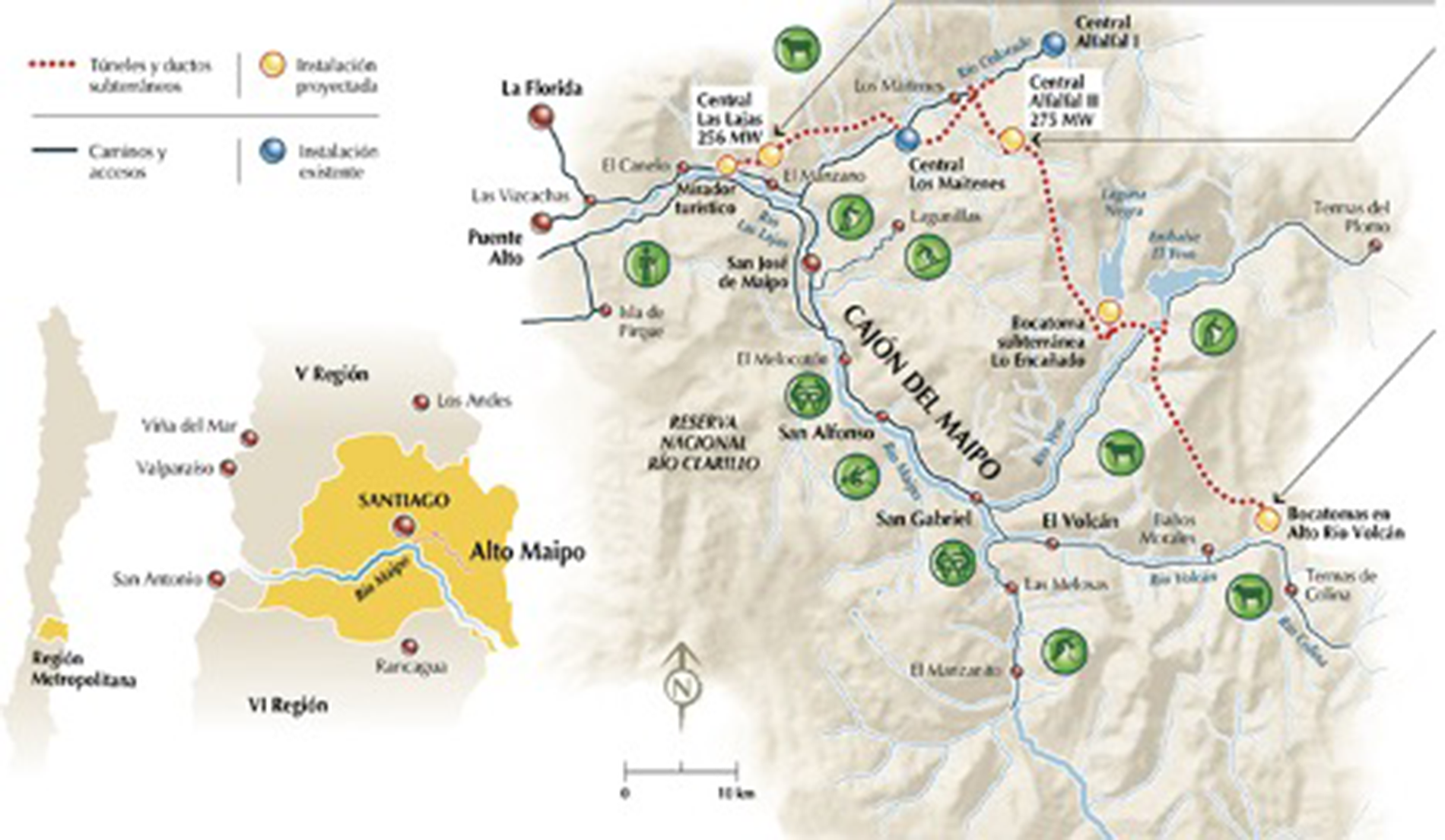
The mining history of the Cajón del Maipo dates back to the colonial period, when Spanish settlers started to explore various mining opportunities in the region. However, societies rooted in agriculture, ritual, and kinship existed along the Maipo River during the Inca period, long before colonial mining emerged (Pavlovic et al., Reference Pavlovic, Sánchez, Pascual, Martínez and Cortés2019), and archeological records show signs of pre-Hispanic copper mining activity (Cornejo et al., Reference Cornejo, Pablo Miranda and Miguel Saavedra1997). Today, Indigenous peoples like the Mapuche remain present in the area and continue to challenge extractivism as they struggle for the recognition of their own rights and the protection of nature (Carruthers & Rodriguez, Reference Carruthers and Rodriguez2009; Velasco & Kline, Reference Velasco and Kline2025). By the late 1800s, mining – predominantly of copper and gypsum – was a central activity in the valley, and its impacts have become part of the history of the place (Sánchez et al., Reference Sánchez, Bunster and Peña2018). As it continued to expand, the Cajón del Maipo saw a surge in mines, and it witnessed a fast development of infrastructure, with villages like El Volcán being built solely to support the mines and host workers (Sánchez et al., Reference Sánchez, Bunster, Muñoz and Benavente2024). With the growing environmental concerns and changes in economic patterns, by the late 20th century mining endeavors in the region had slowed down, allowing other activities like tourism to take root and boom (Sánchez et al., Reference Sánchez, Bunster, Muñoz and Benavente2024; Vergara-Daskam & Estay-Daskam, Reference Vergara-Daskam and Estay-Daskam2023). However, mining returned at full force when the Alto Maipo project (Figure 1) was proposed in the 2000s.
The Cajón del Maipo and the Alto Maipo Project, with diversion tunnels (dotted red line), new hydroelectric plants (yellow dots) and existing plants (blue dots), and roads and access (black lines). This map shows how the project is set in and overlaps with existing water-supply, mountain, and community systems.

Figure 1 Long description
The map illustrates the Cajón del Maipo region, highlighting the Alto Maipo Project. Dotted red lines represent diversion tunnels. Yellow dots indicate new hydroelectric plants, while blue dots show existing plants. Black lines depict roads and accesses. The map also marks the Rio Maipo and key locations such as San José de Maipo and Baños Morales. A smaller inset map shows the project′s location within the V and VI regions, near Santiago. The scale bar is present at the bottom center.
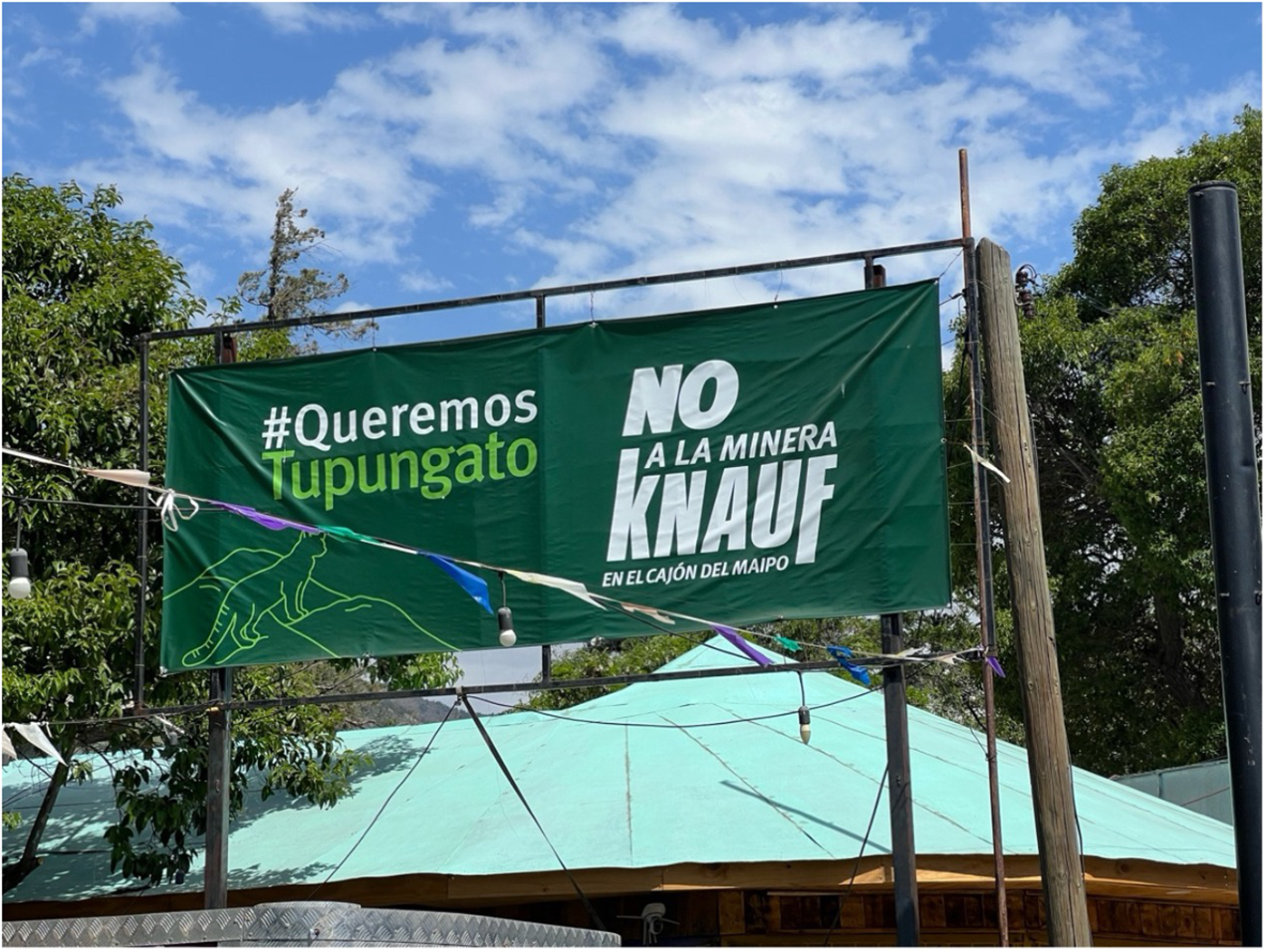
Proposed by AES Andes (formerly AES Gener) in 2007 and approved in 2009, the Alto Maipo Hydroelectric Project (AMHP) aims to generate electricity to power mining operations. Through approximately 60 km of tunnels that AES Andes built into the mountains of the Cajón del Maipo, Alto Maipo seeks to divert water from the Maipo River to hydropower plants that would generate electricity for mines in the north (Borgias, Reference Borgias2018; Folchi & Godoy, Reference Folchi and Godoy2016). From its inception, the project has received harsh criticism, and it has faced many challenges, leading to its costs escalating with the consequent loss of major investors (Borgias, Reference Borgias2018). Local organizations and activist groups have come together to oppose the AMHP, lamenting the devastating consequences that the operations would have on water supplies not only for people in the Cajón del Maipo, but for the seven million residents of the Santiago Metropolitan Region (Walters et al., Reference Walters, Alcayaga, Busco and Araya2021). Although centered around water resources, the forceful opposition to the project brings to light perceptions and values that the people in the Cajón del Maipo hold and see threatened: these values pertain to people’s relationship with natural resources like the river (Folchi & Godoy, Reference Folchi and Godoy2016), and, as the findings in this paper show, glaciers. Despite these obstacles, Alto Maipo – which began construction only in 2013 and was set to be operational by 2019 (Folchi & Godoy, Reference Folchi and Godoy2016) – is still being built, alongside other development and mining projects like Knauf’s (Figure 2), which continue to push to operate dangerously close to glaciers.
A banner in the center of San José de Maipo against the German company Knauf, which hopes to expand its gypsum mining activity in the Cajón del Maipo. The campaign Queremos Tupungato was established to push for the recognition of a protected area, which has led to the creation of the Santiago Glaciers National Park in August 2023. The mine Knauf would operate on the slopes of the Glaciers National Park. Photo by author, 22 October 2024.

The legacy of mining in the Cajón del Maipo is evident not only in abandoned tunnels, degraded hillsides, and ongoing environmental conflicts, but also in local discourse, where people refer to virtually any development project in the area – including Alto Maipo – simply as ‘las minas’ (‘the mines’). In the context of Chile’s mineral export-oriented measures and neoliberal policies which privilege corporate interest (Budds, Reference Budds2004; Urkidi, Reference Urkidi2010; Walters et al., Reference Walters, Alcayaga, Busco and Araya2021), and of Latin America’s long history of violence and dispossession whereby land is valued in terms of economic productivity (Caroca, Reference Caroca2025), the Cajón del Maipo has increasingly become a site of resistance.
3.1. Methods
This study draws on qualitative fieldwork conducted in the Cajón del Maipo during October and November 2024. The empirical evidence is derived from 48 semi-structured interviews with residents, tourism operators, activists, and officials in San José de Maipo and Baños Morales, including one focus group, a walking interview in Parque Arenas, and an online interview conducted in December 2024. Participants were selected through a mix of purposive and snowball sampling. The interview questions did not explicitly address issues of identity, but they focused on personal connections to glaciers, their role in the community, perceptions of glacier change, and adaptation strategies. From these conversations, themes of place identity and mining emerged organically.
Most interviews were not recorded, following participants’ preferences and the decision to prioritize trust-building over documentation,Footnote 2 but detailed notes were taken during and immediately after each conversation. One interview, upon the participant’s wish, and the walking interview were recorded with consent. All interviews were conducted in Spanish and later transcribed and translated. Pseudonyms are used throughout the text to protect participants’ anonymity. Fieldnotes and transcripts were thematically coded to identify recurring narratives around connection to glaciers, identity, changes, and relation to mining and territorial transformation.
It is important to acknowledge that a key limitation of this study is that no current employees of mining or development companies were interviewed. For this reason, the only mining perspectives represented come from two former miners who left the industry to pursue jobs in tourism.
4. Results
The findings in this study unveil a complex tapestry of place identities shaped by the physical presence and the meanings attached to glaciers. What emerges is that glaciers are framed in multiple ways by locals: they are seen as providers (e.g., of water, revenue), as a changing entity, and as not easily accessible and distant. The findings also show that the power relations and the exploitation stemming from development initiatives in the region have deepened human-glacier connections and place identities.
4.1. Framing of glaciers in the Cajón del Maipo
4.1.1. Glaciers as providers
Glaciers are recognized as an important element of the landscape of the Cajón del Maipo, which helps sustain the community in various ways. A member of the National Forest Corporation of Chile (CONAF) tells me that ‘without glaciers there is nothing; they are the life of the place’ (interviewed 30 October), as we stand a few kilometers from the San Francisco glacier. Several participants recognize glaciers as part of the geography and morphology of the place: for Cristobal, owner of a rafting company in San José de Maipo, the Cajón del Maipo would be a desolated, much drier plateau if it lost all its glaciers.
Tourism is a main link that people have with glaciers. Sofia and Martín, tourism operators in Baños Morales, explain that glaciers are indispensable to outdoor activities: without them, their work would not be possible. Similarly, Alonso, a horse-riding guide in Baños Morales, says that his favorite thing about glaciers is their ability to generate income. Diego, born and raised in Baños Morales, explains that when tourists land at Santiago airport, pictures of the mountains of the Cajón del Maipo welcome them, hinting to visit the San Francisco glacier, among others. Joaquín, a park ranger in Baños Morales, shares that tourists, both Chilean and foreign, mostly come to the area to see the glaciers.
People in the Cajón del Maipo attribute importance to the glaciers by linking them to the necessity of water. Josefa, a seamstress from San José de Maipo, says: ‘it’s simple: with no glaciers there is no water, and with no water there is no vegetation. With no vegetation, the Cajón dies’ (interviewed 7 November). Florencia, a local politician, tells me that people in the Cajón del Maipo often forget about glaciers, but they are the most important resource because they are water, contributing to the production of 80% of the drinking water in the region. Participants emphasize that water scarcity from glacier retreat will threaten livelihoods (e.g., tourism and agriculture), damage local ecosystems, significantly altering the flora and fauna of the Cajón del Maipo and creating drier vegetation. But they express that this will also contribute to a more selfish society, where the prices of water and other goods will skyrocket, and people will have to compete over available resources.
While some describe glacial water in utilitarian terms, essential for their daily survival, others speak of it as something far more profound: water is embedded in their lives and worldviews, representing life itself. ‘If the river dries up, the people dry up,’ shares Juan, a climate activist in San José de Maipo (interviewed 12 November). When asked about the relationship between Indigenous people and glaciers, Catalina, a local Mapuche woman, explains: ‘the connection goes through water, and the relationship between the Mapuche and water is special. This is because water is life; without it we cannot live. This is not only true for us, but for all animals and all plants’ (interviewed 14 November).
4.1.2. Glaciers as changing
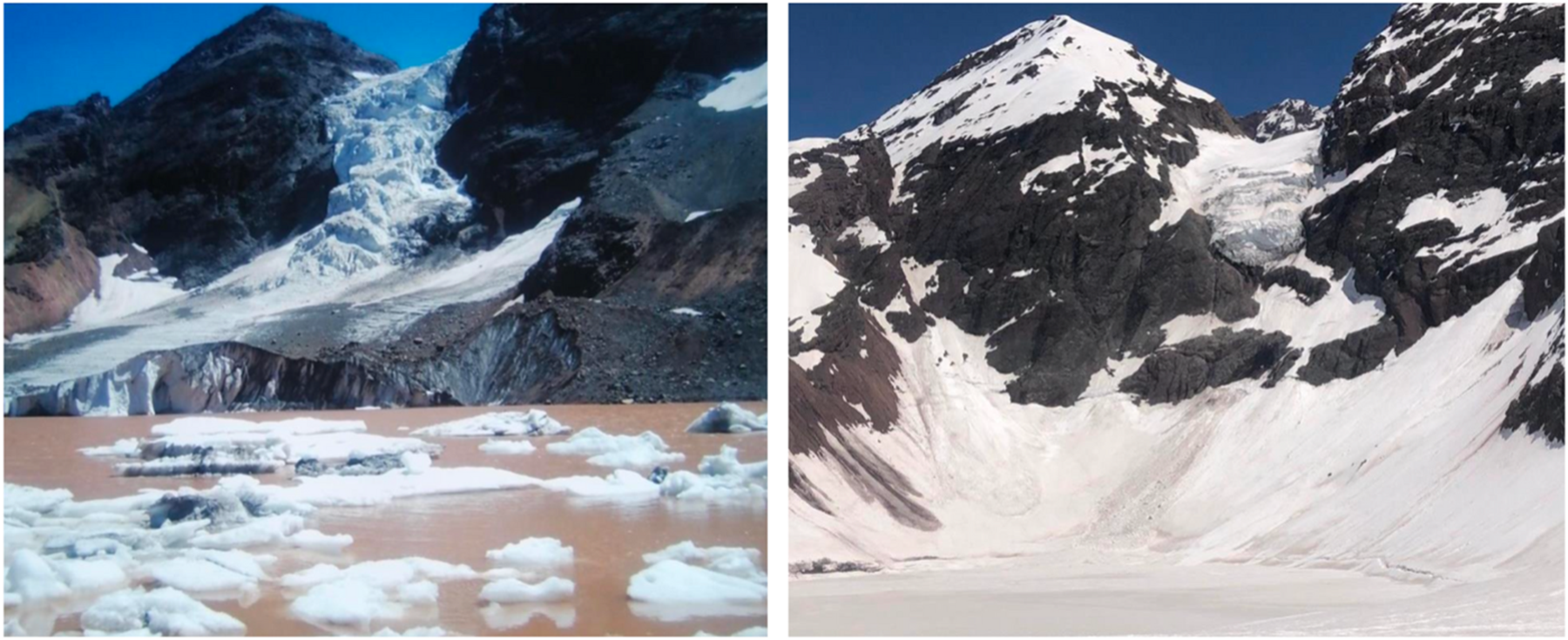
People in the Cajón del Maipo also speak of a landscape that has already drastically changed: they use words like ‘desertic’, ‘visibly drier’, ‘less rich in vegetation’ when describing the landscape, and they speak of a warmer climate, with less demarcated seasons and dominated by drought. Cristobal remembers 2019, an exceptionally dry year, and says: ‘I very clearly remember that when I was checking the water during that summer [a routine activity for his rafting operation], a lot of sick water, full of debris, made its way down to the river. I looked at it, and I just knew that water were the glaciers that were melting’ (interviewed 7 November). People in the Cajón del Maipo know that the glaciers in their region are retreating (Figure 3), and all participants discuss it more or less extensively depending on their degree of interaction with the outdoors and on whether they have witnessed these changes first-hand. Martín recalls: ‘When I was walking [on the glacier], I could feel that it was moving underneath me, that it was very fragile’ (interviewed 1 November). Similarly, Carlos, a mountain guide, shares that he can hear the ice receding – ‘a sort of crunch’, as he describes it. Dominga, a shop owner from San José de Maipo, says: ‘even if I’ve never seen it firsthand, with these temperatures they must be [retreating]’ (interviewed 12 November).
El Morado Glacier in January 2010 (left) and November 2024 (right). These photos show a significant recession in a short period of time. Photos shared by participants.

Interestingly, some participants share that these changes have given a new face to tourism in the area: ‘it’s like something macabre’, says Bastian, a retired arriero,Footnote 3 ‘it is good to have photos of how the glaciers have changed over the years, it is a good thing to show tourists – I mean in the form of entertainment, because tourists are curious to see it, they ask to see the change’ (interviewed 2 November).
4.1.3. Glaciers as distant
Despite being recognized as important, glaciers are still framed as something distant and separate from daily life. ‘I know very little about the glaciers, people here don’t go much’, says Maria from San José de Maipo (interviewed 22 October). Similarly, Agustina, a young waitress from San José de Maipo, explains that she has never been to the glaciers because they are too far away, and Maite, a middle-aged artisan from San José de Maipo, bluntly states: ‘people here have no connection with them’ (interviewed 26 October). In two separate interviews, Mateo and Javiera, the owner of a rafting company and one of his employees, agree that most people in the Cajón del Maipo do not talk about glaciers; they do not know much about them, nor do they visit them, and this is mainly because of their physical distance or difficult accessibility. Felipe, a driver from San José de Maipo, speaks passionately about glaciers, their beautiful colors, and the joy it brings him to enjoy a glass of whiskey with glacial ice, but he is quick to explain that while he has always had a passion for the outdoors, most people in the Cajón del Maipo do not visit glaciers.
Francisco, who is part of a local cultural association, expresses his frustration when reflecting on how the hundreds of glaciers that the Cajón del Maipo stores remain unknown to locals: ‘there are so many glaciers in this area. I don’t know how many — must be 500, 600? I don’t know. But if you ask people, a lot of them will not know’, he says (interviewed 7 November). Lucas, an employee at the tourist office of San José de Maipo, tells me that most people in the Cajón del Maipo are not familiar with local glaciers, and only think of other areas of Chile when asked about glaciers. Isidora, from Baños Morales, talks about this extensively:
We have more of a volcanic culture than a glacier culture. People from outside identify this place with the glaciers, but people inside…not so much. When people here talk about the Cajón, they talk about the fresh air and the possibility to disconnect, [they talk] about nature. But not so much about snow, avalanches, glaciers. […] In fact, if you go ask people about the glaciers, they don’t know what to tell you, if not that they provide some water to Santiago (interviewed 7 November).
Florencia, a local politician, agrees, and toward the end of our interview, she confesses that our conversation has led her to reflect on how people in the Cajón del Maipo might identify more broadly with the mountains, volcanoes and the Maipo River, but not with the distant glaciers – ‘life makes them forget’, she says (interviewed 15 November).
4.2. Glaciers and the threat of development projects
This connection with the landscape, and with glaciers, however, surfaces in relation to the development projects in their area. Dominga, for example, states that unlike her, her husband has a connection with the glaciers as he works for the mines. Similarly, after saying that she does not know much about glaciers, Maria rushes to find a contact on her phone, grabs a piece of paper, and writes down a number. ‘Here’, she says, ‘you should reach out to this friend of mine; he will be able to tell you a lot more because he works with the government on mining projectsFootnote 4’ (interviewed 22 October).
4.2.1. A long history of exploitation
All conversations with the participants speak of a long mining history that has characterized the Cajón del Maipo. When I ask Maria: ‘what is happening with the glaciers, exactly?’, her mother intervenes, her voice sharp with anger, and says:
There are many mining projects in the area, which are destroying the glaciers. A lot of people are not told honestly about this, and people like Maria’s friend who works for the mines will not tell the truth about it. Everyone knows that the glaciers are melting, but the people and the politicians are not going to admit it. The mines work around the glaciers, and this work will destroy them, and no one will speak openly about this (interviewed 22 October).
After this, the tone of our conversation changes drastically: immediately following her mother’s intervention, Maria points at the mountains that we can see peeking through the door, and she tells me about how beautifully green they used to be; she gets emotional and says: ‘I named my daughter after the hills’ (interviewed 22 October).
Isidora, from Baños Morales, tells me about a long legacy of exploitation: she explains that over time, people have gone to the Cajón del Maipo to harvest resources. ‘This form of imposition over a population that is introverted has not left much’, she says as she explains that people in the Cajón del Maipo have always been, and continue to be, inward and reserved (interviewed 17 November). Daniel, who is involved in San José de Maipo’s culture department, tells me: ‘Mining is part of the local identity of the Cajón del Maipo’ (interviewed 31 October), and this resonates with what several other participants share, like Gabriel from the municipality of San José de Maipo, who says: ‘many places in the region exist thanks to the mines […] like San José de Maipo, which was born out of mining roots’. He explains, however, that there have always been few to no studies to determine the impacts of mining in the area, and for this reason many industries – like Alto Maipo – were able to dig underneath the glaciers and the mountains. ‘And they destroyed everything,’ he says, ‘these were our water sources’ (interviewed 6 November). What these companies did do, explains Gabriel, is promise jobs and economic gain for the community, which is how they were ultimately able to operate. The link between mining and job opportunities is brought up by several participants in this study, and so it becomes apparent why this is a contested issue in the community. Francisco says:
of course, it is good that we have mines, because they contribute to the local economy, they give jobs. But they don’t take care of nature. Alto Maipo is a great example in this sense. Sure, they give jobs, but if we think of the destruction that they cause nature, it is not worth it. People have witnessed the consequences that projects like Alto Maipo have on nature. This is an issue that greatly divides the community (interviewed 7 November).
Similarly, José, an ex-miner, explains that people will continue to support the extractive industry hoping for short-term benefits. However, he continues, in the long run, ‘they will destroy everything’. He says: ‘the Cajón del Maipo is a sacrifice zone, it was born as a mining project, it rises from an extractivist culture’ (interviewed 5 November).
Participants often expressed feelings of exploitation, as exemplified by statements like: ‘the glaciers are receding, but the water is being used for other purposes, like with the Alto Maipo project. […] All of this water that could have benefited many people here is being used to benefit only a few’ (interview with Simón, hotel owner in Baños Morales, 2 November). Juan, climate activist, shares that the Cajón del Maipo was born a mining place, ‘a place that was exploited, and where a lot of raw materials were taken in a way that did not benefit the place and people here’. When I ask Juan to tell me more about the history of mining in the Cajón del Maipo, he takes out his phone and shows me the coat of arms of San José de Maipo, which displays a yellow hammer and pickaxe in the lower right and two crossed yellow lightning bolts in the lower left: ‘you see’, he says, ‘this is a very colonial image, and there are many symbols here that refer to the raw materials in the area, and to the mines’ (interviewed 12 November).
4.2.2. The negligent work of the mines
Mining operations have been, as expressed by the participants, negligent due to lack of knowledge of the morphology of the place, and lack of measures that would protect the glaciers.
When talking about Alto Maipo, Gabriel says that the company did not have the right expertise; they did not employ people with the right knowledge, and so they ‘built things poorly, which never worked but still destroyed the landscape’ (interviewed 6 November). Similarly, Simón shares that the people behind Alto Maipo did not understand how the Cajón del Maipo had formed, and so when the excavation crews began their work on the tunnels, ‘they were not able to break the rocks because they were too hard, so they tried with a different rock, but this was too soft and it crumbled down, and ultimately they had to stop building many of the tunnels that they were attempting’. He adds: ‘this is how the mountain defended itself’ (interviewed 2 November). A few participants share that because the Cajón del Maipo is not extensively studied, especially its glaciers, development companies have been able to exploit the area more easily. Florencia speaks of the work that she has done throughout her career in politics to prevent further environmental harm, and she shares that, after years of construction, the Alto Maipo project is currently inactive, as all the tunnels they attempted to build have collapsed: ‘but they keep trying, and this project is very damaging for the community’, she explains (interviewed 15 November).
During our walking interview across Parque Arenas, Javier shows me some of the sites where Alto Maipo has attempted to build. ‘What is this?’ I ask as we pass what appears to be an abandoned construction site. ‘It’s the project Alto Maipo, this is the project that people opposed since it was being built, and now they are still protesting but Alto Maipo is done building,’ he adds, laughing: ‘and it does not work!’. He explains that there is significantly less water now than when they started building, after years of drought. The irony, he says, is that the project contributed to destroying the glaciers and to causing this: ‘so it self-destructed!’ (interviewed 17 November). Similarly, Bastian, retired arriero, angrily tells me that those behind the Alto Maipo project hope to make money for a future that does not exist, and nor does the money, since, he says, ‘they put down four turbines that did not work because there was no more water’ (interviewed 2 November).
Other participants discuss the pollution that various mining operations have caused in the region: many recount the trucks and heavy machinery that, simply by lifting dust and debris, have covered many glaciers. Others talk about the countless explosives used to build tunnels in the mountains. ‘People blame the Alto Maipo project for the recess [of the glaciers]. I remember talking to a park ranger here who used to tell me about the many trucks that came and went,’ says Emilia (interviewed 17 November), a resident in her 70s from Baños Morales. Emilia did not share much during our interview but opened up when talking about the pollution caused by the mines. Felipe says: ‘the glaciers will disappear, especially if we continue with all these mining projects’ (interviewed 22 October). During our short interview, Salvador, a young artist from San José de Maipo, tells me: ‘I can’t tell you much about the glaciers, but I know that Alto Maipo built tunnels in the mountains that have destroyed everything,’ and he adds: ‘if I think of the machines that the industries use, how they come and destroy everything, it makes me very sad. I ask myself “how can they ruin an entire place, its history, its fossils?”’ (interviewed 26 October). After telling me about the tension that the presence of mines causes in the community, Francisco shares that while he thinks that development is good, nature ought to be better cared for. He recounts going to see glaciers when he was young and being impressed by all the nature around: ‘now you see construction everywhere, a lot of asphalt. They have made everything uglier. And sure, now we have better roads, but we could be doing things better’ (interviewed 7 November).
To this, Catalina adds that the companies that work in the area do very little, if any, Indigenous consultation. ‘For the mines’, she says, ‘this dialogue has no value’. To fight back, she explains, a coalition of Indigenous associations has been demanding to regularly meet with the companies. ‘The problem is’, says Catalina, ‘that they want to expand, they won’t stop until they are only one kilometer away from the glacier. And this is a huge problem because there is no one external to control what they do’. For this very reason, Catalina tells me: ‘my personal connection with the glaciers has to do with the work that we have done to defend them from the extractive industry’ (interviewed 14 November).
4.2.3. ‘The mines have more rights than the people’
The quote above is from Benjamin, a shop owner in Baños Morales (interviewed 2 November). Benjamin proceeds to say that he does not think that this will change. This sentiment of coming second, after the mines, is shared by other participants who believe that the government will continue to fund extraction and destroy nature. ‘I picture a future full of mining projects for the Cajón del Maipo’, says Salvador, ‘I don’t think anyone will be able to defend and change the situation, and politicians don’t do much. The government is not interested in promoting tourism, they choose to focus on other things like the mines’ (interviewed October 26). Nicolas, an agronomist and artisan in San José de Maipo, warns me to be careful investigating these issues, because, he says, ‘the economic power in the Cajón del Maipo is a disaster’, and in the context of a natural treasure such as the Cajón del Maipo, the industry always wins (interviewed 27 October).
That some in the community support the mines further complicates this: Cristobal, ex-miner, believes that things will not change if people continue to prioritize economic gain from mining. A retired arriero from San José de Maipo defeatedly shares that there is not much to do, and that the Cajón del Maipo will continue to be a sacrifice zone, as it has always been, supporting other areas like Santiago as they continue to develop. ‘No one helps us, we are a sacrifice zone, so the mines continue to come and destroy our territory,’ agrees Josefa in a separate interview (interviewed 7 November). The choice to prioritize economic gain additionally goes against the Mapuche cosmovision, as explained by Catalina. To her, the goal should not be economic progress, but to safeguard the land, ‘which does not mean that one cannot work on it, but the work that is done on it cannot be damaging; it needs to be sustainable over time’, unlike what the mining industry does, she adds (interviewed 14 November).
That mining is prioritized truly comes to light when Javier tells me about the twelve lawsuits that Parque Arenas has attempted against Alto Maipo, of which – he explains – eleven were lost. ‘For example’, he says as he points at a hillside eroded by another mine on our drive back to Baños Morales,
the heavy machinery lifts a lot of dust that the wind moves, and it covers the glaciers. So, you talk to them and you say: ‘you are covering the glacier with dust.’ ‘So what? What should we do?,’ they say. So you move on to justice, you try to sue. And then it gets delayed by months, years, only to get a no at the end. […] Chilean law, in general, helps the mine, they have more rights because they bring much money, millions and millions of dollars compared to the glaciers: glaciers only have ice, not money, so they don’t give them importance (interviewed 17 November).
It is in this conflict over extractive development that the Cajón del Maipo finds its spotlight, and being vocal about this struggle becomes an opportunity to be recognized and seen, explains Juan. As shown by Joaquín, people in the Cajón del Maipo do feel a sense of belonging to what is the most pristine area inside of the Metropolitan region – however, this connection becomes stronger as they start to feel that they ought to protect it. He explains: they see what has happened to similar places where the [extractive] industry has taken over the territory, and so they want to protect it. This creates even more of a sense of belonging, above all for the locals’ (interviewed 3 December).
5. Discussion
The case of the Cajón del Maipo, where people understand the retreat of glaciers to be a consequence of both climate change and human intervention, shows that there are clear power structures at play which influence people’s place identities. These power relations relate to a long-standing history of exploitation, and to a feeling of powerlessness against a system that prioritizes private interests.
Supporting what the literature has shown (Bonaiuto et al., Reference Bonaiuto, Breakwell and Cano1996; Devine-Wright & Lyons, Reference Devine-Wright and Lyons1997; Dixon & Durrheim, Reference Dixon and Durrheim2000), identity in relation to glaciers in the Cajón del Maipo becomes a social process, and it does so through conflict. Glaciers here are framed in terms of their provisions for the community and for the wider region: the local politician states that ‘we produce […] water [for the Santiago area]’, (interviewed 15 November) identifying with the glaciers as water resources, and the climate activist asserts that should the glaciers disappear, ‘the river would dry up, [and so would] the people’ (interviewed 12 November). This also reinforces Strandberg & Ek Styvén’s idea (Strandberg & Ek Styvén, Reference Strandberg and Ek Styvén2024) that people merge their sense of selves with their surroundings – including other people, objects and, in this case, glaciers. Despite these examples, the connection between people in the Cajón del Maipo and glaciers is not perceived as strong: although understood as important, glaciers are not an integral part of the everyday life of Cajón del Maipo, and if they are, this only pertains to a smaller group of outdoor enthusiasts or tourism operators. That is at least until participants start discussing resource extraction: only then do they truly begin to construct their identities around glaciers. This reveals that place identities are far more complex than originally theorized, and the Cajón del Maipo shows that they are indeed shaped by political and ecological struggle.
From the early stages of my fieldwork, it became apparent that in the Cajón del Maipo, engaging in conversations about landscape and glaciers would inevitably lead to discussing mining and environmental degradation. Place, here, is a dynamic site of political struggle, as seen in Massey (Reference Massey and Massey1994) and Escobar (Reference Escobar2001). The way the inhabitants of the Cajón del Maipo talk about their region is far from neutral: they describe it as born out of mining endeavors, as a sacrifice zone, and as a land that has historically been exploited for profit. As brought forward by Stokowski (Reference Stokowski2002) and Masterson et al. (Reference Masterson, Enqvist, Stedman and Tengö2019), dominant narratives over time silence alternative meanings attached to place; and so, the Cajón del Maipo is spoken of as a tourist hotspot – on the one hand – and as a mining area, on the other. That the commune was declared Geological Capital of Chile because of its geological diversity and natural beauty (Cantillana & Sandoval, Reference Cantillana and Sandoval2019) takes secondary place in these narratives.
This further suggests that while political ecology wishes to emphasize place identity as a bottom-up force of resistance against hegemonic development (Escobar, Reference Escobar2001; Walker & Fortmann, Reference Walker and Fortmann2003), the case of the Cajón del Maipo would point to a more nuanced framing of the concept, one which sees place identities as not inherently resistant, but rather ambivalent and strategically mobilized, echoing Harner (Reference Harner2001) or Katju and Kyle (Reference Katju and Kyle2021). In the Cajón del Maipo, attachment to place is indeed leveraged to question extractive activities (for example when Gabriel shares that as mining grew more resource-intensive, operations like Alto Maipo have destroyed their water sources) – however, place identity is also used to simply make sense of the exploitation at hand: statements like ‘the mine is part of the local identity of the Cajón del Maipo,’ ‘[the Cajón del Maipo] was born out of mining roots’, ‘[the Cajón del Maipo] rises from an extractivist culture’ serve to rationalize and legitimize the ongoing exploitation, and, I argue, are also employed as a way of coping with a situation that participants themselves perceive as controversial and out of their control.
Indeed, in the Cajón del Maipo, people both re-fabricate their identities through selective interpretations of local history, as suggested by Watts (Reference Watts, Sheppard and Barnes2017), and construct alternative imaginaries in response to environmental disruption, in line with Escobar (Reference Escobar2001), Johnson et al. (Reference Johnson, Halfacre and Hurley2009), and Wood and Young (Reference Wood and Young2016). These strategies – at the same time coping mechanisms and forms of resistance – highlight the dynamic ways in which identities are produced through struggle. A key point here is that the findings show that glaciers serve as the central focus around which these identities transform. This supports arguments in human geography that place identity is not reducible to symbolic or affective attachments alone, but it is shaped by the material and physical qualities of the landscape itself (Sebastien, Reference Sebastien2020). In this context, glacierized landscapes do not merely hold emotional significance, but they materially anchor the question of ‘who we are’ to ‘where we are’, and to ‘what power do we hold here’, revealing how place and identity are co-constituted in politically charged terrain (Dixon & Durrheim, Reference Dixon and Durrheim2000). It is through struggle that people in the Cajón del Maipo begin to identify with glaciers and see their own exploitation reflected in their degradation. By extending their very identities to include glaciers and other natural resources in the area, the participants in this study attempt to cope and take power back.
6. Conclusion
This article has argued for the politicization of place identity, showing how political ecology aids a better understanding of the contested nature of identity in the context of glacier change. Drawing on 48 semi-structured interviews in the Cajón del Maipo, I have shown that place identities are not only mobilized in political struggle but also shaped by it. The stories of the people of the Cajón del Maipo demonstrate that identity, particularly in vulnerable glacierized regions, is shaped by complex negotiations with both environmental change and institutional power. The findings in this article challenge depoliticized accounts of place identity and show how meaning is constructed in response to ecological and socio-political disruptions. With an ever-more apparent glacier retreat, place identities intensify through narratives of loss, resistance, and belonging. Indeed, in the Cajón del Maipo, otherwise marginal connections to glaciers are turned into identities and leveraged through narratives of extractive-induced harm.
Acknowledgements
I am grateful for all the help received in Chile and to the people of the Cajón del Maipo. A special thanks to Dr. Cristián Simonetti, without whom this would never have been possible. Sincere thanks to Dr. Mine Islar and Dr. Melissa García-Lamarca at Lund University: your guidance was essential every step of the way. Lastly, huge thanks to the reviewers for the useful comments and the learning opportunity.
Author contributions
I am the sole author of this paper.
Funding statement
This paper was made possible by the Erasmus+ grants at Lund University and the NaturICE project with FORMAS number 2022-01756.
Competing interests
I declare there is no conflicting interest.

 Open access

