Mastitis is a common and painful disease afflicting dairy cattle, which negatively affects animal welfare and consumers' image of the dairy industry (Ventura et al., Reference Ventura, von Keyserlingk and Weary2015). Kielland et al. (Reference Kielland, Skjerve, Østerås and Zanella2010) reported severe clinical mastitis was assigned a median pain assessment score of 7.6 on a 1 to 10 scale by Norwegian dairy farmers, with 1 representing ‘no pain’ and 10 representing ‘unbearable pain.’ Dairy producers were 10.3 times more likely to believe cows experienced physical pain similar to humans, only when herd mean milk production was 7100 to 7800 kg/cow/year, rather than mean milk production from 5000 to 6500 kg/cow/year (Kielland et al., Reference Kielland, Skjerve, Østerås and Zanella2010). This suggests that although producers may be concerned with mastitis, pain, and animal welfare, profitability may dictate animal care.
Pain behaviors among cows infused with Escherichia coli or Staphylococcus aureus were highly correlated (r = 0.71) with SCC of infused quarters, suggesting a relationship between pain and SCC (Giovannini et al., Reference Giovannini, van den Borne, Wall, Wellnitz, Bruckmaier and Spadavecchia2017). Therefore, bulk tank somatic cell count (BTSCC) may be a useful tool for assessing pain among cows with mastitis. Producers are regularly provided BTSCC for their herd, and quarterly or monthly changes can be monitored across time (Schewe et al., Reference Schewe, Kayitsinga, Contreras, Odom, Coats, Durst, Hovingh, Martinez, Mobley, Moore and Erskine2015). However, the relationship between producer concern about mastitis and perception of cow suffering caused by mastitis have not been related to self-reported BTSCC. The objective of this study was to explore the association between self-reported BTSCC and Southeastern US dairy producers' responses to three main statements: (1) ‘a troublesome thing about mastitis is the worries it causes me,’ (2) ‘a troublesome thing about mastitis is that cows suffer,’ and (3) ‘my broad goals include taking good care of my cows and heifers.’ A secondary objective was to determine Southeast producers' opinions about animal welfare statements and the importance of animal welfare on their operation.
Materials and methods
The research was supported by funding from the USDA-AFRI (Grant 2013-68004-20424), as part of a larger survey project (DeLong et al., Reference DeLong, Lambert, Schexnayder, Krawczel, Fly, Garkovich and Oliver2017). Surveys were mailed to all grade A dairies (n = 1855) in Georgia, Kentucky, Mississippi, North Carolina, South Carolina, Tennessee, and Virginia between 2013 and 2014, as described in DeLong et al. (Reference DeLong, Lambert, Schexnayder, Krawczel, Fly, Garkovich and Oliver2017). Grade A regulations serve as a sanitary regulation for fluid milk in the United States, as controlled by the Federal Food, Drug, and Cosmetic Act (United States Department of Health and Human Services, 2017). To prevent multiple surveys from the same farm, each farm was assigned a unique identification that was printed on the survey before distribution. Producers were asked to describe their current management practices, producers' opinions about mastitis, motivations for managing mastitis, perceptions of mastitis and management (online Supplementary Table S1). To minimize misunderstanding or misinterpretation of the statements, cognitive interview pre-testing at 5-test locations was conducted before survey administration. As a result of pre-testing, ambiguous and confusing wording was revised, question order was revised, and the set of information sources was expanded.
Producers self-reported current herd statistics including herd size and demographics, current milk production, rolling herd average, current BTSCC, and previous 12 and 36 month estimated BTSCC (DeLong et al., Reference DeLong, Lambert, Schexnayder, Krawczel, Fly, Garkovich and Oliver2017). Mean reported BTSCC was 254 500 cells/ml (minimum: 34 000 cells/ml; median: 240 000 cells/ml, and maximum: 800 000 cells/ml; De Long et al. Reference DeLong, Lambert, Schexnayder, Krawczel, Fly, Garkovich and Oliver2017). Statements were asked as binomial (yes or no; n = 9), Likert scale (strongly negative to strongly positive; n = 7), and descriptive statements (n = 18).
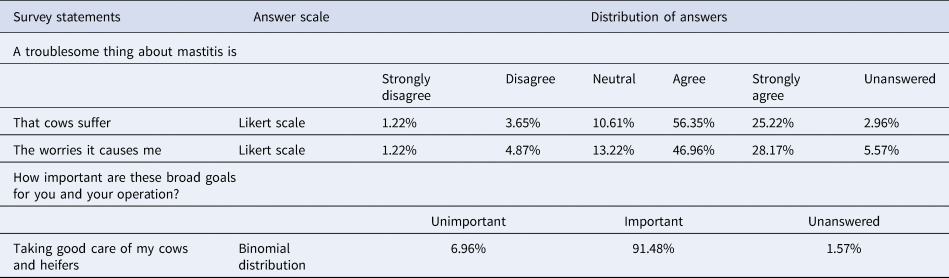
Total survey response rate was 29% (N = 596 surveys). Missing response rate per statement ranged from 1.57 to 5.52% of the total statements asked on the returned surveys (Table 1). Producers answered Statements 1 and 2 on a 5-point Likert scale from ‘strongly disagree’ to ‘strongly agree’ (Table 1). Producers answered Statement 3 on a 5-point Likert scale from ‘very unimportant’ to ‘very important’ (Table 1). Likert scale questions were used because of their sensitivity to small sample size and ease of use (Sauro and Dumas, Reference Sauro and Dumas2009). Before analysis, ‘my broad goals include taking good care of my cows and heifers’ was summarized into a dichotomous response of ‘unimportant’ (very unimportant and unimportant) and ‘important’ (important and very important). Binary development of variables was based on Widmar et al. (Reference Widmar, Morgan, Wolf, Yeager, Dominick and Croney2017). A single neutral producer response (n = 1) to ‘my broad goals include taking good care of my cows and heifers’ was removed from the data set.
The three statements evaluated for relationship with BTSCC among 574 Southeastern dairy producers, the answering scale (binomial or Likert scale) and distribution of answers as calculated by the FREQUENCY procedure of SAS 9.4

Statistical analysis
Of the 596 surveys returned, 13 dairies were removed because they stopped operating a working dairy farm prior to receiving the survey and 9 were removed because no self-reported BTSCC was included. Total surveys analyzed were 574 (96% of total sample). Separate univariable logistic regressions using generalized linear mixed models (SAS 9.4, Cary, NC, USA) with a random effect of farm were performed to determine if BTSCC was associated with probability for a producer's response to the statements of interest. Producers' responses to ‘a troublesome thing about mastitis is the worries it causes me’ and ‘a troublesome thing about mastitis is that cows suffer,’ were assessed on an ordinal scale using a multinomial distribution, and cumulative logit link. Producers' response to ‘my broad goals include taking good care of my cows and heifers’ was assessed as a binary event using a binary distribution and logit link. Odds ratios were used to determine the probability of a producer response given self-reported BTSCC. Unit changes in BTSCC were set at 10 000 cells/ml. Single variable analysis was used to establish if BTSCC and other survey statements were associated with each additional survey statement response. If BTSCC was significant, forward stepwise manual selection was used to develop multi-variable models while maintaining individual independent variables significance at P < 0.05. Statistical significance was set at α = 0.05.
Results
Results reported are part of a larger survey effort to assess dairy producers and BTSCC (DeLong et al., Reference DeLong, Lambert, Schexnayder, Krawczel, Fly, Garkovich and Oliver2017). Demographic information of respondents can be found within DeLong et al. (Reference DeLong, Lambert, Schexnayder, Krawczel, Fly, Garkovich and Oliver2017). Producer response ranged from 19.2 to 30.5% of producers within the state. (DeLong et al., Reference DeLong, Lambert, Schexnayder, Krawczel, Fly, Garkovich and Oliver2017). However, within that publication, producers' focus on animal welfare was not considered, necessitating further publications about animal welfare and BTSCC. Greater than 75% of dairy producers were concerned with mastitis (Statement 1), that cows suffer (Statement 2), and taking good care of my cows (Statement 3; Table 1). Less than 7% of dairy producers disagreed with Statements 1 and 2 or considered Statement 3 was unimportant (Table 1). Between 15 and 19% producers indicated that they were neutral or disagreed with mastitis causing worry and that cows suffer (Table 1).
Mean herd size was 204 (DeLong et al., Reference DeLong, Lambert, Schexnayder, Krawczel, Fly, Garkovich and Oliver2017). Bulk tank somatic cell count was not associated with ‘a troublesome thing about mastitis is that cows suffer’ or ‘my broad goals include taking good care of my cows and heifers’ (F ≤ 0.99; P > 0.54; DF ≥ 525). Self-reported BTSCC (F = 5.62; P = 0.018; and DF = 511) were associated with ‘a troublesome thing about mastitis is the worries it causes me,’ when included as the only variable. An increase in BTSCC by 10 000 cells/ml, was associated with a decrease in the odds of a respondent to select a lower ordered response (strongly disagree) with an odds ratio of 0.981 (95% CI: 0.965, 0.997). This suggests that as self-reported BTSCC increases, producers are more likely to agree with the statement ‘a troublesome thing about mastitis is the worries it causes me.’
Discussion
Data collected through the administered survey demonstrated that producers are concerned with management practices and cow welfare, as related to mastitis. The majority of surveyed producers were ‘worried’ about mastitis, concerned with cow suffering, and wanted ‘to take good care of their cows’. Previously, Spooner et al. (Reference Spooner, Schuppli and Fraser2012) reported Canadian beef producers were concerned with ‘comfort,’ ‘happiness’, and ‘contentment’ of animals, noting painful procedures, like branding, are not desirable. Because of their concern, producers made attempts to reduce pain including freeze branding and elastrators, rather than surgical castration (Spooner et al., Reference Spooner, Schuppli and Fraser2012). This suggests that when producers are concerned about dairy cow welfare, they will make changes to reduce painful or uncomfortable procedures. Although our results did not explore management decisions based on welfare concerns, producers' worry and desire to take good care of cows can lead to management changes.
Exploring the relationship between BTSCC and producers' concern and goal setting related to cow care is helpful to understand producers' responses to these statements. BTSCC was only associated with ‘a troublesome thing about mastitis is the worries it causes me’, from the statements analyzed. Jansen et al. (Reference Jansen, van den Borne, Renes, van Schaik, Lam and Leeuwis2009) and Schewe et al. (Reference Schewe, Kayitsinga, Contreras, Odom, Coats, Durst, Hovingh, Martinez, Mobley, Moore and Erskine2015) reported attitudes towards mastitis were associated with producers' perception of the ease with which mastitis could be controlled and belief that mastitis was a problem, respectively. Schewe et al. (Reference Schewe, Kayitsinga, Contreras, Odom, Coats, Durst, Hovingh, Martinez, Mobley, Moore and Erskine2015) and Jansen et al. (Reference Jansen, van den Borne, Renes, van Schaik, Lam and Leeuwis2009) observed employees that believed mastitis was a problem in their operation, self-reported greater BTSCC. Factors associated with producer concern related to mastitis were associated with increased BTSCC (DeLong et al., Reference DeLong, Lambert, Schexnayder, Krawczel, Fly, Garkovich and Oliver2017). For each 1 standard deviation increase in concern relating to mastitis, a 17 700 cells/ml increase in mean current self-reported BTSCC was observed (DeLong et al., Reference DeLong, Lambert, Schexnayder, Krawczel, Fly, Garkovich and Oliver2017). This suggests a relationship between producers increased mastitis concerns and increased BTSCC.
Jansen et al. (Reference Jansen, van den Borne, Renes, van Schaik, Lam and Leeuwis2009) and DeLong et al. (Reference DeLong, Lambert, Schexnayder, Krawczel, Fly, Garkovich and Oliver2017) observed that 48 and 65% of variation in BTSCC was explained by behaviors and attitudes towards mastitis and concern and control methods, respectively. However, Schewe et al. (Reference Schewe, Kayitsinga, Contreras, Odom, Coats, Durst, Hovingh, Martinez, Mobley, Moore and Erskine2015) reported that producers become concerned about BTSCC when counts exceed 300 000 cells/ml. In this study, 75% of producers' self-reported BTSCC was ≤300 000 cells/ml. Among 25% of producers with a self-reported BTSCC >300 000 cells/ml, other challenges, such as financial costs, may be a greater concern than mastitis. Within this survey, other ‘troublesome’ factors were not considered and should be assessed in further research. A similar survey about management practices was conducted by Schewe et al. (Reference Schewe, Kayitsinga, Contreras, Odom, Coats, Durst, Hovingh, Martinez, Mobley, Moore and Erskine2015), but did not consider producers concerns for animal welfare and animal pain. Therefore, this study of Southeastern dairy producers may be the first to report producers' opinions relating to animal welfare.
Although under or over estimation of BTSCC is possible for individual herds, Dairy Herd Improvement records for 2017 suggest self-reported BTSCC was accurate within 5000 cells/ml (Norman et al., Reference Norman, Walton and Durr2018). Dairy Herd Improvement records from 2017 report mean somatic cell count for Georgia, Kentucky, Mississippi, North Carolina, South Carolina, Tennessee, and Virginia was 268 500 cells/ml (Norman et al., Reference Norman, Walton and Durr2018), which agrees with our results obtained in this study between 2013 and 2014. This suggests that under and over-reporting of BTSCC was limited to individual producers and did not further effect results.
Survey participation was similar to other studies with mailed surveys consisting of Likert scale measurements (Schewe et al., Reference Schewe, Kayitsinga, Contreras, Odom, Coats, Durst, Hovingh, Martinez, Mobley, Moore and Erskine2015). Schewe et al. (Reference Schewe, Kayitsinga, Contreras, Odom, Coats, Durst, Hovingh, Martinez, Mobley, Moore and Erskine2015) reported Florida producers response rate was 21%, compared to Michigan and Pennsylvania (39 and 45%, respectively). Although email surveys may have a larger response, due to ease of access (Widmar et al., Reference Widmar, Morgan, Wolf, Yeager, Dominick and Croney2017), within the Southeast, a substantial portion of producers do not use email, suggesting a need to provide mail surveys to maximize producers' response rate in the region. As with any survey, statements' wording may greatly influence producers' understanding and interpretation of the statements. Survey wording was modeled after Jansen et al. (Reference Jansen, van den Borne, Renes, van Schaik, Lam and Leeuwis2009) including ‘most annoying aspect of mastitis is the worries that it generates.’ During cognitive interview pre-testing, ‘annoying’ was determined problematic and ‘troublesome’ was substituted. The word ‘suffer,’ associated with the statement ‘a troublesome thing about mastitis is that cows suffer,’ has previously been used to evaluate mastitis and lameness (Nechanitzky et al., Reference Nechanitzky, Starke, Vidondo, Müller, Reckardt, Friedli and Steiner2016). Additionally, by using a Likert scale, producers may have been limited to defining each term based on their own perception of the question. For example ‘worry’ could have referred to concern surrounding milk loss, antibiotic use, or somatic cell count, but was not specified. However, producers agreed or strongly agreed with statement 2 and ranked statement 3 as important, suggesting they recognized that ‘worry’ about mastitis was related to cow-level welfare. The authors recognize the limitations of Likert scale and binomial scale questions, despite their commonality within research.
Despite the potentially influential nature of words including ‘suffering’ (Oppenheim, Reference Oppenheim1992), word consistency with peer-reviewed literature is necessary for further analysis and comparison. Further survey work should consider producers' pain management protocol to understand how BTSCC can affect producers' perceptions of ‘a troublesome thing about mastitis is the worries it causes me,’ ‘a troublesome thing about mastitis is that cows suffer,’ and ‘broad goals include taking good care of my cows and heifers.’
In conclusion, the data collected with this survey can begin to explain the association between Southeast United States dairy producers' opinions and BTSCC. The majority of producers (>75%) answered all three statements positively, suggesting a greater emphasis on animal welfare. ‘A troublesome thing about mastitis is the worries it causes me’ was the only factor of three assessed statements associated with BTSCC for Southeastern United States dairy producers. Recognizing producer concern, opinions of mastitis, and current management strategies positively and negatively related to BTSCC can help to provide further information on improving milk quality in the Southeast. Understanding Southeast producers' answers and associated self-reported BTSCC is necessary to create targeted management tools for herds with elevated BTSCC.
Supplementary material
The supplementary material for this article can be found at https://doi.org/10.1017/S0022029919000943.
Acknowledgements
The authors would like to thank the participating producers from Georgia, Kentucky, Mississippi, North Carolina, South Carolina, Tennessee, and Virginia for their voluntary participation in this survey. This project is supported by Agriculture and Food Research Initiative Competitive Grant no. 2013-68004-20424 from the U.S. Department of Agriculture National Institute of Food & Agriculture.