1. INTRODUCTION
Clusters are formed from high pressure gas jets resulting from the cooling associated with the adiabatic expansion of gas into vacuum (Hagena et al., Reference Hagena and Obert1972; Taguchi et al., Reference Taguchi, Antonsen, Palastro, Milchberg and Mima2010). The atoms in a cluster are held together by Van der Waals forces and these forces cannot be overcome by thermal energy. Laser cluster interaction has several applications, for example, as a source of radiation such as extreme ultraviolet and X-rays that is applicable to lithography (Kubiac et al., Reference Kubiac, Bernardez, Krenz, Connell, Gutowski and Todd1996) or X-ray microscopy (Kirz et al., Reference Kirz, Jakobsen and Howells1995), and as a source of energetic electrons or ions (Shao et al., Reference Shao, Ditmire, Tisch, Sprigate, Marangos and Hutchinson1996; Kumarappan et al., Reference Kumarappan, Krishnamurthy and Mathur2001; Ditmire et al., Reference Ditmire, Zweiback, Yanovsky, Cowan, Hays and Wharton1999; Reference Ditmire, Donnelly, Rubenchik, Falcone and Perry1996). Recent theory (Mishra & Jha, Reference Mishra and Jha2011b), experiments (Alexeev et al., Reference Alexeev, Antonsen, Kim and Milchberg2003; Borisov et al., Reference Borisov, Longworth, McPherson, Boyer and Rhodes1996), and simulations (Gupta et al., Reference Gupta, Antonsen and Milchberg2004) have shown self-focusing of intense laser radiation interacting with clustered gas. When an intense laser pulse interacts with a cluster it immediately converts the cluster into a plasma ball. Inside the cluster the total field (laser plus space charge) leads to inner ionization. Also some electrons leave the cluster (outer shell ionization) leading to a net positive charge on the cluster. The charge accumulated on the cluster is localized on the surface of the cluster and a neutral core remains inside. The dynamics of the expanding clusters gives rise to several nonlinear effects such as harmonic generation (Donnelly et al., Reference Donnelly, Ditmire, Neuman, Perry and Falcone1996) and generation of ultra-short pulses of mono-energetic neutrons from nuclear fusion in cluster-plasmas (Ditmire et al., Reference Ditmire, Zweiback, Yanovsky, Cowan, Hays and Wharton1999).
In many nonlinear systems, an instability leading to modulation of the steady state is exhibited as a result of interaction between nonlinear and dispersive effects. This phenomenon is referred to as modulation instability (Agrawal, Reference Agrawal2006). Modulation instability has been studied quite extensively in many areas of science and engineering. In optics, the interest in modulation instability stems from its possible applications and relevance in ultrafast pulse generation (Sudo et al., Reference Sudo, Itoh, Okamoto and Kubodera1989), supercontinuum generation (Raja et al., Reference Raja, Porsezian and Nithyanandan2010), four-wave mixing (Boggio et al., Reference Boggio, Tenebaum and Fragnito2001), Bragg gratings (Sterke, Reference Martijn de Stereke1998), quadratic media (Sarma & Kumar, Reference Sarma and Kumar2012), optical fiber (Agrawal, Reference Agrawal2006; Sarma, Reference Sarma2010), and parametric oscillators (Philips & Fezer, Reference Phillips and Fezer2010). Modulation instability has also been studied in the field of meta-materials (Sarma & Saha, Reference Sarma and Saha2011). Development of the chirped pulse amplification technique (Strickland & Mourou, Reference Strikland and Mourou1985) has led to the development of very high power (terawatt and petawatt) laser systems. The generation of such high power and high intensity laser pulses has caused considerable interest in the field of laser plasma interaction, which can give rise to a number of instabilities such as Raman and modulation instabilities (Antonsen et al., Reference Antonsen and Mora1993; Guerin et al., Reference Guerin, Mora and Laval1998; Esarey et al., Reference Esarey, Sprangle, Krall and Ting1996; Mori et al., Reference Mori1997; Sprangle et al., Reference Sprangle, Esarey and Hafizi1997; Borghesi et al., Reference Borghesi, Campbell, Schiavi, Willi, Galimberti, Gizzi, Mackinnon, Snavely, Patel, Hatchett, Key and Hazarov2002; Clark et al., Reference Clark and Fisch2005; Jha et al., Reference Jha, Kumar, Raj and Upadhyaya2005; Kline et al., Reference Kline, Montgomery, Rousseaux, Baton, Tassin, Harelin, Flippo, Johnson, Shimada, YIN, Albright, Rose and Amiranioff2009; Esarey et al., Reference Esarey, Schroeder and Leemans2009; Gill et al., Reference Gill, Mahajan and Kaur2010; Zhang et al., Reference Zhang, Fu, Deng, Zhang, Wen and Fan2011). When a laser beam propagates through plasma, the ponderomotive force gives rise to low frequency perturbations of the number density, which interact with the high frequency electromagnetic wave so that the amplitude of the pump wave gets modulated and the modulation instability of the electromagnetic wave occurs. Growth of modulation instability has been reported (Max et al., Reference Max, Arons and Langdon1974; McKinstrie et al., Reference Mckinstrie and Bingham1992). Recently, the effect of laser pulse profile on laser plasma interaction process has been reported (Jha et al., Reference Jha, Singh and Upadhyay2009; Mishra & Jha, Reference Mishra and Jha2011a). Distortion of the laser pulse profile and effect on the growth of modulation instability is shown. Liu et al. (Reference Liu, Tang and Li2011) have investigated the modulation instability of an intense elliptically polarized laser beam propagating in un-magnetized plasma.
This paper deals with the analytical study of the effect of cluster expansion on the growth rate of modulation instability of a laser pulse propagating in tenuous clustered gas. Since Coulombic (hydrodynamic) pressure predominantly contributes to the overall expansion dynamics of small (large) clusters when strong laser fields interact with them (Ditmire et al., Reference Ditmire, Donnelly, Rubenchik, Falcone and Perry1996), the role of Coulombic pressure in the expansion of a single nanometer sized cluster in response to a short (≈100 fs and 80 fs) laser pulses has been considered in the present paper. In Section 2, the wave equation, including cluster radius expansion, group velocity dispersion, and finite pulse length effects has been set up. Considering finite pulse length effects to be a higher order effect, the lowest order solution for the wave amplitude is obtained. Section 3 deals with the evolution of the growth rate of modulation instability at the front, back, and at the centroid of the laser pulse. Summary and conclusions are presented in Section 4.
2. WAVE EQUATION
Consider a linearly polarized laser beam propagating along the z-direction in a tenuous clustered gas. The electric vector of the laser field is given by
 $$\vec{E}\left(r\comma \; z\comma \; t \right)= \displaystyle{1 \over 2}E_0 \left(r\comma \; z\comma \; t \right)\exp \left[i\left(k_0 z - {\rm \omega} _0 t \right)\right]\hat{x} + c.c.\comma \;$$
where E 0 (r,z,t) is the amplitude of the radiation field and k 0 (ω0) is its wave number (angular frequency). Considering the individual cluster to behave like a dielectric sphere, the wave equation governing the propagation of a laser beam in clustered gas is given by
 $$\left(\nabla^2 - \displaystyle{1 \over c^2} \displaystyle{\partial^2 \over \partial t^2} \right)\vec{a}_L = \displaystyle{4{\rm \pi} e \over m_e c^3 {\rm \omega}_0} \displaystyle{\partial ^2 \vec{P} \over \partial t^2}\comma \;$$
where  $\vec{a}_L \left(= e\vec{E}\left(r\comma \; z\comma \; t \right)/ m_e c{\rm \omega}_0 \right)$ is the normalized electric vector of the laser field. The polarization field
 $\left(\vec{P} \right)$ arising due to the presence of the clusters may be written as
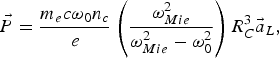 $$\vec{P} = \displaystyle{m_e c{\rm \omega}_0 n_c \over e} \left(\displaystyle{{\rm \omega}_{Mie}^2 \over {\rm \omega}_{Mie}^2 - {\rm \omega}_0^2} \right)R_C^3 \vec{a}_L\comma \;$$
where n c is the cluster density and  ${\rm \omega}_{Mie} \lpar \!\!= {\rm \omega}_p / \sqrt{3}\comma \; {\rm \omega}_p$ being the plasma frequency) is known as Mie frequency. The cluster radius (R C) is a function of time t. The expansion of the cluster radius occurs on the time scale of ion motion (τi). Hence the change in cluster radius averaged over ion time scale is given (Mishra & Jha, Reference Mishra and Jha2011b)
 $$\left(\Delta R_C \right)_{avg}\, = \displaystyle{m_e^2 c^2 {\rm \omega}_0^6 {\rm \tau}_i^2 \left\vert a_0 \right\vert^2 \over {\rm \pi} e^2 M_i n_{i0} R_{C0} \left({\rm \omega}_{Mie}^2 - {\rm \omega}_0^2 \right)^2}.$$
R C0, M i, n i0, and a 0 (eE 0/m ecω0) are initial cluster radius, ion mass, initial ion density, and normalized laser amplitude, respectively. Substituting the value of polarization vector  $\vec{P}$ from Eq. (3) in Eq. (2) gives
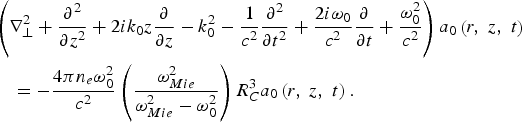 $$\eqalign{&\left(\nabla_{\bot}^2 + \displaystyle{\partial^2 \over \partial z^2} + 2ik_0 z \displaystyle{\partial \over \partial z} - k_0^2 - \displaystyle{1 \over c^2} \displaystyle{\partial^2 \over \partial t^2} + \displaystyle{2i{\rm \omega}_0 \over c^2} \displaystyle{\partial \over \partial t} + \displaystyle{{\rm \omega}_0^2 \over c^2} \right) a_0 \left(r\comma \; z\comma \; t \right)\cr &\quad =- \displaystyle{4{\rm \pi} n_e {\rm \omega}_0^2 \over c^2} \left(\displaystyle{{\rm \omega}_{Mie}^2 \over {\rm \omega}_{Mie}^2 - {\rm \omega}_0^2} \right)R_C^3 a_0 \left(r\comma \; z\comma \; t \right).}$$
With the help of the linear dispersion relation
 $$- k_0^2 + \displaystyle{{\rm \omega}_0^2 \over c^2} = - \displaystyle{4{\rm \pi} n_c {\rm \omega}_0^2 \over c^2} \left(\displaystyle{{\rm \omega}_{Mie}^2 \over {\rm \omega}_{Mie}^2 - {\rm \omega}_0^2} \right)R_{C0}^3\comma \;$$
and the transformation τ = t − z /v g (v g is the group velocity) and η = z, the wave Eq. (5) may be written as
 $$\eqalign{&\left[\nabla_{\bot}^2 + \displaystyle{\partial^2 \over \partial {\rm \eta}^2} - \displaystyle{2 \over v_g} \displaystyle{\partial^2 \over \partial {\rm \eta} \partial {\rm \tau}} - {\rm \beta} \displaystyle{\partial^2 \over \partial {\rm \tau}^2} + 2ik_0 \displaystyle{\partial \over \partial {\rm \eta}} \right]a_0 \left(r\comma \; {\rm \eta}\comma \; {\rm \tau} \right)\cr &\quad = - B\left\vert a_0 \right\vert^2 a_0 \left(r\comma \; {\rm \eta}\comma \; {\rm \tau} \right)\comma \;}$$
where B = 12n cm e2R C0ω08ωMie2τi2/M in i0e 2(ωMie2 − ω02)3 and β (=1/c 2 − 1/v g2) is the group velocity dispersion parameter.
Assuming slowly varying amplitude, the higher order diffraction term (∂2/∂η2~1/Z R2) can be neglected in comparison to 2k 0∂/∂η. The third and the fourth terms on the left side of Eq. (7) representing finite pulse length effects are about two orders of magnitude less than 2k 0 (∂/∂η) and will therefore perturb the pulse amplitude. Also the propagation of a broad laser beam can be described with the help of a one-dimensional model. Therefore, the lowest order of Eq. (7) may be written as
 $$\left[i\displaystyle{\partial \over \partial {\rm \eta}} - \displaystyle{{\rm \beta} \over 2k_0} \displaystyle{\partial^2 \over \partial {\rm \tau}^2} - \displaystyle{1 \over k_0 v_g} \displaystyle{\partial^2 \over \partial {\rm \eta} \partial {\rm \tau}} + \displaystyle{B\left\vert a_0 \right\vert^2 \over 2k_0} \right]a_0 \left({\rm \eta}\comma \; {\rm \tau} \right)= 0.$$
Considering a Gaussian laser pulse profile, the field amplitude is represented by
 $$a_0 \left({\rm \eta}\comma \; {\rm \tau} \right)= b\left({\rm \eta}\comma \; {\rm \tau} \right)\exp \left(- \displaystyle{{\rm \tau}^2 \over {\rm \tau}_0^2} \right)\comma \;$$
where b(η, τ) is the pulse amplitude and τ0 is the initial pulse duration. Substituting Eq. (9) into Eq. (8) and considering the variation in the pulse amplitude with respect to τ to be a higher order effect the lowest order evolution equation for the unperturbed pulse amplitude b 0 is given by
 $$\eqalign{\left[\displaystyle{2 \over k_0 v_g {\rm \tau}_0} \displaystyle{{\rm \tau} \over {\rm \tau}_0} + i \right]\displaystyle{\partial b_0 \over \partial {\rm \eta}} &= - b_0 \left[\displaystyle{{\rm \beta} \over k_0 {\rm \tau}_0^2} \left\{1 - 2\displaystyle{{\rm \tau}^2 \over {\rm \tau}_0^2} \right\}\right. \cr &\quad \left. + \displaystyle{B\left\vert b_0 \right\vert^2 \over 2k_0}\exp \left(- 2\displaystyle{{\rm \tau}^2 \over {\rm \tau}_0^2} \right)\right].}$$
Solving Eq. (10) the lowest order, unperturbed amplitude is given by
 $$b_0 \left({\rm \eta}\comma \; {\rm \tau} \right)= a_{00} \exp \left[A\left({\rm \tau} \right)+ i\Phi \left({\rm \tau} \right)\right]\comma \;$$
where a 00 (laser strength parameter) is the initial (η = 0) amplitude of the laser pulse, A(τ) and Φ(τ) are given by
 $$A\left({\rm \tau} \right)= - {\displaystyle{2 \over k_0 v_g {\rm \tau}_0} \displaystyle{{\rm \tau} \over {\rm \tau}_0} \left[\matrix{\displaystyle{Ba_{00}^2 \over 2k_0} \exp \left(- \displaystyle{2{\rm \tau}^2 \over {\rm \tau}_0^2} \right) + \displaystyle{{\rm \beta} \over k_0 {\rm \tau}_0^2} \left(1 - \displaystyle{2{\rm \tau}^2 \over {\rm \tau}_0^2} \right)} \right]\over 1 + \left(\displaystyle{2 \over k_0 v_g {\rm \tau}_0} \displaystyle{{\rm \tau} \over {\rm \tau}_0} \right)^2},$$
and
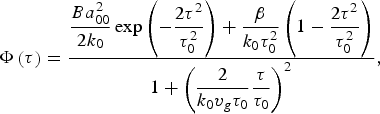 $$\hskip-62pt\Phi \left({\rm \tau} \right)=\displaystyle{{\displaystyle{{Ba_{00}^2 } \over {2k_0 }}\exp \left({ - \displaystyle{{2{\rm \tau} ^2 } \over {{\rm \tau} _0^2 }}} \right)+\displaystyle{{\rm \beta} \over {k_0 {\rm \tau} _0^2 }}\left({1 - \displaystyle{{2{\rm \tau} ^2 } \over {{\rm \tau} _0^2 }}} \right)} \over {1+\left({\displaystyle{2 \over {k_0 v_g {\rm \tau} _0 }}\displaystyle{{\rm \tau} \over {{\rm \tau} _0 }}} \right)^2 }},$$
respectively. A(τ) leads to an exponential amplitude variation in the pulse frame while Φ(τ) is the self-induced phase shift (self-phase modulation) experienced by a laser pulse propagating in clustered gas. A(τ) is positive (negative) at the front (back) of the pulse, hence the amplitude of the laser pulse increases at the front while it decreases at the back of the pulse, while the self-induced phase shift Φ(τ) remains same at the front as well as back of the pulse. It may also be noted that variation in amplitude due to change in pulse length is such that for shorter pulse durations A(τ) is larger and vice-versa while the self-induced phase shift decreases with decrease in the pulse duration.
3. MODULATION INSTABILITY
Modulation instabilities are caused by the interplay between group velocity dispersion (GVD) and self-phase modulation (Sprangle et al., Reference Sprangle, Hafizi and Penano2000). Hence, the modulated amplitude of the laser pulse, due to GVD and finite pulse effects, may be written as the superposition of perturbed and unperturbed amplitudes, as
 $$\eqalign{a\left({\rm \eta}\comma \; {\rm \tau} \right)&= \left[a_{00} \exp \left\{A\left({\rm \tau} \right)\right\}+ a_{01} \left({\rm \eta}\comma \; {\rm \tau} \right)\right]\exp \left(- \displaystyle{2{\rm \tau}^2 \over {\rm \tau}_0^2} \right) \exp \left\{i\Phi \left({\rm \tau} \right){\rm \eta} \right\}\comma \; }$$
where a 01(η, τ) is the complex perturbed beam amplitude. Substituting Eq. (12) into Eq. (8), considering |a 01| <<|a 00|, neglecting further variations in the pulse shape and considering the perturbed wave amplitude to be a sinusoidally varying function of η and τ, that is, a 01 = exp{i(Kη − Ωτ)} + exp{−i(Kη − Ωτ)} (K and Ω are the wave number and frequency of the perturbed wave amplitude, respectively), the dispersion relation for the one-dimensional modulation instability is given by
 $$\eqalign{&\left(1 - \hat{\Omega}^2 \right)\hat{K}^2 + \left(\hat{{\rm \alpha}} + \hat{\Phi} + 8 \hat{{\rm \beta}} \hat{\Omega}^2 \right)\hat{K} + \left\{\hat{\Phi} - \left(\hat{{\rm \alpha}} - \hat{\Phi} \right)\right. \cr &\quad \left. - 16\hat{{\rm \beta}}^2 \hat{\Omega}^2 \right\}\hat{\Omega}^2 = 0\comma \;}$$
where  $\hat{K} = KZ_R$ (ZR being the Rayleigh length),
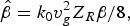 $\hat{{\rm \beta}} = k_0 v_g^2Z_R {\rm \beta} / 8\comma$
 $ \hat{\Phi} = \Phi Z_R\comma \; \hat{\Omega} = \Omega / k_0 v_g$, and
 $\hat{{\rm \alpha}} = {\rm \alpha} Z_R \lpar {\rm \alpha} = \left(Ba_{00}^2 / 2k_0 \right)\exp $
 $\left\{2A\left({\rm \tau} \right){\rm \eta} \right\}\exp \left(- 2{\rm \tau}^2 / {\rm \tau}_0^2 \right)$ are dimensionless quantities. The imaginary part of
 $\hat{K}$, in Eq. (13), gives the growth rate of modulation instability as
 $${\Gamma = \displaystyle{\hat{\Omega} \over 2\left(1 - \hat{\Omega}^2 \right)}} \sqrt{\matrix{\left\{\left(\hat{{\rm \alpha}} - \hat{\Phi} \right)^2 + 2\left(2\hat{\Phi} + 8\hat{{\rm \beta}} \right)\left(\hat{{\rm \alpha}} - \hat{\Phi} \right)\right\}\cr + \left(2\hat{\Phi} + 8\hat{{\rm \beta}} \right)^2 \hat{\Omega}^2}}.$$
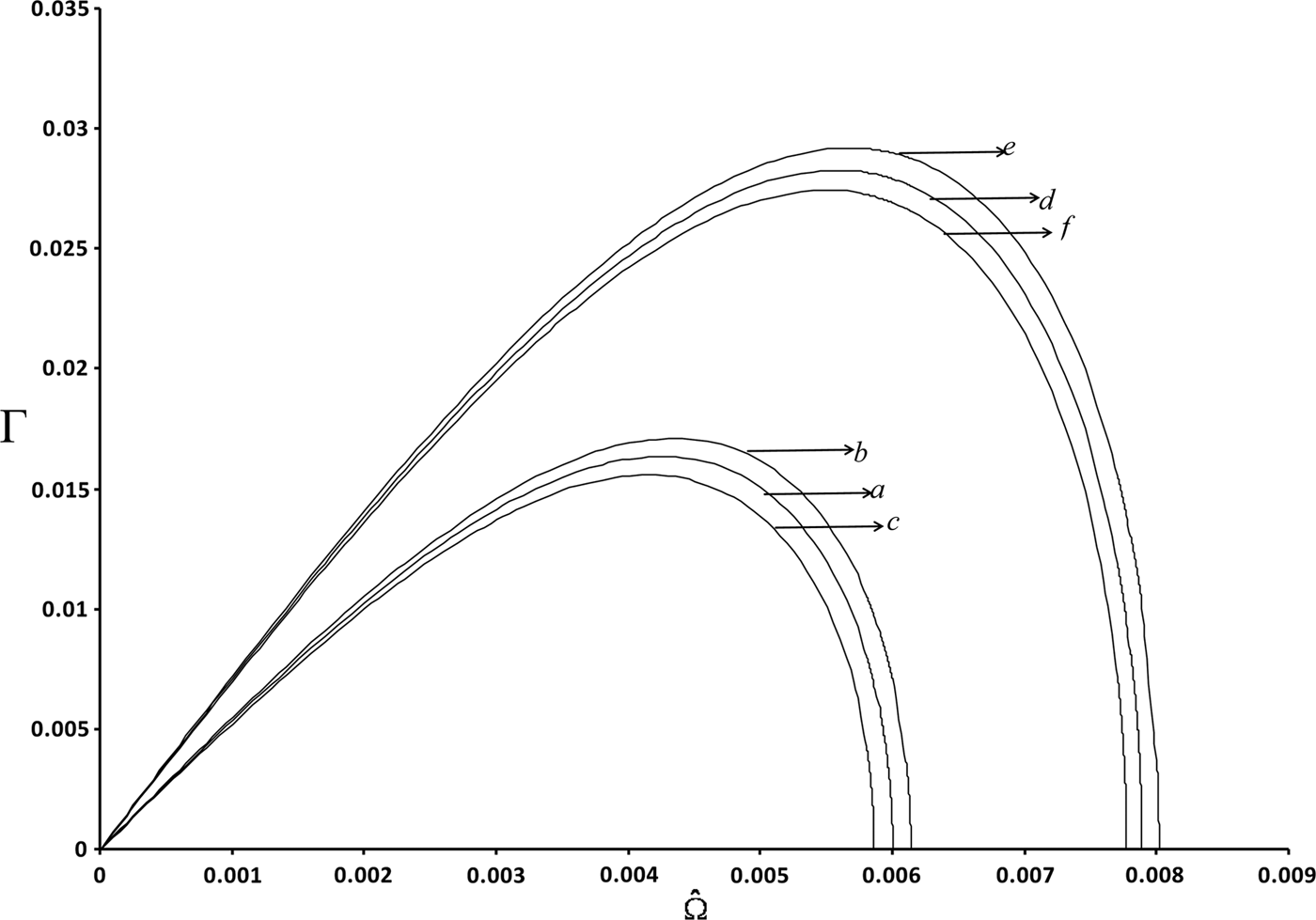
Variation in the growth rate of modulation instability (Γ) with respect to the normalized perturbed frequency  $\left(\hat{\Omega} \right)$ is shown in the Figure 1. Figure 1 shows the growth rates of modulation instabilities at η = 0 as well as at the front (τ/τ0 = −0.14) and back (τ/τ0 = +0.14) of the pulse for 100 fs and 80 fs pulses with τ0 = 100 fs, ω0 = 2.36 × 10¹⁵s −1, λ0 = 800 nm, r 0 = 40 µm, a 002 = 6.84 × 10⁻² (peak intensity = 1.46 × 10¹⁷ W/cm2), n c = 8.0 × 1013 cm −3, n 0 = 1.8 × 1022 cm −3, R C0 = 30 nm and M i = 1.39 × 10⁻¹² gm. Curves a (d), b (e), and c (f) show the growth rate of modulation instability at the centroid (η = 0), at the front and back of the pulse, respectively, for 100 fs (80 fs) pulse. For both the pulses, it is seen that exponential amplitude variation (A(τ)) is positive (negative) at the front (back) of the pulse that leads to increase in growth rate of modulation instability at the front and decrease at the back of the pulse.
Variation in the growth rate of modulation instability (Γ) with  $\hat{\Omega}$ after the pulse has traversed a distance of a Rayleigh length (ZR) at the centroid of the pulse (η = 0) (Curve a (d)), at the front (τ/τ0 = −0.14) of the 100 fs (Curve b) and 80 fs (Curve e) pulses. Curves ‘c’ and ‘f’ represent growth rate of modulation instability at the back (τ/τ0 = +0.14) for 100 fs and 80 fs pulses, respectively. The parameters used are τ0 = 100 fs, ω0 = 2.36 × 10¹⁵s −1, λ0–800 nm, r 0 = 40 μm, a 002 = 6.84 × 10⁻², n c = 8.0 × 1013 cm−3, n 0 = 1.8 × 1022cm −3, R C0 = 30 nm and M i = 1.39 × 10⁻¹²gm.

It is seen that as the pulse duration decreases the growth rate of modulation instability increases due to increase in the exponential amplitude variation (A(τ)) and decrease in the self-induced phase shift (Φ(τ)). Average enhancement in the growth rate of modulation instability of the shorter pulse is 73.17%. For 80 fs (100 fs) pulse growth rate of modulation instability increases by 3.30% (4.67%) at the front and decreases by 2.93% (4.63%) at the back of the pulse in comparison to η = 0 case. It is also seen that with decrease in the pulse duration the percentage variation in the growth rate of modulation instability at the front as well as at the back of the pulse decreases in comparison to the centroid of the pulse.
4. SUMMARY AND CONCLUSION
This paper deals with the analytical study of the growth rate of modulation instability as the laser pulse propagates in a clustered gas. It is shown that exponential amplitude variation (A(τ)) is positive (negative) at the front (back) of the pulse due to which the growth rate of modulation instability increases (decreases) at the front (back) of the laser pulse in comparison to the centroid of the pulse. It is seen that for 100 fs (80 fs) pulse the growth rate of modulation instability at the front of the pulse increases by 4.67% ( 3.30%) and decreases by 4.63% (2.93%) at the back of the pulse in comparison to that of the centroid of the pulse (η = 0). Also, with decrease in the pulse duration the peak value of the growth rate of modulation instability increases and for lower (higher) values of the pulse duration change in the growth rate at the front as well as at the back of the pulse in comparison to the centroid of the pulse is reduced (enhanced). Reason for this behavior may be attributed to the fact that with decrease in pulse duration the exponential amplitude variation (A(τ)) increases and the self-induced phase shift (Φ(τ)) decreases. The average enhancement in the growth rate of modulation instability at the front as well as at the back of the pulse is 73.17% by reducing the pulse duration from 100 fs to 80 fs. This analytical study shows the limitations of using short laser pulse propagating in clustered gas since decrease in the pulse duration causes sharp rise in growth rate of modulation instability. Hence an optimum value of pulse duration may be chosen for application based on interaction of short laser pulses with clustered gas.
ACKNOWLEDGEMENT
This work has been done with the financial support of Science and Engineering Research Council, Department of Science and Technology, Government of India (Project No. SR/FTP/PS-042/2010). The author (Rohit K. Mishra) thanks the organization for funding the research project.