Caring for dependent relatives has a strong impact on the physical and psychological health of the people who take it on (Duggleby et al., Reference Duggleby, Williams, Holstlander, Thomas, Cooper, Hallstrom and O-Rourke2014; Pinquart & Söresen, Reference Pinquart and Sörensen2003; Yee & Shultz, Reference Yee and Schulz2000). Emotional burden often manifests itself in the form of psychosomatic problems (headaches, various pains, anorexia, fine tremor, gastric problems, shortness of breath, heart arrhythmias and palpitations, sweats and vertigo, unexplained allergies), insomnia, memory problems, difficulty concentrating, and chronic fatigue (Rodríguez del Álamo, Reference Rodríguez del Álamo2002). The main emotional responses identified in the literature are anxiety, depression, and guilt (Duggleby et al., Reference Duggleby, Williams, Holstlander, Thomas, Cooper, Hallstrom and O-Rourke2014; Martín-Águeda et al., Reference Martín-Águeda, López-Muñoz, Rubio, García-García, Silva and Álamo2006; Romero-Moreno et al., Reference Romero-Moreno, Losada, Marquez, Laidlaw, Fernández-Fernández, Nogales-González and López2014). However, feelings of guilt among caregivers need to be examined more in-depth (Duggleby et al., Reference Duggleby, Williams, Holstlander, Thomas, Cooper, Hallstrom and O-Rourke2014; Yaffe et al., Reference Yaffe, Fox, Newcomer, Sands, Lindquist, Dane and Covinsky2002) given their relationship with psychological distress (Romero-Moreno et al., Reference Romero-Moreno, Losada, Marquez, Laidlaw, Fernández-Fernández, Nogales-González and López2014).
Guilt has been described as the dysphoric feeling associated with the recognition that a personally important moral or social standard has been violated and this may cause other people to suffer (Jones & Kugler, Reference Jones and Kugler1993). It is one of the so-called moral emotions related to self-awareness, and it depends on desires and socially accepted outcomes, such that a person makes a moral judgment, and based on that judgment they emotionally accept or reject a given situation (Bennett & Matthews, Reference Bennett and Matthews2000). Various studies have shown that guilt prompts reparative behaviors that attempt to compensate for the damage the individual has caused another person, and it is associated with all sorts of prosocial behavior – that is, approach as well as relationship behaviors (Etxebarria-Bilbao, Apodaca-Urquijo, Ortiz-Barón, Fuentes-Rebollo, & López-Sánchez Reference Etxebarria-Bilbao, Apodaca-Urquijo, Ortiz-Barón, Fuentes-Rebollo and López-Sánchez2009; Haidt, Reference Haidt, Keyes and Haidt2003). It has been observed that feelings of guilt take on particular importance in people who care for others on a daily basis, via their actions as well as inactions, or omission of activities (Duggleby et al., Reference Duggleby, Williams, Holstlander, Thomas, Cooper, Hallstrom and O-Rourke2014).
In caregivers of older family members and Alzheimer’s patients, there is evidence that guilt is a contributing factor to “feeling burnt out” by daily care work (Ankri, Andrieu, Beaufils, Grand, & Henrard, Reference Ankri, Andrieu, Beaufils, Grand and Henrard2005; Gonyea, Paris, & de Saxe-Zerden, Reference Gonyea, Paris and de Saxe-Zerden2008). It is also reported that feelings of guilt can have different consequences on the psychological distress of caregivers of Alzheimer’s patients as a function of gender and kinship (Romero-Moreno et al., Reference Romero-Moreno, Losada, Marquez, Laidlaw, Fernández-Fernández, Nogales-González and López2014).
With regard to kinship, in the context of caring for dependent relatives, informal or family caregivers belong to the patient’s social network. In other words, they are family members (husbands, wives, sons, and daughters) dedicated to caring for people with significant difficulty doing the basic and instrumental activities of everyday life (Ministerio de Sanidad & Política Social, 2006). Caregivers are also tasked with providing emotional and social support, supervision, keeping the patient company, communicating, and helping them engage in social and recreational activities (Bover, Reference Bover2004; Dumont, Jacobs, Turcotte, Andersen, & Harel, Reference Dumont, Jacobs, Turcotte, Andersen and Harel2010). That said, little research has been done to analyze the relationship between kinship and feelings of guilt among caregivers.
In terms of gender, care work has traditionally been in the purview of women, but for some years now, more men have joined in this work (García-Calvente, Mateo-Rodríguez, & Maroto-Navarro Reference García-Calvente, Mateo-Rodríguez and Maroto-Navarro2004), so it would be interesting to study, in-depth, feelings of guilt among caregivers as a function of that dimension.
On another note, it has been observed that daily time spent on care work can impact the manifestation of emotional problems like stress, anxiety, and depression, but it is not yet known if it yields differences in caregiver feelings of guilt. Casado-Mejía and Ruiz-Arias (Reference Casado-Mejía and Ruiz-Arias2013) distinguish among three strategies for providing family care, as a function of the time dedicated to it, that account for differences in caregivers’ health: a) Assuming care work full-time with caregiver and care recipient living together under one roof. This strategy has repercussions on the caregiver’s mental and physical health, and on family and social dynamics (Gálvez-González et al., Reference Gálvez-González, Saucedo-Figueredo, Calderón-Ortega, Pacheco-López, Carmona-González and García-Martínez2014; García-Calvente et al., Reference García-Calvente, Mateo-Rodríguez and Maroto-Navarro2004; Rojo et al., Reference Rojo-Pérez, Fernández-Mayoralas, Ahmed-Mohamed, Prieto-Flores, Martínez-Martín, Forjaz and Rojo-Abuín2007; b) Partial management of care work, where the caregiver and care recipient live together under one roof, but care work is part-time because the caregiver works outside the home. In most cases it is the daughter, and a caregiver is usually hired to cover while she is away at work. This, too, has repercussions on the caregiver’s health and family dynamic; c) Independent care management, in which the caregiver and care recipient live in separate homes, and care work consists of follow-up by phone and periodic visits. The care work directly received by the dependent is usually done by a contracted in-home caregiver, most often an immigrant. This strategy is healthier in terms of caregiver health and family dynamic.
In light of the above, this study’s objective is to explore feelings of guilt in caregivers of dependent patients, and determine whether differences occur as a function of gender, kinship, and care strategy.
Method
Qualitative study using semi-structured interviews and focus groups.
The setting for this study was the Primary Care District of Seville.
Participants and procedure
Sources of information included caregivers of dependent family members, and family health, community nursing, and social work professionals employed at district health centers.
This study had 96 participants in total. First, 44 semi-structured, in-depth interviews were conducted with family caregivers of dependent persons. To select them, purposive sampling was utilized, and 18 basic profiles were established with the study’s objective in mind. The sample was segmented by sex, kinship, and care provision strategy with support from nursing case managers at the participants’ health centers (Las Letanías, San Pablo, Esperanza Macarena, San Jerónimo, Marqués de Paradas, and La Campana). Regarding care recipients, 26 were women and 18 men. The majority were severely dependent (25), followed by moderately dependent (17), and the 2 remaining cases were of total dependency. Of the people interviewed, seven were caring for two relatives at once.
Meanwhile, six focus groups were formed, with 52 people participating: Three groups for health professionals (doctors, nurses, social workers), and three for caregivers according to socioeconomic status (high, middle, and lower class). Focus group (FG from here on) was the qualitative technique chosen to identify knowledge shared by health professionals and caregivers, who all had experience with the subject of study.
Homogeneity and heterogeneity criteria were used to form FGs (Rubio & Varas, Reference Rubio and Varas2004). We applied homogeneity criteria to maintain each group’s symmetry and take advantage of their shared experiences: occupation in the professional groups; and socioeconomic status in the family caregiver groups. Meanwhile, we applied heterogeneity criteria to ensure a clashing of different perspectives in each focus group: in the professional groups, sex, prior professional experience with caregivers according to level of assistance (primary care or specialized care), and provenance of the care population (urban, rural); and for caregivers, sex, kinship, tenure as caregivers, and care strategy (full-time, part-time, or independent).
The semi-structured interviews lasted an average of 60 minutes and the focus groups 90 minutes approximately. They were carried out during the first half of 2013. All the information gathered was audio-recorded for later word-for-word transcription and analysis.
Categories of analysis
Information was analyzed according to predefined categories based on the dimensions of guilt measured by the Caregiver Guilt Questionnaire by Losada, Márquez-González, Peñacoba, and Romero-Moreno (Reference Losada, Márquez-González, Peñacoba and Romero-Moreno2010). This questionnaire was used because it was validated in Spain and fit the characteristics of the participating caregiver population. It covers five dimensions of guilt: guilt about doing wrong by the care recipient; guilt about failure to meet the challenges of caregiving; about self-care; about neglecting other relatives; and about having negative feelings towards other people.
This study addressed an emerging category of guilt, placing the dependent relative in a nursing home, so we ultimately decided to consider the following categories: a) guilt for abandoning family and friends; b) guilt for the relationship with the dependent person; and c) guilt for placing the relative in a nursing home.
Validity
To add rigor and validity to the results (Denzin & Lincoln, Reference Denzin and Lincoln2011; Flick, Reference Flick2002), we triangulated sources of information (bibliographical, professionals, caregivers), methodological techniques (bibliographical review, in-depth interview, focus group), and the researchers’ disciplines (nursing, gender studies, psychology, anthropology, social work). Furthermore, these were reviewed and approved by study participants (one male and one female caregiver, and a female nurse).
Interview and focus group content was analyzed using the software N-Vivo10. Relevant paragraphs and primary and secondary nodes were identified according to predefined categories tailored to our research objectives, and an emerging category was added, as described above.
With respect to ethical considerations, this study was approved by the Primary Care District of Seville Ethics Committee. At the beginning of each interview, the study was presented and informed consent to participate was gathered. Participants were guaranteed the confidentiality of their information, and that it would be used for research purposes.
Results
Results in each category of guilt appear below. These data were generated by analyzing the discussions and interviews with caregivers and health professionals.
Guilt for abandoning family and friends
In interviews with caregivers, we observed how the situation of caring for a dependent family member affects their relationships with other relatives and friends. Most reported having to cut back on leisure time, and time with other family members, generating feelings of guilt.
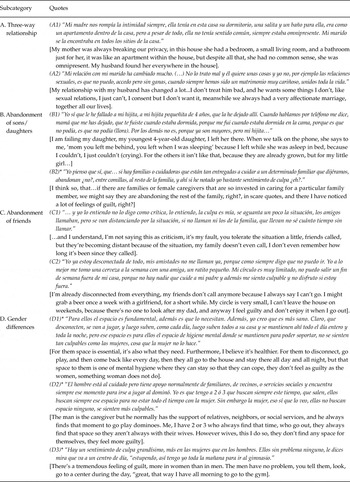
If kinship to the care recipient is son/daughter, and they live together, the caregiver’s relationship with his or her spouse is affected. It becomes a three-way relationship; the presence of the dependent person takes on a huge role in their lives (Table 1, quote A1). The couple’s leisure time is limited or eliminated entirely by the responsibilities of care work. This is reflected in their sexual relations as well, whether for lack of desire, of time, of intimacy, and above all exhaustion (Table 1, quote A2).
Transcribed Quotes in the Category “Guilt for Abandoning Family and Friends”

* Quotes from health professionals
By the same token, people who care for their parents but live separately with their children report feeling additional guilt for “abandoning them” and not giving their kids the time they need. In those cases, we observed that the roles of daughter and mother enter into conflict, generating sadness as well as guilt (Table 1, quote B1). Health professionals likewise reported feelings of guilt in such situations (Table 1, quote B2).
As for caregivers’ relationships with friends, they reported going out less to share in leisure activities, making them feel distant from their friends, and isolated. One consequence of this situation is that it is harder to leave the circuit of care work, and when they do, they are not as able to enjoy it and feel guilty for “abandoning the relative for a little while” (Table 1, quotes C1 and C2).
In terms of gender, male and female health professionals observed that women express more guilt about abandoning their family and friendships than men. They often hear that women feel guilty for enjoying their free time, whereas men are able to disengage from care work when they do other activities (Table 1, quotes D1, D2, and D3).
To summarize the findings in this category, it can be said that feelings of guilt about family abandonment are exhibited more in daughters caring for their parents, and in cases where the strategy is full-time care.
Guilt for the relationship with the dependent person
There are different reasons for feeling guilty about the dependent person, according to caregivers’ and health professionals’ statements. Of the various motives, these stood out: a) relationship history with the dependent person; b) feeling ambivalent about care work, sometimes due to social desirability – that is, having to be a caregiver because it is the socially acceptable thing to do; c) not feeling capable as a caregiver; d) loss of emotional control; and e) the care recipient’s power, exercised through excessive demands. We should also mention the guilt-generating situation of long-distance family “caregivers,” who put someone outside the family in charge of care work.
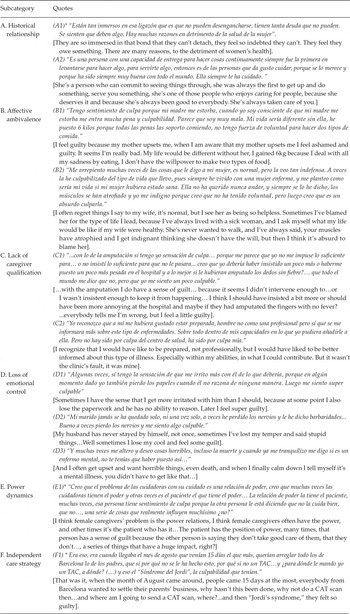
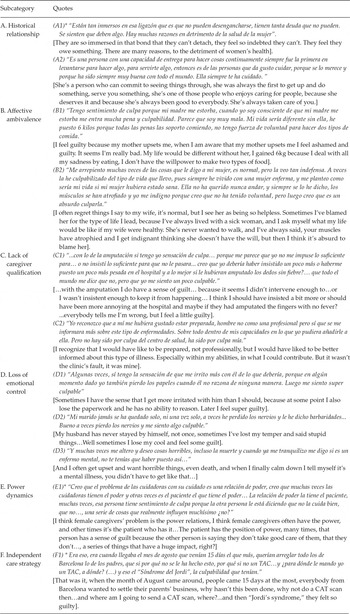
Caregivers and health professionals alike report that the quality of the affective relationship with the dependent throughout the caregiver’s life influences their care work. They perceive an obligation to “pay them back” (Table 2, quotes A1 and A2).
Transcribed Quotes in the Category “Guilt for the Relationship with the Dependent Person”
* Quotes from health professionals
On another note, in coping with the reality of chronic illness, caregivers and professionals report experiencing or having observed, respectively, ambivalence toward the dependent person’s progressive loss of ability. On the one hand, caregivers want to care for and protect their family member, but on the other, they feel angry and wish the situation were over, in other words, that the dependent were dead. Furthermore, that desire is systematically negated because it is morally unacceptable, for not resonating with societal expectations of them (Table 2, quotes B1 and B2).
Caregivers additionally express guilt for not being sufficiently prepared to understand and manage the illness afflicting their relative. Similarly, it is common for caregivers to blame themselves for getting into a situation that could have been avoided (Table 2, quotes C1 and C2).
Another guilt-producing situation for caregivers is losing control over their emotions while caring for the dependent, most often observed in caring for people with cognitive decline. The experience of “losing your temper” prompts feelings of guilt upon reflection, once they accept that the care recipient is not conscious of their actions (Table 2, quotes D1, D2 and D3).
Health professionals have likewise observed that caregivers feel guilty because of the care recipient’s position of power. In some cases, they have witnessed that the care recipient’s different preferences or criteria can lead to disagreements and arguments, even leading them to discredit the care provided. This situation leads the caregiver to have negative thoughts about the dependent relative, followed by guilt for having had them (Table 2, quote E1).
The professional FGs talked about different causes of guilt in relation to the dependent person, as a function of gender. Men reportedly feel guilty about not being able to perform household tasks, while women feel guilty about being tired or exhausted from care work tasks.
As for kinship, it was evident in the discussions that sons and daughters caring for parents express more feelings of guilt than people caring for a spouse. This is justified by the excessive demands of care work and combining family and work life.
Last, according to health professionals, the care strategy that yielded the most feelings of guilt was independent, where the caregiver does not live with the dependent family member. That is expressed above all by sons and daughters who visit their relative during vacation time (Table 2, quote F1).
Guilt for placing the relative in a nursing home
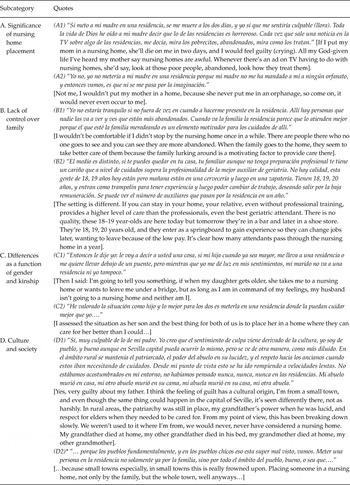
In the present study, when asked how they would feel if they placed their dependent relative in a residential care facility for people who need assistance, the majority said they would feel guilty. That feeling is explained by the significance families attribute to nursing home placement. People consider them to lack the comforts of home, and believe this option should only be considered in extreme situations. They see it as abandoning family in highly disgraceful institutions (Table 3, quotes A1 and A2).
Transcribed Quotes in the Category “Guilt about Nursing Home Placement”

* Quotes from health professionals
They also express concerns about the lack of qualified personnel and resources at nursing homes, suggesting that overburdens workers and gives rise to abusive situations (Table 3, quotes B1 and B2).
It has additionally been observed that kinship on the part of the caregiver influences the decision to admit the patient to a nursing home. Difficulty proposing this is most apparent in spouses, especially wives, who likely feel even more obligated because of their traditional role in care work (Table 3, quotes C1 and C2). Thus, caregivers who propose placing the family member in a nursing home are offspring, mostly men, with part-time or independent care strategies, and occupational as well as domestic strain.
Finally, we must point out an emerging category in discussions of caregivers’ experience of guilt: the influence of rural or urban culture. In rural areas, there seems to be more social rejection associated with placing family in a nursing home than in cities (Table 3, quotes D1 and D2).
Discussion
This study’s objective was to analyze feelings of guilt in caregivers of dependent relatives. What follows is a discussion of the results obtained through discussions with caregivers and health professionals.
First of all, in terms of caregiver guilt over abandonment of family and friends, this study demonstrated that this feeling is observed most in daughters with full-time care strategies. Our results are consistent with those of García, Sala, and Coscolla (Reference García, Sala and Coscolla2009); they found evidence that cohabitating with the care recipient impacts spousal intimacy and relations. Gender socialization may also explain why some women consider themselves bad mothers and wives when they cannot tend to their children and husband, instead caring for a dependent relative. In that vein, Agulló-Tomás (Reference Agulló-Tomás2002) and de la Cuesta-Benjumea (Reference De la Cuesta Benjumea2009) argue that men have been taught to be cared for by women. Conversely, according to Carrasco (Reference Carrasco2006), women have been educated according to a model of other-care; it would be considered unusual or strange if her spouse did not complain about time spent caring for a dependent relative. García-Calvente et al. (Reference García-Calvente, Lozano, Castaño-López, Mateo-Rodríguez, Maroto-Navarro and Hidalgo-Ruzzante2010) reinforced that idea in stating that for female caregivers, there is an order of priority: first the care recipient; then other family and professional obligations; and last themselves. On the other hand, Rodríguez-Pérez (Reference Rodríguez-Pérez2013) explained feeling guilty while going out and having fun as a consequence of the strong connection, and situation of dependence, established between caregivers and care recipients.
In the category of guilt about the relationship with the dependent person, we observed differences as a function of gender, kinship, and care strategy. The results according to gender and kinship can be explained by Carrasco (Reference Carrasco2006), who proposed that feelings of guilt in female caregivers (daughters) are produced as a result of doubting the absolute moral norm of caring for family. This suggests not being the good person one strives to be, or not responding to societal expectations, is at the root of this feeling. López and Noriega (Reference López and Noriega2012); Crespo and López (Reference Crespo and López2008) posited some of the same motives for feelings of guilt observed in this study. They emphasized that care work can express gratitude and reciprocity (first parents care for their offspring, then sons and daughters must care for their parents); resolve feelings of guilt about past actions; and respond to social desirability – that is, care work can be a means to avoid censure or reproach from family or friends if they stop tending to the relative.
Caregiver ambivalence and its impact on feelings of guilt have been documented by other male and female authors in the context of caring for dependents with cognitive decline (Laserna et al., Reference Laserna, Castillo, Peláez, Navío, Torres, Rueda and Pérez1997; Muela-Martínez, Torres-Colmenero, & Peláez-Peláez, Reference Muela-Martínez, Torres-Colmenero and Peláez-Peláez2002).
In terms of the care strategy selected, in keeping with Casado-Mejía and Ruiz-Arias’s (Reference Casado-Mejía and Ruiz-Arias2013) findings, these results indicate caregivers who do not live full-time with dependent family members – in other words, people with part-time or independent care-management strategies – have feelings of guilt by omission, for being absent when they know the dependency situation but cannot be with the family member. Normally, when they appear at the dependent person’s home, often in his or her final days, they are the ones most demanding of the healthcare staff serving their needs. This situation, described in the professional focus groups, is referred to as the Child from Bilbao Syndrome (Gómez-Sancho, Reference Gómez-Sancho2005; Muñoz-Cobos, Espinosa-Almendro, Portillo-Strempell, & Rodríguez-González de Molina, Reference Rodríguez del Álamo2002).
Regarding guilt about nursing home placement, this study, like the reports released by the Spanish Institute for the Elderly and Social Services (IMSERSO, 2010), found that the dependent person not being in possession of their full mental faculties is a deciding factor in nursing home admission. Another accepted cause for nursing home placement is circumstances at home barring any other alternative; in other words, extreme circumstances prevent the presumed caregiver from assuming that role. We definitively found that the idea of placing the dependent family member in a nursing home gets proposed when the demands of care work exceed the caregiver’s physical, psychological, or structural abilities. However, the significance of nursing home placement generates feelings of rejection and guilt.
In terms of kinship, as López and Noriega (Reference López and Noriega2012) reported, we observed that caring for a spouse produces more rejection of institutional care. Admitting him or her to a nursing home is interpreted as failing to fulfill marital obligations, provoking greater feelings of guilt.
By way of conclusion, it is suggested, first, that there are differences as a function of gender in perceived feelings of guilt among caregivers. Women feel guiltier for leaving the dependent person alone or with other caregivers, and for abandoning their own family as well as friends. Men express more guilt for being unable to perform the domestic tasks involved in care work. Second, caregivers with an independent care strategy experience the most feelings of guilt, because they perceive an abandonment of the dependent person. Next, the part-time care strategy seems to produce guilt for abandoning family and friends. Finally, with regard to kinship, sons and daughters who are caregivers report the most feelings of guilt, probably due to the burden of having to combine care work with family and professional life.
We believe this study is a step forward in the analysis of guilt as an emotion highly present in caregivers of dependent family members. Results indicate male and female health professionals should bear in mind the importance of addressing it early to prevent caregivers from developing mental health problems. Identifying the guilt-generating situations and caregiver dimensions evaluated in this study could serve and support different professional interventions in this area.