Introduction
Phlebotomine sand flies (Diptera: Psychodidae: Phlebotaminae) are the established vectors of leishmaniasis, a disease which has recently become a significant public health concern in Sri Lanka. Indigenously transmitted leishmaniasis was first reported in the country in 1992 (Athukorale et al., Reference Athukorale, Seneviratne, Ihalamulla and Premaratne1992). More than 2500 cases of leishmaniasis have been reported from different parts of the country since then and leishmaniasis became a notifiable disease in 2008 (Siriwardana et al., Reference Siriwardana, Chandrawansa, Sirimanna and Karunaweera2012). The presence of sand flies in Sri Lanka has been documented for many years. Three species of Phlebotomus and 18 species of Sergentomyia sand flies have been previously recorded in the country (Lewis, Reference Lewis1978; Gajapathy & Surendran, Reference Gajapathy and Surendran2011, Reference Gajapathy and Surendran2012a , Reference Gajapathy and Surendran b ; Ozbel et al., Reference Ozbel, Sanjoba, Alten, Asada, Depaquit, Matsumoto, Demir, Siyambalagoda, Rajapakse and Matsumoto2011).
Sergentomyia species are widespread across old world countries and are the predominant sand flies (Lewis, Reference Lewis1978; Elnaiem et al., Reference Elnaiem, Hassan and Ward1997; Sadlova et al., Reference Sadlova, Dvorak, Seblova, Warburg, Votypka and Volf2013). As they generally feed only on reptiles, sand flies of the genus Sergentomyia are considered to be vectors of reptilian and not human Leishmania parasites (Lewis, Reference Lewis1978). However, recent reports from different parts of the world ascribe a role for some Sergentomyia species in the transmission of human visceral and cutaneous leishmaniasis (Campino et al., Reference Campino, Cortes, Dionisio, Neto, Afonso and Maia2013; Kanjanopas et al., Reference Kanjanopas, Siripattanapipong, Ninsaeng, Hitakarun, Jitkaew, Kaewtaphaya, Tan-ariya, Mungthin, Charoenwong and Leelayoova2013; Sadlova et al., Reference Sadlova, Dvorak, Seblova, Warburg, Votypka and Volf2013). Sergentomyia species have been detected with Leishmania donovani DNA in nearby India (Mukherjee et al., Reference Mukherjee, Hassan, Ghosh, Gosh, Bhatacharya and Adhya1997). A previous study from a leishmaniasis endemic locality in Sri Lanka revealed only the presence of Sergentomyia zeylanica and it was suggested that this species could play a role in the transmission of the disease (Premachandra et al., Reference Premachandra, Senarath, De Silva and Peiris2012).
The taxonomic characterization of sand flies has been a cumbersome procedure, traditionally based on morphological characteristics that require microscopic examination (Lewis, Reference Lewis1978). However, sand fly taxonomy and phylogeny has been recently reassessed (Bates et al., Reference Bates, Depaquit, Galati, Kamhawi, Maroli, McDowell, Picado, Ready, Salomón, Shaw, Traub-Cseko and Warburg2015). Conventional morphology-based identification may fail to identify morphologically similar sibling species or cryptic species (Kumar et al., Reference Kumar, Srinivasan and Jambulingam2012). The presence of cryptic species in many insects has been well documented. Sibling species of malaria vectors show different bio-ecological traits including vector potentiality, seasonality and differential susceptibility to insecticides (World Health Organization, 2007; Surendran & Ramasamy, Reference Surendran and Ramasamy2010). In addition to classical morphology-based identification, genetic and biochemical differences are now being used to distinguish sibling species in anopheline vectors of malaria (World Health Organization, 2007). DNA sequence analysis of ribosomal DNA (rDNA) and mitochondrial DNA (mtDNA) have been previously used to distinguish sibling species within malaria and schistosomiasis vectors (Collins & Paskewitz, Reference Collins and Paskewitz1996; Nalugwa et al., Reference Nalugwa, Kristensen, Nyakaana and Jørgensen2010).
A recent genetic study suggested the presence of cryptic species within the Sergentomyia bailyi complex in India (Kumar et al., Reference Kumar, Srinivasan and Jambulingam2012). The present study investigated the possible presence of cryptic species within the Se. bailyi complex in Sri Lanka using morphological and genetic criteria for differentiation.
Materials and methods
Study sites and sample collection
Sand flies for the study were collected during the period September 2013–May 2015 from nine different sites within the leishmaniasis non-endemic and endemic districts that lie predominantly within the dry zone of Sri Lanka (fig. 1). Monthly collections were carried out using aspirators and a modified CDC light trap from human and animal dwellings. Collection was performed in the morning between 0530 and 0630 h and in the evening from 1800 to 2130 h. The collected flies were transferred to the laboratory in 1.5 ml microfuge tubes in 70% v/v ethanol.
Sand fly sample collection sites in Sri Lanka. Sand flies were collected from nine sites in four different administrative districts. Leishmaniasis is considered to be endemic in the Anuradhapura and Hambantota districts (demarked in bold line).

Morphometric characterization
The collected specimens were dissected and mounted on microscope slides in Berlese's medium (Widaa et al., Reference Widaa, Ahmed, Bari, Ali, Ibrahim, Bashir, Mastour, Yagi and Hassan2012). Morphometric characteristics of head, wings and abdominal terminalia (genital region) were used for identification using published keys (Lewis, Reference Lewis1978; Lane, Reference Lane, Lane and Crosskey1993). The remaining thorax and abdominal parts were preserved in 70% alcohol for DNA extraction. Morphometric and meristic characteristics were scored in a CX21FS1 (Olympus, Japan) microscope equipped with a moving Vernier scale and an ocular micrometer. The head length, head breadth, eye length, eye breadth, inter-ocular length, length of antennal flagellomere (AF) I, II and III, sensilla chaeticum (Sc) on AFI, AFII and AFIII, labrum, proboscis, maxillary palp, wing length, wing breadth, wing venation (Radial R2, R3, R2 + 3 and R overlap), and length and breadth of spermatheca were measured. The length of AFs I, II and AFIII, and ScI on AFI, AFII and AFIII were determined. In addition AFI/labrum, palp ratio, the wing index (R2/R2 + 3), wing overlap (R1overlap/R2) and wing length and width were also calculated and recorded. Structural images were captured using a digital camera (Aiptek HD 1080P) fixed to the microscope. Mean values of sensilla chaeticum were subjected to the Student's t-test to detect significant variations.
Genetic characterization
DNA extraction and the amplification of cytochrome c oxidase gene sequences
Genomic DNA from morphologically identified individual Se. bailyi specimens was extracted using a commercially available DNA extraction kit (DNeasy® Blood and Tissue Kit, QIAGEN®) following the manufacturer's instructions. A portion of the mitochondrial cytochrome c oxidase subunit-I (COI) gene was amplified using the primers LCO1490 and HCO2198 (Folmer et al., Reference Folmer, Black, Hoeh, Lutz and Vrijenhoek1994) using thermocycling conditions described previously (Kumar et al., Reference Kumar, Srinivasan and Jambulingam2012). Similarly a portion of the cytochrome c oxidase subunit-II (COII) gene was amplified using the universal primers C2-J-3138 and C2-N-3686 (Simon et al., Reference Simon, Frati, Beckenbach, Crepsi, Liu and Flook1994) as described by Goswami et al. (Reference Goswami, Raghavendra, Nanda, Gakhara and Subbarao2005). The amplified polymerase chain reaction (PCR) products were sent to M/S Macrogen, South Korea for bi-directional sequencing.
DNA sequence analysis
DNA sequence chromatograms were manually edited in FinchTV 1.4.0 (Geospiza, Inc., Seattle, WA, USA; http://www.geospiza.com) and compared with sequence data available in GenBank using BLAST. All COI sequences generated were aligned, using ClustalW2 in MEGA, version 6 (Tamura et al., Reference Tamura, Stecher, Peterson, Filipski and Kumar2013), along with other previously available sequences for Se. bailyi retrieved from GenBank. Genetic information such as the number of haplotypes, the number of segregating sites, and the maximum composite estimate pattern of nucleotide substitution were determined for the COII sequences using DnaSP 5.10 (Librado & Rozas, Reference Librado and Rozas2009) and MEGA, version 6 (Tamura et al., Reference Tamura, Stecher, Peterson, Filipski and Kumar2013) respectively. Phylogenetic relationship among members of the Se. bailyi complex from Sri Lanka and India was inferred using the maximum likelihood (ML) method. The substitution model selection was also performed in MEGA, version 6 based on the lowest Bayesian Information Criterion (BIC) value. The general time reversible + gamma distribution (GTR + G) model for the COI sequence dataset was selected. Bootstrap (Felsenstein, Reference Felsenstein1985) support values were based on 1000 re-sampled datasets using MEGA, version 6. Sergentomyia insularis (HQ585365) was used as an outgroup in the analysis.
Development of an allele-specific (AS) PCR assay
In order to distinguish the two cryptic species in the Se. bailyi complex in Sri Lanka, an AS-PCR assay based on sequence variation in the COI region, that utilized a common forward primer BailF (5′−3′: AATTGGAGATGATCAAATTTATAATG) and species-specific reverse primers BailA (5′−3′: ATTATTTGAAAGAGGAGGATAG) and BailB (5′−3′: GAACAGCTGTAATAATTACTGATCAG) was developed. The expected diagnostic size of the PCR product for Se. bailyi species A was ~250 bp while that for species Se. bailyi species B was ~420 bp. The PCR reactions were performed in 25 µl volumes. Each reaction mix included 1 µl of DNA, each primer at 1.5 µM, 2.5 mM MgCl2, 0.2 mM dNTP mix and 1.25 U Taq DNApolymerase in 1× PCR buffer (QIAGEN®). The samples were heated at 94°C for 5 min before 30 cycles of amplification at 94°C for 40 s, 50°C for 30 s, and 72°C for 30 s followed by a final extension at 72°C for 7 min. The amplified PCR products were visualized by electrophoresis in 1.5% agarose gels and staining with ethidium bromide.
Results and discussion
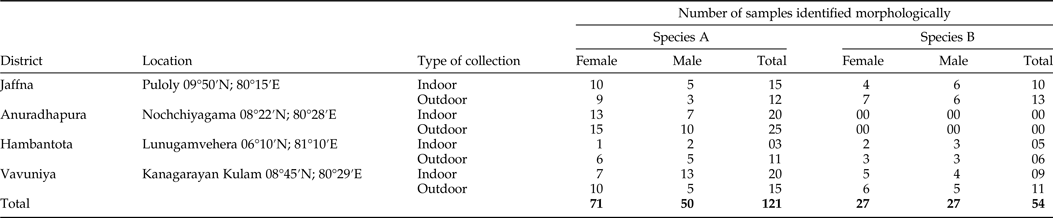
Sri Lanka, based on annual rain fall and its seasonality, is divided into three climate zones, viz. wet (>2500 mm annual rainfall during the North East and South West monsoons), intermediate (2500–1750 mm with mixed monsoonal rainfall) and dry (<1750 mm during the North East monsoon) zones. A total of 175 specimens of Se. bailyi, comprising 98 females and 77 males, were collected and identified from four out of nine locations during the study period (table 1). Beliatta and Tangalle although located in the Hambantota district are considered to be within the intermediate rainfall zone and no Se. bailyi were found at the two locations during the study period. All Se. bailyi samples therefore originated from locations in the dry zone viz. Puloly (Jaffna district), Kanagarayankulam (Vavuniya district), Nochchiyagama (Anuradhapura district) and Lunugamvehera (Hambantota district). However Se. bailyi specimens could not be collected in the dry zone sites of Suthumalai (Jaffna district), Thonikal (Vavuniya district) and Palagala (Anuradhapura district) during the study. Two distinct morphological variations (tentatively termed as Se. bailyi species A and Se. bailyi species B) were observed within Se. bailyi based on the relative length of sensilla chaeticum (Sc) on antennal flagellomere I (AFI) (fig. 2a, b), AFII (fig. 2c, d), and AFIII (fig. 2e, f). The morphometric characteristics obtained are presented in table 2 and the structural similarity in the cibarial armature of Se. bailyi species A and species B in fig. 3. Statistical analysis using the Student's t-test showed that the length variation between the two cryptic species was significantly different for sensilla chaeticum on AFI (t = 18.54, P < 0.001), AFII (t = 15.02, P < 0.001), and AFIII (t = 15.02, P < 0.001).
Morphometric characteristics of sensilla chaeticum (Sc; solid line) and antennal flagellomere (AF; dashed line) in the first (AFI), second (AFII) and third (AFIII) segments of Se. bailyi species A and B. (a) Sc vs. AFI of species A. (b) Sc vs. AFI of species B. (c) Sc vs. AFII of species A (d) Sc vs. AFII of species B. (e) Sc vs. AFIII of species A. (f) Sc vs. AFIII of species B.

The cibarial armature of Se. bailyi species A (a) and species B (b).

Details of the collection of morphologically identified Se. bailyi species A and B from the different sites in Sri Lanka.

Morphometric characteristics in Se. bailyi species A and B.

ScI- length of sensilla cheaticum on antennal flagellomere I; ScII- length of sensilla cheaticum on antennal flagellomere II; ScIII- length of sensilla cheaticum on antennal flagellomere III; AFI- length of antennal flagellomere I; AFII- length of antennal flagellomere II; AFIII-length of antennal flagellomere III.
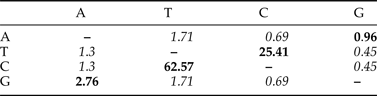
Se. bailyi samples that were processed for morphometric analysis were subsequently used for genetic characterization. A total of nine species A (KT284862, KT284863, KT284867, KT284864, KT284866, KT284870, KT284871, KT284877 and KT284882) and six species B (KT284868, KT284869, KT284872, KT284873, KT284874, and KT284875) sand fly specimens were sequenced for COI. Six specimens each for species A (KU379880, KU992633, KX270823, KX270824, KX270825, and KX270826) and species B (KU379661, KU992633, KX270827, KX270828, KX270829, and KX270830) were sequenced for COII. A minimum of the same three specimens from each species were used for the analysis of both the COI and COII sequences. Samples were also selected to represent all collection locations. In the COI sequences, there were a total of six (KT 284863, KT284864, KT284864, KT284866, KT284867 and KT284867) haplotypes in species A and a single (KT284868) haplotype in species B. None of the haplotypes are shared by both sibling species. In the COII sequences, two and one haplotypes were found in Se. bailyi species A and Se. bailyi species B respectively. The corresponding COII haplotype sequence for Se. bailyi species A (KU379880 and KU992633) and species B (KU379661) are deposited in GenBank. In the absence of other previous GenBank entries for COII sequences for Se. bailyi, the resulting 518 bp 12 COII sequence dataset was used to identify number segregating sites and amino acid substitutions. There were 54 segregating sites that resulted in 2 amino acid substitutions (Ser-Pro, and Val-Thr) in Se. bailyi species B. The maximum composite estimate pattern of nucleotide substitution revealed transitional and transversional substitutions with 25.4% for T-C transitional substitutions (table 3) and nucleotide frequencies as 31.27% (A), 41.12% (T), 10.91% (C), and 16.7% (G).
Maximum composite likelihood estimate of the pattern of nucleotide substitution between Se. bailyi species A and B.

Rates of different transitional substitutions are shown in bold and those of transversional substitutions are shown in italics.
All sequences of the COI region of Se. bailyi species A and B from Sri Lanka were aligned with GenBank entries for Se. bailyi from India (identified as group I and II by Kumar et al., Reference Kumar, Srinivasan and Jambulingam2012). The sequence dataset used for the final phylogenetic tree reconstruction was 507 bp in length. The resulting tree with corresponding GenBank accession numbers is shown in fig. 4. The phylogenetic analysis showed that the Sri Lankan samples clustered into two separate clades (termed as species A and B) and corresponding exactly to their morphology-based species identification. In addition they also claded with the two cryptic species of Se. bailyi (e.g., HQ585383 and HQ585387) identified in India (Kumar et al., Reference Kumar, Srinivasan and Jambulingam2012). The DNA sequence data showed that the two cryptic species were genetically distinct. The mitochondrial markers such as cytochrome oxidase b (cytb) and COI been previously used in sand fly molecular taxonomy (Depaquit, Reference Depaquit2014). However, this is the first report to our knowledge of the use of mitochondrial COII gene sequence as a marker to distinguish two cryptic species in a sand fly taxon. It has been argued that the use of both mitochondrial and nuclear markers may be more appropriate to differentiate closely related species and to establish reproductive isolation (Depaquit, Reference Depaquit2014). Therefore further studies using different nuclear genes as additional markers may be appropriate for Se. bailyi.
Phylogenetic analysis of the COI sequences of Se. bailyi complex. The specimens used for analysis were sequences from the morphologically identified Se. bailyi species A and B of Sri Lanka and GenBank entries for Indian specimens. Bootstrap values, indicated at the nodes, were obtained from 1000 bootstrap replicates and are reported as percentages. Bootstrap values less than 60 are not shown. Se. insularis was used as outgroup.

As the morphometric and genetic studies showed the presence of only two sibling species in Se. bailyi complex in Sri Lank, an allele specific PCR (AS-PCR) assay was developed to differentiate them. A common forward primer was used with two species-specific reverse primers that were designed to amplify only from either Se. bailyi species A or species B. Considerations in the design of species-specific reverse primers were (1) fixed base substitutions between the COI sequences being mostly located at the 3′- end of the primers to eliminate mismatch primer-DNA templates, and (2) the generation of species-specific amplicons that could be easily separated by size on agarose gel electrophoresis. A panel of 20 samples collected from different localities and identified morphologically as Se. bailyi species A and B were used for this assay. The AS-PCR assay clearly separated the specimens in a manner wholly consistent with the morphology-based identification of the two species. All the tested specimens produced the expected size of amplified DNA fragments (Se. bailyi species A ~250 bp and Se. bailyi species B ~420 bp) in the AS-PCR assay (fig. 5). This assay is potentially useful for screening large numbers of samples wherever species A and B are found to be sympatric in Sri Lanka and possibly in neighbouring countries, e.g., India.
Agarose gel analysis of the diagnostic fragments for Se. bailyi species A and B in the AS-PCR assay. M: 100 bp marker; B: control without DNA; 1–3: species A; 4–6: species B.

A very recent report confirms our morphological description, mainly based on length variation in sensilla chaeticum and antennal flagellomere, for the presence of two cryptic species in the Se. bailyi complex in neighbouring South India (Yogeswari & Srinivasan, Reference Yogeswari and Srinivasan2016). Morphological variations have been previously used to describe cryptic species in sand flies (Lane & Fritz, Reference Lane and Fritz1986; Ilango, Reference Ilango2000, Reference Ilango2010; Cazorlap, Reference Cazorlap2009). The sensilla chaeticum (previously known as antennal ascoid) is used in sand fly taxonomy to differentiate within and between species (Lane & Rahman, Reference Lane and Rahman1980; Lane & Fritz, Reference Lane and Fritz1986; Lane, Reference Lane, Lane and Crosskey1993, Ilango, Reference Ilango2000, Reference Ilango2010). Presence of two morphospecies based on relative length of sensilla chaeticum and antennal flagellomere have also been reported for Phlebotomus argentipes complex in India (Ilango, Reference Ilango2000, Reference Ilango2010) and Sri Lanka (Surendran et al., Reference Surendran, Kajatheepan, Hawkes and Ramasamy2005, Reference Surendran, Kajatheepan and Ramasamy2007; Gajapathy et al., Reference Gajapathy, Peiris, Goodacre, Silva, Jude and Surendran2013). The morphological differences are considered as a character displacement indicating reproductive isolation among members of a species complex (Ilango, Reference Ilango2000).
Both Se. bailyi species A and species B are sympatric in nature. Sympatric populations that occupy different ecological niches may become reproductively isolated (Dantas-Torres et al., Reference Danta-Torres, Latrofa and Otranto2010). The present morphological and genetic characterization provides evidence for two cryptic species A and B within the Se. bailyi complex in Sri Lanka, but this can be further established by studies on mating compatibility between the two species to confirm reproductive isolation.
Variation in geographical distribution that is associated with leishmaniasis endemicity has been reported for species A and B of the Phlebotomus argentipes complex (Ilango, Reference Ilango2000). Although Se. bailyi has not yet been associated with the transmission of leishmaniasis, both cryptic species are sympatric and prevalent in different habitats. The morphological and molecular characteristics reported here for the first time in Sri Lanka will be useful for differentiating the two sibling species of Se. bailyi in field collections and investigating their possible role in transmitting leishmaniasis.
Acknowledgements
The authors acknowledge research grant support from the National Research Council of Sri Lanka (NRC/11/064) as well as field assistance from the entomological assistants and others in the entomology teams of Anti Malaria Campaign.