1. Introduction
The past few decades have seen a drastic increase in the strength of regional courts. Various scholars have noted the increased prominence of international dispute settlement and the proliferation of the number of courts with direct effect and access for non-state actors (Allee and Huth, Reference Allee and Huth2006; Alter, Reference Alter2011, Reference Alter2012; Keohane et al., Reference Keohane, Moravcsik and Slaughter2000). This development can be captured by the concept of judicialization: ‘the increase in enforceability through adjudication and the possible authorization of sanctions by an independent third party’ (De Bièvre and Poletti, Introduction to this special issue). Two dynamics could be involved in the rise of judicialization. On the one hand, the rise in judicialization could be the result of the creation of new regional international organizations (RIOs) with strong dispute settlement mechanisms. On the other hand, it may also be that existing RIOs undergo reforms in their dispute settlement mechanism that render them stronger. For regional international organizations, it is the latter dynamic that prevails. In other words, most regional organizations do not start out with a strong dispute settlement mechanism but member states only agree to set up a court or make an existing dispute settlement mechanism more powerful after the organization has been operational for some time. Understanding the causes for change, therefore, is essential for explaining the rise of judicialization.
I define institutional change in dispute settlement as a reform that renders the dispute settlement mechanism weaker or stronger. Two plausible drivers of institutional change in RIO dispute settlement are changes in the balance of power or the level of trade interdependence between member states. An increase in trade interdependence may induce change by creating a demand for regulation of these trade flows. Societal actors will cooperate with the international organization in order to expand the organization's mandate, leading to more delegation, including an increase in dispute settlement to enforce decision-making on trade policy. Others have emphasized the role of power. RIOs are often assumed to be created in order to reflect the balance of power between their member states at creation. When there is a change in the balance of power between member states, institutions may no longer reflect member state preferences, necessitating reform in order to bring them back in line.
In this paper, I will propose a third variable that may help understand dispute settlement reform: the nature of organization's founding contract. The treaties on which regional trade organizations are based vary considerably in their degree of completeness: some have detailed specifications of the objectives the organization hopes to achieve, whereas others are unclear about the precise goals the member states want to accomplish. RIOs based on more incomplete contracts are more flexible. Hence, they allow member states to adapt to changing circumstances and to discover their shared interests. This flexibility, while oft beneficial to member states, also creates uncertainty about the nature of the cooperation. Therefore, states are more likely to find they need strong institutions to share information and enforce decisions. Since the specific goals of the organization in the context of an incomplete contract only become clear over time, these institutions will only be created after the organization has been set up. Thus, incomplete contracts are expected to be associated with higher levels of judicialization and more change over time.
The paper proceeds as follows. In the next section, I will explore the explanations for institutional change that have been put forward in the literature in more detail. The following section provides the case selection and introduces the measure for dispute settlement that I use in this paper. In this section, I also outline some trends in judicialization. In the next section, I explore the causes for change in dispute settlement across 25 regional international organizations with a strong trade focus. The descriptives reveal that the nature of the underlying contract is a strong predictor for dispute settlement change, whereas the other predictors have less purchase on institutional reform. Nevertheless, these variables fail to explain all cases. In order to find an alternative explanation for dispute settlement reform, this paper includes a case study of change in the Latin American Free Trade Association (LAFTA, the predecessor of the Latin American Integration Association). The case study reveals that in the case of ALADI, the influence of other organizations was the main driver behind dispute settlement reform. The final section serves as a conclusion.
2. Theories of reform
The literature has put forward several possible causes of institutional change. In this section, I will highlight the three most important determinants of institutional change. These include the balance of power and the level of trade interdependence between member states. In addition, I will draw attention to a third variable: the nature of an organization's founding contract. Whereas the effects of power and trade have received considerable attention amongst scholars of institutional design and institutional change, the part an organization's founding contract plays in inducing institutional change has featured less prominently in the literature.
Balance of power
Power is often considered an important determinant of institutional design, and a shift in power relations may lead to a change in international institutions. Institutions are often assumed to reflect the power relations between member states at their creation (Keohane, Reference Keohane1984). This line of thinking is particularly strong in the rational choice framework. There, the central assumption is that actors have a set of rank-ordered preferences and try to maximize their utility accordingly. Hence, actors will only agree to the creation of an institution if the institution allows them to further their interests. In the international realm, this means that states will only create an international organization if they anticipate benefiting from this organization (Keohane, Reference Keohane1982). As Koremenos, Lipson, and Snidal explain: ‘states use diplomacy and conferences to select institutional features to further their individual and collective goals, both by creating new institutions and modifying existing ones' (Koremenos et al., Reference Koremenos, Lipson and Snidal2001). Institutions, then, will only arise when the perceived benefits of the institution exceed the transaction costs involved in setting it up (Hall and Taylor, Reference Hall and Taylor1996). A shift in power relations may induce change when it causes the institution to no longer match the preferences of member states. States will seek to address this imbalance between power relations and institutional design by changing the institution, or even by abandoning the organization altogether and starting over in a new venue (Helfer, Reference Helfer2006). Hence, a shift in state preferences can induce institutional change.
Not only an incongruity between the balance of power between member states and institutional design plays a role for change in third party dispute settlement, but the specific power balance between member states also is significant. More precisely, in organizations where there is a hegemon, third party dispute settlement is less likely to increase in strength than in those RIOs that enjoy egalitarian power relations. Hegemons prefer not to be bound by strong courts, since they can also get their way without a body enforcing the organization's decision-making. A strong dispute settlement mechanism levels the playing field, something which is mainly appealing for those countries which otherwise are at a disadvantage (Stone, Reference Stone2010). Empirical evidence supports this argument (Kono, Reference Kono2007; Koremenos, Reference Koremenos2007).
Trade interdependence
Increased trade interdependence is regularly mentioned as an explanation for institutional change. Trade interdependence features prominently in neofunctionalist theories of international organizations. These theories date back to the 1960s when scholars became interested in comparing the level of integration of different regional organizations (Nye, Reference Nye1968). Neofunctionalism not only considers the role of states in international cooperation, but also the role of other societal actors, including interest groups, political parties and business (Haas, Reference Haas1961). In neofunctionalism, integration is driven by societal actors who cooperate with the RIO in order to advance their interests. Hence, the causal mechanism that links trade interdependence to institutional change in neofunctionalism pays attention to both the demand and supply side of integration.
On the demand side, societal actors lobby for more delegation to supranational institutions in order to further their own interests. On the supply side, supranational institutions are looking to expand their responsibilities by taking away more decision-making power from the domestic level (Caporaso, Reference Caporaso1998; Mattli, Reference Mattli1999). Trade interdependence often is the driving force behind the demands of societal actors. This becomes evident within the context of the EU, where increased trade interdependence led to a demand by societal actors (particularly business interests) to regulate these trade flows through European rules and regulations. The European Commission made use of this functional pressure to gradually increase its influence over the decision-making process (Stone Sweet and Sandholtz, Reference Stone Sweet, Sandholtz, Sandholtz and Stone Sweet1998; Stone Sweet and Brunell, Reference Stone Sweet and Brunell1998). Thus, trade interdependence can lead to functional pressure to render the regional organization more authoritative by a process of incremental change. Dispute settlement plays an important role in this process as it allows for the enforcement of decisions made by international institutions.
Contract
Although scholars have frequently paid attention to the role of shifts in power and trade interdependence as explanations for institutional change, in this paper I argue that a third variable also contributes to our understanding of change in dispute settlement: the nature of the organization's founding contract. Different scholars have argued that international agreements can be conceived of as contracts (Cooley and Spruyt, Reference Cooley and Spruyt2009; Abbott and Snidal, Reference Abbott and Snidal2000; Lake, Reference Lake1996). Contracts vary in their degree of completeness: whereas some RIOs are based on a treaty that specifically outlines the objectives of the organization, others are vague about the goals and subjects of the contract. As Marks et al. (Reference Marks, Lenz, Ceka and Burgoon2014) outline, incomplete contracts offer a considerable advantage over complete ones: they are flexible, which enables them to survive exogenous shocks and adapt to changing circumstances. This flexibility, however, comes at a cost. In the context of an incomplete contract, states deal with constant ambiguities. Uncertainties are caused by a shortage of information, a lack of clarity about the decision-making process and the possibility of rule violations. In order to achieve cooperation in the face of such uncertainty, delegated agents, including third party dispute settlement mechanisms, are of great importance. They can collect and distribute information, avert issue cycling, and prevent escalation of conflicts by adjudicating in the between conflicting interpretations of the rules (ibid.).
For most organizations, however, the creation of strong delegated agents is a gradual process that comes about as a result of continued interaction.Footnote 1 When working together in the context of an incomplete contract, states find out about their needs and learn to trust each other. Cooperation is ‘a creative enterprise through which the parties not only weigh the benefits and burdens of commitment but explore, redefine, and sometimes discover their interests' (Chayes and Chayes, Reference Chayes and Chayes1993). As member states come to see themselves as belonging to the same community, they are much more likely to create strong institutions. Several authors have emphasized how member states need shared norms in order to delegate authority, including dispute settlement, to the international level (Acharya, Reference Acharya2004; Duina, Reference Duina2011; Keohane and Martin, Reference Keohane and Martin1995; Deutsch, Reference Deutsch1966 [1953]). Hence, even though organizations based on incomplete contracts have a need for delegated agents, including dispute settlement mechanisms, these often are only created after member states have some experience of cooperation. Incomplete contracts do not necessitate organizations to start out with powerful institutions, but rather induce an ‘endogenous dynamic’ (Marks et al., Reference Marks, Lenz, Ceka and Burgoon2014) that leads organizations to undergo institutional change over time.
3. Trends in judicialization
Case selection
In this paper, I consider change in dispute settlement in regional international organizations that are concerned with trade. I define regional international organizations as institutions with at least three geographically proximate member states (Haftel and Thompson, Reference Haftel and Thompson2006; Powers and Goertz, Reference Powers and Goertz2011). In the sample of the strongest international organizations, 33 organizations are classified as regional. Footnote 2 To sift out the organizations with a strong focus on trade, I only include those organizations that also are regional trade agreements. Of those agreements, I include the ones that have been notified to the World Trade OrganizationFootnote 3 and those included in Haftel (Reference Haftel2013). In addition, I include APEC and the Benelux, which also have a strong focus on trade. In total, this brings the sample size to 25. The complete list of organizations can be found in Appendix A.
Measuring judicialization
Various authors have made an attempt to quantify the difference between dispute settlement mechanisms. Most of these hinge on the question of the degree of independence dispute settlement mechanisms have with regard to the organization's member states: the more independent, the stronger the dispute settlement mechanism.
Delegation at the international level can take different forms. One of these forms is adjudicative delegation, the ‘authority to make a decision about a controversy or dispute’. The extent of this type of delegation is determined by the legal effect of the decisions made by the dispute settlement mechanism and by the independence of the judicial body. The legal effect is high when decision-making is binding and when decisions are enforceable, e.g. they have direct effect or sanctions are permitted (Bradley and Kelley, Reference Bradley and Kelley2008). These variables help us to conceptualize delegation but are too imprecise to help us rank various dispute settlement mechanisms.
Keohane, Moravscik, and Slaughter also consider dispute settlement a form of delegation. There are three dimensions of delegation on which dispute settlement mechanisms can vary: independence, access, and embeddedness. Independence is concerned with the way in which judges or arbitrators are selected; access takes into account who has legal standing before the tribunal, or ‘who can set the agenda’; embeddedness has to do with the control over formal implementation. The position on these dimensions allows us to distinguish between interstate and transnational dispute resolution (Keohane et al., Reference Keohane, Moravcsik and Slaughter2000).
Karen Alter distinguishes between old- and new-style international courts. New-style international courts have several characteristics that set them apart from old-style courts. First, these bodies have compulsory jurisdiction: there is an automatic right to litigation. Second, new-style courts have enforcement jurisdiction, which means they also get to adjudicate in case of state non-compliance. Finally, they allow private actors access to the judicial proceedings; this often increases the number of cases and brings international law to the domestic level (Alter, Reference Alter2006).
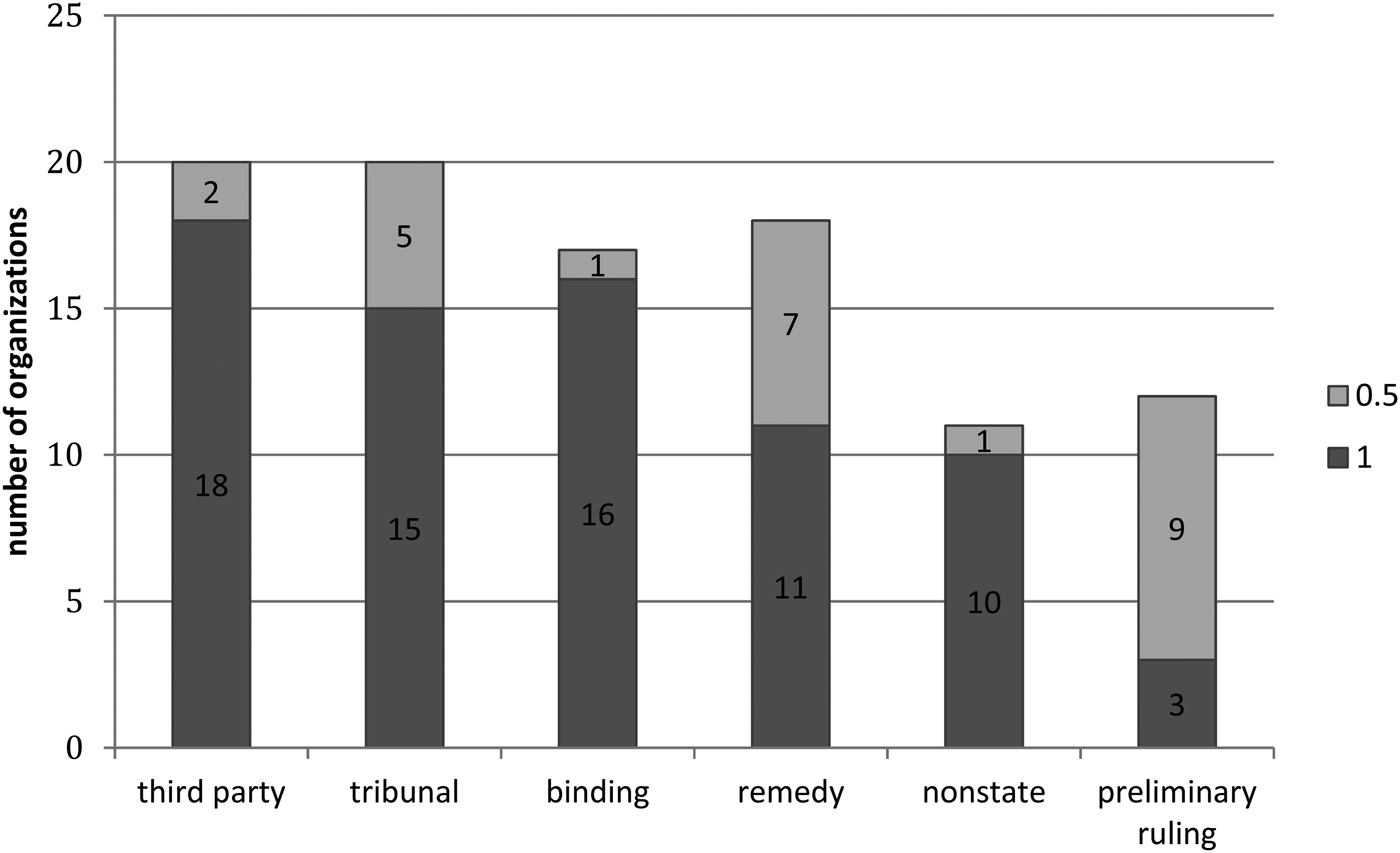
In this paper, I use a refined measure of dispute settlement that takes into account all elements that have been identified as relevant for measuring the strength of judicialization in the literature. The measure consists of six elements of judicialization: (a) automatic third party access; (b) nature of the tribunal; (c) bindingness of the ruling; (d) non-state access, (e) enforcement, and (f) whether the judicial body can issue preliminary rulings (Hooghe and Marks, Reference Hooghe and Marks2014; Marks et al., forthcoming). These relate to the studies discussed previously: automatic third party access corresponds to Alter's (Reference Alter2006) compulsory jurisdiction; the nature of the tribunal is found in Keohane et al.'s (Reference Keohane, Moravcsik and Slaughter2000) framework as independence; bindingness relates the notion of legal effect in the work of Bradley and Kelley (Reference Bradley and Kelley2008). Keohane et al. and Alter emphasize the importance of non-state access; the concept of enforcement is found in Bradley and Kelley and Alter; the latter also identifies the importance of preliminary rulings. All six elements are measured trichotomously.Footnote 4 The elements are added up to create a dispute settlement score that ranges from zero to six. This measure is based upon the work of McCall Smith (Reference McCall Smith2000), which has also been used by others, including Kono and Haftel and Thompson (Kono, Reference Kono2007; Haftel and Thompson, Reference Haftel and Thompson2006): it differs from McCall Smith's contribution in that it included preliminary rulings, and measures all elements trichotomously. Figure 1 shows the distribution across the different elements of dispute settlement for all 25 trade RIOs in 2010.
Distribution of the different elements of dispute settlement for all 25 regional trade organizations in 2010

Change over time
From the measure for the strength of third party dispute settlement in RIOs that was outlined in the previous section, we can construct a measure for change. I define a moment of change as a year in which one or more of the elements of dispute settlement are different from the previous year.
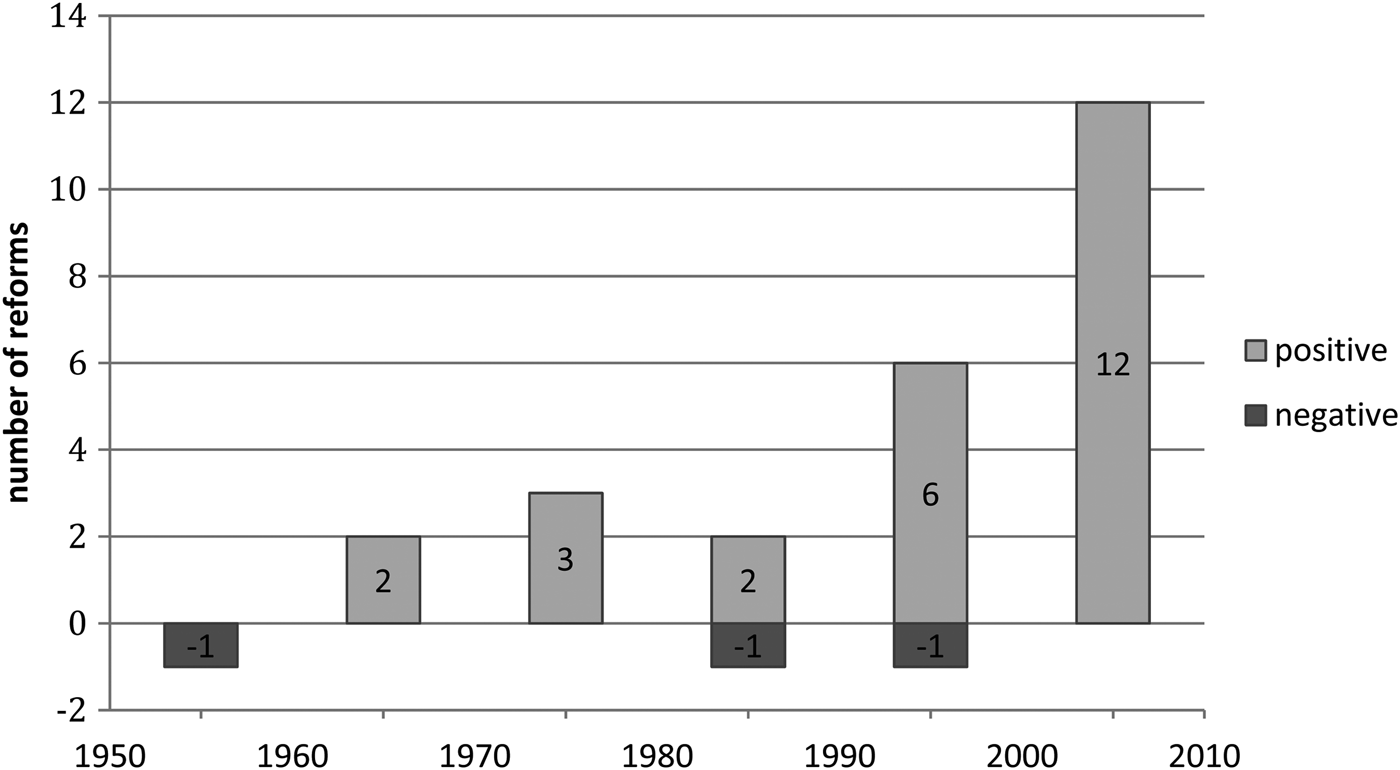
Figure 2 shows the number of organizations that have a change on one or several of the six elements of dispute settlement in each decade. The number of organizations that reform in each decade is quite small but increases over time. The majority of changes occur in the 1990s and 2000s. This can partly be attributed to the larger number of organizations that are active in this time period, but not entirely: the number of organizations increases by six, but the number of reforms more than doubles.
Number of organizations with dispute settlement reform per decade

Reforms in dispute settlement in most organizations are independent of the founding contract. The Caribbean Community (CARICOM), for example, had a reform in dispute settlement with the establishment of the Caribbean Court of Justice in 2005. By then, the organization had already been operational for several decades: the Caribbean Free Trade Agreement (CARIFTA) was created in 1968 and transformed into the Caribbean Common Market with the signature of the CARICOM Treaty in 1973. Before the establishment of the Caribbean Court of Justice, the organization had an arbitration procedure to resolve disputes, but that had never been used. Hence, the creation of the Court was not part of the negotiation on the organization's founding contract. Even when discussions on dispute settlement are part of the negotiations on the RIO's founding contract, this does not mean that the creation of a dispute settlement mechanism is a given. A good example is the Community Court of Justice of the Economic Community of Western African States (ECOWAS), established in 2001. The Lagos Treaty that founded the organization in 1975 already contained provisions on dispute settlement: there was to be a tribunal that guaranteed: ‘the observance of law and justice in the interpretation of the provisions of this Treaty’ (Lagos Treaty Arts. 11.1 and 56). Despite these intentions, member states only adopted the Protocol on the Community Court of Justice (Protocol A/P1/7/91) in 1991. The protocol did not enter into force until 1996 and the Court only became operational in 2001. Hence, there was not only a long time period between the original treaty negotiations and the establishment of the Court, but the member states also had separate negotiations on the specific design features of the new dispute settlement mechanism, necessitated by the lack of detail in the organization's founding treaty.
If we only consider whether or not there has been a change, however, we lose a lot of interesting variation. It is sensible to differentiate between reforms that increase an organization's score on dispute settlement, and those that decrease it. As Figure 2 indicates, the vast majority of changes serve to make an IO's dispute settlement mechanism more authoritative. In fact, in only three cases has a change led to a weakened dispute settlement mechanism. In 1958, the European Union made a change so that rulings no longer had direct effect. Direct effect was re-instated in 1963. In 1980, the Latin American Free Trade Association (LAFTA) was reformed into the Latin American Integration Association (ALADI), and the new IO lost its dispute settlement. Finally, the East African Community (EAC) became inactive after 1984, as did its dispute settlement mechanism. In 1993, a new treaty was signed to bring the organization back to life, but this treaty contained no provisions on dispute settlement. In 1999, the member states signed the Arusha treaty, which provided for the establishment of the East African Court of Justice. The court became operational in 2001. Apart from these three instances, all changes in dispute settlement have rendered organization's dispute settlement bodies more authoritative.
4. Exploring change in dispute settlement
Methodology
What explains dispute settlement reform? In this section, I will systematically consider the effect on dispute settlement reform of the three main variables outlined previously: balance of power, trade interdependence, and the nature of the contract on which the RIO is based. In order to see how these variables can combine with each other to produce dispute settlement reform, I use a configurational approach rooted in Qualitative Comparative Analysis (QCA). Pioneered by Charles Ragin (Reference Ragin1987), QCA combines features of qualitative, case-oriented research methodology with quantitative, variable-oriented approaches (Marx et al., Reference Marx, Rihoux and Ragin2014). QCA is qualitative and case-oriented since it emphasizes that the effect of variables cannot be understood in isolation, but that configurations of different variables contribute to various outcomes. In this approach, therefore, different combinations of variables can lead to the same outcome. QCA is quantitative since it allows for the comparison of a larger number of cases than would be possible using case study research, and therefore allows us to find patterns in explanatory variables and outcomes (Marx et al., Reference Marx, Rihoux and Ragin2014).
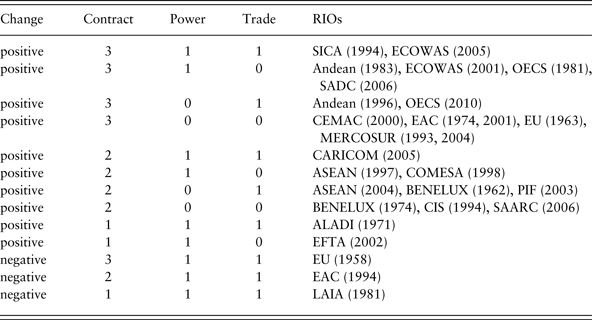
In this section, I use the most basic application of the configurational approach: to construct a truth table that allows for summarizing data and exploring the relevancy of different theories (Rihoux and Marx, Reference Rihoux and Marx2013). In the truth tables I present below, I am interested in the different combinations in which the three variables outlined above contribute to change in third party dispute settlement. I analyze the RIOs that do not have a change in their third party dispute settlement mechanisms in a separate table. For the organizations that change, each moment of change is taken as a case; for those that do not change, I analyze the organizations in 2010, the final year of observation in the dataset. To create the truth tables, I dichotomize the variables for balance of power and trade interdependence. The variable that measures the degree of completeness of the RIO's founding contract can take on three distinct values. The truth table reveals that the nature of the founding contract can explain most cases of change, whereas the explanatory value of the other values is less obvious. A closer examination of the cases indicates that there might be an omitted variable: the influence of other international institutions.
Overview of independent variables in trade RIOs that reform

Operationalization
As outlined previously, the literature expects changes in trade interdependence and power inequality, as well as the nature of the organization's founding contract, to affect the likelihood of observing institutional change. In this section, I will outline how I operationalize these variables.
Balance of power
A shift in power relations can cause a change in dispute settlement if this means that the institution no longer matches the power relations between member states. A common way to operationalize the balance of power in a regional trade agreement is to consider the material capabilities of member states. The Composite Index of National Material Capabilities (CINC) version 4.0 draws upon military expenditure, military personnel, energy consumption, iron and steel production, urban population, and total population. By taking the material capabilities of the most powerful member state as a ratio of the other member states, we gain a measure for detecting hegemons (1972, 1987). I compare the power asymmetry at the moment of change to the levels of inequality three years prior. I assign this variable a one if there has been an decrease in the level of power asymmetry of more than 3%. In all other cases, the variable is assigned a zero.Footnote 5
Trade interdependence
An increase in trade interdependence is expected to lead to a gradual increase in dispute settlement. I measure trade interdependence as an organization's trade share as a proportion of member states' total trade.Footnote 6 In order to evaluate whether trade interdependence has increased, I compare the trade interdependence at the moment of change to the levels of trade interdependence three years prior. In case of an increase of more than 3%, the variable is assigned a score of one; if it has remained the same or decreased, a zero.Footnote 7
Contract
The nature of the contract underlying the regional organization is expected to have a strong influence on the likelihood of institutional reform: where contracts are fairly incomplete, RIOs are more likely to find that over time they need strong institutions to ensure decisions are made and enforced. I use the coding of Marks et al. (Reference Marks, Lenz, Ceka and Burgoon2014), in which the contract variable can take on three different values: complete (1), intermediate (2), and incomplete (3).Footnote 8 A contract is defined as complete when the founding treaty outlines a fixed objective for member states to achieve through clearly specified means. An intermediate contract commits member states to cooperation on goals that are not fully specified, for example encouraging economic progress. An incomplete contract leaves the nature of the cooperation fully unspecified. The contract covers not just member states but the population as a whole (‘the people’) and the goal of cooperation is undetermined (e.g. ‘an ever closer union’).
Organizations that reform
Table 1 shows the truth table with different combinations of independent variables for all cases of reform in regional international organizations. In total, 18 RIOs undergo a reform in dispute settlement; some reform multiple times and in total there are 28 instances of reform. The vast majority of reforms occur in organizations that are characterized by an incomplete (15) or intermediate (10) contract. In fact, there are only three instances of reform where the organization is based on a complete contract. Hence, there seems to be a strong association between the degree of completeness organization's founding contract and dispute settlement reform. The other variables, power asymmetry and trade interdependence, seem to have less purchase on dispute settlement reform. In 12 cases of dispute settlement reforms, there is an increase in trade interdependence; in 15%, there is a decrease in power asymmetry. From these results, we can infer that the nature of the organization's founding contract is the strongest predictor of dispute settlement reform.
EFTA and ALADI are interesting cases: they undergo a reform in dispute settlement even though they are based on a complete contract. EFTA reformed its dispute settlement mechanism in 2002 within the context of the ratification of the Convention Establishing the European Free Trade Association. The dispute settlement procedure consists of arbitration, as was also the case under previous agreements; the main difference is that decision-making became binding. EFTA's legal situation, however, is complicated by the fact that three out of four EFTA member states are also members of the European Economic Area.Footnote 9 The EEA set up the EFTA Court of Justice in order to allow for the enforcement of EEA regulations in EFTA member states. The EFTA Court mimics the European Court of Justice, which is responsible for compliance with EEA regulations in EU countries (Sevon, Reference Sevon1992; Haukeland Fredriksen, Reference Fredriksen2010). It is a strong court with an automatic right to review, a standing tribunal, binding decision-making that takes direct effect, non-state access, and the possibility to issue preliminary rulings. Although there also is a decrease in the level of power inequality, the move towards binding decision-making in the EFTA tribunal is more likely to have been affected by the presence of the EFTA Court. I will discuss the case of ALADI in more detail below.
The organizations that have a negative reform, i.e. a reform that renders the dispute settlement mechanism less authoritative, are a mixed bag. The EU is the only RIO in this group with a highly incomplete contract. It is interesting to note that for the EU this negative reform only endured briefly: by 1963, the court was restored to its full strength. The East African Community has an intermediate contract. The negative reform, however, comes within the context of a renewed period of activity for the organization, and dispute settlement comes back at a later stage. This is also accompanied by a change in contract: the organization moves towards an incomplete contract. Finally, ALADI has a negative reform and a complete contract. This is the only organization in the sample that has a negative reform where dispute settlement is not restored afterwards. In all cases of negative reform, there also is a change in the balance of power and the level of trade interdependence. These results are surprising: we would expect an increase in trade interdependence to be accompanied by higher levels of dispute settlement, not lower. Lower levels of power inequality are also expected to facilitate higher levels of judicialization. Hence, these variables do not perform well for explaining negative reform.
Organizations that do not reform
Table 2 shows the different combinations of independent variables amongst RIOs that did not reform in 2010, the last year in the dataset. In total, seven regional organizations did not have a change in dispute settlement. The table also includes the average legalization score for each combination (maximum score is six). When organizations do not reform their dispute settlement mechanism, this might be due to a ceiling effect: once an organization arrives at high levels of dispute settlement, reform is less likely to occur, or even impossible when the maximum score has been reached. Looking at the average legalization score for the RIOs that do not reform, however, tells us that this is not the case. Most organizations in this group do not have provisions on dispute settlement at all, and those that do are at very low levels of judicialization.
Overview of independent variables in trade RIOs that do not reform

Four of the organizations that do not reform are based on a complete contract: APEC, EEA, NAFTA, and SACU. These organizations also do not have changes in their levels of power inequality and trade interdependence. Hence, these results are as expected. Two organizations are based on an intermediate contract, yet do not have any change in dispute settlement. ECCAS does have provisions on dispute settlement in its founding treaty, but the court was never set up. The League of Arab States (LOAS) created the Arab Investment Court in 2003 (Alter, Reference Alter2014: 373) but since this body only applies to one agreement and a very limited issue area, it is not included in the dataset. Only one organization that does not reform that has an incomplete contract: the Gulf Cooperation Council (GCC). The organization envisaged reforming its dispute settlement mechanism, but has not managed to do so just yet. The GCC Charter, which established the RIO in 1981, provided the creation of the so-called ‘Commission for the Settlement of Disputes' (GCC Charter, art. 10). By 2005, however, the Commission had not been used even once (Sturm and Siegfried, Reference Sturm and Siegfried2005). The GCC member states signed a new Economic Agreement in 2001, which also plans for the establishment of a new dispute settlement mechanism to govern the terms of the agreement. So far, this institution has not been brought to life, but the agreement indicates that the member states have at least considered reform.
5. Case study: dispute settlement reform in ALADI
As shown in Section 4, the nature of the organization's founding contract has a strong influence on the likelihood of dispute settlement reform. Nevertheless, the nature of the founding contract cannot explain all cases: EFTA and ALADI reform despite having a complete contract. As we have seen, in the case of EFTA this reform is likely to have been induced by the presence of the EFTA Court of Justice, which was set up to ensure compliance with EEA legislation in the EFTA countries. This seems to indicate there is a missing variable that can explain institutional change: the influence of other international institutions that are active in the same issue area. In this section, I will explore dispute settlement reform in ALADI in more detail. As we will see, the influence of other international institutions once again plays an important role. ALADI is a critical case because it undergoes change despite having a complete contract, and is an unusual case since it is the only organization which completely abandons its dispute settlement mechanism after a few years (Yin, Reference Yin2014: 51‒52). The case study is split into two parts: the first section covers the period from 1960 to 1971, when the dispute settlement mechanism was created. The second section addresses the period from 1971 to 1980, when the organization was reformed without a dispute settlement mechanism. I will first give an overview of the development of the organization in these time periods before systematically analyzing the influence of different variables on dispute settlement reform.
1960–1971
Background
ALADI has its origins in the Latin American Free Trade Organization (LAFTA). The organization was founded in 1960 by seven countries in Latin America: Argentina, Brazil, Chile, Mexico, Paraguay, Peru, and Uruguay. Later on, Colombia (1961), Ecuador (1961), Venezuela (1966), and Bolivia (1967) also joined. The Montevideo Treaty that established the organization stated that the goal of LAFTA was to establish a fully functioning free trade area within 12 years (1960). The organization came about in response to rules put forward in the General Agreement of Tariffs and Trade (GATT). Whereas before, the founding states of LAFTA, particularly Argentina, Brazil, Chile, and Uruguay, had been able to grant each other preferential treatment through exchange controls, under GATT, which sought to eliminate these, they were no longer able to do so. In order to continue giving each other preferential treatment, they established a free trade area under Art. XXIV.4 of GATT (Ferrere, Reference Ferrere1985).
LAFTA was the first organization that sought to improve coordination and integration between Latin American countries. LAFTA aimed at establishing a common market by gradually reducing and eliminating tariffs. It was based on the principle of reciprocity, and the member states regularly negotiated on which products trade restrictions should be eliminated (Marotta Rangel, Reference Marotta Rangel and Wolfrum2008). The organization was initially successful, with ‘thousands of tariffs' being eliminated or reduced, and trade between member states increasing (Padilla, Reference Padilla1979).
The 1960 Montevideo Treaty did not contain any provisions on third party dispute settlement. In December 1964, however, the Conference adopted a protocol which ordered the Executive Committee to propose a protocol for the settlement of legal disputes (Padilla, Reference Padilla1979). Before this protocol was adopted, a provisional method of dispute settlement was put in place. This procedure is not coded because it was entirely political: the Executive Committee only referred disputes to the so-called Special Commission of Jurists after a unanimous decision. This led to a situation where everyone could veto the proceedings and the legal effect of the rulings remained unclear (Padilla, Reference Padilla1979). The protocol on third party dispute settlement, which was adopted on 2 September 1967 and entered into force in 1971, introduced a stronger dispute settlement mechanism.
The protocol provides for the establishment of an Arbitral tribunal where member states have an automatic right to third party review: ‘either of the parties may resort to the arbitration procedure established in the present Protocol’ (art. 16). The tribunal consists of ad-hoc arbitrators, one selected by each member state (art. 12). Decision-making is binding. The protocol specifies that ‘the award is compulsory for the Parties to the dispute from the time notice is given, and it shall have the force of res judicata with respect to the Parties' (art. 30). In case of non-compliance with the decisions of the tribunal, the member states involved in the dispute may request the Conference, the organization's legislative body, to issue a resolution to enforce compliance. Members may also request the Conference for permission to impose retaliatory sanctions (art. 34). There is no mention of access for non-state actors and the tribunal also does not have the power to issue preliminary rulings. In case of a dispute, three arbiters would decide on the case and make a decision by majority vote (art. 18).
Analysis
What led member states to adopt a dispute settlement procedure in 1967? In this section, I will argue that the establishment of the tribunal was mainly spurred by an increase in trade interdependence. In what follows, I will examine each of the causes for change in turn. First, let us consider LAFTA's founding contract. When we consider the 1960 Montevideo treaty, we find that it is much closer to a complete than to an incomplete contract. The Treaty states a very specific goal for the organization: ‘By this Treaty the Contracting Parties establish a Free-Trade Area’ (art. 1). The Treaty then proceeds to indicate precisely the steps by which this is to be achieved. As Wionczek observes: ‘The scope of the Treaty was closely circumscribed by special provisions for agriculture, escape clauses, and the possibility of renegotiating the composition of national schedules in the light of experience’ (Wionczek, Reference Wionczek1963). Nowhere in the Treaty is there an indication that any cooperation beyond the establishment of the free trade area is intended, or, indeed, desired. As outlined in Section 2, incomplete contracts can lead to institutional change because states discover their interests over time and learn to trust each other enough to delegate to a dispute settlement mechanism. This, however, does not seem to be the reason behind dispute settlement reform in LAFTA.
Power may also play a role in institutional change. As outlined above, egalitarian power relations are necessary to facilitate delegation to the international level. A shift in power relations can cause a change in dispute settlement if this means that the institution no longer matches the power relations between member states. Using the measure for power asymmetry discussed in Section 4, we see a slight change in the balance of power between member states. We do, however, not observe a strong fluctuation in these numbers, indicating that the balance of power between LAFTA member states remained fairly constant over time. Although new members joined the organization in the 1960s, this did not cause a significant shift in the balance of power since the states that joined were weak compared to the powerful founding members (particularly Brazil, Chile, and Argentina), and therefore were unlikely to bring about a change in institutional arrangements. A change in power, therefore, seems unlikely to be the cause of a change in dispute settlement.
Finally, trade interdependence can also induce change because increased levels of trade create a demand for regulation. In order for this to be true, we would expect an increase in trade interdependence in the years leading up to the signature of the protocol on dispute settlement. The total value of trade between LAFTA member states before and after the Montevideo Treaty was signed indicates that trade interdependence increased with the creation of LAFTA. Trade increases for all member states, although there is a substantial difference in the percentage increase per member state (Wionczek, 1963‒1965). Nevertheless, the increase in intra-regional trade was significant and led to a positive evaluation of the contribution of the organization (Padilla, Reference Padilla1979). It therefore seems most likely that increased trade interdependence led to a demand for third party dispute settlement.
1971–1980
Background
Although member states initially had some success in implementing the goals of the 1960 Montevideo treaty, after a couple of years disagreements arose. The organization was based on the principle of reciprocity, which turned out to be problematic given the difference in the levels of development between the member states (Marotta Rangel, Reference Marotta Rangel and Wolfrum2008). The member countries soon found themselves in two blocs. On the one hand there were the more developed ‘Six’ (Argentina, Brazil, Chile, Mexico, Paraguay, and Uruguay), on the other hand the lesser-developed Andean bloc (Bolivia, Colombia, Ecuador, Peru, and Venezuela). The two blocs had different preferences concerning the goals of the organization. The ‘Six’, and especially Argentina, Brazil, Chile, and Uruguay, were mainly interested in using the organization as a vehicle for granting each other preferential treatment. The Andean countries, on the other hand, were interested in developing a true free trade zone and adopted this goal in their national policies (Ferrere, Reference Ferrere1985). This difference in preferences led to delays in the negotiation over which products and services should be subjected to trade liberalization in each round of implementation. The ‘Six’ started using escape clauses in order to escape their obligations. This, in turn, led the Andean countries to put a hold on their efforts as well, and they tried to revert earlier policies.
The growing divisions between member states rendered the organization ineffective (Aitken and Lowry, Reference Aitken and Lowry1972). Already in 1965, Wionczek wrote: ‘It seems doubtful that any substantial progress can be achieved without redrafting the Montevideo Treaty to include a detailed program to which participating countries subscribe without reservations' (Wionczek, 1963‒1965). In November 1979, GATT adopted a decision that allowed developing countries to grant each other limited trade preferences: ‘contracting parties may accord differential and more favorable treatment to developing countries, without according such treatment to other contracting parties' (1979, art. 1). This solved the problem of the LAFTA member states: they could now give each other preferential treatment without the need for the obligations established within the context of the organization. The disagreements between the member states and the decision by GATT led to the decision to dismantle the organization in 1980 (Ferrere, Reference Ferrere1985).
The Arbitral tribunal, which became operational in 1971, was never very successful. In fact, it never heard a single case. This was not for lack of disputes: as the division between member states grew, a number of issues came up, but these were resolved bilaterally (Padilla, Reference Padilla1979). This led to ‘a substantial weakening of the rule of law in the process of (LAFTA) integration’ (Orrego-Vicuña, Reference Orrego-Vicuña1976).
In 1980, a new Montevideo treaty was signed and LAFTA was replaced by ALADI (sometimes referred to as LAIA, Latin American Integration Association). All member states of LAFTA joined the new organization, and ‘for all practical purposes, the LAIA is a continuation of LAFTA’ (Ferrere, Reference Ferrere1985). The ambitions of ALADI were more modest and flexible than those of its predecessor: the long-term goal was to establish common market by means of partial agreements and bilateral negotiations. This would eventually lead to a ‘multilateralization’ of concessions, resulting in a common market (Marotta Rangel, Reference Marotta Rangel and Wolfrum2008). Under ALADI, all institutions that were established under the 1960 treaty ceased to exist (art. 66). This also meant that the Arbitral tribunal was abolished. The new treaty does not set up a new tribunal in its place. Instead, the Treaty lists ‘To propose formulae for the solution of questions brought by member countries concerning non-observance of any of the rules or principles of this Treaty’ (art. 35 m) as one of the tasks of the Committee of Representatives, ALADI's executive body. This is a political procedure, which does not register on our measure for third party dispute settlement. In 1990, the Committee of Representatives adopted a procedure that member states were to follow in case of non-compliance. It is based on consultation between the disputing parties. If they fail to reach an agreement, the Committee of Representatives takes the final decision (art. 5). Although this makes the procedure more formal, it does not make a difference for our measure on dispute settlement since states still have to follow a political trajectory.
Analysis
What led the member states to abandon LAFTA, and why were there no provisions on dispute settlement included in the 1980 Montevideo Treaty? I will once again discuss each of the variables of interest in turn. As we have seen above, LAFTA was based on a complete contract; hence, a change in dispute settlement is unexpected. The balance of power in the period preceding the abolishment of the dispute settlement mechanism remains at the same level, and therefore also does not seem a likely cause of dispute settlement reform in this time period. Increased trade interdependence can lead to institutional change, and in the time period between 1971 and 190 we do indeed see trade interdependence increase. We would, however, expect an increase in trade interdependence to be associated with stronger dispute settlement rather than a decrease in the organization's level of judicialization. Therefore, a change in the level of trade interdependence is also not a good candidate for explaining the abolishment of the LAFTA tribunal.
Instead, what led to the abolishment of LAFTA and the establishment of ALADI is the influence of other international institutions. In this case, it was the influence of the GATT that caused the downscaling of the organization. The above-mentioned new GATT regulations allowed developing countries preferential treatment. As a consequence of this, LAFTA, with its ambitious goals, was no longer necessary. The member states were now able to continue their cooperation in an organization that was much less stringent and did not force member states to oblige by commitments they did not fully support. The Arbitral tribunal had not been called upon before, and in this context of less powerful demands on member states it was also less likely to be needed. Dispute settlement mechanisms are particularly likely to arise in situations where the incentive to defect is high (Koremenos, Reference Koremenos2007). Since the incentive to defect in ALADI was lower, and because the Arbitral tribunal in LAFTA had been overlooked in favor of bilateral negotiations, it did not come back in ALADI.
The abolishment of the LAFTA tribunal shows the influence of what Jo and Namgung refer to as the multilateral trade regime (Reference Jo and Namgung2012). In their article, the authors show that dispute settlement mechanisms that were created after the Uruguay Round are significantly less likely to include strong provisions on dispute settlement. This is because member states now had an outside option available: dispute settlement through the WTO. Similarly, the creation of LAFTA and the eventual abolishment of its dispute settlement mechanism was spurred by outside options, in this case the GATT looming in the background. Similarly, the development of stronger dispute settlement in EFTA was a result of the close presence of the EFTA court and EU regulations. Hence, these cases demonstrate that we should not only consider variables that only concern the institution itself, but also variables that affect the environment in which the RIO does its work.
There had been many disagreements between member states during the 20 years when LAFTA was in operation. The member states soon organized themselves into two blocs that did not trust each other. There only were narrowly defined goals for the organization, and when the rationale for the organization fell away, the member states were happy to tone down the objectives. The two blocs that characterized the conflict between member states later organized themselves in distinct organizations with broad contracts: Argentina, Brazil, Paraguay, Uruguay, and Venezuela joined together in Mercosur; Bolivia, Columbia, Ecuador, and Peru established the Andean Community.
6. Conclusion
Dispute settlement reform is essential for understanding how high levels of judicialization come about, since most organizations only develop strong dispute settlement mechanisms after they have been set up. Change in dispute settlement might also be able to tell us more about institutional change in a broader sense. In this paper, I have explored the causes for dispute settlement reform in regional international organizations. The paper first discusses the consequences of power inequality, trade interdependence, and the nature of the organization's founding contract for institutional development. Truth tables reveal that the nature of the organization's founding contract is a powerful predictor of the likelihood of finding institutional reform. The balance of power and level of trade interdependence between RIO member states have a smaller influence on the possibility of a change in dispute settlement.
Nevertheless, these variables cannot explain all cases of reform. The results point towards an omitted variable: the influence of other institutions in the same issue area. In the case of EFTA, the EU has likely had a strong effect on its dispute settlement design. A case study of ALADI reveals that in this organization, the influence of the GATT played an important role in the creation of the organization and the eventual abolishment of its dispute settlement mechanism. Hence, this study identifies the influence of the environment in which the organization operates as an impetus for institutional reform. To gain a better understanding of the importance of this variable, it would be useful to systematically explore its influence across all cases, preferable through a full QCA analysis.
As the paper revealed, it is easier to explain positive changes rather than negative reform, i.e. reforms that make the dispute settlement mechanism less authoritative. Neither of the proposed variables performs particularly well for negative reforms. Therefore, more research is needed to understand this phenomenon. As we have seen, negative reform is a rare event. When organizations no longer perform according to the desires of the member states or are no longer perceived to be necessary, they are much more likely to be abandoned than scaled back. Hence, negative institutional change poses a bit of a puzzle and is another possible avenue for future research.
Appendix A: List of 25 regional trade organizations