Significant outcomes
-
∙ The review discusses about the potential roles of glial cells in the pathophysiology of bipolar disorder (BD) by emphasising on the neurotrophic and neuroprotective roles of these cells.
-
∙ Glial cell loss especially in specific brain regions and glial cells-specific neurotrophic factor deprivation may have important contribution to the pathophysiology of BD.
-
∙ Glial cells, at least partly, may mediate the therapeutic effects of mood-stabilising drugs.
Limitations
-
∙ In spite of many evidence that addresses glial cell roles in the pathophysiology and treatment of BD, some inconsistencies are present that may be related to the obstacles present in the neuropsychopharmacological studies.
-
∙ Establishment of relationship between peripheral and central levels of glial cells-specific neurotrophic factors and assessing glial cell loss in regions revealed by neuroimaging studies seem very necessary.
Introduction
BD is a common, chronic mental disorder with a high rate of relapse, cognitive impairment, psychosocial disability and suboptimal outcome (Reference Belmaker1). The prevalence of BD is between 1% and 2% around the world (Reference Oswald, Souery and Kasper2,Reference Pini, de Queiroz and Pagnin3). However, the real prevalence is mainly higher because of under-diagnosed subjects (Reference Angst, Azorin and Bowden4,Reference Ghaemi, Boiman and Goodwin5). BD is a heritable disorder that may disrupt several systems and functioning such as sleep/wake system, autonomic, motoric, cognitive and endocrine systems (Reference Schloesser, Huang, Klein and Manji6). The exact pathophysiology of this complex disorder remained elusive. However, it has been proposed that multiple layers of body function including behavioural, cellular and molecular systems may be involved in the pathogenesis of this disorder. Recent studies imply that the impaired cellular plasticity of neuronal and glial network or impaired communication of these cells may be responsible for BD (Reference Kapczinski, Frey, Kauer-Sant’Anna and Grassi-Oliveira7–Reference Czeh, Fuchs and Flugge9). Several postmortem studies with neuroimaging investigations have implied about the roles of glial cell in the pathophysiology of this disorder. However, there are many questions in this area that should be answered to complete the puzzle of this disorder. This review aims to discuss the roles of glial cells in the pathophysiology of BD and their contribution to the mechanism of action of mood-stabilising drugs.
Glial cells
Glial cells have been considered as the passive constitute of central nervous system (CNS) that only have supportive or nutritional roles for the neural network (Reference Abbott, Rönnbäck and Hansson10,Reference Acosta, Gioia and Silva11). However, recent evidence has proposed that high-order CNS functions may be the outcome of glial-neuronal interaction (Reference Araque, Parpura, Sanzgiri and Haydon12).
Astrocytes, oligodendrocytes and microglia are three main types of glial cells in the CNS, which are the most prevalent constitute of the cortex (Reference Cotter, Pariante and Everall13). Each glia type can be distinguished by specialised functions and specific morphology. For instance, astrocytes are responsible for the metabolic support of neurons and the development of blood–brain barrier, oligodendrocytes for the myelin production, whereas the function of microglia is important in the cell immunity in the CNS (Reference Rajkowska and Miguel-Hidalgo14). However, dysfunction of any type of glial cells may be involved with the development of neuropsychiatric disorders (Reference Eroglu and Barres15). In general, all the glial types have important physiological roles that can regulate neuronal functions. Regulation of synapses (Reference Araque, Parpura, Sanzgiri and Haydon12), the clearance of extracellular ions and transmitters (Reference Verkhratsky, Orkand and Kettenmann16,Reference Mennerick and Zorumski17), the control of neuronal metabolism and migration (Reference Tsacopoulos and Magistretti18–Reference Anton, Cameron and Rakic20), the regulation of brain energy supplies (Reference Eroglu and Barres15), neurotrophic factor synthesis and release (Reference Lin, Doherty, Lile, Bektesh and Collins21), angiogenesis and immune function in the CNS (Reference Pont-Lezica, Béchade, Belarif‐Cantaut, Pascual and Bessis22), coping with brain insults (Reference Tremblay, Stevens, Sierra, Wake, Bessis and Nimmerjahn23), and myelin formation (Reference Baumann and Pham-Dinh24) are the most important functions of the glial cells. Among these functions, several studies have suggested that neurotrophic and neuroprotective roles of the glial cells may be very relevant to the pathophysiology and treatment of mood disorders (Reference Chen, Peng and Li25,Reference Barbosa, Huguet and Sousa26).
Neurotrophic and neuroprotective roles of the glial cells
It has been shown that glial cells, especially astrocytes, may possess the potency to exert neuroprotective effects (Reference Dhandapani, Hadman, De Sevilla, Wade, Mahesh and Brann27). Gliotoxins which abolish astrocyte functions have increased the susceptibility of neurons to the cellular stressors (Reference Largo, Cuevas and Herreras28). Moreover, in vivo ablation of astrocytic function has been increased neuronal cell death and vulnerability to ischaemia-induced injuries (Reference Nawashiro, Brenner, Fukui, Shima and Hallenbeck29,Reference Cui, Allen, Skynner, Gusterson and Clark30). The roles of the glial cells in the production of neurotrophic factors, homoeostasis of glutamate and production of antioxidants may be the important mechanisms proposed for the neuroprotective actions of these cells.
Glial cells synthesise and release several neurotrophic factors such as brain-derived neurotrophic factor (BDNF), glial derived neurotrophic factor (GDNF) and S100B that regulates neuronal survival and plasticity (Reference Rajkowska and Miguel-Hidalgo14). Accordingly, it was proposed that the deprivation of neurotrophic factors, potentially from the glial cells, may contribute to the neural damage or death (Reference Connor and Dragunow31).
Furthermore, some reports have demonstrated the role of astrocytes in the protection of neurons against neurotoxic agents such as hydrogen peroxide and glutamate (Reference Desagher, Glowinski and Premont32,Reference Cotter, Mackay, Landau, Kerwin and Everall33). It has been revealed that antioxidants are present at high concentrations in the astrocytes (Reference Peuchen, Bolaños, Heales, Almeida, Duchen and Clark34,Reference Dringen, Gutterer and Hirrlinger35), and protect other cells, particularly neurons, from oxidative stress-induced cell death (Reference Dringen, Gutterer and Hirrlinger35). Moreover, neuro–astrocyte co-culture system showed the protective effects of astrocytes against hydrogen peroxide (H2O2)- and nitric oxide (NO)-induced neuronal death (Reference Desagher, Glowinski and Premont32,Reference Tanaka, Toku, Zhang, Ishihara, Sakanaka and Maeda36). In addition, astrocytes have important roles in the modulation of glutamate level that may be actively involved in the protection of neurons against excitotoxicity. Astrocytes protect neurons against excitotoxicity in the mixed neuro–astrocyte cultures by reducing extracellular level of glutamate (Reference Rothstein, Dykes-Hoberg and Pardo37). Recent findings on the cell loss in the brain of patients with mood disorders have shown that neurotrophic and neuroprotective effects of glial cells may be very relevant to the pathophysiology of these disorders (Reference Chen, Peng and Li25).
Glial cell roles in BD
Reduction in the grey matter volume in the patients with BD
Neuroimaging studies have consistently shown a reduction in grey matter volume in the patients with BD. A meta-analysis conducted by Ellison-Wright and Bullmore (Reference Ellison-Wright and Bullmore38) demonstrated that four regions of the grey matter were decreased in the patients with BD. The decrease in the grey matter volume was occurred in the right insula, perigenual anterior cingulate, left insula and subgenual anterior cingulate (Reference Ellison-Wright and Bullmore38). The findings of their study were similar to the findings of other studies in which the authors have reported a reduction in the prefrontal lobe volume (Reference Arnone, Cavanagh, Gerber, Lawrie, Ebmeier and McIntosh39), the left anterior cingulate cortex (ACC) (Reference Arnone, Cavanagh, Gerber, Lawrie, Ebmeier and McIntosh39,Reference Kempton, Geddes, Ettinger, Williams and Grasby40) and the left subgenual prefrontal cortex (PFC) (Reference Kempton, Geddes, Ettinger, Williams and Grasby40,Reference McDonald, Zanelli and Rabe-Hesketh41). In contrast, a meta-analysis of amygdala volumes did not show any significant change in the patients with BD (Reference Hajek, Kopecek, Kozeny, Gunde, Alda and Höschl42). It has been proposed that the glial cell loss, at least partly, is responsible for a reduction in the grey matter volume in the patients with BD (Reference Öngür, Bechtholt, Carlezon and Cohen43). Moreover, it has been revealed that reduction in the neuronal density, which is more subtle than glial alteration, may be relevant to the morphometric changes detected in the patients with BD (Reference Rajkowska44).
Glial cell loss in the brain of patients with BD
In the late 90s, a theory developed that glial cell abnormalities may play an important role in the pathophysiology of mood disorders (Reference Cotter, Pariante and Everall13,Reference Rajkowska44). For the first time, Ongur et al. (Reference Öngür, Drevets and Price45) found a selective reduction in the glial cell number and density in the subgenual PFC in the patients with an apparent family history of BD. Afterwards, Rajkowska et al. (Reference Rajkowska, Halaris and Selemon46) demonstrated a significant alteration in the density, shape and size of the glial cells in the dorsolateral PFC of the patients with BD. Their results showed that the mean glial cell density was significantly reduced below the control values in the sublayer IIIc of PFC, and was associated with a marginally significant decrease in the sublayer Vb in the brain of patients with BD (Reference Rajkowska, Halaris and Selemon46). Moreover, Brauch et al. (Reference Brauch, Adnan El-Masri, Parker and El-Mallakh47) found a decrease in the glial size of the temporal cortex in the patients with BD may reflect glial dysfunction. In contrast, some studies have reported no glial cell reduction in the dorsolateral PFC of the patients with BD (Reference Cotter, Mackay, Chana, Beasley, Landau and Everall48,Reference Webster, Knable, Johnston-Wilson, Nagata, Inagaki and Yolken49).
In addition to PFC, some investigators have focused on other brain regions to find glial abnormalities in the brain of patients with BD. In a study conducted in 2011, Gittins and Harrison (Reference Gittins and Harrison50) assessed glial cell density in the ACC and found lower glial density in all layers except Vb in the patients with major depressive disorder (MDD) and BD. In contrast to the above mentioned investigations, several studies did not find any evidence of glial cell reduction in this region (Reference Chana, Landau, Beasley, Everall and Cotter51,Reference Benes, Vincent and Todtenkopf52). It is important to notice that Gittins and Harrison study had the limitation of measuring glial cell density in only two patients with BD.
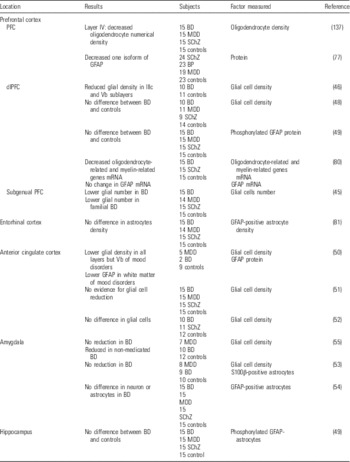
Some studies measured the density of the glial cells in the amygdala of the patients with BD and controls, but they found no difference in the glial density in the patients with BD (Reference Hamidi, Drevets and Price53–Reference Bowley, Drevets, Öngür and Price55). Interestingly, Bowley et al. (Reference Bowley, Drevets, Öngür and Price55) found glial cell reduction in the amygdala of un-medicated patients with BD. They proposed that mood-stabilising drugs such as lithium and valproate may attenuate glial reduction in the patients with BD (Reference Bowley, Drevets, Öngür and Price55). Moreover, Webster et al. (Reference Webster, Knable, Johnston-Wilson, Nagata, Inagaki and Yolken49) studied the glial reduction in the hippocampus and they reported no significant difference in the glial cell density in this region in the patients with BD. Table 1 summarises the studies that evaluated glial cells loss in different brain regions in the patients with BD.
Glial cells loss in different brain regions in the patients with bipolar disorder

BD, bipolar disorder; dlPFC, dorsolateral PFC; GFAP, glial fibrillary acidic protein; MDD, major depressive disorder; mRNA, messenger RNA; PFC, prefrontal cortex; SChZ, schizophrenia.
The results only show the condition of patients with bipolar disorder compared with control group.
An important limitation in postmortem studies is that many of them have assessed the region that was not match with the information received from the volumetric studies. Neuroimaging studies have shown grey matter volume reduction in the insula and cingulate cortex of patients with BD (Reference Ellison-Wright and Bullmore38), whereas many postmortem studies have measured glial loss or reduced glial density in the other regions like amygdala or hippocampus. Moreover, some reports showed that glial size has increased in the patients with BD (Reference Rajkowska, Halaris and Selemon46). Therefore, it can be suggested that the reduced density of the glial cells in patients with BD may be related to the increased glial size. In addition, in a study conducted by Rajkowska et al. (Reference Rajkowska, Halaris and Selemon46), the authors reported that the glial cell alteration may be layer specific. Moreover, the mean age of participants in the majority of studies was above the 40 years, whereas mood disorders are very prevalent among younger adults. Furthermore, another important limitation of almost all of the above mentioned postmortem studies is the small sample size.
Implications of the loss of glial cells in BD
There are some hypotheses about the mechanisms underlying neuronal loss in the patients with mood disorders. However, there are very limited information about the cause and mechanism of glial loss or reduced glial density in the patients with mood disorders. Therefore, the exact mechanism underlying glial loss or reduced density of glial cells in the patients with BD needs to be further elucidated. Recent studies implied that chronic stress, cytokines, excitotoxicity and oxidative stress may be involved in the glial loss in the patients with BD. It has been proposed that volume change in the patients with mood disorder may be related to the stress-induced reduction in the glial cells (Reference Czéh, Müller-Keuker and Rygula56). Cytokines such as tumour necrosis factor-α (TNF-α) can induce glial apoptosis (Reference Brietzke and Kapczinski57) and reduce glial fibrillary acidic protein (GFAP) content in the primary mouse astrocyte culture and human glioblastoma cells (Reference Murphy, Lee and Jia58). Stimulation of TNF-receptor with enhanced level of TNF-α activates apoptotic routes in the glial cells during mood episodes (Reference Brietzke and Kapczinski57). Glial cells are sensitive to the elevated levels of glutamate (excitotoxicity) and oxidative stress (Reference Dewar, Underhill and Goldberg59–Reference Danilov, Chandrasekaran, Racz, Soane, Zielke and Fiskum62). These vulnerabilities may contribute to the glial loss in the ischaemia and demyelinating diseases (Reference Dewar, Underhill and Goldberg59,Reference Sugawara, Lewén, Noshita, Gasche and Chan63,Reference Matute, Alberdi, Domercq, Pérez-Cerdá, Pérez-Samartı́n and Sánchez-Gómez64). However, the exact relationship between these factors and glial loss in the patients with BD should be determined (Reference Rajkowska65).
The impact of glial loss or reduced glial cell density in the pathophysiology of BD is not fully elucidated. Moreover, it needs to be fully clarified that the glial reduction is a reaction to the process of underlying mechanism of mood disorders or have a causative role in these disorders (Reference Bowley, Drevets, Öngür and Price55). However, some evidence shows that decreasing glial number or density may play important roles in BD. Neuronal activity is crucially dependent upon homoeostatic functions of glial cell and glial loss can damage these modulatory roles of the glial cells (Reference Bowley, Drevets, Öngür and Price55).
Glial cells express a wide range of neurotransmitter receptors such as receptors for serotonin, norepinephrine and dopamine (Reference Henn66). It has been suggested that perturbation of brain monoamine system may be an important mechanism underlying mood disorder (Reference Millan67) and impairment of monoamine neurotransmission may be related, at least partly, to the glial loss in mood disorders (Reference Rajkowska65).
In addition, glutamate activity may contribute to the neuroplasticity impairment detected in the patients with mood disorders (Reference Maeng and Zarate68). In normal condition, glutamate exerts substantial roles in the regulation of neuroplasticity, learning and memory (Reference Riedel, Platt and Micheau69). Glutamate also is the most important excitatory neurotransmitter responsible for the neurotoxicity in the CNS, which is known as excitotoxicity (Reference Maeng and Zarate68). Glial cells, particularly astrocytes, have a primary function in the regulation of glutamate level in the brain by glial transporters (Reference Anderson and Swanson70). Reuptake of glutamate by astrocytes decreases synaptic level of this excitatory neurotransmitter and protects neurons from apoptotic insults in the mixed culture (Reference Rothstein, Dykes-Hoberg and Pardo37). Astrocytes convert glutamate to the glutamine via an enzymatic reaction by glutamine synthetase and use glutamine as the source of glutamate and gamma-aminobutyric acid (GABA) for the neurons (Reference Pfrieger and Barres71). Therefore, glial loss may give rise to the perturbation of glutamate homoeostasis and enhancement of the risk of excitotoxicity in neurons in the patients with mood disorder. These functions are mainly related to the astrocytes, whereas oligodendrocytes are the other glial type which is involved in the glial loss in the patients with BD (Reference Bowley, Drevets, Öngür and Price55). Therefore, the effects of oligodendrocyte loss in BD need to be exactly clarified in the future.
Contribution of each glial type to the loss of glial cells in BD
The exact cell type responsible for the glial loss in the patients with BD is not completely clear. Some studies have suggested that astrocytes and oligodendrocytes may be the most relevant cell types in the glial cell loss in patients with BD (Reference Rajkowska and Miguel-Hidalgo14). However, recent reports imply that microglia activation but not loss may contribute to the pathophysiology of BD (Reference Hamidi, Drevets and Price53,Reference Watkins, Sawa and Pomper72).
Contribution of astrocytes to the loss of glial cells in BD
Growing evidence suggests that astrocytes have a potential role in the pathophysiology of several CNS disorders (Reference Sofroniew and Vinters73). It was demonstrated that the structure and function of astrocytes have been altered in the neuropsychiatric disorders such as neurodegenerative disorders, epilepsy, schizophrenia and mood disorders (Reference Volterra and Meldolesi74–Reference Seifert, Schilling and Steinhäuser76). Therefore, many groups have investigated the potential roles of astrocytes in the pathophysiology of mood disorders.
Johnston-Wilson et al. (Reference Johnston-Wilson, Sims and Hofmann77) showed that some isoforms of GFAP, specific markers of astrocytes, were reduced in the frontal lobe of patients with BD. Moreover, Gittins and Harrison (Reference Gittins and Harrison50) documented lower level of GFAP in the white matter of patients with mood disorder (both BD and MDD). A study conducted by Gos et al. (Reference Gos, Schroeter and Lessel78) showed that there was a reduction in S100B-immunocontent of astrocytes in the hippocampus of patients with BD and MDD. Toro et al. (Reference Toro, Hallak, Dunham and Deakin79) also demonstrated that the level of GFAP was reduced in the PFC and orbitofrontal cortex of the patients with BD compared with the healthy controls. On the contrary, some studies have not supported astrocytes role as a main glial type responsible for the glial loss in the patients with BD. In line with this, the finding of a study conducted by Tkachev et al. (Reference Tkachev, Mimmack and Ryan80) showed that there was no change in the level of GFAP in the PFC of patients with BD compared with the healthy controls. Similarly, Altshuler et al. (Reference Altshuler, Abulseoud and Foland-Ross54) found no difference in the density of astrocyte in the amygdala of the patients with BD. Another study in the entorhinal cortex in 13 patients with BD showed that there was no difference in the astrocyte density between the patients with BD and the healthy controls (Reference Damadzic, Bigelow and Krimer81). Bernstein et al. (Reference Bernstein, Meyer-Lotz and Dobrowolny82) measured the numerical density of glutamine synthetase immunoreactive-astrocytes in eight cortical and two subcortical regions of the patients with BD. However, they found no change in the glutamine synthetase immunoreactive-astrocytes in the patients with BD (Reference Bernstein, Meyer-Lotz and Dobrowolny82).
It is very hard to make a conclusion about the astrocytic loss in the brain of patients with BD. Several factors can confound the results of the studies on the glial cell loss in the patients with BD. One important factor may be the proliferative effects of the mood-stabilising drugs on the astrocytes that affect the density of these cells in the CNS (Reference Rocha and Rodnight83,Reference Rocha, Achaval, Santos and Rodnight84). Unfortunately, a majority of these studies have not reported drug effects on the GFAP or astrocyte density.
Contribution of oligodendrocytes to the loss of glial cells in BD
Oligodendrocyte is another cell type that may be responsible for the glial cell loss in the brain of patients with BD. Some studies showed that the gene expression of oligodendrocyte- and myelin-related genes has been greatly reduced and multiple transcription factors with regulatory roles on the myelin gene expression have been altered in the patients with BD (Reference Tkachev, Mimmack and Ryan80). Moreover, Uranova et al. (Reference Uranova, Orlovskaya and Vikhreva85) showed that the numerical density of oligodendrocytes in the VI layer of the PFC in the patients with BD was reduced compared with the control groups. Because the volume of brain regions was not different between groups, authors concluded that the difference should be related to the reduced oligodendrocytes numbers in the patients with BD. Similarly, follow-up studies have demonstrated a reduction of myelin staining of the dorsolateral PFC in the patients MDD and BD (Reference Regenold, Phatak, Marano, Gearhart, Viens and Hisley86). Gos et al. (Reference Gos, Schroeter and Lessel78) showed that S100B-immunocontent of oligodendrocytes was reduced in the hippocampus of the patients with BD, but it was not reduced in that of the patients with MDD. Therefore, some studies suggested that the glial cells loss in the patients with BD may be related to the oligodendrocytes abnormalities (Reference Hamidi, Drevets and Price53,Reference Uranova, Orlovskaya and Vikhreva85).
Contribution of microglia to the pathophysiology of BD
Some evidence suggests the involvement of microglia in BD. According to this theory, chronic activation of the immune system mediated by the microglia in the CNS and enhanced production of inflammatory mediators may precipitate mood disturbances (Reference Munkholm, Braüner, Kessing and Vinberg87). Moreover, it has been postulated that the enhanced release of pro-inflammatory cytokines by the activated microglia exerts debilitating effects on the neuroprotective system, thereby interfering with the pathophysiological changes in BD (Reference Rajkowska65,Reference Munkholm, Braüner, Kessing and Vinberg87). In vivo analysis of peripheral blood showed that the pro-inflammatory cytokines have increased in various phases of BD (Reference Brietzke, Stertz and Fernandes88). Moreover, Söderlund et al. (Reference Söderlund, Olsson and Samuelsson89) revealed higher level of pro-inflammatory markers in the cerebro-spinal fluids (CSF) of patients with BD. It has been shown that pro-inflammatory cytokines activate microglia and this may result in the enhanced release of glutamate from microglia and excitotoxicity (Reference Takeuchi, Jin and Wang90). Therefore, microglia activation rather than microglia loss may contribute to the pathophysiology of BD. In this line, Hamidi et al. (Reference Hamidi, Drevets and Price53) showed no significant change in the density of microglia in the amygdala of patients with BD. However, there are very limited reports in the literature about the alteration of microglia in the patients with BD.
Roles of glial cells-specific neurotrophic factors in the pathophysiology of BD
Recently, it was hypothesised that the cell loss or the reduced density of glial cells in the patients with BD may be related to the abnormalities of the neurotrophic factor (Reference Berk, Kapczinski and Andreazza91). Glial cells loss may be an important feature of BD and it is possible to assume that the abnormalities in the synthesis or release of neurotrophic factors that mainly origin form glial cells may be, at least partly, responsible for the pathologic events in the process of BD. Therefore, we discuss possible roles of some glial cells-specific neurotrophic factors in the pathophysiology and treatment of BD.
GDNF in BD
GDNF is an important neurotrophic factor for the dopaminergic neurons (Reference Lin, Doherty, Lile, Bektesh and Collins21). However, this neurotrophic factor is extensively expressed throughout the CNS (Reference Pochon, Menoud, Tseng, Zurn and Aebischer92), and produces neuroprotective effects in different neuronal populations (Reference Airaksinen and Saarma93). It has been demonstrated that GDNF has regulatory effects on the noradrenergic neurons (Reference Quintero, Willis and Zaman94) and protects against kainate-induced oxidative stress in the rat hippocampus (Reference Cheng, Fu and Guo95). Furthermore, it has been shown that GDNF can protect both neurons and glial cells against oxidative stress insults (Reference Quintero, Willis and Zaman94–Reference Gratacòs, Pérez-Navarro, Tolosa, Arenas and Alberch96).
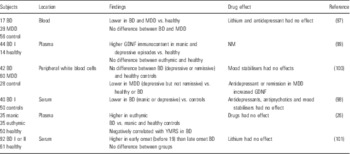
Some other studies have shown that GDNF can contribute to the pathophysiology of BD. In 2006, Takebayashi et al. (Reference Takebayashi, Hisaoka and Nishida97) studied the alteration in the level of GDNF in the Japanese patients with BD and reported that total blood level of GDNF was lower in the patients with BD I and II compared with the healthy controls. Moreover, Zhang et al. (Reference Zhang, Zhang and Sha98) evaluated a Chinese Han cohort of patients with manic and depressive stages of BD for the serum GDNF levels and their finding showed a lower level of serum GDNF in both stages of disease and an increment of this neurotrophic factor after 8 weeks of treatment with mood-stabilising drugs (Reference Zhang, Zhang and Sha98). On the contrary, Rosa et al. (Reference Rosa, Frey and Andreazza99) showed that there was a higher level of GDNF in the manic and depressive phases of Brazilian patients with BD. Moreover, Barbosa et al. (Reference Barbosa, Huguet and Sousa26) reported a higher plasma GDNF level in the euthymic patients with BD compared with the manic and healthy controls. In contrast, Otsuki et al. (Reference Otsuki, Uchida and Watanuki100) reported no alterations in the expression of GDNF messenger RNA in the peripheral blood cells in the depressive and remissive phases of patients with BD compared with the healthy controls. Tunca et al. (Reference Tunca, Ozerdem and Ceylan101) studied 92 patients with BD I and II and their finding showed that there was no difference in the serum GDNF level, whereas early onset patients (before 19) had higher serum GDNF level. Furthermore, in a study conducted by Rybakowski et al. (Reference Rybakowski, Permoda-Osip, Skibinska, Adamski and Bartkowska‐Sniatkowska102), the authors reported that there was no difference in the serum level of GDNF in the drug-responder and non-responder patients with BD. Table 2 summarises the studies which have measured the level of GDNF in the patients with BD.
Glial cell line-derived neurotrophic factor (GDNF) level in the patients with major psychiatric disorder

BD, bipolar disorder; MDD, major depressive disorder; NM, not mentioned; YMRS, Young Mania Rating Scale.
Findings related to the peripheral measures of GDNF are inconsistent (Reference Tunca, Ozerdem and Ceylan101). An important limitation of most of these studies is the ignorance of the renal function. It seems that renal impairment may affect plasma level of neurotrophic factors including GDNF. To our knowledge, only one study has reported the renal function (Reference Rosa, Frey and Andreazza99), whereas others have not reported any information about the renal condition of patients with BD. In addition, most of these studies were limited with the measurement of GDNF in the peripheral tissues, whereas it is not clear whether these peripheral changes reflect actual changes in the CNS. Previous data indicate that GDNF penetrates very poorly across the brain–blood barrier (Reference Albeck, Hoffer, Quissell, Sanders, Zerbe and Granholm103,Reference Kastin, Akerstrom and Pan104). Moreover, small sample size of these studies may be another limitation and future meta-analyses may overcome this limitation. In spite of these controversies, it has been suggested that GDNF may be a non-specific peripheral marker in different phases of BD (Reference Zhang, Zhang and Sha98,Reference Scola and Andreazza105).
S100B in BD
Another glial cells-specific neurotrophic factor that may be involved in the pathophysiology of BD is S100B. S100B is an acidic Ca+2-binding protein (Reference Schäfer and Heizmann106) which is primarily found in the CNS, especially in the cytoplasm of astrocytes (Reference Schroeter, Abdul-Khaliq, Diefenbacher and Blasig107). It regulates cell shape, energy metabolism, contraction, cell-to-cell communication, intracellular signal transduction and cell growth (Reference Zimmer, Chaplin, Baldwin and Rast108). Interestingly, the extracellular S100B can produce both pro- and anti-apoptotic effects depending on its concentration (Reference Schäfer and Heizmann106). S100B at nano-molar concentrations acts as a growth and/or differentiation factor for neurons and astrocytes, whereas at micro-molar concentrations may activate apoptotic pathways (Reference Van Eldik and Wainwright109).
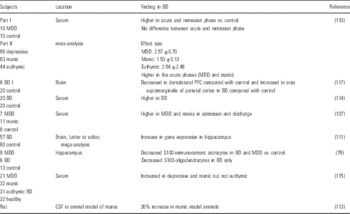
Several animal and human studies have shown that S100B has a potential role in the pathophysiology of BD. Previous studies have shown that S100B has been changed in both serum (Reference Schroeter, Abdul-Khaliq, Krebs, Diefenbacher and Blasig110,Reference Schroeter and Steiner111) and CSF (Reference Grabe, Ahrens, Rose, Kessler and Freyberger112) of the patients with mood disorder. It was also revealed in an animal model of mania, S100B increased in the CSF of rodents (Reference Machado-Vieira, Schmidt and Ávila113). Moreover, Machado-Vieira et al. (Reference Machado-Vieira, Lara and Portela114) showed that serum S100B was higher in the 16 drug-naïve patients with acute mania compared with the healthy controls. Similarly, the results of other studies confirmed the elevated level of S100B in the manic and depressive but not euthymic patients (Reference Andreazza, Cassini and Rosa115). Furthermore, a meta-analysis demonstrated that serum S100B is higher in the acute phase of mania in the patients with BD (Reference Schroeter, Abdul-Khaliq, Krebs, Diefenbacher and Blasig110). In another meta-analysis, Schroeter et al. (Reference Schroeter, Steiner and Mueller116) studied 174 patients with mood disorder and 102 healthy controls and their findings showed that both young and older patients with BD had higher levels of S100B compared with the healthy control. In addition to the peripheral levels of S100B, a postmortem study which was conducted by Dean et al. (Reference Dean, Gray and Scarr117) revealed that S100B was increased in the area supramarginalis of parietal cortex and decreased in the dorsolateral PFC of patients with BD compared with the healthy controls. As it was mentioned previously, the S100B-immunocontent of astrocytes and oligodendrocytes has decreased in the hippocampus of patients with BD (Reference Gos, Schroeter and Lessel78). However, it is not fully understood that the altered level of S100B was related to the passive diffusion from destroyed astrocytes or secretion from the activated astrocytes to repair neuronal injury (Reference Van Eldik and Wainwright109,Reference Hetzel, Moeller and Evers118). Table 3 summarises the studies which have measured S100B level in the patients with BD.
S100B level in the patients with mood disorders

BA, Brodmann area; BD, bipolar disorder; CSF, cerebro-spinal fluid; MDD, major depressive disorder.
In addition, genetic studies provide new evidence for the association of S100B with BD. The gene encoding S100B in humans is located on chromosome 21q22.3 (Reference Allore, O’Hanlon and Price119). This region shows a genetic linkage to BD (Reference McQuillin, Bass and Kalsi120, Reference Roche, Cassidy and Zhao121).Whole genome scan revealed that variants within S100B are related to BD (Reference Roche, Cassidy and Zhao121). Moreover, Dagdan et al. (Reference Dagdan, Morris and Campbell122) found that single nucleotide polymorphisms within the promoter of S100B gene are related to BD. Furthermore, a powerful whole genome gene expression studies with mega-analytic evidence has demonstrated an increase in the S100B gene expression in the hippocampus of patients with BD, but not in that of the patients with MDD (Reference Schroeter, Steiner, Schönknecht and Mueller123).
Consequently, it has been suggested that S100B may be an important factor involved in the pathophysiology of BD. However, the exact role of this neurotrophic factor in the pathophysiology of BD remains to be elucidated.
Glial cell roles in the mechanism of action of mood stabiliser drugs
Regarding the roles of the glial cells in the pathophysiology of BD, it is possible to assume that these cells may be involved in the mechanism of action of mood-stabilising drugs. Several studies have demonstrated that mood-stabilising drugs such as lithium increase the volume of brain grey matter (Reference Bora, Fornito, Yücel and Pantelis124). An magnetic resonance imaging (MRI) study has reported that chronic lithium therapy increased cortical grey matter volume (Reference Moore, Bebchuk, Wilds, Chen and Manji125) and N‐acetyl aspartate which is a marker of cell viability in the CNS (Reference Moore, Bebchuk and Hasanat126). Accordingly, it was suggested that lithium may act as a neurotrophic and neuroprotective agent (Reference Machado-Vieira, Manji and Zarate127). Some have proposed that this increase in grey matter volume may be related to the anti-apoptotic or proliferative effects of these agents on the glial cells. It has been demonstrated an increase in the GFAP (Reference Rocha and Rodnight83) and astrocytosis (Reference Rocha, Achaval, Santos and Rodnight84) in the hippocampus of rats after 4 weeks treatment with lithium. Moreover, Rajkowska et al. (Reference Rajkowska, Clarke and Mahajan128) showed that 4 weeks treatment with lithium increases the total number of glial cells and the density of astrocytes in the hippocampus, but not PFC of mice. In our previous study, we showed that chronic lithium therapy increased bcl-2, an important anti-apoptotic agent, only in the astrocytes but not in the neuronal culture (Reference Keshavarz, Emamghoreishi, Nekooeian, Warsh and Zare129). It is likely that lithium may exert glio-protective effects by promoting bcl-2 up-regulation (Reference Bowley, Drevets, Öngür and Price55) that can be possibly relevant to the therapeutic mechanism of action of this agent (Reference Moore, Bebchuk and Hasanat126,Reference Manji, Moore and Chen130). Human studies have supported glio-protective effects of mood-stabilising agents. Bowley et al. (Reference Bowley, Drevets, Öngür and Price55) showed that the two patients with BD who were not treated with lithium or valproic acid had low glial numbers that were significantly lower than either control or treated patients. They suggested that the mood-stabilising drugs may be effective in the modulation of the glial cell changes in the patients with mood disorders (Reference Bowley, Drevets, Öngür and Price55). They proposed that mood-stabilising drugs effect on the glial cells may be responsible, at least partly, for the therapeutic effects of these agents. However, their suggestion was based on only two patients and future studies may be warranted to further investigate this idea.
Regarding the glial cells-specific neurotrophic factors, especially GDNF and S100B roles in the pathophysiology of BD, it seems logical to assume that these neurotrophic factors may have important functions in the mechanism of action of mood-stabilising drugs. Our study showed that chronic lithium therapy in the therapeutically relevant concentration increased the level of GDNF in the astrocytes culture (Reference Emamghoreishi, Keshavarz and Nekooeian131). Moreover, lithium treatment has increased GDNF concentration in some cortical regions of the Flinders resistant rats (Reference Angelucci, Aloe, Jiménez-Vasquez and Mathé132). It has been reported that up-regulation of neurotrophic factors like GDNF, originated from astrocytes, may be responsible for the neurotrophic and neuroprotective effects of valproic acid (Reference Chen, Peng and Li25). In contrast, it was shown that acute or chronic lithium treatments did not change GDNF protein expression in the brain of rat (Reference Fukumoto, Morinobu, Okamoto, Kagaya and Yamawaki133), spinal cord-derived progenitor cells (Reference Su, Chu and Wu134) and neural precursor cells (Reference Qu, Sun and Young135). Moreover, human clinical studies have shown no relationship between the serum level of GDNF and mood-stabilising drugs (Reference Takebayashi, Hisaoka and Nishida97,Reference Otsuki, Uchida and Watanuki100).
As mentioned above, there are some inconsistencies in the effects of mood-stabilising drugs on the GDNF. However, regarding the in vitro and animal studies, these differences may be related to different setting of experiments (cell culture vs. animal model or various animal models that were employed). Moreover, to our knowledge, there is no controlled clinical trial in the literature that specifically assessed the effects of mood-stabilising drugs on the level of GDNF and there is no established relationship between CNS and the serum level of GDNF.
There are few investigations on the lithium effects on the S100B. Chronic lithium therapy does not increase S100B in the rat primary astrocytes culture (Reference Emamghoreishi, Keshavarz and Nekooeian136). Human studies reported that there is no relationship between mood-stabilising drugs and the serum level of S100B (Reference Schroeter, Abdul-Khaliq, Diefenbacher and Blasig107). Currently, it is impossible to draw any conclusive comment about the relationship of the glial cells-specific neurotrophic factors and the mechanism of action of the mood-stabilising drugs. However, future studies may be warranted to further investigate the possible roles of these neurotrophic factors in the mechanism of action of mood-stabilising drugs.
Consequently, it seems that glial cells may be important mediators for the action of mood-stabilising drugs. However, future controlled trials may shed more light on the contribution of these cells in the mechanism of action of these agents.
Future direction and concluding remarks
Some postmortem studies, but not all, have shown that there is a loss of glial cells or decreased in the glial density in some layers of PFC and ACC, but there is no difference in other regions of brain including entorhinal cortex, amygdala and hippocampus in the patients with BD. Astrocytes and oligodendrocytes may be the most important glial types which are responsible for the glial reduction in the brain of patients with BD. However, it seems necessary to assess the loss of glial cell in the regions that were established with neuroimaging studies. Furthermore, some studies have shown the alteration of the glial cells-specific neurotrophic factors (GDNF and S100B) in the different phases of BD. However, it is necessary to evaluate relationship between plasma and central levels of these neurotrophic factors. In addition, glial cells, at least partly, may mediate therapeutic effects of mood-stabilising agents in the treatment of BD.
Acknowledgements
The author would like to sincerely acknowledge Dr. Masoumeh Emamghoreishi for her guidance. Moreover, the author also thanks Mrs. Gholami for revising the manuscript.
Conflicts of interest
None.