1. Introduction
Since the seminal 1994 World Bank publication that proposed a multi-pillar conceptual social security framework, this blueprint has become widely accepted in many countries around the world. The notion of establishing multiple sources of savings or income for retirement within the pension system in lieu of a single state-run pension scheme has merits. In particular, multi-pillar designs that contain some funded element or mandatory pre-funding is perceived as attractive to policymakers because it can increase long-term saving, foster capital market deepening, and boost economic growth (World Bank, 1994; Müller, Reference Müller2008). At the same time, transferring substantial parts of retirement income provisions from the public sector to the private sector may help to address fiscal unsustainability amidst the backdrop of rapidly aging populations, as well as accelerate financial market development. The higher expected economic growth, in turn, may ease some of the transition costs associated with the reform (Holzmann, Reference Holzmann2013).Footnote 1
In this study, we focus on pension reforms characterized by the introduction of a new second pillar scheme in the economy. Our definition of second pillar schemes adheres to the World Bank's classification schema: such schemes are mandatory, fully funded, occupational or private contributory plans that are managed almost wholly by the private sector.Footnote 2 Combining data from the World Bank and the Quality of Government standard dataset, we construct a new dataset of close to 100 medium to large economies around the world for the period 1980–2012. Determinants of the speed of reforms are analyzed using duration analysis methods. Given rapid population aging and escalating concerns over the sustainability of public pensions, the question of what drives structural pension reforms is of interest to policymakers and pension administrators who oversee such regimes. The results may also be of interest to individuals and retirees who rely on their pension assets to finance their retirement.
Our study builds on intersecting strands of the literature from the fields of political economics and pension economics that have examined reforms or regulatory changes in pension systems and why reform efforts have succeeded or failed. A number of studies, for example, highlight the importance of political factors such as political ideology, fiscal federalism, degree of democratization, and chief executive constraints (Levy, Reference Levy2002; Mesa-Lago and Müller, Reference Mesa-Lago and Müller2002; Hering, Reference Hering2006; Spruk and Vebic, Reference Spruk and Vebic2016). Other studies point to the role of macroeconomic factors including economic stagnation (Jensen and Richter, Reference Jensen and Richter2004), debt levels (James and Brooks, Reference James, Brooks, Holzmann and Stiglitz2001), globalization pressures (Lesay, Reference Lesay2006; Brooks, Reference Brooks2007a), as well as business cycles (Beetsma et al., Reference Beetsma, Romp and van Maurik2017). Prior studies have also deliberated the role of economic crisis (Müller, Reference Müller2003); demographic aging (Góra, Reference Góra2013); influence by international organizations such as the World Bank and the International Labor Organization (Müller, Reference Müller2001; Brooks, Reference Brooks2005; Orenstein, Reference Orenstein2005); and pension contribution volatility (Clair and Guzman, Reference St. Clair and Martinez Guzman2018).Footnote 3
Yet the large majority of these studies are narrative and descriptive in nature. Few studies have sought to econometrically assess the direct effects of various factors on pension reform likelihood and reform outcomes. One exception is Spruk and Vebic (Reference Spruk and Vebic2016) who examine the political and institutional factors influencing pension reforms in 34 countries and finds that countries with greater political competition and fiscal federalism are significantly more likely to reform. Also employing panel data analysis methods, Beetsma et al. (Reference Beetsma, Romp and van Maurik2017) examine pension reforms in 23 OECD countries over the period 1970–2013 and find that business cycle indicators play a substantial role in explaining the expansion and contraction of pension arrangements. Nevertheless, the definition of ‘reform’ in both these studies centers on changes in old-age social security legislation to facilitate changes in pension schemes rather than actual structural reforms to a social security system per se, as evaluated in this present study.
Brooks (Reference Brooks2005) considers pension reforms of a nature that is closest to our paper. Specifically, that study's definition of reform is whether a country adopted some degree of pension privatization in its mandatory national social security system in the likes of that implemented by the Chilean government in around 1980.Footnote 4 Using data from 59 countries over 1980–1999 and duration analysis methods, Brooks (Reference Brooks2005) finds that the decision to privatize pensions in one country is systematically linked to corresponding decisions made by governments in relevant peer nations, especially in Eastern European and Central Asian nations.Footnote 5 Countries which are richer (as measured by trade exposures and foreign direct investment), more demographically matured, and have greater democratic freedom are also more likely to adopt pension privatization reform.Footnote 6 In a follow-up study, Brooks (Reference Brooks2007b) further evaluates the role of peer diffusion in explaining pension privatization reform as compared to notional defined-contribution pension reform.
Our study similarly adopts a duration analysis approach to explore the determinants of second pillar pension reforms. Event history analysis offers a richer analytical framework than simple panel data analysis because it takes into account the speed of event occurrence, in addition to the likelihood of event occurrence (see, e.g., Clair and Guzman Reference St. Clair and Martinez Guzman2018). In a departure from Brooks (Reference Brooks2005, Reference Brooks2007b), however, we use the mean values of time-varying independent variables rather than their annual values in the panel.Footnote 7 We opine that structural pension reforms – being fundamental shifts in the way a social security system functions and operates – are likely to involve an extended policy decision and legislation process. Consequently, annual variations in factors such as inflation and gross domestic product (GDP) have little to bear on whether a country implements a second pillar reform in that respective year. Our analytical strategy also reduces the risk of having atypical values from some particular year influence the results. Importantly, the use of average values of explanatory variables is consistent with other economics-based empirical studies on institutional reforms: for example, Berggren et al. (Reference Berggren, Daunfeldt and Hellström2016) employ the mean values of explanatory variables in studying the determinants of central-bank independence reforms.
Our paper contributes to the literature in two other ways. First, our dataset is more extensive than those used in prior studies. The data combine data from the World Bank and the Quality of Government standard datasets and includes close to 100 medium to large economies in different geographical regions around the world. In addition, it spans a relatively long observation period from 1980 to 2012. More than a quarter of the countries in the dataset implemented a second pillar reform during the observation window. Second, we explicitly account for the role of economic crisis and globalization in influencing pension reforms. While several scholars (e.g., Müller Reference Müller2003; Holzmann Reference Holzmann2013) provide useful qualitative discussions on how economic and financial crisis may have spurred pension privatization in Latin American and Europe over the last two decades, this variable has been omitted in previous empirical studies on pension privatization reforms. Likewise, the impact of global pressures on pension reforms remains largely empirically untested. To the best of our knowledge, our paper is the first to econometrically assess the impact of economic crisis and different facets of globalization on second pillar reforms.
The remainder of the paper is organized as follows. Section 2 provides an overview of second pillar pension reforms worldwide and the importance of such reforms. Section 3 presents the data and methodology. It also outlines testable hypotheses regarding the role of economic crisis and globalization in influencing pension reforms. Section 4 evaluates the effect of various determinants on time until a second pillar pension reform is implemented. Sensitivity analysis is also presented. The last section concludes.
2. Background
2.1 Pension reform landscape
The World Bank's proposed classification system comprises a combination of five basic elements: (i) a non-contributory ‘zero pillar’ social assistance scheme that provides a minimal level of protection; (ii) a ‘first pillar’ contributory scheme that is linked to varying degrees to earnings and seeks to replace some portion of income; (iii) a ‘second pillar’ that typically comprises individual savings accounts that are mandatory; (iv) a voluntary savings-based ‘third pillar’, and (v) a non-financial ‘fourth pillar’ comprising access to formal social programs and informal support. In characterizing the nature of risks under each element, Holzmann and Hinz (Reference Holzmann and Hinz2005) note that second pillar schemes can better insulate individuals from political risks than first pillar schemes since the former are privately-managed while the latter are publicly-managed.Footnote 8 The downsides of second pillar schemes, however, are the risks of financial market volatility and higher transaction costs.
An important reason for focusing on second pillar schemes – and their implementation in a country's social security system – is because the second pillar represents a unique component in the multi-pillar pension model. Its two key features – namely, mandatory pre-funding and private sector participation – distinguishes it from the other pension pillars. Based on World Bank's definition, second pillar schemes are rolled out on a mandatory basis meaning they are to be made compulsory for workers. This contrasts with the third and fourth pillars which are both voluntary in nature. The fact that second pillar schemes are wholly managed by the private sector also differentiates it from the zero pillar and first pillar, both of which are managed by the public sector or governmental agencies.
The UK and the USA are among the countries classified by the World Bank as having a first pillar but no second pillar.Footnote 9 Another country that falls into the same category is Singapore, which hosts one of the world's oldest government-run defined-contribution national provident fund schemes. By contrast, Hong Kong (PRC) and Australia are classified as having a second pillar and no first pillar. Both these countries have privately-managed mandatory occupational retirement schemes that are defined-contribution in nature. In Hong Kong's Mandatory Provident Fund, for instance, employers and employees contribute to plan funds which are managed as trusts and investment decisions are delegated to trustees in the private sector. Countries classified as having both first and second pillars by the World Bank include Armenia, Estonia, Ghana, Norway, Peru, and Sweden.
Second pillar schemes are predominantly based on defined-contributions arrangements, that is, the pension monies accumulated depends on contributions and the interest earned on them.Footnote 10 The second pillar may be instituted as the main scheme in a pension system to substitute a public scheme (e.g., Australia and Chile), or as a complement to other existing pension pillars (e.g., Switzerland and Poland). Fundamentally, the implementation of a second pillar constitutes a structural reform to a country's social security system because it often results in a systemic shift in the way that pensions are financed (from pay-as-you-go (PAYG) financing to fully-funded) and/ or change in the way accrued retirement benefits are paid out (from defined-benefit to defined-contribution). This is unlike non-structural reforms which mostly involve changing the parameters of an existing scheme such as raising contribution rates, cutting back on too generous benefits, reducing administrative expenditures, and making entitlement conditions stricter, among others (see, e.g., Chłoń-Domińczak Reference Chłoń-Domińczak2018).
2.2 Reforming countries over 1980–2012
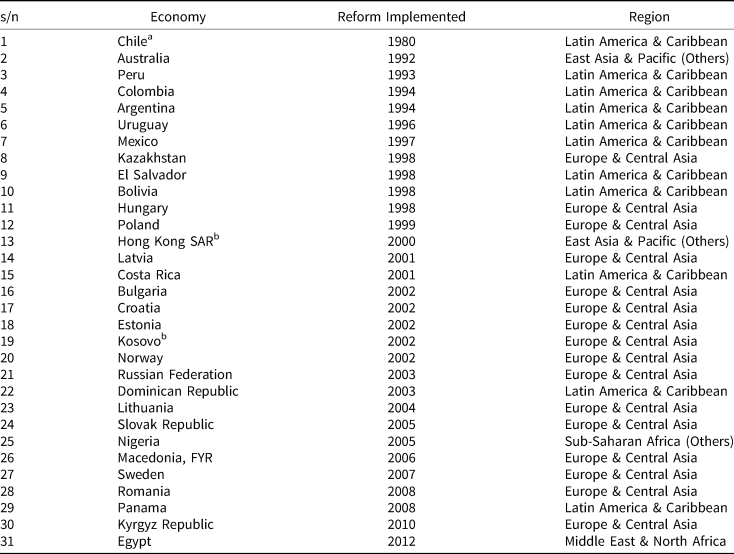
Data on year of implementation of second pillar schemes is sourced from the World Bank Pension Database. The database contains rich information on pension systems for more than 180 countries around the world, including the types of retirement income schemes by country, pension pillars, contribution rates over time, scheme design parameters, coverage of beneficiaries, amount of pensions spending, etc. As of 2013, there are 30 economies identified in the database as having an existing second pillar defined-contribution scheme. From Pallares-Miralles et al. (Reference Pallares-Miralles, Romero and Whitehouse2012) and related studies, we uncover another three economies that had similar schemes back in the 1990s but which are now closed. These are namely, Argentina, Bolivia and Hungary. After excluding Ukraine and Ghana due to missing data,Footnote 11 we have a total of 31 countries for which the year of implementation of second pillar pension reform is available (see Table 1).
Countries which implemented second pillar defined-contribution schemes

Source: World Bank (2014).
a Chile is not in the sample as it defines t = 0.
b These countries are excluded from the sample due to several missing explanatory variables; see text.
Figure 1 displays the cumulative number of countries with second pillar defined-contribution schemes worldwide over the last three decades. Chile is the first country to implement a second pillar reform. Specifically, in 1980–1981, the Chilean government under the Pinochet dictatorship dramatically reformed its retirement system by replacing its insolvent PAYG defined-benefit system with a fully-funded mandatory individual savings accounts scheme. Workers are required to contribute about 10% of their monthly earnings, up to a maximum of 60 Unidades de Fomento (approximately US$2,400) per month to their individual accounts (Mittelstaedt and Olsen, Reference Mittelstaedt and Olsen2003).Footnote 12 The acceptance by the democratic government in Chile of the new system, together with the excellent economic performance of Chile in the late 1980s and early 1990s, conferred legitimacy on the pension privatization model. In fact, the second pillar reform is credited to have played a key role in boosting savings, investment, employment and growth in the economy, which helped lift Chile out of poverty (Huber and Stephens, Reference Huber and Stephens2000; Brooks, Reference Brooks2005; Holzmann, Reference Holzmann2013).
Evolution of number of countries with second pillar schemes as of 2012. Source: Authors’ own constructed based on data from the World Bank (2014).

The Chilean pension model became a shining example held up by international organizations like the World Bank for other countries to emulate. Not surprisingly, the Chilean experience spurred similar reform attempts in neighboring Latin America countries over the 1990s and 2000s. These include Peru (1993), Argentina (1994), Colombia (1994), Uruguay (1996), Mexico (1997), Bolivia (1998), El Salvador (1998), Costa Rica (2001), Dominican Republic (2003), and Panama (2008). By the late 1990s, policy enthusiasm towards pension privatization had spread to Europe and Central Asia as well. Countries which introduced second pillar schemes include Poland (1999), Latvia (2001), Bulgaria (2002), Estonia (2002), Norway (2002), Slovak Republic (2005), Sweden (2007), and Kyrgyzstan (2010). For many countries in that region at that time, the adoption of varying degrees of private pension provision through individual retirement accounts was viewed as attractive given the strained finances of generous public pension systems against the backdrop of demographic aging (Müller, Reference Müller2001, Reference Müller2003; Schludi, Reference Schludi2005).
2.3 Testable hypotheses
An objective in this study is to econometrically assess the role of two factors – economic crisis and globalization – on pension reforms. Both factors have been labeled as key drivers of pension privatization reforms in recent qualitative literature on structural pension reforms, but it is unclear if these factors are significantly associated with time to second pillar reforms given other confounding variables. In this sub-section, we provide a review of relevant literature to extract the main testable hypotheses for economic crisis and globalization. We then elaborate on the measures for these main explanatory variables in Section 3.
Crisis as a catalyst for reform activity and financial liberalization, or the so-called crisis-induced reform hypothesis, is well-documented in the literature (Drazen and Easterly, Reference Drazen and Easterly2001; Abiad and Mody, Reference Abiad and Mody2005; Agnello et al., Reference Agnello, Castro, Jalles and Sousa2015). More specifically, in the context of old-age pensions and retirement systems, severe economic turmoil may spur reform in several ways. During a crisis, the option to transfer substantial parts of retirement income provisions from the public sector to the private sector becomes more attractive to policymakers because it is viewed not only as a means to alleviate the growing public pension burden (Mesa-Lago, Reference Mesa-Lago1993; Gronwald, Reference Gronwald2012), but also as a signal to external investors that the economy is committed to fixing its structural weaknesses (Müller, Reference Müller2003). In addition, the economic crisis may result in shifts in the constellation of political actors in the pension reform arena. According to Mesa-Lago and Müller (Reference Mesa-Lago and Müller2002), Ministries of Finance (which are often staffed by more liberal economists) tend to gain relative power over Ministries for Social Policies and this shift in political power dispersion is generally favorable for pension privatization reforms.
Another variable that has been closely linked to second pillar reforms in the existing literature is the rate of globalization. Globalization growth is the speed that markets for goods, capital, and services are integrated internationally. Brooks (Reference Brooks2007a), for example, outlines the influence of economic integration and global pressures (partially from international financial institutions like the World Bank) on pension reform agendas in the Latin American region in the 1990s. Economic liberalization, in particular, may act as a restraint on governments such that they are no longer able to finance extensive social security safety nets. From a macro perspective, market-oriented reforms tend to send a credible policy signal to investors that a country is ‘playing by market rules’. The weaker bargaining power of low-skilled labor stemming from economic globalization may also create an opportune timing for the shift from state-run PAYG defined-benefit pension schemes to private-run defined-contribution schemes.
We note that globalization is a multi-faceted phenomenon that incorporates economic, political, and social dimensions (see Dreher Reference Dreher2006; Dreher et al., Reference Dreher, Gaston and Martens2008).Footnote 13 The empirical analysis in Brooks (Reference Brooks2007b), however, only accounts for the economic globalization dimension as captured by foreign direct investment and trade flow measures. Accordingly, it is valuable to include all dimensions of globalization growth in our analyses to better assess the effect of individual globalization subcomponents on pension reforms. In particular, we hypothesize that increased political globalization – in form of joining international organizations or signing international treaties – likely will result in external bodies exerting more ‘soft power’ on governments to implement economic reforms, including those of the pension system. It is also possible that increased social globalization may lead to increased pension reform pressures since voters are exposed to greater information flows and exchanges with foreign countries.
Given the above discussion, our main hypotheses in this study are that economic crisis and overall rate of globalization will accelerate the time to second pillar reforms. Additionally, we expect the negative relationship between globalization and time until reform to hold for all three facets of globalization. Nevertheless, it is an empirical question which facet (economic, political or social) plays the most prominent role.
3. Methods
3.1 Sample and empirical approach
Our dataset spans the period 1980–2012. The initial sample comprises a total of 98 countries with GDP per capita (in constant 2005 US$) of at least $670 in 1980. This threshold reflects Egypt's GDP per capita in 1980, which is the lowest among the list of reforming countries identified per Table 1. After excluding Hong Kong (PRC) and Kosovo for which data on several key variables are lacking, our final analytical sample comprises 96 countries. Of these, 28 economies implemented a second pillar defined-contribution scheme during the observation period. In other words, almost one-third of the subjects in the sample are reforming countries.
A duration analysis approach is used to model the time to implementation of a second pillar reform. Survival time (or time at risk) is therefore the time to the occurrence of a reform and is measured in years. Various approaches can be used to analyze survival data. While the Cox proportional hazard model allows one to fit survival models without knowing or assuming the distribution of survival time, it is a semiparametric method which fits the coefficients of the hazard function using partial likelihood. In comparison, if one is willing to assume a parametric form for the distribution, then fully parametric models can be fitted to the data and estimated using maximum likelihood. The parametric family of survival models, conditional on a suitable distributional assumption, is thus considered to be more efficient than the Cox proportional hazard model (Kalbfleisch and Prentice, Reference Kalbfleisch and Prentice2011). Accordingly, we utilize the parametric approach and implement survival models of the accelerated failure time (AFT) type.Footnote 14
In the AFT model, we measure the direct effect of the explanatory variables on the survival time. The survival time variable T is modeled, on the log scale, directly in terms of the explanatory variables x. Formally, the log-linear form of the AFT model with respect to time is expressed as:
 $$\log T_i = \alpha + \beta _1x_1 + \beta _2x_2 + \cdots + \beta _nx_n + \sigma \varepsilon _i$$
where T i is survival time for country i, α is intercept, x i are the regressors, β i are the coefficients to be estimated, σ is a scale parameter, and ε i is the error term. The members of the AFT model class include the exponential model, Weibull model, log-logistic model, log-normal model, and gamma model. We use standard statistical criteria to determine the optimal distribution of survival time in our data. The estimated coefficients  $\hat{\beta} _i$ measure the effect of the correspondent covariate on the mean survival time. Specifically, a positive coefficient implies that this covariate prolongs the time to reform, while a negative coefficient indicates that this covariate shortens the time to reform (or accelerate the reform). Results from the AFT models thus informs about the effect of various factors on the speed of second pillar reforms.
3.2 Dependent variable
The dependent variable, being log T in Equation (1), is the log of the survival time. Countries which did not implement a reform as at the end of the observation period (being, 2012) are treated as censored. So for a non-reforming economy (event = 0), survival time is the difference between 2012 and the year of origin. For a reforming economy (event = 1), survival time is given by the difference between the year of reform and the year of origin. The choice of the year of origin, that is t = 0 in duration analysis, requires judgment. For our purposes, a suitable year of origin is 1980 which is the year that Chile implemented the first-ever second pillar pension scheme and before which such reform may not have been thought possible. Furthermore, the fact that the Chilean model is often held up as an exemplar for other countries suggests that 1980 is a defining moment in second pillar reform event time history and is an appropriate starting point in our context. Thus the default year of origin is set at 1980.
For certain economies in Europe and Central Asia, however, 1980 is not a suitable year of origin. These are former Communist countries which existed as centrally planned economies up to the late 1980s and would not have had the option to implement a second pillar scheme during the Communist era. There are 24 transition economies in our sample, including the former Soviet Union and Eastern bloc countries of Europe which transited from a centrally planned economy to a market economy mostly around 1992 after the fall of the Iron Curtain. For these transition economies, a more suitable year of origin is the year the country gained independence. For example, the year of origin employed for Croatia, Russia, and Lithuania is 1992 while that for Hungary and Poland is 1989. This adjustment for transition economies allows for a more accurate representation of economic events in our analyses, and ensures that the onset of risk is set at the point that an economy actually has the option to undertake a second pillar reform.
3.3 Independent variables
Our main explanatory variables of interest are economic crisis and rate of globalization. We consider two alternative measures for severe economic crisis: (i) extreme inflation, and (ii) negative growth in real GDP. Following Drazen and Easterly (Reference Drazen and Easterly2001), we define extreme inflation as a situation where a country experiences mean annual inflation rate above 100% and the indicator variable is set to one.Footnote 15 The variable for negative growth is the number of years in which the growth rate in real GDP is less than −0.2% as a proportion of total years at risk. The threshold value of −0.2% is derived from Bjørnskov (Reference Bjørnskov2016) and is more appropriate than a simple 0% threshold since imprecise measurement of national accounts in some countries may often result in a 0% GDP growth. The measure for overall globalization growth is the traditional KOF Index of Globalization which incorporates economic, social and political dimensions and is sourced from Dreher (Reference Dreher2006). In addition, we use the KOF sub-indices as the measures for the subcomponents of globalization growth.
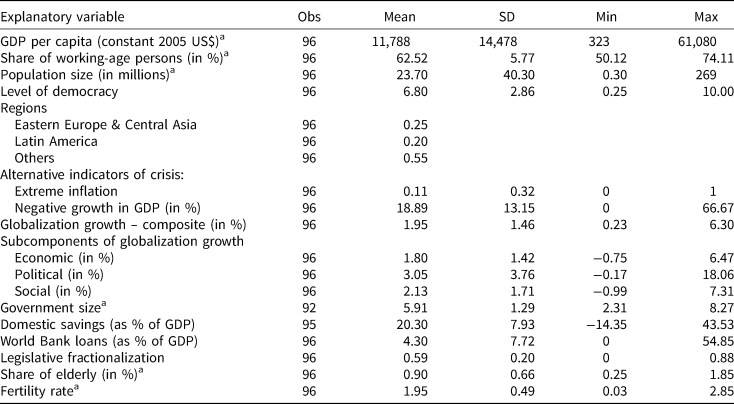
The control variables used in the analysis comprise a representative set of economic, political and cultural factors derived from previous studies on pension reforms. GDP per capita and population size capture economic development and the size of a country, respectively. The share of working-age persons (15–64 years) controls for the urgency to reform traditional PAYG pension systems. A higher share of the working population is conducive for having a sustainable PAYG system in force and should delay pension reform.Footnote 16 Since a higher level of democracy increases the likelihood of economic liberalization and deregulation (Giuliano et al., Reference Giuliano, Prachi and Spilimbergo2013), we hypothesize that democratic societies will have a shorter time to reform. Following Brooks (Reference Brooks2005), we also include dummy variables to control for regional groupings: Latin America nations; Eastern Europe and Central Asia (EECA) nations; and others. Data are mainly sourced from the Quality of Government standard dataset 2016 (Teorell et al., Reference Teorell, Dahlberg, Holmberg, Rothstein, Khomenko and Svensson2016). Table 2 provides descriptive statistics of the main explanatory variables and other covariates.
Descriptive statistics

a Explanatory variables which enter regression in logged form; see text. The full sample is N = 96. Mean values are calculated over the time being at risk of reform, i.e., for reforming countries (event = 1), the average is taken from the first year at risk until the year prior to reform. For non-reforming or censored countries (event = 0), the mean is taken from the first year at risk until the year prior to censorship. Data are sourced from the Quality of Government standard dataset 2016 (Teorell et al., Reference Teorell, Dahlberg, Holmberg, Rothstein, Khomenko and Svensson2016) unless otherwise stated. Share of working-age persons refers to persons age 15–64 as a percentage of total population. Level of democracy ranges from 0 to 10, with 0 least democratic and 10 most democratic. Indicator variables are used for regions and extreme inflation. Negative growth in GDP is the number of years in which the growth rate in real GDP is less than −0.2% as a proportion of total years at risk. Globalization growth indexes are expressed in % terms. Government size is measured using the Fraser Institute's index (range 0–10), where a higher index value represents a smaller size government. Legislative fractionalization is the probability that two deputies picked at random from the legislature will be of different parties (range 0–1). Share of elderly refers to persons age 65 and older as a percentage of total population. Fertility rate measures the number of births per woman.
Given the number of observations in the sample (N = 96), we start with a parsimonious model which comprises the seven key explanatory variables identified above: GDP per capita, population size, share of working-age persons, democracy, regional dummies, crisis, and globalization growth. Subsequently, in the sensitivity analysis, we explore whether the inclusion of other known variables that influence pension reform likelihood affect the base results. These other factors include World Bank loans (as a percentage of GDP), legislative fractionalization, government size, domestic savings, and fertility rate. The relevance of World Bank loans to pension reforms has been discussed in Brooks (Reference Brooks2005) and Holzmann (Reference Holzmann1999). Conditions under which such loans are granted may shape public policies in recipient countries, especially in developing nations. High legislative fractionalization may lead to a stalemate in political decisions delaying various economic reforms, including pension reforms (Agnello et al., Reference Agnello, Castro, Jalles and Sousa2015). The impact of government size on reform speed is, a priori, ambiguous. On the one hand, larger governments are more likely to recognize the urgency for market-based reforms such as pension privatization reforms. On the other hand, larger governments may be less inclined to cede political power over pension systems. Since funded defined-contribution schemes are generally perceived as a means of increasing future savings, low levels of domestic savings tend to prompt pension reforms (James and Brooks, Reference James, Brooks, Holzmann and Stiglitz2001). Higher fertility rate may suggest the existence of a greater number of future earners to support the system. Lastly, for completeness, we test whether the regression results are robust when the share of working-age persons variable is replaced by an alternative share of elderly (age 65+) in the population variable.
As discussed earlier, our analytical strategy uses the mean values of time-varying explanatory variables rather than their annual values. For reforming countries (event = 1), the average is taken from the first year at risk until the year prior to reform. For non-reforming countries (event = 0), the mean is taken from the first year at risk until the year prior to censorship. Independent variables with strictly positive values enter our regressions in logged form.Footnote 17 Finally, we perform a sensitivity check for variation in the empirical methodology. We re-run the regression for our base model using the Cox-estimator in lieu of the AFT-estimator. Although the Cox proportional hazard model produces less efficient estimates than the AFT model, it avoids distributional assumptions about the baseline hazard. This robustness check further serves to provide a validation of our main results from the AFT regressions.
4. Results
4.1 Main results
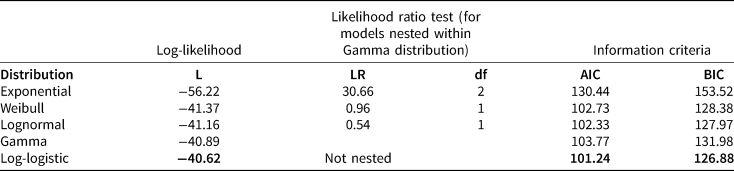
Table 3 compares the various distributions of survival time under AFT-type models using statistical criteria. Models nested within the gamma model can be compared using the likelihood ratio (LR) test. According to the LR test, the log-normal model fits better than the exponential and Weibull models. Nonetheless, the LR test cannot be applied to non-nested models. In this case, we use Akaike and Bayesian information criteria to compare across a broader cross-section of models. The log-logistic AFT model has the smallest AIC and BIC values, which suggests it is the most suitable model in our context. Since the AIC values for the log-normal, gamma, and log-logistic models are quite close, we further check the goodness-of-fit of the model using Cox-Snell residual plots.Footnote 18 Visual checks of the plots confirm that the log-logistic AFT model provides the best fit. Thus the AFT estimation results that follow are based on the log-logistic distribution of survival time.
Model selection indices for different parametric distributions

df, degrees of freedom; AIC, Akaike information criterion; BIC, Bayesian information criterion.
Only models nested within the gamma model can be compared using the likelihood ratio (LR) test; see text. The explanatory variables included are GDP per capita, population size, share of working-age persons, democracy, regional dummies, crisis and globalization growth. The values indicating best fit under each test are marked in bold.
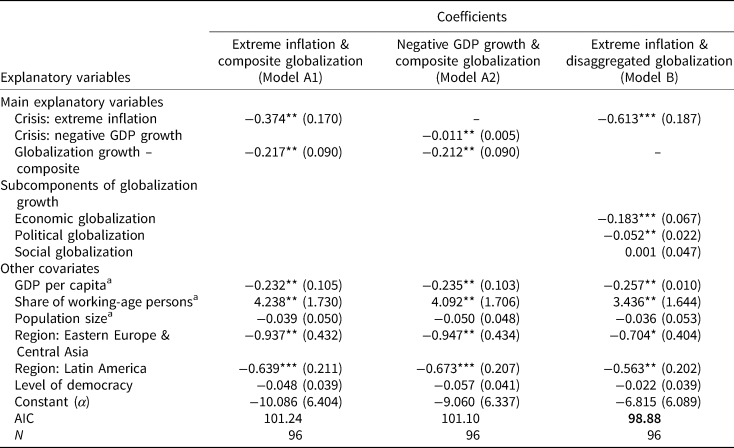
Table 4 presents the regression results from two different specifications of the log-logistic AFT model. One specification uses the composite globalization growth variable (model A), and another specification that the sub-components of globalization growth (model B). Three main conclusions are worth highlighting. First, the results demonstrate that crisis is a key determinant of pension reform regardless of model specification. In each specification (A) model, the negative coefficient for crisis is significant at the 5% level which means crisis shortens time to reform. We can also derive the magnitudes by exponentiating the coefficient estimates. The crisis coefficient of −0.374 in model (A1) is interpreted as follows: the meantime to reform for an economy with high inflation is about 69% [=exp(−0.374)] that of a country without high inflation, all else equal. If the crisis is defined as negative growth in real GDP instead as per model (A2), the positive relationship between crisis and reform speed still holds. A one percentage point increase in the negative growth rate reduces time to reform by 1%.Footnote 19
Effect of selected covariates on time to pension reform

*p < 0.10, ** p < 0.05, *** p < 0.01.
aExplanatory variables which enter regression in logged form; see text. Standard errors are shown in parenthesis.
AIC, Akaike information criterion. The lowest AIC value across models is marked in bold.
The estimated coefficients are based on the log-logistic AFT model and measure the effect of the correspondent covariate on the mean survival time. A positive coefficient implies that the covariate prolongs the time to reform, while a negative coefficient indicates that the covariate shortens the time to reform; see text.
Second, we find evidence that greater globalization growth hastens second pillar pension reforms and that this explanatory power stems mainly from the economic and political dimensions of globalization. In each specification (A) model, the negative coefficient for globalization growth is significant at the 5% level. A one percentage point increase in overall globalization growth reduces time to reform by approximately 20%. Model (B) estimates the individual effects of economic, political, and social globalization growth on reform speed. Economic and political globalization growth have strong independent effects controlling for other confounding factors; a one percentage point increase in economic globalization and political globalization reduces time to reform by 18% and 5%, respectively. Social globalization is statistically insignificant. Note that model (B) is associated with a lower AIC value than specification (A) models which implies it is more informative.
Finally, turning attention to the other covariates, we see that pension privatization reform tends to be faster in richer countries (higher GDP per capita) and in countries with a smaller share of working-age persons. A 1% increase in GDP per capita reduces time to reform by 0.26% while a 1% increase in the share of working-age persons prolongs time to reform by 3.44%. Not surprisingly, time to reform is significantly shorter in the Latin America region and the Eastern Europe & Central Asia region, a result that is broadly consistent with our earlier review of the pension reform landscape and Brooks (Reference Brooks2005). By contrast, population size and level of democracy are statistically insignificant in our model.
4.2 Sensitivity analyses
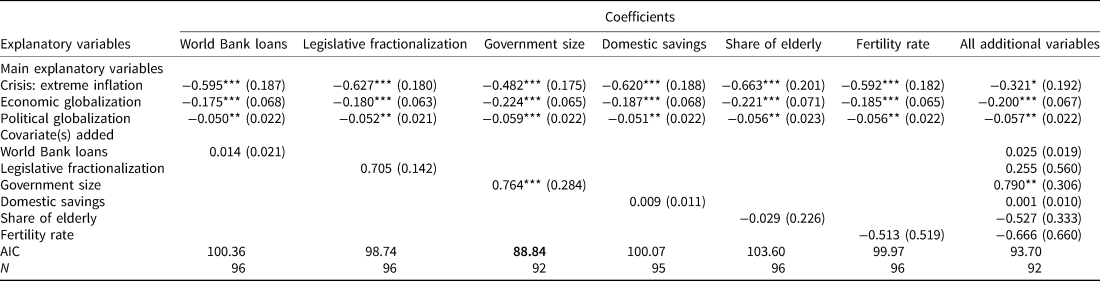
We perform two sensitivity checks. The first sensitivity check explores whether our results are affected by the inclusion of other known variables that influence pension reform. To do so, we add World Bank loans, legislative fractionalization, government size, domestic savings and fertility rate one at a time into model (B). Table 5 shows that the main results are robust to the singular or joint addition of the new variables; the signs and magnitudes of the coefficients for crisis and globalization (economic and political) remain similar. Also, the additional variables are statistically insignificant except for government size. Government size has a coefficient of 0.764 significant at the 1% level. A larger index value for the government size variable corresponds to smaller-size governments. Thus the interpretation is that smaller-sized governments prolong time to reform, possibly because they face less urgency to conduct market-based reforms as government influence is low.Footnote 20 In other words, countries with large governments are more inclined to implement pension privatizations. Our finding that World Bank loans have no significant impact on pension reform activity is broadly consistent with Brooks (Reference Brooks2005). Similarly, the insignificant impact of the level of domestic savings on pension reform is consistent with James and Brooks (Reference James, Brooks, Holzmann and Stiglitz2001).Footnote 21 The regression results also remain robust when the share of elderly (age 65+) variable is used in lieu of the share of working-age persons variable.
Robustness checks: additional explanatory variables

*p < 0.10, **p < 0.05, ***p < 0.01. Standard errors are shown in parenthesis.
AIC, Akaike information criterion. The lowest AIC value across models is marked in bold.
This robustness check explores whether the effects of crisis and globalization are affected by the inclusion of other known variables that influence pension reform. In the first six columns, the new variables are added one at a time into the base model (i.e., model (B) in Table 4). In the last column, the new variables are added jointly into the base model. The variable for government size is measured using the Fraser Institute's index (range 0–10), where a higher index value represents a smaller size government. The estimated coefficients are based on the log-logistic AFT model and measure the effect of the correspondent covariate on the mean survival time. For brevity, the effects of the other explanatory variables, including GDP per capita, population size, share of working-age persons, democracy, regional dummies, and social globalization growth are not shown. The regression results for the ‘share of elderly’ column, however, omits the share of working-age persons variable so as to avoid multicollinearity.
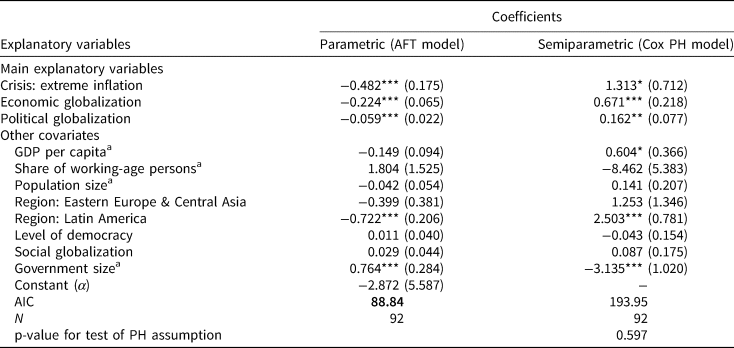
We adjust our base model (B) at this point by adding in the government size variable.Footnote 22 The full results from our revised base model are shown in the first column of Table 6. The coefficient of −0.482 for crisis implies that the mean time until reform for an economy with high inflation is about 62% [=exp(−0.482)] that of a country without high inflation, all else equal. A one percentage point increase in economic globalization growth and political globalization growth reduces time to reform by 22% and 6%, respectively. Latin America countries tend to implement second pillar reforms faster than the rest of the world; the coefficient of −0.722 is significant at the 1% level which indicates that the mean time until reform for a Latin America economy is roughly half [49%=exp(−0.722)] that of a non-Latin America economy. As noted above, the coefficient for government size suggests that countries with large governments are more inclined to implement second pillar reforms. Comparing model (B) and the revised base model, we note that the introduction of the government size variable into the model has taken explanatory power away from GDP per capita and share of working persons. In separate post-regression checks, we conduct Jackknife analysis by dropping one country at a time from the regressions. We find that the results are robust to the exclusion of single countries and not driven by an extreme outlier.Footnote 23
Robustness check: Alternative empirical approach using the semiparametric Cox proportional hazard model

*p < 0.10, **p < 0.05, ***p < 0.01.
AIC, Akaike information criterion. The lowest AIC value across models is marked in bold.
aExplanatory variables which enter regression in logged form; see text. Standard errors are shown in parenthesis; Mean values = average values of the explanatory variables over years preceding the reform (or censorship) in each country. In the log-logistic AFT models, the estimated coefficients measure the effect of the correspondent covariate on the mean survival time. The first column shows regression results based on the parametric AFT model (our default approach); see text. These results are identical to the column indicated ‘Government size’ in Table 5. The second column shows regression results from the semiparametric Cox proportional hazard (PH) model based on the mean values of explanatory variables. In the Cox PH model, the estimated coefficients measure the effect of the correspondent covariate on the hazard rate of pension reform (that is, the risk of failure). Comparing the two columns provides a sensitivity check for alternative empirical approaches to analyzing survival data.
Table 6 also shows results from our second sensitivity check which explores an alternative empirical approach (see the last column). Estimated coefficients from fitting a semiparametric Cox model are presented. The semiparametric Cox proportional hazard approach is chosen for comparative purposes because it is widely used in the time-to-event analysis. A couple of key conclusions as follows. First, the Cox model is not as good a fit but is estimated here to illustrate robustness. The AIC value from the Cox model (193.95) greatly exceeds that of the AFT model (88.84). Nonetheless, the Cox model is valid since a statistical test of the proportional hazard assumption yields a p-value of 0.597 implying no evidence to reject the null hypothesis of proportional hazards. Thus this sensitivity check in part validates that the Cox model provides a less suitable fit and modeling framework than the AFT model in our study. Second, we find that the two sets of results in Table 6 are consistent. The main variables of crisis and globalization (economic and political) are statistically significant in the Cox model, as are the Latin American dummy and government size variables. We also verify that the estimated hazard ratios (obtained by exponentiating the Cox parameter estimates) for crisis, economic globalization, and political globalization, are greater than unity.Footnote 24 Hazard ratios greater than unity indicate that a change in the covariate increases the hazard of reform or in other words, decreases the time at risk prior to second pillar adoption – an interpretation consistent with the results under the AFT model. A caveat, however, is that the two sets of results are not directly comparable. This is because the AFT model is based on log-time parametrization while the semiparametric Cox model is based on hazard parametrization.
5. Conclusions and discussion
In this paper, we examine the political economy of second pillar pension reforms using a variety of economic, political and social factors. We construct a new dataset comprising of almost 100 medium-large economies around the world for the period 1980–2012. As compared with prior studies, we adopt a broader lens in our exploration of relevant determinants of pension reforms. Overall, our results based on a duration analysis approach highlight that the fundamental importance of economic forces in explaining the speed of reforms after adjusting for the confounding effects of demographic and geopolitical factors. Specifically, economic crisis – characterized by high rates of inflation or negative growth in real GDP – accelerate structural pension reforms. For example, the mean time until reform for an economy with extreme inflation is about 62% that of a country without extreme inflation, all else equal. This finding, which is consistent with the well-known crisis-begets-reform hypothesis, provides compelling new evidence that economic crisis is a major catalyst that drives reforms in social security systems, in addition to its role in propelling financial liberalization and broader economic reforms.
We also find evidence that greater globalization growth accelerates second pillar pension reforms. The impact of global economic forces on domestic political decisions pertaining to pension reform may stem in part from economic liberalization and public-sector downsizing such that governments are no longer able to finance extensive social security benefits, and in part from the necessity to send a credible policy signal to external investors that a country is ‘playing by market rules’. Other factors that are statistically significant in our base regression include regional dummies and government size. Level of loans from the World Bank, legislative fractionalization, and domestic savings have no measured effect on the speed of reform in our model.
Finally, our results are informative about the relative importance of the various facets of globalization growth on the speed of pension reform. Upon disaggregating globalization growth into its economic, political, and social dimensions, we find that only the first two measures have powerful effects on reform speed. The social globalization measure, however, is statistically insignificant. A faster rate of economic globalization through greater capital mobility, financial market liberalization, and increased exposure to trade can systematically reduce the ability of governments to finance large social insurance schemes and, more generally, exert downward pressure on state intervention in pension programs. With political globalization, countries are likely to adopt social policy models that are more in tune with those of member states within their political grouping. In relation, the trend towards multilateralism often results in international nongovernmental organizations acting as watchdogs over governments and this exertion of ‘soft power’ on governments tends to hasten economic reforms, including those of pension systems.
Although this paper makes the first attempt at empirically investigating whether economic crisis and globalization are drivers of market-based pension reforms, it has some limitations that future research can remedy. First, the study does not account for the co-existence of other pillars in the pension system due to data limitations. For example, we are unable to include a control variable for whether a given country has a first pillar or third pillar when implementing a second pillar reform. Longitudinal data on the modalities of social security systems across countries will facilitate such analysis. Second, our dependent variable measure is event-based i.e., whether a second pillar reform occurred or not. It does not account for the varying depth of reforms across countries or possible design differences in the second pillars that were adopted. Third, second pillar reforms and the trend of pension privatization which had swept the world during the 1990s and 2000s started to taper off around 2008–2009. Following the global financial crisis, divergent reform paths have emerged among countries in the new wave of post-2008 pension reforms. While some economies like Chile and Peru have strengthened their defined-contribution accounts under the second pillar through a range of second-generation reforms, others such as Argentina and Hungary have opted to abolish individual pension accounts and renationalize the first pillars previously introduced. Future research should take into account this latest wave of structural changes to better understand the economic, political, and social factors that drive pension reforms.
Author ORCIDs
Joelle H. Fong, 0000-0003-0267-6779.
Acknowledgements
We are grateful to two anonymous referees for the useful comments and suggestions. We also thank Hanming Fang, John Piggott, Olivia Mitchell, Mike Orszag, and Hazel Bateman, as well as seminar participants at the Addressing Population Aging: Institutional and Public Policy Innovation held in ShanghaiTech University (June 2018) for helpful comments. All opinions are solely those of the authors. ©2018 Fong and Leibrecht. All rights reserved.