


INTRODUCTION
Studies of inter-ethnic differences in US English often compare ‘ethnolects’ against local, white varieties, which are frequently presumed to be prototypical examples of place-linked variation. Meanwhile, much work on Jewish speakers has drawn on ideologies linking Jewish speech styles throughout the country to New York City English (NYCE; e.g. Knack Reference Knack and Eckert1991; Benor Reference Benor2011). This raises questions regarding why these speakers would adopt a non-local set of features in constructing local identities. In this article, we explore meta-linguistic commentary and place-linked vocalic variation in white Jewish and Catholic residents of Chicago. We find that while circulating meta-linguistic ideologies link Jewish speakers with NYCE and white Catholic speakers with ‘local’ Chicago features, vocalic differences in actual production emerge among Jewish speakers based on their neighborhoods of residence. We connect these differences to the ways different Jewish communities within Chicago are framed by participants in ideological terms, and we argue that analyses of ethnic differences must contend with other social factors which are known to condition engagement with regional features.
The American English Jewish ethnolinguistic repertoire
In the United States, distinctly Jewish ways of speaking include prosodic, phonological, syntactic, and discourse features, many of which are assumed to be substrate effects of Yiddish even if their current speakers are English monolinguals (Tannen Reference Tannen1981; Fishman Reference Fishman1985; though some communities maintain Yiddish and other heritage languages, e.g. Bleaman Reference Bleaman2018). However, not all Jewish Americans engage in all of these linguistic practices, as different combinations of features can be used to index different Jewish identities, such as affiliation with a certain denomination or sociopolitical ideology (Benor Reference Benor2010, Reference Benor2011). As a result, Benor (Reference Benor2010) suggests the ‘ethnolinguistic repertoire’ as a framework for understanding Jewish American linguistic practices in English.
Under a repertoire approach, ethnically linked variants are available resources for participants to index ethnicity, but no individual is required to utilize all (or any) of these features (Benor Reference Benor2010). Previous work on the Jewish American ethnolinguistic repertoire has included phonological features like /t/-release (Benor Reference Benor2001; Levon Reference Levon2006) and prosodic contours (Burdin Reference Burdin2020), as well as syntactic features, such as calques from Yiddish (Benor Reference Benor2010). Included in this repertoire are regional dialect features associated with New York City English (NYCE), even when produced by Jewish speakers who live elsewhere. Jewish speakers across the US self-report using some NYCE features, specifically, maintaining a distinction between MARYFootnote 1 and MERRY class vowels, producing ‘orange’ and ‘horrible’ with a START vowel (Benor Reference Benor2011), and raising the THOUGHT vowel (Knack Reference Knack and Eckert1991; Sacknovitz Reference Sacknovitz2007). Similarly, Tannen (Reference Tannen1981) discusses a discourse style involving fast-paced, overlapping speech which indexes both ‘New York’ and ‘Jewish’ identities.
The inclusion of these NYCE features in the Jewish English ethnolinguistic repertoire has been attributed to (i) the high propensity of Jewish Americans to have family or social network ties to New Yorkers (Knack Reference Knack and Eckert1991; Burdin Reference Burdin, Calhoun, Escudero, Tabain and Warren2019), (ii) the high likelihood for Jewish Americans to have lived in New York (Benor Reference Benor2011), and/or (iii) ideologies connecting Jewish identity to New York City (Sacknovitz Reference Sacknovitz2007; Benor Reference Benor2011).
There are certainly ideological links between Jewish identity and New York City. New York has the largest Jewish population in the US (Sheskin & Dashefsky Reference Sheskin, Dashefsky, Dashefsky and Sheskin2015); in the mid-twentieth century, 40% of all Jewish Americans resided in the city (Moore, Gurock, Polland, Rock, & Soyer Reference Moore, Gurock, Polland, Rock; and Soyer2017), where they ‘identified their own visions of what it meant to be Jewish in America with New York itself’ (Moore et al. Reference Moore, Gurock, Polland, Rock; and Soyer2017:7). Jewish New Yorkers are a recognizable character type in media (Krieger Reference Krieger2003). Further, perception studies have revealed ideological links between Jewishness and New York with respect to segmental and prosodic features (Becker Reference Becker2014; Burdin Reference Burdin2020). Under this interpretation, then, Jewish speakers’ productions of NYCE features make use of an n + 1st order indexical association (Silverstein Reference Silverstein2003), in which the ideological connections between New York and Jewishness have led features originally associated with place to now index ethnoreligious identity.
However, it is not entirely clear from previous work how directly these New York-linked features index Jewish identity. These features may be used to index place identity vis-à-vis contact with New Yorkers, as postulated by Knack (Reference Knack and Eckert1991), who observed that Jewish speakers in Grand Rapids, Michigan with more social network ties to New York and fewer ties to non-Jewish Grand Rapidians produced higher THOUGHT vowels. These sociolinguistic differences may thus be related to a speaker's engagement within the local community, in addition to contact or ideologically induced indexical links between New York vowels and Jewish identity (Knack Reference Knack and Eckert1991). Alternatively, these features may be recruited as indices of a particular type of Jewishness: Sacknovitz (Reference Sacknovitz2007) hypothesized that members of a more strictly observant synagogue in Maryland should have higher THOUGHT productions than those at another synagogue. This suggests that there is intra-community variation in the use of this feature (though cf. Knack's (Reference Knack and Eckert1991) participants who were Reform), perhaps reflecting processes of fractal recursivity (Irvine & Gal Reference Irvine, Gal and Kroskrity2000), in which a feature used to mark a social opposition (between Jewish and non-Jewish speakers) is also used within a group to mark differences (between Orthodox and non-Orthodox Jewish speakers).
Furthermore, the mere correlation of a group of speakers and some linguistic variable does not necessarily mean that the variable in question is used to index group membership (Eckert Reference Eckert2008a). Through bricolage, socially meaningful linguistic features take on new, but related indexical meanings as they are stylistically combined with others features in new ways (Silverstein Reference Silverstein2003; Eckert Reference Eckert2008b). For example, while raised THOUGHT may have originated with ‘white ethnic’ New Yorkers (Labov Reference Labov1966), this variable may be combined with features associated with African American and/or Latinx identity (e.g. Becker Reference Becker2010), retaining the feature's place-linked association while changing its ethnoracial connotations. Meanwhile, Knack's (Reference Knack and Eckert1991) participants may have drawn upon raised THOUGHT's ideological links to Jewishness despite not living in New York. In order to identify what is indexed by the use of a given linguistic feature, then, it is necessary to explore its use in the context of the other features a speaker produces. For Jewish Americans, this means evaluating not only features linkable with Jewish identity, but features associated with other co-territorial groups as well, including regional dialect features. Features that are associated with shared place identity across different ethnic groups are of particular interest in explorations of ethnically based linguistic variation within geographically defined communities.
Place-linked variation among Jewish Americans
While it has long been noted that ethnicity conditions the production of regional features (e.g. Labov Reference Labov1966, Reference Labov1972), studies typically frame the linguistic behavior of ethnic group members in terms of their participation, or lack thereof, in the processes of local sound change common to speakers assumed to be prototypical of the region (often non-mobile, white speakers from earlier waves of European immigration). ‘Ethnolectal’ features are assumed to operate separately from regional dialect features (though cf. Eckert Reference Eckert2008a; King Reference King2018 inter alia). Studies of regional variation in North America have sometimes found Jewish speakers to ‘participate’ in local patterns of sound change (Labov Reference Labov2001; Morgan, DeGuise, Acton, Benson, & Shvetsova Reference Morgan, DeGuise, Acton, Benson and Shvetsova2017). In other cases, white Jewish speakers use regional linguistic variants differently from other white speakers in their area (Labov Reference Labov1966; Laferriere Reference Laferriere1979; Knack Reference Knack and Eckert1991; Boberg Reference Boberg2004, Becker Reference Becker2014; Burdin Reference Burdin, Calhoun, Escudero, Tabain and Warren2019).
Recent work has illustrated that the linguistic behavior of ethnic groups must be situated in the local sociohistorical positioning of those groups (Wong & Hall-Lew Reference Wong and Hall-Lew2014; King Reference King2018). What it means to be a member of an ethnic group varies in place and time, as do the ways that ethnicized individuals orient towards or away from particular places, which can have consequences for linguistic behavior (Dodsworth & Kohn Reference Dodsworth and Kohn2012; Wagner, Mason, Nesbitt, Pevan, & Savage Reference Wagner, Mason, Nesbitt, Pevan and Savage2016). In New York, for instance, Labov (Reference Labov1966) observed the beginnings of the collapse of the so-called ‘tricorner’ Jewish-Irish-Italian pattern of variation into a white-nonwhite binary in response to increasing non-European immigration (Becker & Coggshall Reference Becker and Coggshall2009). A full account of the use of New York-linked features of the Jewish ethnolinguistic repertoire in other locations must consider the social meanings of these features in that specific location, how they may be stylistically integrated with local regional features, and how this relates to the social experience of Jewish speakers there. The present study focuses on place-linked features produced by Jewish speakers in Chicago, a major urban center with established Jewish communities. While this is the first exploration of the production of Jewish English in the Chicago area, previous work suggests that ethnoreligious identity is a relevant factor for the production of vocalic features associated with Chicago. In one Chicago community, Catholic high school attendance—associated with the area's large Irish Catholic population—predicted the use of regionally linked vowel productions (D'Onofrio & Benheim Reference D'Onofrio and Benheim2020). Neighborhoods and institutions associated with newer, ‘ethnic’ European immigrant communities (Jewish, Polish, Irish, Italian, etc.) also feature prominently in Chicagoans’ folk ideologies about the social organization of the city (Binford Reference Binford, Grossman, Keating and Reiff2004). In this study, we examine meta-linguistic commentary and productions from both Jewish and non-Jewish Chicagoans.
Chicago's Jewish communities
Chicago is the third largest city in the US, and fifth in terms of its Jewish population (Sheskin & Dashefsky Reference Sheskin, Dashefsky, Dashefsky and Sheskin2015), with approximately 300,000 Jewish residents in the metro area. Jewish individuals have resided in Chicago since its founding in 1833, many of whom immigrated directly from Europe (Cutler Reference Cutler1996). Today, Chicago's Jewish communities continue to thrive in urban neighborhoods and suburbs (Aronson, Brookner, & Saxe Reference Aronson, Brookner and Saxe2021).
Within Chicago, various Jewish communities are regarded differently in ideological terms, stemming from the historical circumstances that led to their development. The area surrounding the West Rogers Park (WRP) neighborhood is perceived as more Orthodox and lower in socioeconomic status than other parts of the metro area. While most Jewish Chicagoans were of German descent for the majority of the nineteenth century, Eastern European Jews began to arrive in Chicago en masse in the 1880s. These Eastern European immigrants spoke Yiddish, rather than German or English, and adhered to Orthodox Judaism, whereas many Germans observed Reform Judaism. The German Jews were also more affluent, not only due to their longer residence in the US, but also because most had immigrated in search of economic opportunity, whereas many Eastern Europeans were fleeing antisemitism under the Russian and Austro-Hungarian empires. The newer immigrants moved into the lower-income Maxwell Street area of Chicago's West Side, whereas Germans lived in middle class South Side neighborhoods like Kenwood, South Shore, and Hyde Park (Cutler Reference Cutler1996; Moore et al. Reference Moore, Gurock, Polland, Rock; and Soyer2017). As Cutler writes, German Jews were ‘embarrassed by the Old World ways, beliefs, demeanor, language, and dress of their poor coreligionists… they were physically removed from the Jews of the Near West Side… and felt even further removed from them culturally and economically’ (Reference Cutler1996:94).
During the mid-twentieth century, Eastern European Jews began to leave Maxwell Street due to upward socioeconomic mobility. Most recreated Maxwell Street's tight-knit community in nearby Lawndale, but others joined the predominantly German-Jewish communities on the South or Northwest Sides of the city, in turn prompting some more affluent Germans to move to northern suburbs such as Highland Park (Cutler Reference Cutler1996). When racially restrictive covenants were made illegal in the 1960s, white flight out of both Lawndale and South Side German-majority neighborhoods accelerated in response to increasing African American populations in those areas. In turn, more affluent Jews moved into suburbs where restrictive covenants had previously prevented them from owning homes (Jewish Telegraphic Agency 1965; Cutler Reference Cutler1996).
While wealthier German Jews migrated to outer northern suburbs, Eastern Europeans landed mostly in the less affluent city neighborhood of West Rogers Park and neighboring suburbs of Lincolnwood and Skokie, whose Jewish populations quadrupled in the 1950s and 1960s. Bolstered by immigration of Holocaust survivors post-WWII and Jewish Soviet refugees in the late twentieth century (Cutler Reference Cutler1996), the area today contains more than a quarter of the Chicago metro area's Jewish population, and Jews in WRP report a high level of involvement with Jewish cultural and religious life compared to other Jewish Chicagoans (Aronson et al. Reference Aronson, Brookner and Saxe2021). The WRP area contains over sixty Jewish institutions, and roughly two-thirds of the population identifies as Orthodox, a greater proportion than all other Chicago metro regions (Aronson et al. Reference Aronson, Brookner and Saxe2021), in part because the Orthodox prohibition on driving on holidays requires them to live within walking distance of a synagogue. Class differences remain between the area encompassing WRP, Skokie, and Lincolnwood, on one hand, and the northern suburbs on the other. As of 2018, WRP's median household income was $53,000, below the $63,300 median income of the Chicago area, whereas northern suburb Highland Park's was $130,400 (Statistical Atlas 2018).
Denominational and class differences exist between the predominantly Orthodox, lower-middle-class WRP area and the predominantly Reform, upper-middle-class northern suburbs, though both are locally ideologized as Jewish areas based on their demographic representation and Jewish infrastructure (Aronson et al. Reference Aronson, Brookner and Saxe2021). Specifically, WRP is imagined as a continuation of the Maxwell Street area community, which has long contrasted ideologically with Jewish communities elsewhere in Chicago (Cutler Reference Cutler1996).
Chicago and New York City vowels
This article examines several vowel classes that are implicated in both New York City English (NYCE) and in Chicago English. Chicago, like the rest of the US Inland North, is characterized by the Northern Cities Vowel Shift (NCS; Labov, Ash, & Boberg Reference Labov and Boberg2006). The NCS involves the rotation of six vowel classes (see Figure 1). Canonically, TRAP fronts and raises, LOT fronts, THOUGHT fronts and lowers, STRUT backs, and DRESS and KIT back and lower in the vowel space.
The Northern Cities Shift.

While the NCS advanced throughout the Inland North over the twentieth century, more recent work in Chicago (McCarthy Reference McCarthy2011; Durian & Cameron Reference Durian and Cameron2018; D'Onofrio & Benheim Reference D'Onofrio and Benheim2020) and elsewhere (Wagner et al. Reference Wagner, Mason, Nesbitt, Pevan and Savage2016; Driscoll & Lape Reference Driscoll and Lape2017; Thiel & Dinkin Reference Thiel and Dinkin2020) has observed that the NCS is reversing in apparent time. NCS reversal has links to class: it is led by college-educated women in Chicago (McCarthy Reference McCarthy2011) and has been associated with upward economic mobility elsewhere (Wagner et al. Reference Wagner, Mason, Nesbitt, Pevan and Savage2016; King Reference King2018). Features of the NCS can be recruited to index ethnoreligious identity (Knack Reference Knack and Eckert1991; Samant Reference Samant2010) and other group affiliations (Eckert Reference Eckert1989). For example, in Chicago, the NCS has become enregistered with white, working-class Chicagoans, especially ‘white ethnic’ Irish, Italian, and Polish (largely Catholic) speakers, evidenced by meta-linguistic commentary (D'Onofrio & Benheim Reference D'Onofrio and Benheim2020) and parodic performances (Hallett & Hallett Reference Hallett and Hallett2014).
The salient features of NYCE examined in this article include raised THOUGHT and the production of a complex short-a split, wherein TRAP tokens are produced as tense when they precede front nasals, voiceless fricatives, and voiced stops, and lax elsewhere (Labov et al. Reference Labov and Boberg2006; Becker & Wong Reference Becker and Wong2009; Shapp Reference Shapp2018); no such split exists under the NCS (Labov et al. Reference Labov and Boberg2006). As with the NCS, these NYCE features have been receding among younger white speakers in New York City itself (Becker & Wong Reference Becker and Wong2009; Becker Reference Becker2014; c.f. Shapp Reference Shapp2018). Though both regions distinguish between LOT and THOUGHT class vowels, New Yorkers produce backer LOT vowels than Chicagoans (Labov et al. Reference Labov and Boberg2006).
Previous analyses of Jewish American engagement with regional features have focused on differences between white Jewish and other white speakers (Laferriere Reference Laferriere1979; Knack Reference Knack and Eckert1991) or on intra-Jewish differences in the use of regional features associated with NYC, often interpreted in relation to (i) contact with New Yorkers and (ii) the relative Orthodoxy of participants (Knack Reference Knack and Eckert1991; Sacknovitz Reference Sacknovitz2007; Benor Reference Benor2011). That vocalic features in Chicago are also associated with other demographic characteristics, such as class, however, means that ethnoreligious identity is not the only significant characteristic to Jewish speakers. While we can interpret less Northern Cities-shifted vowel spaces as indexing Jewishness vis-à-vis New York, these same vocalic features also have local social meanings within Chicago.
This article analyzes meta-linguistic commentary and production data from sociolinguistic interviews with twenty-one Jewish Chicagoans. We first compare these speakers against a reference sample of demographically similar white Catholic Chicagoans. We then assess how location within the Chicago area, as well as individual speaker differences, condition the use of NCS features and the production of raised THOUGHT vowels. Despite meta-linguistic commentary associating Catholic speakers with the NCS, group-level differences between Jewish and Catholic speakers are conditioned by localized place. Additionally, while no aggregate differences appear in THOUGHT height between groups, some Jewish speakers may use this feature for stylistic purposes. We argue that local social context must be taken into account in considerations of ethnically linked variation, as speakers integrate elements of their ethnolinguistic repertoire with features that index place, class, or other locally meaningful identities.
METHODS
Participants
Sociolinguistic interviews were conducted in 2019 with twenty-one self-identified Jewish speakers, ages twenty-one to seventy. Speakers were recruited via social media, flyers, and snowball sampling. All speakers were raised in the Chicago metropolitan area and lived there at the time of the interview, though many had lived elsewhere during college and/or early adulthood. In an open-response question on a questionnaire, all participants reported their race/ethnicity as ‘white’, ‘Caucasian’, ‘Jewish’, ‘Ashkenazi’, or some combination of these terms; one participant reported that his father, a convert, is Mexican. This is representative of Chicago's Jewish population: just 2% of Jewish adults identify as people of color (Aronson et al. Reference Aronson, Brookner and Saxe2021). All participants reported English as their only native language, though some had parents who spoke additional languages (Yiddish, Russian, Spanish) and most spoke at least some Hebrew.
We include comparison data from sociolinguistic interviews with Catholic Chicagoans, conducted in 2017–2018. These speakers were also raised in the Chicago area and grew up or lived in the Beverly or Morgan Park neighborhoods on Chicago's far Southwest side. All listed their race/ethnicity as one or a combination of ‘white’, ‘Caucasian’, ‘Irish’, ‘German’, ‘English’, and ‘Croatian’. These speakers were selected due to local meta-linguistic associations (see below) between white Catholic Chicagoans in neighborhoods like Beverly/Morgan Park and NCS features. A subset of Catholic speakers from D'Onofrio & Benheim (Reference D'Onofrio and Benheim2020) were selected to demographically match the sample of Jewish participants as closely as possible in terms of age and self-reported gender. Table 1 outlines participants’ demographics. Participants are binned binarily by age for readability; all analyses use year of birth as a continuous predictor. All participants had at least some college education. Jewish participants were interviewed by the first author, a white Jewish woman from the mid-Atlantic region of the US, while Catholic participants were interviewed by the second author, an Asian-American non-Jewish woman from the North Central region, using a Zoom H4n Pro recorder and Audio-Technica PRO 70 lapel microphone. We note that, since speakers may style shift based on interlocutor identity (Benor Reference Benor2011), speaking with an interviewer whom they knew to be Jewish may lead Jewish participants to utilize their ethnolinguistic repertoires in a particular way. Neither interviewer is from the regions discussed in this article, so we expect accommodation related to regional differences to be minimal.
Demographic information for Jewish and Catholic participants.

In comparing Jewish and Catholic speakers, we do not suggest that either group is prototypical of Chicago's white population more generally, nor that either group is representative of place-linked Chicago linguistic features. Rather, given the commentary below linking white Catholic Chicagoans—especially those from historically ‘white ethnic’ neighborhoods like Beverly and Morgan Park—with the NCS, this speaker sample allows us to probe the relationship between meta-linguistic ideologies about linguistic variation and actual production of these features by Chicagoans.
Unless introduced unprompted by the participant, questions about the ‘Chicago accent’, who was likely to have such an accent, and (for Jewish participants) whether there were particularly Jewish ways of speaking were asked at the end of the interview to prevent these topics from drawing attention to speech (Labov Reference Labov1972). Some of this commentary is also reported in Benheim (Reference Benheim2020), a perception study involving the same Jewish sample from the present study.
Meta-linguistic commentary
Jewish speakers explicitly link Chicago dialect features to white Catholics. When asked who has the ‘Chicago accent,’ Ezra,Footnote 2 21, responded, “The image I have in my head is like… Irish, working class person from the like, near South Side or West Side”. Similarly, Emmett, 53, stated, “If you went to Bridgeport. Like old Irish neighborhoods. You'd hear a strongly old Chicago Irish Catholic accent… the trope here is the white ethnics. Meaning the white, kinda lower middle class, more blue collar, strongly associated with their parish”. This commentary parallels the production difference found by D'Onofrio & Benheim (Reference D'Onofrio and Benheim2020), where white Catholic high school attendees had more Northern Cities-like productions of some vowels than white attendees of other high school types, and that older white Catholics produced more NCS-like vowel spaces than their older white Protestant neighbors.
Both Ezra and Emmett link NCS features to ethnicity (Irish), class (working or lower middle class, blue collar workers), place (historically white neighborhoods on the city's South or West Sides), and religion (Catholicism). Notably, these associations are shared by Catholic participants. For example, Rebecca, 28, associates the ‘Chicago accent’ with people who are “probably more blue collar”, and Matt, 61, said it was common “for sure [in] Bridgeport” (D'Onofrio & Benheim Reference D'Onofrio and Benheim2020). Though some participants allege that Chicago and the Midwest are linguistically ‘neutral’, Jewish and Catholic participants who recognize a ‘Chicago accent’ often mention the TRAP and LOT vowels explicitly, referring to the ‘flat A’ or ‘nasal A’ sound, though several also mentioned dh-stopping or lexical variants (‘gym shoes’, ‘pop’).
Jewish participants also frequently referenced NYCE in describing stereotypes of Jewish English in the US. Erica, 30, discussed watching the television show The Sopranos: “It's like these very New York area accents. Like when I first started watching the show, I was like, ‘Oh, are they Jewish?’ Like, ‘They all sound Jewish!’”. These cultural stereotypes also arise in several participants’ familiarity with existing research on Jewish English via podcasts or general audience books. Sharon, 59, referred to Tannen's (Reference Tannen1981) work on the New York Jewish conversational style in recounting, “One thing I heard um [is] that it's a Jewish trait to interrupt. Like, that it's a good thing. Like you're acknowledging, you're sharing. Although I think in my family we do interrupt a lot, and I find it kind of embarrassing. But then when I heard, well, that's kinda a Jewish trait… I felt a little better about it”. However, other Jewish participants highlighted a distinction between salient stereotypes and their actual exposure to Jewish speakers. Simon, 35, was hesitant to endorse the link between New York and Jewish English spoken by non-New-Yorkers: “There's definitely like a New York accent that is stereotypically Jewish and that people recognize as Jewish [but] I don't know if it's very salient in our generation though. Like I don't think anybody that I know who grew up from Chicago—even, actually, Jews from the East Coast don't—I mean, you [the first author] don't sound—Like, you don't have an accent like that”.
Though most participants acknowledged ideologies linking New York ‘accents’ to Jewish speakers and NCS features to non-Jewish ‘white ethnic’ Chicagoans, they highlight distinctions between the ‘accents’ associated with Jewish and other white Chicagoans, especially along class lines. In discussing Jewish ways of speaking, for instance, Simon acknowledges that lexical items borrowed from Yiddish are common: “Most Jewish people probably say, like… ‘We say schlep [‘carry’] and schvitz [‘sweat’] and maven [‘expert’]”. However, he notes that non-ethnoreligious social factors also impact speech styles: “There are geographic and like socioeconomic, like features that have become associated with Jews and to the extent that I sound like I'm Jewish that's probably what—because I don't think most Jews have that, like, white working class—like you know ‘Superfans’ is probably the best way to put it—Chicago accent”. In mentioning the Saturday Night Live ‘Superfans’ sketch, Simon points to parodic performances that may be involved in the enregisterment (Agha Reference Agha2003) of NCS features with white Catholic Chicagoans (e.g. Hallett & Hallett Reference Hallett and Hallett2014). Yet implicit in Simon's commentary is an assumption that ‘most Jews’ occupy higher socioeconomic positions than the stereotypical NCS speakers.
Similarly, David, 26, notes, like Ezra and Emmett, that “The Chicago accent…, is typical of white working class people, right? And I think my perception and a lot of people's perception is… that's the… Northwest side, Southside Irish, Bridgeport… not something that we think of when we think of Lakeview or Lincoln Park”. Here, David highlights historically white working-class Chicago areas with large Polish and Irish populations (‘Southside Irish’ includes Beverly and Morgan Park) in opposition to Chicago neighborhoods known as hot spots for younger, college-educated individuals. Lakeview in particular also houses a sizeable Modern Orthodox and Conservative Jewish community (both Orthodox participants who live outside of the West Rogers Park (WRP) area live in Lakeview).
Additionally, many participants described the Jewish community in WRP, Skokie, and Lincolnwood as distinct from other Chicago-area Jewish communities. Rina, 68, explained, “West Rogers Park [is] a Jewish community that has outlasted—has lasted longer than most Jewish communities in North America um it is going on seventy years… [Residents] didn't want to go out to the suburbs necessarily, because the institutions that they were interested in were not there”. The availability of Orthodox synagogues, schools, and other organizations in the area have led to a longstanding Orthodox presence, but the area is not entirely Orthodox; of the eight participants from WRP, Skokie, or Lincolnwood in the sample, four identify as Orthodox (a slight underrepresentation: two-thirds of the area's residents identify as Orthodox; Aronson et al. Reference Aronson, Brookner and Saxe2021). In contrast, two out of thirteen participants from other areas identify as Orthodox.
Commentary about this area also implicated language. Speaking about her stepdaughter, Louise, 70, explained, “She went to a day care in Skokie and every once in a while she'd say something and we'd go, ‘Oh, she's from Skokie’… The way she pronounced certain words was very Skokie”. David added, “There's something different about how my grandmother, grandfather, and my mom talk, right? My dad, who grew up in Highland Park [a northern suburb], it's not as apparent. Whereas my grandparents, who lived in West Rogers Park, um that was you know the shtetl… There was more I guess is it elongated, like, ‘Chicago’ kinda thing. Like ‘Oh my God’”. David performed fronted LOT vowels in ‘Chicago’ and ‘God’. In referring to WRP as a shtetl (Yiddish for Jewish towns in Eastern Europe), David discursively connected this area to traditional Jewish life, as well as to the Eastern European, Yiddish-speaking origins of this community via its roots in early twentieth century Maxwell Street. Simon similarly reported, “My mom, she sort of talks that way [with a ‘Chicago accent’]. Like she's like, ‘I'm from Skokie’, like that kind of a thing. And I mean, it definitely sounds Jewish, now that I think about it. I don't know if that's, like, universally considered to be Jewish or if that's like a Chicago Jewish thing”. Here, Simon connects Skokie with sounding Jewish, though from his performance (“I'm from Skokie”) it's not clear what linguistic features he is referring to.
Meta-linguistic commentary about the NCS, then, focuses on both ethnoreligious identity and place as distinguishing white speakers who are likely to use the ‘Chicago accent’ and those who are not. In the acoustic analysis that follows, we test two distinctions quantitatively: (i) Jewish vs. Catholic Chicagoans and (ii) intra-Jewish variation according to location of origin within Chicagoland.
Acoustic analysis
Interviews were transcribed and force-aligned using the FAVE suite (Rosenfelder, Fruehwald, Evanini, Seyfarth, Gorman, Prichard, & Yuan Reference Rosenfelder, Fruehwald, Evanini, Seyfarth, Gorman, Prichard and Yuan2014). Tokens were collected from eleven vowel classes: NCS-implicated LOT, THOUGHT, pre-oral DRESS, STRUT, pre-oral KIT, and pre-oral TRAP; pre-nasal BAN, excluding velar nasals; and four additional classes for normalization (GOAT, FLEECE, pre-/l/ POOL, and GOOSE). Tokens adjacent to another vowel, glide, or rhotic, or which preceded any liquid, were fully excluded, with the exception of POOL-class tokens.
Within these criteria, we hand-selected and corrected boundaries for up to thirty tokens per vowel class per speaker (total N = 11,443). Only tokens greater than 60 ms in duration were selected, to ensure that the vowel was long enough for participants to hit the phonetic target. A maximum of three tokens per lemma were included to ensure that a range of phonological environments were included and to minimize lexical effects on production; frequent ‘stop words’ (e.g. ‘this’) were fully excluded. The first thirty tokens to meet these criteria were selected, though for many vowel classes the upper limit of thirty tokens was sufficient to capture every eligible token. Midpoint F1 and F2 values were extracted via a Praat script (Boersma & Weenink Reference Boersma and Weenink2015), with all measurements greater than 1.5 standard deviations from the vowel class mean hand-checked by the authors. These values were normalized in R using the Lobanov method (Lobanov Reference Lobanov1971).
Statistical analysis
Linear mixed effects models were fit to F1 and F2 of each vowel class. Two sets of models were fit to the data: first, comparing the effects of ethnoreligious group on productions of each vowel class (fixed effect of interest: Jewish vs. Catholic), and second, comparing the effects of neighborhood on vowel class production (fixed effect of interest: Beverly/Morgan Park vs. West Rogers Park/Skokie/Lincolnwood vs. Other). This second comparison splits the Jewish participants into two levels (WRP area vs. another neighborhood) and compares these against each other and against the Catholic Beverly/Morgan Park residents. In all models, age (year of birth), gender, preceding place (labial vs. coronal vs. dorsal vs. glottal) and manner (lateral vs. nasal vs. oral) of articulation, and logarithmically transformed duration were included as control fixed effects, with speaker and word included as random intercepts. Interactions between fixed effects were included in the final models when they improved model fit (determined by comparing the sums of squares of the residuals using the anova function in R), but were otherwise dropped. In the second set of models (the neighborhood comparison), the three-way neighborhood comparison was assessed using a Bonferroni-corrected multiple comparisons of means test with Tukey contrasts.
RESULTS AND DISCUSSION
Acoustic results by ethnoreligious group
Table 2 depicts the coefficients from the models for each vowel class, with normalized formant as the dependent variable and social factors of interest as predictors.
Model coefficients from linear mixed effects models (* p < 0.05, ** p < 0.01, and *** p < 0.001).
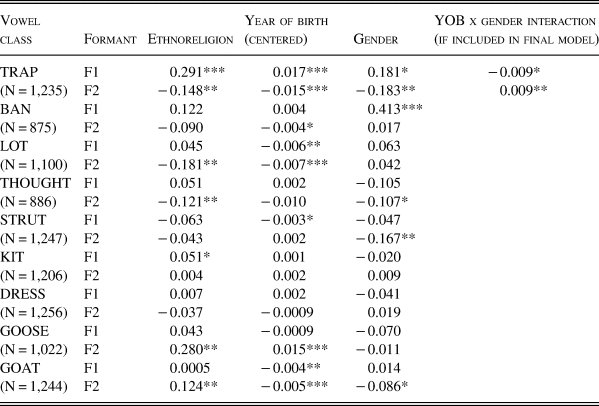
Model coefficients from linear mixed effects models predicting normalized formant values (* p < 0.05, ** p < 0.01, and *** p < 0.001).

We find significant main effects of year of birth on several vowel classes, indicating an apparent time change in progress: TRAP F1 (loweringFootnote 3 in apparent time) and F2 (backing), LOT F1 (raising) and F2 (backing), STRUT F1 (raising), BAN F2 (backing), GOOSE F2 (fronting) and GOAT F1 (lowering) and F2 (fronting). These results are consistent with previous work on NCS reversal (McCarthy Reference McCarthy2011; D'Onofrio & Benheim Reference D'Onofrio and Benheim2020), and the apparent time fronting of GOOSE and GOAT across many regions of the US (Labov et al. Reference Labov and Boberg2006). We additionally find significant main effects of gender on several vowel classes (Table 2), though the only interaction is for TRAP: while women produce significantly higher and fronter TRAP vowels than men, this difference does not emerge for younger speakers. Given that our sample is not fully balanced for gender, we treat these gender effects as control fixed effects.
We find significant main effects of religion for a number of vowel classes (Figure 2): Jewish speakers produce lower and backer TRAP, backer LOT, backer THOUGHT, and lower KIT vowels than Catholic speakers. Jewish speakers also produce fronter GOOSE and GOAT vowels.
Mean ethnoreligious differences (Jewish vs. Catholic) in vocalic productions.
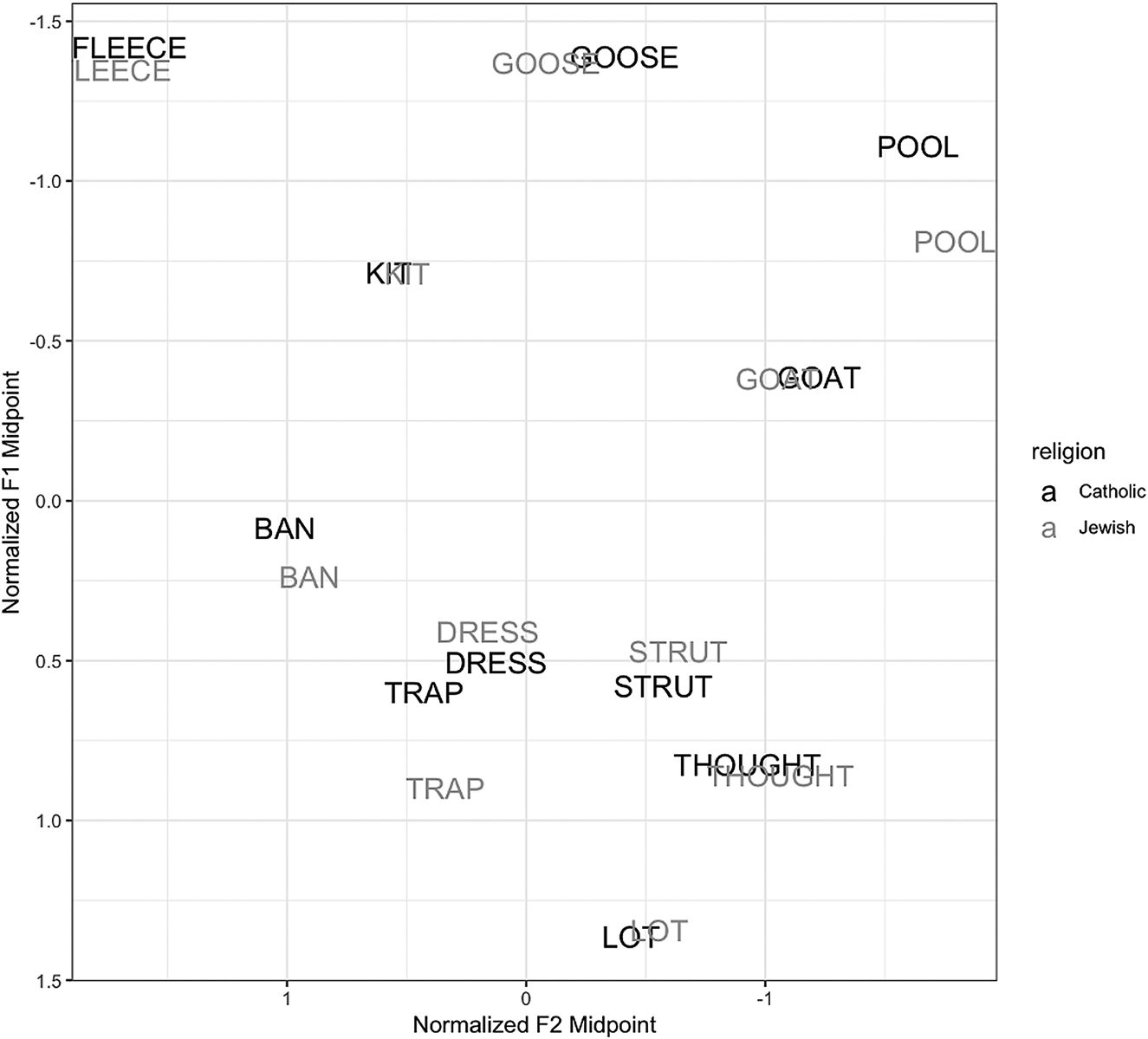
Jewish speakers’ lower/backer TRAP and backer LOT is consistent with an interpretation of their vowel spaces as more ‘New York-like’ than Catholic speakers’. However, other evidence suggests that Jewish speakers are not simply producing New York-linked vowel spaces: Jewish speakers’ backer KIT vowels represent more NCS-like vowel spaces than Catholic speakers. Further, their fronter GOOSE and GOAT vowels are also inconsistent with characterizations of NYCE, which is more conservative in the fronting of these vowels relative to other US dialect regions (Labov et al. Reference Labov and Boberg2006; Coggshall & Becker Reference Coggshall, Becker, Yaeger-Dror and Thomas2010). Though much has been made of Jewish speakers’ raised THOUGHT vowels in prior work (Knack Reference Knack and Eckert1991; Sacknovitz Reference Sacknovitz2007), we find no significant difference between Jewish and Catholic realizations of THOUGHT height; a distinction emerged for THOUGHT only in the F2 dimension, with Jewish speakers producing a backer THOUGHT vowel. Finally, we did not find evidence of the NYCE complex short-a split (Shapp Reference Shapp2018) among our participants. For example, Figure 3 below depicts all pre-oral TRAP and pre-front nasal BAN tokens from two Jewish participants, Erica, 30, and Joe, 67.
Lobanov-normalized TRAP (darker text) and BAN (lighter text) tokens for Erica, 30, left, and Joe, 67, right. TRAP tokens in NYCE tensing contexts are in boldface text.

Consistent with ongoing NCS reversal in Chicago, Erica produces a clearer ‘nasal’ split between BAN and TRAP tokens than Joe. However, neither speaker demonstrates evidence of a NYCE-like short-a split. Like others in the sample, some of their lowest TRAP tokens precede voiceless fricatives, typically a tensing environment in NYCE (Shapp Reference Shapp2018). For this reason, all pre-oral tokens are classed together as TRAP in our analysis.
Results by neighborhood
As participants’ meta-linguistic commentary differentiated Jewish speakers based on location, we next classify Jewish participants binarily by neighborhood: West Rogers Park/Skokie/Lincolnwood (WRP; n = 8) vs. Other Jewish (n = 13), where ‘Other’ includes both northern suburbs as well as Chicago neighborhoods like Lakeview and Hyde Park. These groups are compared against each other and against Beverly/Morgan Park (Beverly, n = 21), all of whose residents were Catholic. In cases where participants have moved between Other Jewish neighborhoods and WRP (n = 2), we classify them based on where they lived longer.
We find the same control effects of age and gender discussed above, as expected given that these models are fit to the same data.
We find significant differences between Jewish speakers from WRP and those from ‘Other Jewish’ neighborhoods. WRP speakers produce higher and fronter TRAP, fronter LOT, higher KIT, and backer GOOSE vowels than ‘Other Jewish’ speakers. We additionally find significant effects of neighborhood in comparing Catholic speakers from Beverly vs. ‘Other Jewish’ neighborhoods (Figure 4; Table 3). Controlling for age and gender, ‘Other Jewish’ speakers produce significantly lower and backer TRAP, backer BAN, backer LOT, and fronter GOOSE and GOAT vowels. There is also an interaction between year of birth (age) and neighborhood for both WRP and Beverly vs. ‘Other Jewish’ speakers for TRAP F2. The between-neighborhood difference in F2 is greater across older speakers than it is among younger speakers. Finally, both WRP and ‘Other Jewish’ speakers produce significantly backer THOUGHT vowels than Beverly Catholic speakers.
Mean neighborhood differences in production: WRP (light bold text) vs. Beverly (dark plainface text) vs. Other (medium italic text).

Although Jewish speakers as a whole produced less Northern Cities-shifted vowel spaces than Catholic speakers for many vowel classes, when broken down by neighborhood, we find that these effects generally remain only for Jewish speakers from ‘Other’, non-WRP area neighborhoods. WRP Jewish speakers only differ from Beverly Catholic speakers in THOUGHT F2. This suggests that Jewish speakers from WRP use many NCS features similar to Catholic Beverly speakers, perhaps indexing social meanings associated with the NCS other than ethnoreligious status (e.g. McCarthy Reference McCarthy2011; Durian & Cameron Reference Durian and Cameron2018). That only THOUGHT F2 differs between Catholic and Jewish speakers regardless of neighborhood, and not F1, suggests that this vowel is being recruited differently by Jewish Chicagoans than by non-NYC Jewish speakers in other studies, who used THOUGHT height in indexing Jewish identity (e.g. Knack Reference Knack and Eckert1991).
Indeed, though raised THOUGHT and other features of NYCE frequently surface in both linguistic descriptions of Jewish English in the US (e.g. Knack Reference Knack and Eckert1991; Sacknovitz Reference Sacknovitz2007) and the meta-linguistic commentary above, results suggest that many differences between Jewish and Catholic speakers may actually be conditioned by neighborhood. While Jewish speakers produce backer THOUGHT vowels than Catholics regardless of neighborhood, a broader examination of place-linked vocalic features shows little evidence that Jewish speakers are simply adopting NYCE vowels, nor are they consistently ‘less Northern Cities-shifted’ than the Catholic speakers associated with the NCS. Rather, social dynamics within Chicago, like neighborhood differences, appear to condition engagement with locally meaningful features.
This is especially noteworthy given the bricolage (Eckert Reference Eckert2008b) of backed THOUGHT with relatively more Northern Cities-shifted TRAP and LOT in WRP, versus less Northern Cities-shifted TRAP and LOT in ‘Other Jewish’ neighborhoods. NCS vowels have been linked ideologically and in production to lower socioeconomic status (McCarthy Reference McCarthy2011). WRP as a community has historically been lower in SES than the northern suburbs or city neighborhoods like Lincoln Park (Cutler Reference Cutler1996; Aronson et al. Reference Aronson, Brookner and Saxe2021). Further, WRP's Jewish community is perceived as an ethnic enclave, much like Beverly is perceived as an Irish Catholic enclave. It is perhaps reflective of ideologies that differentiate the WRP area from other Chicagoland Jewish communities that Jewish speakers from different locales also differ in their implementation of TRAP and LOT.
Previous work (Knack Reference Knack and Eckert1991; Sacknovitz Reference Sacknovitz2007) has focused on Jewish speakers’ THOUGHT productions, though typically the F1 dimension. While THOUGHT comes into play in this sample, we note that Jewish speakers are not necessarily adopting a supra-regional Jewish raised THOUGHT feature, as they are using F2, rather than F1. Jewish speakers’ backer THOUGHT vowels regardless of neighborhood suggest that this vowel may be performing some indexical function, possibly related to its associations with Jewish identity; it's also possible that fronter THOUGHT vowels index Catholic identity. While no significant differences in THOUGHT height emerged at the neighborhood level, two individual Jewish speakers produce higher THOUGHT vowels than their peers. We qualitatively examine these speakers in turn, in order to investigate why some Jewish Chicagoans might adopt this feature.
Yoni and Micah
Yoni, 24, was raised in the suburb of Skokie, within the WRP area, in a family that was not religiously observant. As a college student, he became connected with the local Orthodox community, ultimately prompting him to leave his Chicago-area university for a local yeshiva for Torah study.
Figure 5 depicts Yoni's vowel space (darker text) against the other younger men from the sample (both Jewish and Catholic; represented by points). The vowel space of Micah, another speaker who fits into the same demographic categories as Yoni (male, Orthodox, 24, and from West Rogers Park), is represented by lighter text.
Yoni (darker text) and Micah (lighter text) compared to other younger men in their twenties to thirties.

Yoni's and Micah's TRAP vowels are among the highest in their generation, and their LOT vowels are among the lowest and frontest. This is consistent with the general trend of WRP speakers producing more Northern Cities-shifted TRAP and LOT vowels than Other Jewish speakers. Despite these similarities, Yoni produces by far the highest THOUGHT vowel of any young male speaker in the sample, while Micah's THOUGHT vowel is closer to the middle of the range. Additionally, Yoni's GOOSE production is among the backest in the cohort, whereas Micah's is one of the frontest. While both raised THOUGHT and backed GOOSE have been associated with NYCE (Coggshall & Becker Reference Coggshall, Becker, Yaeger-Dror and Thomas2010), the rest of Yoni's vowel space, particularly his raised/fronted TRAP and LOT vowels and backed STRUT vowel, appears to be influenced by the NCS, albeit consistent with community-level apparent time reversal. Indeed, while Yoni does have some contact with New Yorkers, mostly yeshiva students or rabbis who have moved to Chicago from New York, he does not necessarily evaluate NYCE positively: “My friends from New York tell me that I speak like I'm from Chicago. And I'm like, come on, you guys have the accent, not me”. Elsewhere in his interview, he made additional comments framing the Chicago/Midwestern accent as normative: “The weather reporters always usually have the Midwestern [accent]. It sounds American… sounds normal, too”.
Micah echoed these comments: “I feel like there's no accent in Chicago. I feel like there's more of an accent outside. But that's because to me it's different so I think it's just a matter of perspective”. Like Yoni, Micah has exposure to NYCE through a brother-in-law who has since moved to Chicago, and added, “New York, you hear it [an accent] from time to time. Especially if you know someone with a yeshivishe background or raised in Brooklyn. You know, like ‘They went to the store to get coffee’”, performing ‘coffee’ with an exaggerated, raised THOUGHT vowel. Nevertheless, despite similarities with Yoni in demographics and exposure to NYCE, Micah does not produce a particularly raised THOUGHT. While Yoni's production of raised THOUGHT may serve some indexical purpose, this cannot be clearly tied to his Jewish or Orthodox identity broadly speaking. However, Micah's comments connecting the raised THOUGHT in ‘coffee’ to the yeshivishe (ultra-Orthodox) community—like other meta-linguistic commentary linking features of NYCE with Jewish identity—suggest that THOUGHT may be available for indexical use by some speakers. While Micah does not draw on this feature himself, it is possible that Yoni is drawing on this ideological connection to index his identity as Orthodox.
Beth and Rina
Like Yoni, Beth, 64, grew up and currently lives in Skokie, in the WRP area. While Beth's Jewish identity is important to her, she does not affiliate with any Jewish denomination. However, like Yoni, she produces the highest THOUGHT vowel of all the women in her age cohort. Figure 6 plots Beth's vowel space against the other women in her age group. Rina, 68, is highlighted in lighter text.
Vowel spaces for Beth (black) and Rina (gray), compared to other women in their fifties and sixties.

Rina was raised and continues to identify as modern Orthodox. She was born near Maxwell Street and moved northward to WRP during childhood, where she continues to reside. Both Beth and Rina produce raised TRAP vowels similar to others in their age group and relatively backed (Northern Cities-shifted) KIT vowels. However, differences emerged between the two speakers: while Beth's LOT vowel is among the lowest and frontest in the sample, Rina's, though still Northern Cities-shifted, is more similar to others in the cohort. A larger discrepancy emerges for DRESS: Beth is relatively Northern Cities-shifted (lowered) and Rina is relatively conservative. Though both produce fronted GOAT vowels, only Rina fronts GOOSE, with Beth producing one of the backest GOOSE vowels in the sample. Finally, Beth produces a much higher THOUGHT vowel than Rina and other members of the cohort.
This discrepancy in THOUGHT is especially notable given that Rina lived in New York City for several years as a young adult while completing a graduate degree. She describes New York favorably, stating that she “moved to New York because I wanted to live in New York… it's very lively, very dynamic… I wanted to be part of that”. Though she ultimately returned to Chicago to be near family, she continues to view New York positively. Regarding language, she says, “I don't know if I have a Chicago accent… Living in New York, you know, people have New York accents, so people would say to me, ‘Well, you have a Chicago accent’. So does that mean that I just don't speak like them? Well it's true, I don't. But what does that mean exactly?”. Like Yoni and Micah, Rina expresses an ideology of a neutral-sounding Chicago accent which differs from accents in other regions, including New York.
Beth, meanwhile, has never lived outside Chicago, with the exception of college elsewhere in Illinois and a few years abroad in Israel as a young adult. Her adult daughter lives in New Jersey, but Beth expresses no desire to move there: “Especially now that I've retired, I know my daughter wants me to come and my grandchildren too keep asking why I don't stay there all the time, but I'm kind of settled here… I really see myself staying in Chicago and just going to visit them”. Yet despite Beth's more secular, Chicago-centric identity, she produces a raised THOUGHT vowel.
While raised THOUGHT may serve some indexical purpose to at least some Jewish speakers in Chicago, it is not clear what that social meaning might be. Unlike Knack's (Reference Knack and Eckert1991) finding in Michigan, where raised THOUGHT was commonly produced by Jewish women as a group, we find just two participants with seemingly little in common beyond their neighborhood who produce this feature. One possibility is that Beth and Yoni both report feeling somewhat marginalized from the broader Jewish community in childhood and early adulthood. Yoni ultimately embraced Orthodox Judaism, joining an observant religious community, and Beth found community through a folk dancing group. Meta-linguistic commentary suggests that raised THOUGHT is at least ideologically connected with ‘sounding Jewish’, though it is not generally utilized in production. It is perhaps unsurprising then, that these speakers, who grew up somewhat peripherally to Chicago's Jewish communities, would draw on a feature heavily ideologized as Jewish, even though it is not necessarily widespread among local Jewish speakers. Importantly, however, while raised THOUGHT is also indexical of New York, both speakers affiliate in opposition to New York. In combining raised THOUGHT with NCS vowels, Yoni and Beth can recruit the Jewish-linked associations of raised THOUGHT without also indexing New York, resulting in a style that sounds Jewish, but also clearly Chicagoan.
Discussion
Meta-linguistically, Jewish and Catholic speakers alike associate NCS features with white Catholic, working class Chicagoans. At least some Jewish speakers also associate NYCE with Jewish speakers, though others state that these features are not prevalent among Jewish Chicagoans. Commentary also highlights ideologized class differences between Jewish and Catholic speakers, as well as within-group differences between Jewish speakers from West Rogers Park, Skokie, and Lincolnwood compared to those from other areas.
In production, we observe an overall Jewish vs. Catholic difference that aligns with this meta-linguistic commentary: for some vowel classes, Catholic speakers are more Northern Cities-shifted than their Jewish counterparts. However, these ethnoreligious differences really constitute differences between Catholic speakers and Jewish speakers from non-WRP-area neighborhoods: the only vocalic difference that remains for Jewish speakers from WRP is for THOUGHT F2.
Some individual Jewish speakers might rely on raised THOUGHT for indexical purposes, but this is not widespread within the sample, nor does it extend to other NCS-implicated vowel classes, suggesting that these speakers are not simply adopting NYCE norms. While Jewish speakers overall produce backer THOUGHT vowels, and some individual speakers produce raised THOUGHT, this feature does not appear to be conditioned by contact with NYCE or Orthodoxy, unlike findings in other areas (Knack Reference Knack and Eckert1991; Sacknovitz Reference Sacknovitz2007).
CONCLUSION
The experience of a particular ethnic group within a given region can influence how members of that group engage with ethnically linked features, as well as which features are considered ethnically linked in the first place. In New York, for example, Jews are grouped together with Irish and Italian Americans in ideologies about ‘white ethnic’ English (Labov Reference Labov1966; Becker Reference Becker2010). In Chicago, Jewish speakers are excluded from commentary about the traditional ‘white ethnic’ accent, despite production data suggesting that some Jewish speakers sound similar to ‘Chicago accented’ Catholics in neighborhoods like Beverly.
Indeed, Northern Cities-shifted vowels have been linked to lower socioeconomic status (McCarthy Reference McCarthy2011; Durian & Cameron Reference Durian and Cameron2018), a pattern which is corroborated by these findings, to the extent that neighborhood area serves as a proxy for class. Yet despite the social salience of the WRP community, lower in socioeconomic status than other neighborhoods and suburbs both actually (Statistical Atlas 2018; Aronson et al. Reference Aronson, Brookner and Saxe2021) and ideologically (Cutler Reference Cutler1996), Jewish Chicagoans are generally ideologized as more affluent. While WRP is highlighted as a prominent Jewish community, its socioeconomic circumstances are subject to erasure and its residents excluded from ideologies about ‘prototypical’ NCS speakers. These ideologies possibly stem from broader cultural stereotypes connecting Jewish Americans with high socioeconomic status, despite the fact that they average similar income and formal education levels to non-Jewish Americans when controlling for other social factors (Mazur Reference Mazur2016).
More generally, work on ethnolinguistic repertoires should consider both the social and the linguistic context in which speakers live. This study demonstrates that stereotypes in meta-linguistic commentary do not necessarily bear out in actual production. Less Northern Cities-shifted TRAP and LOT vowels could be interpreted as more ‘New York-like’, but they can also be evidence of higher socioeconomic status or particular place identities within Chicago. Regional features are not orthogonal to ethnically linked features, in part because the social meanings of particular linguistic features vary by place (Wong & Hall-Lew Reference Wong and Hall-Lew2014). A feature that indexes some identity in one location, such as raised THOUGHT indexing Jewishness in Grand Rapids (Knack Reference Knack and Eckert1991) or Maryland (Sacknovitz Reference Sacknovitz2007), will not necessarily index the same identity in a different location. While New York regional features may be ideologically linked with Jewish speakers, NCS-implicated features have their own social meanings in Chicago, and variation of these features may better reflect locally relevant factors than speakers’ ethnoreligious identities. As Jordana, 39, says, “I believe that the Judaism that you live is actually not only a product of like what it is to be Jewish, but what it is to live in the civilization that you live in… [There] are things about the culture of the place that influence how you Jew… It's just like a different thing to be Jewish in Omaha than to be Jewish in Skokie”. That Jewish Chicagoans’ productions seem to be influenced by the local place- and class-based meanings of these vocalic features suggests that examining place-linked features of Jewish English requires understanding the local social positionalities of the speakers in question.
In previous analyses of the ethnolinguistic repertoire, gender, contact with NYCE, and religiosity (Benor Reference Benor2001, Reference Benor2011; Levon Reference Levon2006; Sacknovitz Reference Sacknovitz2007) have been examined in relation to the use of Jewishly linked features in English. Here, we argue that localized place and its intersections with ideologies about ethnoreligious identity and class can also condition the uptake of certain elements of the repertoire. Through their involvement in the NCS, THOUGHT and other vocalic features already carry social meaning in Chicago. Thus, it is unsurprising that, in this longstanding and socially embedded Chicago community, we observe Jewish speakers embracing some features of the ethnolinguistic repertoire (individual use of raised THOUGHT, loanwords, etc.) while not adopting NYCE features wholesale. In order to make legible (Eckert Reference Eckert2008b) indexical moves, speakers must consider the classed and place-linked social meanings of these features, which may in turn influence which repertoire elements are adopted.
More broadly, previous research has demonstrated that ethnicized individuals are not monolithic in their engagement with place-linked features common to local white speakers across regions (e.g. Becker & Cogshall Reference Becker and Coggshall2009; Wong & Hall-Lew Reference Wong and Hall-Lew2014; King Reference King2018). The current study suggests that we must also consider how members of a given ethnic or ethnoreligious group might use linguistic resources to index locally relevant positionalities within a given region, as well as how the use of elements of the ethnolinguistic repertoire interface, through bricolage, with features shared with members of other local ethnic groups.



