INTRODUCTION
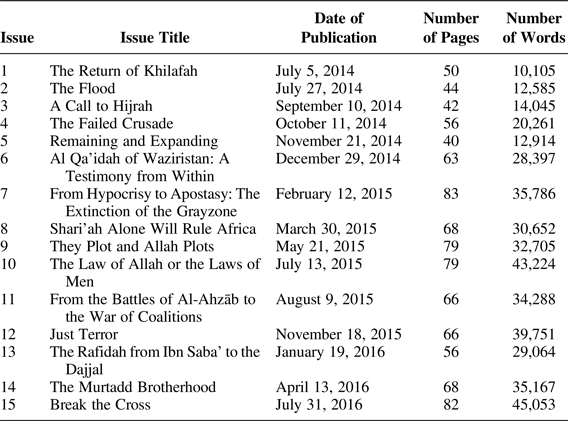
Named after the eponymous town in Syria mentioned by the prophet as a location for an eschatological battle between the best of Muslims and the worst of disbelievers, the first issue of Dabiq appeared in July 2014, the week after the Islamic State (ad-Dawlah al-Islamiyah—or simply ad-Dawlah to its citizens) captured the country's largest oilfield (Weiss and Hassan Reference Weiss and Hassan2015, xi). It was accompanied by the announcement that it had re-established the khilafah with the intention of returning Muslims’ “dignity, might, rights, and leadership” (Issue 1: 7). Continuing for another 2 years during ad-Dawlah’s expansion and consolidation (before being re-titled Rumiyah in September 2016), 14 more editions followed in Spanish, German, Russian as well as English, constituting a corpus of 942 pages and over 400,000 words (summarized in Table 1). A number of analyses of its content have now appeared. Some commentators, such as Celine Marie Novenario (Reference Novenario2016), have, for instance, compared Dabiq with other militant magazines, while Brandon Colas (Reference Colas2017) and Haroro Ingram (Reference Ingram2016) have considered, respectively, how it fosters its various potential audiences and a sense of in-group identity. Although its “religious” content has generally been noted in these (as well as in the burgeoning literature on ad-Dawlah generally (Alexander and Alexander Reference Alexander and Alexander2015; Stern and Berger Reference Stern and Berger2015; Gerges Reference Gerges2016; Wood Reference Wood2017 etcetera), there are currently no studies seeking to understand Dabiq's particular approach to Islamic exegeses. I seek to address this by focusing on three areas of Dabiq’s content (1) its analysis of the Qur'an (2) its use of classical scholarship, and (3) its engagement with contemporary readings of Islam.
Dabiq

While it might be argued that a wider breadth of ad-Dawlah’s outputs may provide a fuller approximation of its true thinking, looking at Dabiq alone does have a number of merits. Firstly, it is official. There is no doubt that it originates from within the organization—specifically, the al-Hayat branch of its central media council (Zgryziewicz Reference Zgryziewicz2015, 23–4). This is not necessarily true of the great range of statements, speeches, and videos being uploaded and distributed in its name every day. Secondly, its content is self-selecting. This avoids the problem of methodological circularity—picking, in other words, the content that best suits the analyst's predetermined argumentative position (such as the six themes presented by the Quilliam Foundation's Charlie Winter, for instance (Reference Winter2015)). Thirdly, it is well resourced. Ad-Dawlah has clearly invested heavily in its production and is therefore likely to take considerable care over its informational content. For that reason, it is generally agreed that “Dabiq both concisely reflects the ideological framework of the Islamic State and mirrors its current situation in Iraq and Syria” (Günther Reference Günther2015, 9). Fourthly, it presents a developing narrative of considerable cogency. Examining all 15 of its issues in series allows the reader to follow the complexities of its content, especially when articles and features are spread over consecutive editions. Finally, Dabiq is highly influential. Each release increased Google searches by up to a factor of 160 and much of the high-resolution imagery it showcases has been subsequently sold to major international press agencies searching for better quality alternatives to the blurry footage on offer elsewhere (The Carter Centre 2015, 6; Günther and Kaden Reference Günther and Kaden2016, 17).
Dabiq and the Qur'an
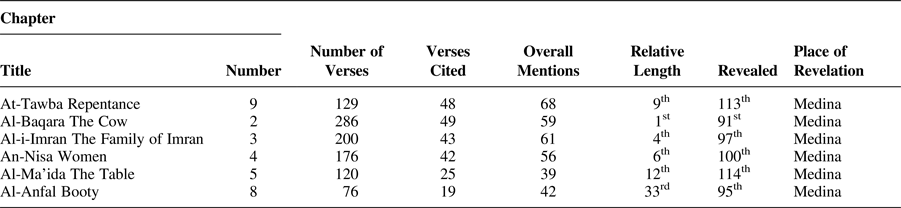
Together, all 15 editions of Dabiq contain an overall total of more than 2000 references to the Qur'an drawn from 76 of its 114 chapters. Such a detailed engagement might suggest a reasonably comprehensive cross-section of its content. This is not the case. As Figure 1 makes clear, its writers have disproportionately concentrated on the latter part of the revelation—a fact which remains true regardless of which of the highly disputed chronologies are employed (I use Theodor Nöldeke's four-part structure of three Meccan and one Medinan period (see Böwering, Reference Böwering and Reynolds2008)). Indeed, the first of these, which lasted from 610 to 614 and saw the arrival of 48 chapters (Watt and Bell Reference Watt and Bell2005, 110), is almost ignored altogether with only 39 of its 1235 verses being mentioned across all 15 editions of Dabiq. While it is true that these are among the shorter of the Qur'an's chapters, Table 2 shows that those that are most heavily referenced are not necessarily the lengthiest. In fact, the 10 longest chapters considered to be Meccan (each over 100 verses) provide a total of only 94 citations—although it is important to note that a significant proportion of Meccan chapters do contain (a small number of) verses revealed after the emigration to Medina (then known as Yathrib) in 622.
Dabiq's Qur'anic Citations per Chapter.

Qur'anic Chapters most commonly cited in Dabiq

While it is, of course, true that all citations are necessarily miscellaneous (and that the Medinan part of the Qur'an is every bit as “Islamic” as that revealed in Mecca), what is important here are the reasons behind such selectivity—why, in other words, ad-Dawlah concentrates its attention so heavily on its later chapters. An explanation for this might be found in the social context of the revelation itself. As Neal Robinson notes, during the first two Meccan periods (which he dates 610–617), the prophet was protected by his uncle and leader of the powerful Hashim tribe, Abu Talib (Reference Robinson2003). By 617, this was weakening and with his passing in 619, followed by the death of the prophet's wife of 25 years, Khadija (herself an influential and wealthy merchant) a year later, the embryonic Muslim community entered a period of considerable hardship and conflict. The character of the revelation thus moved from what Nöldeke called an “imaginative glow” to become “almost entirely prosaic” (Reference Nöldeke2010, 44–5); away, in other words, from “major ethical, eschatological and theological preaching, and [towards] what one might call the more “political” aspects of the message” (Campanini Reference Campanini2007, 145). The 24 chapters that Nöldeke believes were revealed after the emigration to Medina in 622, and which make up the bulk of Dabiq’s Qur'anic citations, extend these social themes and relate them to the prophet as “no longer merely a warner or messenger, but an administrator” of a diverse and conflictive polity (Fischer and Abedi Reference Fischer and Abedi1990, 464). Away from pagan Mecca and within the Muslims’ new cosmopolitan home, this part of the revelation, therefore, tended to guide the growing Muslim community in its relationship with established Jewish and Christian communities, as well as those who professed to be allies, but secretly connived against Muhammad's leadership (Abdel Haleem Reference Abdel Haleem2011, xviii).
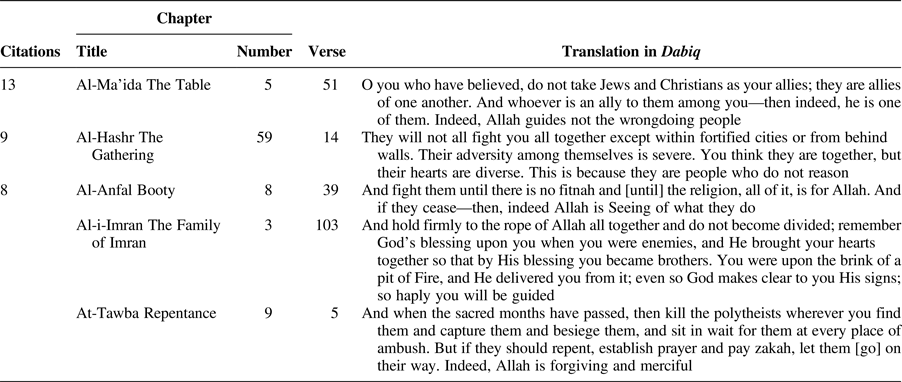
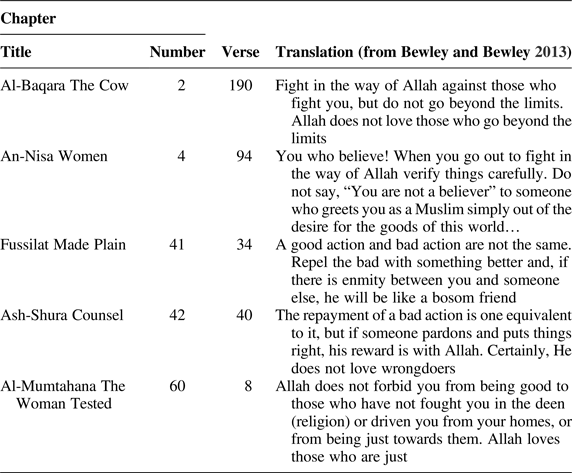
As Table 3 illustrates, the verses that appear most frequently in Dabiq are drawn from this Medinan period (al-Hashr is 102nd in Nöldeke's chronology). The commonest of these, al-Ma'ida: 51, is perhaps no surprise. It is often used as a basis for disavowing Western culture (part of the notion of al-wala wal-bara), but here it is presented in isolation from the two important moderating verses (al-Mumtahana: 8 and Fussilat: 34 (translated in Table 4))—neither of which are cited at all in Dabiq. These obligate believers to act kindly towards non-Muslims and, for Oliver Leaman, must be read alongside al-Ma'ida’s injunctions (Reference Leaman and Leaman2006). Equally contentiously, the translation of this verse in Dabiq renders the word awliya as “allies”. As Leaman continues though, the fact that these passages were revealed around the time of the Battles of Badr (624) and Uhud (625) suggests that the meaning of awliya should be limited to ““protectors” or “guardians” in the strict military sense of the terms” (Reference Leaman and Leaman2006, 679–681). Given that the next four most commonly cited verses deal with martial themes, it is difficult to believe that ad-Dawlah would be unaware of this.
The Most Frequently Cited Verses in Dabiq

Key Omissions from Dabiq

Of these, the occurrence of al-Anfal: 39 and at-Tawbah: 5 may also be considered unsurprising. They are two of the five key “war” verses identified by Reuven Firestone in his highly comprehensive survey of the Qur'an, and thus “carry the highest authority in all discussions of war” (Reference Firestone1999, 84). There is, however, little agreement on their precise value in translating these debates into action. As Asma Afsaruddin notes (Reference Afsaruddin2013, 4), for instance, the idea that these passages are especially instructive (even abrogating earlier revelation) evolved during the “the rise and consolidation of the imperial Umayyad and Abbasid” empires when an emerging and “powerful class of religious scholars… were often willing to defer to Realpolitik… [and offer] support for statist policies of territorial expansion”—“freeing the rulers” hands’, as Blankinship puts it (Reference Blankinship and Esposito2009). Others, such as Abdullahi An-Na'im, view these passages as relating to specific groups of belligerents and thus must be treated with caution when attempting to formulate generalized guidelines (Reference An-Na'im1992, 152). What is mostly agreed upon is that both verses “do not stand alone in the qur'anic presentation but must be read in conjunction with other revelations taking different positions on the issue’ (Firestone Reference Firestone1999, 84). Ignoring these, Mohammad Hassan Khalil points out, would overlook the “qualified directives” of other congruent passages and their commonplace call upon believers to restrict warfare to “those who attacked you first” (Reference Khalil2018, 14). However, despite the great range of restrictions on the use of violence within the first 15 verses of at-Tawbah, for instance, only half of these are mentioned across all editions of Dabiq (Abdel Haleem Reference Abdel Haleem2011, 67).
Other verses of the Qur'an (also translated in Table 4) that are often considered to be essential accompaniments to the martial passages set out in Table 3 include, amongst others, an-Nisa: 94 (highlighted in March and Modirzadeh (Reference March and Modirzadeh2013, 375) and ash-Shura: 40 which Naveed Sheikh cites as demonstrating “the moral superiority of patient forbearance and forgiveness” (Reference Sheikh2015, 290). Commentaries on the Qur'an have also frequently pointed to the importance of al-Baqara: 190 (Amjad-Ali Reference Amjad-Ali2009, 246). Both Muhammad al-Ghazali (Reference al-Ghazali2000, 105) and Muhammad Asad (Reference Asad1980, 256), for instance, list it as indispensable when reading at-Tawbah: 5. Indeed, if the latter's insistence that “every verse of the Qur’ān must be read and interpreted against the background of the Qur’ān as a whole’ is followed, Richard Bonney concludes, then the sword verses certainly appear less belligerent and more defensive in character (Reference Bonney2004, 29–32). Yet, none of these three verses appears at all in any of Dabiq’s 15 editions.”
Moreover, on three occasions, the later dispensations of at-Tawbah: 5 are removed in favor of simply telling its readers to “kill the polytheists wherever you find them” (Issue 7: 21, Issue 13: 18 and Issue 15:28). Al-i-Imran: 103 is similarly truncated, being quoted as, “And hold firmly to the rope of Allah all together and do not become divided” without the subsequent conciliatory admonition (which I have taken from Arberry's Reference Arberry1955 translation) in all eight of its occurrences. Such selectivity is, of course, an inevitable part of any form of argumentation, but, as 126 Islamic Studies scholars pointed out in an open letter to ad-Dawlah’s leadership, any resultant edict must “consider everything that has been revealed relating to a particular question in its entirety, without depending on only parts of it” if it is to have authority (Open Letter to Dr Ibrahim Awwad al-Badri Alias “Abu Bakr al-Baghdadi”, 2014, 3). In this sense, then, the context of the revelation is essential. A complete grasp of the conduct of the early Muslim émigrés before, during and after the battles of Badr in 624 and Uhud in 625 is, for instance, central to understanding al-Anfal and Al-i-Imran respectively—both in general and the abbreviated excerpts presented in Dabiq. Similarly, their opponents’ breaching of the subsequent peace treaty, signed by the prophet despite considerable opposition from his followers at Hudaybiyyah in 628, is, according to Mohammad Hassan Khalil, also crucial in fully comprehending at-Tawbah and its infamous sword verse (Reference Khalil2018, 13).
Dabiq and Classical Scholarship
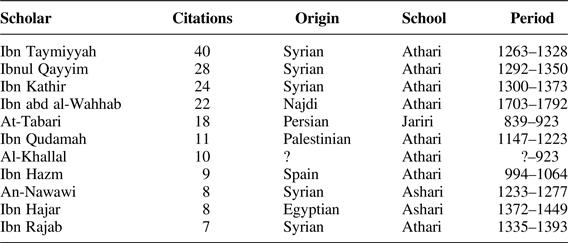
Excluding references to the great collectors of prophetic narrations (which are almost entirely drawn from standard sources—al-Bukhari, Ahmad, Abu Dawud, Muslim, and so on—and therefore reveal little about ad-Dawlah’s interpretative position), 65 different classical scholars are cited across the entirety of its 15 editions. At first glance, this appears to be a diverse engagement with a wide range of exegetes, but it actually consists of quite a narrow body of work. In apparent contrast to the commonplace observation that its leadership's “romantic inspiration… [is a] return[ ] to the golden age of the Abbasid caliphate”, Dabiq’s authors make little attempt to promote the intellectual tradition of the region's imperial past (Bazam Reference Bazam2017). Excluded completely, for instance, are the “paradigmatic exemplars” al-Farabi (d. 950), Ibn Sina (d. 1037), al-Ghazali (d. 1111) Ibn Tufayl (d. 1186) and Ibn Rushd (d. 1198) (Khalidi Reference Khalidi2005, xii). Even ignored is “quite possibly the only highly regarded philosopher to be Arabian”, the Kufan polymath, Al-Kindi (d. 873) (Jackson Reference Jackson2014, 33). Rather, as Table 5 shows, Dabiq focuses on the small Athari jurisprudential school. A third of all its references to classical scholars (92 out of a total of 276) relates to the most important exponent of the Atharite school—Ibn Taymiyyah—and two of his students, Ibnul Qayyim (who also taught Ibn Rajab) and Ibn Kathir.
Most Commonly Cited Classical Scholars

Such selectivity can, much like Dabiq’s Qur'anic content, be explained by the social context in which these thinkers wrote. Influenced by the earlier work of Ibn Qudamah, who was born only a short distance south of the Battle Hattin of 1187 in which Salah ad-Din defeated the Frankish Crusade, they were active at a time when Syria and Iraq were being invaded from both the west and the east (Kaminski Reference Kaminski2017, 41). Indeed, Ibn Taymiyyah, himself, was forced to flee his birthplace 130 kms north of Raqqah in 1269 following a Mongol attack led by Samaghar −11 years after his commander, Halagu Khan, had completely destroyed Baghdad and brought the Abbasid Caliphate to an end (Amitai-Preiss Reference Amitai-Preiss2004). Although subsequently re-established by the Mamluks in Egypt, its Syrian provinces continued to be assailed by both Ilkhanate and Crusader forces which, from 1271 onwards, began to act intermittently in concert (Sicker Reference Sicker2000, 123). Aleppo fell a number of times during this period and a combined army of Abaqa Khan, Leo II of Cilicia, Demetrius II of Georgia and the Acre Franks nearly took Homs in 1281 (Jackson Reference Jackson, Abulafia and McKitterick2000). Worse came in 1299 when Ghazan Khan succeeded in occupying Damascus itself, following which the retreating Mamluk army was plundered by largely Alawite and Twelver Shi'a forces from Kisrawan (Harris Reference Harris2012, 69–72).
From his position as leading professor at the Sukariyyah Institute in Damascus, Ibn Taymiyyah and his students were personally involved in these events. They took up arms against Ghazan and provided the legal justification for the subsequent crushing of Kisrawan (Morkevičius Reference Morkevičius2018, 149). They excoriated the Mongol leadership (dismissing Ghazan's ostensive acceptance of Islam in 1295) and condemned Mamluk society as polluted by a combination of Western philosophy, Eastern despotism, and un-Islamic innovation—particularly from the Shi'a, whose influence over the Mongols grew significantly during the reign of Öljaitü, Ghazan's successor (Hope Reference Hope and May2017, 174). Especially to blame, for Ibn Kathir, was “the failure of the scholars to act as guides for the community” (Jaques Reference Jaques2006, 6), who, according to Baber Johansen, both Ibn Taymiyya and Ibnul Qayyim criticized for amassing “construct[ed] abstractions that correspond[ed] neither to the life experience of the ordinary Muslim nor to the example of the charismatic members of the early Muslim community.”
The model of the early Medinan state was evoked, Johansen continues, “not in order to justify the legal categories that are the product of legal reasoning and its systematic constraints, but to downplay them”, so as to allow, and even promote, judgments not “based not only on fiqh [legal] norms but also on political considerations and state interest’. The “goal of the new doctrine”, Johansen concludes, was therefore “not to guarantee the rights of the defendant, but to protect the public interest and the ability of the political authorities to control disturbances and lawlessness”—or, for Ibnul Qayyim, to prevent “a situation in which religion loses control over people” (Reference Johansen2002, 180–186). Far from the usual atavism ascribed to him, Ibn Taymiyyah's contribution was, in this sense, an iconoclastic, yet empowering, response to the existential threats of the contemporary. Not anti-rational, but grounded on the “methodological principle that clear reason and sound tradition necessarily agree, …. [he] made doctrinal discussions not only a privilege for scholars, but also a matter for the public sphere” (Tamer Reference Tamer, Krawietz and Tamer2013, 370–371). As Ovamir Anjum concludes, his “reformist endeavors can [therefore] be best understood as a political project, namely one fundamentally concerned with the revival of the political sphere in Islam that had vanished in the classical age” (Reference Anjum2012, 9, emphasis in original).
It is precisely this social context that ad-Dawlah seeks to emphasize. Their importance to Dabiq’s authors is, in other words, based much less on the content of their ideas and scholarly debates than on who they were and when they lived. Disregarding the now increasingly accepted fact that “some form of Sufism existed amidst the circle of students and followers of Ibn Taymiyyah” (Post Reference Post2016, 156), mention is made neither of their admiration for “the acknowledged first master of the Sufi path”, al-Junayd (d. 910), nor of their references to the founder of the Qadiri Sufi fraternity, al-Jilani (d. 1166), as “our shaykh” (Anjum Reference Anjum2010, 165; Sarrio Reference Sarrio2011, 275). Instead, there is a pronounced focus on their struggles with the established powers of their day. A six-page article, entitled “Lessons from the Fitnah [strife/chaos] of the Mongols”, from the 14th edition of Dabiq, for instance, sets outs to link Ibn Taymiyyah's “utilitarian idiom of costs and benefits” (Cook Reference Cook2000, 154) to the difficulties of mobilizing the Sunni masses against the overwhelming force of today's Western “crusaders” and their eastern (ie Iranian) allies. Elsewhere, Abu Musab az-Zarqawi's justification of attacking Iraq's Shi'a is placed alongside Ibn Taymiyyah's condemnation of the Nusayris’ and Ismailis’ willingness to co-operate with the Mongols (Dabiq 13: 43–4), while Ibnul Qayyim's warnings against following fabricated textual evidence are used to denounce an-Nusra’s decision to leave ad-Dawlah in April 2013 (Dabiq 2: 26–7).
Similar themes appear in Dabiq’s use of the life and works of the eighteenth-century Najdi scholar, Muhammad ibn abd al-Wahhab. Like Ibn Taymiyyah and Ibnul Qayyim, alongside whom he is frequently cited, he was motivated by the need both to respond to growing chaos and lawlessness (between the city-states of the Arabian peninsula) and to influence the political authorities of the day—notably through his pacts with the “petty tyrants” Ibn Mu'ammar and Ibn Saud between around 1742 and 1744 (Shahi Reference Shahi2013, 48). Indeed, it is this politicization of Ibn abd al-Wahhab's otherwise unremarkable Hanbali/Athari scholarship on the dangers of taqlid (imitation) and the need to resist fabricated religious edicts with increased public engagement (to a point where it was used by the nascent Saudi state to attack the Persians at Karbala in 1801 and to lay claim to the Hejaz in 1804) which largely determines ad-Dawlah’s selection of his work (al-Rasheed Reference al-Rasheed2002, 22). Ignoring the awkward fact that neither he nor his followers advocated establishing a Caliphate in opposition to Ottoman suzerainty, Dabiq’s authors prefer to concentrate largely on the same narrow medley of quotations (al-Ibrahim Reference al-Ibrahim2015, 412). Derived less from his writings and more from “the practices of the early Saudi wars of expansion, over which Ibn Abd al-Wahhab, during his life, had considerable influence”, the great majority of these focus on three intertwined themes: (1) the obligation to oppose tyranny (such as the Baghdad and Damascus governments of today), (2) the responsibility to emigrate if imperiled (to the new Caliphate), and (3) the need to impose social order (through the domestic policies of the nascent regime in Raqqah) (Macris Reference Macris2016, 240).
In this sense, then, ad-Dawlah's engagement with classical scholarship can—much like Dabiq’s Qur'anic content—be said to be principally driven by a prosaic search for authority. Social legitimacy is, in other words, its central objective in approaching Atharism. As a result, neither Ibd abd al-Wahhab's vision of a faith “revived and reformed in the service of public order and welfare” nor the earlier Damascene scholars’ attempts to empower an independent intellectual class are related in any cogent or consistent manner (Delong-Bas Reference Delong-Bas2004, 289). References to Ibn Taymiyyah are no more than a brief smattering taken from just one of the great number of collections of his works currently available (the 20-volume Majmu al-Fatawa). Most quotations from Ibn abd al-Wahhab are taken from the generalist compendium, ad-Durar as-Saniyyah fi al-Ajwiba an-Najdiyyah (The Sparkling Pearls in Najdi Responses), compiled by Abd ar-Rahman ibn Qasim long after his death (Alnogaidan Reference Alnogaidan, Kendall and Stein2015). Others come from a short anti-Persian polemic, Risalah fi al-Radd ala al-Rafidah (The Rejection of the Rejectionists (Olsson Reference Olsson2017, 415)) — the other 23 primary sources listed in Delong-Bas’ authoritative study of his work are all ignored altogether (2004, 349–50).
What appears to be important for ad-Dawlah, then, is less a demonstrable adherence to a particular current of Islamicist thought and more an incongruent apparatus of support for its state-building project. The Persian scholar at-Tabari is, for instance, cited 18 times across all editions, despite being frequently accused of having “Shia sympathies” and refusing to accept the legal authority of the Athari patriarch, Imam Ahmad (Hazleton Reference Hazleton2009, 220). The Asharite thinkers Imam an-Nawawi and Ibn Hajar receive a total of 16 citations even though Asharism is generally condemned (see Issue 2: 23 for instance). Even Mutakallim theorists, Mutazilite rationalists and Sufi mystics (derided by Dabiq’s authors as “deviant and widespread historical sects” (Issue 14: 28)) are referenced whenever convenient. The great philosopher al-Juwayni (d. 1085) is a case in point. He is described in Dabiq as a “scholar of shar'i governance’ and quoted to defend the importance of remaining loyal to a competent, yet fallible, Caliph (Issue 10: 19). The Persian theologian az-Zamakhshari (d. 1144), author of the Mutazila’s “swan song… [on] the idea of human free will” (Campanini Reference Campanini2012, 47), is also cited as support for the eternal life of the martyr in Issue 5 (page 7). Even the work of eminent Sufis, such as the biographer Abu Nu'aym (d. 1038), who is accredited with the miraculous collapse of a mosque in Isfahan (Mojaddedi Reference Mojaddedi2001, 40)), appear as textual references—in this case, espousing the universalism of Islam (Issue 15, page 58).
Dabiq and Contemporary Scholarship
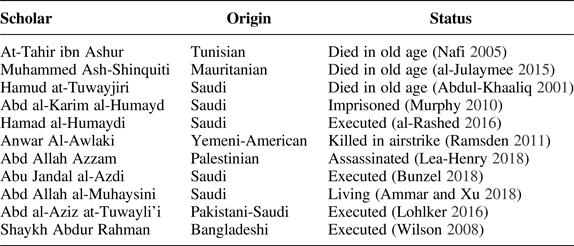
Although ad-Dawlah usually prefers to approach exegetic sources directly, Dabiq does include references to 57 contemporary scholars—excluding those without any significant training in religious studies (such as Ibn Laden, adh-Dhawahiri, az-Zarqawi, and so on). These tend to be quite concentrated, with only three such citations contained within Issues 1, 3, 4, 5, and 9 as a whole. They are also generally not used as academic support for the arguments being made. Of the 57, only 11 are referred to positively. As Table 6 illustrates, nine of these are dead and thus unable to distance themselves from ad-Dawlah (as almost every living cleric has now done). With the imprisoned ascetic al-Humayd unlikely to offer any support given the chance to comment, the only living cleric favorably referenced in Dabiq is the an-Nusra go-between, Abd Allah al-Muhaysini.
Favorably Cited Scholars

Many clerics generally cited by other militant groups, such as Hammoud ibn Uqla as-Shuaybi and Abd al-Rahman abd al-Khaliq, are overlooked. Even Nasir ad-Din al-Albani, who Quintan Wiktorowicz places at the heart of the “densely connected educational network” that makes up his “anatomy of the Salafi movement”, is notable in his absence (Reference Wiktorowicz2006, 213). Indeed, of the 25 clerics listed in William McCants’ encyclopedic Militant Ideology Atlas (Reference McCants2006), only 11 are referred to in Dabiq and just four of these positively. Scholars close to the Saudi establishment have been particularly targeted. An article entitled “Kill the Imams of Kufr [disbelief]” in Issue 13 singles out many of the country's leading religious voices, including Abdur-Rahman as-Sudays, Hatim al-Awni, Sa'd ash-Shathri, Adil al-Kalbani, Abdullah al-Mutlaq, Muhammad ar-Arifi, Salman an-Nashwan, and A'id al-Qarni (who was subsequently shot and wounded by an assailant purported to have links with ad-Dawlah) (Paton Reference Paton2016).
Instead, nearly all contemporary commentaries on faith and politics in Dabiq come from five of ad-Dawlah’s own leaders Abu Mus'ab az-Zarqawi (d. 2006), Abu Umar al-Baghdadi (d. 2010) Abu Hamzah al-Muhajir (d. 2010), Abu Muhammad al-Adnani (d. 2016), and Abu Bakr al-Baghdadi. Excluding the eschatological comment on the city of Dabiq from the former which appears near to the start of each issue, they are mentioned over 100 times across all 15 editions. While little is known about the background of these men, the first 4 are very unlikely to have had any formal religious training. There have been reports that the latter holds post-graduate religious studies qualifications from the University of Baghdad, but these remain unverified and appear to be based on a biography released by ad-Dawlah itself (McCoy Reference McCoy2014). Despite this, all are frequently referred to as shaykh and given the honorific post-nominal suffixes rahimahullah or hafidhahullah (may God forgive/protect him). Their deployment of Qur'anic verses, ahadith and classical scholarship is not generally to support particular strands of Islamic thought. In fact, less than 30% of Dabiq’s overall content can, according to Brandon Colas, be classified as “religious” (Reference Colas2017). Rather, “universally appealing narratives—security, social justice and so on—feature more prominently than the niche theological ideas that the organisation claims to sustain itself with” (Winter Reference Winter2015, 34). Indeed, NATO calculates that political messaging amounts to 48% of Dabiq’s subject matter (Issues 1–10) (Zgryziewicz Reference Zgryziewicz2015, 32).
Within these, commentaries involving ad-Dawlah’s leadership tend to revolve around three closely inter-connected ideas: (1) it is doing God's work (2) resistance is apostasy (3) the punishment of dissent is necessary to maintain order (security, wellbeing and so on). Mostly set out within the longest feature of each edition, the result is a pronounced focus on the value of force. As Aaron Zelin notes of its media output generally, more than five times as much copy is given over to military themes than to proselytising Islam (Reference Zelin2015, 90). Al-Muhajir's 16-page, a two-part feature entitled “Advice for the Soldiers/Leaders of the Islamic State” from Issues 6 and 7, for example, focuses almost entirely on combat, logistics, and battlefield tactics. Abu Bakr al-Baghdadi's speech from May 2015, partly reproduced in Issue 9, seeks to connect similar topics to prophetic tradition. Islam, he claims, “is the religion of war. Your Prophet… was dispatched with the sword… [and] never for a day grew tired of war” (52–3). Emigration to the Caliphate or the taking up of arms is, Dabiq’s narrator continues, mandatory; do “not hesitate in doing so, nor consult any supposed “scholar” on this obligation” (Issue 9: 54).
This is not simply to escape the rule of non-Muslims, but also—or perhaps especially—to resist those defined as apostates. These include the Shi'a as set out in a 15-page feature drawing heavily from az-Zarqawi's 4-hour audio recording, Hal Ataka Hadith ar-Rafidah (Has Word of the Rejectionists Reached You?) in which he argues that provoking the newly-formed Maliki government is the only way “to awaken the neglectful Sunnis”, mobilize military action and establish a secure homeland (Issue 13: 42). More space, however, is given over to excoriating the Sunni “Allies of al-Qa'idah in Sham”. Presented in five instalments taking up 25 pages of Issues 8–12 and including commentary from al-Muhajir and Abu Umar al-Baghdadi, it concludes with a warning from al-Adnani (repeated in Issue 10) that “by fighting the Islamic State you fall into kufr” for which the punishment “is a bullet splitting the head or a sharp knife inside the neck” (Issue 12: 16).
In reaching these judgments, ad-Dawlah’s leadership is operating within, what Nelly Lahoud calls, “a political space that allows contenders without classical religious training to challenge, on the basis of Islamic teachings, not just the political establishment but also the religious establishment itself” (Reference Lahoud2010, 105). Not a single contemporary scholar is cited in any of the articles above and ““Salafi Jihadi” claimants” are condemned as “deviant intermediar[ies]” (Issue 11: 10). Perhaps realizing that such denunciations “threaten to erode the support of its core constituencies”, they are also careful to remove their call to action from any broader Islamic debates (Ingram Reference Ingram2015, 743). Kill “in any manner”, al-Adnani tells his readers. “Do not ask for anyone's advice and do not seek anyone's verdict” (Issue 6: 4). This anti-clericalism runs right through Dabiq, even to the point of ignoring ad-Dawlah’s own imamate. Neither its religious leaders killed in the past (such as the Palestinian cleric and az-Zarqawi's “first true spiritual leader in Iraq”, Abu Anas as-Shami (Fishman Reference Fishman2016, 362)), nor those working there at the time of publication (like its late Mufti, Turki al-Binali (Joscelyn Reference Joscelyn2017)) receive any mention at all.
Instead, Dabiq’s key themes are presented in isolation from the substantive scholarly debate. Instead, there is a pronounced emphasis on the immediate priorities of institution building. As Issue 1 (page 25) makes clear, “religious affairs cannot be properly established unless the people of truth first achieve comprehensive political imamah [leadership] over the lands and the People’. “Action precedes authority in this philosophy”, Harleen Gambhir observes. Ad-Dawlah was established through an individual agency, not divine intervention—“the Caliphate hangs on military victory and consolidation success, as proof of God's approval”, she concludes (Reference Gambhir2014, 6–7). Dabiq is thus replete with stories of the proto-state's imposition of order without referring to established jurisprudential standards. The early editions’ focus on recruitment, for example, ignores the contemporary writing on living amongst non-Muslims, simply characterizing emigration from the West as an uncontested religious duty. More likely to appear, in fact, are “quotes from Western policymakers and journalists that corroborate the image of strength it seeks to project” (Novenario Reference Novenario2016, 8) It is no surprise then that, as Andrew March and Mara Revkin note, ad-Dawlah neither offers a legal defense of its claim to the territory it controls, nor attempts to codify, in shari'a terms, the structure of the social contract it seeks to establish with its residents therein (Reference March and Revkin2015).
CONCLUSION
This paper has suggested that any easy association of ad-Dawlah’s ideology, as evidenced in its flagship magazine, with Islamic exegeses (understood in the three ways outlined above) is highly problematic. Dabiq’s writers’ approach to the Qur'an, their concentration on a small selection of classical scholars and their willingness to condemn virtually every living religious authority reveal, it has been argued, a prosaic anti-intellectualism intimately intertwined with the practical expediencies of state-building. While not to be particularly unexpected (after all, we might predict that ad-Dawlah would choose the scriptures and commentaries that best suit its interests), it is, nonetheless, valuable to trace out the contours of, and reasons behind, such selectivity. Indeed, this type of analysis becomes especially important in an age defined by what Nelly Lahoud calls the “decentralization of Islam” and the resultant growth in organizations such as ad-Dawlah attempting to “assume[ ] ownership of the classical Islamic corpus’. She, like many others, observes that these “are less interested in the intellectual exercise of reading… [it] in the context within which it was intended” than on highlighting “those aspects that lend support to their current programs”, prompting important questions over how such instrumentalization works in practice (2010, 105–106). This paper has thus sought to provide an answer to at least some of these questions in the case of ad-Dawlah. In other words, it aims to get beyond the broader observation that “practitioners of holy war do not refer to Islamic texts in any extended or exegetic sense” (Devji Reference Devji2005, 119) or, more specifically, that Dabiq’s engagement with the Qur'an “steps out of any sort of commentary (tafsir) tradition” (Colas Reference Colas2017, 182) and to offer an explicatory account of the key areas where this has actually happened in practice.
Similarly, I have also endeavored to explain the magazine authors’ dual focus on the Damascene classicists of the fourteenth century and the early ahl as-sheikh tradition of the Arabian Peninsula. Neither, it is argued above, are commended as part of a coherent defense of Atharism. Rather, their work is presented as an attempt to equate their struggle to buttress the political institutions of their day against the combined threats of Persian and European hegemony to what Dabiq’s authors see as their own defense of Sunni Arab integrity in Iraq and Syria. These scholars’ usefulness to ad-Dawlah’s leadership is thus not to be found in their contribution to a shared aqida (creedal interpretation), but in their discourse on the value of social activism. It is their response to the Mamluk imamate's ineffectualness and to the “disorderly, uncouth and irreligious” tribal chaos of the eighteenth-century Najd that is of interest, not their opponents’ attachment to Asharism or Sufi heterodoxy—the politics of resistance are, as such, the principal basis upon which Dabiq’s writers engage with classical scholarship (Commins Reference Commins2006, 7). There is, in other words, little interest in using these sources to substantiate any specific ideological position and no meaningful attempt to present them as a form of proto-Salafism.
Indeed, the magazines’ most scathing content is reserved for contemporary clerics and intellectuals themselves—many of whom are typically thought of as coming from the Salafi tradition. With so many of these leading thinkers dismissed and excoriated, its anti-scholarly ideological apparatus might be better regarded as bespoke, rather than indicative of any particular dogma. Indeed, Ad-Dawlah’s insistence that any “literate individual has the ability to come to the correct interpretation of a text” reveals a call-to-arms grounded more upon a generalized anti-clericalism than on intellectual engagement or theological reasoning (Colas Reference Colas2017, 182). It is perhaps no surprise, then, that Dabiq’s discourse on the law is (in contrast to its ostensive preoccupation with the minutiae of the shari'a) not drawn from any identifiable jurisprudential tradition. Instead, it is, as Andrew March and Mara Revkin note of the organization's legal superstructure more broadly, principally intended to “legitimize the regime's monopoly on violence, resource extraction, and political authority” (Reference March and Revkin2015).
Again, this perhaps should not be entirely surprising. As former U. S. Department of Defense analyst Michael Ryan points outs (quoting the militant ideologue, Abu Ubayd al-Qurashi), “most revolutionary movements spend some time to set up not only the local administration but also parallel governmental institutions, which act as a pivot point in the struggle for the people's loyalty” (2013, 88). In this sense, ad-Dawlah might be more fruitfully understood as a “revolutionary (or radical) insurgent actor” which, through the pages of Dabiq, is following a well-established practice of utilizing cultural resources in order “to mobilize resistance to imperial control, gain access to political power and territory, and exercise power in the construction of new national institutions” (Crawford Reference Crawford, Crawford and Lipschutz1998, 19; Kalyvas Reference Kalyvas2014, 36). Its religious reference points may, therefore, be thought of as principally motivational—playing, in Arun Kundnani's words, “an enabling role in cohering a group”—with the overall aim of achieving a military advantage (Reference Kundnani2014, 65). The intellectual heritage here is perhaps less in (even supposedly aberrant) variegations of contemporary Islamic thought, and more in much older utopian discourses of the subaltern—a kind of “Muslim-based Fanonist perspective” as Beverly Milton-Edwards puts it (Reference Milton-Edwards2006, 102).