


Introduction
The Loess Highland of north-central China occupies an agro-pastoral ecotone between the agricultural heartland of the early states and the pastoral steppe regions further north. As a region of scarce resources and harsh natural environment, it has traditionally been regarded as a cultural periphery. Yet, recent discoveries, such as the large regional centre at Shimao (425ha), demonstrate that complex societies had already emerged in this region in the late Longshan period and Early Bronze Age (2300–1800 BC; Shaanxi Provincial Institute of Archaeology & Shenmu City Shimao Site Management Office 2024). These findings have prompted a reconsideration of the traditional centre-periphery model, which primarily focused on the socioeconomic development of the Central Plain while treating surrounding highland regions as marginal, and emphasise the importance of highland societies for understanding early Chinese history. Building on frameworks on landscape classification (Li Reference Li2018), the “Loess Highland” has been proposed as a distinct geographic and cultural core region in northern China (Jaang et al. Reference Jaang2018), drawing attention to the political and economic development of the region and its relationship with the societies of the Central Plain.
During the Yinxu period (1300–1050 BC), political and cultural dominance shifted southward to the Shang state centred at Anyang in the Central Plain. Oracle-bone inscriptions from Anyang record the existence of numerous groups and polities (fangguo) in the Loess Highland (see for example, Zou Reference Zou1980: 274–81; Lin Reference Lin1981; Li Reference Li1988; Sun & Lin Reference Sun and Lin2010; Han Reference Han2016) but the archaeological evidence for such communities is relatively scarce. Over the past century, more than 400 bronze artefacts of Yinxu date have been discovered in parts of the Highland within Shaanxi and Shanxi provinces. All were stray finds with no clear archaeological context, though some were associated with human remains and might be burial goods. Most belong, in style or casting technique, to the orbit of the Anyang culture and though such objects were likely costly goods of high prestige, this evidence for social complexity long remained uncorroborated. A Yinxu-period settlement was excavated in the 1980s at Lijiaya in Qingjian county, Shaanxi, revealing a cultural assemblage distinctly different from that of the Anyang culture and leading the excavators to define an Indigenous Lijiaya culture that they dated from the thirteenth–ninth centuries BC (Zhang & Lü Reference Zhang and Lü1988; Shaanxi Provincial Institute of Archaeology 2013). However, only a few Lijiaya sites were found and excavated, including Xuejiaqu (Xu Reference Xu1988), Xinzhuang (Shaanxi Provincial Institute of Archaeology 2014, 2015) and Gaohong (National Cultural Heritage Administration et al. 1999; Shanxi Provincial Institute of Archaeology Reference Jinming2006a; Shanxi Provincial Institute of Archaeology et al. 2019), giving the impression of a sparsely settled landscape and a small population. The discrepancy between the abundance of bronzes and the records on oracle bones on the one hand, and the absence of other evidence for complex Highland societies on the other remained puzzling.
The results of a comprehensive survey carried out in 2010–2011 changed this picture (Cao Reference Cao2019). The survey identified 379 Lijiaya sites in the Loess Highland, 237 in Shaanxi and 142 in Shanxi, and established that the Lijiaya culture was concentrated along both banks of the southward-flowing Yellow River, particularly in Shilou, Yonghe, Suide and Qingjian counties. Between 2022 and 2025, new studies were undertaken in northern Shaanxi by Peking University, the Shaanxi Provincial Institute of Archaeology and several local archaeological institutes. As part of this, our team conducted systematic surveys, coring and excavations at the Zhaigou site in Qingjian county. This article introduces the results of these investigations and their implications for our understanding of Yinxu-period Highland society and the mechanisms underlying its development. More broadly, the finds from Zhaigou provide new evidence for understanding the diversity of societies that developed and coexisted during the Early Bronze Age.
Zhaigou: a complex settlement in the Yinxu-period Loess Highland
The Zhaigou site takes its name from a village situated at the confluence of the Yellow and Wuding rivers in Qingjian county, northern Shaanxi. The local topography features flat-topped elevations, loess ridges, steep hills and valleys. Our survey identified dozens of archaeological localities in an area of about 300ha, among them a large rammed-earth architectural complex called Zhaiyuangai. Functional areas—cemeteries and residential zones—are densely distributed over 12 hills: cemeteries are identified on Houliujiata, Xiloumao, Nianzeju, Yutaliang, Caojiashan, Heichutumao and Renjialing; metallurgical remains on Yutaliang; and residential areas on Baicaosi, Yutaliang, Liujiawa, Caojiashan, Shijiacha and Heichutumao (Figure 1; Shaanxi Provincial Institute of Archaeology et al. 2024a). The scattered arrangement makes it difficult to define settlement boundaries because the site lacks conventional urban markers like defensive walls, moats and formal road systems and differs substantially from the densely populated settlements of the Central Plain, with their clear boundaries and orderly layouts. This morphology may reflect adaptation to terrain and perhaps, by comparison with Central Plain urbanisation, more fluid social boundaries or different modes of community organisation. So far, three localities have been excavated: Zhaiyuangai, Houliujiata and Yutaliang.
The distribution of Zhaigou sites (after Shaanxi Provincial Institute of Archaeology et al. 2024a: fig. 2).

Zhaiyuangai
Zhaiyuangai is the dominant feature of the Zhaigou site. At its summit is a platform composed of two side-by-side natural terraces, which were levelled by pounding. The eastern terrace is higher than the western one, though each has an area of about 1ha. The western terrace has not yet been excavated, but coring has revealed several small tombs, badly looted, and three wide steps at its eastern end (dark blue in Figure 2). From the steps it may have been possible to reach the eastern terrace by means of a passageway (orange in Figure 2).
Plan of the architectural complex at Zhaiyuangai (after Shaanxi Provincial Institute of Archaeology et al. 2024a: fig. 4).

The eastern terrace is enclosed by a rammed-earth parapet (pink in Figure 2). The parapet survives best on the western and southern edges of the terrace, where it reaches a height of 16m and can be as much as 18.5m thick at the base. Heavy logs embedded in the structure, running from one face to the other, may have been intended as reinforcement; the work of adding layers of rammed earth was paused at three heights to allow the placement of logs at intervals along the length of the parapet. Two radiocarbon measurements taken from logs are quoted in the excavation report as “between 1300 and 1226 BC” (Shaanxi Provincial Institute of Archaeology et al. 2024a: 50). On top of the terrace an area of 0.6ha was excavated, exposing the remains of five structures (F1–F5; Figure 2). F1 is a sunken courtyard measuring approximately 41 × 17m. The other four foundations (F2–F5) were damaged by later human activity. F2, 4–8m wide and 86m long, contained several rooms separated by rammed-earth walls. It contained the largest quantity of artefacts, including thousands of pottery sherds and dozens of lithics, bone artefacts, jades and oracle bones. Carbonised fragments of wooden structures survive in F3, which measures about 39 × 7m. Only portions of F4 (17 × 16m) and F5 (13 × 8m) survive. The passageway that leads to the western terrace (orange in Figure 2) has a width of about 4m and an excavated length just under 17m. Its walls were reddened by burning, and postholes and a carbonised wooden floor are apparent. The floor is overlain by in situ destruction debris and stone disks (bi), axe blades (yue) and chimes.
The Zhaiyuangai site conspicuously lacks domestic waste and trash pits, though a few cooking utensils were recovered and storage vessels, such as the three-legged jars called weng, were abundant. Numerous valuable objects, including oracle bones, disks, axes and stone chimes (Figure 3), likely served ritual functions. Its location on top of the largest hill in the area, liberal use of locally scarce timber and large interior space together suggest that it was probably a venue for communal activities (Shaanxi Provincial Institute of Archaeology et al. 2024a). While the storage vessels and utilitarian artefacts (stone and bone tools) hint at multifunctional use, perhaps including elite residence, the imposing architecture of the complex and the richer artefacts argue for a ritual character. Severe post-occupation damage hinders clearer interpretation.
Artefacts found at Zhaiyuangai (not to scale): 1) li-tripod (F2:86); 2) pen-basin (F2:85); 3) stone yue-axe (west passageway:9); 4) oracle bone (F2:33); 5) collared disk (F2:68); 6) stone axe (F2:5); 7) guan-jar (F2:79); 8) chime stone (west passageway:1); 9) weng three-legged jar (F2:80) (images after Shaanxi Provincial Institute of Archaeology et al. 2024a: figs. 20–22, 25, 27–31).

Houliujiata
The Houliujiata cemetery occupies a prominent hilltop location about 10km west of the Yellow River and 2.5km east of the village of Zhaigou (Figure 1). The size of the tombs and the quality of the grave goods indicate that this was an elite burial ground. Three of the four tombs are arranged on a north–south line (Figure 4). Although about 200 artefacts were recovered, damage caused by looting indicates that these remaining goods cannot be taken to measure the original wealth of the tombs nor to reflect the relative status of their occupants.
Plan of the tombs at Houliujiata cemetery (after Shaanxi Provincial Institute of Archaeology et al. 2024b: fig. 2).

All four of the Houliujiata tombs (M1–M4) are substantial shaft burials exhibiting sophisticated construction techniques. The largest, M1, measures 39m long and 12m deep and was accessed by a ramp from the south (from the left in Figure 5). The walls slope inward. A wooden box or housing fills the burial pit sunk into the floor; though the box and pit are coffin-shaped, they measure 4.1 × 1.5m. Minimal skeletal material survived the looting. The other three tombs, M2–M4, follow much the same plan on a smaller scale, ranging from 9–17m2 in floor area with inward-sloping walls. The occupant of M3 was buried on their back (supine) with limbs extended. Chariots were placed above the coffins in M1, M3 and M4, most were damaged by looters, but chariot 1 in M1 is still in good condition. Many of its components have survived, some in bronze and some as earthen pseudomorphs, including the yoke bar, draught-pole, axle and spoked wheels. The structure of these chariots and the measurements of their components are consistent with those of Anyang chariots.
Houliujiata M1 (after Shaanxi Provincial Institute of Archaeology et al. 2024b: fig. 3).

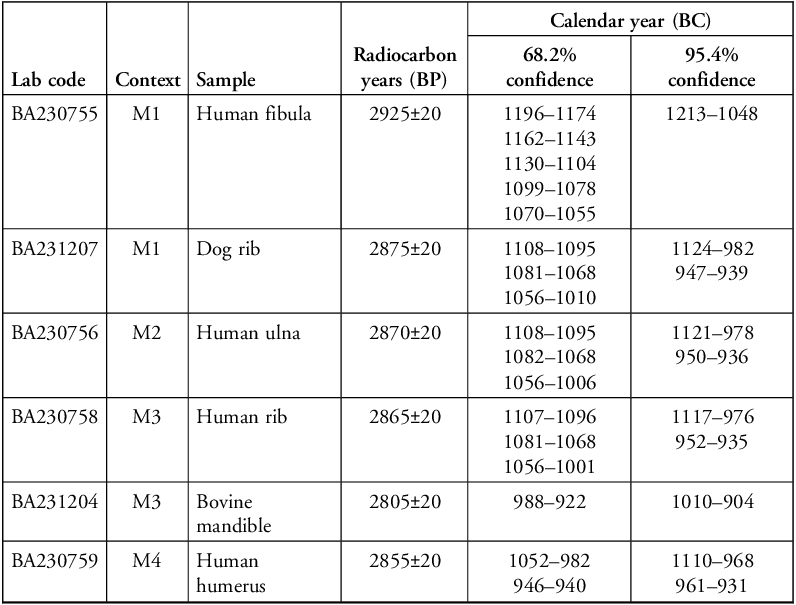
Recovered burial goods include bronzes, jades, bone artefacts, ornaments made of shell, gold objects, lithics, turtle carapaces, lacquer fragments and pottery (Figure 6). The bronze inventory consists primarily of chariot fittings (yokes, axle caps, small bells, a knot opener, bosses and other ornaments), weaponry (arrowheads) and tools (axes, ring-handled knives), most exhibiting recognisably Anyang decorative motifs such as taotie faces, cicadas, dragons and geometric patterns (spirals, diamonds, triangles). The jades resemble jades from Anyang, including knot openers, parrot-shaped plaques, monster-face ornaments, fish pendants, bi disks and arc-shaped pendants. The bone artefact repertoire features hundreds of arrowheads, divination materials (turtle plastrons, alligator scutes) and ritual objects (whip spikes, yoke ornaments, spatulas), the carvings on the spatulas again matching common Anyang designs. Shell ornaments also resemble Anyang examples (bosses, fish plaques), but the gold items (one boss, three spiral earrings) belong to distinctive Loess Highland types. The only pot is a Lijiaya-culture jar with diamond-spiral motifs. Lacquer fragments feature Anyang-derived imagery (taotie, dragons). Radiocarbon dates on associated osteological materials put the cemetery between 1250 and 930 BC (at 95.4% confidence; Li et al. Reference Li2024; see Table 1), in other words between the Yinxu II and early Western Zhou periods. Artefact typologies favour the first half of this interval.
Burial goods from the Houliujiata cemetery (not to scale): 1) si-bone spatula (M3:03); 2) turtle plastron (M1D1:069); 3) xi-knot opener (M1:18); 4) ring-handled knife (M3:06); 5) ornament (M1:69); 6) ornament (M1:5); 7) pao-boss (M4D2:011); 8) turquoise ornament (M1:47); 9) chariot fitting (M1:3); 10) pao-boss (M1D1:070); 11) pao-boss (M1:37); 12) pao-boss (M1D1:043); 13) gold earring (M4D2:07); 14) ornament (M1D1:025); 15) jade (M1D1:017) (after Shaanxi Provincial Institute of Archaeology et al. 2024b: figs. 15, 16, 20, 35, 55, 58, 69 & 71, pl.).

Radiocarbon dates for Houliujiata cemetery (after Li et al. Reference Li2024).

Table 1 Long description
The table presents radiocarbon dates and their corresponding calendar years for different samples from the Houliujiata cemetery. It includes six rows and five columns. The columns are labeled Lab code, Context, Sample, Radiocarbon years (BP), and Calendar year (BC). The Calendar year (BC) column is further divided into two sub-columns: 68.2% confidence and 95.4% confidence. Each row lists the lab code, context, sample type, radiocarbon years before present (BP), and the corresponding calendar years with their confidence intervals. The samples include human fibula, dog rib, human ulna, human rib, bovine mandible, and human humerus. The radiocarbon years range from 2805±20 to 2925±20 BP, and the calendar years range from 930 BC to 1196 BC.
As the first documented high-status burial complex from the Yinxu-period Loess Highland, the Houliujiata cemetery is a major discovery, providing a secure and contemporaneous archaeological context for the century-long accumulation of stray bronze finds. While the artefacts show strong affinities with Anyang, particularly in bronze types, jade styles and decorative motifs, the burials show distinct local practices: in-chamber chariot deposition (in contrast to the separate chariot pits observed at Anyang), absence of a waist pit (located under the person’s waist) below the coffin (yaokeng), absence of human sacrifice (Sun et al. Reference Sun2024) and use of a single large coffin (guan) or burial chamber (guo) instead of a nested pair. The persistence of local mortuary customs and selective adoption of Shang material culture suggest that the tomb occupants were Indigenous elites, perhaps regional chiefs (Shaanxi Provincial Institute of Archaeology et al. 2024b).
Yutaliang
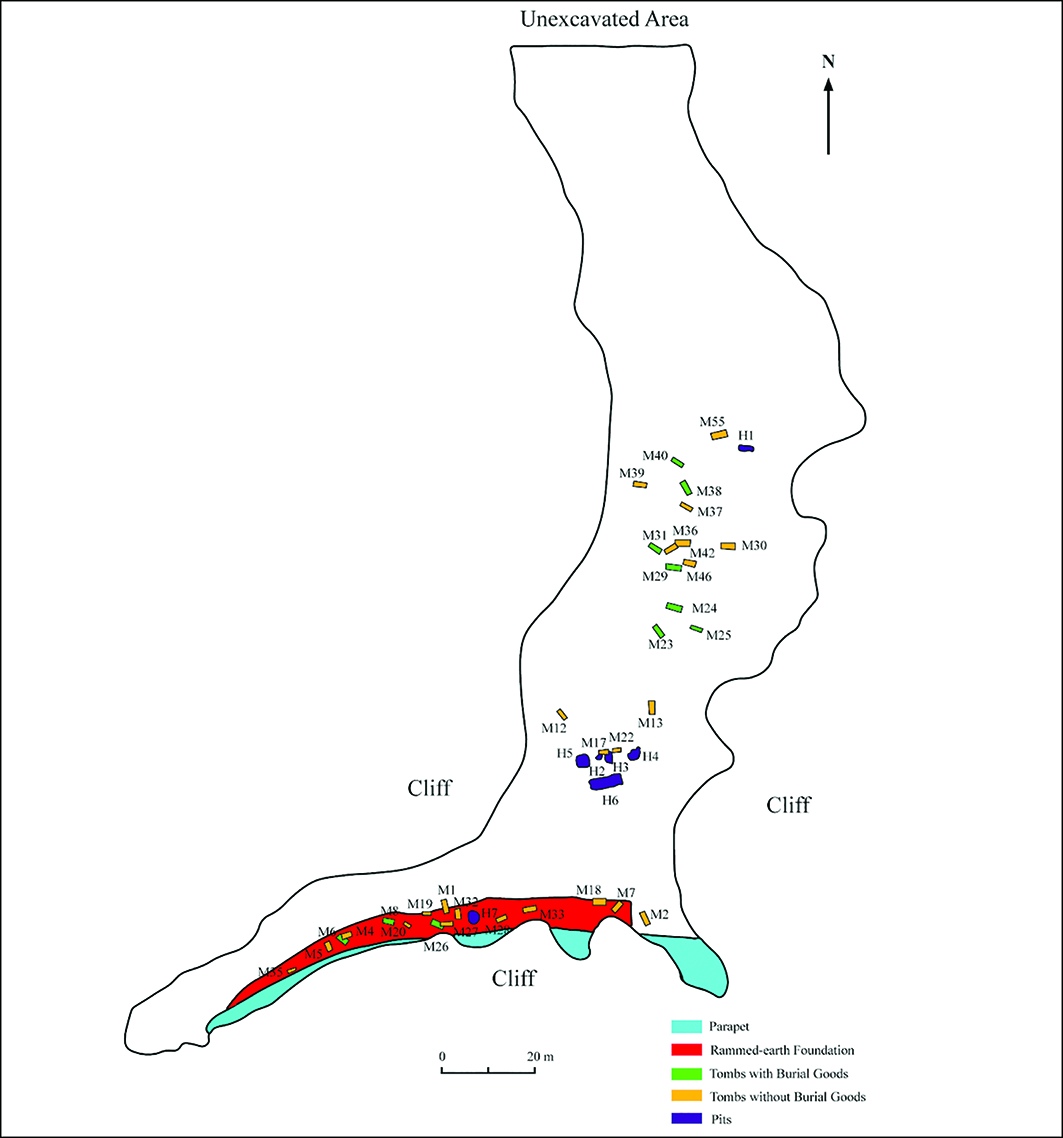
The Yutaliang cemetery, situated on a hill 500m south of Zhaiyuangai, contains 33 rectangular shaft tombs cut into a hillslope (Figures 1 & 7). Partly looted, these tombs range from 1 to 4m2 in area. Most individuals seem to have been interred in wooden coffins in a supine extended position. In contrast with Houliujiata, only 10 of the tombs contained grave goods (green in Figure 7). The modest offerings, including pottery, bronze tools/weapons, jade ornaments, seashells and one necklace, were placed inside the coffins. Typological analysis shows predominantly local material culture, with only a few Central Plain items, such as tanged dagger-axe blades (ge). Combined with the small tombs and modest grave goods, this suggests that the cemetery served a non-elite population. According to the excavation report, the radiocarbon dates for the human bones fall between 1227 and 1000 BC (Shaanxi Provincial Institute of Archaeology et al. 2024c), contemporaneous with Yinxu II–IV.
Plan of the tombs at Yutaliang cemetery (modified after Shaanxi Provincial Institute of Archaeology et al. 2024a: fig. 32).

More than 30 fragments of clay moulds and models for bronze casting have been recovered from the fill of a rammed-earth foundation along the southern cliff of the locality (red in Figure 7). These bear finely executed decoration in Anyang style, including spirals, diamonds, borders of small circles, dragons and taotie faces. Some are recognisable as belonging to moulds for ornamental bosses, chariot fittings or typical Anyang vessel types (gui, bu, gu and zhi) (Figure 8). The quantity of production debris is limited, suggesting that bronze casting at Zhaigou was conducted on a relatively small scale. Similar casting debris has been reported at other Lijiaya culture sites, such as Xinzhuang (Chong & Sun Reference Chong and Sun2019) and Lijiaya (Shaanxi Provincial Institute of Archaeology 2013), suggesting that small-scale bronze production may have been practiced more widely in the Loess Highland. Thus, the metallurgical evidence from Zhaigou is perhaps best understood as reflecting localised production organised by regional elites rather than large-scale, state-directed manufacture. The ability to produce bronzes using Anyang-related techniques indicates that Anyang metallurgical expertise and an Anyang artefact repertoire had been transmitted to the Loess Highland. Anyang-style metallurgical activities at a site where burials contain a mix of local and Anyang-style artefacts imply substantial interactions between cultures.
Metallurgical remains (moulds for casting) from Yutaliang (not to scale): 1) IT032087➂:28; 2) IT032088➀:2; 3) IT032088➂:14; 4) IT032088➂:16; 5) IT032089➂:8; 6) IT032087➂:9 (after Shaanxi Provincial Institute of Archaeology et al. 2024a: figs. 38–43).

Regional surveys and excavations in the Loess Highland are ongoing. Already nine large tombs, some bigger than Houliujiata M1, have been found 17km south of Zhaigou at a site called Wayaogou (Shaanxi Provincial Institute of Archaeology 2025). The finds reported in the present article nevertheless provide ample material to revisit aspects of social development in the Yinxu-period Highland, not least inter-regional interaction, technology transfer, innovation in ritual and social stratification.
Social stratification of Lijiaya settlements
Architectural remains and burials indicate that Lijiaya social stratification was on the rise in the Yinxu period. A settlement hierarchy is apparent in a three-tiered architectural system differentiated by scale, construction quality and functional complexity (Figure 9). Monumental complexes built on elevations occupy the top tier, for example the Zhaiyuangai complex at Zhaigou (6000m2), structure A1F1 at Lijiaya (1066m2) and Houlaoyegai F1 at Xinzhuang (4200m2). These elite compounds resemble contemporaneous structures in the Anyang palace district, such as the B group buildings (6300m2 area excavated; Shi Reference Shi1959). Their symmetrical layouts, axial planning and substantial material investment suggest multifunctional use as ceremonial, administrative and perhaps residential spaces for ruling elites. As soil erosion and human activity have destroyed most building remains, only the Zhaiyuangai complex has so far been fully excavated at the Zhaigou site. However, evidence from other Lijiaya sites helps reconstruct the lower tiers of the settlement hierarchy. The middle tier is currently represented by only a single structure, Zaowanpan F1 at Xinzhuang (48m2), which has corridors on its perimeter, and functional analysis is limited by incomplete publication. At the bottom of the hierarchy are modest residential units (less than 25m2) containing hearths, everyday artefacts and simple domestic features not encountered in the elite compounds. Elite residential zones have not yet been identified; perhaps they were located on rammed-earth platforms near Zhaiyuangai. Nevertheless, the architectural evidence indicates the existence of social hierarchies in the Loess Highland that parallel without exactly matching those of contemporaneous Shang urban centres.

Hierarchy is also apparent in Highland cemeteries, most obviously in the contrast between the elite Houliujiata cemetery and the more modest Yutaliang burial ground. A three-tiered classification has also been proposed for Yinxu-period tombs in northern Shaanxi (Sun et al. Reference Sun2024). First-rank tombs, exemplified by Houliujiata M1 (surface area 227m2), occupy isolated ridge-top locations and have ramps. Though they are generally smaller than tombs at the Anyang royal cemetery (e.g. Xibeigang M1500 at 333m2; Liang & Gao Reference Liang and Gao1974), they are larger than Shang burials found elsewhere (e.g. Subutun M1 at 160.5m2; Shandong Provincial Museum 1972) and on this account have been attributed to local chieftains. Second-rank tombs (10–100m2), including Houliujiata M3 (90.5m2) and M4 (83m2), are around the scale of elite tombs that rank just below the tombs from the royal cemetery (typically 20–70m2). Third-rank tombs (less than 3m2), as seen at Yutaliang, contain few or no grave goods and represent non-elite burials. This hierarchy is much simpler than the seven-rank system described by Anyang archaeologists (Institute of Archaeology, Chinese Academy of Social Sciences 2003: 338–51), possibly reflecting the smaller Highland population, but the monumental investment in elite tombs nevertheless confirms the consolidation of political authority by elites who adapted Shang burial practices to local needs.
The sociopolitical landscape of the Yinxu-period Highland
The Anyang oracle bone inscriptions, discovered in 1898 or 1899, record divinations made by the last nine kings of the Shang dynasty (1250–1046 BC). They mention non-Shang polities (identified as such by the suffix fang) occasionally as trading partners but more often as allies or enemies: Guifang, Tufang, Gongfang and others. Though they give scant clues to the location of these polities (revealing, for instance, that news of a border attack reached the Shang king a few days later without indicating where the border was located), some were certainly in the Loess Highland (see e.g. Zou Reference Zou1980: 274–81; Lin Reference Lin1981; Li Reference Li1988; Sun & Lin Reference Sun and Lin2010; Han Reference Han2016). Thus, when Yinxu-period artefacts and sites came to light in the Highland, attempts were made to connect them with the names of the fangguo (“fang polities”) (e.g. Zou Reference Zou1980: 280–81; Lü Reference Lü1990; Tang Reference Tang2000). Such associations were largely unfounded and uninformative (Cao Reference Cao2021: 3): the polity names represent the Anyang kings’ view of their world, which was not necessarily well informed or unbiased, and the reports are largely only concerned with the targets of Shang campaigns or fang attacks.
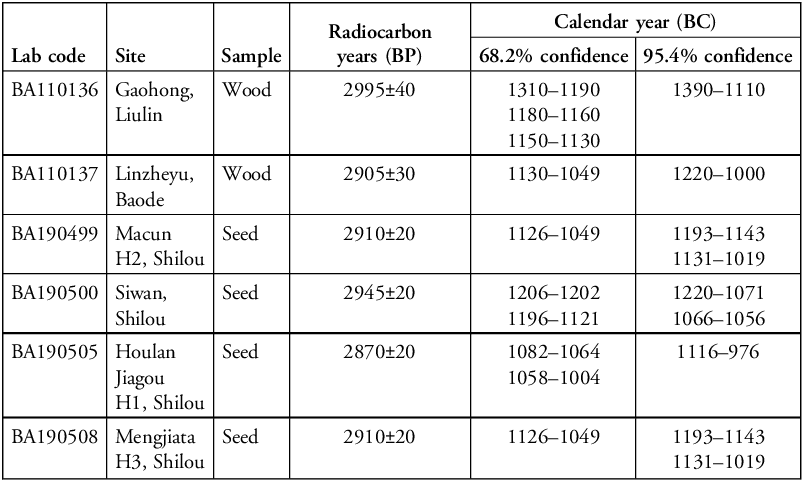
No archaeological indicators of a centralised Highland polity comparable to the Shang dynasty in the Central Plain have yet been found, though a systematic survey found large settlements in Shilou county that typically consist of a core area (1–2ha) surrounded by smaller sites ranging from several hundred to a thousand square metres (Cao Reference Cao2019, Reference Cao2021: 50–53). These settlements may have been neighbour polities on equal terms. Zhaigou, consisting of Zhaiyuangai (2ha) and a scattering of smaller sites, was probably a settlement of the same kind. The pattern seen at Shilou seems to recur in Qingjian, where a landscape of small, independent polities is suggested by four contemporaneous Lijiaya settlements, all within 20km of one another and all with stratified cemeteries, public architecture and metallurgical remains (Figure 10). A settlement that controlled all the hamlets within a 10km radius would have been rather like a modern township-scale territory (Sun et al. Reference Sun2024). Lijiaya culture sites in Shilou have radiocarbon dates that fall mostly between 1220 and 1000 BC (at 95.4% confidence; Cao Reference Cao2021; see Table 2), suggesting that they were approximately contemporaneous with Zhaigou. If the pattern at Shilou and Qingjian was replicated elsewhere, the Yinxu-period Loess Highland could have supported dozens of peer polities, Zhaigou among them, forming a political landscape quite different from the Central Plain’s hierarchical urban system. In this landscape, elites commanded considerable authority, evidenced by their buildings and tombs, but only within small areas.
Excavated sites of the Lijiaya culture (map by Yuan Wang).

Radiocarbon dates for some Lijiaya Culture sites (after Cao Reference Cao2021).

Table 2 Long description
A table with six rows and five columns comparing radiocarbon years and calendar years for various archaeological sites. The columns are labeled Lab code, Site, Sample, Radiocarbon years (BP), and Calendar year (BC). The Calendar year (BC) column is further divided into two sub-columns: 68.2% confidence and 95.4% confidence. Each row provides data for a specific site, including the lab code, sample type, radiocarbon years, and corresponding calendar years with confidence intervals. Row 1: Lab code BA110136, Site Gaohong, Liulin, Sample Wood, Radiocarbon years 2995±40, Calendar year (BC) 1310–1190, 1180–1160, 1150–1130, 1390–1110. Row 2: Lab code BA110137, Site Linzheyu, Baode, Sample Wood, Radiocarbon years 2905±30, Calendar year (BC) 1130–1049, 1220–1000. Row 3: Lab code BA190499, Site Macun H2, Shilou, Sample Seed, Radiocarbon years 2910±20, Calendar year (BC) 1126–1049, 1193–1143, 1131–1019. Row 4: Lab code BA190500, Site Siwan, Shilou, Sample Seed, Radiocarbon years 2945±20, Calendar year (BC) 1206–1202, 1196–1121, 1220–1071, 1066–1056. Row 5: Lab code BA190505, Site Houlan Jiagou H1, Shilou, Sample Seed, Radiocarbon years 2870±20, Calendar year (BC) 1082–1064, 1058–1004, 1116–976. Row 6: Lab code BA190508, Site Mengjiata H3, Shilou, Sample Seed, Radiocarbon years 2910±20, Calendar year (BC) 1126–1049, 1193–1143, 1131–1019.
The relationship between these local polities and the Shang state is still the subject of debate. When Anyang-style bronzes first began to turn up in large numbers in the Highland, they were interpreted as evidence of Shang control over the region (Hei & Zhu Reference Hei and Zhu1975). Later, it was proposed that they were plunder taken by nomads who raided Shang towns to seize livestock, slaves and other valuables (Li Reference Li1988; So & Bunker Reference So and Bunker1995; Hwang Reference Hwang and Li2015). In 2021, Cao Dazhi challenged both hypotheses. Using faunal and floral evidence, he argued that the Lijiaya people were not nomads but farmers with limited mobility (Cao Reference Cao2021: 36–48). While elite tombs sometimes contain Anyang-style bronzes, Cao notes that they also contain such items as gold earrings and local tools, ornaments and pottery, marking the tomb occupants as Indigenous. Differences between Anyang and Highland pottery assemblages argue for little interaction below the level of elites, suggesting that Anyang neither stationed officials in the region nor exerted direct political or military control (Cao Reference Cao2021: 133–35). Cao also observed that the bronzes found in the Highland are uniformly small, seldom inscribed and occasionally have odd features, concluding that, rather than the spoils of plundered towns, these bronzes were probably sent to the Highland by Anyang elites (Cao Reference Cao2021: 113–14), though the mould fragments from Zhaigou suggest that they might have sent casters as well.
Finds from the Houliujiata and Yutaliang cemeteries support this interpretation. As noted above, the Zhaigou elites selectively adopted Shang material culture but followed local mortuary customs and architectural style, suggesting that they were regional chiefs rather than commanders of Shang colonies or outposts. In the Yutaliang cemetery most finds, especially pots, are typical of the Lijiaya style, and there are no Shang burial features such as waist pits or sacrifices, indicating that the occupants were Indigenous. In the Linfen Basin of southern Shanxi, by contrast, several tombs at Jingjie follow Shang burial customs and contain many inscribed Anyang-style bronze ritual vessels and weapons. The excavators of Jingjie believe that it was a Shang colony or military outpost (Shanxi Provincial Institute of Archaeology 2006b: 205–208). The relationship between Anyang and the Loess Highland was instead one of cultural and material exchange without direct political subjugation.
The mechanisms for local social complexity
The self-sufficient communities and dispersed settlement pattern seen today in the Loess Highland must also have been influenced by its topography in the Yinxu period. Yet, the archaeological evidence for social complexity in this region shows that environmental constraints can be overcome by social mechanisms. The consolidation of power was likely facilitated by the construction of communal spaces, such as the Zhaiyuangai complex, that served both practical and ideological functions, creating nodes of collective identity, and by control over prestige-good economies, particularly bronze production and distribution.
Current archaeological evidence suggests a system in which elite power was derived less from territorial domination than from strategic control over exchange networks. In Shilou county, large settlements were positioned at transport nodes, particularly river confluences and narrow stretches of the Yellow River, suggesting that their primary function was as trading posts or ferries (Cao Reference Cao2021: 50–55). At these locations, local elites could regulate the flow of goods between the Shang heartland and more northerly regions while also accumulating prestige objects for themselves. The fact that high-status contexts contain an abundance of luxury items in distinctive Anyang styles while local production of such items was evidently limited (Hwang Reference Hwang and Li2015) supports a model in which Loess Highland elites traded local resources, like horses, cattle and sheep, and secondary products such as wool for Shang prestige goods and bulk commodities (Cao Reference Cao2021).
The chariots recovered by our excavation are strong testimony to long-distance interaction. Chariots appeared late in China, and the earliest Chinese examples are comparable to older Eurasian examples, such as those from the Sintashta culture in the southern Urals, thousands of kilometres from Anyang (Piggott Reference Piggott1974: 20–21; Barbieri-Low Reference Barbieri-Low2000: 46). The transmission route may have gone from Mongolia to Anyang by way of northern Shaanxi (Piggott Reference Piggott1974: 20–21, Reference Piggott and Denwood1978: 42–43; Wang Reference Wang1998: 386). Anyang elites who imported horses and learned to build and drive chariots from the Loess Highland might have exported bronzes or skilled artisans in return.
The discoveries at Zhaigou provide a valuable comparative case for understanding how highland societies interacted with neighbouring lowland societies and how different pathways toward social complexity could emerge in such settings. In the Maya region of South America, for example, highland and lowland societies often developed through interaction within broader regional networks rather than under the domination of a single political centre (Sharer & Traxler Reference Sharer and Traxler2006; Martin Reference Martin2020). By contrast, highland societies in mainland Southeast Asia developed as the result of strategies aimed at avoiding incorporation into expanding lowland states (Scott Reference Scott2009). The evidence from Zhaigou now suggests another trajectory, in which a highland community developed increasing social complexity through actively sustained interaction with a powerful lowland state and other surrounding societies while maintaining its own political autonomy. The Loess Highland therefore offers an important comparative case demonstrating that highland societies could follow diverse pathways toward social complexity.
Conclusion
The archaeological discoveries at Zhaigou provide new insights into the society of the Loess Highland during the Yinxu period. Monumental architecture, stratified cemeteries and evidence of craft production demonstrate that the site was not a simple rural settlement, but a community characterised by clear social differentiation and organised political authority. These findings indicate that complex local polities existed in the Loess Highland during the late second millennium BC.
At the same time, the sociopolitical landscape of these highland communities differed from that of the emerging Shang state centred at Anyang in the Central Plain. Communities in the Loess Highland remained smaller and less centralised than the Shang state but the archaeological evidence from Zhaigou demonstrates that these highland societies cannot be understood simply as occupying passive frontiers or marginal peripheries. Instead, the Yinxu-period Loess Highland appears to have been inhabited by multiple locally organised polities that maintained their own social hierarchies and political autonomies while participating in wider networks linking the region with the Central Plain. The presence of Anyang-style bronzes and other prestige goods suggests connections with the broader Shang cultural orbit, but these materials were incorporated into local social and political contexts rather than representing direct political control. The discoveries at Zhaigou therefore contribute to wider discussions of social complexity, illustrating a novel trajectory to social complexity in a highland area.
Funding statement
This research received no specific grant from any funding agency or from commercial and not-for-profit sectors.





 Open access

