In March 2017, a multistate outbreak of hepatitis A virus (HAV) infections began in the United States. Reference Foster, Ramachandran and Myatt1 The following December, Tennessee identified a statewide hepatitis A outbreak, primarily among people who use recreational drugs or were experiencing homelessness. At the time of this report, both outbreaks were ongoing. 2
HAV is spread by fecal–oral transmission. Hand washing with soap and water and vaccination are the primary prevention methods. HAV transmission from patients to HCWs has been described only occasionally. Reference Chodick, Ashkenazi and Lerman3 Previously reported nosocomial outbreaks have typically occurred when the index patient had undiagnosed HAV infection with diarrhea or vomiting, and when HCWs deviated from proper hand hygiene practices and standard precautions. Reference Chodick, Ashkenazi and Lerman3–Reference Goodman, Carder, Allen, Orenstein and Finton7
On January 2, 2019, the Tennessee Department of Health (TDH) learned of 2 HCWs at a 261-bed hospital (hospital A) with laboratory-confirmed HAV infection. We investigated to identify additional cases among HCWs or patients, to identify risk factors for infection, and to make recommendations to prevent HAV transmission.
Methods
We identified confirmed cases of acute HAV infection among employees or patients of hospital A during October 1, 2018–January 10, 2019. Confirmed cases met the 2012 Council of State and Territorial Epidemiologists clinical case definition for hepatitis A 8 : an acute illness with discreet onset of any sign or symptom consistent with acute viral hepatitis and jaundice or elevated alanine aminotransferase (ALT) or aspartate aminotransferase levels (AST). These cases were laboratory confirmed to have HAV immunoglobulin M [IgM] antibodies.
The TDH surveillance data were reviewed to identify additional cases reported from hospital A and 2 other hospitals (hospitals B and C), which had potential epidemiologic links with cases among hospital A HCWs or patients. HCWs with suspected or confirmed infections were interviewed by phone or in person with a standardized questionnaire to evaluate their exposures (eg, food or contact with ill patients), activities (eg, food preparation and sharing of work assignments), and use of hand hygiene and standard precautions. Patient medical records and hospital administrative records (eg, work shifts, assignments, and responsibilities) were reviewed to identify any common exposures. A site visit to hospital A was conducted to assess knowledge of hand hygiene, standard precautions, and cleaning and disinfection practices among interviewed HCWs.
Serum specimens from ill persons were sent to the Centers for Disease Control and Prevention for HAV RNA testing using PCR, and all positive HAV RNA samples were sequenced to determine the viral genotype.
Results
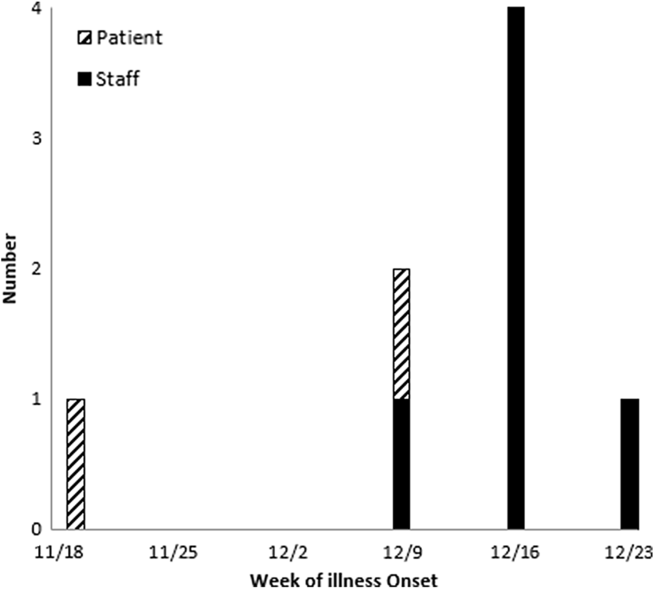
In total, 6 HCWs and 2 patients from hospital A with laboratory-confirmed HAV infection were identified. Illness onset dates ranged from November 19, 2018, to January 4, 2019, with the first infection occurring in a male patient (Fig. 1). No cases of HAV infection were identified among HCWs or patients from the 2 other hospitals (hospitals B and C), and no secondary cases were identified among family members of infected HCWs or among patients cared for by infected HCWs during their infectious periods. None of the infected HCWs in hospital A worked at hospital B or C.
Epidemic curve of hepatitis A virus infections among healthcare workers (HCWs) and patients by week of illness onset in hospital A, Tennessee, November 2018 through January 2019.

Infected patients
The index patient was initially treated at hospital B during November 2–November 19, 2018, for sepsis, endocarditis, pneumonia, and injuries sustained from a fall after injecting methamphetamine. At admission he was anicteric and had nausea and diarrhea (that were attributed to drug withdrawal), and his serum bilirubin (3.3 mg/dL), ALT (71 U/L), and AST (92 U/L) levels were elevated. On November 19, the patient, who was homeless, was transferred to hospital A to receive long-term intravenous antibiotics. He was anicteric with diarrhea on admission and was treated in the medical-surgical unit of hospital A from November 19 to November 28. As his condition deteriorated, he had episodes of incontinence; however, there were no episodes of gross fecal contamination and he was not placed on contact precautions. On November 28, after an episode of respiratory arrest, he was moved to the intensive care unit (ICU) of hospital A and was treated there until December 4. On November 28, the index patient had a positive anti-HAV IgM test and his ALT (35 U/L) and AST (18/U/L) were within normal limits; however, his HAV infection remained undiagnosed and he was not placed on contact precautions. While in the ICU, nursing staff managed his diarrhea and reported that it was not severe enough to require a specific fecal management system. He was discharged on December 4 to hospital C, and he died on December 16, 2018. On January 1, 2019, HAV RNA was detected in a serum sample collected on November 28, 2018, confirming that the patient had an active HAV infection.
The second patient likely acquired HAV infection at hospital A through nosocomial transmission from the index patient. The second patient did not have independent risk factors for HAV infection but was hospitalized in a room adjacent to the index patient for 6 days in the medical-surgical unit. Both patients were cared for by the same medical personnel for 10 of 12 shifts, 2 of whom were HCWs who developed HAV infection (Fig. 1). The second patient’s hepatitis A symptom onset occurred 23 days after being hospitalized in the room adjacent to the index patient and during the same timeframe as the HCWs who became ill.
HCWs with suspected or confirmed infection
All ill HCWs were women, with a mean age of 50 years (range, 33–62), and all were employed as a registered nurse (n = 2), a patient care assistant (n = 2), a certified nurse assistant (n = 1), or a dietary worker (n = 1). HCW illness onsets occurred within a 15-day span from December 20, 2018, to January 4, 2019, consistent with a single exposure source within hospital A (Fig. 1). Of the 6 HCWs, 5 were interviewed. No common food exposures, history of foreign travel, recreational drug use, or men who have sex with men were identified.
Approximately 1 month before their illness onsets, all 6 HCWs were exposed to the index patient during his infectious period. The ill HCWs worked at hospital A during the index patient’s hospitalization and 4 HCWs provided direct care to him. The other 2 ill HCWs likely interacted directly with the index patient, based on their routine duties as a dietary worker and patient care assistant.
Infection control breaches
During a TDH site visit to hospital A, inappropriate use of personal protective equipment was observed, including inconsistent use of gowns and gloves in contact precaution rooms. Interviews identified the potential for breakdowns in standard precautions and cross contamination. For example, none of the interviewed HCWs were able to identify when, how, or who was responsible for cleaning equipment commonly used by HCWs for multiple patients (eg, computers on wheels, thermometers, or glucometers). Additionally, HCWs reported a range of hand hygiene practices from appropriate hand hygiene to wearing double gloves so they could remove the outer layer and have a remaining set of clean gloves. Some HCWs reported they only wore gowns when patients were on contact precautions. If a patient was not on contact precautions, some HCWs said they would use an item, such as a pillowcase, to create a barrier to prevent contact with diarrhea instead of wearing a gown.
Laboratory results
In total, 7 serum specimens (from 5 ill HCWs and 2 patients) were positive for HAV RNA by PCR, and sequencing revealed that all belonged to HAV genotype 1b, which matched the only locally circulating HAV strain.
Discussion
We describe a nosocomial outbreak of hepatitis A among patients and HCWs, likely resulting from exposure to a single patient with undiagnosed HAV infection at one hospital. The delayed recognition of the index patient’s HAV infection and multiple breakdowns in routine infection control practices contributed to the outbreak.
The index patient had a history of substance use and homelessness (both risk factors for the statewide hepatitis A outbreak) and clinical signs of HAV infection; however, he was not jaundiced at admission. Because he presented with complaints unrelated to hepatitis, his signs and symptoms were attributed to other conditions, resulting in a missed diagnosis. During an ongoing community hepatitis A outbreak, medical providers should have a low threshold for considering HAV infection in a person with risk factors and signs and symptoms consistent with HAV infection.
Fecal–oral transmission of HAV in this outbreak was likely multimodal and included person-to-person transmission (eg, patient to HCW transmission) and fomite transmission (eg, common equipment used with multiple patients). The transmission of disease from patient to HCW and nosocomial transmission to another patient indicated breakdowns in standard precautions, hand hygiene, and disinfection practices. Hospitals should enforce adherence to proper hand hygiene and standard precautions and should develop and enforce policies for routine disinfection of shared equipment.
Because healthcare-associated HAV transmission has been rarely reported, hepatitis A vaccine is not routinely recommended for HCWs. Hand hygiene and standard precautions effectively prevent healthcare-associated transmission. However, postexposure prophylaxis (PEP) with hepatitis A vaccine and immune globulin is important for preventing additional cases during an ongoing hepatitis A outbreak. Hepatitis A vaccination was recommended for anyone (patients and hospital employees) with an outbreak risk factor who had not been vaccinated. Reference Doshani, Weng, Moore, Romero and Nelson9,Reference Fiore, Wasley and Bell10 Timely communication between public health and hospital A resulted in rapid risk communication with exposed patients and administration of hepatitis A vaccine for PEP to 622 of 649 potentially exposed and unvaccinated employees (96%).
All of the ill HCWs identified in this outbreak continued to provide patient care after they developed HAV infection symptoms, including 2 HCWs who worked while jaundiced and 1 who was experiencing vomiting and diarrhea, thus putting additional patients and HCWs at risk. Hospital A’s sick leave policy effectively encouraged HCWs to work while ill by penalizing those using sick leave. The policy required the use of vacation time before being able to access sick leave, and HCWs had the potential to lose an annual bonus if they called in sick. Sick leave policies that mandate the exclusion of ill employees, without penalizing the employees, should be in place to prevent disease transmission among HCWs and patients. Reference Bolyard, Tablan and Williams11,Reference Seigel, Rhinehart, Jackson and Chiarello12
We recommended that the hospital prevent additional nosocomial HAV transmission with the routine use of appropriate hand hygiene, standard precautions, and routine disinfection. During community outbreaks, medical providers can reduce the likelihood of ongoing transmission resulting from a missed diagnosis by including hepatitis A in the differential diagnosis among patients who have a history of substance use and homelessness.
Acknowledgments
Melissa Barnett, Barry Honeycutt, Mark Moody, Sarah Dickenson, Gary Mayes, Stacey Bosch, Infection Preventionists from Hospital A provided assistance during this investigation.
Financial support
No financial support was provided relevant to this article.
Conflicts of interest
All authors report no conflicts of interest relevant to this article.