INTRODUCTION
The investigation of previously unexplored areas of the ocean continues to yield unexpected records of sponges (Van Soest et al., Reference Van Soest, Boury-Esnault, Vacelet, Dohrmann, Erpenbeck, De Voogd, Santodomingo, Vanhoorne, Kelly and Hooper2012). According to the Systema Porifera (Hooper & Van Soest, Reference Hooper, Van Soest, Hooper and Van Soest2002) the demosponge family Trachycladidae Hallmann, 1917 (order Hadromerida) contains two genera, Rhaphidhistia and Trachycladus, having an axial (or basally) compressed skeleton, and an extra-axial plumo-reticulate skeleton, with megascleres predominantly oxeas, less often strongyles and/or (tylo-)styles, in spongin-enforced multispicular tracts. The ectosomal skeleton is a crust of spinispirae microscleres (spined vermiform or straight spiraster-like spicules), with smooth microrhabds and/or spinispirae dispersed throughout the mesohyl. Rhaphidhistia Carter, Reference Carter1879 has spiraster-like spinispirae, with a long and straight shaft, but with spines forming a complete full turn around the circumference of the shaft, producing concentric spiral rows along its length; smaller, curly spinispirae may also be present (Hooper & Van Soest, Reference Hooper, Van Soest, Hooper and Van Soest2002).
Until now Rhaphidhistia has been found only in the Pacific and Indian Oceans with only two species, R. spectabilis Carter, Reference Carter1879 from Mauritius and R. mirabilis (Dendy, Reference Dendy1924, as Dotonella) from Three Kings Island, New Zealand (Hooper & Van Soest, Reference Hooper, Van Soest, Hooper and Van Soest2002). During benthic trawling carried out in the Colombian Caribbean, Atlantic Ocean, we found a specimen of a new species of Rhaphidhistia.
MATERIALS AND METHODS
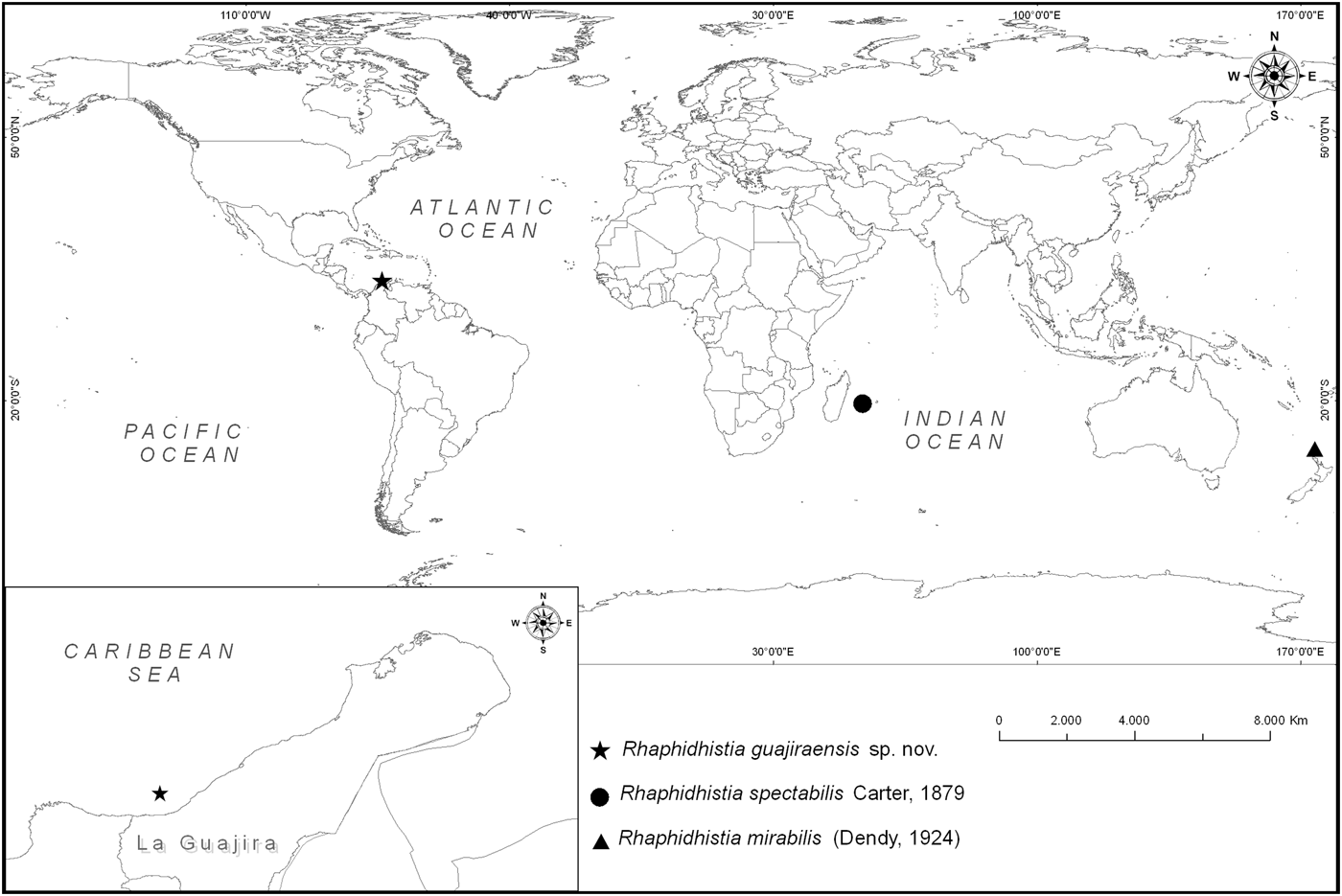
The specimen was collected during benthic surveys on the continental shelf of La Guajira peninsula in the Colombian Caribbean (Figure 1), carried out in 2005 during a joint project of Instituto de Investigaciones Marinas y Costeras — INVEMAR and Corporación Autónoma Regional de La Guajira — Corpoguajira. The sampling was carried out on-board the RV ‘Ancon’ with a bottom trawl net. General methodology of spicule preparation and tissue sectioning follows Zea (Reference Zea1987) and the terms follow Boury-Esnault & Rützler (Reference Boury-Esnault and Rützler1997). Twenty-five spicules were measured for each category. SEM images were taken with a FEI QUANTA 200 microscope in the electron microscopy laboratory of the Universidad Nacional de Colombia in Bogotá. Material was deposited in the Museo de Historia Natural Marina de Colombia — MHNMC at INVEMAR, Santa Marta, Colombia. The systematics follow the World Porifera Database — WPD (Van Soest et al., Reference Van Soest, Boury-Esnault, Hooper, Rützler, de Voogd, Alvarez de Glasby, Hajdu, Pisera, Manconi, Schoenberg, Janussen, Tabachnick, Klautau, Picto, Kelly, Vacelet, Dohrmann and Cristina Díaz2013) accessed in January 2013. INV-POR, Porifera collection at MHNMC.
Global distribution of the Rhaphidhistia species. Inset: detail of La Guajira, Colombian Caribbean (Atlantic Ocean) where Rhaphidhistia guajiraensis was discovered.

RESULTS
SYSTEMATICS
Phylum PORIFERA Grant
Class DEMOSPONGIE Sollas
Order HADROMERIDA Topsent, 1894
Family TRACHYCLADIDAE Hallmann, 1917
Genus Rhaphidhistia Carter, Reference Carter1879
DIAGNOSIS
‘Thinly or thickly encrusting growth forms, with 1–2 size categories of spinispirae, and if both are present, the smaller forming an ectosomal cortex. Choanosomal skeletal architecture ranges from loosely dispersed megascleres in vaguely plumose arrangement to hymedesmioid architecture, consisting of erect megascleres embedded in the substratum and protruding through the surface. Megascleres are oxeas or tylostyles. Microscleres are spinispirae in one or two size categories, the larger with a long straight shaft and bearing concentric spiral rows of spines forming a complete turn around the circumference of the shaft, producing a smooth inner curve, and the smaller with similar spination but with the shaft curled into c-, s- or contorted-shapes.’ (Hooper & Van Soest, Reference Hooper, Van Soest, Hooper and Van Soest2002).
TYPE SPECIES
Rhaphidhistia spectabilis Carter, Reference Carter1879. Type locality: Mauritius, western Indian Ocean (Hooper & Van Soest, Reference Hooper, Van Soest, Hooper and Van Soest2002).
TYPE MATERIAL
The holotype (INV-POR 1147) is stored in 95% ethanol. It was collected by INVEMAR-Corpoguajira project in 2005 at Station E242 (11°24′4.7′′N 73°23′7.4′′W) in the Colombian Caribbean, approximately 16 km west-north of the coastal town of Dibulla, La Guajira Department, Colombia, South America. This specimen was found on soft substratum (sand and mud) at a depth of 50 m.
Spicule dimensions of the holotypes of described species of Rhaphidhistia. Values are in μm, minimum–maximum, length/width.
*, refers only to the large size category; −, absent.
DESCRIPTION
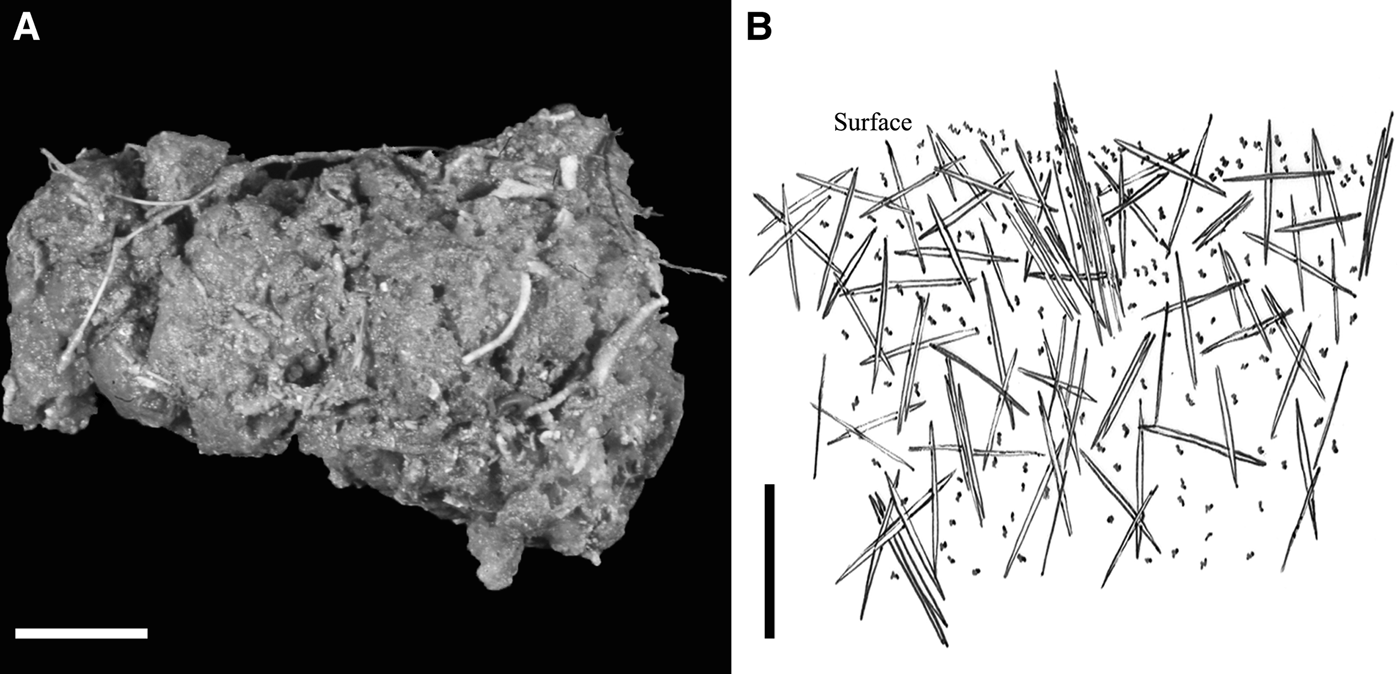
The specimen has a thickly encrusting form that agglutinates fragments of substratum forming an amorphous mass 6 mm thick and up to 5 cm wide and 10 cm long (Figure 2A). Surface rather densely covered with empty shells and some sand. Coloration in alcohol light-brown. Consistency compressible and fragile. Surface even and texture smooth to the touch in most of the specimen. Oscules and subdermal channels are not evident.
Rhaphidhistia guajiraensis sp. nov.: (A) holotype, probably broken off from being collected with a bottom trawl; (B) drawing of a cross-section of the skeleton. Scale bars: A, B, 1 mm.
Skeleton of sparse, non-continuous, multispicular bundles of megascleres and free spicules, confusedly arranged, both in sections near the base or near the surface, although with more bundles towards the surface; microscleres abundantly dispersed throughout the body. Ectosome pierced by projecting spicule tracts (Figure 2B); there is not a distinct cortex of microscleres.
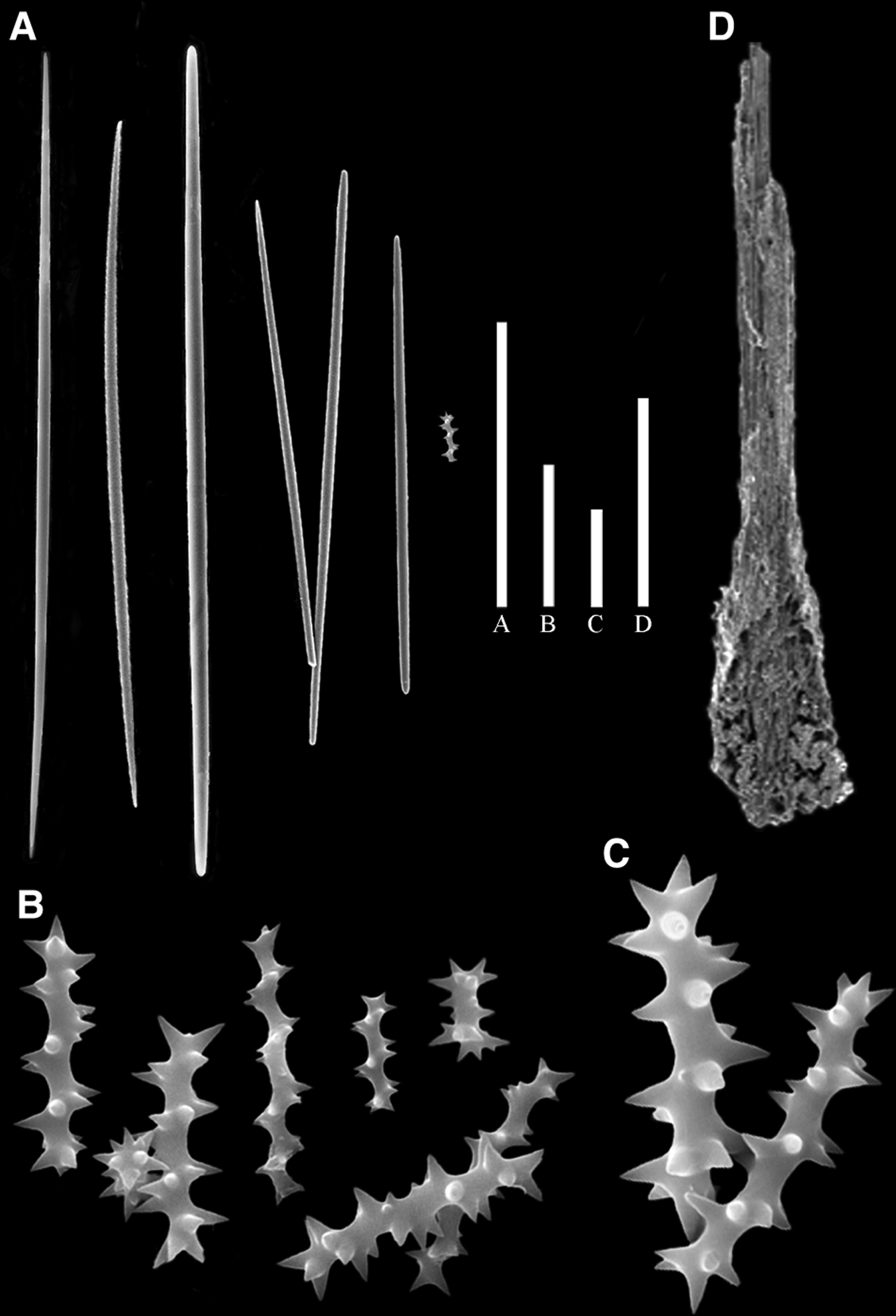
Megascleres oxea-like (Figure 3A), often asymmetric (anysoxea or styloids; iso- or anisostrongyloxea sensu Wiedenmayer, Reference Wiedenmayer1977), with slightly blunt endings, sometimes telescopic; the thinner, possibly developmental stages have sharp endings, 465–757 × 6.3–17.5 μm (N = 25). Microscleres spiraster-like spinispirae with straight or slightly spiraled shaft, in a wide range of sizes without clear size categories; spines robust, aligned in up to about four full spiral turns around the circumference of the shaft, leaving a smooth inner curve, 15–37 × 2–5 μm (N = 25) (Figure 3B, C). Measurements in Table 1.
Rhaphidhistia guajiraensis sp. nov.: (A) oxeas with slightly blunt endings (towards anisoxeas or styloids); (B) spiraster-like spinispirae of various sizes; (C) detail of two spiraster-like spinispirae; (D) choanosomal multispicular tract. Scale bars: A, 200 μm; B, 20 μm; C, 10 μm; D, 2 mm.
ECOLOGY
The specimen was collected on sand and mud bottoms in 50 m depth.
ETYMOLOGY
Named after the collecting area, La Guajira peninsula.
DISCUSSION
Rhaphidhistia guajiraensis sp. nov. fits the characteristics of the type species of Rhaphidhistia, R. spectabilis Carter, Reference Carter1879, both having a skeleton of slightly asymmetrical oxeas and straight-shafted spinispirae (Carter, Reference Carter1879; Hooper & Van Soest, Reference Hooper, Van Soest, Hooper and Van Soest2002). The oxeas of the type species are slightly shorter than the megascleres of R. guajiraensis sp. nov (Table 1). The spiraster-like spinispirae of both species are similar in morphology, although shorter and thinner in the new species (Table 1); this difference in size implies also a greater number of full turns of the spinal arrangement around the shaft (up to ten in R. spectabilis, up to four in R. guajiraensis sp. nov). Rhaphidhistia spectabilis is thin, with a skeleton apparently formed by erect, loosely arranged plumose spicule bundles, packed with microscleres (Hooper & Van Soest, Reference Hooper, Van Soest, Hooper and Van Soest2002). Rhaphidhistia guajiraensis sp. nov. appears to be more thickly encrusting, but has also scarce megascleres bundles, more abundant towards the surface, and microscleres are also dispersed throughout the body.
The third currently valid species of the genus, R. mirabilis (Dendy, Reference Dendy1924, as Dotonella) only shares with the other two species the presence of straight-shafted spinispirae, which in R. mirabilis are long (90–135 μm, Table 1) and have a thick shaft and small spines tightly packed in a very regular spiral fashion with many more turns. In contrast, spinispirae in R. spectabilis and R. guajiraensis sp. nov. are shorter (15–75 μm), more slender, and have prominent and more irregularly aligned spines, not unlike some spirasters of the genus Cliona (see Rützler, Reference Rützler, Hooper and Van Soest2002). Rhaphidhistia mirabilis further differs in having a hymedesmioid skeleton of tylostyle megascleres embedded in the basal layer and a superficial layer of an additional category of small curly spinispirae in which the spines occur in rows following the direction of the shaft and not spirally arranged (Hooper & Van Soest, Reference Hooper, Van Soest, Hooper and Van Soest2002). Thus, we disagree with Hooper & Van Soest (Reference Hooper, Van Soest, Hooper and Van Soest2002) in considering R. mirabilis spinispirae as Rhaphidhistia-like. The discovery of R. guajiraensis sp. nov. as closely similar to R. spectabilis confirms the existence of a natural group defined by the combination of anisoxea and spiraster-like spinispirae, and calls for the exclusion of R. mirabilis from Rhaphidhistia. Furthermore, the placement of Rhaphidhistia within family Trachycladidae also needs to be reassessed, for it is lacking the typical vermiform curly spinispirae. What is clear is that regardless of Rhaphidhistia's fate, both R. spectabilis and R. guajiraensis should go together. Solving these issues is out of the scope of this paper and may need molecular tools (e.g. Morrow et al., Reference Morrow, Picton, Erpenbeck, Boury-Esnault, Maggs and Allcock2012).
Whereas R. spectabilis is thinly encrusting, the new species is more massive and was found agglutinating free carbonate particles and skeletal remains of other invertebrates, a feature common in several other sponge species found in La Guajira shelf, apparently allowing these sessile organisms to thrive in soft bottoms (Díaz & Zea, Reference Diaz and Zea2008). Trachycladidae species are known from the shallow subtidal to depths of up to 220 m (Hooper & Van Soest, Reference Hooper, Van Soest, Hooper and Van Soest2002). Rhaphidhistia mirabilis was found in a depth of 180 m, while R. guajiraensis sp. nov was found at 50 m depth.
Rhaphidhistia spectabilis is found in the western Indian Ocean (Mauritius), while Rhaphidhistia mirabilis occurs in the south-western Pacific (New Zealand). Rhaphidhistia guajiraensis sp. nov is the first record of this genus for the Atlantic Ocean (Colombia). The Atlantic distribution of R. guajiraensis sp. nov is not unique for the family Trachycladidae, with two species of Trachycladus (T. minax (Topsent, 1888) and T. spinispirulifer (Carter, Reference Carter1879)) having eastern and southern Atlantic populations (Van Soest et al., Reference Van Soest, Boury-Esnault, Hooper, Rützler, de Voogd, Alvarez de Glasby, Hajdu, Pisera, Manconi, Schoenberg, Janussen, Tabachnick, Klautau, Picto, Kelly, Vacelet, Dohrmann and Cristina Díaz2013). The finding of R. guajiraensis sp. nov. in the western Atlantic adds one more case of sponge lineages that possibly underwent subgeneric differentiation during relatively ancient geographical events such as the Tethys Ocean and Pangaea supercontinent breakup in the Mesozoic era (e.g. Nichols & Barnes, Reference Nichols and Barnes2005; Hajdu & Desqueyroux-Faúndez, Reference Hajdu and Desqueyroux-Faúndez2008; Parra-Velandia, Reference Parra-Velandia2011; Fernandez et al., Reference Fernandez, Peixinho and Hajdu2012). However, phylogenetic analyses would be needed to find their areas of origin and subsequent influence of vicariance and dispersal events (e.g. Van Soest et al., Reference Van Soest, Hooper and Hiemstra1991; Fernandez et al., Reference Fernandez, Peixinho and Hajdu2012). Owing to the estimated great number of sponge species still to be described in well researched areas (e.g. Zea, Reference Zea1998) and throughout the world (e.g. Van Soest et al., Reference Van Soest, Boury-Esnault, Vacelet, Dohrmann, Erpenbeck, De Voogd, Santodomingo, Vanhoorne, Kelly and Hooper2012), it is not surprising that such unexpected records of species representing genera thought to be restricted to other oceans appear in previously unexplored or undocumented areas such as La Guajira peninsula continental shelf.
ACKNOWLEDGEMENTS
The authors thank Michelle Kelly (NIWA, New Zealand), who helped us in confirming the status of this new species. E. Hajdu (Museu Nacional, Universidade Federal do Rio de Janeiro, Brazil) greatly helped build up the discussion. This research was funded by the Corporación Autónoma Regional de La Guajira — CORPOGUAJIRA and by Instituto de Investigaciones Marinas y Costeras — INVEMAR, both Colombian government organizations. The specimen was collected under Decree 309, 2003, Colombian Ministry of the Environment and Sustainable Development. Contribution CTRB-1126 of INVEMAR and 382 of CECIMAR.
FINANCIAL SUPPORT
S. Zea's work was supported by Universidad Nacional de Colombia, Caribbean campus.