INTRODUCTION
Habitat selection in fish species is influenced by the degree of habitat structural complexity, the level of interspecific competition and the perceived risk of predation, as shown by several field and laboratory investigations (Werner & Hall, Reference Werner and Hall1977; Savino & Stein, Reference Savino and Stein1989; Utne et al., Reference Utne, Aksnes and Giske1993; Jordan et al., Reference Jordan, Bartolini, Nelson, Patterson and Soulen1996; Munday et al., Reference Munday, Jones and Caley2001; Schofield, Reference Schofield2003; Araújo et al., Reference Araújo, Silva, Santos and Vasconcellos2008). The occupation of different habitats by different fish species and the movement from one habitat to another as a species increases in body size enable the spatial resources in an ecosystem to be partitioned both among and within those species (Ross, Reference Ross1986). Such habitat partitioning reduces the potential for inter- and intraspecific competition for space and may have evolved as a result of competition for the same spatial resources and thus represent the ‘ghost of competition past’ (Connell, Reference Connell1983; Werner & Gilliam, Reference Werner and Gilliam1984; Kido, Reference Kido1997).
Each species is distributed according to its own genetic, physiological, and population characteristics and its own way of relating to environmental factors; hence no two species are distributed alike. Species respond in differing ways to factors that vary within communities in space and time, and such differences determine which species can coexist (Whittaker & Levin, Reference Whittaker and Levin1975). This principle of competitive exclusion is not the only response for coexistence mechanisms. Patterns of species occupancy of habitats depend on the densities of the interacting species, the competitive hierarchy among them, the presence of detectable intra-type variation in patch quality, and on their fundamental habitat preferences (Rosenzweig, Reference Rosenzweig1981, Reference Rosenzweig1991).
Many mechanisms may influence the distribution of fish within estuarine systems. Several investigators have suggested that biotic processes, such as competition and predation, may be influential in driving the spatial and temporal patterns of occurrence of fish in estuaries (Holbrook & Schmitt, Reference Holbrook and Schmitt1989; Lankford & Targett, Reference Lankford and Targett1994; Ogburn-Matthews & Allen, Reference Ogburn-Matthews and Allen1993; Ross & Epperly, Reference Ross, Epperly and Yáñez-Arancibia1985). In addition, a myriad of abiotic factors have been associated with the structure of these assemblages including salinity (Peterson & Ross, Reference Peterson and Ross1991; Szedlmayer & Able, Reference Szedlmayer and Able1996; Wagner & Austin, Reference Wagner and Austin1999), temperature (Peterson & Ross, Reference Peterson and Ross1991; Szedlmayer & Able, Reference Szedlmayer and Able1996) and turbidity (Peterson & Ross, Reference Peterson and Ross1991). Physical habitat characteristics, such as the surrounding vegetation and type of substratum also determine the use of space by estuarine fish species (Blaber, Reference Blaber2000). It thus follows that a similar suite of species will be expected to recur consistently in those areas with similar environmental attributes, i.e. habitat types (Erwin, Reference Erwin, Earll and Erwin1983; Ray, Reference Ray1991; Roff & Evans, Reference Roff and Evans2002). Some species will be able to tolerate environmental variability in nearshore marine waters to a greater extent than others, and will thus be likely to occur in more than one of those habitat types (Erwin, Reference Erwin, Earll and Erwin1983; Underwood, Reference Underwood, Raup and Jablonski1986).
Estuaries are peculiar transient areas where waters from continental drainage, which is directly associated with rainfall season, and tides are the main forces determining local environmental conditions, which vary markedly along the estuarine axis. Because of these harsh and changeable environmental conditions, mainly in salinity, only few fish species are adapted to the use of the estuarine system. In such areas the adapted fish species take advantage of high resources availability and comparatively low exploitative competition. Primarily, the adaptation to the estuarine area is directly linked to the species ability to adjust to changes in salinity. Such adjustment can be gradual, as occur in an estuarine system temporally closed, or suddenly, as is frequent in open estuaries dominated by tides (Whitfield, Reference Whitfield1999).
The Mambucaba estuary is a small microtidal open estuarine system that has a mixed area of tide and river flow interacting. Three different areas can be established in this estuarine system (middle and lower estuary): (1) the main estuarine channel that is approximately 120 m wide, where the mixture is more intense and dynamic (middle estuary), with a more homogeneous sandy substrate surrounded by sparse mangrove formation at the lower reaches and small villages at the upper reaches; (2) an adjacent estuarine lagoon of approximately 0.7 ha, permanently connected to the main estuarine channel by a narrow channel of 2 m at the upper reaches of the middle estuary, with more diverse substrate comprising muddy and sandy formation, surrounded in parts by mangrove and in other parts by ripraps, with environmental conditions comparatively more stable than the main channel; and (3) an estuarine plume (lower estuary) encompassing an extension of approximately 2.3 km from the river mouth with a maximum depth of 17 m with the most stable condition (higher depth and salinity) and the substrate formed by sand at the shallow areas to mud towards the deeper areas. In this system, the Gerreidae family is the most abundant group of fish.
Species of the Gerreidae are important models to assess the spatial partition in dynamic estuarine systems because of their high abundance and wide distribution in tropical and subtropical estuaries (Aguirre-León & Yáñez-Arancibia, Reference Aguirre-León and Yáñez-Arancibia1986; Matheson & Gilmore, Reference Matheson and Gilmore1995; Chaves & Bouchereau, Reference Chaves and Bouchereau1999). The main aim of this study is to determine the spatial pattern of distribution of five species of the Gerreidae in Mambucaba estuary: Diapterus rhombeus (Cuvier, 1829), Eucinostomus argenteus Baird & Girard, 1855, Eucinostomus gula (Quoy & Gaimard, 1824), Eucinostomus melanopterus (Bleeker, 1863) and Eugerres brasilianus (Cuvier, 1830). The following questions have been asked: what and where species are partitioning the estuarine habitat?; what are the coexisting species?; and does the species change habitat along the development?
MATERIALS AND METHODS
Study area
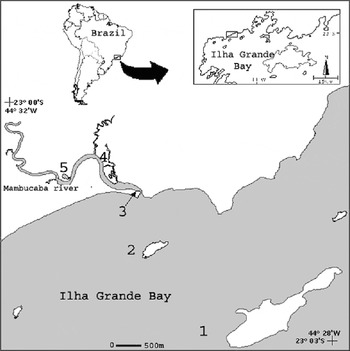
The Mambucaba River (23°01′37.30″S 44°31′15.22″W) has a small open estuary, on the coast of the State of Rio de Janeiro, south-eastern Brazil (Figure 1). The estuary is 5 km long with a mouth width ranging from 20 m at low tide to 40 m at high tide, and a maximum width of 10 m at the main channel. The region has semi-diurnal tides, with a mean variation ranging from 0.1 m at neap tides to 1.3 m at the highest tides, and is considered a microtidal estuary according to the McLusky & Elliott (Reference McLusky and Elliott2004) classification. The water circulation is mainly dependant on the tides and on a small freshwater input of about 13.8 m3·s−1 to 37.9 m3.s−1 (Francisco & Carvalho, Reference Francisco and Carvalho2004). Coastal littoral transport accumulates sediment at the estuary entrance and changes the main channel position. Averaged accumulated annual rainfall is 1770 mm, ranging from 180 mm in the dry season (June–August) to 1000 mm in the wet season (December–March).
Map of the study area with indication of the five sample sites.

Sampling methods
Sampling was conducted for two months in each season, between October 2007 and August 2008. A total of 106 samples, evenly distributed among seasons, were performed in five sites distributed in the two estuarine zones: 61 in the middle (main channel and estuarine lagoon) and 45 in the lower estuary. To minimize the confounding effects of variations in tidal stage and environmental conditions between each sampling period, as well as to standardize the sampling regime, all sites were sampled at flooding tide during full or new moon because in such conditions the tidal gradient is better defined. To ascertain the sampling time and flooding period, we measured salinity increase before the fishing procedure. Two consecutive days were required to sample all the sites.
Fish were collected at five sites: two in the lower estuary (1 and 2) and three in the middle estuary (3, 4 and 5); multiple active fish capture methods were used according to the habitat characteristics of each zone. In the lower estuary, fish were collected by bottom trawl with a 7 m long net with 20-mm mesh at the wings and 12-mm mesh at the cod end. The length of the ground rope was 8 m and the head rope was 7 m. The distance travelled was obtained using the coordinates registered at the beginning and end of each trawl with a global positioning system (GPS, Garmin III) used to determine the swept area. For each sample, the swept area (A) was estimated: A = D × h × X2, where D is the length of the path, h is the length of the head rope and X2 is that fraction of the head rope which encompasses the width of the path swept by the trawl (Sparre & Venema, Reference Sparre and Venema1995). In this study, the samples were taken at speeds between 2 and 2.5 knots and it was assumed that X2 = 0.6, with the swept area corresponding to approximately 3780 m2. Two sites (1 and 2) were sampled in the lower estuary. Site 1 was 2.3 km away from the river mouth, 17 m deep and had a muddy substrate. Site 2 was 900 m from the river mouth with greater influence of the estuarine plume, 10 m depth and featured a substrate comprising sand and vegetal organic debris brought by the river.
In the middle estuary, fish were collected by a seine of 40 m length, 5 m height and 6 m at the cod end. The net has 10 mm mesh between adjacent knots at the wings, 5 mm mesh at the central part and 2.5 mm at the cod end. The net was set up with the help of a small boat and hauls were performed perpendicularly to the margins at a standardized distance of 15 m. Each seine covered an area of approximately 450 m2, according to the following equation: A = D × L, where D is the distance from the margin (15 m) and L is the net length effectively used in the haul (30 m). Two sites (3 and 4) were located in the main channel while the third site (5) was a protected lagoon adjacent to the main channel in the upper part of the middle estuary. This latter site was 2 km away from the estuary mouth. Site 4 was in the main channel next to a mangrove formation between tidal channels, 500 m away from the river mouth with sandy substrate due to high dynamism of the channel, while site 3 was a sandy beach along a sandbank by the sea connection, with high dynamism and low physical structure.
A series of environmental variables were measured at each fish sampling occasion. Temperature, salinity and dissolved oxygen were determined using a multiprobe YSI 85. Turbidity was calculated using a Policontrol model AP2000 turbidimeter. Depth was measured with a Speedtech model SM-5 digital sounder. Three measurements of each variable were taken from water collected near to the depth in a Van Dorn bottle.
Data analysis
One-way analysis of variance (P < 0.05) was used to compare environmental variables and fish data (density and weight) among seasons for each site and zones, respectively, followed by an a posteriori Tukey honestly significant difference test (Zar, Reference Zar1996). Environmental data were previously log transformed using Log10(x + 1), where x is the raw value, to address the assumptions of normality and homocedasticity of the parametric analyses. A detrended correspondence analysis (DCA), performed on Log10(x + 1) transformed fish densities, was used to explore spatial and seasonal distribution patterns; this provides a powerful tool for identifying pattern in the structure of the populations.
Total length (TL) and total weight (TW) data for each species were submitted to the non-parametric analysis of variance to investigate possible spatial variations in the size of individuals. Whenever differences were detected in the body size of individuals along the estuarine sites, the Mann–Whitney test was applied to the data in order to quantify and establish those differences.
RESULTS
Environmental variables
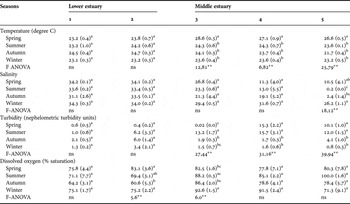
The temperature ranged from 20.9 to 29.3°C in the middle estuary, and from 19.4 to 26.3°C in the lower estuary. The middle estuary had values comparatively similar to the lower estuary during all seasons, except in spring. In the middle estuary the temperature was higher in spring, while in the lower estuary no significant seasonal difference in temperature was found (Table 1). Salinity ranged from 0.1 to 33.1 in the middle estuary (mixohaline), and from 17.9 to 35.1 in the lower estuary (mixo-polihaline). Seasonal changes in salinity were recorded only for the protected adjacent lagoon (site 5) in the middle estuary, with higher values in winter and spring and lower values in summer and autumn (Table 1). Turbidity ranged from 0.02 to 23.2 nephelometric turbidity units (NTU) in the middle estuary, and from 0.02 to 20.4 NTU in the lower estuary. The lowest turbidity values were recorded in the lower estuary. Seasonally, the highest turbidity was recorded in spring and summer except at site 3, which had the highest values in summer and the lowest in spring (Table 1). Saturation of dissolved oxygen ranged from 52.6 to 102.8% in the middle estuary, and from 38.9 to 93.6% in the lower estuary. Although some significant differences existed in dissolved oxygen between seasons, mean saturation values were always higher than 60% (Table 1).
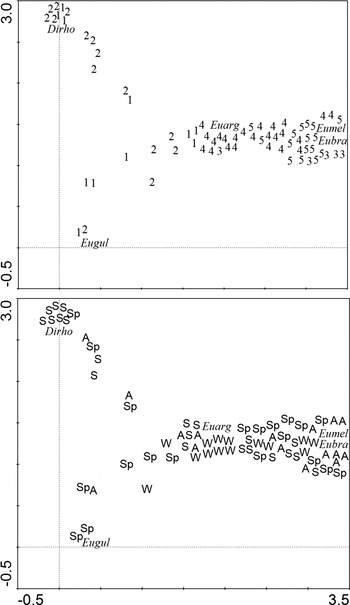
Ordination diagram from the first two axes of detrended correspondence analysis on the density of the five Gerreidae species with samples coded by sites (above) and seasons (below). Lower estuary, sites 1 and 2; midddle estuary, sites 3, 4 and 5. Species code: Dirho, Diapterus rhombeus; Eugul, Eucinostomus gula; Euarg, Eucinostomus argenteus; Eumel, Eucinostomus melanopterus; and Eubra, Eugerres brasilianus. Seasons: Sp, spring; S, summer; A, autumn; W, winter.

Means ± SE of environmental variables and among-seasons comparisons according to analysis of variance (ANOVA) for each site in Mambucaba River estuary. Superscript letters indicate significant differences levels from ANOVA.

*, significant (P < 0.05); **, highly significant (P < 0.01); ns, non-significant.
Fish composition
The Gerreidae family was represented by a total of 3188 individuals, weighing 32,217.57 g in the 106 samples carried out in this study. The mean density and weight estimated for the pooled samples were 5.7 individuals × 100 m−2 and 46.8 g ×100 m−2, respectively. The lower estuary had comparatively lower values (mean density = 0.2 individuals × 100 m−2; mean weight = 9.7 g × 100 m−2) than the middle estuary (mean density = 6.9 individuals × 100 m−2; mean weight = 76.1 g × 100 m−2). Diapterus rhombeus and E. gula were exclusively found in the lower estuary, whereas E. melanopterus and E. brasilianus were exclusive from the middle estuary. Eucinostomus argenteus was common in the two estuarine zones.
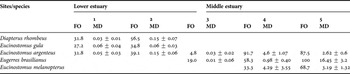
Eucinostomus argenteus was the most abundant species collected in the lower estuary accounting for 41.0% of the total number of Gerreidae, followed by D. rhombeus with 35.8% and E. gula with 23.2%. In the middle estuary, E. brasilianus was the most abundant species, accounting for 48.6% of the total number, while E. argenteus and E. melanopterus had similar relative abundance comprising 25.8 and 25.6% of the total number, respectively. Site 2 in the lower estuary had comparatively higher densities of E. argenteus and D. rhombeus compared with site 1 (Table 2), while E. gula did not change abundance irrespective of sites. In the middle estuary, E. brasilianus had the highest density at site 5 while E. argenteus and E. melanopterus had their highest density at site 4 (Table 2).
Frequency of occurrence (FO) and mean density (MD, number × 100 m−2) ± standard error, for the five Gerreidae species at the five sites in Mambucaba estuary.

Spatial and seasonal variation
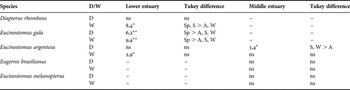
There is a clear spatial segregation between the species of Gerreidae, with D. rhombeus and E. gula occurring in the lower estuary only whereas E. brasilianus and E. melanopterus occurred in the middle estuary only. On the other hand, E. argenteus occurred in both the lower estuary and middle estuary. Seasonally, E. gula (density and weight) was more abundant in spring, and D. rhombeus (weight) was more abundant in spring and summer compared with the others seasons (Table 3). Eucinostomus argenteus (density) from the middle estuary was more abundant in summer and winter compared with autumn. No seasonal difference was found for E. brasilianus and E. melanopterus.
F values from one-way analysis of variance and comparisons (Tukey test) for density (D) and weight (W) for the five fish species between seasons in the lower and middle zones of the Mambucaba estuary.

Sp, spring; S, summer; A, autumn; W, winter; ns, not significant.
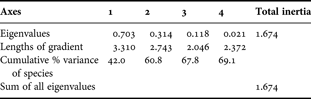
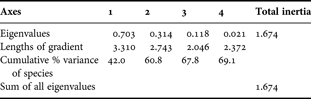
The DCA ordination plot on species density showed three distribution patterns, with two species being associated with the lower estuary, another two species associated with the middle estuary and one species in the middle of the diagram being associated with both estuarine zones (Figure 2). Diapterus rhombeus and E. gula were closely related to sites 1 and 2 while E. brasilianus and E. melanopterus were associated mainly with sites 4 and 5. Eucinostomus argenteus occurred in sites for both the middle estuary and the lower estuary, but had more close association with site 4. The main observed seasonal changes in fish abundance were found for D. rhombeus, that was associated with summer samples (Figure 2), and for E. gula that was associated with spring samples. The remaining species did not show indication of seasonal changes in densities (Figure 2). The first DCA eigenvalue (0.703) indicated that most of the variation (42.0%) within the species data set could be explained by the first DCA axis (Table 4). However, the second axis (eigenvalue of 0.314) also explained a large portion of the variation (18.8%). The remaining axes were not explanatory, thus, a two-dimensional ordination plot was sufficient to summarize the overall variation in species density.
Summary of detrended correspondence analysis on density of Gerreidae species for each axis in Mambucaba estuary.
Size distribution
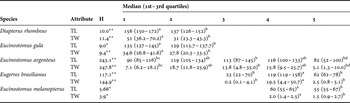
Total length and total weight data showed that the largest individuals of D. rhombeus and E. gula were found at site 1 compared with site 2, according to the Kruskal–Wallis test (Table 5). The smallest individuals of Eucinostomus argenteus were found at site 5, compared with the other sites. Site 4 (main channel) had the largest individuals of E. argenteus, E. brasilianus and E. melanopterus.
Results of the Kruskal–Wallis test (H) for the comparison of total length (TL) and total weight (TW) median of five fish species among the five sites of Mambucaba River estuary. The medians and quartiles for TL and TW indicate the variation in these attributes.

*, significant (P < 0.05); **, highly significant; superscript letters indicate significant differences levels from Mann–Whitney test.
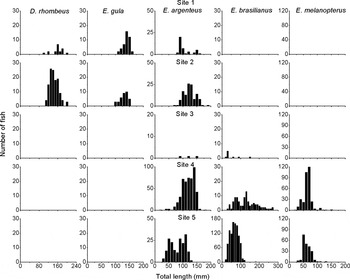
Gerreidae species exhibited size-specific habitat use across the estuarine gradient (Figure 3). In the lower estuary, the smallest Diapterus rhombeus (<150 mm TL) and Eucinostomus gula (<127 mm TL) individuals were mainly collected at site 2. The smaller (<70 mm TL) E. argenteus individuals were almost exclusively collected in the adjacent protect lagoon (site 5) while the largest (>125 mm TL) individuals were found almost exclusively at the main channel (sites 3 and 4) and at the lower (sites 1 and 2) estuary. Individuals of E. brasilianus smaller than 130 mm were found in both sites (4 and 5), although the largest (>150 mm TL) were exclusively collected at sites 3 and 4. Eucinostomus melanopterus had sizes ranging from 40–140 mm TL at sites 4 and 5, with modes of 50 mm at site 5, and 70 mm at site 4.
Length–frequency distributions for the five Gerreidae species at the five sites of the Mambucaba estuary.

DISCUSSION
Spatial partition seems to be the strategy developed by the 5 members of the Gerreidae family to coexist in the Mambucaba estuary, with two species being exclusive of the lower estuary (Diapterus rhombeus and E. gula) while two other species (E. brasilianus and E. melanopterus) were exclusive of the middle estuary. The fifth species (E. argenteus) was widely distributed being common in the two estuarine zones. The reasons for this pattern of spatial distribution are rather unknown. The wide coastal area in the lower estuary is hardly limiting the distribution of E. brasilianus and E. melanopterus in these reaches. Previous competition in the past between the species of Gerreidae could depict the present pattern (ghost of the past competition) with E. brasilianus and E. melanopterus retreating in the more harsh estuarine areas (middle estuary) where they could adapt more easily than the other co-familiar species. The middle estuary has more limited area, where the estuarine channel and the adjacent coastal lagoon comprise a more dynamic system with more changeable environmental conditions that were used by these species. Habitat selection in motile animals is a complex and dynamic function, synthesizing an organism's requirements for food, mates, avoidance of predators/competitors, perception of habitat availability, and ability to move between habitat patches. Interspecific competition has been shown to directly affect habitat selection in fish (Zaret & Rand, Reference Zaret and Rand1971; Werner & Hall, Reference Werner and Hall1977; Hixon, Reference Hixon1980; Larson, Reference Larson1980; Munday et al., Reference Munday, Jones and Caley2001). Additionally, fish make active habitat selection decisions based on their perceived risk of predation (e.g. Savino & Stein, Reference Savino and Stein1982, Reference Savino and Stein1989; Sogard & Olla, Reference Sogard and Olla1993; Utne et al., Reference Utne, Aksnes and Giske1993; Jordan et al., Reference Jordan, Bartolini, Nelson, Patterson and Soulen1996). Therefore, it is reasonable to suppose that previous competition and habitat selection have been performed by members of the Gerreidae family in the Mambucaba estuary that result in the present patterns of observed distribution.
Differences in composition of the Gerreidae family among the estuarine zones can be attributed, at least partially, to the large variability in environmental conditions in the middle estuary. Castillo-Rivera et al. (Reference Castillo-Rivera, Montiel, Añorve and Zárate2005) found the Gerreidae E. melanopterus and D. auratus in a protected coastal lagoon where the salinity changed between 0.5 and 33 throughout the year. These results are close to our findings that recorded E. melanopteurs in an area of wide change in salinity. On the other hand, salinity seems to act as a barrier for D. rhombeus and E. gula to colonize the estuarine channel. Even in those species known to be tolerant to wide salinity variation (0–26) (Barletta et al, Reference Barletta, Amaral, Correa, Guebert, Dantas, Lorenzi and Saint-Paul2008; Castillo-Rivera et al., Reference Castillo-Rivera, Montiel, Añorve and Zárate2005), quick changes in environmental condition that occur in the middle estuary can have contributed to the present pattern of distribution, limiting the occurrence of those species in the lower estuary where conditions are more stable. During the sampling period, we observed regular changes in salinity in the middle estuary as a result of flooding tides, with changes from freshwater conditions (salinity ≅ 0.1) to approximately 25 in less than 6 hours. Such harsh shifts in salinity can limit species distribution. The overriding view of estuaries is that the distribution of organisms is related to their ability to endure harshly fluctuating environmental conditions, in particular salinity (McLusky, Reference McLusky1971), which limit their ability to exploit the large food resources present in estuaries. In bay areas with low changes in salinity (e.g. Sepetiba bay, salinity range: 28.3–34.0) species of the Gerreidae family had only slight change in density all year round (Pessanha & Araújo, Reference Pessanha and Araújo2003). The main seasonal variation in densities was observed for D. rhombeus that was associated with summer samples and for E. gula associated with spring samples, with the remaining species not changing seasonally. Pessanha & Araújo (Reference Pessanha and Araújo2003) also found seasonal variation for D. rhombeus with peaks in the summer in a sandy beach in Sepetiba bay (another embayment close to Ilha Grande bay) which coincide with the findings of this study.
Although the Gerreidae species are generally present in high abundances in tropical estuaries (Aguirre-León & Yáñez-Arancibia, Reference Aguirre-León and Yáñez-Arancibia1986), D. rhombeus and E. gula had comparatively low densities (<0.15 individuals), which may be partly related to the habitat conditions, such as high depths, low turbidity and comparatively constant temperature and salinity of the lower estuary. On the other hand, the comparatively higher densities found in the middle estuary, can be associated with more structured habitat in the estuarine channel, with vegetated margins and more complex habitat and more turbidity that enables refuges for fish. One of the most basic attributes of a habitat is the degree to which it is structurally complex. In estuarine areas, structurally complex seagrass beds commonly support greater numbers of individuals and species of fish and invertebrates than adjacent unvegetated (i.e. bare mud/sand) areas (Orth et al., Reference Orth, Heck and Montfrans1984; Heck et al., Reference Heck, Able, Fahay and Roman1989; Ferrell & Bell, Reference Ferrell and Bell1991; Sogard & Able, Reference Sogard and Able1991). The highest turbidity of middle estuarine reaches is linked to nutrients trapping caused by the encounter of tides with the river flow (Blaber, Reference Blaber2000). An increased turbidity gradient from site 1 to site 5 was observed, being more conspicuous during the summer, when the rainfall influence is most pronounced. Some species take advantage of the high turbidity and hydrodynamism of sandy beaches that revolve the substrate enabling feeding and shelters for juvenile fish. Blaber & Blaber (Reference Blaber and Blaber1980) reported that turbidity impairs predation rates and increases food availability in shallow waters for juvenile fish.
Diapterus rhombeus and E. gula had a comparatively narrow size-range, which is an indication that only some part of their population uses the studied area. Comparatively smaller individuals were found in the site near to the mouth of the Mambucaba River, while the larger individuals were found in a deeper area with less influence of the estuarine plume. This suggests that this species may be using the sandy beaches adjacent to the estuary (not the estuary itself) as recruitment grounds, since Godefroid et al. (Reference Godefroid, Santos, Hofstaetter and Spach2001) found larvae and juveniles of E. gula in sandy beaches of Angra dos Reis, which is also located in the Ilha Grande bay.
The species recorded in the middle estuary showed a differentiated spatial pattern, with E. argenteus having comparatively higher density (4.6 individuals × 100 m−2) at site 4, and the smaller individuals in the adjacent lagoon. This is an indication of the high tolerance to salinity and that this species moves from estuarine zones to coastal marine adjacent areas as they reach larger sizes. Eugerres brasilianus had the highest densities in the adjacent lagoon (16.4 individuals × 100 m−2), where it occurred in comparatively smaller sizes (average size = 62 mm TL), which suggests that this species uses the lagoon as rearing grounds. Its high density suggests interspecific competition for space with other species that occur in the area with comparatively low densities. Eucinostomus melanopterus was collected in the highest density at site 4 (4.29 individuals × 100 m−2) but the smallest individuals were collected at the adjacent lagoon, suggesting that this latter area can be used as rearing grounds for this species. Site 3 had low frequency of individuals due to unstable conditions caused by tide flow.
The adjacent lagoon to the main estuarine channel (site 5) had the highest density among all other sites, with a large number of small-sized individuals, suggesting it to be rearing grounds for these species that occur in the middle estuary. The sheltered ambient and comparatively higher physical structural complexity (substrate muddy and sandy, mangrove formation, ripraps, etc) are favourable for such an area being used as rearing grounds (Araújo, Reference Araújo1992; Grift, Reference Grift2001). Such a protected area adjacent to estuarine channels should be considered as important rearing grounds for several fish species and environmental managers should consider its conservation in order to maintain the biodiversity in estuarine systems.
ACKNOWLEDGEMENTS
We thank Alexandre Araújo, André Luiz Balbino dos Santos and Hamilton Hissa Pereira for their help in the field work. We are particularly grateful to Aurea Maria de Oliveira Teixeira for invaluable laboratory activities. This study was partially financed by CNPq-Brazilian National Counsel for Research Development (Proc. 556298/2006–3 and Proc. 302555/2008–0).