Introduction
In 1977 two French men, Simon Nora, a high-level civil servant, and Alain Minc, an economist, co-authored a report entitled L'informatisation de la société to French president Valery Giscard d'Estaing, which was later translated into English and published as The Computerization of Society (Nora & Minc, Reference Nora and Minc1980). However, in a paper of the same title written in English and published in 1987, Minc simply transplanted the French word informatisation directly into English rather than sticking to the old translation computerization. However that was not the first time the word informatisation was used in the English language. One year before, the word informatization had appeared in an article published in the American magazine Dædalus:
-
(1) This is what the information society is offering as a by-product of a new stage in the mechanization of the economy and the informatization of culture. […] It is no accident that the phrase “artificial intelligence” has become such an important term within the culture of those responsible for the informatization of society, because, if intelligence can be artificial, then the randomness of history will disappear (Smith, Reference Smith1986: 165–6).
Thus began the long journey by which informatization would make its way into the Oxford English Dictionary (OED)Footnote 1 .
In China the lexical gap in English for the concept of ‘information-ization’ was first noticed in 2002 by Chinese translators faced with the English translation of the Chinese term 信息化 (xìnxīhuà), of which the stem 信息 (xìnxī) means ‘information’, and the suffix -化 (-huà) ‘-ize/-ization’. Unable to find an English equivalent, Wang (Reference Wang2002: 25) proposed translating the term into ‘to promote IT (for national economic and social development)’, which was endorsed by Jin (Reference Jin2003: 62), who dismissed the alternative informationalize as a ‘mechanical word-for-word translation’. However, Zhao (Reference Zhao2005: 62) favoured informationalization, arguing that -ize is one of the most productive suffixes in English, creating words like nationalize and globalize. He supported his argument with the fact that a Google search of informationalization instantly produced thousands of hits.
Following Zhao's article, a heated debate arose over how to translate xìnxīhuà (cf. Huang, Reference Huang2006; Wang, Reference Wang2007; Jin, Reference Jin2010, Reference Jin2011). After comparing the meanings and derivational processes of informationalization, informationization and informatization, Huang (Reference Huang2006) pointed out that informationization was semantically more accurate and had followed the conventions of English word formation more strictly. Doubting the acceptability of informatization and informationization by native English speakers, Wang (Reference Wang2007: 64) proposed “interpretative translation”, advocating terms like the application of information technology and computerization. Jin (Reference Jin2010, Reference Jin2011) questioned the reliability of using a Google search to justify the creation of a new word and dismissed informationalization as a made-up word, as no entry for this word could be found in any English dictionary. In the debate, although the French word informatisation was also mentioned, it did not receive much attention because it presupposed the existence of the verb informatise, which did not exist in English and did not represent a lexical gap. While the debate in China was still going on, informatisation, now spelled informatization, found its way into the online edition of the OED in March 2010.
Thanks to its inclusion in the OED, there has been no more debate in China in recent years about how to translate xìnxīhuà into English. But questions still remain as to whether the OED might have included informatization earlier to meet the Chinese translators' crying need for information about the English translation of xìnxīhuà and why it is informatization rather than its variants such as informationization and informationalization that was allowed into the OED.
Criteria for new inclusions in the OED
It is widely known that there are strict criteria for a new term to be included in the OED. One criterion is general currency, that is, there must be wide-ranging recorded evidence of its use. Another is sufficient time span, that is, it has to have been ‘in sustained use for about 10 years' (ft.com, 2012). Let us take a look at these two criteria one by one.
General currency
Before a new term can be included in the OED, it has to reach a level of general currency, which can be indicated both textually and generically. Textually, a term of general currency means it is used unselfconsciously with the expectation of being understood (OED Online, 2015b). A sign of general currency is that its use is not immediately followed by an explanation of its meaning for the benefit of the reader. If it is, as in example (2), it indicates that the term is not perceived as having been generally accepted by the expected reader.
-
(2) Indeed, the spread of the Net in China has been largely a product of state initiative. From the outset, the Beijing authorities began a process of ‘informatisation’, using IT to modernise the economy and decentralise decision making, yet also making the administrative process more transparent and open to central control (Todd & Bloch Reference Todd and Bloch2003: 60).
In (2) the word informatisation is, first of all, in quotation marks, which shows that the authors have reservations concerning the appropriateness of its use, so they distance themselves from it by means of a pair of quotation marks. More importantly, following ‘informatisation’ is the explanatory participle phrase ‘using IT to modernise the economy’, which shows that the authors are uncertain about whether the reader knows exactly what this word means.
Generically, general currency means that instances of the use of a new term have to come from not just one or two authors but a number of independent sources covering a number of genres, such as arts, humanities, social sciences, science, and technology, home life and across a number of different media, such as newspapers, magazines, books, television, films, and online resources.
The lexicography department of the Oxford University Press has a large collection of new terms that have found their way into the English language and keeps them under constant review. When the editorial team of a dictionary have enough evidence of a new term being used in a variety of different sources, it becomes a candidate for inclusion in a new edition of the dictionary or its online update. Items which have not yet accumulated enough evidence are kept on file, so that the editors can refer back to them if further evidence comes to light.
Sufficient time span
For a new term to be included in the OED, the editorial team also need to have evidence that it has been in use for a reasonable length of time. The exact time span and number of examples may vary. For instance, one word may be included on the evidence of only a few examples, spreading out over a long period of time, while another may gather momentum very quickly, resulting in a wide range of evidence in a shorter space of time (OED Online, 2015b). Usually the time span is 10 years (ft.com, 2012). The editors will select those items which they judge to be significant or important enough and which they think are likely to stand the test of time. Only when they have enough evidence of the use of a new item in print or online sources will it be included in a dictionary. For example, one of the new entries in June 2014 is selfie, meaning ‘photographic self-portrait; esp. one taken with a smartphone or webcam and shared via social media’. Before consulting the OED, one might think that selfie is a brand new word. In fact, the earliest example of its use cited in the OED is dated 2002:
-
(3) Sorry about the focus, it was a selfie. (www2b.abc.net.au, O.E.D. Archive, 13 Sept. 2002)
It turns out that the word selfie had been on a 12-year journey before it reached the OED. Similarly, Skype entered the dictionary as a verb in June 2014, 11 years after the app was created. For many other words, the journey may be even longer. A good example is the word Ebola. Very few people had heard of the word before 2014, when the epidemic broke out on a large scale in West Africa. We thought this ought to be a brand new word. Yet looking it up in the OED, we found that it had already entered the dictionary in June 2003 in the sense ‘a tropical African filovirus known to infect humans and certain other primates, causing epidemics of severe, usually fatal haemorrhagic fever in humans'. To our surprise, its first recorded use in the OED is dated as early as 1976, which is evidenced by the following example:
-
(4) The virus responsible for the recent epidemic of green monkey fever… will be known as the Ebola Virus, after a river in the north [of Zaire]. (N. Y. Times 1 Dec. A7/1, 1976)
This means that Ebola had to wait for a good 27 years before its inclusion in the OED.
Not all new terms have to wait for so long before entering the OED.Footnote 2 Through an advanced search on the OED, we find that of the new entries whose first appearancesFootnote 3 in the English language are dated 2004 or thereafter, eleven waited for less than ten years before being admitted into the dictionary. Among the eleven, SARS waited for only 33 months, and podcasting and its derivatives only four years. It would be interesting to find out why the time span varies so much from word to word and in particular why it took so long for an English equivalent of xìnxīhuà to enter an English dictionary.
The problems with informatization and its variants
As no recorded use of informatization can be found in English prior to the appearance of informatisation in French, it can be assumed that informatization was initially a French borrowing. Nora and Minc, whose 1977 report played a crucial role in promoting the concept of informatisation, were by no means the first users of the word. Its earliest recorded use is found in a book entitled Marxisme et Informatique,Footnote 4 which contains the following sentence:
-
(5) c'est loin d'être une boutade que de dire: la construction du socialisme en France ce sera «le pouvoir du peuple plus l'informatisation du pays». (Quiniou Reference Quiniou1971: 137).
‘It is far from a joke to say that the construction of socialism in France will be “people's power over the computerization of the country”.’
In the context of (5) informatisation seems to carry a derogatory connotation. The noun informatisation was clearly derived from the verb informatiser, which had appeared one year earlier in an article in Le Monde:
-
(6) Il sera nécessaire d'«informatiser» notre gestion et nos reservations (Le Monde, 24 January 1970).
‘It will be necessary to “computerize” our management and our bookings.’
The quotation marks around informatiser indicate that the author did not regard this word as having entered the vocabulary of ordinary readers. Earlier still, its participle form informatisé appeared as a post-modifier in the phrase le traitement informatisé ‘computerized processing’ in an article published in Le Monde on 25 February 1969. As we can see from their English translations, computerization, computerize and computerized appear to be appropriate English renderings of informatization, informatize and informatized, respectively. In fact, to this day the three French words can still be translated into these three English words in proper contexts. So, technically and semantically, there was nothing wrong with translating the title of Nora and Minc's (Reference Nora and Minc1977) report into The Computerization of Society. It is not known why Minc later chose informatization over computerization for his English article. Maybe he disliked the mechanical and therefore slightly negative connotation of computerization, or maybe he thought there was a denotative difference between computerization and informatization. Whatever the motivation was, the three French words form a complete chain of derivation and there is nothing wrong with any of them in French.
In English things are different. Some English speakers may have directly borrowed informatisation from French and Anglicized it orthographically. The assumption that this word was initially a French borrowing is also supported by the fact that its presupposed verb informatize did not exist in English prior to the appearance of informatization. Even today there is still no entry for informatize in the OED. Interestingly, the first appearance of informatization in English in 1986, as cited in the OED and quoted in (1) above with a greater context, was not accompanied by any definition or explanation. It seems as if the author thought the meaning of the word was self-evident, at least in the context in which it was used. The same is true with Minc's (Reference Minc and Cawkell1987) translation of the term. Yet the second citation of the word in the OED, which is quoted below, sounds more like a definition:
-
(7) Informatization represents the penetration of information technologies into as many aspects and nooks and crannies of life as possible. (C. Pursell White Heat viii. 209, 1994)
So does the third citation dated 2003, which we have seen in (2). Since the second and third citations in the OED suggest that informatization still had not achieved true general currency status by 2003, the OED editors had very good reason to postpone its inclusion in the dictionary.
For those who did not know the French word informatisation and who might have been inspired by Marc Porat's (Reference Porat1977) classification of human civilization into the Agricultural Age, the Industrial Age and the Information Age, they might think that since there was industrialization in the Industrial Age, there ought to be ‘information+ization’ in the Information Age. However, in the process of deriving a verb via -ize from information and then re-nominalizing the derived verb via -ization, they encountered what looked like insurmountable difficulties.
In word formation, the most important mechanism is analogy. In terms of information, analogy with words like industrialize and industrialization would produce informationalize and informationalization. Analogy with words like revolutionize would produce informationize. Although the inclusion of informatization in the OED in 2010 put an end to the long debate among Chinese translators over the translation of xìnxīhuà, it was not enough to kill off the other derivations found on the internet. A Google search of the three pairs of words on 8 April 2015 produced the following results:
Informatization: 438,000 hits
Informationization: 121,000 hits
Informationalization: 20,700 hits
Informationalize: 136,000 hits (657% of informationalization)
Informatize: 42,600 hits (9.7% of informatization)
Informationize: 7,190 hits (5.9% of informationization)
As we can see, the number of informationalize is 6.57 times that of informationalization while the number of informatize is less than 10 per cent of that of informatization and the number of informationize is less than 6 per cent of that of informationization. These statistics give rise to a number of questions. Why have users of English created so many synonymous but different derivations on the basis of the same stem information and the same verbalizing suffix -ize? More specifically, why has the most frequent verb informationalize produced the least frequent noun informationalization? Why does the semantically correct and derivationally valid informationize (cf. revolutionize) lag behind the derivationally odd informatize in popularity?
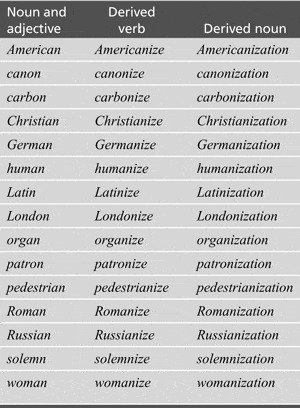
In English, -ize (also written -ise) is a ‘suffix forming verbs’ (OED), -ization, a ‘suffix forming nouns of action from verbs in - ize ’ (ibid. –ization, suffix). In other words, -ization is a double suffix comprising -ize serving to verbalize a noun or adjective and -ation serving to re-nominalize the resulting verb. Table 1 presents an alphabetical list of words found in the OED entry -ize, including both nouns and adjectives, that have undergone verbalization via -ize, and the verbs that have undergone re-nominalization via -ization. To compare these words with information and its derivative informatization, only nominal or adjectival stems ending in -n have been selected.
Verbalization via -ize and re-nominalization via -ization

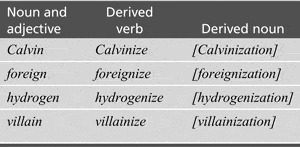
There are also words that have only gone through the first step of this verbalization and nominalization process, as shown in Table 2, in which the square brackets in the third column indicate that the re-nominalized words are not found in the OED. They have been put in the third column of the table because we assume they are readily acceptable to native English speakers.
Re-nominalization via -ization not yet recognized by the OED

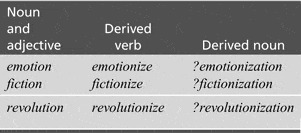
Interestingly, in English we can also find nouns, as shown in Table 3, that have gone through verbalization via -ize, but seem unable to be suffixed by -ization. The question mark preceding the words in the third column, none of which is found in the OED, indicate our uncertainty as to whether they are acceptable to native English speakers.
Effect of prosody on re-nominalization via -ization

The words in the first column of Table 3 share a common characteristic. They are all nouns ending in /ʃən/. This suggests that native speakers of English, for some prosodic reason, do not like the syllable /ʃən/ repeated in close proximity in one and the same word. Informationization apparently falls into this category. But there is a difference between information and the other words: while it is much easier for the other words to be suffixed by -ize, information proves the most resistant to it. Moreover, it has to be pointed out that among the other words, revolution appears to be an anomaly because it has an adjectival form revolutional but has been verbalized directly via -ize, and re-nominalized by adding either -ment (as revolutionizement) or –ization (as revolutionization), though the former is rarely used now (see the OED).
To avoid two /ʃən/s occurring in close proximity in the same word, speakers of English can add an adjective-forming suffix -al to the stem before verbalizing it with -ize and further nominalizing it with -ization. This has resulted in a process of triple derivation, as shown in Table 4.
Triple derivations involving -ize and –ization Footnote 5

Informationalize and informationalization clearly fall into this category. In terms of the verb-noun ratio of the derivation, that of these two words is the highest of the three pairs of words derived from information (657% vs 9.7% and 5.9%). The drawback with informationalization is that it sounds rather longwinded.
Among the three pairs of words, informatize and informatization are the odd ones out, with the verb informatize looking more like the result of backformation rather than the stem on which informatization is derived. The analogy on which their derivation was based may be the same as the analogy between systematize and systematization. However, systematize is derived from the noun system, whereas the word inform from which informatize is supposed to have been derived is a verb which is not directly related to the concept of information technology in English. So, the most plausible explanation is that informatize in English is the result of backformation and its relative high frequency is due to the inclusion of informatization in the OED.
The validity of the x-year time span
While it is perfectly justifiable for the OED editors to require that a new term has to have been found in a variety of different sources before it can become a candidate for inclusion in one of their dictionaries, the time span of an x number of years seems less justifiable today when ‘new terms can achieve enormous currency with a wide audience in a much shorter space of time, and people expect to find these new “high-profile” items in their dictionaries' (OED Online, 2015b), and when online dictionaries can include them shortly after they appear on the internet.
Before the advent of computer-assisted lexicography and online dictionaries, due to the physical constraints of dictionary production, a gap of 10 to 15 years was normal between two editions of a dictionary, be it a desktop dictionary or a pocket one. Besides, before the advent of the internet, it usually took a new term a number of years before it was printed in paper and read by the lexicographer, and another couple of years before its general currency was assessed and the term itself was incorporated into the new edition of the dictionary. For these reasons a time span of at least 10 years was perfectly normal and taken for granted. Even if the lexicographer had wanted to shorten this time span, physical and real-time difficulties would have prevented him from doing so. During this time span, if users of a dictionary came across a new term whose meaning or use they could not agree upon, as in the case of the Chinese translators faced with the translation of xìnxīhuà, they could do nothing but resort to their individual learning and argue with one another.
With the advent of the internet, large electronic corpora, and online dictionaries, truly revolutionary changes have taken place in lexicography. Today a new term can be instantly known in all forms of media throughout the world via the internet. If its meaning is not clear to people who encounter it for the first time, they normally do not have the patience to wait for 10 years before the lexicographer provides them with an answer. Instead, they will want to find out the answer immediately. If they cannot find it from one dictionary, they will turn to another one, and if none of the dictionaries contains any information about it, they will simply Google it and may even create an entry based on the result of this search in an open online dictionary. By then, dictionaries produced by publishing houses will have failed in their functions, and the lexicographers, their duty. Of course, a dictionary like the OED will always be the ultimate authority on any English word, but if the information they provide is not timely enough, its users will sometimes feel disappointed. And they have every reason to feel disappointed because they know that the general currency of any word can be instantly assessed on the internet, and the result of the lexicological and lexicographical research concerning it can be instantly incorporated into an online dictionary. With the old technical constraint on lexicography largely removed, the challenge to today's lexicographer is how to ‘assess whether a term is ephemeral or whether it will become a permanent feature of the language’ (OED Online, 2015b). Though the 10-year time span is not always a must for a new entry in the OED, we hope the ultimate lexicographical authority like the OED can also meet the current and increasingly demanding needs of its readers.
Conclusion
While ‘information+ization’ has been an important concept since the early 1970s, it has run into great difficulty finding an expression readily acceptable by all English speakers and once caused an insoluble problem for Chinese translators trying to translate the Chinese expression xìnxīhuà into English. Although the French expression informatisation has been adapted into English and included in the OED, it is not fully accepted by every speaker of English, apparently because its derivation and its presupposed verb informatize did not follow the normal process of English word formation. The variant pairs of expressions that have been derived by analogy each have their own advantages and disadvantages.
Faced with a situation like this, we suggest that if a new term signifies an invention, discovery or concept that concerns or is likely to concern a large number of people in different countries, like selfie, Ebola, or informatization, it qualifies as an important term and deserves to be included in an online dictionary as soon as possible so that language users can turn to such dictionaries for help. Furthermore, if such a new term has etymologically correct or derivationally valid variants, such as informationalize/informationize and informationalization/informationization, and each has achieved a certain degree of general currency, they should all be included, leaving it for the language users to decide which one will eventually survive. The criterion that only a term that ‘will become a permanent feature of the language’ qualifies to be included in a dictionary also calls for reconsideration. If we look at the current entries of the OED, we will find that many of the headwords or their senses did not have a very long lifespan. However, since they reflect a significant aspect of the physical, social and linguistic life of people in the English-speaking world and form a part of its cultural heritage, there is no reason why they should not be included in a dictionary based on historical principles and be allowed to remain there.
Acknowledgements
The writing of this article was supported by the China Postdoctoral Science Foundation (Project No. 2012M520197) and the National Social Science Foundation (Project 15BYY018). The authors are deeply indebted to the anonymous reviewers of the article for their comments and advice.
 GUOHUA CHEN is a Professor at the National Research Centre for Foreign Language Education, Beijing Foreign Studies University, Beijing, China. He received a PhD from the University of Cambridge in 1996 and is currently a council member of the Philological Society. His areas of research include contrastive studies of English and Chinese grammars, bilingual lexicography, and English-Chinese translation. Email: prof_chenguohua@163.com; chenguohua@bfsu.edu.cn
 LIXIA CHENG is an Associate Professor of Linguistics at Dalian University of Technology and a postdoctoral research fellow at Beijing Foreign Studies University. She received a PhD in English historical linguistics from Xiamen University in 2005. Her main research interests are the history of the English language, etymology and lexicology, and English-Chinese translation. Email: chenglixia@dlut.edu.cn; susan20050428@sina.com