Introduction
Design can be described as a specific end to the deployment of creativity, which couples creativity to innovation. Product design and development often starts from problem definition and is followed by idea generation. Idea generation or ideation can be described as the process of creating, developing, and communicating ideas, where an “idea” is considered as a basic element of thought in either visual, concrete, or abstract forms (Jonson, Reference Jonson2005). It is deemed to be the foundation of innovation (Sarkar and Chakrabarti, Reference Sarkar and Chakrabarti2011; Cash and Štorga, Reference Cash and Štorga2015). Ideation essentially determines the type of designs produced, and is regarded as having a significant role in novel concept development and business success (Howard et al., Reference Howard, Culley and Dekoninck2011). Creativity is defined as “the process by which something so judged (to be creative) is produced” (Amabile, Reference Amabile1983), “the ability to produce work that is both novel (i.e., original, unexpected) and appropriate (i.e., useful, adaptive concerning task constraints)” (Sternberg and Lubart, Reference Sternberg, Lubart and Sternberg1998), “the production of novel, useful products” (Mumford, Reference Mumford2003), and “the ability to come up with ideas or artifacts that are new, surprising, and valuable” (Boden, Reference Boden2004). It is an integral part of design, which supports problem solving, initiates innovation, and closely relates to business commercial performance (Childs and Fountain, Reference Childs and Fountain2011; Sarkar and Chakrabarti, Reference Sarkar and Chakrabarti2011). This indicates that creativity is connected with economic benefit via design, and thereby suggests the significance of generating creative ideas. Good ideas are regarded as the source from which creativity springs (Goldschmidt and Tatsa, Reference Goldschmidt and Tatsa2005). However, coming up with ideas, especially creative ones, is challenging, due to issues such as numerous existing ideas, limited relevant information, and lack of creative minds (Childs, Reference Childs2018).
Design creativity, alternatively creativity in design, is a notoriously elusive phenomenon which has conventionally been associated with human thinking. A number of methods or tools have been developed to assist creative idea generation in design, for example, conventional creativity tools such as brainstorming (Osborn, Reference Osborn1979) and TRIZ (Altshuller, Reference Altshuller1984), advanced design methods such as bio-inspired design (Helms et al., Reference Helms, Vattam and Goel2009; Chakrabarti and Shu, Reference Chakrabarti and Shu2010; Fu et al., Reference Fu, Moreno, Yang and Wood2014), and design-by-analogy (Goldschmidt, Reference Goldschmidt2001; Linsey et al., Reference Linsey, Laux, Clauss, Wood and Markman2007; Linsey et al., Reference Linsey, Markman and Wood2012). Recently, McCaffrey (Reference McCaffrey2016) has shown how the BrainSwarming graph, a visual representation for insight problems, could lead to a detailed exploration of an individual's creative weakness. Yilmaz et al. (Reference Yilmaz, Daly, Seifert and Gonzalez2016) have identified 77 design heuristics to help designers produce varied concepts in early design phases. Georgiev et al. (Reference Georgiev, Sumitani and Taura2017) have proposed a methodology for creating new scenes to support the development of creative products through combining existing scenes. Most of the tools or methods do not actually produce creative ideas, but provide a means to augment innate generative activity (Childs, Reference Childs2018). However, some of the tools are complex and not intuitive, some are difficult to master, and some rely heavily on users’ knowledge and experience. Different creativity tools have been shown to be beneficial to different applications and suitable for different personality traits (Yan and Childs, Reference Yan and Childs2015). There is an increasing interest in developing computational tools to support creative idea generation for enhancing design creativity, such as the virtual concept generation process (Taura et al., Reference Taura, Yamamoto, Fasiha, Goka, Mukai, Nagai and Nakashima2012) and the Combinator (Han et al., Reference Han, Shi and Childs2016; Han et al., Reference Han, Shi, Chen and Childs2018).
Analogy is described as the ability to perceive and use relational similarity across different contexts, which is widely regarded as a fundamental component of creativity in science and art (Goel, Reference Goel1997; Boden, Reference Boden2004; Ward, Reference Ward, Runco and Pritzker2011; Ozkan and Dogan, Reference Ozkan and Dogan2013; Licato et al., Reference Licato, Bringsjord, Govindarajulu, Besold, Schorlemmer and Smaill2015; Gentner and Smith, Reference Gentner, Smith and Reisberg2013). It is regarded as a fundamental cognitive process that underlies most other cognitive processes (Ozkan and Dogan, Reference Ozkan and Dogan2013), such as learning (Richland and Simms, Reference Richland and Simms2015), predicting and reasoning (Bar, Reference Bar2007; Ward, Reference Ward, Runco and Pritzker2011), problem solving (Ozkan and Dogan, Reference Ozkan and Dogan2013), scientific discovery (Gentner and Smith, Reference Gentner, Smith and Reisberg2013), and creativity (Goel, Reference Goel1997; Boden, Reference Boden2009; Ward and Kolomyts, Reference Ward, Kolomyts, Kaufman and Sternberg2010). In recent years, a number of studies have explored the use of analogy to support design activities. For example, Blanchette and Dunbar (Reference Blanchette and Dunbar2001), Ball et al. (Reference Ball, Ormerod and Morley2004), and Christensen and Schunn (Reference Christensen and Schunn2007) showed that professional designers often use analogies. Goel and Bhatta (Reference Goel and Bhatta2004) used IDeAL (DEsign by Analogy and Learning) to instantiate and evaluate a model-based analogy that transfers design patterns from source cases to target problems. Ball and Christensen (Reference Ball and Christensen2009) indicated that analogy is a strategy deployed to resolve uncertainties in design. Wilson et al. (Reference Wilson, Rosen, Nelson and Yen2010) investigated the impact of biology-inspired examples, which are considered as surface dissimilar analogies, in ideation during the early phases of design. Linsey et al. (Reference Linsey, Markman and Wood2012) proposed the WordTree design-by-analogy method for identifying far domain analogies to support idea generation. Verhaegen et al. (Reference Verhaegen, D'hondt, Vandevenne, Dewulf and Duflou2011) explored the use of automatically distilled product characteristics for identifying candidate products for analogical design. Moreno et al. (Reference Moreno, Hernández, Yang, Otto, Hölttä-Otto, Linsey, Wood and Linden2014) explored using analogy in idea generation for transactional problems.
Transferring information from a source domain to a target domain is a vital process in analogical reasoning. The conceptual distance between the source and target domain is closely related to the outcome of analogy. Chan et al. (Reference Chan, Fu, Schunn, Cagan, Wood and Kotovsky2011) showed that far-field and less common examples could lead to more novel results in analogical design. Similarly, Christensen and Schunn (Reference Christensen and Schunn2007) and Goldschmidt (Reference Goldschmidt2011) indicated that far-domain sources could lead to better results than near-domain sources. However, Chan et al. (Reference Chan, Dow and Schunn2015) have found that conceptually closer sources of inspiration rather than farther ones lead to more creative ideas. Fu et al. (Reference Fu, Chan, Cagan, Kotovsky, Schunn and Wood2013b) indicated that “near” and “far” are relative terms in analogy depending on the features of the stimuli. They also illustrated that although “far” analogical stimuli could lead to novel results, the stimuli, which are too distant, have negative effects on idea generation.
Developing computational methods or tools for supporting analogical design has been a popular topic for years. Qian and Gero (Reference Qian, Gero, Gero and Sudweeks1992) proposed a computational knowledge-based model to support design using between-domain analogy. Bhatta and Goel (Reference Bhatta and Goel1996a, Reference Bhatta and Goel1996b) described a computational method, called IDeAL, for supporting analogical design by employing structure–behavior–function models of designs. Goel et al. (Reference Goel, Bhatta and Stroulia1997) developed a design system, named Kritik, employing case-based and model-based reasoning for producing conceptual designs, and using structure–behavior–function models for guiding design adaptions. The use of databases to support analogical design has also been explored. Chakrabarti et al. (Reference Chakrabarti, Dom, Agrawal and Raghavan1998) showed that hierarchically organized text databases could aid better searching, browsing, and filtering. Fu et al. (Reference Fu, Cagan, Kotovsky and Wood2013a) presented a methodology for discovering structural forms in design repository databases, which is based on latent semantic analysis processing as well as Kemp and Tenenbaum's Bayesian model. This methodology has proven to generate diverse structures of data in terms of functional and surface relations, ultimately leading to the potential production of useful stimuli in design-by-analogy. In recent years, several sophisticated computational analogical design support tools have been developed. For instance, DANE (Design by Analogy to Nature Engine), developed by Vattam et al. (Reference Vattam, Wiltgen, Helms, Goel and Yen2011) and Goel et al. (Reference Goel, Vattam, Wiltgen and Helms2012), provides a library containing structure–behavior–function models of biological and engineering systems. Idea Inspire 3.0, developed by Chakrabarti et al. (Reference Chakrabarti, Siddharth, Dinakar, Panda, Palegar, Keshwani, Chakrabarti and Chakrabarti2017), could retrieve systems from biological domains for solving a given problem to support ideation with the support of the SAPPhIRE model (Chakrabarti et al., Reference Chakrabarti, Sarkar, Leelavathamma and Nataraju2005). McCaffrey and Spector (Reference McCaffrey and Spector2017) have demonstrated that a software program called the Analogy Finder can perform searches to explore analogous solutions to a problem, which are beyond a person's areas of expertise. The software rephrases the goal by using synonyms and verbs, leading to diverse areas for exploration. Possible patents from other fields are then retrieved by the Analogy Finder for solving the original problem.
An ontology is defined as an explicit formal specification of a shared conceptualization (Gruber, Reference Gruber1993). It can be constructed around an individual taxonomy or several taxonomies and their relationships (Gilchrist, Reference Gilchrist2003). The aim of ontologies is to capture consensual data, knowledge, and information in a formal approach for reusing and sharing among different people and applications (Štorga et al., Reference Štorga, Andreasen and Marjanović2010). Ontologies have been widely applied in various areas, such as knowledge and information management, semantic webs, and natural language processing. Ontologies are often used to support design activities, for example, design knowledge representation (Gero and Kannengiesser, Reference Gero and Kannengiesser2007, Reference Gero, Kannengiesser, Chakrabarti and Blessing2014; Cross and Bathija, Reference Cross and Bathija2009), design activity description (Sim and Duffy, Reference Sim and Duffy2003), functional knowledge systematization (Kitamura and Mizoguchi, Reference Kitamura and Mizoguchi2004), product family development (Nanda et al., Reference Nanda, Simpson, Kumara and Shooter2005), and design information extraction and retrieval (Li and Ramani, Reference Li and Ramani2007). There is a potential for enhancing design, especially design creativity, by combining the aspects of analogy and ontology.
This study is an exploration and extension of that conducted by Han et al. (Reference Han, Shi, Chen and Childs2017b). The aim is to investigate the construction of ontologies for supporting reasoning to assist creative idea generation, as well as to develop a computational tool, called the Retriever, based on ontology by embracing the aspects of analogical reasoning to support novice designers and experienced designers in creative idea generation and potentially in idea elaboration. A case study has been conducted to evaluate the usefulness and effectiveness of the tool.
The following section reviews related work in design creativity, ontology, and analogy. “The Retriever” section demonstrates the basic concept of the tool and how the tool was developed. “Evaluation of the Retriever” section evaluates the tool through analyzing a case study and discusses the results. The last section provides conclusions.
Related work
Design creativity
Creativity is a fundamental attribute of human intelligence (Boden, Reference Boden2004; Cross, Reference Cross2011). The outputs of creativity are usually the results of long periods of work with a set of mini-breakthroughs, which arise from the combinations of some essential mental capabilities (Childs, Reference Childs2018). The outputs are conceived to be novel and useful, but in various forms such as ideas, objects, and actions (Carruthers, Reference Carruthers2011). Diverse thoughts from previous experience stored in memory elements are the main sources for originating creative outputs (Liikkanen and Perttula, Reference Liikkanen and Perttula2010; Benedek et al., Reference Benedek, Jauk, Fink, Koschutnig, Reishofer, Ebner and Neubauer2014; Childs, Reference Childs2018). Kaufman and Beghetto (Reference Kaufman and Beghetto2009) introduced the four C model of creativity, which involves mini-c, little-c, Pro-c, and Big-C, for classifying different levels of creativity. Boden (Reference Boden2004) identified three approaches to producing creativity: exploratory, transformational, and combinational creativity. Exploratory creativity involves exploring the structured conceptual space, while transformational creativity involves modifying the structured conceptual space by breaking the boundaries. Combinational creativity is achieved through unusual combinations of familiar ideas.
In design, creativity is a significant element that indicates design effectiveness, but customers may not explicitly state creativity as a requirement while seeking creative designs (Chiu and Shu, Reference Chiu and Shu2012). It has been identified that the early stages of design have a vital impact on the final design (Keller et al., Reference Keller, Eckert and Clarkson2009); moreover, creative ideas or concepts generally lead to creative and successful designs (Chiu and Shu, Reference Chiu and Shu2012). This indicates that creative idea generation is an essential part of the innovation process, which is highly relevant to the performance of new products and services, and thereby determines the later innovation success (Howard et al., Reference Howard, Culley and Dekoninck2011; Sarkar and Chakrabarti, Reference Sarkar and Chakrabarti2011).
Design creativity, or creativity in design, is significantly influenced by the early stages of design. A number of studies have focused on investigating how to promote creativity during the early stages of design, especially during the idea generation phase. Nagai et al. (Reference Nagai, Taura and Mukai2009) analyzed different linguistic interpretation processes in the idea generation stage within the framework of concept synthesizing. They indicated that concept blending, which produces a new idea that is not involved in the two base concepts but inherits certain characteristics, is the most creative idea generation process. Howard et al. (Reference Howard, Culley and Dekoninck2011) explored the use of creative stimuli in brainstorming sessions for creative idea generation. Chiu and Shu (Reference Chiu and Shu2012) showed that oppositely related word stimuli can encourage creative idea generation and ultimately facilitate more creative and successful designs. Viswanathan et al. (Reference Viswanathan, Atilola, Esposito and Linsey2014) demonstrated that the use of physical models during idea generation can mitigate design fixation. Han et al. (Reference Han, Park, Shi, Chen, Hua and Childs2017a) proposed three approaches, which are problem-, similarity-, and inspiration-driven, to generating creative combinational ideas.
Analogy
Analogy, also known as analogical reasoning, is a core process of human cognition frequently used to produce inferences and generate new ideas (Gentner and Smith, Reference Gentner, Smith and Reisberg2013). It can be described as retrieving an idea sharing a noted subset of constituent aspects of another decomposed idea (Liu and Singh, Reference Liu and Singh2004), a form of combinational creativity exploring shared conceptual space (Boden, Reference Boden2009), and applying or projecting structured knowledge from a familiar domain to a less familiar one (Ward and Kolomyts, Reference Ward, Kolomyts, Kaufman and Sternberg2010). Gentner and Smith (Reference Gentner, Smith and Ramachandran2012) suggested that analogy is the cognitive mechanism that most distinguishes humans from other species. Studying and producing analogies can improve the abilities of reasoning and critical thinking, as well as develop the comprehension of vocabulary and concept (Nessel and Graham, Reference Nessel and Graham2007).
Analogical reasoning generates inferences and learning about new domains by using previous knowledge and experience (Daugherty and Mentzer, Reference Daugherty and Mentzer2008). To be more precise, analogy applies the knowledge from a well-known domain (the source domain) to another less-known domain (the target domain) (Blanchette and Dunbar, Reference Blanchette and Dunbar2000; Ward, Reference Ward, Runco and Pritzker2011). In other words, it transfers knowledge from a familiar situation to a less-familiar situation that requires explanation (Casakin and Goldschmidt, Reference Casakin and Goldschmidt1999). Analogical reasoning could also process from unfamiliar to familiar, for example, exploring a new (unfamiliar) problem through identifying or recognizing similarities from a known (familiar) problem (Kim and Choi, Reference Kim and Choi2003).
Analogy can be considered as using a known subject to understand or draw inferences about an unknown one, that is, comprehending Y by noting that Y is similar to Z in some aspects (Ward, Reference Ward, Runco and Pritzker2011; Gentner and Smith, Reference Gentner, Smith and Ramachandran2012). The conventional form of analogy is generally described in a likeness relation of A:B::C:D, which indicates that C is related to D in the target domain as how A is related to B in the source domain (Casakin and Goldschmidt, Reference Casakin and Goldschmidt1999; Ward, Reference Ward, Runco and Pritzker2011). This form of analogy is known as proportional analogy (Gust et al., Reference Gust, Krumnack, Kühnberger and Schwering2008). It transforms into A:B::C:X when solving problems, in which terms A, B, and C are generally known and the term X is unknown requiring to be established. For instance, “lungs:humans::gills:X” can be interpreted as “gills” are related to the unknown term X similar to how “lungs” are related to “humans”. The unknown term X can be inferred according to the provided information.
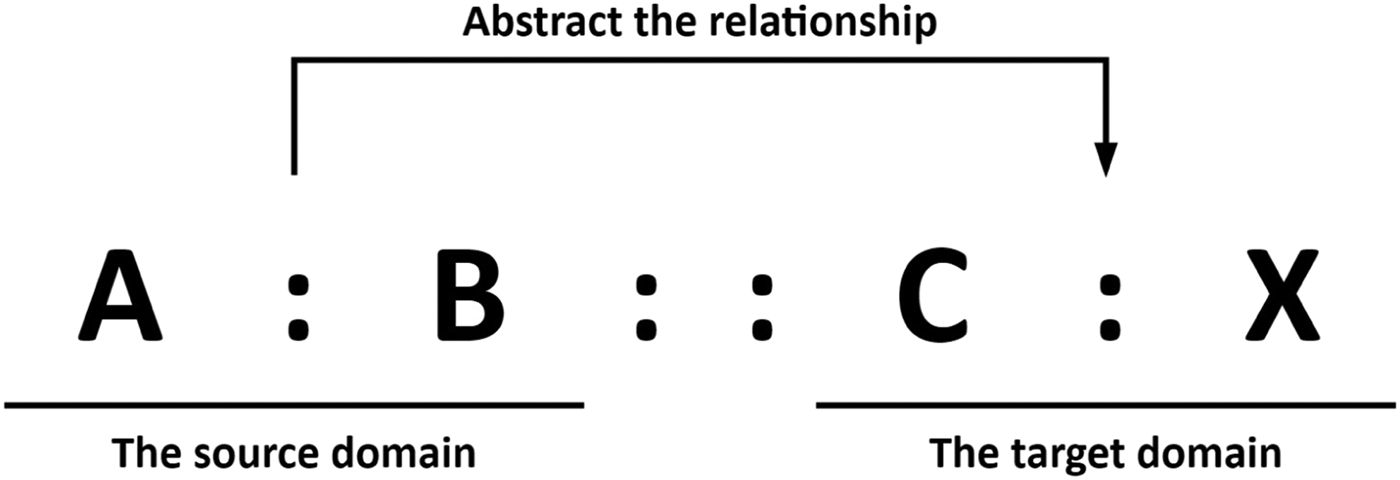
In analogy, especially proportional analogy, the specific relation between the terms in the source domain plays a vital role (Ward, Reference Ward, Runco and Pritzker2011). Analogy relations are abstracted from A:Bs to instruct the retrieval of an unknown analog X based on a given term C in the target domain, as shown in Figure 1. In the previous example, “lungs:humans” in the source domain indicates the analogy relationship is “used for” breathing, as “lungs” are used for breathing by “humans”. Thus, based on the analogy relation and the known term “gills” in the target domain, term X can be inferred as “fish”. That is, “gills” are used for breathing by “fish” similar to “lungs” are used for breathing by “humans”. This example of analogy is used to understand the function of “gills”. Other examples of proportional analogy involves “defending soldiers:invading army::white blood cells:germs” and “planets:sun::electrons:nucleus”, which are often used in medical science to explain the purpose of “white blood cells” and in chemistry to describe the structure of an “atom”, respectively.
Proportional analogy in problem-solving.

Analogy relations are significant for producing inferences for generating ideas and understanding less familiar domains while using proportional analogy. In human cognition, analogy relations, which are generally abstracted from source domains, are stored as rules or principles for solving future problems without the requirement of source analogs (Gentner and Forbus, Reference Gentner and Forbus2011; Lopez et al., Reference Lopez, Linsey and Smith2011; Linsey et al., Reference Linsey, Markman and Wood2012). In design, identifying an analogy relationship from previous knowledge can produce inferences about the design context. It is beneficial for creative idea space exploration and the design space expansion, which enhances context comprehension and idea elaboration.
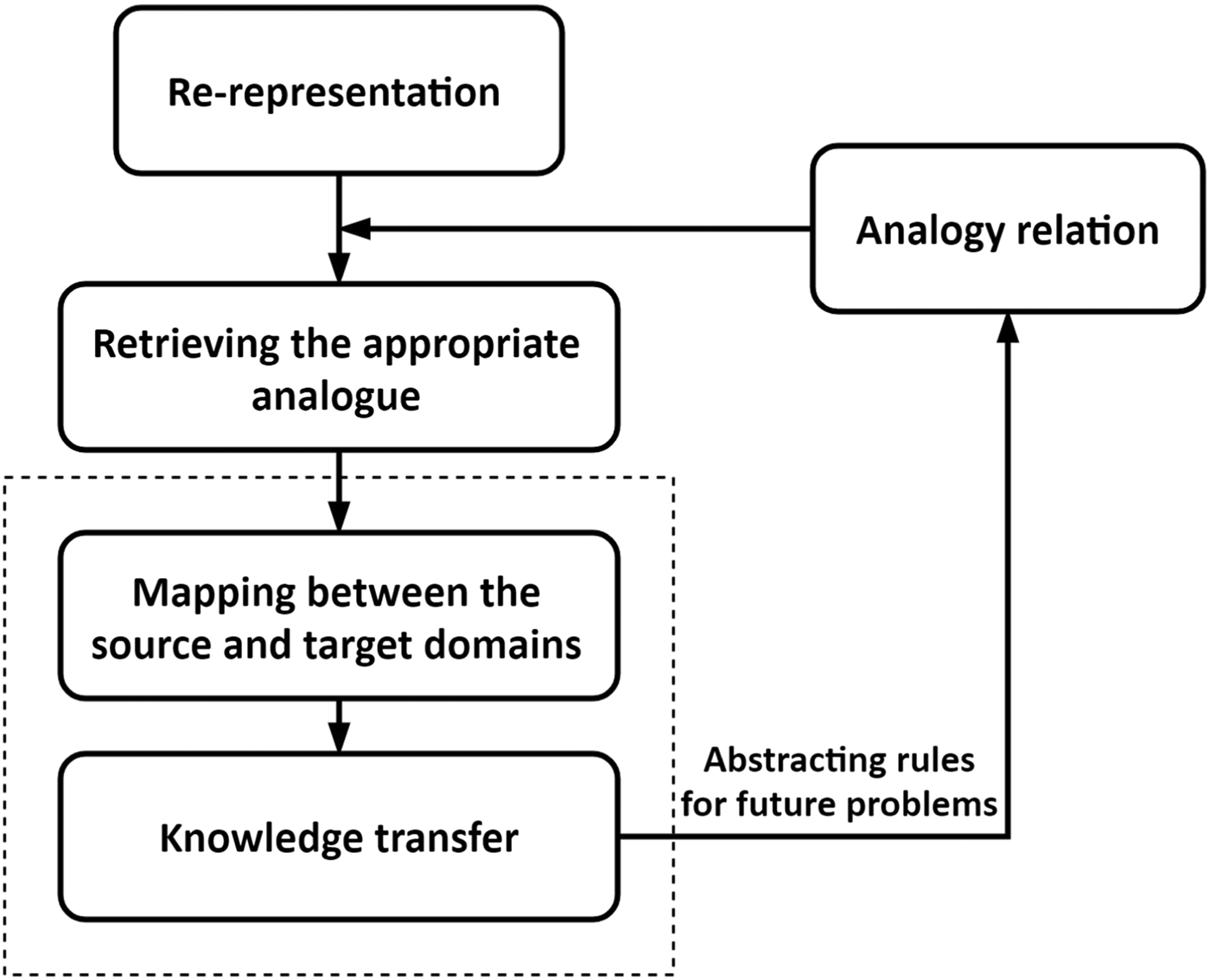
A series of research projects have been conducted by psychologists and researchers studying analogy to explore the cognitive process of analogy. According to the processes proposed by Kokinov and French (Reference Kokinov, French and Nadel2003), Casakin (Reference Casakin2004), Gust et al. (Reference Gust, Krumnack, Kühnberger and Schwering2008), Gentner and Forbus (Reference Gentner and Forbus2011), Lopez et al. (Reference Lopez, Linsey and Smith2011), Linsey et al. (Reference Linsey, Markman and Wood2012), Gentner and Smith (Reference Gentner, Smith and Ramachandran2012, Reference Gentner, Smith and Reisberg2013), analogy generally includes three core processes, which are retrieval, mapping and knowledge transfer, and abstraction. However, human analogy processes depend on how a problem is presented (Moreno et al., Reference Moreno, Hernández, Yang, Otto, Hölttä-Otto, Linsey, Wood and Linden2014). Retrieval involves exploring potential analogs according to the known term and analogy relation. Mapping and knowledge transfer includes aligning the ideas of the source domain and the target domain, and transferring knowledge from the source to the target domain. Abstraction generates schema or rules, also known as analogy relations, from results to apply in future situations without requiring source analogs. Generally, the analogy relations are abstracted from A:Bs in the source domain. In addition, concept re-representation is also a vital cognitive process in analogy, as well as in learning and scientific discovery (Yan et al., Reference Yan, Forbus and Gentner2003). It increases the number of cues for analog retrieval in analogy problem-solving, which enhances the exploration of the design space (Moreno et al., Reference Moreno, Blessing, Yang, Hernández and Wood2016). Thus, re-representing an idea with a similar idea before the retrieval process is indispensable for improving creativity. The cognitive process of analogy proposed in this study is illustrated schematically in Figure 2.
Cognitive process of analogy.

In design, analogy has been considered as a beneficial method for idea generation (Wilson et al., Reference Wilson, Rosen, Nelson and Yen2010; Linsey et al., Reference Linsey, Markman and Wood2012; Moreno et al., Reference Moreno, Hernández, Yang, Otto, Hölttä-Otto, Linsey, Wood and Linden2014), as it can enhance design space exploration and expansion by transferring knowledge from a source domain containing the analog phenomena to a target domain involving the problem. It is significant in terms of delivering creative ideas and understanding ideas. Analogy has been applied in numerous designs, for instance, the cyclone technology used by Dyson vacuum cleaners can be regarded as an analogical reasoning of an industrial cyclone for removing particulates in factory production processes.
Ontology
An ontology is described as a taxonomically or axiomatically based explicit formal specification of a shared conceptualization (Gruber, Reference Gruber1993); a structured conceptualization of a domain involving a set of entities and their relationships in that domain (Lin et al., Reference Lin, Fox and Bilgic1996; Gero and Kannengiesser, Reference Gero and Kannengiesser2007; Raad and Evermann, Reference Raad and Evermann2015); a metadata schema providing a controlled vocabulary of concepts with explicitly defined and machine-understandable semantics (Maedche and Staab, Reference Maedche and Staab2001); a highly structured system of concepts involving the objects, processes, attributes of a particular domain as well as their corresponding relationships (Li et al., Reference Li, Raskin and Ramani2008). It provides uniform frameworks to identify differences and similarities among obscured concepts (Gero and Kannengiesser, Reference Gero and Kannengiesser2007). Ontologies are necessary for representing knowledge as well as exchanging knowledge (Obitko et al., Reference Obitko, Snasel, Smid and Snasel2004).
An ontology captures the structure of a domain and describes the domain. It is not only determined by the nature of each relevant kind in the domain, but rather by the semantic roles it plays (Štorga et al., Reference Štorga, Andreasen and Marjanović2010). Ontologies are usually captured in some form of semantic net (Chandrasegaran et al., Reference Chandrasegaran, Ramani, Sriram, Horváth, Bernard, Harik and Gao2013). A semantic net is an artificial graph-structured associative network with nodes representing concepts or knowledge and arcs describing relationships among the concepts (Sowa, Reference Sowa and Shapiro1992; Chandrasegaran et al., Reference Chandrasegaran, Ramani, Sriram, Horváth, Bernard, Harik and Gao2013). The nodes and arcs in semantic nets are used to create an ontology of a domain and express the relations in the domain. By this, an ontology is useful for human as well as processable for computational machines.
An ontology can be used as a tool for explaining the semantics of a terminology system in a well-defined situation, due to its shared vocabularies for describing the concepts and relations (Guarino, Reference Guarino1998; Lee et al., Reference Lee, Chae, Kim and Kim2009). Ontology relations provide logical associations or dependencies between concepts in an ontology (Gulla and Brasethvik, Reference Gulla and Brasethvik2008). Gulla et al. (Reference Gulla, Brasethvik, Kvarv, Filipe and Cordeiro2009) indicated that the concepts in an ontology may be taxonomically related by transitive relations such as “is a” as well as non-taxonomically associated by a user named relation for instance “has part”. Chang-Shing et al. (Reference Chang-Shing, Zhi-Wei and Lin-Kai2005) claimed that there are three kinds of ontology relationships, which are generalization such as “is kind of”, aggregation such as “is part of”, and association such as “class”. Product ontologies are commonly used for semantic interoperability of product information in the design chain (Lee et al., Reference Lee, Chae, Kim and Kim2009). The relationships involved in a product ontology, such as “parts” and “features”, play an essential role in the ontology construction (Lin et al., Reference Lin, Fox and Bilgic1996; Lee et al., Reference Lee, Chae, Kim and Kim2009).
In the design domain, ontologies are used to formalize domain knowledge in a way which makes it accessible, sharable, and reusable (Darlington and Culley, Reference Darlington and Culley2008). Ontologies allow designers to construct and present a particular domain with regard to taxonomic structures and axiomatic definitions (Chandrasegaran et al., Reference Chandrasegaran, Ramani, Sriram, Horváth, Bernard, Harik and Gao2013). Li and Ramani (Reference Li and Ramani2007) proposed a method for design information retrieval by using natural language processing and design ontology (DO). Darlington and Culley (Reference Darlington and Culley2008) showed how ontologies support the capture of the engineering design requirement. Nanda et al. (Reference Nanda, Simpson, Kumara and Shooter2005) and Liu et al. (Reference Liu, Lim and Lee2013) used ontology for product family design. Chandrasegaran et al. (Reference Chandrasegaran, Ramani, Sriram, Horváth, Bernard, Harik and Gao2013) indicated that ontologies are required for encoding design knowledge as well as facilitating semantic interoperability. Shi and Setchi (Reference Shi and Setchi2013) indicated that ontologies can benefit query expansion by improving the query representation on conceptual. In addition, a number of ontologies have been developed or applied for supporting design, for instance, Gero and Kannengiesser (Reference Gero and Kannengiesser2007, Reference Gero, Kannengiesser, Chakrabarti and Blessing2014) developed a function–behavior–structure ontology to represent objects and processes in engineering design. Štorga et al. (Reference Štorga, Andreasen and Marjanović2010) introduced a design ontology (DO) for improving product development. Ahmed and Štorga (Reference Ahmed and Štorga2009) proposed an ontology for specific applications in engineering design through merging engineering design-integrated taxonomies (Ahmed, Reference Ahmed2005) and the DO (Štorga et al., Reference Štorga, Andreasen and Marjanović2010). Cross and Bathija (Reference Cross and Bathija2009) created DOs through employing an automatic approach by adaption. Hatchuel et al. (Reference Hatchuel, Weil and Le Masson2013) derived an “ontology of design” from C–K theory and forcing.
Analogy and ontology
A limited number of research projects have investigated the use of analogy in ontologies. For instance, Forbus et al. (Reference Forbus, Mostek and Ferguson2002) have proposed an analogy ontology, which is based on Gentner's structure-mapping theory of analogy (Gentner, Reference Gentner1983), for creating a human-like flexible reasoning system by representing key entities and relationships in analogical processing. Raad and Evermann (Reference Raad and Evermann2015) illustrated that analogical reasoning can assist in solving the problem of ontology alignment, which is used for establishing correspondences between concepts of different ontologies, by providing a good source of algorithms and heuristics.
Analogy and ontology are both used in design activities to support design creativity, but they are different in several aspects. Analogical reasoning applies knowledge from a familiar domain to a less-familiar domain that requires explanation, while ontologies are explicit formal representations of concepts and corresponding relations of a particular knowledge domain. That is, analogy is a reasoning process, while ontology is a structured system for representing knowledge. An analogical stimulus helps apply the knowledge from a well-known domain to a less-known domain. For instance, “velcro” was inspired from the analogical stimulus “burrs”. An ontological stimulus assists the understanding of knowledge in a particular domain. For example, an ontological stimulus of “burrs”, which involves relevant knowledge in the domain, could facilitate the comprehension of the properties, functions, characteristics of “burrs”. However, relationship performs the function of a common bridge between analogy and ontology. In analogy, especially proportional analogy, relations are significant for generating inferences about a less-familiar domain. In ontologies, relations are used for constructing an ontology and providing logical associations or dependencies between concepts.
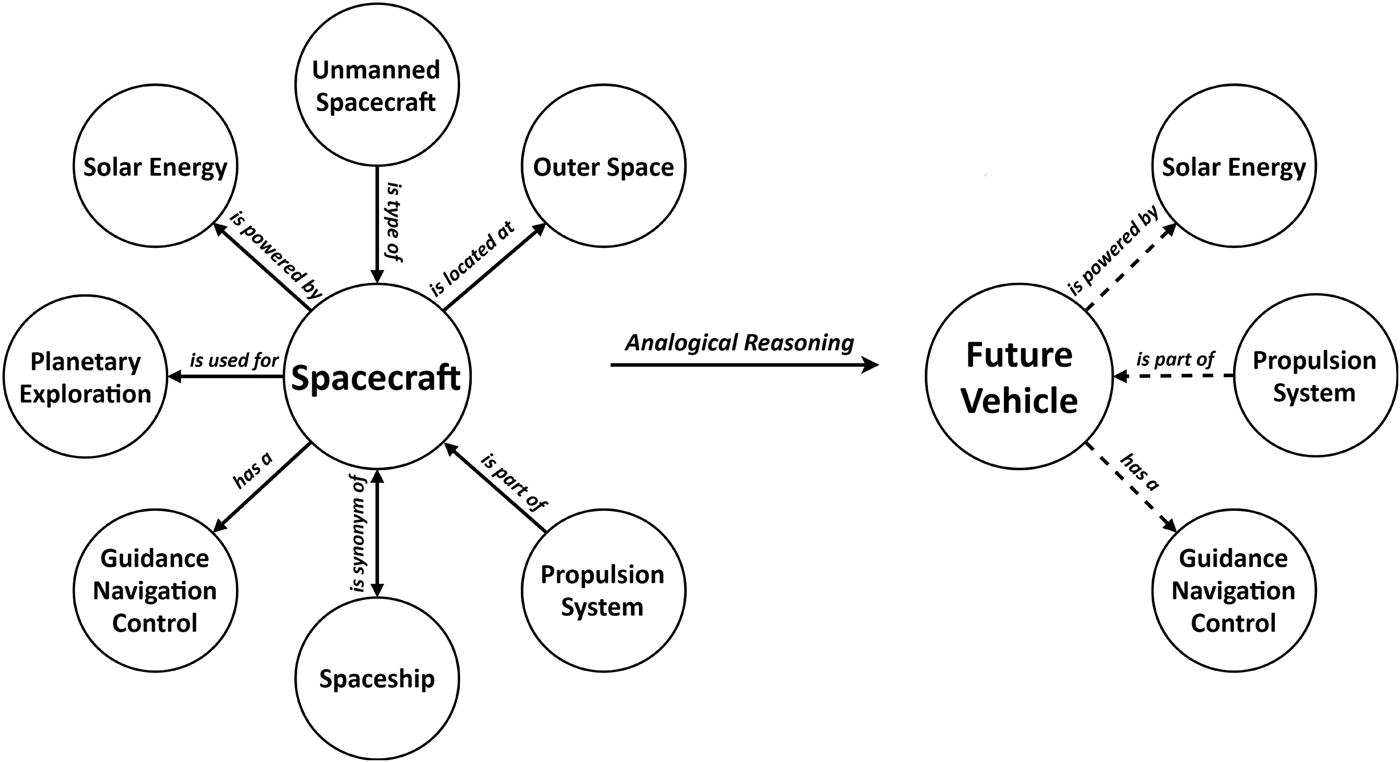
Therefore, there is a potential for improving design creativity by applying the aspects of analogy in ontology. Designers often use ontologies to demonstrate a particular product to help their understanding. However, it is challenging to construct a well-defined ontology, especially confronting those less-familiar ones. This is due to problems such as an unfamiliar subject and lack of relevant knowledge. Mechanisms for reasoning, particularly from ontologies, are significant to idea generation, for instance the foundational work on structure mapping conducted by Gentner (Reference Gentner1983), Falkenhainer et al. (Reference Falkenhainer, Forbus and Gentner1989), and Gentner and Forbus (Reference Gentner and Forbus2011). This study indicates the construction of ontologies with sufficient richness and coverage to support reasoning over real-world datasets. This leverages human reasoning from ontologies, and thereby provokes creative idea generation. For example, as shown in Figure 3, an ontology of “future vehicle” is constructed through reasoning from an ontology of “spacecraft”, which could stimulate the generation of creative ideas about new means of transportation. However, it is necessary to have a knowledge database containing relations and concepts to achieve this type of analogical reasoning for ontologies.
An example of using analogical reasoning to construct a new ontology.

The Retriever
The essential concept of the Retriever
The Retriever is a computational tool for assisting novice designers as well as experienced designers in idea generation. The tool is based on the aspects of the cognitive process of analogical reasoning by employing ontologies. It is designed to help designers construct ontologies to support reasoning for creative idea generation through solving proportional analogy problems in the form of A:B::C:X. To be more specific, the tool constructs an ontology or part of an ontology by retrieving an unknown X or Xs based on a known term C in a less-familiar ontology (target ontology) and an ontology relation abstracted from A:B from a familiar ontology (base ontology). It can retrieve concepts or ideas in both text and visual forms according to the input, and thereby provoke the user in creative idea generation. The following sections demonstrate the essential concept of the Retriever as well as an example of using the tool.
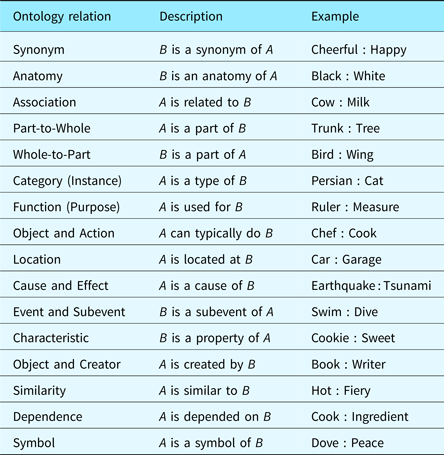
ConceptNet is a knowledge base providing a large semantic net that represents general human knowledge associated by common-sense relations (Liu and Singh, Reference Liu and Singh2004; Speer and Havasi, Reference Speer and Havasi2012), which is used as the knowledge database for concept retrieval and ontology construction in this study. The use of ConceptNet to construct ontologies has been previously explored by, for example, Agarwal and Mittal (Reference Agarwal and Mittal2016), Mukherjee and Joshi (Reference Mukherjee and Joshi2013), Keshavarz and Lee (Reference Keshavarz and Lee2012), and Sureka et al. (Reference Sureka, Goyal, Correa and Mondal2010). ConceptNet has a closed class of over 20 relations used for connecting various concepts. Among them, 16 relations, which are commonly used in DOs to express products, were summarized and selected, as shown in Table 1. Although the ConceptNet database is limited in size, coverage, and diversity compared with humans, it is sufficient for constructing an ontology for representing a design.
The 16 ontology relations

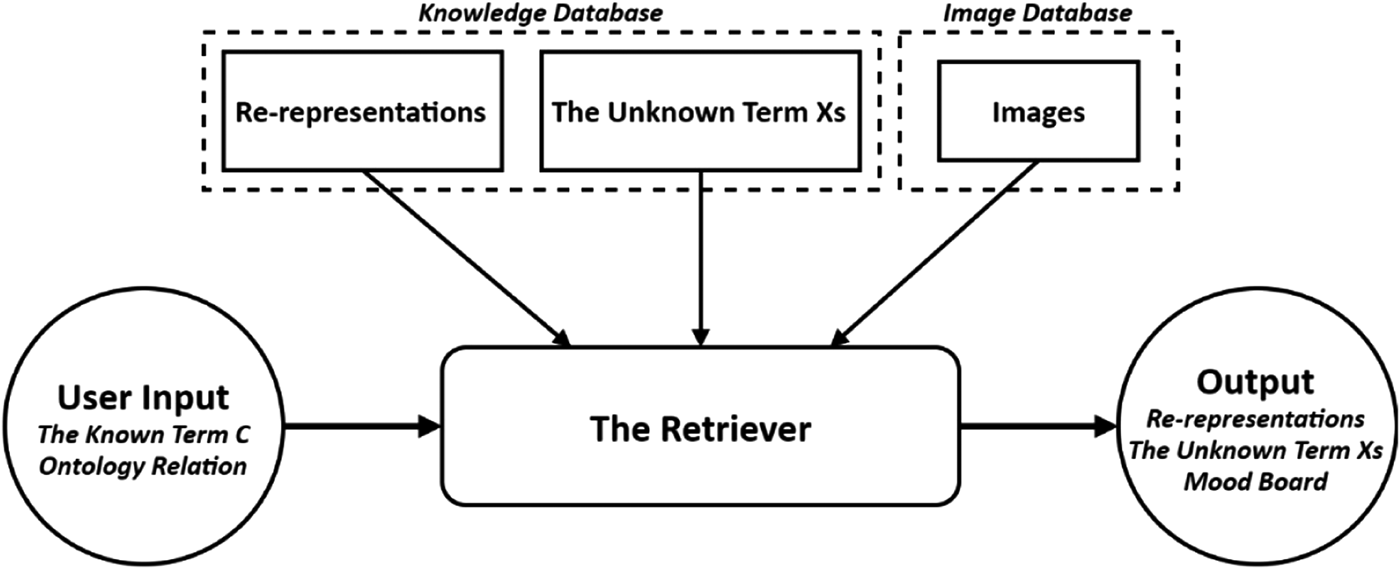
The essential concept, which is a simulation of aspects of the cognitive process of analogical reasoning, used for developing the Retriever is shown in Figure 4. This type of cognition simulation approach has been applied in developing design support tools and has achieved a positive result, such as the Combinator (Han et al., Reference Han, Shi and Childs2016; Han et al., Reference Han, Shi, Chen and Childs2018). Human short-term memory, also known as working memory, is used for manipulating and processing information (Cowan, Reference Cowan2008; Baddeley et al., Reference Baddeley, Eysenck and Anderson2009). Miller (Reference Miller1956) summarized the evidence that human short-term memory is able to store 7 ± 2 items, while Cowan (Reference Cowan2008) indicated that short-term memory could only store four items. This implies that humans could only process about four to nine items at one time. Therefore, we have selected a median number “six” as the number of outputs of the Retriever, in order to help the tool users receive and process ideas effectively. The six outputs of the Retriever consist of a known term C provided by the user, as well as two re-representations and three unknown Xs retrieved by the tool. The known term C is considered as an output of the tool as well as a user input.
The essential concept of the Retriever.

As shown in Figure 4, the essential concept starts with delivering the user inputs, involving a known term C and an ontology relation, to the Retriever. The tool then retrieves two related re-representations from the knowledge database (ConceptNet) according to the known term C for increasing retrieval cues, and thereby expanding the design space exploration (Moreno et al., Reference Moreno, Blessing, Yang, Hernández and Wood2016). The two re-representations are retrieved from the ConcepNet database through using the “association” or “related to” functions which provide the most similar concepts to the known term C. After that, on a one-to-one basis, three unknown terms Xs are retrieved from the knowledge database according to the known term C and the two re-representations through employing the selected ontology relation. To be more specific, through using the same ontology relation, one unknown term X is retrieved according to the known term C, while the other two Xs are retrieved, respectively, according to the two re-representations. This process is conducted by using the “search” function of the ConceptNet, which retrieves corresponding concepts according to a given concept and a given relation.
The Retriever provides 17 relationship selections, such as “random” (selecting an ontology relation randomly), “association”, “location” and “function (purpose)”. The Retriever does not simply identify related functional terms, but retrieves related entities or concepts through using particular relations. It is an enrichment of the structures and components space in an ontology as well as functions and behaviors, which support design exploration and expand the design space. The unknown terms Xs with a higher degree of relation to the input or the re-representations are retrieved prior to lower degree ones. The degrees here are known as the edge weights in ConceptNet, which were programmed into the module representing a rough heuristic of which statements are more reliable than the others. The known term C, re-representations, and unknown terms Xs are considered as the outputs of the Retriever in text forms.
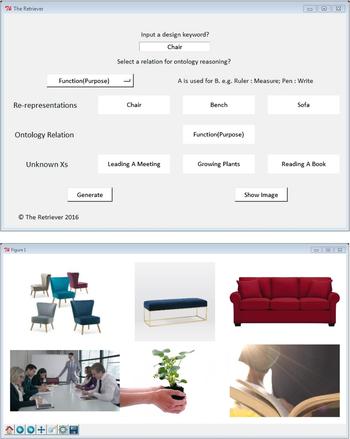
Goldschmidt and Sever (Reference Goldschmidt and Sever2011) indicated that textual stimuli are useful in the design process, especially for improving the idea originality. However, generating results in only text forms might have limitations, as sometimes it is difficult for a user to retrieve corresponding images from long-term memory. It has been identified that the human brain is mainly triggered by visual perceptions, such as images and videos (Luis-Ferreira and Jardim-Goncalves, Reference Luis-Ferreira and Jardim-Goncalves2013). Images are the most preferred inspiration sources for novice designers as well as professional designers (Gonçalves et al., Reference Gonçalves, Cardoso and Badke-Schaub2014). Moreover, designers prefer to explore inspirations from images (Eckert and Stacey, Reference Eckert and Stacey2000). Malaga (Reference Malaga2000) demonstrated that using images as stimuli could produce more creative ideas than using texts as stimuli. Laing and Masoodian (Reference Laing and Masoodian2016) reported positive benefits of using images during the idea generation stage of the design process. We have therefore developed a live feed image crawler and implemented it into the Retriever module. Corresponding images of the known term C, retrieved re-representations, and unknown terms Xs are crawled simultaneously according to the text forms. The crawled images are presented in a mood board style as the output, as shown in the bottom image of Figure 5. A mood board is a collection of images used in the early phases of design for improving creativity and aiding communications (McDonagh and Storer, Reference McDonagh and Storer2004; Setchi and Bouchard, Reference Setchi and Bouchard2010).
The Retriever interface.

Example of using the Retriever
As shown in Figure 5, the Retriever provides a simple and friendly user interface. The tool allows users to input a design keyword or idea, which is considered as the known term C, and select an ontology relationship which is regarded as an abstracted relation from A:Bs in familiar ontologies. The tool produces two re-representations of the known term C, as well as three unknown terms Xs in text forms at each retrieval. It should be noted that the known term C is also considered as an output of the tool. The three Xs, which are considered as the unknown terms in less-familiar ontologies, are retrieved according to the known term C and the two re-representations on a one-to-one basis. The six outputs of the Retriever (the known term C, two re-representations, and three Xs) could support constructing new ontologies and expanding the design space exploration, and thereby provoke users’ creative minds effectively. In addition, the tool can generate an image mood board correlating to its text-form outputs in real time.
As a hypothetical example, suppose new ideas for a chair design are required. The design keyword “chair”, which is regarded as the known term C, is considered as the input. The ontology relation “function (purpose)” abstracted from A:Bs in familiar ontologies is selected to explore what chairs are commonly used for. By using the Retriever, two re-representations, “bench” and “sofa”, are retrieved. According to the input and re-representations, three ideas, “leading a meeting”, “growing plants”, and “reading a book”, are produced, respectively, according to the selected relation. The retrieved outputs are presented in text forms as shown in the top image of Figure 5, accompanying with a mood board containing corresponding images as shown in the bottom image of Figure 5. The example here shows a distant retrieval, of which ideas with lower relational degrees are retrieved, for avoiding design fixation and prompting creative ideation. As illustrated previously, ideas (unknown Xs) that are strongly related (higher relational degrees) to the term C or re-representations via the selected ontology relationship are retrieved prior to lower correlated ones in the Retriever. Using the input “chair” and “function (purpose)” as example, ideas such as “resting” are retrieved prior to “leading a meeting”.
Evaluation of the Retriever
Design challenge and participants
A case study has been conducted to evaluate the creativity of the ideas generated by using the Retriever as well as the usefulness and effectiveness of the tool. The case study was a controlled experiment involving 20 participants to produce ideas for solving a design challenge. The controlled experiment compares participants producing ideas with and without using the Retriever. The participants generating ideas without using the Retriever were granted use of Google Image for constructing a fairer comparison, as both of the tools provide images. The design challenge was to design a “bicycle” to help kids fight obesity, as childhood obesity has been widely considered as a serious public health threat. The design specifications of the new “bicycle” design ideas are feasible, easy to learn, attractive to children, and safe to ride.
Twenty participants, with high levels of interests and intrinsic motivations, participated in the design challenge voluntarily via a case study advertising. Each of the participant could receive a piece of high-quality stationery as a reward after accomplishing the case study. The basic information of the participants is shown in Table 2. The participants involve 15 PhD students, one Masters student, one undergraduate student, and three employees. All of the participants were recruited from a university in the UK. Sixteen were from a Design Engineering department, while the other four were from other departments, such as Computer Science and Mechanical Engineering, to increase the variety of the participants. The average age of the participants was 28 years. Two of the participants have more than 3 years’ experience in design, and were considered as experienced designers in this case study. The other 18 participants were considered as novice designers, as none of them had extensive design experience. All of the participants had signed up with standard case study protocols giving permission to use the data. The 20 participants were divided into two categories having similar capabilities based on their experience and backgrounds, constituting two categories with ten participants in each. Ten of the participants conducted the case study by using the Retriever, which are regarded as the Retriever participants or the Retriever users. The other ten participants produced ideas without using the tool but could use Google Image as an assistant, and are named as the non-Retriever participants. Both the Retriever participants and the non-Retriever participants were recommended to use “bike” or “bicycle” to start the retrieving or searching process. The participants were also allowed to use other keywords during the design challenge. Each of the participants from either category performed the design challenge separately, as a participant's idea generation performance may be influenced by actions or ideas of others (Perttula and Sipilä, Reference Perttula and Sipilä2007), within the same amount of time. The ideas produced by an individual were recorded on a piece of A3 paper in text and images. The papers with ideas produced by the Retriever users as well as non-Retriever users were then collected and mixed together for evaluation to enhance reliability.
Basic participant information

Evaluation methods and processes
The evaluation of an idea generation method can be grouped into outcome-based and process-based, of which process-based approaches are rarely used (Shah et al., Reference Shah, Smith and Vargas-Hernandez2003). Psychometric measurement is an outcome-based approach for assessing creativity. Measuring outcomes can objectively demonstrate the effectiveness of an idea generation method, as specific metrics are used to reflect the creativity of ideas to the performance of the idea generation method. Shah et al. (Reference Shah, Smith and Vargas-Hernandez2003) have proposed a psychometric approach for measuring effectiveness and creativity. It involves four metrics: quantity, novelty, quality, and variety, which were used in this case study to evaluate the Retriever. These four metrics are also known as fluency, originality, usefulness, and flexibility, respectively (Ward and Kolomyts, Reference Ward, Kolomyts, Kaufman and Sternberg2010). The measurement of the four metrics in this research is illustrated in the following paragraphs.
Fluency (quantity) was measured by counting the total number of ideas produced by an individual, which shows the fluency of idea generation of the individual. It is commonly considered that generating more ideas increases the chance of better ideas occurring.
Originality (novelty) indicates the unexpectedness and unusual nature of an idea compared with non-original ones. In this case study, existing conventional children's bikes on the market are considered as non-original ideas. An original idea is usually the result of the design space expansion. The originality of an idea was measured by scoring 1–5 from “poor” originality to “excellent” originality. The overall originality score of an individual participant was the mean originality score of all the ideas produced.
Usefulness (quality) of an idea shows the feasibility of the idea and to what extent the idea meets the design specifications. An idea with high usefulness indicates a higher design success rate. The usefulness of an idea was assessed by scoring each key attribute 1–5 from “poor” usefulness to “excellent” usefulness in terms of the idea's feasibility and how close each attribute meets the design specifications. A total weight of 1 was assigned to four key attributes according to their significance as follows, feasibility (0.25), easy to learn (0.25), attraction (0.25), and safety (0.25). This was assuming that feasibility, easy to learn, attraction, and safety are regarded as equally important in the initial design stage. The overall usefulness score of an idea was computed by Eq. (1) adapted from Shah et al. (Reference Shah, Smith and Vargas-Hernandez2003). In (1), M is the overall usefulness score of an idea with n attributes, while f i is the weight assigned to attribute i and S i is the score of attribute i. The overall usefulness score of an individual participant was the mean usefulness score of all the ideas generated.
 $$M = \mathop \sum \limits_{i = 1}^n f_iS_i{\rm \;} {\rm.} $$
Flexibility (variety) demonstrates the exploration of the design space, which was measured by counting the total number of categories of the ideas produced by an individual. Categorizing the ideas generated was based on assessing how different each idea is from another. In this case study, the assessment was based on the different working principles as well as physical principles, for instance the number of wheels, the variety of the wheels, the structure of the bike, and the drive mode of the bike. The assessment was focused on general aspects instead of very detailed characteristics, as the idea generation case study only produced initial design ideas rather than sophisticated ones. Producing similar ideas shows a low idea variety and a poor idea generation flexibility, and thereby a low probability of exploring better ideas in the design space.
The individual-level mean scores of fluency (quantity), originality (novelty), usefulness (quality), and flexibility (variety) were calculated for a fair and effective comparison. The mean scores of different metrics at the individual level were used instead of total scores, due to the different amount of ideas generated by different participants.
Two professional design engineers having over 3 years of experience evaluated the ideas, respectively, in order to verify the robustness of the metric scores. The two raters, who were researchers in the Design Engineering department, participated in the evaluation voluntarily with intrinsic motivations. The ideas were assessed under the same guidance and inter-rater agreement of scoring 1 ≤ poor < 2, 2 ≤ moderate < 3, 3 ≤ good < 4, and 4 ≤ excellent ≤ 5 for idea originality and usefulness. In addition, the two raters were blind to the idea generation conditions. Moreover, idea fluency and flexibility were measured with relative objectivity by counting the number of ideas produced and the number of idea categories, respectively. The final metric scores were the mean scores marked by the two raters.
Results
A κ test was conducted to assess the rating agreement between the two raters. The test results showed that the κ coefficients of the agreements of fluency, originality, usefulness, and flexibility were 1, 0.353, 0.310, and 1, respectively. This indicated that the two raters had close agreement on fluency and flexibility, and fair agreement on originality and usefulness. This is because fluency and flexibility are objective metrics, while originality and usefulness are subjective metrics in this case study. To estimate the reliability of the consensus between the two raters in terms of originality and usefulness, a popular modification of the percent of adjacent agreements were calculated. Ratings for each idea were regarded as consensus if the two scores did not differ by more than one point (Stemler, Reference Stemler2004). This consensus estimate of reliability method was also used in the idea generation study conducted by Daly et al. (Reference Daly, Seifert, Yilmaz and Gonzalez2016). For the originality and usefulness ratings, the percentage of adjacent agreements between the two raters were 92% and 94%, respectively. The results of the κ test and the consensus test have shown the robustness of the evaluated scores.
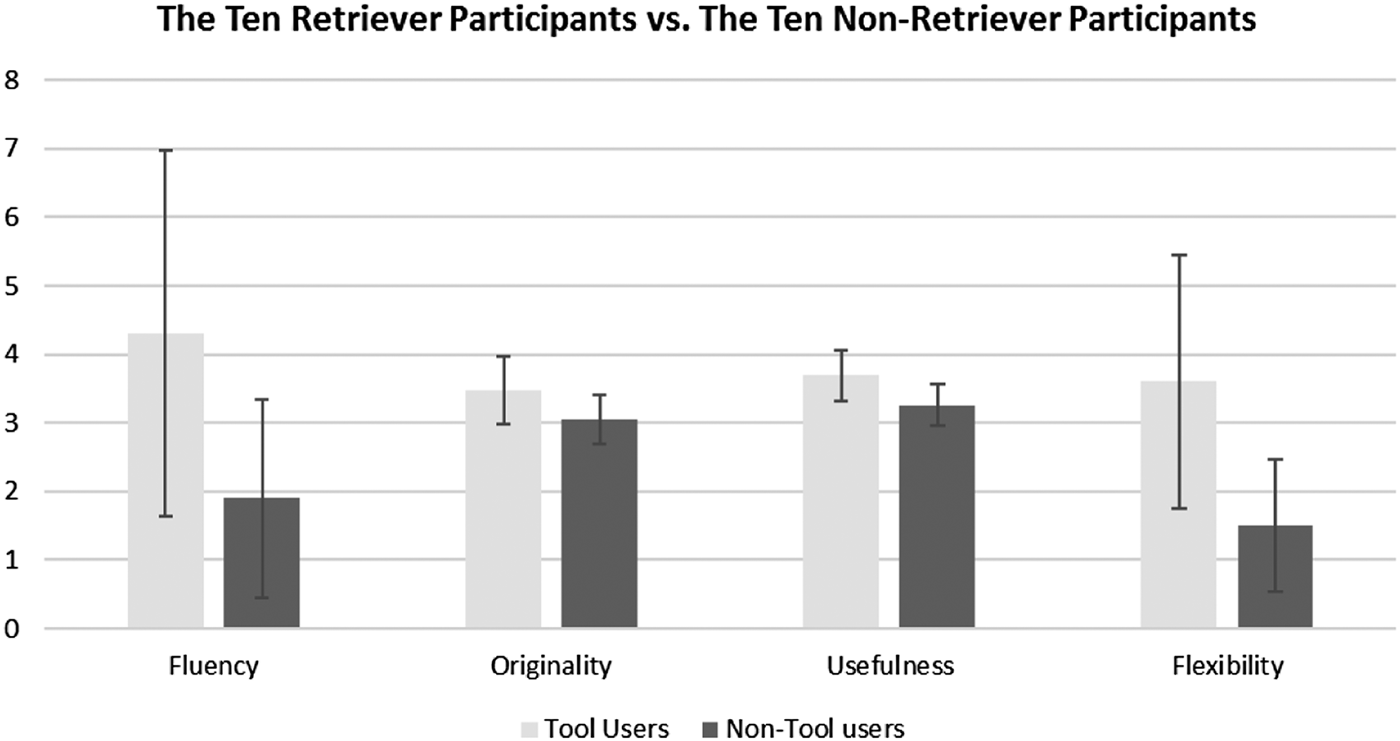
The evaluation results of the Retriever and non-Retriever participants, which are the mean scores of fluency, originality, usefulness, and flexibility at the individual level, are shown in Figure 6. At the individual level, the Retriever participants generated 4.30 ideas with a standard deviation of 2.67, while the non-Retriever participants came up with 1.90 ideas with a standard deviation of 1.45. In terms of idea originality and usefulness, the Retriever participants achieved 3.47 and 3.69 while the non-Retriever participants scored 3.05 and 3.26, respectively. The standard deviation of which were 0.49 and 0.35, 0.37 and 0.30, respectively. The Retriever participants’ idea generation flexibility was 3.60 with a standard deviation of 1.84, which is 2.10 higher than that of the non-Retriever participants with a standard deviation of 0.97.
The evaluation results: the ten Retriever participants versus the ten non-Retriever participants. (Note: The error bars indicate standard deviations.)

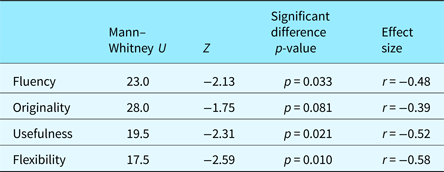
Although the mean metric scores of the Retriever participants are higher the non-Retriever participants, this might occur by chance. The standard deviations of fluency and flexibility are relatively larger than the others, which indicate the values are more dispersed. Thus, a Mann–Whitney U test was conducted in order to measure whether there are statistically significant differences between the means of the metric scores. The significant level of the Mann–Whitney U test was set as 5% (α = 0.05). This suggests that there is a statistically significant difference between the means of two conditions if a p-value is ≤0.05. The Mann–Whitney U test was performed by using SPSS and the results are illustrated in Table 3. Comparing the Retriever participants with the non-Retriever participants, the p-values between the mean scores of fluency, usefulness, and flexibility are all less than the defined 0.05, while the p-value of originality is slightly >0.05. This demonstrates that there are statistically significant differences between the Retriever and the non-Retriever users in terms of fluency (U = 23.0, p = 0.033), usefulness (U = 19.5, p = 0.021), and flexibility (U = 17.5, p = 0.010), while there is no statistically significant difference in terms of originality (U = 28.0, p = 0.081), with medium and large effect sizes.
The Mann–Whitney U test result: the ten Retriever participants versus the ten non-Retriever participants

r effect size: 0.10 = small, 0.30 = medium, 0.50 = large.
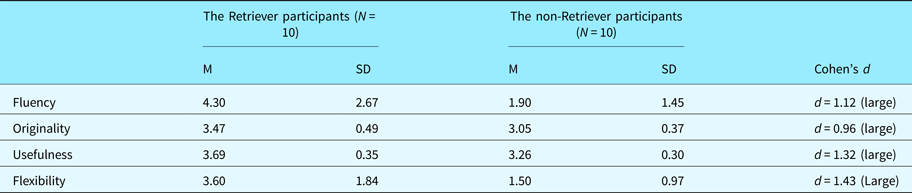
We have also calculated the Cohen's d values to measure the differences between the means to support the statistical analysis. As shown in Table 4, the Cohen's d values of the four metrics indicate that there are large differences, which have suggested high practical significant differences between the mean metric scores of the two types of participants.
Cohen's d: the ten Retriever participants versus the ten non-Retriever participants

Cohen's d value: 0.20 = small, 0.50 = medium, 0.80 = large.
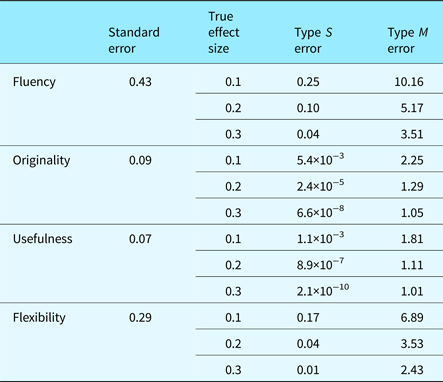
However, in a case study limited by a small sample size, there is an increasing probability of chance to estimate the effects that have incorrect directions (type S error) or to overestimate the effect sizes (type M error) (Gelman and Carlin, Reference Gelman and Carlin2014). To investigate these problems of the conducted case study, type S and type M errors were calculated based on the standard errors between means with estimated true effect sizes 0.1, 0.2, and 0.3, respectively. As shown in Table 5, there are slightly higher probabilities that type S and type M errors might occur in fluency and flexibility rather than originality and usefulness. This indicates that there exist probabilities that the effects of fluency and flexibility are in the wrong directions or the effect sizes of which are too high. However, these figures only present a hypothetical indication, as it is difficult to hypothesize true effect sizes for this case.
Type S and type M errors: the ten Retriever participants versus the ten non-Retriever participants

Due to a small sample size, we have conducted a Bayesian analysis, which is a Bayes factor-independent sample test by using SPSS, to produce more informative statements about the values of the case study data. In the test, H 0 is the null hypothesis indicating that there is no difference between the Retriever participants and the non-Retriever participants, while H 1 is the alternative hypothesis indicating that there are statistically significant differences between the two types of participants. The Bayesian analysis result is presented in Table 6, and the Bayes factors were interpreted according to Jarosz and Wiley (Reference Jarosz and Wiley2014). As shown in the table, all the p-values are smaller than 0.05, which indicate that there could be significant differences between the Retriever and the non-Retriever users in all four aspects. The Bayes factors have shown that there is an anecdotal support for the alternative hypothesis (H 1) in terms of fluency (BF = 0.345, t = −2.49, p = 0.022) and originality (BF = 0.555, t = −2.19, p = 0.042), as well as substantial supports for the alternative hypothesis (H 1) in terms of usefulness (BF = 0.175, t = −2.91, p = 0.009) and flexibility (BF = 0.108, t = −3.19, p = 0.005). The Bayes factors suggest that these data are 2.9, 1.8, 5.7, and 9.3 times more likely to be observed under the alternative hypothesis (H 1) with regards to fluency, originality, usefulness, and flexibility, respectively. Therefore, the Bayesian analysis indicates that there are higher probabilities that the Retriever participants could perform better than the non-Retriever participants, especially in flexibility, usefulness, and fluency.
Bayes factor-independent sample test: the ten Retriever participants versus the ten non-Retriever participants (H 0 null hypothesis: there is no difference between the two types of participants, H 1 alternative hypothesis: there is a statistically significant difference between the two types of participants)

BF, Bayes factor: 1–0.33 = anecdotal, 0.33–0.10 = substantial, 0.10–0.03 = strong.
Therefore, comparing the ten participants using the Retriever with the ten participants without using the tool in this case study, we can conclude that there are significant improvements in ideation fluency and flexibility as well as the idea's usefulness, according to the statistical analysis above. The Mann–Whitney U test has indicated an insignificant difference in originality and the Bayes analysis has shown a poor support for the alternative hypothesis (H 1) in originality, while the Cohen's d value has indicated a large difference. Thereby, we could consider there is a slight improvement in terms of the originality of the ideas produced.
Interviews were conducted after the design challenge. All the Retriever participants provided positive feedback indicating the tool is simple, useful, and effective for assisting idea generation. All the tool users indicated that the outputs were closely related to their input, which were useful for the design space exploration and expansion. Moreover, nine out of ten users agreed that the mood boards produced had provided a better comprehension of the outputs and enhanced their creative thinking during the idea generation. However, two participants pointed out that some of the outputs were common knowledge which they already knew. This is due to the limitation of the common-sense knowledge database used in the Retriever. In terms of the non-Retriever participants, although all of them indicated that Google Image is a simple tool, eight and nine out of ten considered Google Image is not useful nor effective, respectively, for supporting idea generation. They suggested that the images provided by Google Image were monotonous, which might had led them into design fixation. Six of the non-Retriever participants considered the design challenge was difficult and it was therefore challenging to generate creative ideas, despite having access to Google Image. Eight out of ten of the non-Retriever participants considered that it would be useful to have a number of good quality stimuli or source of inspirations, which are relevant to the specific domain, in visual forms during the idea generation.
Discussion
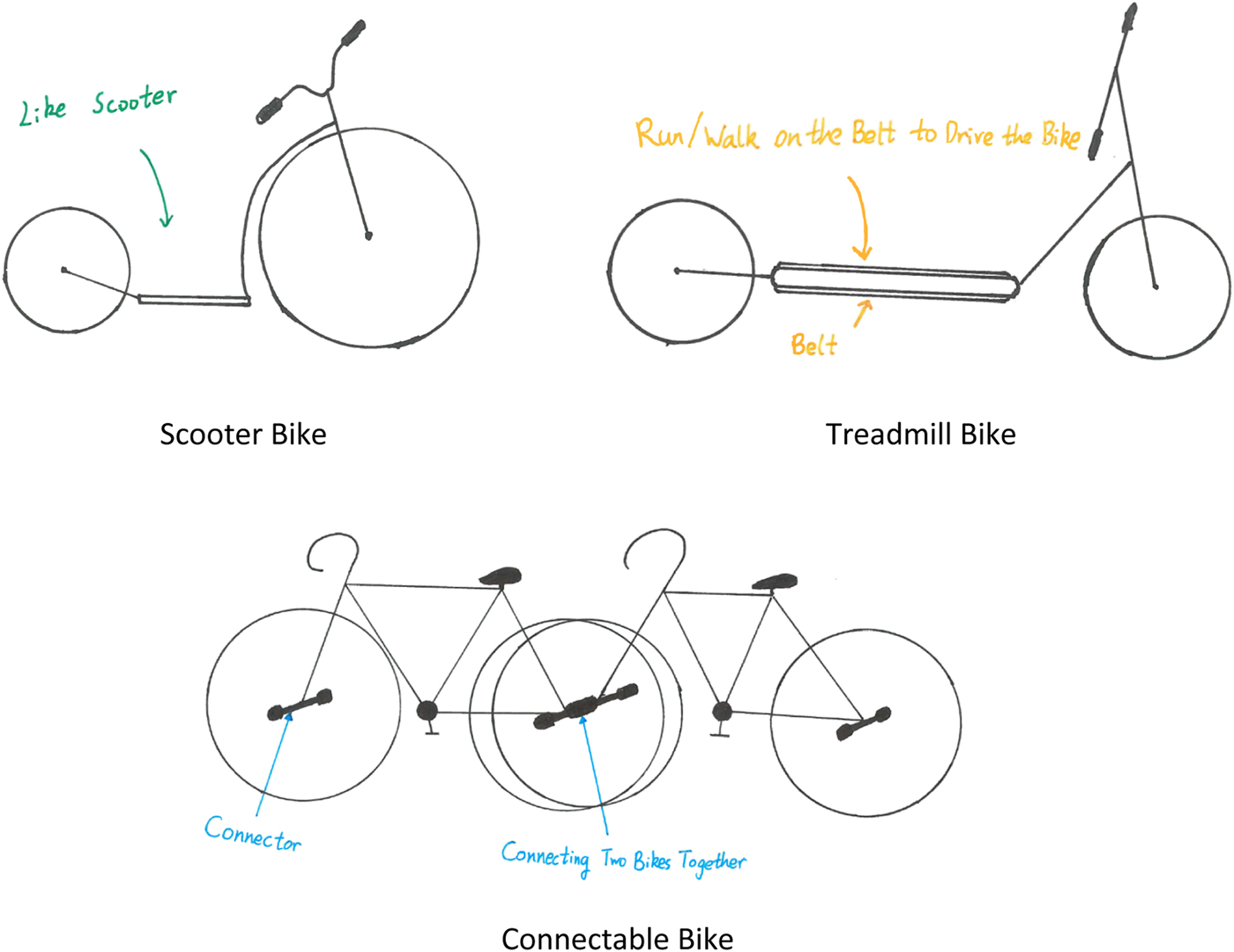
Comparing with the non-Retriever participants, creative ideas were commonly produced by the participants who were using the Retriever. Several creative ideas, “scooter bike”, “treadmill bike”, and “connectable bike”, produced by using the tool have been selected and re-sketched, as shown in Figure 7. The “scooter bike” uses gliding rather riding, which is safer, easier, and more fun than a conventional bike. The “treadmill bike” provides a new method of operating a bike, as well as offers the energy consumption benefit of conventional treadmills. The “connectable bike” allows users to connect two bikes together converting them to a single bike, which provides children with the enjoyment of playing together and subconsciously encourages them to ride bikes. However, these types of creative ideas were less common among the ideas generated by the non-Retriever participants. A significant proportion of the non-Retriever participants’ ideas was focused on the appearance of bikes.
Examples of the ideas produced by the Retriever participants.

The evaluation results show that the usefulness of the ideas as well as the fluency and flexibility of idea generation were significantly improved by using the Retriever, while the originality of the ideas was slightly improved. This is in line with the research conducted by Linsey et al. (Reference Linsey, Clauss, Kurtoglu, Murphy, Wood and Markman2011), of which there are no differences in novelty across different ideation conditions. These evaluation results indicate that the Retriever had increased the success rate of design, improved the occurrence of better ideas, and enhanced the exploration of the design space, and promoted the expansion of the design space. Moreover, all the ten Retriever participants provided positive feedback on the tool, highlighting its effectiveness, usefulness, and simplicity. Without using the Retriever, the other ten participants were confronting difficulties in producing ideas, especially creative ones, to solve the design challenge, despite the assistance of Google Image. As a result, the Retriever is considered as an effective tool for assisting the designers concerned in producing creative ideas, albeit based on a limited sample. However, the capability of the Retriever can potentially be increased by adding an ontology database containing technical concepts and relations.
Using the Retriever is considered to have significant benefits in long idea generation sessions, which exceed 30 min, compared with individuals not using any creativity tools. A human's idea generation rate generally decreases in 30 min, while the idea quality declines in 20 min (Howard et al., Reference Howard, Culley and Dekoninck2011). Theoretically, the tool can continuously generate useful stimuli to assist a designer in idea generation, which can maintain the designer's ideation rate and idea quality (Howard et al., Reference Howard, Culley and Dekoninck2011).
In comparison with other computational analogy tools, such as the WordTree method (Linsey et al., Reference Linsey, Markman and Wood2012) and Analogy Finder (McCaffrey and Spector, Reference McCaffrey and Spector2017), the Retriever can provide image-based stimuli or outcomes in addition to text-based outcomes. Image-based ideas or entities in mood board styles could support the comprehension of text-based outcomes, as well as improve creativity and enhance design communication. The WordTree method and Analogy Finder simply retrieve associated functional terms through abstractions, for instance, Analogy Finder rephrases the goal through using synonyms from WordNet and verbs, and then searches patents that match the rephrased goal from a database. The Retriever uses particular relations for retrieving related ideas or entities, which enriches the space of structures and components in an ontology as well as functions and behaviors. These novel properties of the Retriever could support design exploration and expand the design space.
Conclusion
Design creativity is a significant element in design, which assists problem solving, initiates innovation, and determines a product's performance. However, it is challenging to come up with creative ideas. This study has indicated a method of constructing ontologies with sufficient richness and coverage to support reasoning over real-world datasets for stimulating creative idea generation. The method has been developed into a computational tool, which is based on analogical reasoning and ontology, for supporting novice designers as well as experienced designers in idea generation and prospectively in idea elaboration. The tool is designed for solving proportional analogy problems (A:B::C:X) by retrieving the unknown term X from a knowledge database to help designers construct an ontology. Thereby, it can help designers produce creative ideas through design space expansion and exploration.
The tool has been considered as useful and effective for helping the designers concerned generate creative ideas through a case study. The statistical analysis results have indicated that the tool can significantly improve the designer's ideation fluency, ideation flexibility, and the idea's usefulness, as well as slightly increase the idea's originality, concerning the conducted case study. It has been revealed that the Retriever can improve better ideas occurrence and design success rates, and enhance design space exploration and expansion, albeit based on a limited sample. The cognition simulation approach used in the case study conducted has achieved a positive outcome, which provided a novel and robust method of developing design support tools. However, the current database employed in this study is a common-sense knowledge base, which is considered as a non-technical database. The performance of the tool can be potentially improved by adding a technical ontology database, for example, the one developed by Shi et al. (Reference Shi, Chen, Han and Childs2017) which involves technical terms and relations such as desalination is related to reverse osmosis, electrodialysis, and solar energy. Further research is planned to enhance the tool's performance in idea generation, as well as measure the tool's capability in idea elaboration.
Acknowledgements
This work includes data from ConceptNet 5, which was compiled by the Commonsense Computing Initiative. ConceptNet 5 is freely available under the Creative Commons Attribution-ShareAlike license (CC BY SA 3.0) from http://conceptnet5.media.mit.edu. The included data were created by contributors to Commonsense Computing projects, contributors to Wikimedia projects, Games with a Purpose, Princeton University's WordNet, DBPedia, OpenCyc, and Umbel.
Ji Han is Design Researcher and a PhD student at the Dyson School of Design Engineering, Imperial College London. His research interests focus on design creativity and computational creativity. His current research projects investigate: creative idea generation, the development of computational creativity tools, combinational creativity, design-by-analogy, ontology in design, data-driven design, AI in design, and the application of virtual engineering technologies in creative ideation. He obtained his MSc in Engineering Design from the University of Bath and BEng in Mechanical Engineering from Shanghai University.
Feng Shi is currently a PhD student at the Dyson school of Design Engineering at Imperial College London. He obtained his bachelor and master’s degree in material and mechanical engineering in China. His current research interests focus on data-driven design, text mining and engineering informatics. Feng is interested in using data analytic tools including data mining, machine learning and natural language processing to get insights from large scale human-machine generated data for revolutionising the engineering and design practice.
Liuqing Chen is a Research Assistant and PhD student of Design Engineering at Imperial College London, supervised by Prof. Peter Childs. His general research interests include: the application of artificial intelligence in design; data-driven design; computational creativity; creativity tool design, etc. He has completed projects including ‘B-Link’, AI based combinational creativity, design interpretation using image recognition and NLP.
Professor Peter Childs is Head of the Dyson School of Design Engineering at Imperial College London. His professional interests include: creativity tools and innovation; design; heat transfer and rotating flow; the circular economy and sustainable energy. Former roles include director of the Rolls-Royce University Technology Centre for Aero-Thermal Systems, director of InQbate and professor at Sussex University. He has contributed to over 200 papers, and several books on engineering design, rotating flow, rural urban migration and sports technology. He has been principal or co-investigator on contracts totalling £80 million. He is Founder Director and Chief Scientific Officer at QBot Ltd.