

Introduction
The Danish government recently decided to require all Danish companies to declare their engagement with Corporate Social Responsibility (CSR) (Danish Government 2008). This is only one of many indications of the extent to which Codes of Conduct (CoC) have become ‘mainstreamed’ and integrated in regulatory arrangements often promoted by public authorities; to an extent where some suggest that they have become part of a novel form of ‘constitutionalism’ (e.g. Gill Reference Gill1998; Teubner Reference Teubner, Joergs, Sand and Teubner2004; Van Mulligen 2011). Although this process is widely acknowledged, reactions to it diverge strongly. The thrust towards more socially responsible companies is mostly welcomed, but there is concern that it may be counterproductive because it undermines (the development of) binding hard regulation which is the only really effective guarantee of social responsibility. This article addresses the ambivalence about the mainstreaming of CSR. It does so by looking at an area where the ambivalence is unusually stark: namely military markets where some explicitly oppose the developing/drawing on non-binding regulation (e.g. de Wolf 2006) while others see ‘hybrid’ (i.e. involving overlapping and contradictory forms of) regulation as a possibility for not only obtaining but improving accountability (e.g. Dickinson Reference Dickinson2011). However, the argument has a bearing for the discussion more generally.
More specifically, the article elaborates two conceptual points. The first is that CoC are performative; they are ‘jurisgenerative’ (Benhabib Reference Benhabib2009: 692). By emphasising this point, the article joins the chorus of voices suggesting that to grapple with the implications of CoC, it is important to redirect the debate to focus on the performativity of CoC. The second general argument takes this insight further by showing that performativity is not only variable because it is (necessarily) situated in time and space but may also be multiple and contradictory in a given context. These two points are made through a discussion of the CoC in military markets as captured by three cases involving ArmorGroup on which the article draws to show that CoC in military markets ‘do’ at least two things: they constitutionalize and they militarize. They constitutionalize in the sense that they formulate ‘le règlement fondamental qui détermine la manière dont l’autorité publique doit être exercée’ (Vattel’s 1758 definition of a constitution as quoted in Peters Reference Peters2006: 581). They create first-, second- and third-order rules at the transnational level. They militarize by distracting attention from the violence of military markets facilitating its perpetuation, by distinguishing the ‘good’ military firms from bad ones thereby sanctioning the expansion of commercial military activities, and by diffusing military discourses.
The article unfolds in accordance with this ambition and argument. The first section explains why, how and on what basis the jurisgenerativity in military markets will be analyzed. The following three sections develop the analysis showing that CoC are doubly ‘jurisgenerative’ (constitutionalizing and militarizing) by focusing on the three cases involving ArmorGroup: the Kabul embassy case, the case of the War on Want campaign and the case contrasting the Montreux Document and the DCAF Code of Conduct for Private Security Service Providers. Each case is used to trace one regulatory process (the creation of first-, second- and third-order rules in that order) and one militarizing process (distracting from, distinguishing from and diffusing militarism).
Analyzing the ‘jurisgenerativity’ of codes of conduct in military markets
This section locates the argument theoretically and empirically by showing first why focussing on the performativity of law rids the discussion about the impact of CoC of two core assumptions that hamper efforts to come to grips with the ambiguity surrounding them and global constitutionalism more broadly. It then moves on to suggest how this might be done through an analysis of regulatory and militarizing processes. Finally, the section situates the argument empirically. It explains what empirical context it relates to, that is to CoC in military markets and as exemplified by ArmorGroup’s (now integrated into G4S) CoC.
Why look at ‘what Codes of Conduct do’? Consequences and contradictions
Two assumptions have done much to hamper efforts to come terms with the ambiguity surrounding the rapid growth of CoC. The first is the assumption that CoC should be studied for what they are not for what they do.Footnote 1 This is taken for granted in much of the rapidly growing literature on CoC where the core question is why and when CoC are adopted and how they are implemented. Hence efforts have been made to understand variation for example with reference to variation in the political pressure by policy makers (Flohr et al. Reference Flohr, Rieth, Schwindenhammer, Dieter Wolf, Ougaard and Leander2010) or NGOs (Haufler Reference Haufler2001), the corporatist (‘comparative capitalist’) framework (Gond, Kang, and Moon 2012; Knudsen 2011), the organizational structures of the company (Brown, Roemer-Mahler, and Vetterlein 2010) or their location in a value chain (Ponte and Richey 2011: chap. 4). In this line of inquiry much attention has been paid to variations in how the CoC are implemented and especially to whether they are implemented as intended. Studies have demonstrated for example that CoC tend to lack the obligations that could make them effective (Murphy Reference Murphy2005), are not (or imperfectly) implemented up and down supply chains (Schwartz and Tilling 2009) and sometimes remain window-dressing exercises primarily designed for marketing purposes (Buhmann, Roseberry, and Morsing 2010; Doane Reference Doane2005). This literature dealing primarily with what CoC are (why they are adopted and how they are ‘really’ implemented) is important and interesting. However, it cannot provide answers to the questions about the consequences of CoC which are at the heart of the hesitation surrounding CoC.
To bring the consequences of CoC into focus requires dropping the assumption that consequences are of lesser interest. Shifting focus away from what CoC are to what they do is an obvious route. This route has been taken in the debate about ‘global constitutionalism’ where scholars disagree profoundly on whether or not CoC are (part of) generating a new form of transnational or global hybrid (that is spanning the public/private and the national/international) ‘constitutionalism’ and, if so, whether or not that ‘constitutionalism’ should be welcomed (e.g. Teubner Reference Teubner, Kagan and Winston2002; Klabbers, Peters, and Ulfstein 2009; Picciotto Reference Picciotto2011). Those critical of global constitutionalism include (i) ‘nationalist sovereigntists’ who see global constitutionalism as undermining sovereignty and the national regulatory arrangements (e.g. Dobner and Loughlin 2010); (ii) ‘democratic sovereigntists’ whose main concerns are with undemocratically overriding ‘local’ understandings and values (e.g. Johns Reference Johns1995); and (iii) those whose main concern is that new constitutionalism is a ‘Trojan Horse’ for liberal capitalism and the inequalities and injustices tied to it (e.g. Gill Reference Gill1998).Footnote 2 Those embracing the global constitutionalism see it primarily as ‘compensating’ for the inadequacies of conventional governance arrangements (Slaughter Reference Slaughter and Quintana.2004; Peters Reference Peters2006; Ruggie Reference Ruggie and Ruggie.2008).
As this disagreement shows, focussing on what CoC do does not in itself clear the ambivalence surrounding CoC. Yet this is precisely what both sides claim. Benhabib for instance suggests that the reason critics fail to see the benefits of global constitutionalism is that they ‘ignore jurisgenerativity’ (2009: 691 and passim). By jurisgenerativity she understands ‘the law’s capacity to create a normative universe of meaning that can often escape the ‘provenance of formal law making’ (2009: 696). She suggests that taking jurisgenerativity into account demonstrates that global constitutional arrangements can be at the origin of
‘... those moments of rupture and possible transformation when social actors reappropriate new norms, such as to enable new subjectivities to enter the public sphere and to alter the very meaning of claims making in the public sphere itself. This is the promise of democratic iterations and cosmopolitan norms in the present’ (2009: 701).
However, the critics do not disagree with Benhabib because they ‘ignore jurisgenerativity’. They study it, even if they do not use her term. They disagree because their interpretations of it are diametrically opposed to Benhabib’s. They highlight that jurisgenerativity is undermining existing rights and the rule of law, and imposing economic or cultural domination. They look at jurisgenerativity in other contexts.
To advance in the discussion it is therefore useful to drop a second assumption, namely that the doings of CoC are uniform and/or unidirectional. Benhabib opens up for this possibility by ‘acknowledging’ the ambiguities of ‘the relationship between state sovereignty and various human rights regimes [which] not only generate dangers of increasing interventionism, but also paradoxically create spaces for cascading forms of democratic iteration across borders’ (2009: 701). But she hastens to add that as ‘a critical social theorist’ she focuses on the latter. This begs the question why exactly a critical scholar should rather paper over an ambiguity than subject it to critical analysis.Footnote 3 Especially since focussing on the tensions between multiple jurisgenerativities is one way of making sense of ambivalent reactions towards CoC. This article will therefore analyze the tension between multiple jurisgenerativities, and more precisely between two of them.
How to look at what Codes of Conduct do? Constitutionalization and militarization
CoC act in multiple ways and across multiple contexts. The potential avenues for analyzing their doings are correspondingly multiple. Just drawing on those already introduced, the jurisgenerativity of CoC in reproducing economic/cultural domination, undermining the rule of law, and empowering democratic movements stand out as possible avenues for research and discussion and logically further avenues could be added. To pursue all of these would be impossible. This article therefore focuses on two doings namely what CoC do to legal regulation and what they do to politics. The two jurisgenerativities are particularly central to the discussion surrounding global constitutionalism in general and the regulation of military markets in particular. They are also at the heart of Benhabib’s ambiguity where the potentials for ‘expanded intervention’ and for ‘democratic iterations’ meet.
The question of whether or not CoC generate law is core to the debates surrounding global constitutionalism. For those who think they can discern a ‘hybrid’, ‘global public-private constitutionalism’ (Peters Reference Peters2006: 587, 592), CoC are part of ‘fragmentary constitutional law elements at various levels of governance ... a criss-cross [which is in effect] a “constitutional network”’ (Peters Reference Peters2006: 601). For those who deny the emergence of such an order, CoC are of little regulatory consequence. To address this debate, the article picks up the conventional distinction between first-, second- and third-order rules that are all part of constitutions. First-order rules regulating behaviour, but also the second-order rules (regulating first-order rules) and third-order rules (setting out the general principles that are supposed to inform the first- and second-order rules) are part of constitutions (Hart Reference Hart1961: 77–96; discussed in relation to constitutionalism by for example, Herberg Reference Herberg and Winter2006). The article follows the lead of these scholars in emphasizing the importance of the links between the different-order rules (their ‘unity’ in Hart’s strong formulation). It hence inquires into whether or not CoC do generate rules at all three levels.
Second, the question concerning what CoC do to politics has been a core concern of those who worry that the focus on rules and ‘constitutionalism’ leads to assuming regulation is per se good. Koskenniemi for example has repeatedly underlined that law does not speak for itself but is necessarily reproduced in a political context (e.g. 2007; and 2004). Neglecting this, those who speak the language of ‘global constitutionalism’ may ‘appropriate the voice of international legality to a fully instrumentalist discipline dedicated to serving the interests of power’ (Koskenniemi Reference Koskenniemi2009: 396). Koskenniemi shows how the connotations of global constitutionalism – and particularly the mobilization of references to a Kantian tradition – lead to a misrecognition of these political processes and hence facilitate them. This article sets out to consider analogous processes of misrecognition at work in the more restricted area of military markets. In so doing it draws on the extensive work on misrecognition as a foundation of politics (and of power relations more generally) undertaken by Bourdieu (especially 2000) and scholars following him (IPS 2011). More specifically, it focuses on processes generating a misrecognition of the way that CoC reshuffles power in favour of military establishments (public and private) hence generating a ‘militarization’ in the classical understanding of increasing the weight of the military in society. It looks at three types of misrecognition processes that play an important role in this body of thinking: misrecognition produced by distracting attention away from the power relations and hence producing misrecognition, by distinguishing between power relations and other relations hence making the power inherent in these ‘other’ relations invisible, and by diffusing an understanding that the present relations are the ‘right’ or ‘natural’ ones.
What codes of conduct to look at? Military markets exemplified by ArmorGroup
The jurisgenerativity of CoC will be analyzed in the context of military markets generally and three cases involving ArmorGroup specifically. Concentrating on military markets has the advantage of bringing an under-explored and hard case into the discussion about global constitutionalism. Drawing on cases involving ArmorGroup is a way of anchoring the discussion in a situated context.
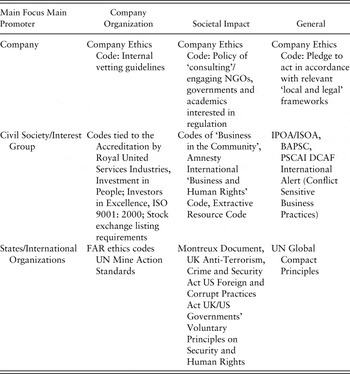
Military markets expanded rapidly in the wake of the cold war and especially after 9/11. The interlocking of the ‘revolution in military affairs’, the inroads of New Public Management technologies in the area of intelligence/defence/security and the centrality of risk management had created a vastly increased role for commercial military/security companies (Leander Reference Leander2006 and 2011). As part and parcel of this expansion a minor forest of CoC emerged ranging from non-binding statements (e.g. company ‘ethic codes’) to formal regulation (e.g. the US Federal Acquisition Regulations ethics requirementFootnote 4) as visualized in Table 1. The complexity of the resulting regulatory arrangements can be gleaned from the development of a secondary consultancy industry that specializes in consulting public and private clients on the applicable regulation and helping them formulate CoC, as required in the context.Footnote 5 In spite of this, it is more often than not assumed that regulation of the use of force, and especially regulation at the international level, remains closely guarded by states to the point of being defining of internationally recognized statehood (Thomson Reference Thomson1994). ‘Shared sovereignty arrangements’ for example are justified on the grounds that states fail to legitimately regulate the use of force (Krasner Reference Krasner2004; Ehrenreich Brooks 2005). It is therefore the area where one would expect (independently of how quickly markets expand) the kind of ‘hybrid’, ‘public-private’ regulatory arrangements at the core of the discussions surrounding global constitutionalism to matter least; it is a hard case. Bringing this development into the discussions regarding CoC and global constitutionalism is long overdue.
ArmorGroup’s Codes of Conduct

Compiled from (ArmorGroup 2007, 2008; IPOA 2005).
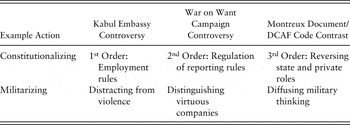
In view of the contextual variability of CoC the article focuses the argument further by anchoring it in a discussion of three cases involving ArmorGroup:Footnote 6 the controversy surrounding the Kabul embassy contract, the controversy surrounding the publication of the War on Want report Corporate Mercernaries and the contrast between the virtually simultaneous development of two major international CoC for private security contractors namely the DCAF Code and the Montreux Document. ArmorGroup’s role as a forerunner in the area of CoC and regulation – a ‘core contributor’ in the company’s own formulation (ArmorGroup 2008) – until it was bought by G4S makes it a good case.Footnote 7 It made the company engage with an unusually wide range of CoC (see Table 1). As such the company offers an exceptionally rich basis for thinking through the multiple jurisgenerativities of CoC (constitutionalizing and militarizing in this case) while at the same time limiting the complexity by providing a unitary background. The three cases have been picked because they revolve around first-, second- and third-order rules respectively. Each conflict can also be used to illustrate one of the three processes of misrecognition empowering military/security establishments (distracting, distinguishing, and diffusing) introduced above. Each misrecognition process will be illustrated by one case. However, this linking is made for reasons of clarity rather than because of some intrinsic or exclusive ties between the case and the misrecognition process.
The resulting structure of the analysis is summarized in Table 2, which consequently also indicates the structure of the argument ahead. As shown there, the article looks at the two kinds of jurisgenerativity of CoC it focuses on – constitutionalization and militarization – in three cases. The table also anticipates the conclusions ahead by indicating that the CoC are indeed both constitutionalizing, in that they generate first-, second- and third-order rules and militarizing through the distractions, distinctions and diffusions they produce.
Analytical Summary

The Kabul embassy controversy
The controversy around ArmorGroup’s contract to guard the US Kabul embassy is in reality a series of controversies that begin with ‘whistle-blowing’ initiatives by company employees in 2007 (the company won the contract in late 2006). According to the whistle blowers, the company was overcharging heavily while at the same time cutting costs to the detriment of the quality of the services provided. It was (among other things) suggested that the company was understaffing with the consequence that too few guards had to take on too many and too long shifts; that the staffing was inappropriate as guards lacked basic competencies and that the extensive reliance on non-English speaking Gurkhas and Peruvians made communication impossible undermining the security of embassy (Siegel and Block 2008; St. Jean 2009). These complaints were ignored until a second controversy erupted. This was a highly mediatised scandal surrounding the publication of ‘lewd photos’ showing ‘the drunken hazing rituals, including those now infamous vodka buttshots’ of ArmorGroup employees which are now routinely invoked to question the professionalism of private military service providers (e.g. Schakowsky 2011). This second scandal played a decisive role in tipping the balance towards a discontinuation of the Company’s contract. Hence at the end of 2009 ArmorGroup lost its US$189 million contract for guarding the embassy to EODT although at the date of writing it is still in charge of security because EODT has not been able to take over (Schulman Reference Schulman2009a; Associated Press 2011). This controversy illustrates both how CoC formulate first-order rules that are part of a hybrid public-private ‘constitutional’ order as well as how they lead to a misrecognition of the kinds of politics created in the process by distracting attention from the military nature of the activities they regulate.
Constitutionalizing first-order rules: Employment regulations
In the controversy surrounding ArmorGroup’s Kabul embassy contract there was constant reference to CoC and the outcome the final sanctioning of ArmorGroup, through the loss of contract is only understandable with reference to them. Part of the controversy revolved around whether or not ArmorGroup had lived up to its various formal contractual obligations, towards the state and towards its employees. Two former employees attempted a lawsuit against the company arguing that it had not respected their terms of employment (Lardner Reference Lardner2009). Similarly, allegations were made that ArmorGroup had falsely represented its ability to handle the Afghanistan security contract. However, the lawsuit was dismissed by ArmorGroup’s legal counsels who deemed the claims ‘without legal merit’ (Schor Reference Schor2008). And although ArmorGroup acknowledged that it ‘cannot provide the services required by the contract for the contract price’ (quoted in O’Keefe 2009) this did not lead the State Department to terminate the contract or revise its terms.
The real controversy revolved around whether or not those involved had in fact lived up to the standards they had committed themselves to follow either by formulating them in internal policies or by signing up to external ones. ArmorGroup repeatedly explained that the reported incidences were exceptional breakings of the general well-institutionalised rules and procedures (e.g. Ackerman Reference Ackerman2009). The State Department tried to convey a similar message when it underlined that ‘ArmorGroup was not a small, undercapitalized, underfunded, fly-by-night organization’ but one that had met ‘all the necessary requirements’ (Sheridan Reference Sheridan2009). To the contrary, the critics focussed on the fact that the standards had been systematically disregarded. This is the core thrust of the POGO [the Program on Government Oversight] lawyers insisting that the processes and standards were disregarded in widespread fashion by ArmorGroup in its handling of the embassy contract (quoted in HR 2009). More than this, the way the whistle-blowing process was handled became a core part of the controversy as it came to epitomize the lack of respect of standards and codes (e.g. CWC 2009; Lardner Reference Lardner2009). ArmorGroup was criticized for dismissing one of the whistleblowers something considered doubly damaging because of the company’s purportedly high ethical standards (Schulman Reference Schulman2009b). The State Department came under critique for its disregard of the complaints preceding the party picture scandal again on grounds that were related more to the declared interest in encouraging transparency and to ensuring high ethical standards for example by supporting whistle-blowing (Sheridan Reference Sheridan2009; Thompson Reference Thompson2009).
The line of response to the scandal both from the State Department and from ArmorGroup is in line with this focus on standards and processes as it is concerned primarily with underlining a tightening of already strict rules and procedures. Hence, ‘the secretary [of state] and the department have made it clear that we will have zero tolerance for the type of conduct that is alleged in these documents’ (quoted in Tyson 2009). Similarly, ArmorGroup responded by underlining that it had ‘instituted new recruiting, screening and training procedures to ensure the guards spoke English and had received the necessary instruction’ (quoted in Dreazen Reference Dreazen2009). Also the ultimate sanctioning of the firm echoes the centrality of standards and processes. ArmorGroup’s embassy contract was opened for rebidding because of a diffuse impression that ArmorGroup was not living up to its standards. As the assistant secretary of state for public affairs at the time put it: ‘the recent allegations of misconduct and various contract compliance deficiencies [which] led us to conclude it was in the best interest of the government to compete a new contract’ (quoted in Cole 2009).
In the controversy surrounding the Kabul embassy, CoC functioned as a relatively institutionalized reference point. They were used by all sides in the discussion to advance claims about responsibility/blame and they ultimately became the basis for sanctions. This is not sufficient to claim that the case demonstrates a fully fledged ‘juridification’ (turning into law) of CoC. Not any and every corporate declaration, societal norm formation or private ordering is a rule/law governing behaviour.Footnote 8 However, it does show that CoC were recognized as core to the regulation of behaviour. They were ‘law’ in the sense being part of the regulatory network to reiterate Peter’s formulation on the basis of which behaviour is deemed legal or not, responsibility is attributed and sanctions enforced.
Militarizing by distraction: Focus on the work environment
The controversy over ArmorGroup’s Kabul embassy contract also illustrates the extent to which CoC are doing things not merely with respect to regulation but also to politics. The CoC and the extensive reference to them fix attention on the question of whether or not the standards they specify are respected. The reverse side of this is to distract attention away from the question of the nature of the work that is being undertaken. Since the latter is inherently controversial, the distraction from the violent and military nature of work made possible by the CoC is a way of papering over this controversy and hence of consolidating the otherwise controversial military role of companies such as ArmorGroup.
Read in this key, references to CoC by ArmorGroup and the Department of State play an important role in redefining politics; not so much by what they say or what their actions draw attention to but what they make it possible to forget and to gloss over and particularly the politics involved in the broader controversy surrounding ArmorGroup’s presence in Kabul. The reference to CoC is a way of concentrating attention on the relatively stringent vetting procedures, elaborate training programs and professional work routines. This potential of de-politicizing by distraction is actively used in the communication strategy surrounding the company. Characteristically, an investor striving to ‘speak up’ ArmorGroup shares under pressure (partly as a consequence of the Kabul embassy controversy) begins by insisting that ArmorGroup’s activities are not of an ‘unethical nature’ by explicitly creating a distance to the military and conflict situations. ‘Only a fifth of the company staff carries firearms and much of its work is relatively peaceful, such as police training’ he insists. He then goes on to highlight the good care that ArmorGroup takes of its employees: ‘you have to be very careful before trying to cut costs or you end up with employee deaths. We [ArmorGroup] spent $13 m in the last two years enhancing kit in Iraq, such as vehicles and body armor’ (quoted in Arnold Reference Arnold2008).
The focus on the high standards enshrined and guaranteed (at least on paper) by the CoC distracts attention from the military nature of the company’s activities not only towards outsiders, but it also works inside the company making the employees complicit in reproducing the image of a company that is not really engaged in military activities that is merely professional as opposed to military. The CoC works as an ethical blueprint, allowing employees to fall back on a reference to professionalism. ArmorGroup’s insistence on its commitment to CoC helped it establish a reputation of being an employer avoiding ‘cowboys’ favouring the professional which in turn triggered a self-selection among those seeking employment with the company; a relatively high proportion of those seeking work with the company identified with this image (Tyson 2009). The commitment of its employees to the high standards seems to have been exceptional even by comparison to other areas of activity. As Danielle Brian (executive director at POGO) explained in a Congressional Hearing (HR 2009): ‘more than 20 whistleblowers, came forward at great personal risk [...] I’ve been doing this for 20 years, and there has not been a circumstance that I can point to where such an enormous percentage of individuals have come forward [...] It is unlike anything I have experienced.’ This commitment is important for effective regulation, as the whistle-blowing shows. It also enables the employees to direct attention (their own and others’) to the professional, ethical and orderly nature of their work and by implication away from the violence, uncertainties and disorders ArmorGroup employees in Kabul are inevitably exposed to and participating in every day. The employees’ wish to engage in such distraction may explain why Danielle Brian ‘had never seen anything like it’. It certainly reinforces the misrecognition of the military side of ArmorGroup’s presence in Afghanistan by enrolling its employees in producing it.
The combination of misrecognition and regulation captures the core contention of this section. The jurisgenerativity of CoC has created a hybrid form of first-order regulation of working conditions for private military and security company (PMSC) employees but it has also created a distraction moving attention away from the military nature of this work. The focus on sleep deprivation of the guards, their drinking and partying habits and their (lack of) competence trivializes their presence. By the same token, it distracts attention from the important role the guards play in upholding the military order. Not by explicit denial or intended rejection but by virtue of the implicit and tacit ordering entailed, the hybrid juridification normalizes the military presence and the related activities. In this sense it militarizes by distraction.
The War on Want controversy
A second controversy that highlights the dual – constitutionalizing/militarizing – and jurisgenerativity of CoC is the controversy that surrounds the campaign ‘Stop the business of war’ of the London based organization ‘War on Want’ (www.waronwant.org/campaigns/corporations-and-conflict) and more specifically the controversy over the publication its report Corporate Mercenaries (War on Want 2006). This report is a short (20-page) statement discussing the rapid rise and privatization of war, the ‘threat’ consequently posed by PMSCs and concluding on the regulatory action therefore necessary on behalf of the UK government. ArmorGroup is one of the companies cited to document the claims in the report. The company hence formulated a public response to the ‘misleading report’ striving to convey the message that the company ‘is not considered a “mercenary grouping” by any responsible pressure group, national or international authority’ (in bold in the original response. See ArmorGroup 2007). To do this, the company addressed what it considered factual errors in the report, but the bulk of the response (around two-thirds) was spent underlining the extent to which ArmorGroup adheres to international CoC, has a stringent ethics policy – elaborated and pursued through dialogue with NGOs, public and market authorities – and is contributing to the development of an ‘ethical and regulatory infrastructure’ for the ‘Private Security Company industry’ as a whole. War on Want followed up on the report with various actions, including for example organizing a parliamentary motion signed by 100 members of parliament urging the government to move towards binding legislation (Norton-Taylor Reference Norton-Taylor2008) and an action at the annual conference of the British Association of Private Security Companies 20 October 2009, where ‘a campaigner dressed as Gordon Brown handed over money to “armed” mercenaries to protest the lack of progress on regulation’ (War On Want 2009).
An analysis of the arguments used in the controversy shows the extent CoC have produced a web of second-order regulation, i.e. of regulation dealing with the rules for setting rules. But more than this, it shows that CoC produce distinctions among respectable and non-respectable firms – that are constantly invoked in the debate – that generate a misrecognition of the overall increase in the weight of military professionals; respectable or not.
Constitutionalizing second-order rules: Regulating regulation
The controversy surrounding the War on Want campaign is about how the regulation of private military markets should be formulated. The first recommendation made in the report launching the action is that ‘The UK government must move towards legislation to control the PMSC sector as an urgent priority. Self-regulation by the industry is not an option.’ (War on Want 2006: 21). The pitching of the company response to underline its already extensive engagement with regulation is therefore logical, as is its effort to explain the nature of ‘the ethical and regulatory infrastructure’ much of which is anchored in CoC of different kinds. By the same token it underlines that War on Want does not know what it is talking about. To ensure that this point is not lost on the audience, ArmorGroup begins its reply by pointing out that War on Want ‘joins what is now a sophisticated debate very late’. The issue at stake is obviously not War of Want ignorance but a fundamental disagreement over the rules governing regulation. War on Want is taking a conventional, statist, binding, hard-law only position while ArmorGroup is defending an understanding more in line with those who think that regulation resides in a criss-cross of hybrid public-private rules. This disagreement remains unsettled. Hence, in 2011 when the spending on contractors was once again up for discussion, Yasmin Khan (responsible for the campaign at War on Want) again took the occasion to deplore that ‘The government has opted in favour of self-regulation accompanied by an international Code of Conduct […when] national regulation is urgently needed to hold British mercenary companies to account’ (quoted in Townsend Reference Townsend2011).
The disagreement about the rules that should govern the rules in military markets raises questions about who can claim the right to regulate and in prolongation of this, what kinds of processes ought to be necessary to (re)formulate regulation and what kinds of sanctioning mechanisms should be in place. When War on Want implies that ArmorGroup (and the industry more broadly) are trying to evade real regulation it is taking a stance in this debate just as much as ArmorGroup is when it suggests that War on Want is ignorant. As the reference to the UK government’s position underscores, the battle for the time being is an uphill one for the War on Want side: CoC are part of the regulatory instrumentarium. For the UK government, the question is not if CoC should be part of regulation but how. This position is a widely shared one including by critical NGOs. A case in point is Human Rights First which concluded its report Ending the Culture of Impunity of security contractors in Iraq by stressing the need for ‘a comprehensive reporting regime’. More substantively, HRF explains that this regime should ensure that reporting leads to ‘company resolutions and criminal prosecutions’ and that for it to function ‘companies must have appropriate internal vetting, training and supervision mechanisms and capabilities, and substantial and rigorous internal discipline systems’ (HRF 2008b: 36 and 39 respectively emphases added). HRF in other words locates regulation, rule formulation processes, and sanctioning mechanisms in CoC.
In sum, CoC are clearly invoked as second-order rules not only by industry advocates trying to escape harder forms of regulation but also by critical NGOs and governments. This is critical for thinking about CoC as part of a hybrid public-private constitution. As Teubner underscores even if primary rules are also part of constitutions, CoC ‘would not establish a corporate constitution if they only introduced primary rules governing corporate activities... The critical threshold is reached when the codes set forth secondary rules concerning the identification, interpretation, amendment, and competences for the enactment and delegation of primary rules (Teubner Reference Teubner2011b: 24)’. As War on Want’s ongoing campaign and continuing protests demonstrate, the last word has not been said about the appropriateness of anchoring rules about rules in CoC. However, as the responses show in current regulatory processes secondary rules are anchored in CoC. In that sense CoC are ‘jurisgenerative’; they are constitutionalizing the regulation of military markets.
Militarizing by distinction: The virtuous company
The controversy over the War on Want campaign also shows a second type of jurisgenerativity CoC; their role in militarizing politics. By creating a distinction between good, respectable and hence legitimate companies that contribute to the development of CoC and abide by them and the illegitimate, unrespectable rest, CoC are part of engendering a dual process of misrecognition of the militarization inherent in the growing role of the companies.
First, CoC create distinctions between the respectable companies that follow CoC and the non-respectable ones that do not. This distinction fixes the discussion on the importance of selecting the right companies and blocks interrogation regarding the need to select in the first place. It is mobilized for this reason. Hence companies, including ArmorGroup, as well as those who contract them, insist heavily on these distinctions. Sir Malcolm Rifkind (chairman of the board for ArmorGroup) rarely missed an opportunity to underline that ‘there is Securicor at one end of the industry and “dogs of war” at the other’ (quoted in Arnold Reference Arnold2008). ArmorGroup employees echo this when they distinguish themselves from the Blackwater ‘cowboys’ (PMCS List 2006; Young Pelton 2006: 60). The commitment is also taken into practice where ArmorGroup insists on outdoing other companies e.g. by distinguishing itself as a company that pays ‘compensation to civilians injured in “road accidents” involving its staff’ (Arnold Reference Arnold2008) and by (as one of worryingly few companies) regularly reporting ‘discharge of firearms incidences in Iraq’ (HRF 2008b: 16). It also actively sustained its position of the distinction by rapidly removing any potential stains that might tarnish its image. The public response to War on Want epitomizes this (the other companies cited chose to ignore the report) as does its rapid removal of ‘another oups video’Footnote 9 featuring ArmorGroup contractors from the net (PMCs mailing list 8 November 2007). Directing the spotlights to the relative respectability of companies leaves the prior questions about their presence in the dark.
Analogously, and second, CoC create distinctions between the contexts they contribute to regulate and the unregulated ones. Again this distinction helps concentrating the discussion on the importance of regulation to which CoC contributes while at the same time leading it away from the thornier but prior question of whether or not it is a regulation or a ban (to use War on Want’s expression) that is warranted. Even more strongly, reference to CoC works as a blackmail locking potential critics into their relationship with the ‘good’ companies that sustain ‘regulation’ such as ArmorGroup. Who could possibly be against promoting regulation in the violent and often confusing contexts in which PMCs work and risk undermining it by not working with companies who sustain it? ‘We need [and…] our system demands… firms that play by rules’ (Rep. Shays quoted in HRF 2008a). This is a strong reason for companies to promote regulatory initiatives as ArmorGroup does. Indeed, it is a good reason for companies to display willingness and capability to take the lead in developing regulation and to flag that they have specific and practicable ideas about how that regulation should look. ArmorGroup does exactly this when it makes general statements about the regulatory process such as ‘we welcome improved law, rather than additional law’ (quoted in Hodge Reference Hodge2007).
The focus on the distinction of the good from the bad (and the outright ugly and entirely unacceptable) company and regulatory context obfuscates the more fundamental questions about the activities of the companies and the relationship between regulation and ban. These questions logically precede the distinctions between the well-behaved and the rogue firm; the well-regulated and the anarchical context. They cannot be answered with reference to these distinctions. However, the distinctions can make them appear irrelevant. The soothing assurance that the good companies do behave well and that regulation does impose order readily overshadows concerns that perhaps the companies (whether or not behaved) have no place in the context (well regulated or not). Distinguishing these concerns into oblivion enshrines and extends the extension of military activity made possible by military markets. For this reason CoC are, as this section has argued, militarizing by distinction as well as generative of second-order regulation.
The Montreux Document and DCAF Code contrast
The last case used to analyze the dual militarizing and constitutionalizing jurisgenerativity of CoC is a contrast between two ambitious Codes that ArmorGroup has been part and parcel of formulating: the 2008 ‘Montreux Document’ – initiated by the ICRC and the Swiss government and open to signature by states – and the 2010 DCAF [Democratic Control over Armed ForcesFootnote 10] Code – initiated by the Swiss QUANGO is open to signature by companies (ICRC 2008; DCAF 2009). The Montreux Document is the most important interstate initiative pertaining to the governance of the use of force by commercial actors taken since the adoption (1989) and ratification (2001) of the UN Convention against the Finance and Use of Mercenaries (UN 1989). It is technically an addendum to the Geneva Conventions that specifies the interpretation and best practice of the conventions in armed conflicts where there is extensive reliance on private contractors. The DCAF code in turn ‘aims to set private security industry principles and standards based on international human rights and humanitarian law’ (DCAF 2010: preamble point 5). To date 211 companies have signed the Code (including G4S that now includes ArmorGroup).
Both codes have been developed and implemented in a process involving extensive consultations with states, human rights organizations and companies including ArmorGroup which to some extent sees itself as a driving force behind both.Footnote 11 Both Codes generate new general principles of regulation – that one might term third-order rules – that should inform both first- and second-order rules and in that sense they have an analogous role to the preambles in Constitutions and indicate the extent to which CoC also constitutionalize general principles of regulation. But the two codes do more than this they militarize politics by diffusion, by bringing more professional military/security voices into the discussion.
Constitutionalizing third-order rules: Specifying principles
The DCAF Code and the ICRC Montreux Document are both CoC that enshrine and promote general overarching principles regarding what norms should be taken into account when interpreting, reformulating and sanctioning according to rules. More substantively, the two codes do so in relatively similar ways: they present themselves as laying out basic principles for regulation, they underscore the centrality of existing human rights law, but they also include references to different kinds CoC enshrining their role in regulation.
Not surprisingly perhaps, the DCAF code – formulated by and directed at private security service providers – grants greater space to regulation enshrined in CoC. The DCAF code starts with an explicit clarification that it is formulated in respect of existing human rights law but it talks about ‘rules’ and ‘good practices’ in the same breath and immediately introduces the Montreux Document and the ‘Respect, Protect, Remedy’ framework developed by the Special Representative of the United Nations Secretary General on Business and Human Rights (preamble point 2). Throughout the document reference to rules and norms such as internal governance processes and ‘due diligence’ play a considerable role. By contrast the ICRC code avoids references to CoC. As the authors of the foreword put it, the document ‘simply seeks to provide guidance on a number of thorny legal and practical points, on the basis of existing international law’ (ICRC 2008: 5). It makes no principled general reference to specific private codes. However, it does not entirely circumvent reference to CoC especially in Part II which is dedicated to ‘best practices’. The Document for example urges states ‘to take into account the PMSC’s internal organization and regulations, such as: the existence and implementation of policies relating to international humanitarian law ... as well as policies against bribery, corruption, and other crimes’ (§12a and b). Along similar lines when outlining best practices for ‘monitoring compliance and ensuring accountability’ it underscores that it is essential to ‘engage PMSCs, Territorial States, Home States, trade associations, civil society and other relevant actors to foster information sharing and develop such mechanisms [ensuring the proper execution of the contract and the accountability]’ (§21f). Even if DCAF is more explicit both Codes in other words consider CoC part and parcel of the regulatory infrastructure they speak to leaving aside the obvious fact that both documents are themselves CoC.
Ironically, the reluctance of the ICRC document to embrace CoC as integral to regulation has the consequence that principles informing regulation become more general, less binding and ‘softer’ than those introduced in the DCAF. The DCAF code sets the tone for what is to come by suggestion that ‘this Code… acts as a founding instrument for a broader initiative to create better governance, compliance and accountability’ (DCAF 2010: Preamble point 7) and develops a process for sanction and control in the form of ‘an external independent oversight mechanism’ and specifies that as ‘as a minimum’ this mechanism ‘is to include certification, auditing, monitoring and reporting’.Footnote 12 Logically following from this, the DCAF code is formulated in terms of ‘specific principles’ and ‘commitments’ (sections F and G respectively which constitute the core of the code) and outlines precise and specific instructions on a range of pertinent issues and does not hesitate to formulate prohibitions and sanctions in relation to these.
The Montreux Document by contrast, states that ‘this document is not a legally binding instrument’ (§3) and that it ‘should therefore not be interpreted as limiting, prejudicing or enhancing in any manner existing obligations under international law’ (§4). The Montreux document consequently urges states to extend, strengthen, adopt and implement the legislation and best practices it suggests, including ‘ideally’ as the commentary underlines in situations for which they are not intended such as peacetime situations or situations where PMSCs contract for non-state actors (ICRC 2008: 32). But it refrains from specifying processes for following up on the suggestions or sanctioning those who fail to do so. Ironically, principles for developing binding regulation appear easier to formulate and more present in the DCAF code that fully integrates CoC than in the Montreux document that does not. There is a reversal of logics where the CoC seem to harbinger stricter and more binding rules than state-based law which remains ineffectual; a trend identified also in other contexts as heralding an ‘inversion of Nation-State Hierarchies’ where CoC come to provide binding law while states formulate general ethical principles (Teubner Reference Teubner2011b: 28). The call is still out on how effective this form of ‘binding’ regulation’ can be when (and if) implemented.
Effective or not the general principles spelled out in CoC signal the extent to which these are constitutionalizing also in the third sense of spelling out the third-order rules that should inform rules and rule-making/amending process. As the DCAF Code and Montreux document contrast demonstrates, the anchoring of these principles in CoC does not entail a displacement of principles formulated by states. Pace Backer (Reference Backer2008: 523), it is not the case that ‘[c]ontract replaces law; networks of relationships replace a political community; interest replaces territory; the regulated becomes the regulator’. Rather, an intertwining, interlocking, and overlapping of public and private regulatory arrangements is altering regulatory logics and articulated in the formulation of overarching principles.
Militarizing by diffusion: Multiplying the military voices and practices
Setting standards for PMSCs and making reference to the CoC pertaining to their activities legitimizes their presence both on the ground and in regulatory debates. The ICRC is explicitly wary of this as it cautions that the Montreux ‘document should not be construed as endorsing the use of PMSCs in any particular circumstance but seeks to recall legal obligations and to recommend good practice’ if PMSCs are contracted (ICRC 2008: Preface point 7). However, in spite of such cautioning, CoC – including the Montreux document – do extend the range of practices and voices. The result is a diffusion of military ideas and practices and the related normalization of a situation where a wide range of actors practice and speak authoritatively in military matters. In this way CoC engender a third type of political jurisgenerative process: militarization through diffusion.
The mainstreaming of CoC places the central role of companies in regulatory debate beyond doubt. It is hence not surprising that ArmorGroup confidently can declare that it ‘strongly believes its ethical and regulatory activities over the last 25 years have helped raise industry standards to levels which are now widely acknowledged to be suitable for the purpose and acceptable to educated observers’ (ArmorGroup 2007). The company can also contest public institutions as it does when protesting a proposal originating from the UN working group on mercenaries underlining that it would ‘draw too hard a line’ on what contractors can do in a war zone and potentially ‘undermine humanitarian missions everywhere’, implying that its understanding of regulation is superior to that of the working group (ArmorGroup spokesperson quoted in Varner Reference Varner2010). This form of company participation may not be surprising in other areas of public life. However, twenty or even ten years ago (public) military establishments effectively monopolized public discussions about military matters. They were contested mainly by peace movements/researchers (Guzzini and Jung 2004; Kaldor Reference Kaldor2003). Companies did not engage. Their participation raises a number of classical questions about the practical import of the skewed distribution of resources for public debates, where the growing company involvement is granting those who already have a disproportionately strong voice an even stronger one.Footnote 13 But most centrally, including them as CoC do, amounts to granting a diffuse (and potentially wide) variety of actors – whose job includes marketing their own views – a say in the discussion about military matters and their regulation. This is militarizing in the classical sense of increasing both the intensity and the presence of military views in politics.
More than this, CoC diffuse military practices by consolidating and expanding the range of actors engaging in them. Even if they – as is the case with the Montreux Document – do not endorse the presence of PMSCs, CoC at the very least serve to confirm that situations where PMSCs play an extensive role are common, not to say normal. In that sense, they fuel and sustain the impression that this presence is unavoidable and (consequently) has to be dealt with, even if this is done reluctantly as it is by the Montreux Document. Telling in this regard is the recent debate about the extent to which ArmorGroup (and other contractors in Afghanistan) had been paying the Taliban by subcontracting them. ArmorGroup was specifically targeted in the Senate Report on the issue (SASC 2010). When seven men believed to be company employees were killed along with Mullah Sadeq the discussion intensified (Risen Reference Risen2010). The company responded by emphasizing that when hiring from local villages, it had followed applicable guidelines and internal procedures in addition to acting ‘on the recommendation of U.S. Special Forces’, underscoring that its presence (including ultimately its hiring of the Taliban militants) was in accordance with rules and intertwined with U.S. presence and the authority of its special forces (ArmorGroup spokesman quoted in Hodge Reference Hodge2010). Doug BrooksFootnote 14 takes the response a step further explaining that ‘there is not a huge amount of choice in the local hires they can use. Where are they going to get guys who have never smoked hashish, who have never worked for the Taliban or who have never considered joining the Taliban?’ (quoted in Hodge Reference Hodge2010). This response rests on the assumption that the company’s presence as well as the expansion of military practices more broadly goes uncontested. Only from this perspective does the bizarre justification of supporting the enemy – and hence a self-sustaining expansion of military activities – by reference to the practical challenge involved in finding suitable locals make sense.
CoC are partly an expression of this perspective and context. But they also consolidate and reproduce it by offering a stamp of legitimacy to the multiple actors engaging in military practices and expanding it even when this involves paying the other side. In other contexts, the broadening of debates through the inclusion of new voices and practices, as well as the related levelling of hierarchies of authority is more often than not welcomed as a development poised to improve both the deliberative processes surrounding regulation and the effectiveness of their outcomes. Not only NGOs or other political organizations but also companies are relevant ‘stakeholders’ (Ruggie Reference Ruggie and Ruggie.2008). Involving companies therefore ensures that the markets operate by the rules but also that the rules by which they operate are legitimate (Callon, Lascoumes, and Barthe 2009: 238). This ‘democratizing’ aspect of extending participation to include companies is advanced as a reason to resist the inclination to ‘level up’ or ‘level down’ (to re-establish clear hierarchies of legal norms and lines of responsibility/ accountability) when faced with global constitutionalism and to instead to ‘govern across’ (Heyvaert Reference Heyvaert2009). Along these lines, a discussion of global constitutionalization hence concludes: ‘Is there an implicit message for legal policies as opposed to ‘De-constitutionalize formal organizations!’ or ‘Strengthen communal norms!’? If any, it is: ‘Strengthen the networks’ polycontexturality!’ (Teubner Reference Teubner, Kagan and Winston2002: 330). The prospect of polyphonies of military talk and a polycontexturality bolstering military networks is unlikely to muster great enthusiasm.
Conclusion
This article set out to explore the ambiguity surrounding CoC. It has not resolved that ambiguity but it has suggested that thinking about what CoC do – their jurisgenerativity – and acknowledging that this jurisgenerativity is plural allows us to make sense of it and more importantly to analyze it. More specifically two jurisgenerative processes were traced a constitutionalizing and a militarizing. With regard to the former, the article showed that in military markets (as elsewhere) ‘corporate codes are emergent legal phenomena in the constitutionalisation of private governance regimes. Unlike when they were first spawned, they are no longer mere public relations strategies; instead, they have matured into genuine civil constitutions’ (Teubner Reference Teubner and Nickel2008: 3). As such they are not hypothetically emergent but they are integral to the existing (indeed hybrid) regulatory framework within which companies can be (and are!) held accountable and sanctioned (as the ArmorGroup cases above show). With regard to the latter, militarizing process, the article underscored that CoC are jurisgenerative outside the legal sphere, looking at politics specifically, where it showed that they generated distractions, distinctions and a diffusion that contributed to militarizing politics through misrecognition. In military markets, the ‘democratic iterations’ involved in empowering and broadening the discussion hardly bolsters the ‘cosmopolitan norms’ Benhabib sees emerging in the area of human rights. The actors brought in and empowered are military/security professionals; attaching the qualifier ‘democratic’ to their enlarged role in debate and practices irks. Focussing on constitutionalization would seem to give much reason to welcome the spawn of CoC, while focussing on the militarization would give reason for concern. Tracing yet other jurisgenerative processes, for example the influence of CoC on the environmental field or on labour relations, might add arguments to either side. Considering this, the ambiguity surrounding CoC appears exceedingly warranted and this article has shown why it is there and how it can be made sense of.
The article has not removed the ambiguity surrounding CoC but reconfirmed it. Even more strongly the two jurisgenerative processes discussed make the ambiguity appear as an intractable dilemma; having to side either against regulation or in favour of militarism is singularly unattractive. Unfortunately, this dilemma is hardly unique to military markets. A recent contribution to the discussion about global constitutionalism suggests that a ‘social catastrophe’ is looming unless the expansion of ‘societal constitutions’ is subjected to ‘politico-legal regulation’ (Teubner Reference Teubner2011a: 224 and passim). That the dilemma is not unique may provide inspiration regarding how it may be dealt with. The contribution just cited, underscores that there are no easy answers since how the politico-legal regulation can be achieved ‘cannot be known in advance’. However, it is exceedingly clear on two things: (i) that precisely because both regulation – in the form of societal constitutions – and politics are needed there is ‘no alternative but to experiment with constitutionalization’ and (ii) that such experimentation necessarily ‘requires massive interventions from politics, law and civil society’ to even begin (225). This can be taken as a cue to how the dilemma this article leaves us with might be addressed. The argument above confirms the importance of CoC for advancing regulation. However, it also underscores that CoC hamper ‘massive interventions from politics…’ because of the militarization they engender. Taking the cue, the logical conclusion ought to be that far more systematic effort has to go into limiting this militarization and into positively furthering a broader civil and political engagement with military markets. In this sense the article may not have removed the ambivalence of CoC, but it has arrived at a rather straightforward answer about how the intractable dilemma it poses might be dealt with.
Acknowledgements
Thanks to Claire Cutler, Hilal Elver, Stephen Gill, Elspeth Guild, Stefano Guzzini, Jette Steen Knudsen, Chris May, Eleni Tsingou, Teivo Teivanen, Steen Vallentin, Wouter Werner and Antje Vetterlein for comments on earlier versions of this argument. The editors and two anonymous referees provided very constructive suggestions for the final version of the argument.