INTRODUCTION
The diagnosis of advanced cancer is a major blow, as it raises the prospect that disease can no longer be cured and confronts the person with his or her own mortality. Among parents with advanced cancer, distress about the diagnosis is compounded by grief and guilt about the impact on their children and uncertainty about how to talk with their children about the diagnosis (Turner et al., 2005). Some Web-based resources have been developed to help parents with advanced cancer, such as Helping Your Child Deal with a Cancer Recurrence or Progressive Illness in the Family (American Cancer Society) and Advanced Cancer: Living Each Day (National Cancer Institute). However in the absence of a systematic approach to provision of information and support for parents with advanced cancer, it is unlikely that these resources will be widely promoted. Parents may fail to access these resources because of lack of skill or experience in internet searches or because to do so would be highly confronting and a source of distress (Saldinger et al., 2004). Health professionals may avoid discussion of emotionally charged issues such as parents' concerns about their children because of fear of distressing the patient (Maguire, 1999); however, other pertinent reasons for avoidance of discussion may be lack of knowledge and lack of easy access to resources. Existing brief resources such as brochures that are widely available and accessible to clinicians for distribution to patients with cancer focus on the early stages of disease and treatment, neglecting the specific needs of parents with advanced cancer.
What Is the Impact of Parental Advanced Cancer on Children?
The developmental stage of the child is a key factor affecting children's needs for information and emotional support (Northouse, 1995). This is true of both adjustment to parental cancer and subsequent bereavement (Christ, 2000). Levels of stress in children with a parent with advanced cancer have been found to be even higher than those experienced after bereavement (Christ et al., 1993). However parents may not be aware of the level of distress of their children (Welch et al., 1996), with the consequence that the emotional needs of children are neither identified nor appropriately addressed. Even apparently minor practical issues can impact on children's' adjustment—for example, the redistribution of domestic tasks when a parent is ill is inevitable, and parents may expect that their children will intuitively “step up to the mark.” However the imposition of increased domestic responsibility without negotiation can lead to increased stress, especially for adolescent daughters (Grant & Compas, 1995).
How Do Parents Respond to Their Children?
Parents feel that they lack information about how to talk with their children, and this increases parental distress (Elmberger et al., 2000). Given this lack of information and fear of distressing their children (Kirsch et al., 2003), it is not surprising that patterns of avoidance of discussion by parents are common (Barnes et al., 2000). If parents do talk, they try to protect their children by being positive (Hilton et al., 2000) and avoid exploration of the child's emotions or understanding, instead focusing on practical information (Shands et al., 2000).
What Would Help Children to Cope?
Children need information that is appropriate to their developmental stage. Normal routine appears to help with coping (Hilton, 1996) in the case of early cancer, and more open communication also assists (Leedman & Meyerowitz, 1999). However as described above, open communication is distressing for parents, whose instinct may be to avoid discussion, this being compounded by the tendency of children themselves to become more avoidant as cancer progresses, leading to increased distress in children (Compas et al., 1996).
This Project
The aim of this project was to develop a resource that could be widely distributed to parents when they are diagnosed with advanced cancer, to encourage them to feel more confident about initiating discussion about the cancer with their children, to give suggestions about strategies to assist their children to cope, and to give guidance about more detailed resources that are available. Given the evidence about parental anxiety, guilt, and avoidance, this resource would need to have a highly supportive framework, while being grounded in the best evidence. However, much of the evidence about ways of assisting children is drawn from research relating to early cancer. To determine the specific needs of parents with advanced cancer in relation to their children, their access to resources, and the relevance of the existing research evidence, a series of structured interviews was conducted with a small number of women with advanced breast cancer. This article reports on the results of those interviews and the development of the new resource.
METHODS
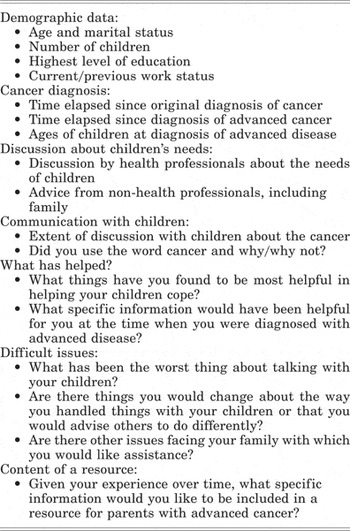
Women were recruited through the Breast Cancer Network of Australia, a consumer group for women with breast cancer, which has a subgroup comprised of women with advanced breast cancer. Members of the subgroup were informed about the project via a Network newsletter and invited to participate. Ethical approval for the project was obtained from the University of Queensland, and women were informed that their responses were confidential and that they were free to withdraw from the project at any time. Women consented to participate in a telephone interview, using a structured proforma (see Table 1).
Themes addressed in interviews

Interviews were tape recorded, transcribed and responses collated into themes relevant to the development of the resource. A draft resource was then developed, distributed to the women for critical review, and their feedback was incorporated into the final version.
RESULTS
Eight women participated in interviews, their ages ranging from 39 to 57 years. All but one of the women were married. Two women had one child, one woman had four children, and the others each had two. Ages of children at the time of diagnosis of advanced disease ranged from just under 2 years to 13 years. The time elapsed since diagnosis of advanced disease ranged from 8 weeks to 10 years. Key themes raised in the interviews are summarized below.
Assistance Offered By Health Care Professionals
Of the eight women interviewed, five declared that their health care professionals avoided any discussion about the impact of the cancer on children or ways of talking about the diagnosis with their children: “Nobody offered a thing.” Of the three women whose children were acknowledged, the assistance ranged from a general question about the children, to being given a list of books that the woman could obtain herself, to “I was told ‘A social worker is available to provide information about children's needs if necessary.’ But that was not pursued in detail, more just in passing.” These women struggled to know how to broach the subject with their children but, “There was no direct information about what I might say to him [son].”
This pattern of avoidance of discussion about children continued during treatment, often over many years. One woman whose metastatic disease was diagnosed five years ago said: “There has only been discussion by health professionals when I have raised it myself,” echoed by a woman receiving follow-up for 10 years after being diagnosed with advanced disease: “The only time anyone has ever discussed anything is if I raise it as a problem.”
Women also felt that the traditional emphasis on provision of information by physicians could be expanded to include other members of the multidisciplinary team: “There is a great avenue in oncology for nurses to be able to provide information for parents about children. The nurses never raise it [concerns about children], but they are in a good position to be able to provide 1:1 support and information.”
Usefulness of Existing Resources
In the absence of assistance from health professionals, women felt alone and concerned about how they could talk with their children, so initiated investigation of resources: “Basically I found out things myself.” However women found few resources relevant to their needs: “There doesn't seem to be much available for women with metastatic disease. I've tried to look for information but it isn't always relevant” and “It was also targeted for people with early cancer.”
Furthermore, even when women did find information, they had no way of appraising its accuracy and currency: “I went to the library and searched for everything I could find about cancer. Unfortunately a lot of the material was not very up-to-date, so some of it was very negative and that was very depressing. It was only later that I realised that the information was out-of-date and I could have spared myself some misery.”
Experiences of Seeking Assistance
Professional Help
Several women who sought assistance through counselors or cancer service agencies reported negative experiences because the counselor was not sufficiently aware of the issues facing women with advanced breast cancer: “The first one was not helpful—she said we shouldn't focus on the cancer, and that I didn't know for sure that I was going to die from advanced breast cancer. She really had no idea—maybe she might have known a bit about early breast cancer. She said we had to be positive and get on with life, and didn't really understand that women with advanced breast cancer can get sick and die. She seemed to think that I was overreacting.”
Another woman commented: “A few young friends with breast cancer have died. One friend had a daughter who was 4 years old and a son who was 8 years old. She felt she just couldn't explain what would happen. This friend was seeing a counsellor who told her not to say she could die because then every day her son would wake up and be anxious and wonder if she was going to die that day. I think in the end they did talk about death.”
Countering these experiences was that of a woman who felt that the style of the counselor was too confronting about her mortality, something which she found highly traumatic: “It was soon after I was diagnosed with secondaries and I was upset, because the reality of it was really hitting home. I was at the cancer centre and asked about the children, and talked with a counsellor who said ‘You're worried you won't be able to raise your children. But you've probably got about 2 years and you should make the most of it.’ I had never asked for a timeframe and was so angry. I just freaked out. I thought that was quite out of line.”
Women wanted information, and assistance in supporting their children, but even if a counsellor was available, this often posed logistic problems, especially for adolescent children: “Part of the reason was that the counsellor only operated between 9 a.m. and 4 p.m., and my daughter had to miss school to see her, and I had to drive her to school and she'd be late and that was obvious that she was going somewhere. It was hard work. And she had lots of things on after school, and that was another reason she resented going to see a counsellor.”
Peer and Informal Support
Several of the women felt that membership of a peer support group was helpful, as it reduced the sense of isolation and lack of understanding about their situation. Some women gleaned sporadic pieces of information through their support group: “I do attend a support group and sometimes there is general discussion about children, but nothing specific,” and “Other people have given some information that what you say will have to depend on the age of the children.” In other instances, more structured information was available: “I went to a seminar with some of the women from my support group and one of the presenters talked about getting young children to do drawings as a means of expressing themselves, but I'm not sure what her background was and what qualifications she had.”
Informal connections with women with cancer afforded women the opportunity to think of other strategies to help their children, although these were not always successful: “I did know a lady (now dead) who also had cancer, who had children of similar ages to mine, and thought that if we got the children together that might be a good thing, but they didn't really hit it off, it just didn't work.”
Experiences of Talking with Children about Cancer
Diagnosis of Early Cancer
All women felt that it was necessary to tell their children that they had cancer when the original diagnosis was made. In making this decision, women weighed the potential impact if they did not tell their children: “I made the decision that I had to be honest with the children because if things went wrong or there were problems in the future and they found out I hadn't told them the truth they would lose trust in me. They would feel betrayed, and wonder if they could believe what else I said to them. Trust is so important.”
Another woman said: “We have used the word cancer from the beginning and have been honest with them. I feel that you have to be honest—my personal understanding is that if they are not told the truth kids will be rude, and angry, hate you.”
Diagnosis of Advanced Cancer
When discussing the diagnosis of advanced cancer, women described the need to help their children maintain hope, while being honest: “He asks me if I will get better, and I say ‘I hope so.’ I think you need to be honest but that doesn't have to mean being really blunt. And the problem with the word cancer is the stereotypes and of course not all cancer is a death sentence. It is important not to lie to children, but it is also important to give them information that they can understand, and gradually, as things evolve.”
This theme of providing information but not being too explicit about the implications of this was echoed by another woman: “I did tell them that I had the cancer in my bones. I guess I don't know what other word I would use than cancer. I think it is important to be honest, so told them the cancer had spread to my bones. I didn't spell out what exactly that meant and that this could lead to being terminal. They didn't really ask very much, they tended to take what I said at face value. I have always had the feeling that I am going to die from this, but that it won't be for a long time. I will die from it eventually but it is a long-term thing.”
Similarly: “I am an upfront person and we have told her the truth, but couched in a positive way.”
Women emphasized the benefits of treatments in their discussions: “Indicated that I would have treatment and would not then have any more pain. Did not say to the children that there was no cure. Told them that the treatment would do its best.”
Responding to Questions about Death
All of the women felt that they may die from their cancer at some stage, but in any discussion with their children felt it was important to maintain some optimism: “Their fear is that Mum's going to die. If my son has asks: ‘Are you going to die?’ I answer that I am having chemotherapy to keep the cancer under control. The chemotherapy might not keep doing that in the future, but because we watch TV, we are aware of new drugs coming onto the market. It's about maintaining hope for the future, rather than making them fear I might die tomorrow.”
Another woman explained: “In the beginning when I was diagnosed with early breast cancer the first question the children asked was: ‘Are you going to die?’ My daughter was only 7 years of age. I answered them that sometimes people with cancer live for a long time and some only live for a short time, that I hoped it wasn't going to happen that I would die, but there was no 100% guarantee that it wouldn't happen. I made the analogy of flowers in the garden—that some bloom for a long time and some don't.” And “If the children have asked ‘Are you going to die?’ I have tended to respond in a general way ‘We're all going to die’, trying to make it more general and taking the emphasis away from just me.”
If the woman felt that there was prognostic uncertainty, it made it more difficult to respond to questions about death: “The children have asked if I am going to die. I have said ‘No,’ and that I am having the best possible treatment so that the cancer won't come back. This has been a considered decision as there is so much uncertainty about future treatment developments and given a solitary metastasis this may not happen. The hardest thing is feeling that I can't be completely honest. A sense of it being too painful to implant in their mind distress about something that may not happen, and even if it does, the time frame is very uncertain. I don't know the timing of it. Don't want to burden them with distress when this may not be necessary.”
Drawing on Experience: Women's Experiences of Not Being Told
Women drew on their personal experiences and those of others to consider how communication about parental illness and death might shape subsequent adjustment: “The other reason is because of my own experience. My father died when I was 14 years old. It was never discussed with me, I wasn't given any information, wasn't allowed to go to the funeral and that made it so hard—I didn't want that for my children. I also have a friend who is only in her 30s and her father died from cancer and she wasn't told anything about it and she is still so angry.”
Similarly, another woman related: “I once met a woman whose mother had died from cancer when she [the woman] was 9 years old. No one told her what was happening to her mother, her mother was just whisked off. That woman has remained angry and bitter into her later life.” And, “I know that when my grandfather died my brother was 4 years of age. My mother told him that Pa went to sleep. Some time later he asked when Pa was going to wake up, and when she said that he would never wake up he was so distressed. It was terrible for my mother and for the whole family. Maybe partly because of that I think you have to be honest.”
Things That Have Helped
Some of the following strategies were things that women had worked out for themselves over time, some came from links with others with advanced cancer, and some represented a modification of what women had gleaned from resources for patients with early cancer.
Honesty
Honesty and trust emerged as recurrent themes. Women were emphatic that an honest approach was essential: “It is important to have trust. If you don't tell them they can't trust you. Secrets are not a good thing.” Although acutely aware of their prognosis, women felt that being able to talk about the cancer was likely to help children to cope: “We have used the word cancer. I think if you're honest the children can deal with it better. Honesty is important. Then they won't be so afraid, and it's not such a big scary word.”
Staging Information
Especially for younger children, women were aware that their children's needs for information changed over time according to their understanding, and changes in clinical status. Changes in well-being would also impact on the woman's attitudes toward the disease and how she approached discussion with her children: “I think you change what you say over time, and that relates to my approach to the disease as well. I had felt very well until last year and so had felt very optimistic.”
Routine
Although this may pose some logistic difficulty, women felt that having some structure made their children feel safer and more grounded: “Routine helps, and keeping up with some fun things.” Similarly, “Kids don't like being different, and having things as normal as possible helps.”
Involvement of Children in Treatment
None of the women described receiving any professional recommendations about involving their children in treatment, but their attitude to this was remarkably consistent: “You don't want them to feel excluded and if they don't know things they will imagine the worst. When I was having radiotherapy it was during the school holidays and I took the children up to treatment with me. One of my friends raised the concern that maybe that was too traumatic for the children, but I feel it helped them cope, because they were involved and they knew what was happening.” Another woman felt: “I had the children attend radiotherapy treatments occasionally. It demystified the treatment and was helpful for them. The younger daughter made a poster which they put up in the treatment area and she liked the attention.”
One woman reflected that, on balance, it might have been better to have more actively involved her children: “I didn't encourage them to come because I knew they were busy. But it probably would have been better to have encouraged them to come. It would bring the reality of the situation home, and help them realise that it is serious.”
Getting Support for Yourself
Women found it helpful to connect with others facing advanced cancer, although this could also come at a cost: “Being part of a support group which is informal and casual and includes members with advanced cancer [not specific to breast]. Can share ideas with other people. Can be a double-edged sword when you see people around you who are pretty sick and wonder if that is ahead of you, but can cope by thinking how much better off you are than them.”
Several women felt that there was pressure to adopt a positive attitude, but this inhibited expression of feelings and obtaining emotional support: “Looking back I think that keeping up the façade was short-changing the family, because I was shaping they way they reacted, and it was only when I reached a point where I couldn't pretend it was alright anymore that I could let myself get the support. That isn't only me, and you do get pressure from other people to be positive because they can't handle to hear what it is really like.”
In addition to the importance of having emotional connections with others and accepting emotional support, several women alluded to the need for time away from family commitments and the role of caring for others: “Parents are all different and have different needs, but you need some time for yourself.”
Accepting Help
In addition to the need for emotional support, practical assistance emerged as an important theme: “If you are part of a mother's group that mutual support can be helpful with practical issues. Childcare is a big issue if your children are young. Especially if you can't afford to pay for it. You should never feel afraid of asking people for help with practical things such as childcare.”
Telling the School
Not all of the children were of school age. The mothers of school-aged children felt that if the school was supportive that would make things easier for their child: “We have told the school. My younger daughter accepted an offer of some sessions with the school psychologist and that was helpful for her.”
What Should Be Included in Any Resource?
It was obvious that women felt enormous sadness: “Just the knowledge that I'm not going to be there for them. I'm not scared of dying but it's the thought of leaving the children behind.” They also expressed grief and concern about the potential impact of their cancer on their children: “I feel that the uncertainty is a burden on the children, and I feel sadness and guilt about that. I often think about how it might affect them in the longer term.” And, “Concern about the long-term impact emotionally. I know it will affect them.” Although not expressed directly, it was clear from these comments and others made by women that any resource would need to provide information in a sensitive and supportive way, balancing difficult issues with some optimism about the capacity of parents to help their children.
Women in this study had coped with their disease for up to 10 years and had over time developed strategies to respond to their children. However they still felt that further information would have been valuable: “If had more information could have responded to their concerns.” In addition to the helpful items described above, women wanted to see inclusion of information as listed below.
Developmental Stages
The ages of children of women in this study ranged from just under 2 years of age to 13 years when their mother was diagnosed with advanced cancer. None of the women had information about the differing impact depending on developmental stages, and all expressed the desire for information about the key issues relevant to children at differing ages.
Talking about Dying
Women wanted information and reassurance that their approach was likely to be helpful and gave examples of how they were approaching it: “I'm trying to really prepare them now without talking about it directly. I guess I am slowly preparing them. We are doing normal things, but I say ‘if something happened’ and that could be to Daddy or me, they would still live in the house, they would be sad, but they would be safe, and looked after and they would never be abandoned.”
Examples of What Other Families Have Done to Cope
Women felt that it was empowering to hear about the ways in which others had coped, this information being seen as authentic and valuable: “Everybody likes to hear other peoples' stories—what others have said and how they have coped.”
Things That Might Help Children Have a Better Outcome
- Honesty: Women felt it was important for parents to be reassured that this approach was in the best interests of their children, despite the temptation to avoid talking about difficult issues. “If you don't tell them, children imagine the worst anyway, and that scares them more. Telling the children is not going to damage them, but secrets will.”
- Reassurance: Especially for younger children, participants felt it was important for parents to tell their children that the cancer was “not their fault”, and explicitly: “Children need reassurance that they will be safe ‘no matter what.’ ”
- Sharing time together: When coping with treatment and side effects it was often hard to focus on family time, and women felt it would be helpful to provide practical examples of things families could do: “I remember reading something about the need for sharing with children. Any information would have been helpful.”
- Helping them not to be hurt by careless comments: Children can be exposed to thoughtless or even malicious comments about their parents by other children, and it was thought worthwhile to preempt any distress this might cause: “Tell them that they shouldn't be wounded by the comments of others, for example at school, as other people are not aware of their situation.”
- Having a break: “If the children have a chance to have some time with other family or friends that is good, because they need a chance to escape it [the cancer]. It's hard to escape it when you are at home and your mother is having treatment all the time.”
- Being prepared to revisit and revise information: Women recognised that it was easy to overlook the need for children to be kept informed of changes in disease and treatment options, and parents needed encouragement to have ongoing discussions with their children.
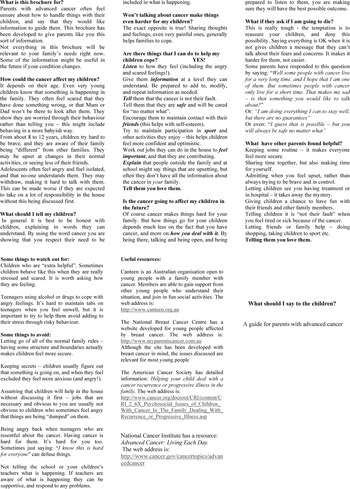
The revised brochure is presented in Figure 1. It is designed to be copied back-to-back and folded into a brochure format.

Brochure for parents with advanced cancer.
DISCUSSION
All of the women who participated in this project were eager to contribute to the development of a resource to assist parents coping with advanced cancer. Their own distress about the trauma of the diagnosis of advanced cancer had been compounded by the dearth of resources to assist them in talking with their children, and women expressed the hope that a resource could be made widely available to health care professionals such as oncologists, surgeons, and oncology nurses, who could provide this for parents. It is known that health professionals find it stressful to care for young patients with cancer and those with young children (Catalan et al., 1996; Fallowfield et al., 1998), and lack of training and limited access to resources is likely to increase this distress. Access to a resource that is evidence-based and developed in collaboration with patients with advanced cancer may well be a valuable tool for professionals who otherwise feel uncertain about ways of offering assistance.
Women felt strongly that there was a need for a brief resource that could be given to parents at the point of diagnosis of advanced disease, as this was a time of great distress when parents felt uncertain and in need of support. Despite having coped with the previous diagnosis of early breast cancer, women felt that the diagnosis of advanced disease posed different challenges in terms of their children, and they did not assume that strategies that had worked in the past would be best now. Women saw that a resource such as this was necessary to provide a supportive framework that would minimize distress and fear about how to talk with their children, following which parents could feel more confident about exploring other more detailed sources of information, rather than avoiding confronting the inevitable sadness and distress. Although it seems that many of the women had ample skills in assisting their children, they were emphatic that many strategies had only been arrived at over considerable time, and they would still have liked professional reassurance that following their instincts, for example about open communication, was best for their children.
Many of the themes identified by the women in this project, such as the need for routine, practical assistance and honesty, are included in other resources designed to assist parents coping with serious illness (Rauch & Muriel, 2005). However, women also felt the need for detailed information about issues specific to the diagnosis of advanced disease, such as ways in which other parents had responded to children's questions about death. Other key themes that women felt were unique to parents with advanced cancer were the need to modify and add to information as the parent's clinical status changed and the need for reassurance for children that they would continue to be safe even after the parent's death. Unkind or inappropriate comments by schoolchildren, for example that the parent will die, can be refuted by parents with early cancer. For parents with advanced cancer, it was seen as important to help the child understand that comments were often ill informed and that the course of cancer varied for each person. Women felt that especially when a parent is highly symptomatic and undergoing treatment, as is often the case with advanced disease, it was helpful to remind parents that children still need “time out” rather than being immersed in the cancer experience. Underpinning all of these themes was the prominent issue of helping parents feel less guilty and afraid about the impact on their children. For parents with early cancer, there is often a notion that after acute treatment the family can “recover,” although in reality much has changed. However, parents with advanced cancer know that the cancer will not be cured and need help to cope with concerns about their children's future.
It could be argued that recruitment of only women with breast cancer and via a single source has led to a biased sample. The Breast Cancer Network of Australia was established in October 1998 with the expressed aims to empower, inform, represent, and link together those affected by breast cancer. It has links to over 17,000 individuals and 150 breast cancer groups. Recruitment of participants via this organization allowed access to women from diverse regions in Australia, treated in a variety of clinical settings. This reduced the risk of bias inherent in recruitment from a single setting, where supportive care might be far from typical. Clinically, the women were a more heterogeneous group than might have been anticipated, the extent of disease ranging from a single metastasis to widespread, symptomatic disease. Similarly, the time since diagnosis of advanced disease ranged from 8 weeks to 10 years. Improvements in treatment for advanced breast cancer may mean that women survive many years, and it could be argued that these women did not face the poor prognosis of, for example, patients with advanced lung or pancreatic cancer. However, in this instance it meant that women had experience of coping with advanced cancer often over some years, and had a wealth of experiences they could share about ways of responding to their children, including things that they now felt they could have done differently. The small number of participants in this study may mean that results cannot be generalized to the broader population of parents with advanced cancer; however, there was remarkable consistency of themes raised across the interviews.
ACKNOWLEDGMENTS
The authors thank the Breast Cancer Network of Australia for its interest in this project and assistance with recruiting participants. The women who participated are thanked for their enthusiasm, frankness, and generosity in contributing to the development of this resource. This research was supported by a grant from the Queensland Cancer Fund Services Committee.