INTRODUCTION
Cystoisospora belli is an obligatory intracellular protozoan responsible for human cystoisosporosis (Lindsay et al. Reference Lindsay, Dubey and Blagburn1997a). In patients with the acquired immunodeficiency syndrome (AIDS) it has been described as another opportunistic agent that can cause chronic diarrhoea, acalculous cholecystitis and cholangiopathy (Benator et al. Reference Benator, French, Beauder, Levy and Orenstein1994; Zenta and Topazian, Reference Zenta and Topazian2009). Reports of disseminated cystoisosporosis with unizoite tissue cysts in the lamina propria of the intestines, lymph nodes, liver and spleen in patients with AIDS have been published (Comin and Santucci, Reference Comin and Santucci1994; Restrepo et al. Reference Restrepo, Macher and Radany1987; Michiels et al. Reference Michiels, Hofman, Bernard, Saint Paul, Boissy, Mondain, LeFichoux and Loubiere1994; Velasquez et al. Reference Velasquez, Carnevale, Mariano, Kuo, Caballero, Chertcoff, Ibañez and Bozzini2001; Frenkel et al. Reference Frenkel, Oliveira Silva, Saldanha, De Silva Vergara, Correia, Barata, Lages Silva, Ramirez and Prata2003). The Cystoisospora felis species infects cats and several hosts (Dubey and Frenkel, Reference Dubey and Frenkel1972; Costa and Lopes, Reference Costa and Lopes1998; Melo et al. Reference Melo, De Carvalho Filho, Lopes, Flausino and De Oliveira2003). C. felis has an extraintestinal cycle with unizoite tissue cysts in cats as definitive hosts and in other hosts including mice, rats, hamsters, birds, rabbit and swine (Dubey and Frenkel, Reference Dubey and Frenkel1972; Costa and Lopes, Reference Costa and Lopes1998; Melo et al. Reference Melo, De Carvalho Filho, Lopes, Flausino and De Oliveira2003). Another species Cystoisospora ohioensis has an extraintestinal cycle with unizoite tissue cysts in dogs as definitive hosts and in other hosts such as mice and broiler chicken (Dubey and Frenkel, Reference Dubey and Frenkel1972; Dubey and Mehlhorn, Reference Dubey and Mehlhorn1978; Massad et al. Reference Massad, Oliveira, Albuquerque and Lopes2003). The systemic distribution of unizoite tissue cysts in the viscera of the hosts showed a tropism by lamina propria of the intestines, lymph nodes, liver and spleen for both species (Dubey and Frenkel, Reference Dubey and Frenkel1972; Melo et al. Reference Melo, De Carvalho Filho, Lopes, Flausino and De Oliveira2003; Massad et al. Reference Massad, Oliveira, Albuquerque and Lopes2003). Histological and ultrastructural electron microscopy findings of unizoite tissue cysts in humans and animals revealed similar structures, and this explains the difficulty in distinguishing zoites of C. belli, C. ohioensis complex and C. felis on the basis of their morphology (Dubey and Mehlhorn, Reference Dubey and Mehlhorn1978; Lindsay et al. Reference Lindsay, Dubey and Blagburn1997a). The ultrastructure of Cystoisospora canis monozoic cysts produced in vitro is similar to that of C. belli unizoite tissue cysts in immunocompromised patients (Mitchell et al. Reference Mitchell, Zajac and Lindsay2009). Immunohistological studies using antisera against Cystoisospora suis and other Apicomplexans showed variable reactions with unizoite tissue cysts in a patient with AIDS and C. belli (Lindsay et al. Reference Lindsay, Dubey, Toivio-Kinnucan, Michiels and Blagburn1997b), but this procedure was not carried out on C. felis and C. ohioensis. Reports of molecular tools to differentiate genus and species level of Cystoisospora have been published (Müller et al. Reference Müller, Bialek, Fätkenheuer, Salzberger, Diehl and Franzen2000; Samarasinghe et al. Reference Samarasinghe, Johnson and Ryan2008). These molecular tools could be used for distinguishing zoites of C. belli, C. ohioensis complex and C. felis species.
The present study was undertaken to identify Cystoisospora isolates, with and without the presence of zoites, with molecular tools in order to differentiate C. belli from other species of Cystoisospora in AIDS patients.
MATERIALS AND METHODS
Studied population
Eight adult patients with AIDS who were evaluated for chronic diarrhoea and diagnosis of cystoisosporosis were included in the present study. These individuals had an age range between 51 and 23 years, 6 were male and 2 were female, and all of them were living in Buenos Aires, Argentina.
Cystoisospora isolates
Fecal samples were collected from patients daily for 1 week. Stool specimens were fixed in 5% formalin and screened for the presence of Cystoisospora oocysts using formalin-ether concentration followed by microscopy.
Five biopsy specimens from patients were obtained from the distal duodenum by flexible fiberglass endoscopy. Two samples were fixed in 10% formalin, embedded in paraffin, and stained with haematoxylin-eosin and Giemsa. Two specimens were fixed in 2·5% buffered glutaraldehyde and routinely processed for transmission electron microscopy (TEM). Tissue samples embedded for TEM were also stained with Azur II and examined by light microscopy. The fifth sample was stored at –20°C in saline solution.
DNA extraction
DNA purification from frozen duodenal biopsy samples was carried out by phenol-chloroform extraction. Each sample was centrifuged for 5 min at 15 000 g. The pellet was resuspended in 200 μl of phosphate-buffered saline pH 8, with 20 μl of 5% trypsin and incubated overnight at 37°C with orbital shaking. Then, 200 μl of lysis buffer 2× (200 mm Tris-HCl pH 8, 20 mm EDTA pH 8, 1% SDS, 300 mm NaCl) and 4 μl of proteinase K stock solution (200 mg/ml) were added. Samples were incubated for 3 h at 58°C and overnight at 37°C.
After lysis, a standard phenol-chloroform extraction was carried out (Maniatis et al. Reference Maniatis, Fritsch and Sambrook1989), and DNA was precipitated in absolute ethanol, dissolved in 10 μl of double-distilled water and kept at –20°C until use.
When stool samples were employed, 2 ml of feces in 5% formaldehyde were gauze-filtered, treated with ether and centrifuged for 3 min at 15 000 g. The pellet was resuspended in 1 ml of 70% ethanol and kept overnight at –20°C. Then samples were centrifuged for 5 min at 15 000 g and washed twice with 1 ml of double-distilled water by centrifugation at 15 000 g for 3 min each wash. Final pellets were evaporated at 37°C until they appeared dry and then resuspended in 200 μl of lysis buffer 2× and 4 μl of proteinase K stock solution. The following steps were the same as those employed for biopsy specimens.
Nested PCR amplification for the 18S rRNA gene
Nested PCR to amplify a fragment of the 18S ribosomal RNA gene from Cystoisospora sp. was carried out essentially as described by Müller et al. (Reference Müller, Bialek, Fätkenheuer, Salzberger, Diehl and Franzen2000). For the first round the outer primer pair IsoFO (5′-GTGCCTCTTCCTCTGGAAGG-3′), corresponding to nucleotides 174 to 193 of the small subunit ribosomal RNA (SSU-rRNA) sequence of Cystoisospora belli (GenBank Accession nos. AF106935 and U94787), and IsoRO (5′-GCACTCCACCCAGTTAAGTGC-3′), corresponding to nucleotides 712 to 732 was employed in order to amplify a 559 bp DNA fragment. For the second round the inner primer pair IsoFI (5′-CGATGGATCATTCAAGTTTC-3′), corresponding to position 286 to 305, and IsoRI (5′-ACCACGTACACACCCCTAAG-3′), corresponding to position 662 to 681 was used to amplify a 396 bp DNA fragment.
For the first round, the sample was 1 μl of genomic DNA. Amplifications were performed in 50 μl reaction mixtures containing 0·5 μ m each primer, 200 μ m each deoxinucleotide triphosphate (dNTP), 2·5 U Taq DNA polymerase (Fermentas International Inc.), 20 mm (NH4)2SO4, 75 mm Tris-HCl, 0·01% Tween 20, 1·5 mm MgCl2, 400 ng/μl bovine serum albumin (BSA), template.
After the first round 10 μl of amplification products were employed for the second reaction in a total volume of 50 μl using the same concentrations of reagents.
A P×2 Thermal Cycler (Thermo Electron Corporation) was employed. After initial denaturation at 94 °C for 3 min, 35 cycles were run at 94°C for 1 min, 61°C (56°C for the second round) for 2 min, and 72 °C for 3 min, with a 10 min final extension at 72 °C.
Twenty μl of amplicons from the second round were run on ethidium bromide-stained 2% agarose gels and visualized under UV illumination.
Nested PCR amplification for the internal transcribed spacer 1 (ITS-1) of the rRNA genes and RFLP analysis
The procedure was performed employing the primer pairs designed by Samarasinghe et al. (Reference Samarasinghe, Johnson and Ryan2008). The outer primer pair corresponded to ITSF (5′-CCGTTGCTCCTACCGATTGAGTG-3′) located in the 3′ end of the 18S rRNA gene, and EMR7 (5′-GCATTTCGCTGCGTCCTTCATCG-3′) located at the 5′ end of the 5·8S gene. For the first round reactions were carried out in 25 μl containing 0·5 μ m each primer, 200 μ m each dNTP, 1·25 U Taq DNA polymerase (Fermentas International Inc.), 20 mm (NH4)2SO4, 75 mm Tris-HCl, 0·01% Tween 20, 1·5 mm MgCl2, 400 ng/μl BSA, template. Cycling conditions consisted of a pre-cycle (94°C for 2 min, 62°C for 1 min, 72°C for 2 min), 45 cycles (94°C for 30 sec, 62°C for 20 sec, 72°C for 35 sec) and a final extension step (72°C for 7 min). The inner primer pair ITSGF (5′-GATCATTCACACGTGGCCCTTG-3′) and ITSR2 (5′-GACGACGTCCAAATCCACAGAGC-3′) were used to amplify an approximately 450-bp portion of the ITS-1 rDNA locus of Cystoisospora sp. For the second round, reactions were carried out in 50 μl containing 0·5 μ m each primer, 200 μ m each dNTP, 2·5 U Taq DNA polymerase (Fermentas International Inc.), 20 mm (NH4)2SO4, 75 mm Tris-HCl, 0·01% Tween 20, 1·5 mm MgCl2, 400 ng/μl BSA, template. Cycling conditions were as for the first round except that the annealing temperature was raised to 68°C. Both rounds were performed in a P×2 Thermal Cycler (Thermo Electron Corporation). Fifteen microlitres of amplification products from the second round were analysed by 2% agarose gel electrophoresis, stained with ethidium bromide and UV visualized.
Restriction fragment length polymorphism (RFLP) analysis was carried out according to the method described by Samarasinghe et al. (Reference Samarasinghe, Johnson and Ryan2008). Ten microlitres of amplification products from the second round of the nested PCR were digested in a final volume of 30 μl with 10 U of Alu I restriction enzyme (Fermentas International Inc.) by incubation overnight at 37°C. Digestion products were run on ethidium bromide-stained 3% agarose gels.
DNA sequencing
To confirm the sequence of the amplification fragments of the 18S and ITS-1 rDNA locus, amplicons of the right size were purified from 1·2% agarose gels with the centrifugal filter device Ultrafree®-DA (Millipore). DNA sequencing of the PCR products was performed using a Hitachi 3130XL Genetic Analyzer (Applied Biosystems) with the BigDye® Terminator v3.1 Cycle Sequencing Kit (Applied Biosystems). Sequence similarity was analysed using the Blast program of the National Center for Biotechnology Information, and multiple alignments employing the ClustalW 2.0.12 free software. A sequence identity matrix was performed using the BioEdit Sequence Alignment Editor version 7.0.9.0.
RESULTS
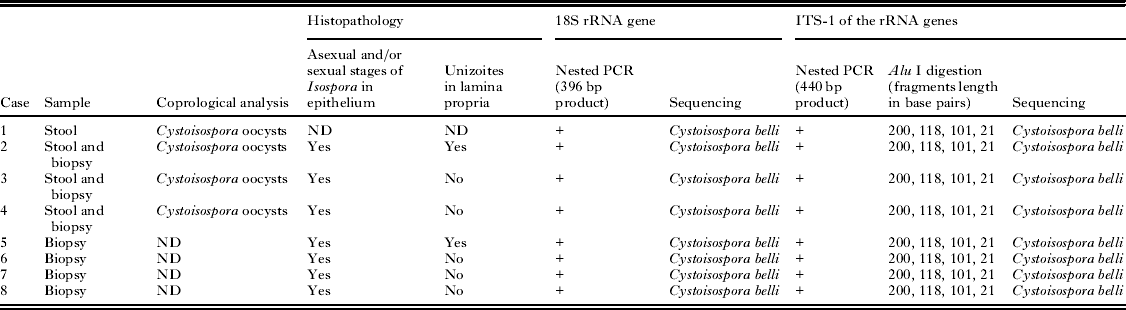
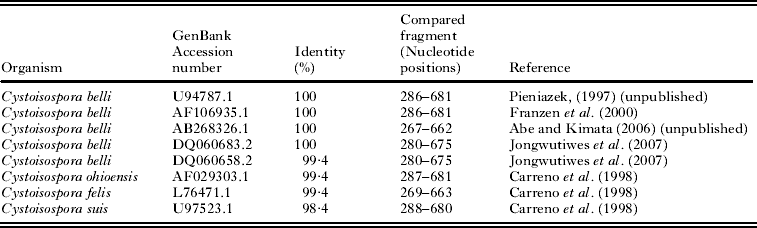
General results for samples from the 8 Cystoisospora-infected patients are summarized in Table 1. Cases 2 and 5 had unizoites in duodenal samples (Fig. 1). Nested PCR amplification of a fragment of the 18S rRNA gene produced the expected 396 bp amplicon in all samples and sequences of the 8 cases were identical to those previously reported for C. belli. No differences were observed between cases, especially when compared with samples containing unizoites (Fig. 2). Identity was 100% for previously reported sequences for C. belli, with the exception of 1 case described by Jongwutiwes et al. (Reference Jongwutiwes, Putaporntip, Charoenkorn, Iwasaki and Endo2007) of an immunocompetent patient with multiple relapses. When compared with other Cystoisospora species, this value reduces to 98·4% (Table 2).
Unizoite tissue cyst in lamina propria of the duodenum. (A) Light microscopy of an Azur II-stained biopsy specimen. (B) TEM. Scale bars: (A) 5 μm; (B) 1 μm.

Alignment of the sequences from the 8 amplicons generated by the 18S rDNA nested PCR with those of different Cystoisospora species. Dots and dashes represent identical residues and deletions, respectively. GenBank Accession numbers and species are detailed in Table 2.

Microbiological and molecular results for the eight Cystoisospora-infected patients

Identity of the SSU-rRNA amplified fragment with different Cystoisospora sequences available at the GenBank database

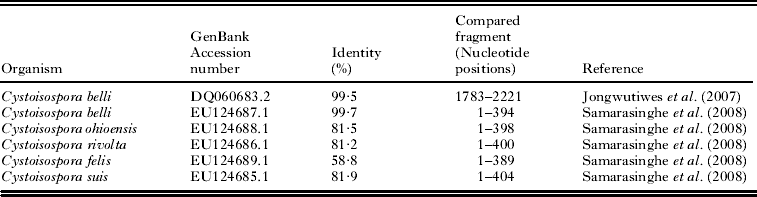
The DNA fragment generated from the nested PCR for the ITS-1 contained 440 bp. Sequences were generated for the 8 cases and are available from GenBank under the Accession nos. HM630352-HM630359. All isolates yielded RFLP fragments of identical size when digested with Alu I. Sequences of the 8 isolates examined were identical between them, but differed from the isolates reported by Jongwutiwes et al. (Reference Jongwutiwes, Putaporntip, Charoenkorn, Iwasaki and Endo2007) and Samarasinghe et al. (Reference Samarasinghe, Johnson and Ryan2008) (GenBank Accession nos. DQ060683.2 and EU124687.1, respectively). They differed from DQ060683.2 at an insertion and a base substitution and from EU124687.1 at an insertion (Fig. 3). Identity was 99·7% and 99·5% for previously reported C. belli ITS-1 sequences and ranged from 81·9% to 58·8% for other Cystoisospora species (Table 3).
Alignment of the sequences from the 8 amplicons generated by the ITS-1 rDNA nested PCR with those of different Cystoisospora species. Dots and dashes represent identical residues and deletions, respectively. GenBank Accession numbers and species are detailed in Table 3.

Identity of the ITS-1 amplified fragment with different Cystoisospora sequences available at the GenBank database

DISCUSSION
Several authors have used the SSU-rRNA sequence for detection and investigation of species/strain variation of the genus Cystoisospora in oocysts, bile and duodenal biopsy samples (Müller et al. Reference Müller, Bialek, Fätkenheuer, Salzberger, Diehl and Franzen2000; Franzen et al. Reference Franzen, Müller, Bialek, Diehl, Salzberger and Fätkenheuer2000).
The detection of C. belli in duodenal biopsy and bile samples by PCR using primers based on the SSU-rRNA sequence was described for 2 AIDS-patients (Müller et al. Reference Müller, Bialek, Fätkenheuer, Salzberger, Diehl and Franzen2000). Two reports determined the sequences of the SSU-rRNA gene of C. belli (Jongwutiwes et al. Reference Jongwutiwes, Putaporntip, Charoenkorn, Iwasaki and Endo2007; Franzen et al. Reference Franzen, Müller, Bialek, Diehl, Salzberger and Fätkenheuer2000). One study used only the oocyst stage in fecal samples from HIV-infected patients and immunocompetent individuals in Thailand (Jongwutiwes et al. Reference Jongwutiwes, Putaporntip, Charoenkorn, Iwasaki and Endo2007). Bile juice sample from 1 patient was used in another report (Franzen et al. Reference Franzen, Müller, Bialek, Diehl, Salzberger and Fätkenheuer2000). The presence or absence of unizoites in tissues was not studied in these reports (Müller et al. Reference Müller, Bialek, Fätkenheuer, Salzberger, Diehl and Franzen2000; Jongwutiwes et al. Reference Jongwutiwes, Putaporntip, Charoenkorn, Iwasaki and Endo2007; Franzen et al. Reference Franzen, Müller, Bialek, Diehl, Salzberger and Fätkenheuer2000).
In our study we compared samples with and without the presence of unizoites in lamina propria and we did not detect differences by sequencing a 396-bp fragment of the SSU-rRNA gene. This fragment showed also high identity values (over 99%) with the sequences of other Cystoisospora species in which the presence of unizoites in their life cycles is common, namely C. ohioensis and C. felis.
The ITS-1 region has been shown to be useful for the distinction of Cystoisospora species (Samarasinghe et al. Reference Samarasinghe, Johnson and Ryan2008). This report used fecal samples collected from cats, dogs, pigs and humans and developed a PCR-RFLP assay that detected and differentiated the Cystoisospora species C. suis, C. rivolta, C. felis, C. ohiohensis-like and C. belli (Samarasinghe et al. Reference Samarasinghe, Johnson and Ryan2008). The identification of unizoites in tissue was not studied.
In this report, we analysed the DNA fragments generated from the nested PCR for the ITS-1 and all isolates yielded RFLP fragments of the sizes expected for C. belli species. Sequences of the 8 isolates examined were identical between them and it was not possible to identify species or strain variation in isolates of C. belli with or without unizoite tissue cysts.
Identity was 99·7% and 99·5% for previously reported C. belli ITS-1 sequences because they showed a low variation from the isolates reported by Jongwutiwes et al. (Reference Jongwutiwes, Putaporntip, Charoenkorn, Iwasaki and Endo2007) and Samarasinghe et al. (Reference Samarasinghe, Johnson and Ryan2008). When our isolates were compared with the sequences of the other Cystoisospora species that have unizoite tissue cysts in their life cycles, identity values varied from 81·9% to 58·8%.
In conclusion, it is clear that we still need another molecular tool that could be used to identify species strain variation in C. belli with and without the presence of unizoites.