Introduction
Delirium is common, occurring in up to 40% of older people in hospital (Lipowski, Reference Lipowski1987). It is associated with significant mortality; a recent review reported mortality rates of 14.5% to 37% (Siddiqi et al., Reference Siddiqi, House and Holmes2006). Other associated negative health outcomes include increased hospital length of stay, poor functional status, persistent cognitive impairment and need for institutional care (Cole and Primeau, Reference Cole and Primeau1993). There is no definitive treatment for delirium. Educational programs with service reorganization have been effective in reducing the duration of delirium, length of hospital stay and mortality (Lundstrom et al., Reference Lundstrom, Edlund, Karlsson, Brännström, Bucht and Gustafson2005). However, two randomized controlled trials of similar intervention programs did not demonstrate effectiveness (Cole et al., Reference Cole, Fenton, Engelsmann and Mansouri1991; Reference Cole2002).
The mainstay of pharmacological treatment for delirium is antipsychotic medications. Many delirium treatment guidelines, such as the American Psychiatric Association's practice guidelines (American Psychiatric Association, 1999), recommend the use of haloperidol, which may be effective in reducing the duration and severity of delirium in post-operative patients (Lonergan et al., Reference Lonergan, Britton, Luxenberg and Wyller2007). However, there are often problems with the tolerability and safety of antipsychotic medications (Maximer et al., Reference Maximer, Mellow and Tandon1999). Recently there have been concerns that typical and atypical antipsychotic medications increase mortality in the elderly (Wang et al., Reference Wang2005), especially in those with dementia (Schneider et al., Reference Schneider, Dagerman and Insel2005; Gill et al., Reference Gill2007). As well as these concerns there is also a lack of evidence from randomized controlled trials for the efficacy of antipsychotic medication in the treatment of delirium (Seitz et al., Reference Seitz, Gill and van Zyl2007). There is a need to explore the use of other groups of medications in the treatment of delirium.
Decreased cholinergic activity has been suggested as the main neurochemical correlate of delirium (Mussi et al., Reference Mussi, Ferrari, Ascari and Salvioli1999; Trzepacz et al., Reference Trzepacz2000). Acetylcholine plays a significant role in attention and consciousness, which are impaired in delirium (Hshieh et al., Reference Hshieh, Fong, Marcantonio and Inouye2008). It acts as a modulator of signal-to-noise ratio in sensory and cognitive input and irregularities in these functions cause core symptoms of delirium, including disorganized thinking and perceptual disturbances (Gottlieb et al., Reference Gottlieb, Johnson, Wanich and Sullivan1991). In support of the cholinergic hypothesis, it is generally accepted that anticholinergic medication can precipitate delirium (Tune, Reference Tune2000; Han et al., Reference Han, McCusker, Cole, Abrahamowicz, Primeau and Elie2001). Serum anticholinergic activity has been found to be associated with delirium in older medical patients (Mach et al., Reference Mach, Dysken, Kuskowski, Richelson, Holden and Jilk1995).
There have been reports of the benefit of cholinesterase inhibitors, which increase cholinergic activity, in delirium (Wengel et al., Reference Wengel, Roccaforte and Burke1998; Gleason, Reference Gleason2003; Dautzenberg et al., Reference Dautzenberg, Mulder, Olde Rikken, Wouters and Loonen2004). Two open label studies examining cholinesterase inhibitors as a possible therapy for delirium in vascular dementia (Moretti et al., Reference Moretti, Torre, Antonello, Cattaruzza and Cazzato2004) and for patients following a stroke (Oldenbeuving et al., Reference Oldenbeuving, de Kort, Jansen, Kappellem and Roks2008) have indicated that they are safe and may be effective. Three randomized trials have described the use of cholinesterase inhibitors in preventing post-operative delirium in patients undergoing elective total joint-replacement (Liptzin et al., Reference Liptzin, Laki, Garb, Fingeroth and Krushell2005; Sampson et al., Reference Sampson2007) and cardiac surgery (Gamberini et al., Reference Gamberini2009). Treatment was well tolerated but ineffective in preventing delirium.
This pilot study was undertaken to determine whether rivastigmine, a cholinesterase inhibitor, would be safe and helpful in the treatment of delirium.
Methods
This double-blind, placebo-controlled randomized pilot study was conducted in medical wards in the University Hospital of South Manchester NHS Trust, Manchester, U.K. Patients over the age of 65 years were identified as having delirium by the Confusion Assessment Method (CAM) (Inouye et al., Reference Inouye, Dyck, Alessi, Balkin, Siegal and Horwitz1990) during their admission to a medical ward. The CAM was completed with information provided by the medical and nursing team caring for the patients; if it was positive, or only missing one criterion, then the patient was approached to enter the study. The patients entered the trial early in their hospital admission and cases of both incident and prevalent delirium were included. Once entered into the study the patient was assessed by a member of the research team and the CAM was repeated. If the patient was still found to be positive for delirium then the patient was assessed for other exclusion criteria. Patients were excluded if they were too ill, were taking a cholinesterase inhibitor, had blood test abnormalities (urea ≥15 mmol/litre, or creatinine over 200 micromol/litre, or transaminases twice the upper normal limit or a bilirubin level over 40 micromol/litre), had suffered a myocardial infarction, had an unstable cardiac arrhythmia, or had severe respiratory disease. Patients who were assessed to have a delirium underwent a stringent consent process, and if they did not have capacity their nearest relative was approached to give assent for the patient to be included in the study. The study was approved by the local research ethics committee. The trial was registered with the National Research Ethics Service (Reference number: 02/CM/351) and the Clinical Trials Unit at the Department of Health of England and Wales (Reference number: MF 8000/12552).
Patients with delirium were randomized to receive rivastigmine 1.5 mg once a day increasing to 1.5 mg twice a day after seven days or an identical placebo (two tablets after seven days). Both sets of tablets were dispensed by the hospital pharmacy and supplied by Novartis Pharmaceuticals U.K. Limited. Randomization was by numbered treatment packets by the Department of Medical Statistics in South Manchester, independent of the research team, with the sequence concealed until outcome measures had been completed for all patients. If clinicians looking after included patients of either group needed to prescribe treatment for behavioral problems then this was in accordance with clinically derived protocol for the management of delirium with chlomethiazole and risperidone. The exact dose and duration of either medication was determined by the clinical team, who could also withdraw the patient from the study at any time.
Each group – treatment or placebo – was assessed with the CAM daily following entry, together with a proforma for adverse events, blind to knowledge of the patients’ group membership by one of two research nurses. If the assessment identified a change in CAM status then the assessment was independently repeated by another researcher (a senior trainee in old age psychiatry) and if there was a difference in opinion then the patient was reassessed by a senior old age psychiatrist, and the majority opinion of the assessments was recorded. Patients remained in the study until either they were assessed not to have delirium by the CAM for three consecutive days or until, if they remained positive for delirium as assessed by the CAM, they received 28 days’ treatment. Patients were withdrawn from the study if they missed three consecutive doses for any reasons. The maximum length of the study was therefore 28 days.
The primary outcome was duration of delirium as assessed by the CAM. Other measures included length of admission and discharge destination. The researchers, who were blind to allocation (two experienced nurses and a senior trainee in old age psychiatry), were also asked to predict the group (placebo or active drug) to which each patient belonged, using their clinical experience. Adverse events were monitored. The Mini-mental State Examination (Folstein et al., Reference Folstein, Folstein and McHugh1975) was administered at the start of the study.
Statistical analysis was carried out using SPSS (version 14). Unpaired t-tests were used for continuous outcomes to measure the differences between means, χ2 tests for categorical outcome measures, and Fisher's exact test used where appropriate. As a pilot study, no power calculation was conducted but empirically a total of 50 patients were chosen to give an estimate of the effect size, safety and tolerability.
Results
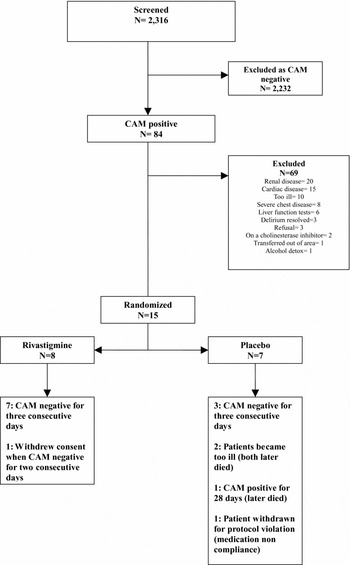
Figure 1 shows the flow of subjects through the study.
Flow of subjects through the study.

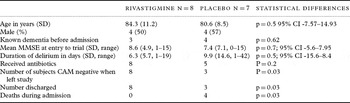
The sample consisted of 15 subjects, eight of whom were men, with a mean age of 82.5 years (SD = 9.9, range 65–97). One patient was deemed to have capacity to give consent. Their characteristics are shown in the Table 1.
Characteristics of the sample

There were no significant differences in the number of comorbid illnesses suffered by the patients in the two groups: five had a history of hypertension (three in the rivastigmine group, two in the placebo group), five had a history of angina (three in the rivastigmine group, two in the placebo group), four had previously had a stroke (two in each group), four had atrial fibrillation (three in the rivastigmine group, two in the placebo group) and one patient had a history of diabetes (in the placebo group).
All of the patients in the rivastigmine group were negative for delirium using the Confusion Assessment Method when they exited the trial whereas only three of the placebo group had no delirium when they exited the trial. One patient in the placebo group was withdrawn from the study because the trial medication was lost when the patient was transferred to another ward. The patient had been in the trial for eight days and had been positive for delirium on every assessment. The patient died later during admission.
Only one adverse event was noted. A patient in the placebo group suffered from nausea. Three patients in the placebo group needed additional psychotropic medication (either risperidone or chlormethiazole) because of behavioral disturbance.
Researchers correctly identified seven out of eight of the treatment group as patients receiving active treatment in the trial. They also correctly identified six of the seven placebo group as patients receiving placebo.
Discussion
This is the first randomized placebo controlled trial examining the efficacy of a cholinesterase inhibitor for treating delirium. Previous placebo controlled trials of cholinesterase inhibitors in delirium focused on whether donepezil was effective in preventing delirium in post-operative orthopedic patients (Liptzin et al., Reference Liptzin, Laki, Garb, Fingeroth and Krushell2005; Sampson et al., Reference Sampson2007) and post-operative cardiac patients (Gamberini et al., Reference Gamberini2009). The patients in previous studies were younger, not acutely unwell and less cognitively impaired than those in this study. It is therefore encouraging for future studies that rivastigmine was not harmful and was well tolerated during the trial.
The number of patients who screened positive for the trial was very small (3.8%) and as a result the sample size was too small to make any meaningful inferences about treatment of delirium. The small number diagnosed with delirium may reflect that we used information from medical ward nurse informants to complete the CAM, who had cared for and observed the patients. They may have underestimated the number and significance of symptoms of their patients, especially as the study was conducted on busy acute medical wards where the subtleties of the presentation of delirium (e.g. hypoalert delirium) may not be identified because of high patient turnover and high workload. It may be that only patients exhibiting very obvious signs of delirium were identified, which suggests that only patients with a particular set and severity of symptoms were included in the study. The low detection rate of delirium greatly affected recruitment and raises questions of how applicable the study's findings are to other patient groups. If future studies use a similar method to identify patients, and also include measurement of severity of delirium at baseline and as an outcome measure, it may be necessary to consider special training in detecting delirium. Outcome measures were assessed by one of two research nurses but if there was a change in delirium status using the CAM then the patient was also assessed by a senior old age psychiatry trainee. There was no disagreement between the assessments of the nurses and the senior trainee.
Despite the small number of participants, there are some indications that rivastigmine may be effective. All eight of the rivastigmine group were discharged from hospital while four of the placebo died after they left the trial. The difference between the two groups in the number of deaths during admission and the proportion who did not have delirium when they left the trial was significant. Two of the placebo group died soon after the medical team caring for them withdrew them from the study as they thought the patients were too unwell to continue. Such withdrawal suggests that the trial treatment had been unsuccessful and the duration of their delirium was recorded at the time they left the study. Another of the placebo group was withdrawn because of a protocol violation when their trial medication was lost during transfer between wards. The patient had been in the trial for eight days before the violation, which was used in the calculation for the duration of delirium in the placebo group. It could be suggested that this patient did not respond to the trial medication as they were positive for delirium for every day they were in the trial and later died during their admission. The mean duration of delirium was shorter for the rivastigmine group by three days compared to the placebo group although not statistically significant, possibly due to a type 2 error. If this finding was reproduced in a larger study then it may be clinically important and beneficial for patients, and may reduce length of hospital stay. None of the rivastigmine group had delirium, as identified by the CAM, when they left the study while only three of the rivastigmine group were identified not to have delirium when they left. Perhaps most interestingly, the blinded researchers were very successful in identifying which patients were in which treatment group. This is unlikely to happen by chance. We did not, however, evaluate what factors aided our decision but there was obviously some aspect of how patients progressed whilst in the trial which suggested to researchers which group the patient was in. This finding perhaps does not progress the search for whether cholinesterase inhibitors are effective but it does suggest that the question is still worth pursuing.
One of the weaknesses of our trial is that we did not focus on any particular cause of delirium and so the patient group included in the study is fairly heterogeneous and therefore difficult to generalize to other specific patient groups. In this small sample there was no obvious difference in the number of comorbid illnesses between the groups. However, the severity of comorbid illness was not assessed which may account for the difference in mortality between the groups as there may have been an unequal distribution in severity of illness between the treatment and placebo groups. Not only was the rate of detection of delirium in the screening process lower than expected but, because of stringent exclusion criteria, just over a fifth of those who screened positive were able to enter the trial. The stringent criteria may have led to more unwell patients being excluded from the study, who might have benefited more from treatment with rivastigmine than patients who were not as ill. The combination of potential non-detection of delirium and a high exclusion rate of those who were identified to have delirium raises further questions of how representative the study sample was of older people who have delirium.
Delirium is a serious clinical condition which is associated with several adverse outcomes, but there is no consensus on what is the most effective pharmacological treatment. Our study indicates that treating delirium with rivastigmine is safe and may be beneficial, especially in reducing mortality. There is still a need for large, adequately powered randomized controlled trial to establish the effectiveness and safety of cholinesterase inhibitors in the treatment of delirium.
Conflict of interest declaration
AB receives research funding and consultancy fees from pharmaceutical companies involved in the manufacture and marketing of drugs for Alzheimer's disease, including Janssen–Cilag, Pfizer, Novartis, Eisai, Shire, and Lundbeck.
Description of authors’ roles
R. Overshott was responsible for data collection, statistical analysis and writing the paper. M. Vernon was responsible for the study design and assisted with writing the paper. J. Morris assisted with statistical analysis and writing the paper. A. Burns was involved in the study design, supervised the data collection and assisted with writing the paper.
Acknowledgments
We acknowledge the contribution of research nurses Sarah Burgess and Zena Height to this study. We are also grateful to participating patients and their families. Funding was provided by endowments from University Hospital of South Manchester NHS Foundation NHS Trust.