





1. INTRODUCTION
In his catalogue of nine female poets, Antipater of Thessalonica reports that Corinna ‘sang of the impetuous shield of Athena’ (καὶ σέ, Κόριννα, | θοῦριν Ἀθηναίης ἀσπίδα μελψαμέναν, Anth. Pal. 9.26.5–6 = 667 PMG). This alluring testimonium, rarely discussed in scholarship on Corinna, offers untapped evidence for enhancing our understanding of the content, nature and aesthetics of her poetry.Footnote 1 In this article, I explore the possibility that Corinna’s poem offered a female-oriented counterpoint to the Homeric and Hesiodic shields of Achilles and Heracles, and that it resonated with local Boeotian myths surrounding the martial goddess. Through this analysis, I hope to offer new insights into Corinna’s relationship to—and reworking of—both local and Panhellenic tradition.Footnote 2
My argument proceeds in three stages. First, I focus on Antipater’s epigram, in which Corinna takes pride of place in the central couplet (§2). By analysing details from the epigram, I suggest that Antipater is responding to the distinctive poetry of the different female authors he lists, strengthening the likelihood that the ‘shield of Athena’ was indeed the subject of one of Corinna’s poems. Second, I consider the possible nature of a poem that treated ‘Athena’s shield’ (§3), highlighting the traditional prominence of the female Gorgon in accounts of Athena’s shield and aegis. I suggest that Corinna might have co-opted Athena and Medusa as distinctive emblems of female power, set against the masculine shield ecphrases of the epic tradition. This strategy would complement Corinna’s practice elsewhere in her extant fragments, where she attentively reworks the male epic tradition from a female perspective. Finally, I consider the possible narrative context of a poem featuring Athena’s shield (§4), exploring connections with the known titles of Corinna’s poetry, as well as a possible link with the cult and myth of Athena Itonia at Coroneia.
Before going any further, however, I must lay my cards on the table when it comes to Corinna’s date, a topic of debate for well over a century. There is no up-to-date assessment of the issue, so I seek to provide that here before laying out my own position.Footnote 3 Traditionally, scholars have been divided into three camps: (1) those who prefer an archaic date, treating Corinna as a sixth/fifth-century contemporary of Pindar;Footnote 4 (2) those who consider Corinna a third/second-century Hellenistic poet on various stylistic, metrical and linguistic grounds;Footnote 5 and (3) those who situate her between these two extremes in the fourth century.Footnote 6
The early date is based primarily on claims by imperial (and later) authors that Corinna was Pindar’s adviser or rival, or that both were students of Myrtis.Footnote 7 But ancient biographies are a genre of creative reception, not factual historicity; they tend to synchronize the lives of poets from different generations (compare Sappho’s string of alleged lovers: not just Alcaeus, but also Anacreon, Archilochus and Hipponax) and to embellish specific details from their original poems to craft elaborate backstories.Footnote 8 In Corinna’s case, the biographical ‘facts’ appear to have been pieced together through creative readings of 664a PMG (in which she criticizes Myrtis for competing with Pindar) and several Pindaric passages reimagined as direct responses to Corinna.Footnote 9 Given the nature of this material, our late testimonies are thus not secure evidence that the two poets were direct contemporaries.Footnote 10 Indeed, this alleged ‘rivalry’ could simply be a misreading of Corinna’s eristic allusions to one of her most famous Boeotian predecessors.Footnote 11 It is true that Propertius calls Corinna ‘ancient’ (antiquae … scripta Corinnae, 2.3.21), but this is better understood as a transferred epithet describing the ‘antique’ style of Corinna’s poetry (scripta);Footnote 12 and even if taken literally, this notion of her ‘antiquity’ (and other iconographic depictions of her alongside Pindar) would stem from the same biographical concoctions.Footnote 13
Arguments for a Hellenistic date are no more decisive. The orthography of the Corinna Berlin papyrus has been dated to c. 200 b.c.e. through comparison with epigraphic evidence.Footnote 14 But one might question whether inscriptions offer a secure comparandum for the writing of literary texts—and even if they do, this only proves that the papyrus was written around 200 b.c.e., not that the poetry was composed then. It is very possible that Corinna’s text simply underwent ‘metagrammatism’ at this time, its orthography updated by later readers or scholars to reflect contemporary Boeotian spelling practice around the end of the third century.Footnote 15 After all, Corinna’s ‘book’ fragments (those preserved via the manuscript tradition, not papyri) are spelled in a manner that coheres with the Boeotian spelling practice of the fourth century b.c.e.Footnote 16
Many of the other arguments for a Hellenistic date are also inconclusive. Alleged signs of lateness include Corinna’s criticism of a poet’s emulation of another (664a PMG); the programmatic nature of 655 PMG (designed as the beginning of a collection?); certain details of subject matter, such as the Curetes’ hiding of Zeus (654.i.12–15 PMG) or the Athenian-style democratic voting in urns (654.i.19–21 PMG); and various features of language, metre and style.Footnote 17 But much of this can be paralleled before the Hellenistic period, and the rest of it is not definitive, especially given the general limitations of our evidence.Footnote 18 Admittedly, Corinna is not named by any source before the mid first century b.c.e. But even this does not prove a late date: her work may have been preserved locally for some time before circulating more widely—a situation that would be paralleled by the reception of Bacchylides, who ‘drops off the map after 452 bc’ and is not named by other sources before making it into the Alexandrian canon of nine lyric poets.Footnote 19
Scholarship thus seems to be at an impasse, and it is understandable that some scholars refrain from committing to any specific date for Corinna.Footnote 20 Progress can be made, however, thanks to a recent re-evaluation of the testimony of Tatian (second century c.e.), who claimed that the bronze-caster Silanion (fl. 328–325 b.c.e.: Pliny, HN 34.51) produced a statue of Corinna. Tatian’s testimony was long dismissed as a fictitious and unreliable source,Footnote 21 but it has now been corroborated by archaeological evidence, which makes it all but certain that Silanion produced a statue of Corinna around 320 b.c.e., a clear terminus ante quem for the poet that rules out a Hellenistic date.Footnote 22 Some scholars have concluded from this that we should accept our ancient sources and date her to the Archaic period.Footnote 23 But this is not conclusive: all we can say for certain is that Corinna belongs to the fourth century b.c.e. or earlier. The old Archaic vs Hellenistic controversy has become a debate between the sixth/fifth and fourth centuries.
My own inclination is to date Corinna to the fourth century, a period from which we have little extant poetry to compare.Footnote 24 As the arguments of the past century have demonstrated, Corinna’s poetry looks both backwards to the Archaic period and forwards to the Hellenistic, but it does not fit straightforwardly into either camp; she seems to sit in a period of evolution and transition between these extremes, which might in part be explained by her epichoric priorities (cf. §4 below), but perhaps also by a chronological in-betweenness. After all, recent studies have highlighted how many apparently distinctive features of ‘Hellenistic’ poetry are already well attested among earlier generations of the fourth century;Footnote 25 and many of the arguments for Corinna’s Hellenistic date work equally well, if not better, for the fourth century.Footnote 26 I thus believe it attractive to situate Corinna among the fourth-century trailblazers who paved the way for various literary features that fully bloomed in the Hellenistic period—a dating that also coheres nicely with the arguments that follow.
2. ANTIPATER’S MORTAL MUSES

These are the divine-tongued women that Helicon and the Macedonian rock of Pieria reared with song: Praxilla; Moero; the mouth of Anyte, the female Homer; Sappho, glory of fair-tressed Lesbian women; Erinna; much-famed Telesilla; and you, Corinna, who sang about the impetuous shield of Athena; soft-tongued Nossis; and sweet-sounding Myrtis—all craftswomen of eternal pages. Great Heaven gave birth to nine Muses, and Earth to these nine, a source of deathless delight for mortals.Footnote 27 (Antipater of Thessalonica, Anth. Pal. 9.26)
Antipater of Thessalonica catalogues nine female lyric poets as a complement and contrast to the Alexandrian canon of nine traditional—and primarily masculine—melic poets (only Sappho features in both lists).Footnote 28 Three of these female poets are simply named, with no further elaboration (Praxilla, Moero, Erinna), but the rest receive a little elaboration in the form of a bare adjective or a slightly more extended clause. These elaborations generally cluster around several recurrent ideas: the poets’ femininity (θῆλυν, 3; θηλύγλωσσον, 7), their fame (κόσμον, 4; ἀγακλέα, 5) and the sound of their poetry (θεογλώσσους, 1; στόμα, 3; θηλύγλωσσον, 7; γλυκυαχέα, 7).Footnote 29
Set against this general pattern, Corinna stands out. Structurally, hers is the longest description within the whole poem, and the only one to extend beyond a single verse (5–6).Footnote 30 Thematically, it also has a different focus to the other descriptions, specifying a precise topic of Corinna’s song: ‘the impetuous shield of Athena’ (6). The strikingness of this clause is reinforced by its prominent position: it occupies the middle couplet of Antipater’s epigram, and it is the only case of a direct second-person address in the whole poem (σέ, 5), shining the spotlight even more fully on this particular poet and her poem.Footnote 31
Does this phrase give us evidence of a now-lost poem by Corinna? Modern editors certainly think so.Footnote 32 Yet as far as I am aware, this point has always just been assumed, rather than specifically argued for. But I think it becomes even more likely when we note how other aspects of Antipater’s epigram seem to respond to the distinctive poetry of the other female authors he lists, strengthening the likelihood that the ‘shield of Athena’ was indeed the subject of one of Corinna’s poems.
This is especially clear in Antipater’s second longest description, of Sappho as ‘the glory of fair-tressed Lesbian women’ (Λεσβιάδων Σαπφὼ κόσμον ἐϋπλοκάμων, 4). The adjective ἐϋπλόκαμος is relatively common in early hexameter and lyric poetry.Footnote 33 But in the Iliad, the women of Lesbos are always known for their knowledge of ‘blameless crafts’, not their looks (ἀμύμονα ἔργα ἰδυίας | Λεσβίδας, 9.128–9, 9.270–1); and Achilles’ enslaved Lesbian concubine Diomede is celebrated not for her hair, but for her fair cheeks (Διομήδη καλλιπάρῃος, 9.665). Antipater’s emphasis on the lovely hair of the women from Lesbos rather seems to foreground the aesthetic interests of Sappho’s own poetry. Sappho’s works are notoriously fragmentary, and we only seem to have one appearance of πλόκαμος in what still survives (] ̣πλοκαμ[, fr. 87(2).5 Neri), but hairstyling and ornamentation are recurrent concerns of her fragments. She mentioned fustic, a wood used for dying hair yellow (fr. 210); in the Tithonus Poem, the speaker talks of her hair changing colour with age (τρίχες ἐκ μελαίναν, fr. 58c.4); according to Himerius, she described Aphrodite’s ritual binding of her hair with hyacinth (Or. 9.4 = fr. 194); and she instructs Dica to garland her ‘lovely locks’ (ἐράτοις φόβαισιν, fr. 81.4; cf. φόβαισι, fr. 103.9). Most striking of all, however, is fr. 98 Neri, which is entirely preoccupied with different hair styles, including the ‘adornment’ of a purple garland (κ]όσμον, 98a.3—notably the same word used by Antipater of Sappho).Footnote 34 Being ‘fine-haired’, ἐϋπλόκαμος, was clearly a recurrent concern of Sappho and her audience. Moreover, that concern was picked up in Sappho’s ancient reception: Anacreon’s Sapphically-infused 358 PMG involves a girl from Lesbos criticizing his white hair (κόμην, 6) amid the provocations of ‘golden-haired’ Love (χρυσοκόμης Ἔρως, 2); an epigram ascribed to Sappho mentions ‘lovely hair’ (ἱμερτὰν … κόμαν, Anth. Pal. 7.489.4); and there are strong Sapphic echoes in Callimachus’ Lock of Berenice (fr. 110 Harder), which suggests Callimachus’ particular debt to the Lesbian poet when it comes to hair-talk.Footnote 35
Antipater’s choice of epithet for the women of Lesbos thus probably responds to Sappho’s particular interest in female hair.Footnote 36 In addition, his word choice might also play acoustically with Sappho’s use of -πλοκος compounds more generally (such as δολόπλοκος, fr. 1.2 Neri and μυθόπλοκος, fr. 188). The noun πλόκος can refer to a lock of hair just as much as something woven; and although such compounds are not exclusive to Sappho, they appear to have been a distinctive part of her poetic idiom, echoed by Alcaeus when he addresses her as ‘violet-haired’ (ἰόπλοκ’ … Σάπφοι, fr. 384 Voigt).Footnote 37
Overall, therefore, Antipater’s description of Sappho resonates pointedly with her own poetry. Yet Sappho is not unique in this regard: Anyte’s reputation as the ‘female Homer’ (θῆλυν Ὅμηρον, 3) is corroborated by her deep engagement with Homeric vocabulary and imagery, alongside her laments for slain warriors and their steeds;Footnote 38 Antipater’s reference to Telesilla’s great fame (ἀγακλέα, 5) acknowledges her own heroic, martial persona, as epitomized in the tale of her famous defence of Argos against Cleomenes of Sparta, which meant that she was ‘well-reputed’ (εὐδόκιμος) and a recipient of ‘glory’ (κῦδος);Footnote 39 and, as Skinner has argued, the hapax legomenon θηλύγλωσσος (7) captures Nossis’ particular orientation towards a female audience (‘one who spoke specifically to women’).Footnote 40 Only in the case of ‘sweet-sounding’ Myrtis (none of whose poetry survives) are we unable to establish any clear allusion behind Antipater’s description; yet even here, the hapax γλυκυηχής in a Doric form (γλυκυαχέα; contrast Πρήξιλλαν, 3) might reflect something of Myrtis’ poetry (particularly given her ancient association with Pindar, whose own poetry displays a significant Doric inflection).
Such allusive resonances are also a typical feature of literary catalogues in Hellenistic epigram more generally. The same intertextual strategy can be found in the anonymous epigrams on the traditional lyric canon, where the ‘poetic features’ that are recalled ‘were accepted as definitive of the poet’s reception and representation’.Footnote 41 Pindar, for example, ‘squawks greatly’ (ἔκλαγεν … μέγα, 9.571.1), evoking the avian analogies and lofty aspirations of his poetry,Footnote 42 while Alcaeus’ sword ‘pours blood of tyrants in defence of ancestral lawful customs’ (9.184.7–8), recalling the revolutionary spirit that motivates his poems. The same is also true of the introductory catalogue poem of Meleager’s Garland (Anth. Pal. 4.1), which uses flowers to evoke particular aspects of the poets named. Once more, this is particularly clear with Sappho: she is associated with the rose (ῥόδα, 4.1.6), a recurrent feature of her poetry that thematizes love, beauty and desire.Footnote 43 This wider Hellenistic practice, alongside Antipater’s distinctive evocation of the other poets that he names, makes it all the more likely that his reference to Corinna alludes to a poem that Corinna had composed.
3. ORIENTATION: OF SHIELDS AND EPIC
What, then, might such a poem on the shield of Athena have looked like? As Page observed, ‘There is no evidence to show what it was that Corinna said about Athena’s shield.’Footnote 44 Yet it is still worthwhile to consider what her poem might have looked like. As McPhee has remarked, we must ‘try … to respond to the internal logic of her narratives and the broader tendencies observable in her extant work. Arguments of this sort are necessarily speculative—doubtless too speculative to satisfy some—but they are necessitated by poetry as fragmentary and innovative as Corinna’s’.Footnote 45 With this principle in mind, let us consider evidence that might shed light on the contents of Corinna’s poem. This section explores the specific language of Antipater’s epigram and other literary and artistic depictions of Athena’s shield; the next will consider possible narrative contexts.
So first, the language that Antipater uses to describe Athena’s shield: ἀσπίδα θοῦριν (‘impetuous shield’). This phrase appears only twice elsewhere, both times in the Iliad to describe the shields of two prominent heroes: Agamemnon, as he arms himself for his aristeia (11.32), and Aeneas as he goes to face Achilles (20.162). The phrase is thus evocative of martial, heroic and—crucially—masculine epic.Footnote 46 The reapplication of the phrase to describe Athena’s shield marks a shift of gender and status. We cannot know whether Corinna used this phrase in her original poem, though the words would fit into her primarily glyconic and ionic rhythms.Footnote 47 Antipater’s μελψαμέναν is a verb that features elsewhere in Corinna’s fragmentary corpus, which would be consistent with Antipater’s drawing on her lexicon (ἔμελψεμ, 654.i.18 PMG; μέλψον[θ, 692.2a.4 PMG). In either case, however, it seems that Corinna’s poem would have transferred material from traditionally military and masculine epic into a new form centred on a female goddess.
Corinna’s choice of subject may have also situated her poem against a core motif of martial epic: the ecphrasis of a shield. The key archaic examples of this motif include the lengthy ecphrasis of Achilles’ shield, as it is forged by Hephaestus (Hom. Il. 18.478–608); the ecphrasis of Heracles’ Hephaestian shield before his clash with Cycnus ([Hes.] Sc. 139–319); and a briefer description of Agamemnon’s shield (Il. 11.32–7; the same passage already encountered above featuring ἀσπίδα θοῦριν).Footnote 48 The centrality of such shield ecphrases to the essence of martial epic is clear from their later reception, above all Virgil’s ecphrasis of Aeneas’ shield (Aen. 8.626–723). But we could equally cite Neleus’ shield in Ovid’s Metamorphoses, which displays the seven mouths of the Nile (5.188–9); Hippomedon’s ‘fiery circle’ (flammeus orbis) in Statius’ Thebaid, which depicts the Danaids’ bloody crime (4.132–44); and the youthful Achilles’ obsession with the shield placed before him in Statius’ Achilleid, which reveals his true warlike nature (1.852–7). In all these cases, the shield is associated with a male hero and reinforces the androcentricity of the epic tradition. Indeed, the shield in the Achilleid depicts nothing other than battles (caelatum pugnas, 1.853), and is even spattered with actual bloodstains (1.853–4), offering a ‘reductively martial’—and we might add ‘masculine’—‘message’.Footnote 49 Corinna, by contrast, does not dwell on the shield of a male hero; instead, she appears to have focussed on the arms of a powerful female figure.
Such a move would fit with Corinna’s practice elsewhere; her extant fragments engage creatively with hexameter tradition at both a verbal and thematic level. For example, her fragmentary poem on the song-contest of Helicon and Cithaeron (654.i PMG) interacts with Hesiod’s Theogony, while her language itself intersects with epic idiom.Footnote 50 A key part of Corinna’s reworking of tradition revolves around what Rayor has identified as her ‘woman-identified’ poetics: even from our scanty fragments, it seems that she retold familiar myth from a new perspective, foregrounding female figures and experience.Footnote 51 This is best visible in the remains of Cithaeron’s theogonic song (654.i.12–18), which focusses on the actions and trickery of Zeus’s mother, describing how ‘blessed Rhea’ (μάκηρα Ῥεία) stole Zeus from the Curetes and won ‘great honour’ (μεγ]άλαν … τιμάν) from the immortals (654.i.15–18 PMG). Corinna arrogates the heroic value system of martial epic for the goddess and highlights her exceptional cunning in outwitting ‘crooked-minded Cronus’ (ἀγ[κο]υλουμείταο Κρόνω, 14–15). Cithaeron’s song ends precisely on this detail, rather than continuing with Zeus’s growth to adulthood and subsequent defeat of his father. Corinna foregrounds the goddess’s achievements, prioritizing a female character who had been relatively sidelined in Hesiod’s dominant narrative.Footnote 52
A poem focussed on Athena’s shield would reflect the same decentring of the masculine tradition. Athena is the ideal figure for such a challenge, given her own ambiguous gender identity: she is a deity who straddles distinctions between the masculine and feminine spheres, born motherless from Zeus’s head and affiliated with the archetypally masculine domain of warfare, yet simultaneously a nurturing and protective virgin goddess.Footnote 53 She also featured elsewhere in Corinna’s poetry. According to the pseudo-Plutarchan De musica (1136B), Corinna claimed that ‘Apollo was taught to play the aulos by Athena’ (καὶ διδαχθῆναί φησι τὸν Ἀπόλλω ὑπ’ Ἀθηνᾶς αὐλεῖν, 668 PMG), subsuming the male god to the goddess, and implicitly denying the tradition in which Athena threw away the aulos in disgust at her puffed-up cheeks, only for Marsyas to find it (cf. Melanippides, 758 PMG; Ath. Deipn. 14.616e). As Larmour has suggested, this story would have enabled a ‘promotion of the female role or feminine cleverness’.Footnote 54 Likewise, a poem on Athena and her shield would have foregrounded a female warrior figure renowned for her cunning (μῆτις).
We can also gain further insight by thinking about how Athena’s shield was traditionally depicted in ancient literature and art. It was most frequently thought to feature the gorgoneion—the severed head of the gorgon Medusa. In literary sources, this iconographic detail is only first attested in the late fifth century in the plays of Euripides: the chorus of Ion mentions the ‘gorgon-faced shield’ wielded by Athena on the west pediment of the temple of Apollo at Delphi (γοργωπὸν πάλλουσαν ἴτυν … Παλλάδ’, 210–11), while in Electra, the Dioscuri predict that Athena will protect Orestes from the Furies by holding her gorgon ‘circle’—or shield—over him (γοργῶφ’ … κύκλον, 1257).Footnote 55 But in the visual arts, this detail is well attested from even earlier, around 600 b.c.e., as Marx has shown; and it appeared not only in art from Athens, but also Corinth, Argos and—crucially—Boeotia.Footnote 56 The motif would thus have been well established and familiar to Corinna and her audience.
The mythical aetiology that underpins this iconographic scheme is outlined by Apollodorus (Bibl. 2.4.3); he claims that Perseus gave Athena the severed Gorgon’s head, which she then affixed to the middle of her shield—an act that made her shield not just a defensive tool, but also a literally petrifying weapon, able to turn her opponents to stone. The Gorgon’s head was not uniquely associated with Athena’s ἀσπίς: it already features on Agamemnon’s shield in Iliad 11 (36–7), and Gorgons are one of the many fantastic monsters that populate the pseudo-Hesiodic Aspis (223–5, 229–37, occurring at the centre of the ecphrasis, as if taking the place of a central gorgoneion?).Footnote 57 But given the recurrent association between the Gorgon’s head and Athena’s shield in particular, it is likely that this detail would have featured in some form in Corinna’s poem—a detail, once more, that would have enabled Corinna to focus on a powerful and dangerous female figure, countering the masculine focus of heroic epic.Footnote 58
This gendered interpretation is supported by material evidence which shows that women embraced the shield and gorgoneion in their dedications to Athena. Our best evidence comes from Athens: we have a miniature shield in bronze dedicated to Athena by Phrygia the bread-seller (Φρυγία ⋮ ἀνέθεκέ με̣ τἀ̣θεναίᾳ hε ἀρτόπολ[ις], IG I3 546, c. 500 b.c.e.), while a treasure list from the Acropolis records that a woman called Phylarche dedicated a ‘little gold shield’ to Athena (χρυσοῦν ἀσπίδιον ὃ Φυλάρχη ἀνέθηκεν, IG II2 1456.6–7).Footnote 59 Crucially, Phrygia’s dedication features a small gorgoneion at its centre (Fig. 1); clearly such shields were appropriate to be associated not just with Athena, but also with her female dedicants. Athena’s shield would have thus been an apt emblem to be appropriated by a female poet.
Miniature bronze shield with gorgoneion, dedicated to Athena by Phrygia the bread-seller, c. 500 b.c.e. Acropolis Museum ΕΑΜ Χ 6837. © Acropolis Museum Photo Archive (photo: Socratis Mavrommatis, 2015).

Athena’s shield is never mentioned in the Iliad. But another item of her equipment described there is relevant for our discussion, the shield-like aegis (5.738–42):
Around her shoulders she flung the tasselled aegis, fraught with terror, all around which Rout is set as a crown, and on it is Strife, on it Valour, and on it blood-chilling Assault, and on it is the Gorgon head of the terrible monster, terrible and awful, a portent of Zeus who bears the aegis.Footnote 60
This aegis is said to feature the Gorgon’s head on it;Footnote 61 and when it is later used by Apollo in Book 15, it is described as θοῦρις, ‘impetuous’ (αἰγίδα θοῦριν, Il. 15.308), the same adjective that Antipater uses of Athena’s shield in his summary of Corinna’s poem.
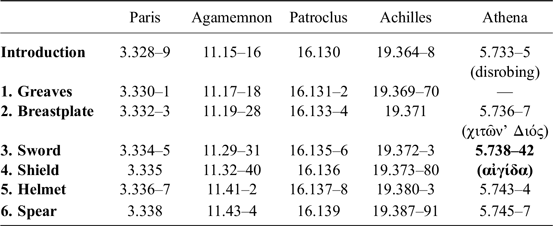
In antiquity, the aegis (αἰγίς) was generally understood to be a protective garment made from the hide of a monster or goat (cf. αἴξ, αἰγός) slain by Athena or Zeus; and so it appeared in ancient iconography from around 540 b.c.e.Footnote 62 But in the Iliad, the status and nature of the aegis are more ambiguous, and some scholars have supposed that it was actually conceived of as a shield. Stengel has elaborated this point at some length.Footnote 63 As he notes, (1) the aegis was made by χαλκεὺς Ἥφαιστος (15.309–10), just as he forged the shield of Achilles and just as mortal craftsmen forge shields for human warriors (for example, χαλκεύς, 12.295); (2) the aegis is decorated with personified and monstrous images (Φόβος, Ἔρις, Ἀλκή, Ἰωκή, Γοργείη κεφαλή, 5.738–42) akin to the shield of Agamemnon (Γοργώ, Δεῖμος, Φόβος, 11.32–7); (3) it takes the place of the shield in the usual arming sequence—and I would add, the place of both shield and sword (Table 1), reflecting the Gorgon-faced aegis’s ability to serve both a defensive and offensive purpose.Footnote 65 Moreover, (4) Athena throws the aegis around her shoulders like heroes do a shield (or also, again, a sword);Footnote 66 and (5) the aegis covers and protects bodies (for example, Hector’s corpse: περὶ δ’ αἰγίδι … κάλυπτε, Il. 24.20) like a shield (σάκος ἀμφεκάλυψε: for example, Ajax ‘covering’ Teucer, 8.331; Antilochus ‘covering’ Hypsenor, 13.420).Footnote 67
The Homeric Arming Sequence, adapted from a schema by Adrian KellyFootnote 64

Table 1: Long description
The table compares the arming sequence of characters in the Iliad, focusing on Paris, Agamemnon, Patroclus, Achilles, and Athena. It has six rows and five columns. The columns are labeled Paris, Agamemnon, Patroclus, Achilles, and Athena. The rows are labeled Introduction, Greaves, Breastplate, Sword, Shield, Helmet, and Spear. Each cell contains specific line references from the Iliad corresponding to each character’s arming sequence. Row 1: Introduction, Paris 3.328-9, Agamemnon 11.15-16, Patroclus 16.130, Achilles 19.364-8, Athena 5.733-5 (disrobing). Row 2: Greaves, Paris 3.330-1, Agamemnon 11.17-18, Patroclus 16.131-2, Achilles 19.369-70, Athena —. Row 3: Breastplate, Paris 3.332-3, Agamemnon 11.19-28, Patroclus 16.133-4, Achilles 19.371, Athena 5.736-7 (χιτῶνὶ Διός). Row 4: Sword, Paris 3.334-5, Agamemnon 11.29-31, Patroclus 16.135-6, Achilles 19.372-3, Athena 5.738-42 (αἰγίδᾳ). Row 5: Shield, Paris 3.335, Agamemnon 11.32-40, Patroclus 16.136, Achilles 19.373-80, Athena —. Row 6: Helmet, Paris 3.336-7, Agamemnon 11.41-2, Patroclus 16.137-8, Achilles 19.380-3, Athena 5.743-4. Row 7: Spear, Paris 3.338, Agamemnon 11.43-4, Patroclus 16.139, Achilles 19.387-91, Athena 5.745-7.
This is a striking list; and the Homeric manuscript tradition evidences confusion about the status of the aegis amongst ancient readers, since in some versions αἰγίδα has been replaced by ἀσπίδα at Il. 15.308, 15.318 and 21.400.Footnote 68 Moreover, Pherecydes appears to have given the same aetiology for the presence of the Gorgon head on the aegis as Apollodorus does for Athena’s shield (Pherecydes BNJ 3 F 11 = Σ Ap. Rhod. Argon. 4.1515).Footnote 69 At one level, we might suspect that for some ancient audiences, the shield and aegis of Athena were interchangeable. I am not arguing that they were ever intended to be the same in Homer—Marx offers prudent caution in this regard.Footnote 70 But these various similarities and the evidence of the manuscript tradition suggest that some ancient audiences and readers collapsed the two together as one single concept.
Given this blurring of shield and aegis, Corinna’s treatment of Athena’s shield might have been responding in some way to the particular associations of Athena’s shield-like aegis in Homeric epic. As Orchard has shown, Athena’s aegis and Achilles’ shield are established as doublets of each other within the Iliad.Footnote 71 Both are crafted by Hephaestus (15.308–10, 18.468–617); both play an important defensive role (protecting Athena and Achilles from Ares’ and Hector’s spears respectively: 21.400–3, 22.289–91); and both seem more impenetrable than other armour.Footnote 72 Moreover, when Achilles is without his arms after Patroclus had borrowed his original set, Athena protects him with the aegis (18.203–6): it fulfils the same defensive role as Achilles’ own shield. Finally, when Achilles receives his new set of armour, it plays the same inspirational and apotropaic functions as the aegis itself.Footnote 73 Against this background, Corinna’s decision to focus on the shield of Athena would have been all the more striking, especially if she did not see a sharp distinction between Athena’s aegis and shield. Whereas the Iliad foregrounded Achilles’ shield in this doublet pairing, Corinna would have instead focussed her audience’s attention on Athena’s shield-cum-aegis. Once more, we seem to have a gendered flip of tradition.
4. NARRATIVE: BOEOTIAN TRADITIONS AND CULT MYTHS
Athena’s shield thus provided Corinna with ample opportunities for recalibrating the masculine world of martial epic. But what narrative context might have featured such a mention of the goddess’s shield? In this section, I explore the possible subject matter of Corinna’s original poem.
In the past, scholars have imagined various poetic forms in which the shield could have been mentioned, including a hymn to the goddess or a self-standing poem entitled The Shield of Athena (akin to the Hesiodic Aspis?).Footnote 74 Without any further indication of the poem’s genre or structure, however, it is better to focus primarily on myths and narratives in which the shield could have featured. Several of Corinna’s known titles offer ready possibilities, such as her Seven against Thebes (659 PMG) or Orestes (690)—both myths in which Athena played a prominent role. The goddess was a close guardian and protector of Tydeus in his attempt on Thebes, famously withdrawing her favour when he consumed Melanippus’ brains (Thebaid fr. 9 West). She was also a supporter of Orestes in the aftermath of his matricide; in Euripides’ Electra, the Dioscuri promise that she will use her shield (κύκλον, 1257) to protect Orestes from the Furies.Footnote 75 Both myths would thus have provided ready opportunities for Corinna to describe Athena’s shield in a martial or protective context.
Other possibilities become clearer when we look beyond these known titles to local Boeotian tradition more generally. Corinna’s poetry focusses particularly on Boeotian myths and legends, centred on local heroes, such as Orion (654.iii.37–41, 655.14–17, 662, 673 PMG), the river-god Cephisus (655.12–13, 692.2a.2) and the eponymous Boeotus (658); the aitia of local cults, such as the Ptoian oracle (654.iii.32–41); and the geography and landscape of Boeotia itself, including Thespia (674), Helicon and Cithaeron (654.i).Footnote 76 Even her mythological innovations foreground a Boeotian element, as when she replaces the Athenian Cephalus with the Theban Oedipus in the story of the Teumessian fox (672 PMG), or attributes all of the Asopides to the Boeotian Asopus river, rather than to its Peloponnesian namesake (654.ii–iv PMG).Footnote 77 Crucially, this strong focus on Boeotia is not a sign of shadowy parochialism; rather, Corinna embraces and reshapes Panhellenic myth with patriotic fervour.Footnote 78
This epichoric orientation might also help explain Corinna’s focus on Athena’s shield, since shields were a key part of Boeotian collective identity. The ‘Boeotian’ cutout shield appears regularly on the obverse of Boeotian coinage from around 500 b.c.e. (for example, Fig. 2), symbolizing Boeotia’s martial identity, its regional manufacture and export of weaponry, and its association with epic heroes of the past (especially Telamonian Ajax, whose shield had a Boeotian origin: Il. 7.219–25).Footnote 79
Silver Boeotian coin from Coroneia, c. 456–446 b.c.e. Obverse: ‘Boeotian’ cut-out shield. Reverse: Head of Gorgon with protruding tongue, in incuse square. BMC 8 (Central Greece) 46 no. 6. © The Trustees of the British Museum.

This same shield-association is also apparent in the pseudo-Hesiodic Aspis, which is traditionally located in a sixth-century Theban context:Footnote 80 the opening of the poem (which overlaps with the Hesiodic Alcmene-Ehoie) describes the Thebans as ‘shield-bearing’ (φερεσσακέας, 13) and the Boeotians as ‘breathing over their shields’ (ὑπὲρ σακέων πνείοντες, 24).Footnote 81 These two descriptions are unparalleled before the third/fourth century c.e.: the latter occurs only here, while the former only reappears many centuries later in imperial Greek epic.Footnote 82 Their rare use in the Aspis thus attests to the Boeotians’ distinctive association with shields in archaic thought well before the cutout shield became prevalent on Boeotian coinage. Corinna’s poem, which focussed on Athena’s shield prominently enough for Antipater to highlight it, would thus have resonated with a core facet of Boeotian self-identity.
Corinna’s treatment of Athena’s shield might also have been connected with the goddess’s worship in Boeotia. We have few traces of Athena’s cult in Corinna’s home city of Tanagra; it is not mentioned in literary sources, and it is only attested epigraphically from the fourth/third century b.c.e., that is, from around the time that Corinna may well have been composing (cf. §1 above).Footnote 83 Other Boeotian sanctuaries of Athena, however, appear to have been far more significant in the late Classical period, especially that of Athena Itonia near Coroneia.Footnote 84 This sanctuary dates back at least to the late seventh/early sixth century, when its fame had already reached overseas.Footnote 85 The site was an important cult centre for the Boeotian League from at least the late fourth century b.c.e., a meeting-point for deliberation (cf. Paus. 9.34.1) and the locale for the celebration of the Panboeotian games.Footnote 86 It is likely, though, that this panboeotian status can be traced back to the late sixth/early fifth century given the site’s early fame outside Boeotia, as well as its later federal status and strategic location (en route between Delphi and Thebes).Footnote 87
Some scholars have suggested a connection between this cult and Corinna’s shield poem, but only ever in passing and without considering the strength or implications of the possibility.Footnote 88 By considering the evidence more fully here, we will see that their intuitions may well be right.
First, we have independent evidence that Corinna referred to this goddess: according to the Apollonian scholia, Alexander Polyhistor discussed the aetiology of Ἰτωνὶς Ἀθηνᾶ in his commentary on Corinna.Footnote 89 It is very possible that a poem featuring this goddess would have focussed prominently on her shield, since the Itonian cult foregrounded the goddess’s martial aspect.Footnote 90 Alcaeus describes Athena at Coroneia as ‘war-sustaining’ (πολεμάδοκε, fr. 325.1 Voigt) and Bacchylides refers to her golden aegis, a weapon that—as we have seen—is simultaneously offensive and defensive (χρυσαίγιδος Ἰτωνίας, fr. 15 Maehler). This strong martial emphasis is also reflected in the iconographic record. A warlike Athena in full panoply (shield and all) is depicted on sixth-century Boeotian black-figure vases, which have plausibly been connected with Athena Itonia, including a black-figure lekanis from the British Museum (B80) that depicts Athena in a martial promachos pose before a sacrificial procession (Fig. 4).Footnote 91 More concretely, a distinctive coin type is associated with Coroneia that combined the typical cutout shield on the obverse with a helmeted Athena on the reverse.Footnote 92 The enduring military nature of the cult is also apparent in the Hellenistic period, where the Panboeotian festival celebrated near the sanctuary involved an elaborate programme of military games, in which select contingents of different Boeotian cities competed.Footnote 93 Across the centuries, Athena Itonia was continuously connected with warfare and conflict; it is no surprise that Tzetzes later described her as ‘most warlike’ (πολεµικωτάτην, on Lycoph. 355 Scheer). This Boeotian facet of the goddess would thus provide a plausible context for Corinna’s mention of her shield. The relevant poem could even have been performed at an early iteration of the Panboeotian festival at this very sanctuary.Footnote 94
Detail of black-figure Attic amphora with gigantomachy: Athena wields a cut-out ‘Boeotian’ shield decorated with a gorgoneion, c. 540–530 b.c.e. Vatican 16445 (BAPD 301601). © 1984 by Patricia A. Marx.

Detail of black-figure Boeotian lekanis, showing an armed Athena in front of a two-stepped flaming altar, with a sacrificial procession advancing from the left, c. 550 b.c.e. British Museum B80 (BAPD 24390). © The Trustees of the British Museum.

One myth associated with the Coroneian sanctuary is of particular interest for thinking about Corinna’s poem: the death of Iodama, as recounted by Pausanias (9.34.2).Footnote 95 Iodama was a priestess at the temple of Athena Itonia; when she entered the precinct at night, she was met by an epiphany of the goddess and was turned to stone after looking at Athena’s gorgoneion. This myth may be alluded to by some coins from Coroneia that feature a Gorgon’s head on the reverse, alongside the cutout shield on the obverse (Fig. 2 above).Footnote 96 As Pausanias reports it, the story is an aition for a daily ritual in the sanctuary, in which a woman would put fire on the altar of Iodama and say three times in the Boeotian dialect (τῇ Βοιωτῶν φωνῇ) that ‘Iodama is alive and asking for fire’.Footnote 97 Could Corinna have mentioned the goddess’s shield in a treatment of this myth? She is, after all, particularly interested in local lore and aitia, and Pausanias’ emphasis on the ‘Boeotian dialect’ of the priestess’s words is in keeping with Corinna’s own poetic dialect. Athena’s shield would also be a natural element of this myth, forming a core part of the goddess’s terrifying epiphany, and perhaps even as the site of the gorgoneion itself. Pausanias imprecisely refers to ‘the head of the Gorgon Medusa’ (τὴν Μεδούσης … τῆς Γοργόνος κεφαλήν) residing on Athena’s ‘tunic’ (χιτῶνι), presumably a reference to her aegis.Footnote 98 But given Pausanias’ late date, and the confusion between Athena’s aegis and shield in antiquity (§3), the goddess’s shield could have played a prominent role in Iodama’s petrification. If this idea is along the right lines, we might even wonder whether Pausanias learned of the episode from Corinna herself; it is barely attested elsewhere, and Pausanias shows himself interested in Corinna’s life, poetry and dialect at other points (9.22.3).Footnote 99
5. CONCLUSION
Antipater of Thessalonica’s epigram on female poets alludes knowingly to the authors that he cites, including Sappho’s concern with hair and Corinna’s poetic treatment of Athena’s shield. I have suggested that Antipater’s language and the broader traditions around Athena’s shield and aegis offer clues to what might have been going on in Corinna’s poem. Corinna appears to have opted for a poetic subject that enabled her to foreground powerful female figures—Athena and Medusa—in a pointed response to the shield ecphrases of Homer and Hesiod. Such a recalibration of tradition could have occurred in multiple different narrative contexts, including Corinna’s treatment of the myths of Orestes or the Seven against Thebes. Another possibility would be to see a link with the cult of Athena Itonia near Coroneia, and especially the myth of Iodama, the petrified priestess. But whatever the ultimate context, Corinna’s focus on Athena’s shield would have resonated with the Boeotians’ broader identity as a martial and warlike community, reinforcing her role as a regional poet who set Panhellenic tradition in dialogue with local myths and politics.



 Open access

