1. INTRODUCTION
Human-centered design (HCD; Gasson, Reference Gasson2003; Dym et al., Reference Dym, Agogino, Eris, Frey and Leifer2005) is an approach to design and innovation in which an understanding of potential users drives decision making. That understanding typically emerges through user research: the systematic study of the attitudes, behaviors, and desires of potential users. In contrast to approaches such as “technology push,” in which designers begin with the technology and then find applications for it (Martin, Reference Martin1994), in HCD user research provides a critical foundation for every subsequent step of the design process. However, the influence of user research depends on its visibility and credibility to decision makers.
The division of roles in commercial product, service, branding, and experience design poses major challenges to that visibility and credibility. It is rare for a single team or organizational unit to take sole responsibility for the entire design process. A specific team or company may conduct user research, then pass what they learn to another team of industrial designers or engineers, such as those doing concept generation or prototyping. Because the second team often neither conducts research activities nor participates in data analysis, they may not necessarily be aware of the research nor feel responsible to it. For that reason, the influence of user research in distributed HCD processes depends on how well researchers communicate findings and their importance beyond their own immediate team.
Researchers have many choices in how they communicate. Forms of communication may include paper and digital reports; presentations; blogs and other websites; informal verbal conversations; educational workshops; and custom-designed artifacts, such as card decks and posters. For that reason, skillful research communication requires more than clear writing or informative visual representations, or even adept speaking, gesturing, and listening. It also demands the ability to connect a narrative to the needs and questions of the audience (Bartel & Garud, Reference Bartel and Garud2009).
Researchers then often find they have diverse audiences. For the purposes of this analysis, we can divide the audience for user research into two groups: the immediate research clients and the secondary research stakeholders. By research clients, we mean the people, acting as representatives of groups or organizations, who commissioned the research. By research stakeholders, we mean other people or groups who were not directly responsible for commissioning the research but who have an influence on design decisions and might find the results interesting, useful, or troublesome. This paper begins with an initial question: to what extent do user researchers make these communication choices with their audiences' needs and questions in mind?
Our study of the communication strategies employed by expert user researchers leads us to propose treating user research communication as a design problem, one amenable to the philosophies and skills of HCD. As we will describe later in this paper, the researchers in our study almost universally used similar tools and methods to investigate their audiences' needs as they did to investigate end users'. They did so to combat persistent and widespread communication problems engendered by the cultural and organizational gaps between researchers and their external audience. An HCD-oriented approach to communication has been largely missing from the literature on design communication, with the notable exception of Raven and Flanders (Reference Raven and Flanders1996), who recommended that technical writers employ formal user research methods to learn about their readers. This paper attempts to fill that gap by describing the communication practices of expert user researchers and by introducing an overall approach to user research communication we call double ethnography.
In Section 2, we review the research and literature to date. After a brief discussion on methodology in Section 3, the following section looks at the communication issues especially relevant in communicating design research. We then explore in Section 5 how design researchers view their clients as “users” of their research results and propose an approach to client communication in Section 6, the double ethnography, which builds on this view. Section 7 presents our conclusions.
2. PAST RESEARCH
2.1. Human-centered design
Human-centered design has emerged as an important paradigm in design and product development over the past 40 years, because it has become recognized that understanding user needs is critical to product success (e.g., Freeman et al., Reference Freeman, Robertson, Achilladelis and Jervis1972; Madique & Zirger, Reference Madique and Zirger1984). The focus on the needs of the end customer or user provides “guidance during the design process and criteria for judging the success or failure” of the final design (Faste, Reference Faste1987). The expanding practice of HCD has resulted in professional specialization and in a division between dedicated user researchers, whose jobs largely involve studying end users, and designers, who see research as part of their design process (Sanders, Reference Sanders2008).
HCD practitioners, whether they identify primarily as designers or as user researchers, often see themselves as spokespeople or “ambassadors for users” (Stompff et al., Reference Stompff, Henze, de Jong, van Vliembergen, Stappers, Smulders and Buijs2011). The practice of HCD uses representations of human activity, including visualizations, narratives, sketchings, and scenarios to solve problems on the user-product level. HCD practices, however, are by no means homogeneous in the way they create and use those representations. Sanders (Reference Sanders2008) modeled HCD approaches to research and design practice along two different dimensions: design-led versus research-led approaches and expert versus participatory mind-sets. The approach can be guided more by the professional concerns of designers, or by the professional concerns of researchers. The mind-set behind the process could give the designer primary control as the expert, or include the user as a partner. In all cases, user research and interactions play key roles in creating shared understandings about user needs and perspectives (Schön, Reference Schön1994) both with users and within the team.
2.2. Research intent
User research is successful when the results of the research activities influence the company, its products, or the way it interacts with its customers (Lai et al., Reference Lai, Honda and Yang2010). We can describe this successful state as the maintenance of research intent. Research intent corresponds to the common notion of design intent (Henderson, Reference Henderson1993), where the underlying purpose of previous decisions must be maintained in preference to the individual decisions themselves. Maintenance of research intent during engineering and design processes connects that purpose back to users' perceptions, wants, and needs. By conveying the research intent, user researchers are trying to create design rationales that can be successfully used throughout an organization to address questions about users' perceptions, wants, and needs with the idea that the answers will help put previous decisions in perspective for the current project.
2.3. Communication of research intent
Studies of multifunctional HCD design teams typically assume that the user researchers and the designers are the same people or members of the same team (e.g., Hey et al., Reference Hey, Yu and Agogino2008). With the increased division between user research and design, communication between these groups has become increasingly important for the success of design projects to incorporate considerations of user needs. Here, we present a useful model of communication and look specifically at communication in design contexts.
2.3.1. Models of communication
Shannon and Weaver (Reference Shannon and Weaver1949) modeled information transmission in communication technology as a system of source, transmitter, channel, receiver, and destination. This mechanistic model (Shannon & Weaver, Reference Shannon and Weaver1949) has been adopted as a metaphor for human-to-human communication, building on the premise that the world is best understood as a mechanical system. It places the emphasis on the sender and the message, while deemphasizing variations in context and individual communication partners. The criterion for successful mechanistic communication is the match between the message packaged and sent, and the message received and decoded. While shedding light on some issues, such as the effect of noise, the mechanistic model obscures important issues in cross-team and cross-discipline communication, such as those of interpretation, negotiated meaning, and resistance to new information.
Other models of communication presume that regardless of what the speaker intends and attempts to communicate, that which the listener is capable of understanding given his or her current set of knowledge and experience constrains the meaning (e.g., Baecker, Reference Baecker2001). The importance lies then with how the parties involved interact, because their ongoing dialog shapes the meaning of a particular piece of information.
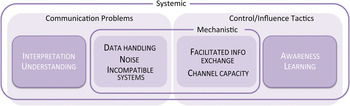
Maier et al. (Reference Maier, Eckert and Clarkson2005) identify these models as having a more sociocultural, or systemic viewpoint, and propose a metamodel of communication where the mechanistic model is situated within the context of the systemic, as seen in Figure 1. Mechanisms for influencing or controlling issues on each level are also included: Facilitating smooth information exchange through the use of a computer tool or prescribed method and reducing noise by increasing channel capacity may control mechanistic issues, while increasing awareness or engaging the audience in a learning process may control issues on the systemic level.
Adapted from Maier et al. (Reference Maier, Eckert and Clarkson2005). [A color version of this figure can be viewed online at http://journal.cambridge.org/aie]

2.3.2. Previous recommendations for communication in design
Maier and her associates identified five factors as influencing communication in product development: product representation, information, individual, team, and organization (Maier et al., Reference Maier, Kreimeyer, Hepperle, Eckert, Lindemann and Clarkson2008). They then organized recommendations from the literature into the latter four of these categories (Maier et al., Reference Maier, Dönmez, Hepperle, Matthias, Lindemann and Clarkson2011). Recommendations for the information and individual factors addressed, to some extent, the systemic issues of translation. Recommendations for information focused on knowing people's information needs, gaining access to the information necessary to fulfill those needs at appropriate times, and establishing a common syntax. Recommendations for the individual focused on clarity and awareness of roles, as well as managing employee development. Within the field of communication design, it is more common to suggest that visual designers “gain information from the public” (Frascara, Reference Frascara2004) through formative interviews or usability tests of prototypes, but recommendations focus primarily on the aesthetics of representation.
Visser (Reference Visser2009) proposed mechanisms for “enhancing empathy, supporting engagement, and providing inspiration” to design teams through engagement with the everyday activities of end users. To support these mechanisms, she suggests sensitizing designers, making communication participatory, and making a good communication plan based on an understanding of the receiver's information needs. However, she does not address how to develop such an understanding, nor does she discuss dealing with issues of inertia, except in terms of a lack of motivation.
Newman and Lieu (Reference Newman and Lieu2005) approached design communication from a more mechanistic viewpoint, identifying message, author, audience, and medium as key factors. However, their framework and recommendations include tools for learning about the audience's needs and initial understandings, primarily by surveying the audience about their prior knowledge, which is useful in an educational context but not appropriate in a professional setting.
Research on the role of artifacts in design communication has examined how “boundary objects” facilitate communication and the development of shared understanding across organizational and cultural boundaries (Star & Griesemer, Reference Star and Griesmer1989; Carlile, Reference Carlile2002). Boundary objects are defined as physical or virtual objects that provide information that is used differently in different communities: though the interpretation is plastic, the content or structure itself remains constant. Some boundary objects, such as computer-aided design drawings, may shape action as well as facilitate communication, thus acting also as “conscription devices” (Henderson, Reference Henderson1991).
Stompff et al. (Reference Stompff, Henze, de Jong, van Vliembergen, Stappers, Smulders and Buijs2011) found that artifacts depicting intended outcomes strongly contribute to HCD. Experiences do as well. These are events that can be experienced and reflected on by all specialists involved. Echoing Bartel and Garud's (Reference Bartel and Garud2009) call for “innovation narratives,” they recommend the use of product stories, a shared narrative that explains expectations for the future product that all team members are working on, which develops as the product does.
2.3.3. Extending the metamodel of communication
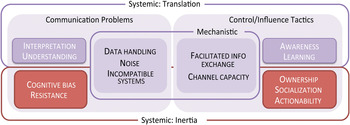
Dougherty (Reference Dougherty1992) found that different departments evolve internally shared systems of meaning and knowledge, which she called “thought worlds.” Ideas that do not fit the system may be reconfigured or outright rejected, so that particular departments within a company may be more or less open to particular pieces of new information. Building on this, Carlile (Reference Carlile2002) proposed a pragmatic view of knowledge as being localized around a particular issue, while also being embedded and invested in practice. This view highlights the resistance people have to new information that puts the knowledge that they've accumulated and use “at stake.” People are reluctant to change their knowledge because it may be costly to reconfigure their thought world to accommodate it (Carlile, Reference Carlile2002). The cost of reconfiguring one's thought world may be so high that one's reluctance to accommodate new information may appear as an inability to do so. A group or individual's reluctance or inability to alter their thought world compounds the inherent difficulty of creating shared frames across boundaries. We refer to this reluctance as inertia and extend Maier et al.'s (Reference Maier, Eckert and Clarkson2005) systemic level of communication to include inertia and translationFootnote 1 aspects, as shown in Figure 2. For inertia, we identify cognitive bias and resistance as sources of communication problems. However, from the literature, we have very little in the way of recommendations for controlling or influencing these communication issues, nor are there extensive recommendations for how to increase one's awareness about the recipients of communication. In this paper, we propose that the activities designers do to extend the impact of their research findings, designing “actionable” deliverables, “socializing” their research, and helping their clients develop a sense of ownership, are techniques for influencing issues of inertia. In addition, we address activities that enable researchers to better convey meaning and inspire action by understanding the expectations, viewpoints, and past experiences of their audience. We draw on Stompff et al.'s (Reference Stompff, Henze, de Jong, van Vliembergen, Stappers, Smulders and Buijs2011) insight that the development of the product story helps create a shared understanding between the different members of the team on what they are developing and on the process they will follow.
Extended model of communication with additions to Maier's model in bottom half of figure. [A color version of this figure can be viewed online at http://journal.cambridge.org/aie]

3. METHODOLOGY
We draw on a tradition of design inquiry that treats design as a social process where dialogue and argumentation enable design stakeholders from different disciplines to collaboratively assemble a coherent and believable “story” about the product and the context in which it will be used (Bucciarelli, Reference Bucciarelli1996). That story, which is expressed in specifications, scenarios, reports, and budgets, motivates production. Tracing and interpreting the creation and assembly of design stories requires attention not only to the final outcome but also to the interactions of various actors along the way. This attention to the details of everyday work practice motivates our choice of methods. In situ interviewing and workplace tours bring to the surface how people discuss their work in context (as in Beyer & Holtzblatt, Reference Beyer and Holtzblatt1997); in-person project observation allows us to follow decision making and tool use as it happens rather than retrospectively (as in Bucciarelli, Reference Bucciarelli1996; Suchman, Reference Suchman1987).
3.1. Study activities
Study activities included both interviews and workplace observation. We conducted interviews with 13 user researchers, 20 interaction designers, and 3 design engineers at 22 companies across 4 major US metropolitan areas. All interviews took place at participants' workplaces and lasted between 1 and 2 hours. Our interview questions for those who conduct user research (both as designers and as professional user researchers) focused on the research and communication process, but we also asked for specific examples to illustrate the application of those processes in actual projects. With the interaction designers and design engineers, we explored their experiences of receiving and interpreting user research communications and paid particular attention to the artifacts made for and during communication, as well as the tools that participants used. Our interview questions for those who conduct user research (as designers and as specialized user researchers) focused on the research and communication process. With the interaction between designers and design engineers, we explored experiences of receiving and interpreting user research communications, with particular attention to artifacts made for and during communication.
We also observed user research activities in four projects at three interaction design consultancies. Project observations all took place in the San Francisco Bay Area. User research methods used during these projects ranged from ad hoc “guerrilla” interviews with passersby to a weeklong diary study followed by visits to the homes of participants. Depending on the teams' preferences, we observed different user research communication activities throughout each of the projects. However, overall we observed two teams designing research deliverables such as personas, all teams planning the presentation, two teams leading research workshops or presentations, and all teams evaluating the team's performance after the meeting and planning follow-up steps.
3.2. Study participants
This study focuses on the experiences of recognized experts.Footnote 2 Many of the interaction designers we interviewed had worked in both a researcher and a designer capacity, often on the same project. The design engineers all had a mechanical engineering background and worked primarily on mechanical designs in close collaboration with user researchers. We selected participants from a variety of fields in order to maximize variation in project domain and stakeholder discipline. The user researchers interviewed have approximately 11 years experience, on average, and have all worked on both digital (e.g., software and websites) and physical (e.g., food packaging, automobiles, and industrial electronics) products. Each workplace selected for project observation was well known and respected in the field of interaction design, as measured by prominence of clients (Fortune 100 and 500), leadership in industry associations, professional awards, published books, and so on. This focus on experts is, of course, also a limitation: our findings may not be representative of the communication practices of less expert practitioners or of communication practices elsewhere in the world.
3.3. Analytic approach
The methodological tradition of grounded theory is the foundation for this analysis. Grounded theory emphasizes inductive theory generation, based on iterative rounds of data categorization or “coding” (Ericson, Reference Ericson1993), interspersed with synthetic analysis and purposeful recruitment of further participants in order to clarify and refine specific themes. In this case, the two researchers independently performed “open coding” on interview transcripts, observation field notes, and photographs to identify critical concepts at stake (Strauss & Corbin, Reference Strauss and Corbin1998), iteratively moving between analysis and systematic recruitment of further participants in order to answer the questions analytically generated. This paper draws on the analysis of concepts common to two separate research projects, with further axial coding (Strauss & Corbin, Reference Strauss and Corbin1998) performed on the conjoined data. This paper is thus based on a multisite and multigroup study, with conclusions internally cross-checked between the two. In addition, the validity and applicability of each study's analysis was verified by presenting emerging conclusions to relevant professional experts.
4. EXAMINING COMMUNICATION CHALLENGES IN HCD
As discussed earlier, researchers are often organizationally and culturally separate from the product teams they serve. All of our participants conduct their user research outside the design production context (e.g., Crilly et al., Reference Crilly, Maier and Clarkson2008; Visser, Reference Visser2009). In this section, we examine how systemic communication issues of translation and inertia manifest in the contexts studied.
4.1. Translation across organizational boundaries
Researchers and their clients are often located in different companies or organizational units, and researchers may not even know the identities of the various stakeholders involved, let alone understand their information needs. For example, the research team may be a subcontractor for a consulting company that was hired by the end client company. In other cases, the group within the client organization who hired the research team may answer to another internal group (R-04), a kind of internal “client's client” situation. Clients and client's clients may come from disparate parts of an organization such as program management, marketing, strategy, or manufacturing, each with different disciplinary perspectives and information needs.
However, many researchers feel obligated even to distant organizational groups. R-11 points out, “Whoever is the ultimate client, at the end, that's our client, even if we're working with an intermediary client. Then her goals are our goals, which means the end client's goals.” As organizational boundaries are crossed, effective communication becomes more difficult. Different cultures across disciplines, teams, and organizations complicate translation:
A lot of it has to do with the culture within our client organizations. … We need to basically communicate in a way that not only as I say engages them, but also that they can use to further move the project through the organization. (R-13)
Translation issues become especially prevalent with greater organizational separation (as in client's client situations). When the design team and the research team cannot communicate directly, the intermediary's ability and willingness to negotiate a shared understanding with both parties becomes critical. Mediated organizational relationships may also produce mechanistic problems, compounding the issues of translation. For example, research may stop while messages travel back and forth from the researcher to the client's client, getting garbled in the process. Researchers sometimes ask for direct talks with the design team (e.g., IxD-01), but when those attempts fail, they are forced to fall back on embedding the research intent into documents or supporting the intermediary to be an effective communicator.
Having lost its original creators, research intent may not survive translation across organizational boundaries once embedded into a document:
It's easy to just start to miss the intent and start changing it. Especially as it goes more downstream and it gets into optimization and how are you going to commercialize it and stuff it's really easy to just start like, slashing features cause you're doing your job without knowing that like, that rounded corner was the most important part of the big idea. (R-13)
Information about why seemingly minor details, such as a rounded corner, might matter to end users ought to reach the stakeholders who have the power to change that corner. Unfortunately, researchers cannot always anticipate exactly who that will be.
4.2. The hired antagonist versus inertia
Researchers are often hired to bring to light insights and ideas that the company has trouble seeing for itself. They are, essentially, there to help the company break out of past inertia. One researcher we spoke to (R-10) told us several stories where the success of a new idea came down to one person in the client company risking dismissal in order to change the project direction. In these stories, the people risking their jobs were sometimes new to the company and sometimes just unusually open to new ideas. The persistence of these war stories illustrates research consultants' belief that conflict is an important part of their job. At the beginning of each project, R-04 asks “What are we up against here?” as he looks for project “champions.” For them, research consultants are brought in to “shake things up”:
In a way we're hired antagonists, you know, we're designed to kind of shake up the process and tell people things they don't know and there's always something that's going to upset somebody, and that's fine. But at the same time, you have to create enough goodwill that people want to continue telling your stories after you're gone. (R-03)
The role of hired antagonist, as an independent “knowledge broker” (Hargadon, Reference Hargadon2002) moving between organizations and teams, offers both strength and weakness. On the one hand, researchers believe that they can take a fresh perspective on old dilemmas as outsiders. On the other hand, they may be unfamiliar with the positions, interests, values, and agendas of the people whose decisions they are attempting to sway, especially if faced with a client's client situation. Though inertia issues are, of course, not unique to HCD, they are especially pressing when a company needs to take a new direction in order to connect to customers. Researchers, particularly in the NPD Group, define successful work by its ability to overcome organizational inertia and allow companies to take advantage of the opportunities identified in the research (R-01).
5. TREATING CLIENTS AS USERS
Researchers often invest considerable amounts of time and energy carrying out a micro-HCD process with their client organization within the broader HCD process of product development, essentially treating their clients and stakeholders as users of research outcomes. From the first kickoff meeting, researchers may use their interactions with clients and stakeholders to map relationships, motivations, and priorities within the organization. They work to understand organizational priorities, communication patterns and preferences, and biases and assumptions within existing company culture.
To assure project success, researchers often try to bridge cultural and organizational disjunctions between them and their clients' organization, while also bridging the needs of clients and their end users. Their goal is to identify not only what the designers and engineers need to know but also how best to design actionable communications so that the users of the research “get it” (R-12) and are able to overcome both interpretation and inertia issues. If they have no previous experience with the relevant stakeholders, researchers work to understand the motives and backgrounds of all those involved.
5.1. Researcher–client relationships
In particular, research companies use “stakeholder interviews” across the organization as a way to investigate project aims, areas of cultural friction, and organizational dependencies. These interviews can include design engineers, marketing people, manufacturing engineers, or salespeople—anyone connected to the project. Seeing all these stakeholders as users of research leads researchers to work with their immediate clients as either stakeholder representatives or collaborative informants.
Researchers who see their clients as full members of the dominant organizational culture treat clients' assumptions, attitudes, and goals as representative of other stakeholders that the project will need to influence. Treating clients as stakeholder representatives reinforces the perception of researchers as outsiders to the dominant organizational culture; researchers maintain an “us versus them” position and clients may not know that they are being analyzed.
Alternatively, researchers may treat their clients as collaborative informants and explicitly ask clients to describe and diagnose their own organizational concerns. In this case, the clients act as peer collaborators rather than subjects. This approach can reinforce a shared, project-based team identity for clients and researchers (they are in it together) with other project stakeholders as the outside party.
The same research team can take both approaches in the same project, since relationships evolve over time. However, they have distinct implications for how researchers work to understand the users of their research. In working with clients as collaborative informants, some researchers see the feedback produced by “real-time” (R-12) collaboration as obviating the need for stakeholder interviews or other specific client research activities. However, others will always push to conduct stakeholder interviews just to hear how decision makers “think and talk about” the project (R-04) or to understand their values (R-13). The two different approaches also have implications for how researchers communicate with their clients. With collaborative informants, the goal may be to support mutual, frank disclosure of information as it develops, gearing the main deliverables to other stakeholders, while drawing on collaborative informants for guidance (IxD-01).
Now it's a lot of back and forth about what they want us to stress, what they find interesting, some of it is about, “within this organization you can't call it this, don't refer to this in this way, everyone will think you mean this and then they'll have this three hour conversation with you because you're calling it high-deductible instead of consumer deductible.” (R-01)
However, when communicating with stakeholder representatives, the strategy may be to maintain a more polished, optimistic front and only bring in the clients when the deliverable is presented. In these cases, the researchers may seek feedback on the form and wording of the deliverables from others in the research group (R-03).
5.2. Learning about clients
To address the communication issues they face, researchers, particularly when the client is treated as a representative, focus on uncovering key themes in client and stakeholder interactions: information needs, organizational and personal barriers, and cultural norms.
5.2.1. Identifying information needs
The researchers we interviewed engaged in extensive activities to uncover and make explicit clients' expectations for the project's ends and means.
That is to say, despite specifying documents such as requests for proposals, statements of work, and memorandums of understanding, researchers usually begin projects by revisiting and reestablishing the goals for the research. They, as one design engineer said, want to be sure they “aim the project correctly” (DE-03) to meet the information needs of their client organization. They ask questions like:
• What research has already been conducted?
• What kind of information does the client want?
• What kind of information does the organization actually need?
• What business reasons motivate this research?
Answering these questions does not just affect research design. It also affects communication practices. As one researcher told us:
I need to understand from them exactly what they want and that's a whole different research process and they don't know that. But you need to, like, actually change your way of working with that person because of it. (R-09)
What R-09 means is that researchers can select from a repertoire of communication strategies. Daily e-mails or weekly phone calls; lots of detail or high-level summaries: the communication media and rhythms follow not only expressed client preference but also heuristics about what kind of communication practices will best support organizational goals. For example, an “agile” software startup, with development cycles measured in days, will call for different patterns of communication than a hardware manufacturer on a 3-year timeline.
Communication decisions also take place within the constraints of time and budget. Researchers want the client to “get it” but need to “figure out the best way to communicate that to them given how much they're actually paying and the time they've told us to spend” (R-12). It is not only the goals of the project but also constraints of time and money, negotiated at the beginning of the project, that concretely affect the kinds of communication strategies that researchers will employ in the weeks and perhaps months to come.
5.2.2. Identifying organizational and personal barriers
Research communication strategies take shape within a web of complex roles and dependencies. As outsiders, researchers try to “suss out” power relationships and orientations to the specific project that might affect communication media and rhythm, as well as the rhetoric of the content:
Part of our work is to suss out who's who and what are they going to bring to the process. Are they going to be champions for this; are they going to get in the way or have to be won over or whatever. So there's kind of who hires us, and who are we working for, and who are we working with? (R-04)
Researchers do not study the entirety of the organization. Rather, they are trying to discover orientations vis-à-vis a specific project. Relevant questions include:
• Who initiated the project? Who is paying for it?
• Who are we working for? Who has final decision-making authority?
• Who are we working with? Who are our peer collaborators?
• Who has a stake in the status quo? Which people will we have to convince?
By answering these questions, researchers are able to identify not only who has information needs but also where inertia issues may crop up. To streamline dealing with issues of interpretation and inertia with senior personnel, user researchers learn from both collaborative informants and stakeholder representatives. Individual players with a stake in the status quo may need special attention to help them make the research insights actionable.
5.2.3. Identifying cultural norms
Whether outsiders or members of the client organization, researchers are not just concerned with the informational needs of the project or the roles and responsibilities of the people involved. They are also concerned with what Schein (Reference Schein2004) would call “organizational culture,” which are the shared values, assumptions, and expectations of their clients. Their goal is to tailor their own communication strategies to get around issues of both inertia and interpretation in order to increase the impact of the research on the end design.
In part, researchers want to avoid content that inadvertently generates unnecessary friction. Some words or phrases may be “land mines” (R-10) and provoke unpleasant and time-wasting refighting of previous organizational battles. Some analytic approaches may be unfamiliar or uncomfortable. One researcher often supplements her primarily qualitative findings with “quasiquantitative” activities, such as small-scale web surveys, because a reliance on qualitative research took her clients “too outside of their comfort zone” (R-03).
Researchers' understanding of organizational culture, and professional subcultures within it, can influence not only what is communicated but also how it is communicated. One researcher revealed her perceptions of the differences between engineers and researchers:
I'd never have engineers do a collage exercise. They'd be like “That's insane. We can't, we don't even know what you're talking about. You know, we're not cutting out pictures, what is this, preschool?” (R-03)
As part of their understood role as hired antagonists, user researchers work to understand organizational culture in order to change it. One researcher described his job as figuring out the “truisms and expectations that this company has that you can push against” (R-10). Another, expressing a similar idea, considered what the client is “going to have to go through to get change implemented” in the design strategy (R-12). Communications that tackle inertia issues, in this case, might be a necessary and important part of a researchers' job.
In engaging with organizational culture, researchers might ask:
• What topics are controversial? Why?
• What are my clients' assumptions?
• What frames or metaphors do they use to describe their customers and markets?
• What might be obstructing change or progress?
The end goal is to deliver the message clearly and persuasively “in a way that the client will get it” (R-12), whether that delivery is friction free or deliberately provocative.
5.3. Responding to inertia
Three major tactics for researchers to combat inertia in companies are creating actionable communications, socializing their findings, and fostering a sense of ownership in the clients they work with. These three tactics provide levers of control against the bias and resistance to changing thought worlds as illustrated in the extended metamodel of communication (Fig. 2).
5.3.1. Designing actionable communications
After the research stage is over, researchers run the risk that their work may be seen as irrelevant, especially as organizational and departmental inertia come into play. To deal with these issues, user researchers often endeavor to make their deliverables immediately actionable while the information is still applicable to the project and the researchers are present.
Actionable research deliverables are tools for inspiring design. They “are not just descriptive,” said one designer who also conducts research (IxD-08), but “suggest opportunities.” For the researchers in this study, actionability did not imply dictating design directions. Instead, actionability meant supplying designers and engineers with the tools and skills to use research insights in their own design processes. These deliverables are neither descriptive analyses, which may be too abstract to be useful, nor prescriptive recommendations, which may leave designers and engineers feeling as if the researchers are claiming too much authority over the design process. An in-house researcher at an agile-based software company, R-05, found that without making the research actionable, his coworkers would not integrate it into their work.
I can produce as many slide decks as I like, but until I show you that it is valuable, it's not going to do anything. At least here. Get some work out there that people can use and get value from. (R-05)
Researchers may see themselves as “delivering an experience” rather than a list of specifications or insights (R-04), thus tapping into “experiential learning” to create momentum in a new direction. Participatory activities, such as brainstorms, get clients and stakeholders invested in turning research insights into action or, as one researcher said, “making it into something that can be real for your company” (R-03). However, what constitutes actionability might change from organization to organization, depending on which clients and stakeholders are involved. Thus, creating actionable communication hinges on researchers' knowledge of the client organization.
5.3.2. Socializing the research
In conjunction with understanding their client's company, researchers work to socialize the research throughout the client organization. To socialize research, as the name suggests, is to circulate research stories or documents widely, past any “gatekeeper” (R-04) clients to others in the organization. As a form of “relationship practice” (Gratton & Erickson, Reference Gratton and Erickson2007), it is one tactic for extending the influence of research insights and reinforcing the research intent against the shifting of roles within a project. By sharing “bonding” experiences with primary clients through field trips to meet end users and shared meals during data analysis sessions, research can be socialized. Successfully socializing research can make “beautifully designed objects” less important than “the relationship aspect” (R-03).
The goal of socializing is to convince more people of the research's relevancy to the organization and to encourage a shift in thought worlds by expanding the shared system of meaning (Dougherty, Reference Dougherty1992) through sharing stories and experiences. “Humorous” or “outrageous” stories might be told and retold around an organization (R-04); anecdotes are easy to grasp, recall, and pass along. Rather than document requirements, they help people internalize perspectives other than their own through a streamlined and surrogate experience (Sole & Wilson, Reference Sole and Wilson2002) that might generate different requirements. These internalized perspectives may support more durable and stickier research intent than documented research findings, because they evoke an emotional response (Heath & Heath, Reference Heath and Heath2008). As design ethnographers Nafus and Anderson (Reference Nafus, Anderson and Cefkin2009) write: “The object may itself be forgotten; the story persists.”
5.3.3. Creating ownership
Meeting users during field research, listening to stories, and helping in data analysis can get clients and stakeholders “invested emotionally” in the users at the heart of HCD. In turn, says one researcher, “They become kind of advocates for these people they heard” (R-10). Written between or after research activities, but before full data analysis, interim reports engage recipients in the research process and get them invested in the decisions that researchers are making. Emotional investment, in turn, can assist in socializing the research.
By including their clients and stakeholders in research activities, researchers are working to give members of the client organization a sense of ownership over the research itself. By owning the research, they become advocates for the users, as they tell the stories from the research as their own, essentially stepping into the shoes of the customer. As these people move to other teams and groups, they carry not only the research findings but also the experience of discovering those insights. By providing experiences rather than solitary deliverables, researchers may hope to convince client organizations to go beyond accepting the research findings and move toward a customer-centric way of doing business.
6. AN APPROACH TO CLIENT COMMUNICATION: THE DOUBLE ETHNOGRAPHY
As we have detailed, user researchers often approach communication with their clients and stakeholders as though it were also a HCD project. There are obvious parallels between the two situations. Both products and reports are intended to meet the specific needs of an external group, whether clients or end users. Upon release, a product leaves designers' control, becoming open for users' interpretations. Likewise, research results are also out of researchers' control and open for interpretation by members of the client organization that use the research. Finally, both products and research results may be rejected. In response, researchers then craft not only a deliverable document but also an experience that can guide decision makers in using the research to inform the design of the end product.
In the words of one of our research participants, effectively working with clients and stakeholders as users of research outcomes requires a double ethnography. The primary goal of the double ethnography is to help researchers figure out how to communicate across boundaries of expertise, culture, and interests. That is, researchers attempt to understand their audiences' worldviews and integrate them into research communication at the same time that they are attempting to understand end users' worldviews and integrate them into design recommendations.
Because professionals often use the term ethnography quite differently than trained scholars, the term has become controversial in the user research industry. However, we adopt the term double ethnography here because it evokes two key characteristics of the practice. First, ethnography involves the self-critical questioning of assumptions. User researchers set themselves seriously to understand both the user and the client company culture. Second, it involves putting the results of inquiry to work by inscribing those understandings into how and what they communicate. As with a more conventional ethnographic practice, their work entwines empirical observation and the making of representations. We are not suggesting that our participants are conducting anything like an academically rigorous ethnographic study of their client organization, or that they should conduct such a study.
A double ethnography may begin by learning about the research project, the clients, and their organization. Insights from informal conversations and stakeholder interviews modify the team's expectations for their audiences' needs and perspectives. After developing an initial understanding of the needs of clients and stakeholders, the research team begins to investigate users. The double ethnography continues at check-in meetings and when clients or stakeholders accompany researchers into the field. New insights from these interactions may again modify the research team's understanding of client and stakeholder needs and perspectives, which may in turn affect ongoing user research activities. After completing the user research, the research team continues to engage with clients in producing the kinds of explanations, social events, documents, and tangible artifacts that will meet clients and stakeholders' needs for actionable information considering their existing perspectives and biases.
6.1. Summary of techniques to address communication issues
We propose techniques for effectively communicating design research findings across organizational boundaries that draw on the communication practices of HCD researchers.
1. Investigate the research environment with a double ethnography approach
• Plan activities that will identify mechanistic information needs throughout the project. The most sophisticated plan for overcoming issues of inertia and translation can fail if researchers do not understand where, when, and how their clients and stakeholders need communication.
• Turn the ethnographic lens on the client organization. What is the organizational culture? The hierarchy? Where might issues of translation or inertia crop up? What kinds of narratives and forms of information have the most credibility within the organization?
2. Focus on sites of inertia
• Identify key decision makers and their stakes in the status quo. Use client and stakeholder research activities to identify biases, reservations, and sources of resistance.
• Create ownership by facilitating emotional and professional investment in the research process, especially by bringing clients or stakeholders along on research outings and by using stories to create emotional impact.
3. Facilitate actionability and socialization by supplementing documents with experiential learning
• Follow up document-focused presentations with experiential-focused ideation or brainstorming sessions. Data-rich storytelling with photographs and video can also help make the deliverables “come to life,” sparking the audience's imagination and building empathy.
• Spend time with clients. Bonding, and the accompanying translucency of work process, may sometimes serve the credibility of research better than hiding the details.
6.2. Applying the approach to other forms of design communication
Though our findings specifically concern user research communication, they have clear implications for design communication in general. Recommendations for boundary-crossing communication practices often focus on the form and content of deliverables (e.g., Carlile, Reference Carlile2002). Here, we have moved from form and content to a conceptual reframing of design communication as a form of HCD. Of course, applying the double ethnography approach to situations outside communicating user research simplifies it to a single ethnography of the clients and the stakeholders. However, the application of the ethnographic approach to developing communication artifacts provides a means for following recommendations in the literature regarding learning about your audience (e.g., Maier et al., Reference Maier, Dönmez, Hepperle, Matthias, Lindemann and Clarkson2011). We believe that this reframing will help mitigate issues of interpretation and inertia in professional communication.
6.3. Areas for further study
This article describes current communication practices that expert user researchers find useful. Though many of the researchers we talked to conducted a formal analysis of their fieldwork with users, it was clear that they did not formally analyze what they learned about their clients, client organizations, or other stakeholders. Future work may examine whether a formal analysis will improve communication by making the client needs, viewpoints, and/or mental models more explicit. We also leave for a future study the question of whether extending structured client and stakeholder research techniques beyond the initial stakeholder interviews would provide more useful understandings or just irritate the participants.
7. CONCLUSIONS
We began by summarizing the challenges of communication in HCD, drawing upon both our empirical research and existing literature in the field. In particular, we focus on the challenges of boundary-crossing communication that were particularly salient to the researchers we encountered. We then described two characteristic moves by user researchers to delineate relationships between themselves and research stakeholders. First, researchers often (though not always) see themselves as outsiders to the organizations they serve and their research communication as boundary-spanning work. Consequently, they treat marketers, engineers, and other stakeholders as the users of their research, interweaving inquiry into clients' aspirations, beliefs, and activities with investigations of end users. Second, user researchers use what they learn about their clients to extend the effective life span of their research findings. They design their deliverables to be actionable, they socialize their research, and they help their clients develop a feeling of ownership over the research outcomes.
These approaches of expert user researchers to the problems of boundary-spanning communication hold fruitful insights not only for user research but also for design communication in general. User researchers face many of the same questions in communicating with their clients that human-centered designers do in imagining new products and services. In creating communication strategies, researchers ask themselves who their clients are, what their clients think they know about the world, and what they believe clients need to know. Because clients are often from different disciplines, groups, and/or companies, researchers find it useful to study them as they do users. As in HCD, they also grapple with project-specific constraints: the organizational structure, their place in the development cycle, and the available budgets. Of course, like design processes, communication norms necessarily differ from company to company. Each company is a culture in and of itself, with different values, missions, and goals. By applying HCD processes in a double ethnography, researchers can work to alleviate communication issues on the systemic level, addressing both translation and inertia issues.
ACKNOWLEDGMENTS
This research was partially funded by a National Science Foundation Graduate Research Fellowship, an Intel PhD Fellowship, and a National Science Foundation grant (1242232). We thank the many people and organizations that welcomed us into their studios and shared their work with us.
Celeste Roschuni teaches at Berkeley's Fung Institute of Engineering Leadership. She attained her PhD from the Department of Mechanical Engineering at the University of California, Berkeley, with a designated emphasis on new media. A member of the Berkeley Institute of Design, she investigates the human-centered design process, its methods, and its models. She also studies design communication, team management, and conflict resolution. In support of her research, Dr. Roschuni has spearheaded the development of thedesignexchange.org, a site for the discussion and development of design research methods within the design community of practice.
Elizabeth Goodman is a PhD candidate at the University of California, Berkeley's School of Information. Her dissertation research examines the role of situated performance in professional interaction design practice. She has taught site-specific art practice and design research at the San Francisco Art Institute and the University of California, Berkeley. She has exhibited her multimedia design work in New York, Paris, and San Francisco. She is a National Science Foundation Graduate Fellow and has received an Intel PhD Fellowship.
Alice M. Agogino is the Roscoe and Elizabeth Hughes Professor of mechanical engineering and affiliated faculty in University of California Berkeley's Haas School of Business, Berkeley Institute of Design, Energy Resources Group, and Studies in Engineering, Science, and Mathematics Education. She received her PhD from Stanford University. She also directs the Berkeley Expert Systems Technologies/ Berkeley Energy and Sustainable Technologies Lab. Dr. Agogino has supervised 82 master's projects/theses and 34 doctoral dissertations.