Implications
Engaging stakeholders can provide valuable information regarding perception and knowledge of farming practices on animal welfare. Online forum discussion combined with pre- and post-forum surveys is an effective way of gathering information about perceptions and reasons for approval or disapproval of furnished cages for laying hen welfare, as well as gauging objective knowledge of those practices. Online forums are practical, low-cost and provide participants with anonymity in comparison to face-to-face groups. They do, however, require participant recruitment method optimisation, especially to stimulate industry engagement.
Introduction
Animal welfare considerations are becoming increasingly important (Eurobarometer, 2007; McKendree et al., Reference McKendree, Croney and Widmar2014; Spooner et al., Reference Spooner, Schuppli and Fraser2014; Coleman et al., Reference Coleman, Rohlf, Toukhsati and Blache2015). The welfare of laying hens, in particular, has been widely debated in the United States, Europe and Australia (European Commission, 1999; Heng et al., Reference Heng, Peterson and Li2013; Rault, Reference Rault2013). According to a public opinion poll in Australia, the welfare of laying hens is considered to be worse than that of other livestock animals, including beef, cattle and pigs (Coleman et al., Reference Coleman, Rohlf, Toukhsati and Blache2015).
The general public has been shown to generally associate ‘natural living’ with positive animal welfare states (Miele et al., Reference Miele, Veissier, Evans and Botreau2011, Duijvesteijn et al., Reference Duijvesteijn, Benard, Reimert and Camerlink2014; Spooner et al., Reference Spooner, Schuppli and Fraser2014; Ryan et al., Reference Ryan, Fraser and Weary2015). Thus, housing which offers freedom to engage in natural behaviours (Waiblinger et al., Reference Waiblinger, Baumgartner, Kiley-Worthington and Niebuhr2006), sufficient space (Ellis et al., Reference Ellis, Billington, McNeil and McKeegan2009), outdoor access (Lassen et al., Reference Lassen, Sandøe and Forkman2006) and freedom to roam (Te Velde et al., Reference Te Velde, Aarts and Van Woerkum2002; Ellis et al., Reference Ellis, Billington, McNeil and McKeegan2009; Miele et al., Reference Miele, Veissier, Evans and Botreau2011) are usually favoured over housing which restricts freedom and behaviour. However, in Australia, 50% of all grocery sales of eggs are still derived from conventional cage housing systems (Australian Egg Corporation Limited, 2015). This discrepancy indicates that, although hen welfare is considered important, these concerns do not always translate into purchasing behaviour. Considerations such as cost, knowledge of welfare-friendly products and attitudes towards housing systems may also drive purchasing behaviours.
Laying hens in conventional cage systems have little opportunity to engage in natural behaviours which they have been shown to be motivated to perform like perching (European Food Safety Authority, 2015) or accessing a nest (Cooper and Appleby, Reference Cooper and Appleby2003). Opposition towards conventional cage systems on the basis of these animal welfare concerns in the European Union led to a ban on the sale of conventional cage laid eggs and the development of a ‘welfare-friendly’ alternative housing system: ‘furnished cages’, also referred to as ‘enriched cages’ (European Commission, 1999; Lay et al., Reference Lay, Fulton, Hester, Karcher, Kjaer, Mench, Mullens, Newberry, Nicol, O’Sullivan and Porter2011; Mench et al., Reference Mench, Sumner and Rosen-Molina2011). Hens in furnished cages are housed in groups of 5 to 100 birds, with a typical stocking density of 750 cm2 per bird. Furnished cages contain a nesting area, perch and scratching area or mat (Tuyttens et al., Reference Tuyttens, Sonck, Staes, Van Gansbeke, Van den Bogaert and Ampe2011) and have been found to deliver good welfare outcomes such as increased behavioural opportunities and increased bone strength (Appleby et al., Reference Appleby, Walker, Nicol, Lindberg, Freire, Hughes and Elson2002; Rodenburg et al., Reference Rodenburg, Tuyttens, De Reu, Herman, Zoons and Sonck2008; Tactacan et al., Reference Tactacan, Guenter, Lewis, Rodriguez-Lecompte and House2009). However, whether this housing system would be acceptable to the public remains unknown, as the consumers could consider furnished cages to be like other cage systems, and, therefore, inferior to non-cage systems in fulfilling animal welfare concerns (Weary et al., Reference Weary, Ventura and Von Keyserlingk2016). Nevertheless, these assumptions about the public’s level of support for furnished cages remain untested.
It has been argued by industry members that public opposition towards some farming practices is due to a lack of knowledge or misinformation. However, Ryan et al. (Reference Ryan, Fraser and Weary2015) found that the provision of information about the farming practice of sow stalls led to greater opposition towards the practice rather than greater support from the public. Furnished cages are a relatively new type of housing system and it is likely that the public have very limited knowledge of it, particularly in regions like Australia where they are not currently in use. Gauging levels of knowledge and support, and whether either of these are impacted by the introduction of an information statement, may help determine whether support for the practice is the result of lack of knowledge or based on an informed opinion (Coleman, Reference Coleman2010).
One way of exploring public and stakeholder knowledge and attitudes is to use face-to-face focus groups. This method is particularly useful for studies which are exploratory in nature because they provide rich information (Schneider et al., Reference Schneider, Kerwin, Frechtling and Vivari2002). They are, however, constrained in terms of time and distance because they require people to travel to a central location. They also do not allow people complete anonymity which may, therefore, impact on participants’ level of comfort in terms of providing honest feedback, particularly if the topic is contentious or taboo in nature. Online forums, in contrast, provide anonymity, are low cost and are not constrained by distance or time, making this method ideal for the purpose of exploring animal welfare topics which may be controversial in nature (Ryan et al., Reference Ryan, Fraser and Weary2015; Howell et al., Reference Howell, Rohlf, Coleman and Rault2016).
In this exploratory study, online forums were used to explore and assess attitudes and knowledge towards laying hen welfare in furnished cages. A secondary aim of the project was to determine levels of support for the practice in Australia, before and after the online discussion and the provision of a science-based information statement.
Material and methods
Participants
A convenience sample of 23 participants from Australia were recruited to participate in an online forum discussion and survey about poultry welfare, farming and housing systems, and were asked to complete a pre-forum and post-forum survey. Owing to survey completion attrition, 20 participants were included in the final analysis of the surveys. Participants were recruited using various sources, including email lists from one animal advocacy group and one laying hen industry, laying hen industry newsletters and social media advertisements. Because recruitment occurred via industry and animal welfare group sources, data were collected on whether participants identified themselves as belonging to the general public, an animal advocacy group or industry group. This was thought to be important in case industry and animal advocacy group since numbers were high enough to permit group comparisons with members of the public. Only three of the 20 participants, however, identified themselves as belonging to an animal advocacy group, so comparisons were not possible. Of the 20 participants, mean age was 53 years (SD = 12.61 years). Most participants were female (80%) and over half (55%) lived in Victoria. New South Wales (20%), Tasmania (10%), the Australian Capital Territory (10%) and Western Australia (5%) were also represented. All four males were members of the general public.
Materials
Animal Welfare Science Centre Content Management System
A Windows-based system was created specifically for this study (see Howell et al., Reference Howell, Rohlf, Coleman and Rault2016) and was compatible with most internet browsers, and multiple platforms (i.e. Windows, Mac and iOS). With a customisable Home page, the content management system allowed the user to create and administer multiple surveys, as well as conduct asynchronous and synchronous forum discussions.
Pre-forum survey
The pre-forum survey (adapted from Howell et al., Reference Howell, Rohlf, Coleman and Rault2016) took approximately 10 min to complete, and consisted of 26 items divided into three sections. Section 1 contained three questions asking participants about their gender and age. Participants also indicated whether they identified primarily as a member of the general public, animal advocacy group member or laying hen industry member.
Section 2 contained seven questions relating to poultry farming and welfare knowledge. The first two questions were measured on a 5-point Likert scale (1 = very low, 5 = very high) and assessed participants’ level of perceived knowledge about the Australian egg industry, poultry husbandry and welfare. The remaining five questions were multiple choice questions designed to measure participants’ level of objective knowledge about industry farming practices in the poultry industry. These knowledge questions were reviewed by animal welfare scientists and industry representatives before their inclusion in the questionnaire.
Section 3 contained 16 questions relating to beliefs about poultry welfare, farming and housing. The first eight items asked participants how important they perceived a number of attributes relevant to poultry welfare to be, using a 5-point Likert scale (1 = not important, 5 = very important). The following three items assessed participants’ perceived welfare ratings of laying hens in three housing systems: conventional cages, free-range and furnished cages, using a 5-point Likert scale (1 = very low, 5 = very high). Given that many participants may not have been aware of furnished cages, a ‘don’t know’ option was included for this set of questions. Next, participants were asked to indicate whether or not they would support furnished cages as an alternative housing system for laying hens in Australia, including a ‘don’t know’ option, and to explain their answer using free-text. Lastly, they were asked to indicate whether or not they accessed any external sources of information while completing the survey, and to describe these using free-text. The full pre- and post-forum surveys are available as Supplementary Material S1.
Post-forum survey
The post-forum survey was similar to the pre-forum survey in order to determine whether any changes occurred in participants’ knowledge of and attitudes towards laying hen welfare, farming and housing systems after the online discussion and the provision of an information statement. Additional questions probing participants’ levels of satisfaction towards participating in the study were included in this section, and a final free-text item provided respondents with an opportunity to make any general comments they had about the study.
Procedures
Interested participants were instructed to contact the principal researcher. Those who elected to participate in the study were set up with user accounts on the Animal Welfare Science Centre Content Management System website and asked to complete the pre-forum survey before being assigned randomly to one of four forum discussions.
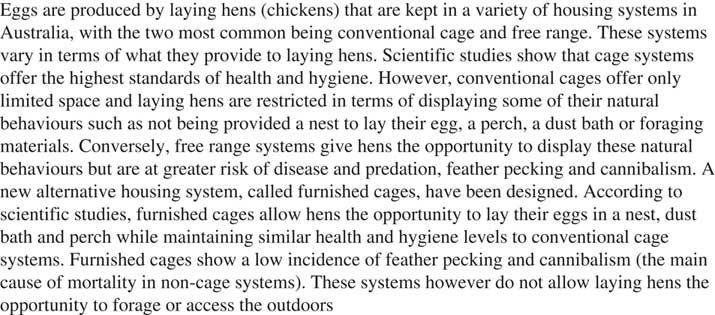
Participation in the online discussion was anonymous. All discussions were moderated by a researcher to ensure that participants followed a discussion plan to maintain consistency across the discussion groups (Table 1). The moderator did not actively engage in discussions but rather facilitated discussions in the following ways: the questions asked by the moderator were consistent and followed the discussion plan in Table 1; the moderator asked for clarification if a response was unclear; the moderator asked for additional information to expand on a participant’s response and summarised information presented by the group on a particular topic before moving on to the next. The discussion plan included the provision of a science-based information statement about furnished cages to ensure that all participants were fully informed about the nature of furnished cages (Figure 1). This statement was provided after participants were asked about their perceptions of furnished cages to determine whether the introduction of the statement impacted on their original beliefs. The statement aimed to be informative, accurate and written in everyday language. It was also reviewed and approved by several animal welfare researchers and industry members before inclusion. Upon conclusion of the forum discussion, participants were asked to complete the post-forum survey within 1 week. Up to two reminder emails were sent to those participants who had not returned the post-forum survey.
Forum discussion plan on the welfare of laying hens

Science-based information statement on the welfare of laying hens.

Asynchronous forums used the platform where participants could discuss issues at will and at any time, whereas in the synchronous discussions, participants discussed issues in a time-limited session. These two approaches were trialled in order to determine which forum method was the most useful in terms of engaging participants in discussions.
Asynchronous (Forums 1, 2 and 3)
∙ Forum opened for 14 days.
∙ Topics introduced periodically over 14 days.
∙ Timing of topic introduction was dependent on level of participation.
∙ Science-based information statement introduced between day 7 and day 11.
Synchronous ‘live chat’ (Forum 4)
∙ Instant messaging discussion group held for 1 h 30 min.
∙ Each topic, including the introduction, was allocated approximately 20 min.
∙ The science-based information statement was introduced approximately halfway through the discussion.
Data analyses
As a measure of participation in forum discussions, the number of posts, number of words and drop-out rates were measured and compared across forum groups. The number of responses to the moderator’s initiated topics and the number of responses to fellow participants were also recorded as a proportion of the total number of responses. Attitudes and knowledge towards laying hen welfare, farming and housing systems were analysed using descriptive statistics to permit observation of trends and patterns in responses. Non-parametric Wilcoxon signed rank statistical test was used to examine the differences between pre- and post-survey results, because of the small sample sizes and the fact that many of the measures were negatively skewed. The T-statistic is the test statistic for the Wilcoxon paired difference test (Siegel, Reference Siegel1956). The z-statistic is the equivalent standard normal deviate for sample sizes >10. The lead researcher analysed the transcripts of the forum discussions and identified recurring themes through an inductive content analysis (Elo and Kyngäs, Reference Elo and Kyngäs2008) using NVivo qualitative analysis software. NVivo provides a platform to categorise unstructured qualitative data, assisting in the identification of themes and patterns. These themes were then confirmed by a second researcher and discrepancies reconciled.
Results
Effects of forum type on engagement
Table 2 provides details about the number of posts, number of words and drop-out rates for the two different types of forums: asynchronous and synchronous (live chat). It also displayed the percentage of posts directed towards the moderator v. other participants. The asynchronous forums had fewer total number of posts compared with the synchronous forum but a greater number of total words. The synchronous forum had the highest drop-out rate with nearly half of participants dropping out before the live online chat began. Follow-up with these participants indicated that they had dropped out due to work or family commitments preventing them from logging in on the scheduled date and time.
Comparison of posts between different types of forums on the welfare of laying hens

*Number of participants does not include the moderator.
Despite the differences, given the small sample size, the results of the two forum types were combined to analyse the information collectively.
Quantitative analysis using pre- and post-survey results
Attitudes and knowledge towards laying hen welfare, farming and housing systems
Table 3 presents pre- and post-forum ratings and associated Wilcoxon signed rank test values for perceived knowledge, perceived importance of attributes to poultry welfare and perceived welfare of layer hens in different housing systems. Ratings for perceived knowledge were near the mid-point of three, suggesting that, as a group, participants perceived themselves to have a moderate level of knowledge on these topics. An increase in perceived knowledge was observed between pre- and post-forum for the Australian egg industry (T = 10.00, z = −2.18 (corrected for ties), N-ties = 21, P < 0.05).
Laying hen welfare descriptive results and Wilcoxon values for the 20 participants who completed both of the pre- and post-forum surveys (medians and interquartiles). Response options ranged from 1 (very low) to 5 (very high)

*The difference is significant at P < 0.05.
All importance ratings of attributes to poultry welfare were rated above the mid-point of three, suggesting that these attributes were perceived as important to very important. The most important attribute was protection from predators. The least important attribute was preventive medicine. No statistically significant differences were observed between pre- and post-forum.
Perceived welfare of laying hens differed by the type of housing system. Ratings for perceived welfare of laying hens living in free-range systems were above the mid-point of three, both in the pre- and post-forum surveys, and ratings for perceived welfare of laying hens living in conventional cages were well below the mid-point, both in the pre- and post-forum surveys, suggesting that the welfare of laying hens living in this system was perceived to be poor in comparison to laying hens living in free-range systems. Perceived welfare of laying hens living in furnished cages was just below the mid-point in pre-survey and increased to above mid-point in post-survey, with this change being statistically significant (T = 0.00, z = −2.23 (corrected for ties), N-ties = 6, P = 0.026). Of participants 10% selected ‘don’t know’ to this question and so were excluded from calculation for this item pre-survey. No participant in post-forum survey selected ‘don’t know’ for this item in the post-forum survey.
Objective knowledge of specific chicken industry practices
Table 3 also contains the questions used to objectively measure knowledge of specific poultry industry practices pre- and post-forum. Pre-survey definitions of free-range and beak trimming were answered correctly by 85% and 100% of participants, respectively. Conversely, only about half of the sample correctly identified the definitions of furnished cages or intensive meat chicken farming, or the reasons for antibiotic use. Since each item had four response options, with one option correct, the likelihood that participants would choose the correct response by chance was 25%. On comparing objective knowledge pre- and post-forum, there was a statistically significant difference in the number of participants who correctly identified furnished cages after participating in the forum discussion compared with their pre-forum responses (T = 0.00, z = −2.24 (corrected for ties), N-ties = 5, P = 0.025). None of the other differences were statistically significant.
Support for the introduction of furnished cages
Participants were asked whether or not they would support the introduction of furnished cages into Australia. Opinions were divided pre-forum, with 55% in support of the introduction and 25% opposed to the introduction; the remaining 20% chose ‘don’t know’. After the forum, participants were asked whether they would support the introduction of furnished cages, and 65% reported that they would, including two participants who had previously indicated that they did not know.
Qualitative analysis of forum discussions
Attitudes towards laying hen welfare
For the most part, participants across all forums appreciated the complexity surrounding laying hen welfare. Their first impressions of laying hen welfare were closely linked to the hens’ housing system.
I don’t think laying hens in general have universally good or bad welfare, and different aspects of welfare will vary from ‘better’ to ‘worse’ across different systems…I can’t really imagine a workable, profitable system that addresses all aspects of welfare perfectly…
Many participants reported that they believed that the welfare of free-range hens was better than the welfare of hens in conventional cages, but they expressed confusion over which free-range eggs to buy given that there are no clear standards as to what specifies free-range in Australia. Some participants stated that they do not believe an ideal housing system exists.
The RSPCA has developed the concept of Five Freedoms … I don’t know of any production system for layer hens (or other animals for that matter) that consistently meets all these ‘freedoms’.
Participants recognised that welfare is multidimensional. When discussing laying hen welfare, health and natural living were frequently noted as indicators of good welfare. Included in the notion of health were low incidence of disease, low rates of predation, climate control and balanced nutrition. Aspects associated with natural living included free roaming, dust bathing and experiencing the outdoors. Stocking density, access to resources and levels of fear were also mentioned in discussions of welfare. However, there did appear to be elements of mistrust towards egg farmers.
I think furnished cages are simply another way that egg producers use to try and get the public to believe that the eggs they buy come from ‘happy hens’.
Furnished cage support before information statement
Some participants reported in the forum discussions that they were not familiar with furnished cages and some participants in the asynchronous forum reported having looked up information on the internet about the housing system. The most recurring source of information cited being the Royal Society for the Prevention of Cruelty to Animals (RSPCA). When asked whether they would support the introduction of furnished cages as an alternative housing system in Australia, opinions were divided. Those that opposed furnished cages believed that laying hens should be free to range, that is to access an outdoor area, and any housing system that does not offer this feature should be rejected.
Those that supported the introduction of furnished cages in Australia typically believed that they were an improvement in hen welfare compared to conventional cages.
Furnished cages are an improvement on conventional cages, allowing birds to scratch, nest, perch and stretch, and are a progression towards meeting the RSPCA’s Five Freedoms.
Furnished cage support after information statement
After the information statement was presented to the participants, this new knowledge sometimes impacted attitudes toward furnished cages. After the statement, participants were asked, ‘in light of this information, would you support the introduction of furnished cages in Australia?’
The furnished cage system sounds like a reasonable compromise. I think we also need to be cognisant of the fact that not all families have the luxury of being able to choose free-range due to cost constraints, so furnished cages might offer improved welfare outcomes at a more competitive price to free-range.
Others were not satisfied with the amount of information provided in the statement, and needed more detail before making a decision.
Furnished cages sound fine in theory, but the devil is always in the detail. Do the hens get to see and hear other hens? I’m assuming that they are not housed in groups, but alone. Presumably there would be no need for de-beaking, but again, that’s not stated.
Some participants already knew enough about furnished cages to make up their minds before the introduction of the scientific statement; thus, the statement rarely changed their views. Other participants were satisfied with the amount of information provided in the statement, but this still did not change their views.
Furnished cages are still an intensive production facility. The same ‘standard farming practice’ principles still apply here: which is legalised cruelty.
Discussion
Through the use of online discussion and pre- and post-discussion surveys, these results suggest that attitudes towards furnished cages were divided and awareness of furnished cages was low. However, levels of knowledge, perceived welfare and support improved after participating in the online discussion, specifically in regards to furnished cages.
Attitudes towards the introduction of furnished cages for laying hens were divided before the online forum discussion and the introduction of the science-based statement. Knowledge of furnished cages was also low in comparison with other chicken husbandry practices pre-forum, such as free-range production and beak trimming, but similar to antibiotic use and intensive farming practices. After the online discussion, both attitudes towards furnished cages and objective knowledge of furnished cages improved.
Analysis of the qualitative data revealed that reasons for support for the introduction of furnished cages were because they represent a good compromise between productivity and animal welfare and that they are an improvement over conventional cages. Nonetheless, other participants opposed furnished cages due to the absence of outdoor access as provided in free-range systems.
These results suggest that there are members of the Australian public who would be supportive to the introduction of furnished cages as an alternative housing system if they were aware of what furnished cages entailed. Future research must, however, determine whether the opinions held by the participants in this study are representative of the Australian public by repeating this study on a larger and randomly selected sample.
Opposition by the public towards farming practices have been argued to be the result of misinformation which led some industry members to argue that the provision of information should, therefore, lead to increased levels of support. Hötzel et al. (Reference Hötzel, Cardoso, Roslindo and von Keyserlingk2017) found that the provision of information had only little effects on the public acceptability of zero-grazing or cow-calf separation in the dairy industry, whereas Ryan et al. (Reference Ryan, Fraser and Weary2015) found that the provision of information led to greater opposition towards sow stalls. However, our findings suggest that information can increase support for at least some farming practices, possibly when these practices are seen as having a positive impact compared to the current situation. Hence, one of the reasons for the discrepancy between these studies may be due to the way the information was framed in our study. The science-based statement on furnished cages framed this housing system as a welfare-friendly alternative to conventional cages and free-range systems. Thus, participants may have been primed to compare housing systems which led some participants to conclude that furnished cages were a favourable alternative.
Members of the public tend to rate ‘naturalness’ as an important consideration when forming opinions about farming practices (Miele et al., Reference Miele, Veissier, Evans and Botreau2011, Duijvesteijn et al., Reference Duijvesteijn, Benard, Reimert and Camerlink2014; Spooner et al., Reference Spooner, Schuppli and Fraser2014; Ryan et al., Reference Ryan, Fraser and Weary2015; Hötzel et al., Reference Hötzel, Cardoso, Roslindo and von Keyserlingk2017). In this study, however, participants may have been primed to widen their views of welfare because they were asked to complete a pre-survey, which included rating the importance of a number of factors in relation to welfare, including risk of predation, risk of aggression from other chickens, in addition to the opportunity to engage in natural behaviours. This widening view of animal welfare, in addition, to the science-based information statement, which included information on how furnished cages fulfil these criteria, may have also led to greater support for furnished cages. It would also be useful to measure the extent to which potentially priming participants in this way leads to different perceptions than what they would have without that prior information.
Previous qualitative research demonstrates that Australians rate the welfare of hens in different production systems differently (Australian Egg Corporation Limited, 2012). A total of 14 focus groups across all states and territories revealed that participants believed hens in free-range systems to be ‘healthy’, ‘happy’ and ‘not stressed’. Laying hens in conventional cage systems, on the other hand, were perceived to be ‘stressed’ and ‘unhappy’ (Australian Egg Corporation Limited, 2012). Cage production systems were perceived to be ‘inhumane’ and ‘cruel’. The current study had similar results, with participants rating the perceived welfare of laying hens in conventional cage systems as below that of laying hens living in free-range systems.
Mixed methods approaches like this study are becoming increasingly popular as a means of data collection because they have been argued by their proponents as a means of providing a more complete and richer perspective of complex social phenomena (Bergman, Reference Bergman2008; Östlund et al., Reference Östlund, Kidd, Wengström and Rowa-Dewar2011). In this study, qualitative information was used as a means of clarifying information gained from survey results and as a means of gaining an appreciation for how participants received, discussed and processed animal welfare relevant information. Further, this study shows that data collection using online surveys and forums are a low cost and effective way of investigating attitudes and knowledge towards animal welfare topics. They are also useful in determining whether engagement in discussions leads to changes in the levels of opposition and support for animal husbandry practices.
Despite these strengths, there are a number of limitations of this study which should be considered. First, the self-identification of participants as a member of the industry, animal welfare interest groups or general public remains subjective as determined by each participant. Second, this study had a small sample size, so a larger study replicating these findings is needed to determine whether the results are generalisable to the wider community. Third, ideally focus groups should be run until no new themes arise; however, because this was a small pilot study only four focus groups were run. Additionally, the synchronous group had different group dynamics from the asynchronous groups, and a high rate of attrition merits further investigation. Discussion in the synchronous group led to a greater number of posts than in the asynchronous group, despite fewer participants, suggesting more intense discussion.
In sum, based on the results of this study, the extent to which Australians would truly support furnished cages is still unclear. Providing information about furnished cages increased support among three out of the 20 participants, including two who did not know whether to support them, and one who was against them, before the forum discussion. The importance of this information statement, and the way its content and wording influence participants’ opinions, require further research. The current study used a small sample size, and caution should be taken in interpreting the results. However, if a study with a larger sample size using a similar methodology shows similar changes, then educating and engaging with the public about what furnished cages are, and possible other farming practices, and the research supporting animal welfare outcome could alter support levels within the community.
Acknowledgements
The authors are grateful to the participants of the study who lent their time to help us better understand perceptions of laying hen welfare and furnished cages. They would like to thank Dan Weary for his advice during the development stage of this project. The authors would also like to thank Sal Bordonaro from Inspired Group for developing and hosting the Animal Welfare Science Centre-Content Management System.
Declaration of interest
This project was partly funded by the Australian Department of Agriculture, Rural Industries Research and Development Corporation-Chicken Meat, Australian Egg Corporation Limited, Australian Livestock Export Corporation Limited (LiveCorp), Dairy Australia, Meat and Livestock Australia, and Australian Pork Limited. The authors declare no conflict of interest.
Ethics statement
This study was approved by the University of Melbourne Faculty of Veterinary and Agricultural Sciences Human Research Ethics Committee (approval no: 1545125.1).
Software and data repository resources
None of the data were deposited in an official repository.
Supplementary material
To view supplementary material for this article, please visit https://doi.org/10.1017/S1751731118003427