INTRODUCTION
Gilded wreaths are among the most interesting finds from the Greek world but have not formed the subject of many studies owing to their state of preservation, which is often poor: they are generally kept in store in museums.Footnote 1 For her DPhil thesis,Footnote 2 the author was able to study some 170 items which form a representative sample of items from mainland Greece including Macedonia, Southern Italy, the Eastern Aegean and Crete. Only excavated wreaths with information available about the context were studied. This article will first introduce some of these wreaths, grouping them into seven types on the basis of their design, which was closely linked to the materials used, referring to them through the catalogue numbers used in the thesis (Jeffreys Reference Jeffreys2019a) and the museum numbers. The types are numbered in broadly chronological order: fashion, religious beliefs, burial customs and economic conditions led to changes in design, but some types continued in use even after a new one had emerged. Wreaths with gilded copper and/or gilded clay elements are included in this categorisation but not gilded silver wreaths since there are very few of these, confined to Southern Italy. The possible uses of the wreaths are then discussed and the most likely region of origin of the various types is suggested, followed by a summary of the results of analytical study for examples of each type.Footnote 3 Some items similar to gilded wreaths are discussed to set the latter in context, and suggestions are made, finally, as to the most likely reasons why gilded wreaths were buried in graves. The Appendix contains a description of an example of each type, with dimensions of the components and information about other contents of the grave. All dates are BC and based on those proposed by the excavator unless otherwise stated. Museum numbers are given to aid identification, e.g. MTh 7573 (Archaeological Museum of Thessaloniki 7573), MArTA 40044 (Museo Archeologico Nazionale di Taranto 40044) and Rhodes AM M551 (Rhodes Archaeological Museum M551).
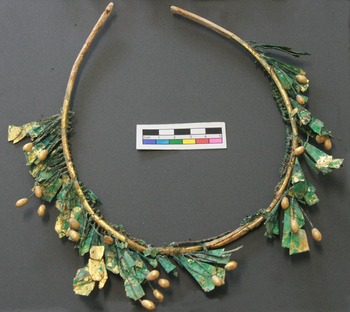
Typically, a gilded wreath was formed of one or two circlets with holes pierced to take stems on which were mounted berries, leaves and sometimes flowers (Fig. 1). The berries and leaves were gilded, and often the bone circlets and part of the flowers; however, the wooden and lead circlets were not gilded, nor were some large white rosettes. Similar items worn on the head include diadems, tiaras and strips known as tainiai, but unlike wreaths these do not mimic plants. The plants were represented accurately on gilded wreaths in the fourth century, and more schematically in the third and second. Myrtle is commonly seen, although oak and ivy are also found and occasionally olive. Myrtle leaves are wider at the end closer to the stem, whereas olive are wider at the opposite end (Despini Reference Despini1996, 26). The state of preservation of some of the wreaths is so poor that it is not always possible to tell which of the two is intended, although assistance can be obtained from looking at other elements such as flowers and berries and comparing them with elements on gold wreaths, which are better preserved. The berries on the Macedonian wreaths with leaves corresponding to Despini's description of myrtle are oval and have a small cross, similar to real myrtle berries and those on gold wreaths, which have flowers clearly identifiable as myrtle.Footnote 4 Ivy wreaths have heart-shaped leaves, and the earliest have berries in the shape of flattened spheres; those from later periods are generally spherical and are found with rosettes resembling groups of ivy flowers or berries. Oak leaves are also easy to identify, and are found in the graves of military leaders in Macedonia, though apparently with members of both sexes in Epirus (Dakaris Reference Dakaris1963, 190; Jeffreys Reference Jeffreys2019a, cat. no. SCG11). Laurel leaves are larger than olive or myrtle, and fairly symmetrical, and are rarely found on wreaths, with the exception of two gilded silver wreaths from Southern Italy (Masiello Reference Masiello1984, 88; Jeffreys Reference Jeffreys2019a, cat. nos SI 15 and SI 23).
Type 2 wreath from Ainiea Grave III, MTh 7570. © Archaeological Museum of Thessaloniki, Hellenic Ministry of Culture and Sports – Hellenic Organization of Cultural Resources Development. Photo by the author.

Macedonian wreaths for the most part represent a single plant, whereas those from Southern Italy generally have several, although ivy is nearly always present. It is not always possible to tell whether more than one plant is represented on wreaths from Central and Southern Greece composed mainly of gilded clay flowers and berries since these are more schematic and the design of the flowers on the same wreath can be different. The spherical items found on these wreaths are most likely intended to represent myrtle berries, but they could represent flower buds of the same plant, which are spherical on real plants.
TYPES AND DEVELOPMENTS IN DESIGN
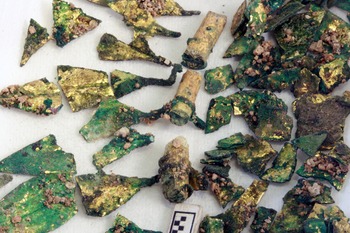
Type 1 had a single circlet made of bone which is round in cross-section, of which three specimens believed to date to the first quarter of the fourth century have been found in Macedonia (Aiani, Olynthos and Thasos).Footnote 5 Four further examples of this type, thought to date a little later, have been found in Rhodes (Appendix, item 1 and Figs 2 and 3).Footnote 6 There does not appear to have been a separate wooden circlet on any of the wreaths in this first group, which had gilded copper leaves, berries and bone circlet and in two instances small flowers (Jeffreys Reference Jeffreys2019a cat. nos M27 [Olynthos] and SEA20 [Rhodes]; Appendix, item 1). The stems are wrapped around the circlet and the ends buried in it.
Elements of Type 1 wreath from Rhodes AM M1382. © Ephorate of Dodekanese, Hellenic Ministry of Culture and Sports. Photo by the author.

Elements of Type 1 wreath from Rhodes AM M1382. © Ephorate of Dodekanese, Hellenic Ministry of Culture and Sports. Photo by the author.

In the second quarter of the fourth century, a slightly different type of wreath emerged in Macedonia, Type 2, which had two circlets, one made of two tapered rib bones held together with linen thread, and a second of wood, used to give the whole structure extra stability. A single hole can sometimes be seen at each extremity to carry a string to tie at the back. A well-preserved example from Aineia is described in the Appendix, item 2 (Fig. 1). These wreaths had many gilded copper leaves and clay berries, each mounted on a separate stem. At least 54 examples of this type can be identified, including 36 from Macedonia. The earliest known are from Phoinikas, Vergina Stenomakri Toumba and Mieza.Footnote 7 Like those of Type 1, they were clearly luxury items since the stems and bone circlet were gilded as well as the leaves and berries, and were found in graves of the elite, including at Aineia and Derveni.Footnote 8 Fragments of Type 2 wreaths have also been found in other parts of Greece, including Epirus (Ambrakia and Michalitsi), the Peloponnese (Isthmia and Sikyon) and Rhodes, dating to the third quarter of the fourth century or later.Footnote 9 They were mainly in places where there was a Macedonian garrison or other strong Macedonian connection, and appear to have been used in the graves of people who had adopted their customs, as can be seen by other burial goods and funeral practices. An example is the wreath fragments found in the Western Foundation at Isthmia with a sword which had been ritually ‘killed’, as well as other weapons (Jackson Reference Jackson2015, 139 and 150), and further Macedonian elements, such as glass ‘eyes’ that would have been used on a kline.Footnote 10 Wreaths of this type have also been found in Taranto,Footnote 11 which had trade and other links with Macedonia.
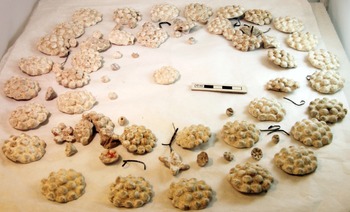
The introduction of heavier elements, such as large rosettes, representing ivy flowers or berries, and of ivy berries often in bound groups, required a circlet of lead to be used, as well as another of bone or wood, on wreaths called here Type 3. The wreath from Potidaia, which has grapes, insects and other elements, is an early example of this type, dating to the late fourth century (Fig. 4) (Sismanidis Reference Sismanidis1997, 28 and Jeffreys Reference Jeffreys2019a, cat. no. M37). Ivy wreaths are sometimes found in Rhodes. A slightly different kind, with large rosettes and lead circlets, was common in Southern Italy in the third and second centuries and is called here Type 3 local variation (an example is described in the Appendix, item 3) (Fig. 5). Gilding is not always visible on the rosettes and may not have been originally present but can still be seen on some of the leaves and flowers.Footnote 12
Type 3 wreath from Potidaia, MTh 9749. © Archaeological Museum of Thessaloniki, Hellenic Ministry of Culture and Sports – Hellenic Organization of Cultural Resources Development. Photo by the author.

Type 3 local variation wreath: flowers, rosettes and grapes from MArTA 50710, by concession of the National Archaeological Museum of Taranto. Photo by the author.

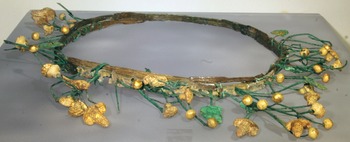
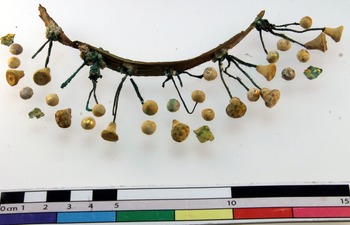
Gilded wreaths seem to have appeared in Boeotia and the Peloponnese a little later than in Macedonia, in the second quarter of the fourth century, but are different from the Macedonian wreaths, being less naturalistic and less lavish. These, denoted here as Type 4, had bell-shaped flowers, spherical berries, copper stems, few leaves and generally a lead, or occasionally wooden, circlet (a relatively well-preserved example from Demetrias is described in the Appendix, item 4, and shown in Fig. 6). An early example, which may be a prototype since the flowers and berries appear to have been formed by hand rather than a mould, was excavated at Akraiphia in Boeotia, and an approximately contemporary wreath was excavated at Elis in the Peloponnese. Both can be dated to the second quarter of the fourth century on the basis of local pottery found in the graves (Akraiphia: Sabetai Reference Sabetai2012, 308 and Jeffreys Reference Jeffreys2019a, cat. no. SCG1; Elis: Arapogianni Reference Arapogianni2000, 193–5). The bell-shaped flowers on wreaths of this type, and probably also the spherical berries, were formed by moulding, giving a uniform, pleasing appearance. Examples are widespread, including several from Thessaly and Crete, but none to date from Athens, and only one or two from Macedonia. They mainly date to the third century or later.
Type 4 wreath: BE18043 and 18060, Volos AM. © Hellenic Ministry of Culture and Sports/Ephorate of Magnesia. Photo by the author.

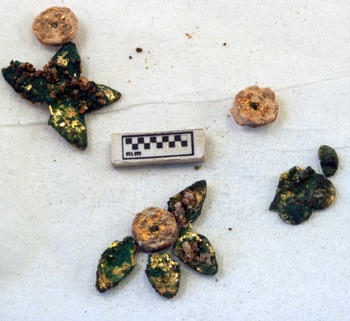
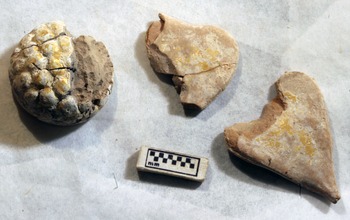
Some examples of a fifth type have been found at Tanagra in Boeotia, which differ from all the preceding types in that there do not appear to have been any copper leaves but instead moulded leaves and rosettes made of clay with gilding above a white ground (Appendix, item 5; Fig. 7) (Andreiomenou Reference Andreiomenou2007, 252–3). The circlets have not survived. All date to the late third century.
Elements of Type 5 wreath: broken clay rosette and fragments of two ivy leaves from 26067, Archaeological Museum of Thebes. © Hellenic Ministry of Culture and Sports. Photo by the author.

Wreaths with moulded elements would have been quicker to make than those on which all the elements were made by hand. They are occasionally found on wreaths of Type 2 as well as 4, as at Aineia III, where the berries are in only two sizes, indicating that a mould was used (Appendix, item 2). Wreaths with mainly clay elements were most popular in places where funerary traditions dictated a simpler style than is found in Macedonia and may spring from a tradition where working with clay, in the form of figurines and other clay objects, was common. The relative cheapness of forming elements in clay cannot have been a determining factor in selecting materials to use since wreaths are found in graves of the wealthy with expensive grave goods. The aesthetic appeal of using elements of the same size should not be underestimated, but the determining factor may have been the quantity of wreaths needed, leading the wreath-maker, faced with the task of making many wreaths (six identical ones were found in the same grave at Aineia III), to decide to mould the berries.
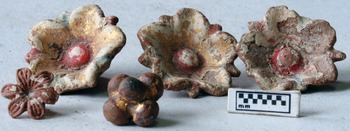
A sixth type of wreath was composed of flowers supported by a circlet, some with leaves like Nikisiani A (Appendix, item 6; Fig. 8), and others composed only of flowers, such as one in Pella (Karamanoli-Siganidou Reference Karamanoli-Siganidou1984, 261 and Jeffreys Reference Jeffreys2019a cat. no. T2X64). Many flowers were painted in bright colours, some with a gold centre, and others were white with gilding. A few wreaths consisting mainly of flowers have also been found in southern Italy.Footnote 13 At least 10 wreaths of this type have been found in Macedonia and one in the Peloponnese, but they were no doubt also used elsewhere, judging by the large number of figurines representing women wearing a wreath or diadem with flowers.Footnote 14 Wreaths of this type seem to have first appeared in late fourth or early third centuryFootnote 15 and represent different plants, which are difficult to identify, but some may be myrtle, others roses or lilies, all of which are known to have been used on natural wreaths (Theophrastus in Athenaeus, Learned Banqueters 15.680e–f) although others appear to be generic rather than a specific plant. They are generally painted red or pink, white and blue; myrtle flowers in nature are white with a pink tint to the buds.
Type 6: flowers from Nikisiani A, Δ368. The large flowers may be myrtle; the smaller ones are probably generic. © Hellenic Ministry of Culture and Sports/Ephorate of Kavala and Thasos. Photo by the author.

The final type, 7 (not illustrated) consists of a few gilded wreaths unsuitable for use directly on a human head as they are inflexible and in many cases too large. Some, such as a wreath from Prodromi in Epirus, could have been used on a hydria or a helmet, and others which have a large metal circlet may have been placed on a statute, such as those found on the Pergamon Acropolis (Appendix, item 7) (Prodromi: Choremis Reference Choremis1980, 6 [who suggests its use may have been on a hydria], Jeffreys Reference Jeffreys2019a, cat. no. SCG13; Pergamon: Grussinger, Kästner and Scholl Reference Grussinger, Kästner and Scholl2011, 496, Jeffreys Reference Jeffreys2019a, cat. nos P1 [Appendix, item 7] and P2).
HOW WERE GILDED WREATHS USED?
That some wreaths were worn on the head even if only in death is clear from their position in the grave, since some have been found on or close to the skull, as for example at Olynthos, in a girl's inhumation in grave Δ at Nikisiani (Lazaridis, Romiopoulou and Touratsoglou Reference Lazaridis, Romiopoulou and Touratsoglou1992, 18), and at Patras.Footnote 16 This raises the question of whether gilded wreaths were intended for wear by the living. There is no overwhelming reason why not, although they were fragile and unsuitable for daily use with the possible exception of types 5 and 3 local variation if used as roll wreaths. Study of the items themselves does not settle the question of whether they were worn by the living since the state of preservation is too poor, but it is fair to say that they bear more resemblance to the type of gold wreaths thought by Dagi to have been solely for funerary use, particularly since the copper leaves were thin, about 0.5 mm thick.Footnote 17 On the other hand, the wooden circlet used on many gilded wreaths would have provided protection from the sharp ends of the stems, and this circlet itself was also sometimes covered with fabric, which would have provided further cushioning, permitting wear by the living.Footnote 18 The wrapping of the stems around the circlets on Type 1 would also have allowed these to be worn. On balance, however, it does seem that the main use is most likely to have been funerary.Footnote 19
The elements of some of the wreaths of Type 3 and all of those of Type 5 are so large and heavy that it is difficult to envisage how a wreath of this kind could be kept on the head without structural support. The author proposes that Type 5 wreaths, and possibly some of those of Type 3, particularly the local variation, may have been worn as roll wreaths, also known as ‘thick’ wreaths (Wulstkränze). A representation of a wreath on a figurine appears to be imitating one made of padded fabric (Fig. 9). It has oversized ivy leaves and berries, suggesting that it represents a man-made wreath, although the large size could of course be due to the limitations of making an object in clay. Could it depict a roll wreath with clay leaves and berries, and if so, might wreaths of Type 5 have looked like this? Although no circlets of Type 5 wreaths have survived, lead is the most likely material for them, given the weight of the elements. Several wreaths of Type 3 still have remains of lead circlets, formed from narrow strips of lead, which was never gilded, so was not intended to be seen. Such a circlet could have provided a counterbalance to the clay elements or large rosettes and been placed inside the roll with the stems passing through the padding (attached to the circlet at one end and the leaf or berry at the other). An alternative possibility is that a wickerwork framework was used to support the leaves and stems.
Type 5 wreath? Figurine known as the Alexandrian Lady (Π 6071) wearing a roll wreath with large ivy leaves and berries. From Andreadaki-Vlazaki Reference Andreadaki-Vlazaki2009, 135. © Ephorate of Antiquities of Chania, Hellenic Ministry of Culture and Sport.

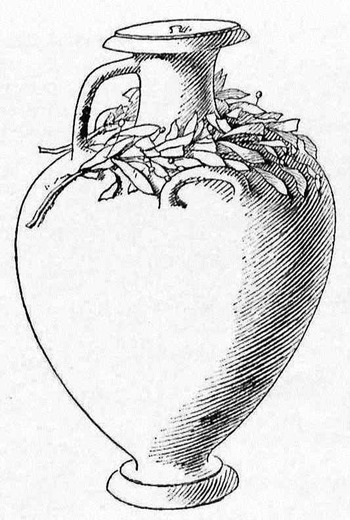
The position in which one of the Type 4 wreaths from the Archaeological Museum of Rhodes, M1378 (Jeffreys Reference Jeffreys2019a, cat. no. SEA16), was found, around the neck of a hydria containing the cremated bones, suggests that some of the wreaths of this type may have been used in a different way. The lead circlet on this wreath is a little large to have been worn around the head (it is oval, 19 x 23 cm), and does not have holes pierced at the extremities. It seems likely that it was originally designed to go around the neck of the hydria, in the same way as wreaths found at Sciatbi (Alexandria) which had the ends of the lead circlet trailing (Fig. 10). Some vases decorated with gilded wreaths painted around the neckFootnote 20 may have contained cremation ashes, and similarly a black-figure amphora showing a warrior wearing a helmet decorated with a wreath is suggested by Karouzou to have been used as a funerary urn for a warrior (NAM 558, CVA Athens 2, III Hg, 10).
Funerary hydria from Sciatbi (16152), with wreath (note long pieces at end of circlet). From Breccia Reference Breccia1915, 21, fig. 1.

Some gilded wreaths may have been used in other ways – four were found, for example, at Sedes, grave Γ, one on each corner of the kline (Kotzias Reference Kotzias1937, 885), and it is possible that they were also hung on the walls of the tomb and perhaps the home.Footnote 21 Epigraphic sources mention wreaths being hung on the walls of sanctuaries or altars but very few of these refer to gilded, as opposed to gold or silver, material.Footnote 22 The priests’ accounts of the treasures in the sanctuaries in Delos, from 279 BC, list gold wreaths with items of jewellery, and specify the number and weight of those dedicated in the three sanctuaries, but only one is described as gilded.Footnote 23 The inventories of the treasuries of the Acropolis in Athens list gold and silver wreaths, and many with no description of the metal, but none is described as ‘gilded’ (D. Harris Reference Harris1995, 104 [Parthenon], 179–201 [Hekatomedon], 215 [Erechtheion]). This terminology is persuasive if not determinative, but a further point is that only a small amount of gilded material appears in archaeological reports as being from sanctuariesFootnote 24 and of that very little could have been part of a wreath, such as some leaves from Corfu, discussed below in the section on leaves. One reason why so little gilded material is found in sanctuaries may be that it would have been less attractive as an offering, as the thin gold leaf would have been difficult to remove and melt down, so it was probably not regarded as a form of treasure or may not have been thought appropriate as an offering to the gods. Metal wreaths were sometimes used on statues, as will be discussed below in the section on significance.
ORIGINS OF TYPES 1–6
Sadly, there is no evidence of any wreath workshops surviving which, amongst other things, would have given some indication of whether wreaths were made in the vicinity of where they were found. Nevertheless, some suggestions can be made as to the probable origin of the various types on the basis of where the earliest wreaths of each type known to date were found. There are several important caveats to this. First, that new material is constantly coming to light, and earlier examples may yet be found. Second, dating is sometimes problematic. And third, material does not always survive even after excavation: there are for example references to ‘gilded bronze’ fragments being excavated in Taranto which are not thought to be still in existence (D'Amicis Reference D'Amicis1990, 304–6). Without seeing this material it is impossible to know whether it really is an example of a gilded wreath. On the basis of the surviving material, however, it seems that the earliest gilded wreaths are those found in Macedonia of Type 1 (Aiani, Thasos and Olynthos), dating to the first quarter of the fourth century. Wreaths of Type 2 (including those from the Phoinikas cist graves, Vergina Stenomakri Toumba and Mieza) seem to have first appeared in Macedonia in the second quarter of the fourth century, before the conquests of Alexander the Great, and are found there in considerable numbers. Macedonia would therefore seem to be the most likely point of origin for both Type 1 and Type 2. Type 3 could also have originated in Macedonia, where several early examples have been found,Footnote 25 but it appears to have developed in Rhodes and Southern Italy where it became prominent in the third century. It seems likely that Type 4 originated in either Boeotia or the Peloponnese, since many examples have been found there, the earliest known to the author dating to second quarter of the fourth century. The only provenanced examples of gilded clay leaves (Type 5) are from Tanagra, which may be their point of origin, but there are other possibilities, including Asia Minor since roll wreaths – if this is what they were – were used all over the Greek world, judging by the many figurines showing such wreaths. It is also difficult to say where Type 6 wreaths originated; Macedonia is perhaps most likely, since several early examples of this type have been found there (including one from the Macedonian Tomb at Phoinikas; see Footnote note 15), but there are also some in the Peloponnese, and such wreaths became common at Sciatbi and in Thrace from the beginning of the third century (Tsigarida Reference Tsigarida1988, vol. 1, 128). Type 7 has wreaths from different periods, from the third quarter of the fourth century onwards.
ANALYTICAL WORK
The author analysed a representative sample from the four regions studied for the thesis (Macedonia, Central and Southern Greece, South Eastern Aegean, and Southern Italy), in order to determine which materials were used and whether they differed between the regions, and if possible to attempt to establish a provenance of the wreaths from the materials. The last was unsuccessful, partly because no sampling could be done and also because of the limitations of the analytical techniques used. Nevertheless, some interesting results were obtained.
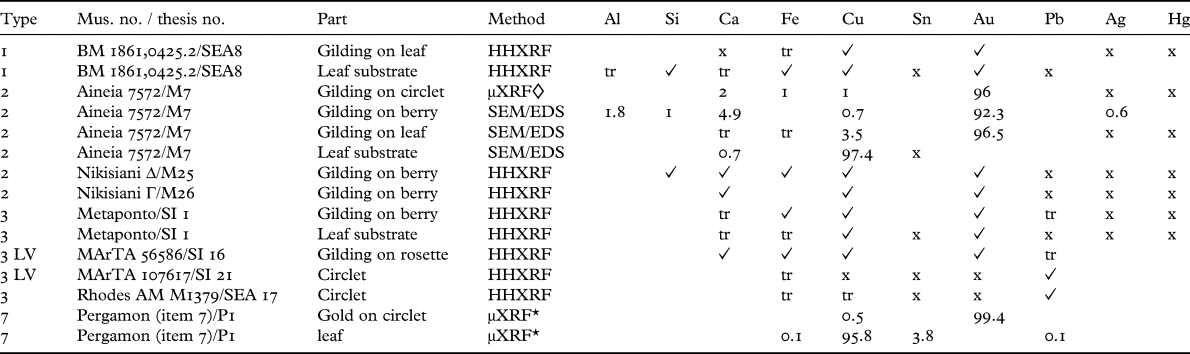
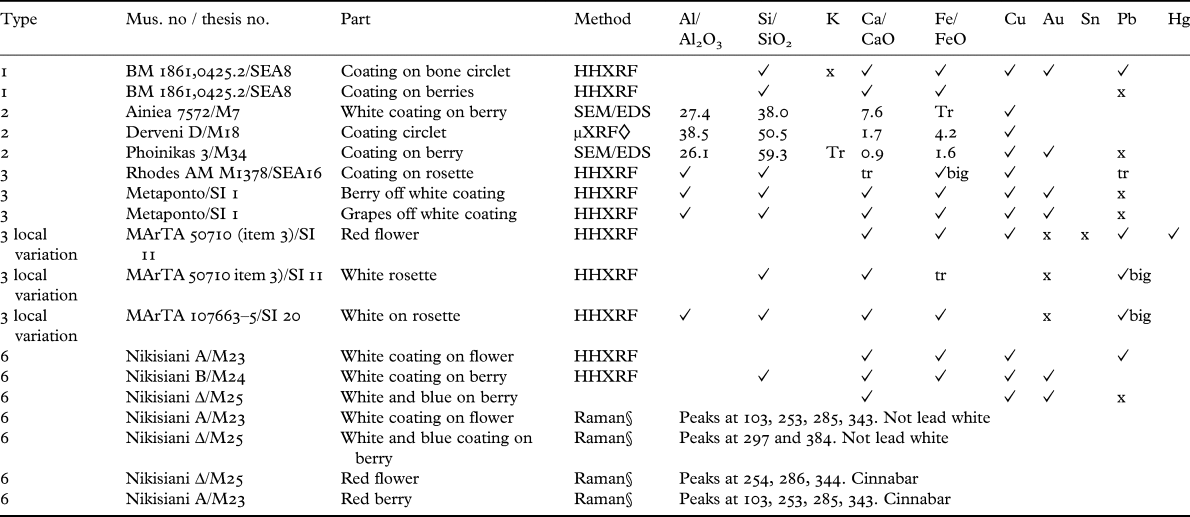
It was a requirement that the analytical work should be non-destructive, as it was on this basis that the museums agreed to it. The techniques which met this requirement were, first, Hand-held X-ray Fluorescence (HHXRF), which can be taken to the object and was used in all regions. Other techniques used when possible were a benchtop micro-XRF (μXRF), a Scanning Electron Microscope with Energy Dispersive Spectrometry (SEM/EDS) and a Raman Spectrometer. Small objects such as a detached leaf or a berry could be analysed by being placed in the beam of the laser or the chamber of the SEM and returned unharmed. A small selection of the results is set out in Tables 1 and 2, and results obtained from further objects are in chapter 6 of the thesis (Jeffreys Reference Jeffreys2019a). Unless otherwise stated, HHXRF and SEM/EDS analysis were done by the author. One limitation of using HHXRF with this kind of material is that the beam covers an area up to 7 mm in diameter, so analysis cannot be limited to a small area, whereas μXRF and SEM/EDS can be focused much more narrowly. A further limitation affecting these techniques is that the uneven surface of the material and its porosity mean that no reliable quantitative analysis could have been done even if permission had been obtained to sample. SEM/EDS and μXRF do show reliably the proportions of the various elements, but the HHXRF results are best used to detect whether a particular element such as mercury was present. The proportions of the elements present found with SEM/EDS and μXRF are given in weight percent and normalised in the tables, but it must be emphasised that these results are only semi-quantitative.
Results of metals analysis on selected wreaths. The results of the analysis using μXRF and SEM/EDS are given in weight percent but are semi-quantitative, with the proportions calculated by averaging several iterations.

◊ Analysis by chemists at Archaeological Museum of Thessaloniki
* Analysed by the Rathgen Laboratory
Results of pigments analysis on selected wreaths. The results of the analysis using μXRF and SEM/EDS are given in weight percent but are semi-quantitative, with the proportions calculated by averaging several iterations.

§ Analysis by Dr Dimitrios Lambakis, Higher Ecclesiastical Academy, Thessaloniki
◊ Analysis by chemists at Archaeology Museum of Thessaloniki
The results of the metals analysis show homogeneity across all the regions. The gold leaf was found to be technically pure, with around 96 per cent gold (Table 1; Jeffreys Reference Jeffreys2019a, table 6:3). It was of such constantly high purity as to suggest that the silver was deliberately removed, for which techniques had existed since at least the sixth century BC (Ramage and Craddock Reference Ramage and Craddock1999, 95). The results are consistent with those obtained by other researchers, including Asderaki (Asderaki-Tzoumerkioti Reference Asderaki-Tzoumerkioti2001, 28), using SEM/EDS in relation to gilded wreaths at Demetrias, and Katsifas and Ignatiadou (Reference Katsifas and Ignatiadou2017) using μXRF on gold wreaths from Derveni and Sedes, all of whom also found gold of very high purity. The gold leaf on the wreaths was measured by the author to be around 1 micron thick. Although it is not essential for the purposes of making fine gold leaf to have such pure gold, it would have been far easier to work. No platinum inclusions could be seen with the naked eye or a microscope, and no evidence of them was detected on SEM/EDS analysis.
On all wreaths except a very late Type 7 wreath from Pergamon (Appendix, item 7) the metal used to make the leaves and stems was found on analysis to be almost pure copper, not alloyed with lead or tin, and so not bronze (Table 1; Jeffreys Reference Jeffreys2019a, table 6:4). These results are consistent with the findings by other researchers: Asderaki and Rehren (Reference Asderaki, Rehren, Facorellis, Zacharias and Polikreti2008, 508–10), using a microprobe, found that the leaves and stems on the wreaths they studied from Demetrias were made of copper with copper sulphide inclusions, and only the merest trace of tin; and Asderaki (Asderaki-Tzoumerkioti Reference Asderaki-Tzoumerkioti2001, 27–32) working with SEM/EDS also found pure copper on further wreaths from the same site. The British Museum scientists similarly found that a leaf from Rhodes was made of copper without any significant amounts of alloying elements (Oddy, Padley and Meeks Reference Oddy, Padley and Meeks1979, 235; see also Table 1: BM 1861,0425.2). It may be asked whether the material was originally bronze and following a process of surface enrichment the tin migrated to the surface and leached into the surrounding environment. However, in the author's view this is most unlikely: any tin that had leached out, had it been present originally, would have remained on the surface of the metal because tin oxide is very insoluble (Meeks Reference Meeks, La Niece and Craddock1993, 265), and yet no tin was found on analysis. Copper was no doubt used because it is easier to work, for example to cut into leaf shapes (Jeffreys Reference Jeffreys2019b, 503) and to work into wire for the stems supporting the berries. The metal used on the circlets of types 3 and 4 was confirmed as lead by the analysis.
Even if sampling and more sophisticated analytical methods had been available to look for trace elements in the gold, it might still not have been possible to pin down a source for it since it is commonly melted down and reused, although it is possible that the gold on the early wreaths, when alluvial gold was available in Macedonia and was also being mined in Western Thrace, had its first use on those items. The results of provenance studies by other scholars on gold material in Macedonia are awaited with interest. For the moment, the most that can be said is that it would be consistent with the results obtained by the author for the gold used on the wreaths to have been from Macedonia/Thrace.
The coating used between the gold leaf and the base of copper or clay was difficult to analyse, but on all the items studied it was found to be made of a white clay, in some cases almost certainly kaolinite, with nearly equal and fairly high proportions of aluminium and silicon (cat. nos M18, M34), and in others more likely to be a marl (calcareous clay) judging by the presence of calcium (Table 2; Jeffreys Reference Jeffreys2019a, table 6:6). Asderaki (Asderaki-Tzoumerkioti Reference Asderaki-Tzoumerkioti2001, 28–9) using SEM/EDS also found kaolinite in the coatings on berries from two graves at Demetrias and on two leaves, but found a calcareous clay on a wreath from a different grave. Oddy, Padley and Meeks (Reference Oddy, Padley and Meeks1979, 237) referred to the coating on the leaf from Kamiros as ‘kaolin’. This clay makes an excellent base for gilding because of its lamellar crystalline structure, and it can be mixed with chalk to ease application (Perrault Reference Perrault1992, 153). It is very likely to be the material called melinum – ‘Melian earth’ – described by Pliny (NH 35.19). Photos-Jones and Hall (Reference Photos-Jones and Hall2011, 83) suggest that Melian earth included silica and alunite, which contains potassium, aluminium and sulphate, as well as kaolin, which produced excellent results in terms of covering power and whiteness because of the high kaolin content. With the techniques used there is no way of knowing whether the white coating used on the wreaths studied from Macedonia was from Milos, but it would be consistent with the author's findings, which show a high proportion of silica. On the South Italian wreaths, the white coating on rosettes was found to contain lead, almost certainly lead white,Footnote 26 whereas Raman results did not show this pigment on the Macedonian wreaths. It seems therefore that the wreaths found in Taras of Type 3 local variation were not imported from Macedonia. The red used on the flowers from Italy and Macedonia was found to be the expensive pigment cinnabar, using HHXRF and Raman (Table 2; Jeffreys Reference Jeffreys2019a, table 6:7). The coating on some of the berries seems to have been coloured with ochre, judging by the iron found in some of the analyses (e.g. Aineia: MTh 7572, Jeffreys Reference Jeffreys2019a, cat. no. M7). All these pigments could have been obtained from Macedonia or Thrace, but would have been easily traded.
Gilded wreaths were objects which would not have travelled easily, and in the author's view it is likely that all of them were made close to the graves where they were found, using local materials where these were appropriate. Local manufacture is confirmed by the many variations in details of the wreaths, even of the same type. The wreath from Thasos (cat. no. 40) and that from Olynthos (cat. no. M27), for example, have sufficient distinguishing features to indicate that they were made by different hands, even though they are approximately contemporary and made of the same materials: the Olynthos wreath had many flowers and leaves; the Thasos item had large berries and no flowers. The basic information as to how such wreaths were made (on the introduction, for example, of the new Type 2) could easily have been transferred by word of mouth.
GILDING TECHNIQUE
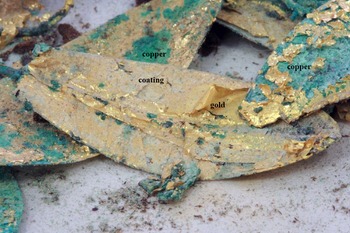
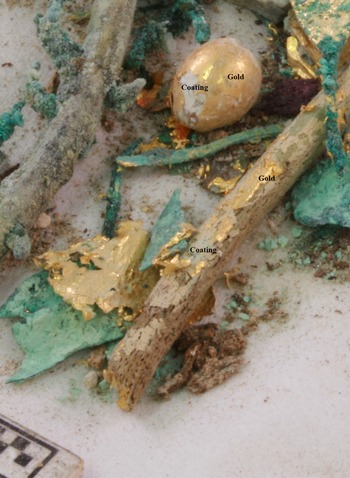
Giumlia-Mair (Reference Giumlia-Mair2020, 4) outlined the main methods of gilding in Antiquity, which include using a layer of what she terms ‘gesso’ beneath the gold. The method of gilding found on all types of wreaths studied, though not all the wreaths, involved applying a thin layer of gold leaf (which is thinner than gold foil) above a layer of coating (the term ‘gesso’ is not used here since the layer was often not a true gesso, which is hydrated calcium sulphate). This coating was applied to the copper leaves and sometimes the stems, and to the elements made of clay such as berries, and occasionally to the bone circlets, and then the gold was laid (Figs 11, 12 and 13). The coating was off-white or sometimes coloured yellow, probably to cover up any gaps in the gilding. The lead and wooden circlets were never gilded.
Detail of coating on leaves, berry and circlet, all from Phoinikas cist grave 5,3. © Archaeological Museum of Thessaloniki, Hellenic Ministry of Culture and Sports Sports – Hellenic Organization of Cultural Resources Development. Photo by the author.

Detail of coating on leaves, berry and circlet, all from Phoinikas cist grave 5,3. © Archaeological Museum of Thessaloniki, Hellenic Ministry of Culture and Sports Sports – Hellenic Organization of Cultural Resources Development. Photo by the author.

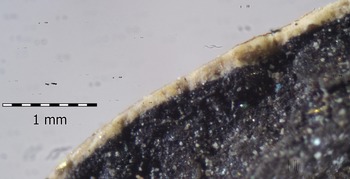
Berry from Phoinikas grave 3 showing clay fabric, coating and thin layer of gold. © Archaeological Museum of Thessaloniki, Hellenic Ministry of Culture and Sports. Photo taken with microscope by the author.

The use of a coating below the gold on metal came as a surprise to Oddy, Padley and Meeks (Reference Oddy, Padley and Meeks1979, 237) when they studied a leaf on a wreath from Kamiros. Asderaki and Rehren (Reference Asderaki, Rehren, Facorellis, Zacharias and Polikreti2008, 510–11) also found a coating beneath the gold in the majority of the examples they studied, but on some the gold was applied directly to the copper with an adhesive. The author also found a few cases where no coating was visible but was not able to do analytical work on these to determine whether a coating was present. It is easy to confuse a coating with soil debris, particularly on corroded copper, but is clearly visible on the berry in the microscope photo in Fig. 13.
Pliny describes how gold was applied to materials that could not be heated, like wood (NH 33.20, trans. H. Rackham): ‘On marble and other materials incapable of being raised to a white heat gold is laid with white of egg; on wood it is laid with glue according to a formula; it is called leucophorum.’ He later refers to coloured ochres being mixed with melinum (Melian earth) to make a coating for gilding (leucophorum) (NH 35.17).
The method described by Pliny was found to work well in experimental work, when the author painted a slurry made of either kaolinite and water or calcite and water on copper, mixing in dry pigments (ochre or hematite) on one or two occasions. She cut leaves from sheet copper 0.5 mm thick with scissors, but a small knife or chisel could have been used. She did not roughen the surface of the metal but added an adhesive made of egg white to get the coating to adhere to the metal, and applied a further layer of adhesive once the coating was dry below the gold leaf. The work required dexterity and patience but was not difficult for someone accustomed to gilding on other surfaces, and satisfactory results were obtained. She found it to be a simple and effective method of obtaining a smooth surface to which the gold adhered securely. She estimates that a typical wreath with copper leaves and berries could have been made by one person in about a week, providing the metals and wires (for the stems) were obtained ready to use.Footnote 27
Another method of gilding referred to by Giumlia-Mair (Reference Giumlia-Mair2020, 5) as used in Antiquity is mercury gilding, though in the author's view it is unclear whether it was used in the Eastern Mediterranean during the period under study.Footnote 28 No evidence of mercury was found when berries, a circlet and leaves were analysed (see Table 1), whereas some trace would have remained had mercury been used (Northover and Anheuser Reference Northover, Anheuser and Drayman-Weisser2000, 114). Mercury gilding also appears to be thicker than the gold leaf used on the wreaths, at 2–10 μm. Silver was gilded in Antiquity by a different method, using heat, known as diffusion bonding, but this is unsuitable for use with copper, which does not form a strong enough bond with the gold (Anheuser Reference Anheuser1997, 58).
The technique with a clay coating had been used in Egypt to apply gold leaf on various materials, including copper, at least as far back as the thirteenth century BC,Footnote 29 transposed from use on wood (Hatchfield and Newman Reference Hatchfield, Newman and Bigelow1991, 39; McArthur, Taylor and Craddock Reference McArthur, Taylor and Craddock2015, 113), but it is not clear when it was first applied on metal in Greece. In Attica potters had applied gold leaf above a clay ground to details on vases from at least as early as the second quarter of the fifth century,Footnote 30 so it is possible that the idea was transferred from potter to wreath craftsman. There is clear evidence of cultural influence from Athens in Macedonia in the early fourth century in several fields (see, e.g., Kyriakou Reference Kyriakou2008, 189; Hatzopoulos Reference Hatzopoulos, Chryssanthaki-Nagle, Descamps-Lequime and Guimier-Sorbets2016, 20–2). Vessels plated with tin to resemble silver were imported to Macedonia from Attica,Footnote 31 but in the case of the gilded wreaths, it seems probable that the technique would have been passed on by word of mouth or by relocation of craftsmen from Athens to Macedonia rather than export of actual wreaths, given the fragility of the material and the many variations in design, even among those of the same type.
POSSIBLE PREDECESSORS TO GILDED WREATHS
There are at least three groups of material bearing many similarities to gilded wreaths, which help to set them in context: gold and gilded silver wreaths and diadems, gilded terracotta material and finally leaves, which will be discussed in turn.
Gold and gilded silver wreaths and diadems
Gold wreaths seem to have first appeared at about the same time as gilded wreaths. A gold wreath was excavated at Golyamata Mogila in modern Bulgaria dating possibly to the first half of the fourth century (Agre Reference Agre2011, 36), but the earliest for which there is reasonably secure dating are from the mid-fourth century or a little later, consisting of very similar wreaths from Pydna and Apollonia in Macedonia.Footnote 32
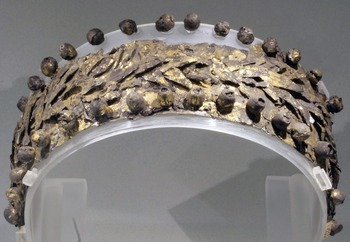
Several items from Southern Italy have elements which bear a resemblance to those on the wreaths, including silver gilt diadems from Archaic graves in Taranto which have myrtle berries and leaves mounted on a broad band and without stems (e.g. Fig. 14, MArTA 12221, Masiello Reference Masiello1984, 74). A gold diadem found in the sanctuary of Hera Lacinia at Croton, where it is thought once to have crowned a statue of the goddess, has berries and myrtle leaves mounted on a band added to the main diadem at a later stage, maybe in the first half of the fifth century (Spadea Reference Spadea and de La Genière1997, 245–6; Reference Spadea1994, 28). Many of these items have a stamped design, which also features on two gilded silver wreaths from Taranto (mid-fourth century) (Masiello Reference Masiello1984, 88; Jeffreys Reference Jeffreys2019a, cat. nos SI 15 and SI 23). The similarity between the leaves, berries and acorns found on these items, as well as the technique of using a matrix for stamping the wreath leaves, show continuity in the Italian material from the Archaic period to the mid-fourth century, although the design did not develop further, and was superseded by wreaths of types 2 and 3.
Detail of silver gilt wreath-diadem 12221 by concession of the National Archaeological Museum of Taranto. Photo by the author.

Further gold and silver gilt items with elements similar to those on the gilded wreaths may of course also have existed in mainland Greece but not survived. A gold and silver wreath with some gilded elements excavated at the Temple of Artemis Orthia at Sparta in a level dating to the seventh century and published with a drawing is a possible example of a distant predecessor, but was not studied and it may not have survived.Footnote 33
Gilded terracotta jewellery
A second group of material with similarities to the wreaths, particularly those of Type 4, is gilded terracotta jewellery, including discs, necklaces and earrings (Marshall Reference Marshall1911, xxxix; Blanck Reference Blanck1976), and examples have been found in many parts of the Greek world (Manetta and Pisani Reference Manetta and Pisani2012, 959–63). Some scholars suggest this material was made to reflect a demand for items made from cheap materials, such as clay, which could be transformed by a skilful craftsman into the appearance desired (Blanck Reference Blanck1976, 19–20). However, as in the case of gilded wreaths, this material is frequently found in the graves of the wealthy, and Manetta and Pisani (Reference Manetta and Pisani2012, 963) rightly comment that the craftsmen were not slavishly imitating a gold original but creating an object which had value in its own right. Gilded terracotta jewellery with elements like those on the wreaths seems to have been in use for a relatively limited period, from the last quarter of the fourth century to the beginning of the third (Manetta and Pisani Reference Manetta and Pisani2012, 959), and it seems more likely that it was influenced by Type 4 wreaths than vice versa. As with gilded wreaths, it seems that the main use of gilded terracotta jewellery was funerary (Manetta and Pisani Reference Manetta and Pisani2012, 958).
Leaves
The third group to be considered is single leaves, made mainly of silver or copper. Several have been found in sanctuaries, and excavators have tended to assume that they once formed part of wreaths. A few do seem to have come from metal wreaths, although with one possible exception, in Corfu, they do not appear ever to have been gilded. As the circlets to which these were attached were metal it is likely that they were not for wear by humans, and so were almost certainly placed on statues. Bronze and copper leaves from Isthmia and Nemea fall into this category, as can be seen from one leaf which is still attached to a bronze circlet (Leaf, Nemea Museum no. BR139 [Jeffreys Reference Jeffreys2019a, vol. 2, 366–7]). The leaves found in these two places mostly represent olive or celery, and the wreaths were surely originally used on statues of victorious athletes (Miller Reference Miller2015, 301). Dating is difficult, but some could be from the fifth century or even earlier.Footnote 34 Finds at Olympia included wreath leaves (Bol Reference Bol1978, 66–8), which were again probably used on statues. Silver leaves from the Temple of Apollo Alea in Calabria were once attached to metal circlets, as can be seen by the excavator's drawings (Orsi Reference Orsi1932, 97 and 113), and may have been placed on a cult or other statue.
At least some of the bronze or copper leaves found in sanctuaries at Dodona, Delphi and the Athens Acropolis were clearly part of branches, since these have been preserved (Dodona: Palaiokrassa Reference Palaiokrassa, Pantermalis, Eleytheratou and Souereph2016, 64; Athens Acropolis: de Ridder Reference Ridder1896, 136; Delphi: Perdrizet Reference Perdrizet1908, 122). The majority do not appear to have been gilded, but a few, which seem to have some gilding on the copper, were found at the oracular site of Klaros in Asia Minor, dated to the fifth or fourth century (Akar Tanriver Reference Akar2009, 186–7; Şahin Reference Şahin2012, 326–7). These have small nicks in the side, probably for attachment to branches since it is difficult to see what part these could have played on a wreath. A few copper or bronze leaves from Corfu may have had gold foil folded around them, since a small piece, which fits one of the leaves, has been preserved (Jeffreys Reference Jeffreys2019a, vol. 2, 361). Many leaves represent laurel and were found in sanctuaries dedicated to Apollo, whereas wreaths do not show this plant, with the exception of the silver gilt Italian material.
The reason for depositing leaves in sanctuaries is not clear, but some may have had a role in cult (Castoldi Reference Castoldi2014, 17) or been offerings in a sort of phyllobolia, in which leaves were thrown to honour victors in athletic games and other contests (Kephalidou Reference Kephalidou1996, 54–5 and 73–6). Whatever the precise reason or reasons for using branches or single leaves, it seems clear that they had a distinct use or uses.
Wreaths made of real plants are likely to be the main artistic and cultural inspiration behind gilded wreaths of all types, although the items discussed above could also have been an influence.
POSSIBLE SIGNIFICANCE OF GILDED WREATHS
The reasons why gilded wreaths were buried almost certainly varied from place to place, and over periods of time, so caution is needed in attempting to draw any general conclusions as to their significance. It may be that placing wreaths in graves was a custom for which few people could offer a precise explanation: this indeed continues to this day and few could say exactly why, other than ‘it is what we do at funerals’. Nevertheless, consideration of the material found with the wreaths helps to set them in context, and literary sources also give some hints.
The overwhelming majority of gilded wreaths have been found in graves: with males and females, old and young, but all were wealthy people as far as can be judged from the types of graves in which they were found and the accompanying goods. The fact that gilded wreaths continued to be used in graves after gold ones appeared suggests that the former had a distinct and continuing significance, since the men buried in Derveni A and B and Tomb II at Vergina/Aigai, to give but three examples, could clearly, had they and their relatives so wished, have afforded to be buried solely with solid gold items. In many cases further south the use of gilded wreaths of Type 2 seems to be due to a wish to be associated with Macedonian culture, but the less showy wreaths of types 4 and 5 may have been influenced by practices of using ungilded material in graves, such as a wreath buried with a young woman who died before her time at Akraiphia, where the burial goods were unusually lavish for this period and place (Sabetai Reference Sabetai2012, 311). In Southern Italy there were long traditions of using gilded silver material in funerary contexts which fell away in the fifth century, when there appears to have been a change in funerary practices following the establishment of democracy in 473 (Masiello Reference Masiello and Lippolis1996, 147). It would not have been alien to revive the idea of burial with a gilded wreath, probably under the influence of contact with Macedonia, and possibly through Epirus, which supplied mercenaries to Taras on two occasions in the third century (De Juliis Reference De Juliis2000, 28–31).
There are four main uses with which wreaths, natural and metal, are associated in ancient Greece, all connected: first, for religious purposes and second, at the symposium and banquets; third, they were used to honour victorious athletes, musicians and other outstanding persons, and such honorific uses included statues and decrees; fourth, they were used on death. Wreaths were also worn in processions for these occasions.Footnote 35
Religion
Wreaths were normal apparel for religious ceremonies; those made of gold were appropriate wear for gods, their statues, priests and priestesses, and were one of three standard public honours awarded to priestesses (Connelly Reference Connelly2007, 203–4). A few gilded wreaths can be identified as buried with priests or priestesses, including a girl at Sedes, grave Γ (Tzanavari Reference Tzanavari, Mols and Moormann2017, 197), a woman at Makrygialos (Pydna) (Ignatiadou Reference Ignatiadou, Ignatiadou and Antonaras2012a, 69) and the man in Derveni A, buried with the famous Orphic Papyrus (Themelis and Touratsoglou Reference Themelis and Touratsoglou1997, 194). Several were also buried with the man in Tomb II at Vergina, believed by many scholars to be Philip II, who as king was also high priest (Kottaridi Reference Kottaridi2011, 42; Reference Kottaridi, Stamatopoulou and Yeroulanou2002, 80).
The most common plants found on wreaths have religious associations, and wreaths were often worn by initiates, including those of myrtle at the Eleusinian Mysteries (Aristophanes, Frogs, 328–30). Ivy bears an obvious relation to Dionysus, and features on wreaths which frequently have in addition vine leaves or small bunches of grapes. Myrtle also seems to have had an association with the god, who is said to have exchanged the plant, one of his three most treasured items, in order to retrieve his mother Semele from the Underworld.Footnote 36 Followers of Dionysus are depicted wearing wreaths, and his Mysteries offered initiates (mystai and bacchoi)Footnote 37 a path to a life in the Blessed Isles. Initiation was open to women as well as men, and a gilded wreath was buried in Pelinna with a female initiate, as can be seen by two inscribed gold ivy leaves found on the body which refer to Bacchios and Persephone (Tziaphalias Reference Tziaphalias1992, 136; Karapanou and Katakouta Reference Karapanou and Katakouta2004, 121–2). A further example of a wreath buried with an initiate can be seen from an inscribed gold myrtle leaf which refers to Persephone, the first mother of Dionysus in the Orphic tradition (Bernabé and Jiménez San Cristóbal Reference Bernabé, Jiménez San Cristóbal and Edmonds III2011, 92), which was found in Pella with a gilded wreath (Lilimpaki-Akamati Reference Lilimpaki-Akamati1992, 95). Although there is no consistent pattern of wreaths being found in graves of those recognisable as initiates, it does seem clear that at least some were. It may be that wearing a gilded wreath would have indicated their status in the Underworld, shining in the dark. Tzanavari (Reference Tzanavari, Mols and Moormann2017, 196–7) suggests that the painted representations of myrtle foliage and wreaths in cist grave 1 at Derveni/Lete indicate that the deceased had taken part in rites of passage or initiation and been placed under the protection of Demeter and Kore, whose cult was much practised in Macedonia as well as Southern Italy.
Symposium and banquets
Some scholars make a link between wreaths and participation in a symposium of the Blessed, where initiates recline on couches, wearing wreaths, and drink (Plato, Republic, 2.363cd). There are, however, difficulties with attempting to apply this idea to explain the presence of all gilded wreaths in graves, since many have been found with females, and women did not of course participate in the symposium or other banquets, with the exception of wedding feasts (Sabetai Reference Sabetai and Schlesier2011, 155).
Mark of honour
As for the third main use, in all parts of the Greek world there was a long tradition of honouring victors in contests, including athletic games and musical contests, with natural wreaths, but there are some examples of them also being honoured with metal wreaths. In Taranto, there is, or rather was (since they have not survived), an example of a deceased being buried with thin gold leaves believed to have once formed a wreath in the Athletes’ Grave (late sixth or early fifth century) (Lippolis Reference Lippolis1990, 302–4). In Nemea, Isthmia and Olympia bronze leaves almost certainly once formed part of wreaths on statues honouring athletes. Victors in musical contests were also honoured with wreaths, sometimes gold (Blech Reference Blech1982, 143–4).
Wreaths were used to honour outstanding individuals ‘as if they were athletes’ such as Brasidas, the Spartan general who fought for the people of Amphipolis.Footnote 38 When placed on honorific statues they are likely to have been made of metal. The statue base of Ioallas in Sardis, dated to 209–193, refers to Ioallas being honoured with two wreaths with the epithet χρυσοῖς, which Waldbaum (Reference Waldbaum1983, 22) takes as meaning ‘gilded’ in this context, since two statues were also awarded in the same material (χρυσῆ), one of which was described as κολοσσικῆ; it is difficult to believe that the statues were made of solid gold, but quite likely that both they and the wreaths were gilded (see also Buckler and Robinson Reference Buckler and Robinson1913, 35). The statues in the Philippeion at Olympia of Philip II and his family, though described by Pausanias as made of ‘gold’ and ivory (5.20.17) are more likely to have been gilded marble, since the beddings in the bases (which still exist) would not have been appropriate for metal statues (Schultz Reference Schultz2007, 220). Although the statues have not survived, that of Philip may well have shown him wearing a gilded wreath or diadem. There is also evidence of gilded marble statues in houses on Delos, some of which depicted individuals wearing wreaths or fillets (Bourgeois and Jockey Reference Bourgeois, Jockey, Brecoulaki, Karydas and Descamps-Lequime2007, 184; Bourgeois, Jockey and Karydas Reference Bourgeois, Jockey and Karydas2011, 648), such as the Diadoumenos in the House of the same name, which it is reasonable to suppose were also made of gilded marble or gilded copper/bronze. The gilded bronze wreaths found on the Acropolis in Pergamon (Appendix, item 7) depicting oak and laurel are likely to have decorated statues, since they are too large for a human head.
It is not clear whether the original bronze statues of the Tyrannicides, Harmodios and Aristogeiton, bore metal wreaths; an epigram cited by Aeschines (Against Ctesiphon, 190) records that the people of Athens bestowed olive wreaths on the two men, and although some vase paintings show the statues wearing wreaths it may be that they were only wreathed during the Panathenaic Festival.Footnote 39 Domingo Gygax proposes that after the posthumous award to the pair of great honours including the statue group it became difficult to reward other citizens in a way that put them on a level with them, but during the Peloponnesian War military commanders were prominent in Athens, and it became increasingly common to reward their services with wreaths and other honours. Other citizens came to be honoured for economic benefactions, and such honours increased as the resources of the city decreased (Domingo Gygax Reference Domingo Gygax2016, 252–3). These honours can be seen as part of a complicated process of gift exchange (Domingo Gygax Reference Domingo Gygax2016, 255).
There are many records of honorific awards of gold wreaths to benefactors dating to the fourth century onwards. Gold wreaths, normally referred to in this context as ‘crowns’, were the most common euergetic honour, but natural wreaths were also awarded (Domingo Gygax Reference Domingo Gygax2016, 231). One example of ‘gifts’ of gold wreaths is those awarded by the Athenians to Spartocus and Paerisades (kings of the Cimmerian Bosporus) which were immediately dedicated by them to Athena Polias (in Athens), possibly for eventual melting-down by the demos as part of the temple treasures (IG II3 1, 298; D. Harris Reference Harris1995, 104; see also Rhodes and Osborne Reference Rhodes and Osborne2003, 323). There are many sculpted representations of wreaths cut in relief on marble, commemorating victories in games, awards to the dead and gifts by civic bodies and religious associations.Footnote 40 When the material is mentioned, it is usually gold (Hussey Reference Hussey1890, 73).
Death
Wreaths were also used at the point of death. In addition to gold and gilded wreaths, many natural wreaths would no doubt have been used in graves, but few of these have survived. One example was found at Kalyvia, where a flower wreath from a fifth-century grave had been placed on human bone remains in a ceramic urn covered by a fine textile, containing the ashes of three individuals (Spantidaki and Moulhérat Reference Spantidaki and Moulhérat2003, 2; Moulhérat and Spantidaki Reference Moulhérat, Spantidaki, Gillis and Nosch2007, 163; Andrianou Reference Andrianou, Carroll and Wild2012, 47). Liddell and Scott cite several instances of words for the making of wreaths and wreath makers;Footnote 41 their sources are almost certainly referring to wreaths made of plants, as can be seen on a white ground lekythos showing a woman seated on a diphros and holding such a wreath beside the grave.Footnote 42
Myrtle, an evergreen plant, can be linked with life after death (Karouzou Reference Karouzou1980, 15); it was used not only to crown the deceased but to decorate the grave (Euripides, Electra 325).Footnote 43 Parker (Reference Parker1983, 35) sees wreaths as a symbol of sacredness and refers to the corpse being washed and crowned to make clear that it had been made pure; only the deceased, and not the mourners, wore a wreath. Use as a mark of cleansing of the impurity of death is one possible explanation for why they were used in graves.
The custom of using a metal wreath in graves in Macedonia seems to have been part of a tradition to honour the dead of both sexes with precious and in particular gold items, as is evident from sixth- and fifth-century graves at Sindos, Aigai and Archontiko where diadems, masks and weapons have been found.Footnote 44 These are thought to have been placed to represent ‘heroic’ burials of both men and women, echoing a purported Homeric past.Footnote 45 It would seem, therefore, that we should look to a continuation of these traditions to explain the appearance of gilded wreaths in graves in Macedonia. In Central and Southern Greece, a high proportion (some 10 per cent) of gilded wreaths were buried with young girls or women who died before their time (see Jeffreys Reference Jeffreys2019a, vol. 1, 110–11) and in Rhodes and Southern Italy many represented ivy, suggesting the deceased may have been followers of Dionysus.
Many Macedonian wreaths were found in graves of military leaders, as is clear from the presence in the graves of weapons and precious helmets. Alexander the Great presented gold wreaths to his generals to recognise their valour (Arrian 7.5.4–5). It is possible that gilded ones were made as copies and eventually buried with the owner, much as people are sometimes buried with their medals today. Several vases depict warriors wearing a wreath, including a neck amphora in Berlin (now lost) showing Ajax carrying the dead, wreathed, Achilles; one side of a neck amphora in Munich has both wearing a wreathFootnote 46 indicating that they were worn by living, as well as dead, warriors to mark their heroic status, which is borne out by surviving helmets with engraved wreaths.Footnote 47
Women could not of course excel in games or military expeditions, but they could show virtue, through piety, purity and justice. Marriage and child-bearing were a key part of a woman's life, and one possibility is that some of the wreaths, of which there are sometimes as many as five identical specimens in a single grave, of one mature woman, in Macedonia,Footnote 48 could have been placed there to commemorate the wedding day: vase paintings frequently show several wreaths being offered to a woman before her wedding, and, occasionally, wearing one.
Although views about the afterlife in ancient Greece were complex, by the late fourth century some held a hope that the virtuous, of both sexes, would be rewarded with a happy life in the Isles of the Blessed, as can be seen from third-century epigrams and a wall painting on the late fourth-century tomb at Lefkadia (Mieza) depicting Rhadamanthys, one of the judges of the dead, implying an exalted position for the warrior (Kravaritou and Stamatopoulou Reference Kravaritou, Stamatopoulou, Ekroth and Nilsson2018, 140 and 142). Excellent moral conduct was required, as was acknowledged by Plutarch, who referred to the person being rewarded as in an athletic contest.Footnote 49 Despini (Reference Despini1996, 28) sums it up, suggesting that wreaths were placed with the dead to certify that he (or she) was worthy of being rewarded with what was fitting, in a moral sense, so that they could lay claim among the virtuous to eternal life after death. In all cases, it would seem that they were used as a mark of respect to the deceased.
CONCLUSIONS
On the basis of current surviving evidence, it seems that gilded wreaths of types 1 and 2 appeared first in Macedonia in the early fourth century. The other type of which many examples survive, 4, seems to have first appeared a little later in Central and Southern Greece. A feature of wreaths of all the types studied is the means of attaching fine gold leaf to the elements, including the copper leaves, by using a coating, perhaps originally adopted by contact with craftsmen familiar with the technique of applying gold leaf on clay vases in Attica. The wreaths themselves would have been fragile and would not have travelled well, and were almost certainly made locally, from local materials where appropriate.
Natural wreaths are likely to be the main artistic and cultural inspiration behind the gilded wreaths of all types, which imitate real leaves, berries and flowers closely. Gilded silver leaves and myrtle berries and a gold diadem have been preserved in Southern Italy, some of the elements of which are similar to those on the wreaths, and they may have been an influence, as may ungilded bronze or copper leaves, particularly when used as part of wreaths on statues.
The reasons for placing gilded wreaths in graves would have varied from time to time and place to place. In many cases they may have been a mark of social status, or an expression of hope that the deceased may live again, perhaps with a distant recollection of wreaths and similar items being connected with ideas of fertility and rebirth. In Macedonia, their use in graves fitted well with earlier traditions of honouring members of the elite by burying them with gold jewellery or precious weapons and other luxury items representing ‘heroic’ burials of men and women. There and elsewhere in the Greek world, some were buried with individuals who were initiates, priests or priestesses; others may have been buried to certify that the individual, male or female, was of exceptional merit, allowing them to lay claim among the virtuous to eternal life after death. In many cases, it may have simply been as a matter of custom, as a way of honouring the dead.
ACKNOWLEDGEMENTS
The rights to the monuments depicted in Figs 1, 4, 11, 12 and 13 belong to the Greek State and the Ministry of Culture and Sports (Law 3028/2002) which are under the jurisdiction of the Archaeological Museum of Thessaloniki. © Archaeological Museum of Thessaloniki, Hellenic Ministry of Culture and Sports – Hellenic Organization of Cultural Resources Development. The rights to the objects depicted in Figs 2, 3, 6, 7, 8, and 9 also belong to the Greek State and the Ministry of Culture and Sports (Law 3028/2002) and are under the jurisdiction of the Ephorates of the Dodekanese, Magnesia, the Archaeological Museum of Thebes, the Ephorate of Kavala and Thasos and the Ephorate of Chania, respectively. Figs 5 and 14 are reproduced courtesy of the National Archaeological Museum of Taranto. No further reproduction of any of these images is permitted.
I was privileged to be allowed to study many gilded wreaths and leaves for the purposes of my DPhil (Jeffreys Reference Jeffreys2019a) and wish to thank Directors Professor C. Morgan and Professor J. Bennet and other members of staff at the British School at Athens, in particular Mrs Tania Gerousi, who kindly obtained many of the necessary permissions for me. I also wish to thank most warmly the curators and conservators in archaeological museums and staff in Ephorates who entrusted me with their material in Thessaloniki, Athens (National Archaeological Museum), Aiani, Arta, Chania, Corfu, Herakleion, Isthmia, Igoumenitsa, Kavala, Larissa, Nemea, Pella, Preveza, Rhodes, Schimatari, Thasos, Thebes, Vergina and Volos, whose material is discussed and in some cases illustrated in this article. In addition I must thank most warmly the chemists at the Archaeological Museum of Thessaloniki, Christos Katsifas and Ioannis Nazlis, and also Professor Ioannis Karapanayotis and Dr Dimitrios Lambakis at the Higher Ecclesiastical Academy in Thessaloniki for their great assistance with the analytical work, and also Ina Reiche and her colleagues in the Rathgen Laboratory in Berlin. Outside Greece, I gratefully acknowledge the curators, conservators and other staff in the National Archaeological Museum in Taranto, as well as those in the Archaeological Museum of Metaponto, the British Museum in London, the Musée du Louvre in Paris and the Antikensammlung in Berlin, who so generously allowed me to study their material. My heartfelt thanks go also to my two supervisors, Professor Maria Stamatopoulou and Dr Christopher Doherty (both University of Oxford), as well as to Dr Despina Ignatiadou (National Archaeological Museum, Athens), for their generous advice and encouragement, as well as to the many archaeologists who allowed me access to unpublished material and kindly gave me of their time to discuss it. I am also most grateful to Dr Konstantinos Papadopoulos, civil engineer, who gave me valuable comments on an early draft of this article, to the anonymous reviewers, and to the Co-Editor Professor Peter Liddel and Dr Joshua Hey who gave me further comments at later stages. The faults, needless to say, are all mine.
APPENDIX: DETAILS OF SOME OF THE WREATHS DISCUSSED IN THE TEXT
This Appendix contains a description of one representative example of each type of wreath, with contextual information.
All dimensions are in millimetres unless otherwise stated.
Item 1; Rhodes AM M1382; Jeffreys Reference Jeffreys2019a, vol. 2, 289–91, cat. no. SEA20; Figs 2 and 3.
Type: 1.
Date: Second half of the fourth or early third century (Kaninia Reference Kaninia1998, 116, n. 67), possibly just after 350 on the basis of the similarity with wreaths from Istrios (Rhodes M 551; Jeffreys Reference Jeffreys2019a, cat. no. SEA6) and Kamiros (BM 1865,0425.2; Jeffreys Reference Jeffreys2019a, cat. no. SEA8). See Jeffreys Reference Jeffreys2019a, vol.1, 130; Jeffreys Reference Jeffreys and Schierup2019c.
Plant represented: Almost certainly myrtle. The leaves could represent olive or myrtle, but the flowers, with five petals, look much more like myrtle than olive. There are no berries.
Provenance and context (Kaninia Reference Kaninia1998, 101): Western area of the necropolis of Rhodes: Sepheris Street or Kamiros Street. These fragments were excavated in 1996 in the course of public works. Other finds are lacking. Pottery collected from a layer of black soil can be dated to the second half of the fourth or the early third century.
Constituents: The wreath has not been fully cleaned, no doubt because of the delicacy of the material. A substantial amount of gritty soil remains.
• Seven fragments of circlet, made of bone which is round in cross-section. Most of the stems were wrapped around the circlet, but traces of three large round holes can be seen which go right through the bone, where apparently the wires were anchored firmly into the circlet. Holes were pierced in the bone, not in a straight line, which, judging by the stems that remain in position, held stems at various positions. There are traces of a yellowish coating beneath the gold on the circlet. Length: 15.26, 9.8, 21.86, 13.95, 13.5, 13.8, 223.1 mm. Diameter of bone: 4.5 mm.
• Fragments of short stems and leaves remain, from which it can be calculated that the minimum number of leaves was 25. None of the leaves is complete, but by placing fragments together which did not necessarily join, but are of a similar size, it would seem that the leaves were symmetrical, and could represent olive or myrtle. They have a pointed end and a central vein. The original length of the leaves could have been about 30 mm, but it is not possible to be sure, given that none of the leaves is complete. The leaves seem to have been much the same size. Thickness of the copper plate from which the leaves are made: 0.68 mm.
• Wrapped in a piece of paper are three flowers, made of gilded copper petals. The petals appear to have been hammered over a template, as they are concave, with the clay stamen in a hollow formed in the centre of the leaves. It appears that there were at least three flowers, each made of five petals, though none is complete. Each flower had a central disc, made of gilded clay, with a white coating above the red clay. There is a tiny wire in the centre of each disc. Diameter of the gilded white centres: 7.86 mm.
Item 2; Aineia Grave III, MTh 7570 on display and in stores; Jeffreys Reference Jeffreys2019a, vol. 2, 11–15, cat. no. M5; Fig. 1.
Type : 2.
Date (Vokotopoulou Reference Vokotopoulou1990, 133): Third quarter of fourth century (beginning).
Plant represented: myrtle.
Provenance and context (Vokotopoulou Reference Vokotopoulou1990, 132–3 and 49–52): Aineia Mound A, Grave III. This was a cist grave in Mound A containing the body of a woman, above the slabs of which were spread the remains of the funeral pyre, which must have been burned outside the limits of Mound A. One wreath (unnumbered) was found with the pyre fragments (Vokotopoulou Reference Vokotopoulou1990, 71, item 68). Inside the grave, a total of five wreaths were found, including fragments around the neck of a bronze kalpis (MTh 7552). The five gilded wreaths are numbered 7570–4 in the publication (Vokotopoulou Reference Vokotopoulou1990, pl. 39 and 66–7); an illustration of how they were found is Vokotopoulou (Reference Vokotopoulou1990), pl. 20 and a plan of the grave is at Vokotopoulou (Reference Vokotopoulou1990), 50. The kalpis is dated to 430–420 BC and is older than the burial; in addition to the wreath, it held the bones of a mature woman,Footnote 50 a gold ring and gold fibulae. From the excavation diary,Footnote 51 it is apparent that this wreath (7570) was found at the south end of the tomb, 7571 on the east side, 7572 on the west, 7573 around the kalpis and 7574 on the north-west. One of the wreaths was found on the floor next to a piece of pottery; 7571 was found on the east side of the grave with four alabastra. On the right were three alabastra, near one of which on the floor was a fourth gilded wreath and next to it a piece of wood with traces of blue and red colour. In the centre of the south side this gilded wreath (7570) was on the floor near four alabastra. The bronze mirror may have been placed in a box, since a ring handle was found on a box lid (Ignatiadou Reference Ignatiadou, Giumlia-Mair and Mattusch2016, 97–8). The mirror back shows a splanchnotes scene, which appears to be unique on a mirror. Other offerings included a glass calyx-skyphos, a gilt clay kotyle (7550), eight Attic vases (7540–7) and a locally made vase coated with yellow paint (7548). One of the two wreaths on display is wreath 7570.
Constituents of wreath on display (7570):
• Gilded bone circlet which has one ancient join with overlapping pieces of bone. Not many holes have been pierced towards the back, but there is a single hole (for a ribbon or tie) on one side. Width: 4.95 mm. Depth: 3.9 mm. Overall dimensions (internal): width 14.5 cm and length 16 cm.
• Fragments of wood circlet lie behind the bone circlet, using the same holes. The holes are 3 to 3.8 mm apart, with the stems almost touching.
• Gilded copper leaves with gold both sides of the leaves with very short stems. Most if not all are broken at one end and all have been made in one piece with stem.
• Leaves length: 1.53 to 10.99 mm.
• The 22 berries are oval and mostly have one hole. There is a yellowish coating beneath the gilding and the fabric is made of red clay. The gilding finishes in a neat line leaving some of the coating showing. Berries length: 8.2 mm; diameter: 4.6 mm.
• Stems: two are mounted on the circlet in bunches, most are single. Length of stems: 26.2, 26.9, 28 mm. Diameter 0.95 mm.
Fragments labelled 7570 (in stores):
• 51 oval berries, several of which have a red coating. Length: 6.98 mm.
• Fragments of leaves, at least one of which shows slight signs of heating (in the pyre?).
• Stems, two in bunches, some single. Width: 0.7 to 1 mm.
Item 3; Taras via Battisti, MArTA 50710, store; Jeffreys Reference Jeffreys2019a, vol. 2, 320–1, cat. no. SI 11; Fig. 5.
Type: 3 local variation.
Date (De Juliis Reference De Juliis1984, 461): end of the third century.
Plant depicted: various. The rosettes represent ivy flowers, there is at least one myrtle berry and the four-petalled flowers could represent either laurel or myrtle.
Provenance and context (De Juliis Reference De Juliis1984, 458–61): The grave also contained a gold wreath (50703), a mirror (50710A), a pin (50710D), three nails (50710C), a key (50710E), six bone rings (50709), part of a distaff (50709C), cylinders (50709F), knucklebones (50709A), discs (50710F), fragments of a foot made of blue glass (50710I), cups (50705), an ‘inkwell’ vase (50708), six bowls (50706), a skyphos (50709), an oinochoe (50704), a seal showing a man wearing an ivy wreath (50710B) and a thymiaterion (50707). The deceased was probably a young girl. There was a louterion in or by the grave.
Constituents:
• The circlet has not been preserved. The main constituents are large rosettes, but some flowers, berries and a few stems have also been preserved.
• 40 rosettes, probably made by hand since the sizes are different. The rosettes are made of spherical balls pressed into a clay base. They are made of a reddish clay with a white coating. What could be traces of colour may just be visible. No gold appears to have been used on them. Diameter of rosettes: 10.3, 12.7 (three), 9.74, 11.7, 10.94, 10.6 mm. Diameter of clay balls constituting rosettes: c. 8.2 mm.
• Two larger flowers with four petals, which bear traces of red pigment.
• 14 small flowers with six petals, but of different designs, some of which bear traces of red pigment. These flowers are so regular that they were probably moulded. Diameter: 14.5, 12.9, 9.7, 9.9 mm.
• One larger flower with red pigment.
• One berry with a cross, representing myrtle.
• Nine further berries. Diameter: 8.2 mm.
• About 12 copper stems. Width of stems: 1 to 1.15 mm.
Item 4; Thessaly Demetrias N. cemetery grave 386, Volos AM BE 18043 and 18060, on display; Jeffreys Reference Jeffreys2019a, vol. 1, 210–12, cat. no. SCG22; Fig.6.
Type: 4.
Date (Asderaki-Tzoumerkioti Reference Asderaki-Tzoumerkioti2000, 317): third century.
Plant represented: Asderaki and Rehren (Reference Asderaki, Rehren, Facorellis, Zacharias and Polikreti2008, 508) regard it as myrtle. The bell-shaped objects with a pronounced ridge represent flowers. The other kind, which is more rounded and has six or seven petals, perhaps represents them full blown. The very few leaves are consistent with myrtle.
Provenance and context (E. Nikolaou, pers. comm., Jan. 2014): The wreath was found in grave 386, a cist grave (1.79 x 0.88 m) which contained two inhumations (superimposed). Most of the bones of the first skeleton have been preserved, but the skull has been separated. Some of the bones of the second skeleton have also been preserved (male). Outside the grave, to the north-west, a plate was found. Inside the grave on the north-west were several alabastra and a silver kylix. In the north-east was the wreath, a broken amphora and fragments of wood where the skull would have been. In the south-east were a bronze lantern and an aryter (Volos AM, BE 16222). An iron needle or pin was found above the lantern, and iron nails along the left arm of the first skeleton, as well as two lamps (one has more than one spout) and a further alabastron beneath the lekane with the first skeleton.
Constituents:
• The circlet is made of wood (in three fragments).
• Width: 9 mm. Overall dimensions: 19 cm long, 11.5 cm across arc, but this is not a complete wreath.
• 18 clay berries with coating and gilding, mostly with diameter of 6.6 mm. The fabric is a reddish clay, and there is a white coating with what appears to be a yellow coating on top.
• 10 clay flowers with yellow coating on top of a layer of white coating and gilding. The flowers are of at least two different kinds: one with a larger diameter (9.54 mm) and six or seven petals, the other with a smaller diameter (7.08–8.12 mm) but longer (8.84–11.09 mm), some with a pronounced ridge.
• About 20 copper stems and leaves, some bound with fibrous organic material. There is also a white material on the bound wires; it is not clear what this is.
Item 5; Schimatari AM, Tanagra A/62, on display and store; Jeffreys Reference Jeffreys2019a, vol. 2, 169–70, cat. no. SCG4; Fig. 7.
Type: 5.
Date: end of third century, based on the pottery.
Plant represented: ivy.
Provenance and context (Andreiomenou Reference Andreiomenou2007, 252–3): The wreath fragments were found in a pit grave with a clay cover. The finds in addition to the wreath fragments consisted of a skyphos, a West Slope phiale (22037), a small black glaze phiale (22082), a small lekane (22085), an unglazed lagynos (22079) and a black glaze lamp (22034).
Constituents:
• Andreiomenou (Reference Andreiomenou2007, 253) lists 11 small gilded clay ivy leaves (26067) and four gilded clay semi-spheres (26066).
• Three gilded clay rosettes on display and one broken rosette from the stores (corresponding to the four semi-spherical objects described by Andreiomenou Reference Andreiomenou2007). Diameter of two rosettes: 23.6, 26.4 mm. The broken rosette is labelled as being from grave A/62 and has a white coating on brown clay beneath the gold. Diameter: 25.4 mm.
• Two ivy leaves kept in the stores are labelled as being from grave 62.
• Dimensions of nearly complete leaf: length 30 mm and max. width 24 mm.
• Andreiomenou (Reference Andreiomenou2007, 253) mentions a hole in one of the leaves for the stem, but this was not visible on the fragments which were examined.
Item 6; Nikisiani grave A, numbers Δ 368–73, Δ 375. Probably two wreaths Kavala AM store; Jeffreys Reference Jeffreys2019a, vol. 2, 69–71, cat. no. M23; Fig. 8.
Type: 6.
Date (Touratsoglou Reference Touratsoglou1998, 248): c. 315.
Plant represented: possibly myrtle.
Provenance and context (Lazaridis, Romiopoulou and Touratsoglou Reference Lazaridis, Romiopoulou and Touratsoglou1992, 17, 19–22, pls 6, 7): Grave A, a cist grave of schist slabs, contained a male burial. A gilded wreath was found attached to a skull. Amongst the other finds were two silver calyces, a clay skyphos (M386), fragments of clay alabasters (A2730–1; A2732), a pointed amphora (A684/2012), a glass ‘eye’ (from a kline) (Δ 362), a human tooth, three bronze coins of Philip II, one coin showing Alexander the Great and one coin of Cassander. The grave was originally dug illicitly.
It appears that there were originally two wreaths, one with circlets made of lead and wood, and the other of lead and bone.
Constituents:
A box contains three large and two small flowers. Three are labelled on the back Δ 368. These clay gilded flowers have petals coated with white material and small blue/green and red calyces between the petals. The centres are red. Diameter: 24.5 mm. It is not clear whether they were moulded – possibly not, as one of the flowers has a deeper central area than the others (depth 14.7 mm, whereas the others are 13.09 mm and 12.5 mm). The two smaller flowers are different from the larger, and different from each other. One has six petals and lines in the clay (Δ 375). Traces of white coating remain. The other labelled on the back Δ 369 looks like five berries put together. Traces of gilding remain. Diameter 14.14 mm. A stem in the hole in the back confirms that it was from the wreath. Both flowers are made of a red clay.
[Description of items Δ370–3 omitted]
Item 7; Pergamon; Antikensammlung Berlin P54; Jeffreys Reference Jeffreys2019a, vol. 2, 151–5, cat. no. P1.
Type: 7.
Date: Late Hellenistic.Footnote 52
Plant represented: Oak.
Provenance and context: Conze (Reference Conze1913, 249), the excavator, describes the fragments as having been found in the Palace ruins at the top of the acropolis (see also Grussinger, Kästner and Scholl Reference Grussinger, Kästner and Scholl2011, 496).
Constituents:
• Four fragments of circlet, two of which still have gilded oak leaves attached. The holes have been pierced on two levels. The stems of the leaves have been folded back at an angle of about 45° and there are traces of white material on the back of the circlet, found to be solder when analysed. The gold has been attached neatly and does not cover the back. Length of fragments: 140 mm (with six leaves), 135 mm (no leaves), 85 mm (six leaves), 56 mm (total 36.6 cm). Width of circlet: 14 mm. Weight of strip which is 135 mm long: 17 g. Distance between holes: 13.5 mm. Diameter of holes: 3.5 mm.
• A total of 18 oak leaves, with substantial amounts of gilding preserved. The leaves on the circlet are much better preserved that those kept separately. Each leaf has five curved indentations on each side. Given the clear form of the curves in the oak leaves which have been preserved on the circlet fragments it seems likely that they were cast. Each leaf has a central vein, and curved veins coming out from the central vein. The veins were formed in the underlying copper alloy and appear to have been chased. It is not clear whether there was ever a coating between the gold and the copper alloy, but no traces are apparent now.
• Six leaves on the strip of circlet 140 mm long. The veins on these leaves appear to be identical, and the shape of each leaf is almost the same, although they are not quite the same sizes (it was not possible to measure all six). The central veins are formed by a double line, and the curved veins are also formed by a double line. Length: 80 mm, 87 mm (two items), 90 mm. Max. width: 29.5 mm. Thickness: approximately 1 mm.
• Six leaves on the strip of circlet 85 mm long. The veins on these leaves are also formed by double lines and are not quite identical. Some of the veins are formed in the negative. Length: 69, 61, 66, 85 mm. Max. width: 22 mm.
• Six leaves kept separately, more fragmentary than those on the circlet fragments. These are more crudely made. Width of grooves: 0.6 mm.
○ Leaf 54,4: Length: 81 mm, width (max): 31 mm
○ Leaf 54,7: Length 67 mm (broken), width 31 mm
○ Leaf 54,8: Length 63 mm, width 31 mm
○ Leaf 84,9: Length 64 mm, width 24 mm
○ Leaf 54,10: Length 71 mm, width 25 mm
○ Leaf 54,14: Length not enough remaining to tell