1. General Introduction
This article focuses on the history, vision and implementation of the ElectroAcoustic Resource Site 2 also known as the EARS 2 pedagogical site. EARS 2 has been created primarily for the age group 11–14, although people of all ages may benefit from what it offers, and is intended to fill a large ‘hole in the market’ in the area. It can be found at www.ears2.dmu.ac.uk. EARS 2 is intended to help music teachers broaden the horizon of music introduced within their curriculum. Neither the design of tasks and content inside the site nor its architecture makes assumptions about the structure of a teacher's curriculum, the allocation of time for electroacoustic music or any form of previous knowledge by young people engaging with the site.
EARS 2 has developed from work done on an original, resource-rich virtual space called EARS. The idea behind the new space was launched during a meeting at UNESCO's main headquarters in Paris where a question was raised concerning what the EARS project team's plans were after EARS had been formally launched as a multi-lingual resource site for specialists (www.ears.dmu.ac.uk). The challenge presented was to create an EARS site that would be relevant for children. After careful consideration, a site introducing vocabulary and relevant literature seemed less than ideal for the proposed age group. In fact, what it should include was, at the time, not entirely obvious. Whilst there is evidence that a constructivist approach to learning is appropriate for young people, catalysed through discovery or inquiry-based learning inside environments that are both supportive and challenging, the role of adults or more experienced peers is also important in moving from a cognitivist approach to learning (Piaget Reference Piaget1926; Bruner Reference Bruner1960; Vygotsky 1960; Bruner Reference Bruner1996; Jonassen Reference Jonassen1997). At issue for EARS 2 was how to make sense of this transition from cognitivist to constructivist learning, related to active learning in terms of concepts, repertoire and creative practice, especially when the subject at hand is presented in a challenging, yet enjoyable manner. The point of departure should be to optimise the balance between passive information acquisition and active demonstration of learned concepts.
Therefore, after careful consideration, including a survey of what is currently on offer internationally, it was determined that a full-scale pedagogical initiative with teacher support was needed, ideally in as many languages as possible. This initiative would be supported by a resource-rich, virtual space, underpinned by an ethos that prioritised learning through technology in social spaces. The space would integrate social networking with personalised access to resources and tools for creative practice, and it would offer information to both teachers and students that might not be available by any other means. The social networking strand not only offers dynamic communication, but also supports community forming by any user and hopefully enhances self-efficacy (Bandura Reference Bandura1977, Reference Bandura1995; Parajes and Schunk Reference Parajes and Schunk2001).
Unfortunately, as is often the case in large-scale projects like this one, the acquisition of funding not only took longer than desired, but was received in separate chunks, not simultaneously. For example, funding from the European Union was gained to develop the creative software, Compose with Sounds (www.cws.dmu.ac.uk) prior to our gaining funds to create the eLearning environment (from the UK's Higher Education Innovation Funds, HEIF) and this occurred prior to receiving funding for content generation.Footnote 1 This impacted the work flow and project management of the space, alongside the production and testing of its associated resources and pedagogic underpinnings. In spite of these issues, a strategy has been developed around the gaps in educational provision for young people related to electroacoustic music, and this underpins the core of this article, which highlights the identified vision behind the EARS 2 site with some developmental examples.
In the following parts of the article, the project will be contextualised, its vision shared and potential next steps proposed. In part 2, the contexualisation of the project will be presented in two sections. Firstly, the raison d’être for the EARS projects, increasing access to electroacoustic music, will be presented, focusing on the first author's initiatives on the subject since the early 1990s. After this, a brief, non-exhaustive summary of types of existent educational initiatives in the field is presented to indicate why an initiative like EARS 2 was needed. This leads on neatly to part, 3 in which the EARS 2 project's vision is introduced at some length, both in terms of a learning environment for electroacoustic music as well as in terms of its technology-enhanced developments. Finally, part 4 offers suggestions of how the project might be further developed in the not too distant future.
2. Contexts
2.1. The issue of electroacoustic music and access
The question of access, both in experimental music in general and in electroacoustic music specifically, has traditionally been avoided. In 1990 this article's first author asked the following rhetorical question in the title of his talk at the ICMC conference in Glasgow: ‘Is more than three decades of computer music reaching the public it deserves?’ (Landy Reference Landy1990). Since that time, to help fill the void, Landy has written a number of books, several articles and led research projects focusing on issues regarding increased access to electroacoustic music. In his book What's the Matter with Today's Experimental Music? (Reference Landy1991), Landy argued that musicians needed to become more able and willing to offer access tools to a wider audience than the one much contemporary music reaches. He also highlighted the need for the communications media, educators and government agencies prescribing national curricula to engage with access and inclusion. A particular focus was on those educators working at primary and secondary school levels.
In developing solutions, the challenge was to find means of improvement in terms of engaging young people. When Emmerson (Reference Emmerson1986) launched the field of investigation related to the language of electroacoustic music, including his well-known ‘language grid’, he implicitly suggested that future listeners might be offered greater means of understanding for this emergent form of innovative music-making. Landy's ‘something to hold on to factor’ in timbral composition offered a further modest tool (Landy Reference Landy1994a) as did his call for more attention to be given to the dramaturgy of this music. This offered potential listeners information regarding intention, often something else to hold on to. Such analytical and compositional tools can easily be integrated into a curriculum for this music, including for young learners, but so far this has almost uniquely taken place at the level of higher education.
A larger project launched early in the following decade. The ‘Intention/Reception project’ (Landy Reference Landy2006; Weale Reference Weale2006) took this journey a few major steps forward. This project had two main goals: firstly, to determine the extent to which certain types of electroacoustic music might be accessible to a wider audience than the fairly marginal one that most musicians had at the time; and, secondly, to determine to what extent a composer's intention, perhaps including those things to hold on to, aids the aural experience of inexperienced listeners. This initial project has provided statistics of great value to demonstrate the potential interest in this body of music. In the carefully chosen works, between about 60 per cent and about 80 per cent of inexperienced listeners were interested in exploring this type of music. Furthermore, it demonstrated that new listeners do find musical discovery easier when offered intention information alongside specific music content items that aid them in their navigation of a new work. It is true that more experienced listeners often prefer to find out about intention after experiencing a work, but that is not relevant to the present discussion. What is relevant here is the fact, demonstrated convincingly in the data gained in the Intention/Reception project, that new or inexperienced listeners enjoy making links with their own experience in order to better understand what they are hearing. It is the role of the musician and educator to aid them in this discovery.
Concurrently with these Intention/Reception initiatives EARS was born. EARS is a means of sharing knowledge regarding terminology and published research in electroacoustic music studies with students and specialists alike.Footnote 2 However, EARS, as many other initiatives within the field, was intended for those who were already committed to electroacoustic music and is of modest use to the uninitiated. Thus, it is argued that whilst these innovations did not take place in isolation, initiatives regarding the accessibility of electroacoustic music were rare, especially in the period immediately after Landy raised the issue of access and participation in 1990. This situation has improved recently, especially due to community music initiatives, many of which are focused on education as is illustrated in section 2.2 below. Still, such outreach initiatives remain more the exception than the rule, regardless of their quality, and none of these bears or develops a curriculum similar to EARS 2.
2.2. A selection of educational initiatives related to electroacoustic music
Most countries – and, in some of these countries, most states or their regional equivalent – are constantly dealing with the awkward equation of improving education and balancing ever-changing budgets. As a result, music has often been seen to be the poor cousin of strategies to enhance literacy and numeracy. Pioneers have attempted, often against the odds, to improve music's lot inside national curricula, including creating opportunities for electroacoustic music to be introduced in some way at all education levels. This brief survey attempts to identify trends and, by implication, the need for an innovation of the type represented by EARS 2.
The 1970s and 1980s, particularly in the UK, were fruitful in terms of visionary writing related to music education. Names that often feature in such surveys include John Paynter and George Self (see, for example, Dennis Reference Dennis1970; Paynter and Aston Reference Paynter and Aston1970; Tillman Reference Tillman1970; Self Reference Self1976; Swanwick and Tayler Reference Swanwick and Taylor1982). The literature combines vision, curricular possibilities and exercises across a variety of twentieth-century experimental music practices, although electroacoustic (or electronic) music was often a minor player in these texts due to questions related to the cost of apparatus at the time. In France, François Delalande (Reference Delalande1984), from the Groupe de recherches musicales (GRM), was a key spokesperson regarding the potential of introducing electroacoustic music to young people; R. Murray Schafer also wrote his key education and visionary texts during this period, focused on education (Schafer Reference Schafer1994) and soundscape studies (1986). These specialists inspired Landy when he wrote his first educational book, Experimental Music Notebooks (Reference Landy1994b).
During this time, a few books with creative exercises, including a few for primary schools, appeared, such as those by Wishart (Reference Wishart1977, Reference Wishart1990), Forster (1983) and Storms (Reference Storms1993, Reference Storms2001). However, these were without underpinning pedagogic introductions. There were also how-to books published for electronic music for older students (Dwyer Reference Dwyer1971, Reference Dwyer1975; Orton Reference Orton1981). Myatt's (Reference Myatt1991) Sound Experience was an excellent and unique secondary school resource that is no longer commercially available. It included a dozen classroom projects with related materials; recordings for all projects, as well as teachers’ notes; ‘the interface’ with remarks regarding England and Wales’ National Curriculum; and ‘the cupboard’ containing how-to and technical guides. Of all of the items introduced here, Myatt's project comes closest to the EARS 2 aims and has been of great inspiration.
More recently the number of texts on the subject of expanding the horizon of musical repertoire in schools as well as music and IT has increased, yet, amongst these texts, those focused on our subject remain fairly modest. There have been important spokespersons in this area (Savage Reference Savage2005), and authors of merit (Cain Reference Cain2004; Reference DillonDillon n.d.; Vella and Arthurs Reference Vella and Arthurs2003), and the young Journal of Music, Technology and Education, which has a broader brief, has already presented important texts related to electroacoustic music. More general texts of note regarding digital music and education include Brown (Reference Brown2007) and Hugill (Reference Hugill2012).
School and outreach projects of importance include Savage and Challis (Reference Savage and Challis2002), alongside Higgins and Jennings’ (Reference Higgins and Jennings2006), initiatives from Sound and Music, which is a young umbrella organisation that includes the old Sonic Arts Network (e.g. Sonic Postcards and Minute of Listening), Sound.Son and more recent soundwalk and acoustic ecology-related initiatives, such as McCartney (n.d.). The key themes here are learning to listen for detail and making music with any sounds, often based on a given theme. One very notable organisation is Ohrenhoch, der Geräuschladen (prick up your ears, the sound shop) that offers introductions to young children in electroacoustic music including hacking and the idea of the student as producer (Neary and Winn Reference Neary and Winn2009).Footnote 3 Furthermore, with the introduction of initiatives such as the new Raspberry Pi computer, the strategy for learners is not solely to use things that appear to need no users’ guide, but instead to return to the approach of the student as maker.
There has been very little electroacoustic music-related software developed for children. The most daring and notable case is NOTAM's DSP for Children, software that introduces additive synthesis to young users. Children often end up using Garageband, which is primarily a note-based platform, on Apple computers, Audacity (freeware), Audiomulch, Metasynth or Reason (all commercial products). None of these covers the breadth needed for introductory-level sound-based music composition. For those seeking sounds to use or who do not have ready access to a high-quality recording device, sites such as Freesound provide alternatives.
In responding to these developments and to catalyse ideas of students as electroacoustic music-makers, the scope for pedagogical engagement through a meaningful resource is opened up for several interconnected reasons. Firstly, whilst many mobile phones can record sound, few offer high-quality recordings. Secondly, students need guidance about how to utilise specific tools or initiatives that include sounds of varying levels of quality. Finally, young people seeking samples should also be aware of the legality regarding their use.
Within the Music, Technology and Innovation Research Centre work continues on the Intention/Reception project. Furthermore, two PhD students have worked on projects related to EARS 2. Wolf (Reference Wolf2008, Reference Wolf2012 and in this issue) created its first prototype, and Therapontos (Reference Therapontos2013) offered a classroom-based approach in Cyprus in the hope that her curriculum for 9 to 14 year olds would be adopted in Cyprus's new National Curriculum for Music.Footnote 4 These two projects have formed an excellent basis for the full-scale EARS 2 project and both offered considerable original knowledge due to the fact that neither of them discovered anything similar internationally during their research.Footnote 5
3. The Vision behind EARS 2
3.1. From the point of view of electroacoustic music
How does one create a pedagogical environment in a subject that, until now, has been taught very little in primary and secondary schools? More importantly, how does one create a pedagogical environment that works effectively when introduced to different year groups, of differing sizes and abilities, with a range both of resources and the number of hours available? These are the challenges the EARS 2 team have had to face.
Electroacoustic music poses other challenges as well. It is, by its very nature, interdisciplinary, not least due to its combination of music and technology. The fact that it can employ real-world sounds implies that it can be introduced in cross-curricular ways, as stimulated by many governments currently. In this way it makes a bridge with a wide variety of arts and sciences. It is also a music in which musical literacy, in the sense of reading the five-line staff, is not compulsory and is therefore open to all. Furthermore, it is something everyone has already heard, although many have not known what to call it, in a number of contexts ranging from computer games, movies, television and within music that they normally listen to. As was noted above, the Intention/Reception project generated very positive statistics in terms of young people's potential interest; therefore, one can understand the need for such an environment, but until now, none has existed. Critical for EARS 2 was defining the vision behind the project in terms of its holistic philosophy, user-friendly approach for student and teacher alike, and its international aspirations.
Many young people, if they do receive a reasonable musical education, learn to make music in one class session, then learn about theoretical concepts in another and about music history in another still. There is, however, no guarantee that concepts will be introduced simultaneously. In fact, this is not dissimilar to some universities that introduce Western music history over a number of years, meaning that composers, who are interested in recent musical trends, are doing creative work years before their official introduction to the subject. Thus, the EARS 2 team believes in a holistic introduction to this corpus of music. Inspired by INA/GRM's CD-Rom called La musique électroacoustique (2000) in which the music was introduced in three areas (entendre/comprendre/faire), EARS 2 contains three main areas: understanding (learning of concepts related to theory, history, technology and so on), listening (repertoire acquisition) and making (creating, using the project's bespoke software, Compose with Sounds).
3.1.1. Understanding
What do we mean by holism? To start, the approach is concept driven. What this means is that a user is not taken directly to the early years of electroacoustic music and introduced to early pioneers, their works and so on. Instead, a concept, such as ‘real-world sounds’ or ‘abstract’ or ‘synthetic sounds’ is introduced and exemplified in repertoire, related artistic ideas and associated techniques (e.g. sound generation and manipulation), and in exercises using Compose with Sounds. Not all sounds clearly fit into such categories in the same manner that not all works neatly fit into a single genre. Despite this, once such concepts are clearly understood the relative position of any exception is easily contextualised. In this manner, all aspects related to the subject at hand are introduced at the same time. The greater the detail the users desire to experience, the more doors that are opened to them.
However, it must be re-emphasised that some individuals or groups may only have limited time to engage with this process. Our view is that the site, and the software, should work on a basis that is similar to computer games: the more an individual is able to achieve, the more the game opens up to them. As long as frustration does not become a factor, and the project team have put in means of support to avoid frustration as well as alienation, this phased opening-up of opportunities should provide an incentive to those who have the time to develop knowledge and skills in the area to do so.
3.1.2. Listening
The EARS 2 team members are honoured to have been provided with the rights to use any material from The Canadian Electroacoustic Community's Sonus collection. Furthermore it can use fragments from works in the GRM's Acousmathèque. We expect, with time, to receive the right to use specific works of a number of musicians within the listening area of the site, both in terms of introducing genres and categories as well as in terms of introducing specific techniques and other aspects related to composition.
To aid its users, EARS 2 includes some examples of guided listening. What this means is that listeners are asked simple questions whilst listening to a work to help increase awareness and, where relevant, introduce information that is directly relevant to a work, such as what a piece is about, which technique is used, or its specific musical characteristics.
Users are also able to upload their works, both original audio and their own mixes, onto the Compose with Sounds site, if they are permitted to by their teacher. This allows others to hear their works and, if they so choose, to remix them.Footnote 6 Clearly, related tagging systems for both sounds and pieces, and for social networking go hand in hand with this aspect of the site. This supports interest and the forming of communities of shared values. Compose with Sounds has a separate existence due to the sequential funding issue mentioned above. Nonetheless, it involves many users who rarely visit EARS 2, so the separation is sensible.
3.1.3. Making
The most important feature of EARS 2's software, Compose with Sounds, was the development team's desire to have it function as intuitively as possible. The key means of achieving this is through the use of ‘sound cards’ to carry the user's sound materials as identified by each sound card's image. Compose with Sounds offers a wealth of sound manipulation opportunities, alongside the option to synthesise sounds, and to add to a sound library through importing recorded sounds or sounds taken from archives, such as the Freesound Project. Additive, subtractive and granular forms of synthesis are available as well as simple FM sounds. Here, too, any manipulation tool is presented as intuitively as possible. Users have their own sound card libraries, the ability to import sounds to add to the sound library, a generation manipulation area in which to generate and sculpt their sounds, and a sequencer/composition surface in which to compose their works.
Users are asked to ensure that their samples and works are free from copyright restrictions and can be stored on the server by way of a copyleft designation (GNU Project 2012). Copyleft is important to the creative software platform as it aims to give all users the freedom to redistribute and change content. It is also important because it encourages users and makers of electroacoustic music, who redistribute artefacts with or without changes, to pass on the freedom to further copy and change them. Copyleft is seen as a guarantee of freedom in use, redistribution and remixing for every user and maker.
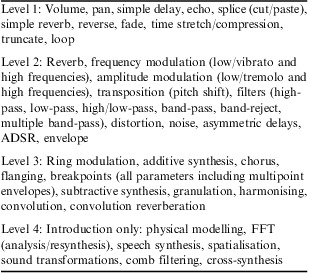
The making section of EARS 2 involves a number of levels (Table 1). Users can opt to start at level 1, working with few manipulation tools, and work their way upwards. This is reflected in the corresponding EARS 2 curriculum. The highest level is introduced in terms of description only – that is, for educational purposes. The reason for this is that these tools are so sophisticated that the user should ‘graduate’ to higher-level programs such as ProTools, Cubase, Logic and the like and/or Max/MSP, PD and Supercollider.
Learning levels and functionality: Compose with Sounds

Teachers can create a template for their students for a particular activity and upload the materials to their own host servers. They are therefore largely in charge of what their students can and cannot use at any given moment. Due to complex issues related to data protection and young people, not to mention rights, not everything uploaded to the site is available to the general public.
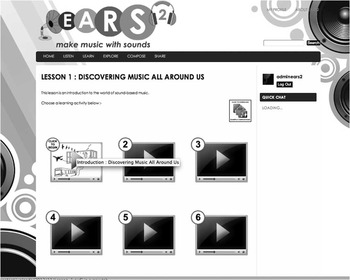
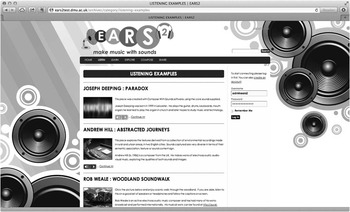
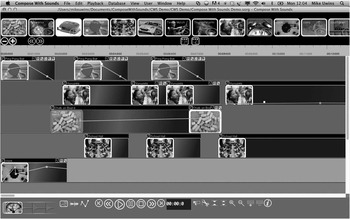
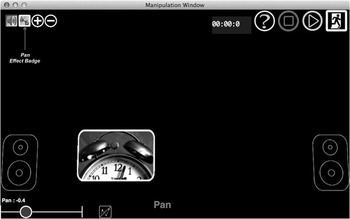
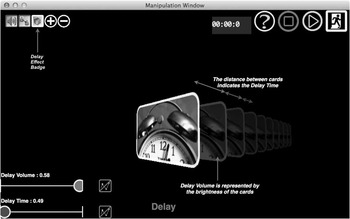
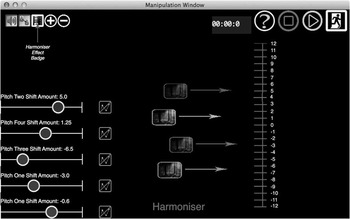
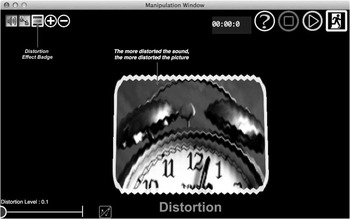
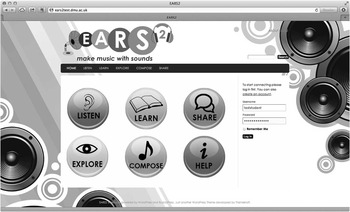
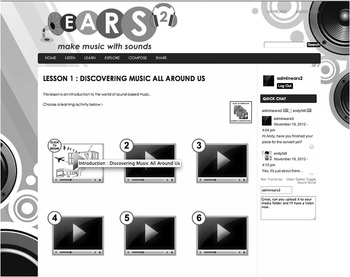
Figures 1–8 provide examples of the look of the EARS 2 site and the Compose with Sounds sequencer and manipulation windows. The manipulation tools have been produced so that they can be used as intuitively as possible.
EARS 2 prototype lesson 1 screen.

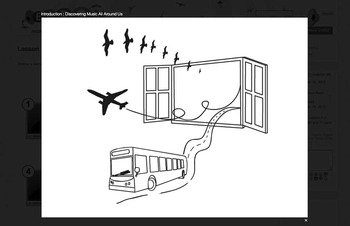
EARS 2 still image by Manuella Blackburn demonstrating the animation house style.

EARS 2 prototype page focused on listening examples.

Compose with Sounds: sequencer with sound cards.

Compose with Sounds: panning.

Compose with Sounds: simple delay.

Compose with Sounds: harmoniser.

Compose with Sounds: distortion.

3.1.4. Cultural conditioning
Compose with Sounds was developed as part of the EU project. The exciting part of its being developed in this manner was that it was immediately translated into five languages beyond English and it was disseminated widely very quickly. It was tested in several schools in six countries, where schools and public concerts were offered alongside workshops for teachers, thus ensuring that the team had user feedback from across Europe. These translations were a relatively easy task. ‘Translating’ the rest of EARS 2 is a more sophisticated endeavour, as adapting the site needs more than just different words. Sounds and sound examples related to the cultures should be used in introductions. In fact the site deserves to be fully culturally adapted, taking diverse educational approaches into account as best as possible. This is our intention as the site becomes increasingly multilingual.
3.1.5. Navigation
Developing options for navigating within EARS 2 is a very important subject, in particular when one goes back to the questions regarding the difference between classrooms. There are basically three means of navigation within EARS 2: teacher led, pre-programmed thematic and pre-programmed subject pathways, and ‘à la carte’ – that is, chosen fully by the user.
-
1. Teacher-led: following the basic premise that teachers will often want to construct their own programme for students, EARS 2 offers the ability to choose subjects and, where relevant, the amount of depth per subject. In this way students can follow a mini-course; those with more time and curiosity will be able to branch out in the site whilst others can stick to the core subject requested.
-
2. Pre-programmed: when not working in a classroom situation, individuals are able to decide whether to opt for pre-packaged ‘syllabi’, such as by level of a specific subject such as acousmatic music or theme such as manipulation tools, and are thus guided through the chosen pathway. One such package corresponds completely with the three levels of the software.
-
3. ‘À la carte’: other users may decide, either due to their not wanting to opt for either of the above choices or due to the fact that they may possess prior knowledge, to have the entire site on offer and simply choose pages or subjects at random.
Through this set of options, the intention is that each EARS 2 user will not feel that too much knowledge or too many options are presented to them at once. Consequently, the availability of a range of schema should mean that users do not have to overcome their fear of having to work their way through daunting decisions.
As stated above a good deal of the pedagogical concepts have been tried out online and in the classroom by De Montfort University PhD students. In particular Wolf (Reference Wolf2012) spent three years working on optimising approaches for the age group in a diversity of schools in and around Leicester. Her tests and analysis of the need to offer less freedom to inexperienced students than one would have imagined, alongside the content she developed, have informed the team carrying her work on the prototype forward immeasurably.
3.1.6. EARS 2 and teachers
One of the team's main concerns is related to the development needs of the teachers using EARS 2. Very few will have been trained in teaching young people any form of composition or experimentation with music, and fewer still the music of sounds. It is our view that teachers should be able to feel at least as much ‘at home’ with any corpus of music they are teaching as their students. Therefore different types of support are on offer.
With this in mind, the site has been made in a way that is intended to allow teachers to educate themselves prior to their teaching. The wealth of subjects, repertoire examples and pathways should provide them with all that they need. For those wanting further support, there are two other options related to the project beyond on-site support. Firstly, Landy (Reference Landy2012) has written a book associated with EARS 2 specifically for teachers, but also of use to anyone inexperienced in the area, Making Music with Sounds.Footnote 7 This volume, however, is not intended to cover all of the subjects available of the site, and instead it focuses on aural awareness, basic techniques and creative opportunities within sound-based music. Its structure identifies one potential EARS 2 pathway: aural awareness, by way of soundwalks including identifying sounds and their qualities; which sounds can be used in a musical context; creating musical gestures and sequences; and creating short musical works. It also presents issues related to the commonalities and differences between note- and sound-based music. The book includes dozens of ‘activities’ that can be undertaken by individuals or class groups with very modest means or highly equipped studios, whether they are beginners or more advanced students. Making Music with Sounds, like EARS 2, makes no assumption regarding the experience of the students or length of time available for the subject. Furthermore, the team is also currently writing teachers packs for additional support that, once completed, will be available by subscription.
3.2. Enhancing learning through technology
The impact of technologies on learner engagement is a central focus of research (Futurelab 2009; Ravenscroft Reference Ravenscroft2009; Facer Reference Facer2011; Selwyn Reference Selwyn2011). In particular, educators have been re-thinking the educational implications of enhancing learning through technology, in terms of the development of personalised, user-controlled learning environments (Anderson Reference Anderson2007; O'Donoghue Reference O'Donoghue2009); social learning environments and massive open online courses, or MOOCs (McAuley, Stewart, Siemens and Cormier 2010); and monitoring student performance and interactions through learning analytics (Siemens Reference Siemens2012). For some researchers, it is the ability of students to assemble and integrate a personally meaningful set of spaces, networks and tools that is critical in extending individual self-conception through self-efficacy (Hall and Hall Reference Hall and Hall2010). However, others (Pachler and Daly Reference Pachler and Daly2009) are more cautionary in stating that teachers need to recognise and support the specific technological strategies that more inexperienced students develop and implement.
What is clear is that the development of understanding, listening and making in a rich, technologically mediated space involves the creation of an environment that recognises the complexities of constructing narratives and authorship. Hemmi, Bayne and Land (Reference Hemmi, Bayne and Land2009) argue that the institutionalisation of social software supports learners in reclaiming innovation within traditional, safe paradigms. Here the possibilities for students in making their own sounds and interpretations can be supported through classroom mentoring. However, there is a risk here that students may steer clear of innovation, rather than developing a curriculum that is modelled upon personal integration and social enquiry (FutureLab 2009), and which enables learners to move in excess of themselves in appreciating and making their own creative artefacts (Neary and Hagyard Reference Neary and Hagyard2010).
In this process of using technology to enable students to produce or make their own work, makerspace projects (Makerspace 2012) offer a way of viewing the production of an integrated curriculum space, which connects social tools to resources and activities for personalised learning. Here, the development of individual self-efficacy (Bandura Reference Bandura1977) inside social learning environments highlights the importance of structured, personalised opportunities for developing mastery in new learning situations (Piaget Reference Piaget1926; Vygotsky Reference Vygotsky1962). Critical in this process of making is the ability to work across disciplines, and to make sense of the world through hacking or cracking established pieces of work. This process of working is tied to individual projects that are motivating because they are personalised, or tied to personal learning outcomes. In this space self-efficacy is critical in explaining an individual's perception of his or her own ability to perform general and domain-specific tasks (Parajes and Schunk Reference Parajes and Schunk2001). However, these issues have received limited attention in research related to education and technology to date (Hall and Hall Reference Hall and Hall2010).
A connected strand that is important here is the ability for learners to collaborate online, and to gain credit for the outcomes that they have achieved or the skills they have developed. The Mozilla Badges initiative (Mozilla Foundation 2012) is a mechanism through which a student's developing repertoire of skills might be recognised and represented through awards that are badged. Learners can create their own badges or collect those created by peer-groups, including on established social networks such as Edmodo (2012). A key aim of the central EARS 2 initiative is to widen participation in the field. The chance to be able to earn and display badges that confirm their understanding of, and practical skills in, electroacoustic music composition would be an additional motivation for the students. Their badges can be displayed in their online collections, or ‘backpacks’, so called as they hark back to the practice of sewing or pinning badges to one's school bag. In this way, badges would not only act as a further motivational tool, but also serve to advertise the subject, and the site, to others within the Open Badges community, a key facet of the sustainability of the project.
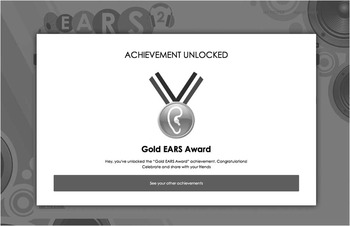
The current revision of EARS 2 uses Courseware's ‘Achievements’ module to recognise and reward student success, offering a number of badges on completion of each level of the curriculum (Figure 9). Teachers can also create and add their own badges (e.g. ‘best in class’) and award these at their own discretion. Although, at present, badges are only visible to other members of the EARS 2 community, there are modules currently in development that will allow full integration with Mozilla Open Badges, thus allowing students to proudly display their achievements to the world.
An EARS 2 prototype badge image.

These forms of accreditation are important where learners are engaging with educational technologies that are more open in nature, and perhaps less proscribed in their outcomes. Neary and Winn (Reference Neary and Winn2009) have developed the idea of student-as-producer for higher education, as a demand for re-forming the role of students inside education as makers or producers of their own lived experiences. For Neary and Winn the key idea is to enable students to describe more revolutionary possibilities embedded within the social relations of education, and to challenge orthodoxies though more open use of technologies. They stress the significance of the student actively producing their lived experience, with the production of a repertoire of understanding and creating as a central pedagogic expectation for any educational intervention. This is deliberately in opposition to the mere consumption of knowledge, and scaffolds the process of producing or making through a constructivist paradigm, where technologies are used to enable expertise and activity to develop. In this process the student learns to become in excess of him- or herself, as a truly social being, who is able to listen, comprehend, make and remix, rather than simply emerging as an institutionalised agent (Neary and Hagyard Reference Neary and Hagyard2010).
Thus, these ideas of student-as-producer and developing a pedagogy of excess are geared to individual mastery inside social spaces that require communal problem-solving and transformation. By integrating these concepts technologically, through open tools such as Edmodo and Drupal, and with a focus on making and accreditation through badges, it is possible that students will be able to develop their own literacies in digital technology and electroacoustic music. The challenge is to work with teachers to frame a set of curriculum activities in both the digital and real-world space that make sense to students as they engage with understanding, listening and making, in each of the above-mentioned EARS 2 pathways.
At this point, it is useful to make a distinction between EARS 2 and existing virtual learning environments (VLE), which are now often seen in schools, colleges and universities (e.g. Blackboard, Moodle). These latter systems are more commonly used to support subjects, courses or modules primarily delivered in a more traditional classroom environment. Although a series of guided school workshops will be delivered as part of the EARS 2 initiative, the objectives of the site are more in line with that of a distance learning programme, where the curriculum and its associated activities should be able to be delivered and assessed entirely via the site.
The social networking or communicative elements of the site, tied to its co-authored or shared content, mean that EARS 2 would be better defined along the lines of a MOOC (McAuley et al. Reference McAuley, Stewart, Siemens and Cormier2010). Once fully implemented, it is envisaged that there will be a large number of users of various ages, cultures and abilities accessing the site, working through the curriculum at their own depth and pace, whether it be as part of a formal music education, or simply as a means to meet their own intrinsic motivations.
Part of this motivational driver crystallises around social networking. Preliminary research undertaken with a group of Year 9 pupils (13–14 years old), studying at one of the schools selected for the UK workshops, revealed that, when asked to name their favourite website, all ten respondents gave the name of a social networking site; social activity is clearly a very important aspect of their online experience (Pachler and Daly Reference Pachler and Daly2009). To this end, the ability to chat and share ideas with their online friends would not be seen as an additional feature but more a prerequisite, and one very much expected to be part of their EARS 2 learning environment. This school recently completed an online collaborative project with their exchange school in Germany in which language students worked together to write stories (in both German and English) in real-time. Real-time interaction and communication between e-learners is as important as that which occurs in the classroom and there are many examples, such as the use of the ‘Musit Interactive’ (Seddon Reference Seddon2009) or F@ust Music Online (Dillon Reference Dillon2009) where the benefits and success of real-time collaboration can be seen.
There were many considerations to be made when deploying social networking tools, especially in mind of the site's target age group of 11–14. Rules that govern the usage of social media vary not only from country to country (Facebook's own terms and conditions were drawn up to adhere to US law and prohibit usage of the service for persons under the age of 13), but also from classroom to classroom. Each school will have their own guidelines that govern Internet usage during a class. This is another reason that, rather than take steps to completely integrate Compose with Sounds into EARS 2, it should remain a stand-alone application that can be installed locally onto the user's machine (although the software bundles, sound packs and user's mixes will able to be downloaded from and uploaded to the Compose with Sounds site). For the individual users of the software, this also means that they would not need to be connected to the Internet in order to compose, something that will be very important to anyone who may be composing on the move.
However, although the majority of EARS 2's learning resources will be freely available for all to view, only registered users will be able to generate user profiles and therefore participate in the chat rooms or forums. Furthermore, tutor-administrators must have it in their power to decide whether any given user will be permitted to interact with the students under their supervision. This is the ‘walled garden’ approach that is already adopted in Edmodo and Twiducate (Edmodo 2012; Twiducate 2012), social networking sites which are specifically designed for educational usage.
Having defined and discussed the primary requirements of EARS 2, we now move on to the question of design and how to create a system that includes all desired features, whilst appealing to our young target audience. As has already been stated, in order to ensure that the site is relevant and meets the needs of individual learners, the site needs to offer the possibility for customisation by the teachers themselves. In addition, we also must consider the ‘back-end’ functionality required to maintain a multi-user, multimedia learning environment.
To facilitate all of the above, the Wordpress content management system (CMS) was chosen as the basis for the EARS 2. Wordpress is a free, open-source platform that was originally designed as simple blogging tool, to enable users to publish their own online journals and simple web pages, without requiring specialist knowledge in HTML. In the years since, it has developed into a full-blown CMS, facilitating the development of websites, for every purpose and of all levels of complexity.
The platform is highly customisable, allowing any site to be themed and designed according to established good practices for general web usability (e.g. Krug Reference Krug2006) and specific considerations for young users (Nielsen Reference Nielsen2010) (Figure 10). It has grown into the most popular blogging and website development platform, with a current worldwide estimate of 57,877,130 sites being reported as having developed in Wordpress.Footnote 8
EARS 2 prototype's user-friendly design.

This enormous user-base has fostered a large and very active community of software developers. At the time of writing there are just over 22,000 user-contributed modules which can be downloaded and installed and that expand core functionality. The ‘Buddypress’ module has been particularly important for the development of EARS 2. Buddypress is in essence a set of additional features, which can transform any site built in Wordpress from a single-user experience to a multi-user, interactive and collaborative one. Additional tools include forums, chatrooms, collaborative documents, shared media folders and many others. Users can also customise their profiles, adding information about themselves, a nickname and their own user picture (or avatar).
However, it is the recent development of the Buddypress Courseware plug-in, which has really opened up the possibilities for using Wordpress as a MOOC. Courseware expands on the features above by allowing the teacher to organise his or her students into specific groups, deciding upon the exact nature of their learning programme. A user-friendly administration interface provides educators, to create and upload additional, bespoke learning materials, even if they have no experience of building and administering websites. Tracking and assessment of student progress can be done using formal tools (e.g. the included ‘gradebook’) or, alternatively, informal feedback may be given via any of the methods of communication offered by the site.
Figure 11 shows a Quick Chat window, enabling users to discuss any part of the curriculum, to comment on what they have heard in the listening rooms or simply to strike up a conversation with another online user. Instant feedback could also be given in this way and teachers will have the choice whether to use this feature in their classes. In situations where live chat is not deemed appropriate (e.g. discussion of compositions, requests for help or advice using software) moderated forums will also be implemented. The Forums module will allow tutor administrators to grant posting privileges, monitor messages and, most importantly, gauge whether a student is engaging with and understanding the course (Scott Reference Scott2012).
EARS 2 prototype lesson 1 window, including chat.

4. Closing Words
It has taken a long time, but EARS 2 has been a gratifying project. With time and many teachers’ and users’ feedback, the site will continue to develop, more resources for it will become available, more repertoire will be added, and so on. Hopefully EARS 2 will continue to be translated and made available to young people in schools and people of all ages in many more countries.
Many users have already sent feedback concerning the addition of live performance to EARS 2. This is indeed one of the next goals. Using controllers, new instruments and interfaces, Compose with Sounds should be further developed to enable live interaction. It should, one day, work with variable spatialisation formats and it should work with still and moving images (e.g. post-synchronisation). Another, related goal is to develop an Internet version of Compose with Sounds so that people can collaboratively create sound-based music online, as a form of online jamming.Footnote 9 Last, but not least, a tablet version is being discussed. Furthermore, turning things around, EARS 2 might influence the original EARS site whereby a new version for universities, colleges and academies or conservatoires, with a broader pedagogy, could be developed. This would be another huge, yet potentially globally important initiative.
In terms of its wider application, it goes without saying that the approach sketched in section 3 above could be applied, at least partially, in terms of other digital media projects within music and in other fields. The environment's approach and philosophy could be adopted to suit the needs of the subject area in question, in particular, focused upon:
-
1. the ability of students to define the repertoire of artefacts, tasks and tools that shape the boundaries of their curricula space;
-
2. the promotion of strategies through which inexperienced listeners can become makers, operating in internal and external social networks and associations; and
-
3. the ways in which new forms of accreditation might enable support and feedback for students to develop themselves and their subject-specific learning, and grow in excess of themselves.
There is still a risk that in the provision of defined frameworks some students will be marginalised. However, in working with teachers and students to frame a set of meaningful, digitally mediated curriculum activities, EARS 2 should enable students to engage with understanding, listening and making, in each of the EARS 2 pathways: teacher led, pre-programmed thematic and subject, and ‘à la carte’.