

1. Introduction
One of the central goals of the Patient Protection and Affordable Care Act (ACA) was increasing insurance coverage in the United States. Fundamental to achieving this goal was the expansion of the Medicaid program by increasing eligibility to any individual below 138% of the federal poverty level. While Medicaid expansion is a vital component to the ACA (Frean et al., Reference Frean, Gruber and Sommers2017), during debate and passage of health reform Congressional Democrats never ‘articulated a vision – or even just an explanation’ on the program (McDonough, Reference McDonough2011). This pattern of Democratic policymaker's silence on the Medicaid expansion was echoed by President Obama, who, when signing the bill into law in March 2010 never mentioned the Medicaid program (White House, 2010). Democrats didn't need to articulate a vision on Medicaid expansion because as the ACA was originally written, states would be required to adopt the program, or risk losing all of their federal funding for Medicaid. Republican policymakers expressed no such reticence at the specter of expanding the program, arguing the ACA ‘would consign sixty million Americans to a health care ‘gulag’ called Medicaid’ (Congressional Record, 2009).
The importance of policymakers framing their stance on the Medicaid expansion increased after the June 2012 Supreme Court case National Federation of Independent Business (NFIB) v Sebelius. In the oral arguments and briefs for the case, the plaintiffs argued that the Medicaid expansion was unduly coercive for states, while the federal government countered that the mandatory expansion fell within the purview of proper Congressional authority (‘Florida v. United States Department of Health and Human Services,’ 2012). The Supreme Court, which agreed with the plaintiffs on the coercive nature of expansion, surprised legal experts by allowing states to reject the Medicaid expansion without incurring any financial penalty (Rosenbaum and Westmoreland, Reference Rosenbaum and Westmoreland2012).
While the Supreme Court upheld the legality of the ACA overall, their ruling on the Medicaid expansion gave opponents of health reform leverage to undermine the effectiveness of the ACA. What had been settled by Congress and President Obama was now open for debate within 50 state capitols. The unexpected nature of the Court ruling allows for a rigorous comparative analysis of how policymakers framed their stance towards the policy and how those framing decisions varied between states and over time.
We focus on governors and their framing selection because they hold a unique position within the states. The opportunity to craft a response to the 2012 Supreme Court decision is an important manifestation of the governor's opportunity to go public in response to a policy and to manipulate and craft mass opinion, guide discourse and to frame the debate over public policy (Jacobs and Shapiro, Reference Jacobs and Shapiro2000; Kernell, Reference Kernell2006). However, even as the most visible policymaker in their state, governors' efforts to go public often have limited influence on the public. These limitations include the receptivity of the audience and the creditability of the policymaker (Brewer, Reference Brewer2001; Druckman, Reference Druckman2001). By going public, a governor can change public sentiment and force policymakers to your position (Kernell, Reference Kernell2006), but this influence is conditional on the popularity of the policy issue and shifts are often small (Canes-Wrone, Reference Canes-Wrone2001, Reference Canes-Wrone2015; Canes-Wrone and Shotts, Reference Canes-Wrone and Shotts2004). The limitations on going public are particularly acute when framing divisive issues, such as health reform and the Medicaid expansion, as it draws more attention to the policy and can stimulate opposition (Edwards, Reference Edwards2006).
Our analysis focuses on Republican governors because they offer a varied and nuanced response to the adoption of the Medicaid expansion. While prior research has documented the relationship between partisanship and adopting the Medicaid expansion (Jacobs and Callaghan, Reference Jacobs and Callaghan2013; Rigby and Haselswerdt, Reference Rigby and Haselswerdt2013; Jones et al., Reference Jones, Bradley and Oberlander2014; Haeder and Weimer, Reference Haeder and Weimer2015), the Republican response to the Medicaid expansion is far more complex than driven by just partisanship. While Democrats have uniformly adopted or supported the Medicaid expansion, more than a third of Republican-majority state legislative chambers have voted to adopt the program and 40% of Republican governors have supported expansion since the Supreme Court decision in 2012. A content analysis of Republican governor speech provides insight into the complexity of how policymakers frame their support or opposition of a controversial policy. We argue that the choice of frames by policymakers in federalist systems will shift in response to national political events, in particular national elections.
We document how Republican governors shifted their framing in response to the 2012 and 2016 presidential election, both of which posed distinct threats to Republican policymakers. Prior to the 2012 election, Republicans held out hope that a Mitt Romney administration would repeal the ACA before the Medicaid expansion adoption could be implemented. Republican governors were uniformly opposed to expansion during this time period, mirroring the stances of their Republican colleagues in Congress during passage of the ACA. After the 2012 election, we document how previously uniform opposition to adopting the Medicaid expansion split. Republican governors had to weigh the positive impacts of adoption of the Medicaid expansion with the threats of provoking other policymakers in their state and constituents. After the 2016 election, with Republicans retaining control of Congress and gaining the Presidency, Republican governors shifted their framing to account for the changing national landscape and the threat of ‘repeal and replace.’
This study asks how Republican governors framed their stance towards the adoption of a controversial health policy? Additionally, we seek to understand how this framing differed between governors and changed over time. Our analysis provides insight into the complexities of how a subset of policymakers, Republican governors, had to grapple with a contentious policy in a hyper-partisan and polarized political setting. Policymakers continue to grapple with how to frame their stance towards health policies in the United States. Health care remains one of the most important issues for the public and both Republican and Democrat policymakers continue to debate the future directions of health policy.
1.1 Framing public policy
Ideas shape public policy, and within a federated polity, policymakers in the state have increased influence in policy debate nationwide. Much of the prior literature on political framing has examined national trends in Congress, the Executive and the Judiciary (Jones and Baumgartner, Reference Jones and Baumgartner2005; Peake and Eshbaugh-Soha, Reference Peake and Eshbaugh-Soha2008; Birkland, Reference Birkland, Fischer, Miller and Sidney2007). There has been less focus on understanding rhetoric and framing at the state level (Coffey, Reference Coffey2005; Carpenter and Hughes, Reference Carpenter and Hughes2011; Heidbreder, Reference Heidbreder2012).
Prior research suggests that the media and political elites use ideas to influence the public through agenda setting and framing (McCombs and Ghanem, Reference McCombs, Ghanem, Reese, Gandy and Grant2001; Hopmann et al., Reference Hopmann, Elmelund-Præstekær, Albæk, Vliegenthart and De Vreese2012). Agenda setting is the intentional emphasizing of some issues over others, often achieved by increasing the frequency or prominence of statements (Weaver, Reference Weaver2007). No governor could ignore addressing the Medicaid expansion, but through the use of their agenda setting powers, governors could choose to emphasize particular components of the adoption decision (Scheufele, Reference Scheufele2000). This power of agenda setting allows for individual policymakers to limit the scope of debate to a particular set of facts or policies that the governor is most comfortable using.
Framing, on the other hand, influences how audiences think about issues by invoking interpretive schemas that influence how incoming information is processed and interpreted (D'Angelo and Kuypers, Reference D'Angelo and Kuypers2010). In other words, it is a method for analyzing public discourse and understanding how multivalent issues are communicated and understood by the public. Framing involves both selection and salience (Entman, Reference Entman1993). In selection, a governor chooses which aspects of Medicaid policy to emphasize which will be most beneficial to advancing their preferred policy position and which facts they believe can be made important to the public. Governors can promote alternative definitions, causal interpretations or moral evaluations of the program. This connects selection with the second task of salience, or packaging the information in a way that makes it ‘noticeable, meaningful, or memorable’ to audiences (Entman, Reference Entman1993).
Recognizing the importance of the media's portrayal of health issues as an important area for advancing our understanding of public health and the politics of policy. Framing has increased in use and been applied to a variety of different areas of health services and health policy research. There is a growing literature on the connections between framing and chronic diseases, such as obesity (Lawrence, Reference Lawrence2004; Patchett et al., Reference Patchett, Yeatman and Johnson2014), type 2 diabetes (Gollust and Lantz, Reference Gollust and Lantz2009), mental health (Sieff, Reference Sieff2003; Klin and Lemish, Reference Klin and Lemish2008; Atia et al., Reference Atia, Grant and Elena2019) and HIV/AIDS (Wu, Reference Wu2006; Calabrese et al., Reference Calabrese, Underhill, Earnshaw, Hansen, Kershaw, Magnus and Dovidio2016), as well as infectious disease (Shih et al., Reference Shih, Wijaya and Brossard2008; Ribeiro et al., Reference Ribeiro, Hartley, Nerlich and Jaspal2018). Our work adds to this literature by focusing the method of framing analysis and applying it to the study of Medicaid expansion, which has been understudied in the literature of policy framing.
2. Materials and methods
2.1 Selection of governors
To study the public framing of the Medicaid expansion, we conducted a content analysis of statements published in two major newspapers from each state with a Republican governor who served between June 2012 and June 2018. Our final analysis included a speech from 43 governors from 33 states, including Republican governors who were serving at the time of the Supreme Court decision, as well as those who were elected in their state after the court decision (see Appendix). Of all the states included in our analysis, 25 had Republican governors for the entirety of the study; the remaining eight states elected a Democratic governor during some portion of the years between 2012 and 2018. Additionally, 16 states had the same governor over the entirety of the study period.
2.2 Data
Much of the public's knowledge about health and health policy comes from major media outlets (Brodie et al., Reference Brodie, Hamel, Altman, Blendon and Benson2003; Barabas and Jerit, Reference Barabas and Jerit2009; Yoo et al., Reference Yoo, Holland, Bhattacharya, Phelps and Szilagyi2010), particularly local news outlets. Analyzing newspaper coverage to understand framing is a strategy which has been employed by several previous studies (Hoffman and Slated, Reference Hoffman and Slated2007; Gollust and Lantz, Reference Gollust and Lantz2009; Gollust et al., Reference Gollust, Niederdeppe and Barry2013; Rose, Reference Rose2015). Our present study differs from this prior work in two important ways, which capitalize on the unique policy at the center of this project. First, many of these previous studies have focused on analyzing speech in only a few national newspapers, like The New York Times, The Washington Post and The Wall Street Journal. This approach misses subtle nuances which can emerge across and within states. Our approach seeks to capture differences in framing of the Medicaid expansion amongst Republican governors by sampling from a larger selection of newspapers that focuses on state politics and policies. Second, we cover a longer time period in our analysis. This extended time frame allows us to analyze changes over time in the use of rhetoric and framing over the second Obama term and the Republican response to Donald Trump's election and administration.
Newspapers were selected through the following criteria. First, using the U.S. Census Bureau designation, we identified the two most populous Metropolitan Statistical Areas (MSA) in each state. Second, the newspaper with the highest circulation within each of the separate MSA was selected, resulting in two newspapers representing each state (Alliance for Audited Media, 2017). The search was conducted using Newsbank and Gannett Newsstand databases. A standardized search was used: ‘GovernorLastName’ & ‘Medicaid’ for all newspaper coverage between 28 June 2012 and 31 June 2018.
2.3 Coding
After completing a search of the newspaper databases, the following inclusion criteria were used: (1) containing statements directly attributed to the governor, (2) containing statements directly pertaining to Medicaid expansion as part of the ACA and (3) printed as news articles or an editorial authored by the Governor themselves. Any editorial or opinion articles, letters to the editor or reader comments were excluded from the analysis.
Statements attributed to the governors were analyzed using a combination of provisional and open coding (Strauss and Corbin, Reference Strauss and Corbin1998; Miles et al., Reference Miles, Huberman and Saldana2014). To develop the provisional codebook, we developed an initial set of expected frames that a Republican governor might use to support their stance on the Medicaid expansion (Rozier and Singer, Reference Rozier and Singer2016). Using this initial codebook, we then independently reviewed a pilot sample of 100 articles to test the applicability of the codebook. We then compared the results of the independent coding and revised the codebook accordingly. After finalizing the codes, we independently coded 100 articles, resulting in an inter-rater reliability of 81% of the shared data. Areas where we disagreed in the application of a code were resolved through further refinement of definitions in the codebook. After all the documents were coded, we undertook axial coding, wherein once-distinct codes were subsumed into broader categories (Miles et al., Reference Miles, Huberman and Saldana2014). Governor statements were not limited to only one framing category in the coding and analysis. Rather, any statement included in the analysis that touched on different types of frames were included in each distinct category.
3. Results
3.1 Uniform opposition to expansion prior to 2012 election
Several themes emerge from our analysis of how Republican governors framed their stance towards the Medicaid expansion – initial uniform opposition to the Medicaid expansion splintered quickly in the wake of the 2012 election, governor's framing choice shifted towards supportive frames and the Trump administration and the threat of repeal and replace influenced governor frame selection.
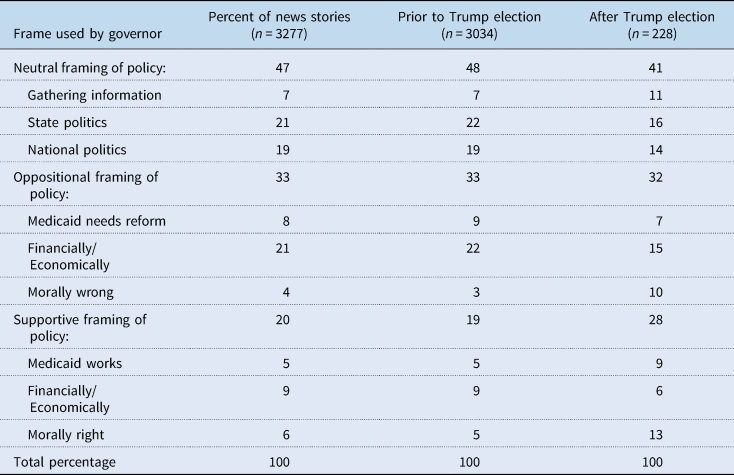
First, over time the opportunity to adopt the Medicaid expansion had a destabilizing effect on what had previously been uniform Republican opposition to health care reform. Over the entire period of the study the most frequent type of framing used by Republican governors was negative in nature (see Table 1). Negative framing of expansion took on a variety of different frames, with governors arguing that Medicaid needed reform, the negative financial impacts of expansion and the immorality of expansion, with economic arguments used most frequently.
Percent of news stories by framing category, June 2012–January 2018

Though negative framing was the most frequently type of rhetoric employed by Republican governors, the overall use of negative framing varied over time, with divisions emerging between Republican governors in how they describe their stance towards expansion. The use of negative framing was most frequently used during the period between the Supreme Court ruling in June 2012 and the presidential election in November 2012. During this period negative frames were 15 times more frequent than supportive frames. For example, during this time period, Governor Nicki Haley (SC) argued that adopting the expansion would leave the state ‘with the status quo – a broken, one-size-fits all program that will spend almost $6 billion next year in South Carolina while undeniably failing to improve the health of our people’ (Haley and Keck, Reference Haley and Keck2012).
While negative framing was most prevalent during this initial period of the study, no governors offered support for adopting the Medicaid expansion. Rather, several Republican governors who did not reject adoption of expansion in the immediate aftermath of the Supreme Court decision, the upcoming 2012 presidential election offered a chance to enter, as Georgia Governor Nathan Deal said, ‘a holding pattern’ (Teegardin and Williams, Reference Teegardin and Williams2012) on having to make a decision on expansion. Most of the Republican rhetoric that occurred during this time period reflected the unknown nature of the policy. Seven percent of all statements attributed to governors focused on waiting and gathering more information on the Medicaid policy, particularly on the effect of the 2012 election, with Republicans banking on the promise of Mitt Romney winning the election and repealing health reform. During the first 6 months after the NFIB v. Sebelius decision, there was no supportive framing towards the Medicaid expansion made by Republican governors.
3.2 Divisions in framing amongst republican governors
However, Obama's reelection victory in 2012 resulted in a splintering of Republican framing towards expansions. Governor Brian Sandoval (NV) marked the beginning of Republican support for adopting the Medicaid expansion and made an explicit connection to the 2012 election when he announced in December 2012 that ‘Obamacare is now the law of the land’ and that he had a responsibility ‘to do what is best for Nevada’ (Spillman and Vogell, Reference Spillman and Vogell2012). In 3 months after Sandoval's announcement, of the 30 sitting Republican governors, nine others also announced their support for expansion. After Sandoval came out in support of adopting expansion we find that 20% of all frames related to Medicaid were positive. Similar to oppositional framing, governors divided their supportive rhetoric into three categories: arguing for the efficacy of the Medicaid program, the economic benefit of adopting the program or the morality of the program. While each supportive governor varied in how they framed their stance towards the Medicaid expansion, overall these governors relied most frequently on the use of economic arguments. Governors emphasized the positive economic and financial benefits for individuals, business, health care organizations or as Governor Matt Mead (WY) did, with state budgets when he argued that failure to adopt the expansion would require the state to ‘cut more than $33 million from literacy, tourism, local government, senior centers and early childhood development – just so we don't have to expand Medicaid’ (Hancock, Reference Hancock2016). The use and frequency of positive economic framing provided political cover for Republican governors to use to convince policymakers and constituents to support a controversial policy in a language which was understood by members of the Republican Party.
Overall, we find that between 2013 and 2016 there is a wide-scale shift in how Republican governors frame their stance towards the Medicaid expansion. Unlike the period prior to the 2012 election, during the second Obama administration there were twice as many supportive as oppositional frames used by Republican governors to describe their stance towards adopting the Medicaid expansion. Part of this shift in framing is due to supportive governors who had failed to adopt the program continuing to push for expansion. For example, Gary Herbert (UT) who tried and failed to adopt the Medicaid expansion in his state for several years continued to work to convince the legislature to approve the program by telling them that ‘The choice before us is stark: We can either watch our hard-earned tax dollars remain on the table in Washington, D.C., primarily benefitting other states, or we can bring back a significant amount of our own money to Utah to be spent on Utahns’ (Gehrke, Reference Gehrke2015).
While some oppositional governors also no longer had to speak about adopting the program, during this time period there were still several state legislatures which continued to pursue Medicaid expansion against the stated wishes of the governor. From 2013 through 2016 the Nebraska legislature introduced a bill that would expand Medicaid in the state, which Governor Pete Ricketts opposed. Ricketts responded to these legislative efforts by arguing that expansion ‘will cost taxpayers millions and expose Nebraskans to unreasonable financial risk. Federal spending is out of control, and we cannot count of federal funding over the long term’ (Stoddard, Reference Stoddard2016).
With the 2016 presidential election looming, previously oppositional governors softened their stance towards Medicaid. For instance, Governor Robert Bentley (AL), who previously called the Medicaid expansion ‘truly the worst piece of legislation that has ever been passed in my lifetime’ (Chandler, Reference Chandler2012) shifted his policy framing to explore expansion because, ‘We lost. And we lost in court. So what we have to do now is move past that, take the resources we have available…and that's exactly what I'm going to do’ (Dean, Reference Dean2015).
3.3 The Trump effect and the post-2016 presidential election
The election of Donald Trump in 2016 shifted the ways in which Republican governors framed their stance towards the Medicaid expansion in response to the federal threat of repeal and replace. With Republican control over the presidency and both chambers of Congress, conservatives had their first serious opportunity to repeal and replace the ACA since it was signed into law in 2010. Trump encouraged those desires by calling on Congress during his first remarks to a joint session in February 2017, ‘to repeal and replace Obamacare’ and give ‘state governors the resources and flexibility they need with Medicaid’ (Trump, Reference Trump2017).
Prior to Trump's remarks to Congress, Republican governors were active staking out their position on what they wanted from their Congressional co-partisans in Washington, D.C. While governors transformed the way in which they framed their stance towards Medicaid expansion in response to the 2016 election, it also cemented their stance towards the program. For governors opposed to expansion, Trump in the White House opened the possibility of transforming the administration and financing of Medicaid with long-sought reforms to the program. Scott Walker (WI) echoed these hopes when he stated that Congressional Republicans should adopt ‘maximum flexibility through full block grants to each state’ (Wahlberg, Reference Wahlberg2017) before Congress began debating repeal and replace. Similarly, Nathan Deal (GA) reinforced this point by remarking that ‘the authority to make decisions regarding our state Medicaid program and how to design it in such a way that best fits the needs of our citizens will be returned’ (Bluestein, Reference Bluestein2017).
Yet, while Trump's remarks about repealing and replacing the ACA and giving governors flexibility was met with standing ovations by Republican in Congress, the actual process of developing legislation that would repeal and replace the ACA was met by criticism by Republican governors, particularly those who had adopted the Medicaid expansion. While each of the many failed Republican repeal and replace bills varied in important ways, they all would have ended the Medicaid expansion program and would place more financial burden on states to operate their Medicaid programs. During his 2017 State of the State speech, Michigan Governor Rick Snyder commented that it was important for the state to show Republicans in Washington, D.C. that ‘Healthy Michigan is a model that can work for the rest of the country’ and that the state and its Republican representatives should ensure that Congress did not act too rashly in doing away with the program. Or, as John Kasich (OH) put it, his fellow Republicans should not tell ‘700,000 people, “You have no health (care)”’ (Torry, Reference Torry2017).
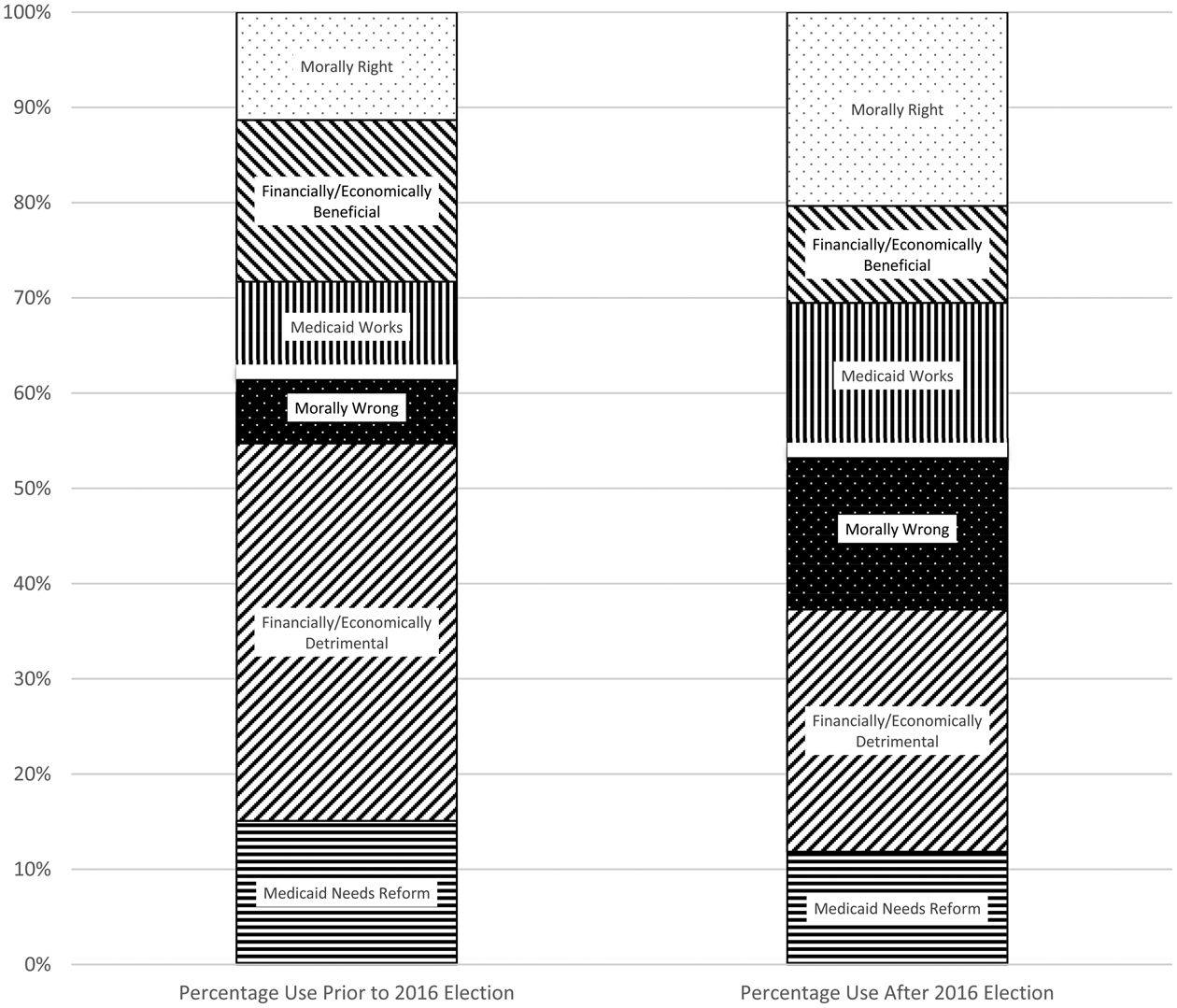
Even as financial concerns were raised by governors who had adopted the Medicaid expansion, both oppositional and supportive Republican governors shifted their framing strategies in the wake of Trump's election and efforts to repeal and replace the ACA and the new threat to their expansion programs (see Figure 1). Instead of focusing on the financial costs of benefits of expansion as had been the preferred framing prior to the 2016 election, Republican governors were more likely to use frames that focused on the morality of Medicaid. The use of moral language was not a new tactic for Republican governors. John Kasich (OH) often invoked his ‘personal faith and the lessons I learned from the Good Book’ and the importance of the state in not turning their backs on ‘those who live with the least among us’ (Higgs, Reference Higgs2013) during the Obama administration. Yet, after Donald Trump's election, the use of moral framing doubled in frequency. Governor Chris Christie (NJ) who had close ties with the Trump administration invoked this moral language to frame his continued support of expansion in the face of Congressional Republicans efforts to alter the program, remarking that he had ‘been lobbied significantly to be supportive of it [the Graham-Cassidy Bill] and I can't be supportive of it’ because when his state adopted the expansion, he did ‘the right thing to do for the people of the state’ (Arco, Reference Arco2017).
Shifts in framing after Donald Trump's Election (only oppositional and supportive frames are included in this figure).

For oppositional governors, the use of negative moral framing also increased in the wake of the Trump election. For these governors, the moral failings of adopting the Medicaid expansion focused primarily on the ‘worthiness’ of individuals for the program. The expansion of the program differentiated those that had the right to public welfare programs, like the aged, disabled and children, with the newly eligible. As Sam Brownback (KS) argued it would move ‘able-bodied adults to the front of the line, ahead of truly vulnerable Kansans’. This type of framing was echoed by Nathan Deal (GA) when he remarked that ‘when you give somebody something for nothing, it's going to be very difficult to take that away’ (Bluestein and Hallerman, Reference Bluestein and Hallerman2017).
To ensure that the shifts in framing selections made by Republican governors were not influenced by a changing set of elected officials, we analyzed the data by dividing the governors by the length of their administration over the study period. Governors were divided into two groups – those that served for the entire period of the analysis and those that served only a portion of the study. We conducted this analysis because the election of a new governor could signal a new mandate from the public and a new policymaker could make different rhetorical choices than their predecessor.
The results of this sub-analysis are focused on governors who served for the entirety of the study period, allowing us to determine the degree to which changing rhetoric is due to changing frame selection or due to a changing governor. We find that governors who served for the entirety of the study period reduced their use of oppositional framing after Donald Trump was elected. This decrease was driven by the reduction of frames related to Medicaid needing reform and the negative economic and financial effects of the Medicaid expansion, which decreased by 7 and 8% points respectively after Donald Trump was elected. The overall use of positive framing increased after the 2016 presidential election amongst Republican governors who served for the entirety of the study period. Similar to the trends in frame selection with the full sample of Republican governors, this change was spurred by increases in the use of frames on the effectiveness of Medicaid and the use of positive moral language, which increased by 8 and 6% points respectively after Donald Trump was elected.
4. Discussion and conclusion
We have analyzed how Republican governors framed their stance towards the adoption of the ACA Medicaid expansion and how this framing changed over time and responded to national political events. The Medicaid expansion has expanded coverage (Sommers et al., Reference Sommers, Blendon and Orav2016; Blavin et al., Reference Blavin, Karpman, Kenney and Sommers2018), improved health access (Griffith et al., Reference Griffith, Evans and Bor2017; Miller and Wherry, Reference Miller and Wherry2017) and provided economic benefits for state budgets, business, hospitals and individuals (Hu et al., Reference Hu, Kaestner, Mazumder, Miller and Wong2016; Freedman et al., Reference Freedman, Nikpay, Carroll and Simon2017; Sommers and Gruber, Reference Sommers and Gruber2017; Lindrooth et al., Reference Lindrooth, Perraillon, Hardy and Tung2018). Yet, in the case of adopting the Medicaid expansion, Republican governors faced political threats in how they framed their stance towards the policy.
Debate and passage of the ACA was marked by intense partisanship and so has the adoption of the components of health reform. Once the potential of electing a Republican to the White House was lost in 2012, many Republican governors shifted their framing selection, grappling with how to positively frame their support for expansion of a highly polarized and contentious policy. Governors who adopted the Medicaid expansion had to frame their support for the policy in a way that resonated with their constituency and their Republican colleagues in the Legislature. From 2012 through 2016 this was done by largely focusing on the potential economic benefits and costs of adopting the program. The reliance on economic framing lends itself to the traditional view of Republican policymakers, as well as representing the way which governors who supported expansion felt would be most persuasive for other state policymakers and constituents.
The election of Donald Trump presented a threat to Republican governors who had adopted the Medicaid expansion. Since its passage in 2010, Republicans had campaigned on the chance to ‘repeal and replace’ the ACA. Starting in 2017, with control over Congress and the Presidency, Republicans had the first real opportunity to repeal and replace health reform. What followed demonstrated the deep divisions amongst Republicans. Central to these divisions within the Party was how to handle the Medicaid expansion. Republican governors were key stakeholders in framing this debate. In response to this new threat to expansion, both supportive and oppositional governors changed how they would frame Medicaid expansion. The increased use of moral framing highlights how Republican governors shifted their framing tactics to appeal to their co-partisans in Washington, D.C. as a mechanism to ensure that repealing the Medicaid expansion would not be detrimental to their state.
There are several limitations worth noting in this study. First, we do not seek, nor does the nature of our data allow for us to determine a causal relationship between the use of frames and the outcome of Medicaid expansion. Only a handful of states allowed governors to unilaterally act in response to adopting the Medicaid expansion. Governors could not control the policy outcome in their state, but they could control the framing they felt was most prudent in achieving their preferred policy outcome. Second, our analysis is limited to a single actor in each state. Although there are compelling reasons to select governors for this analysis, they are one of many voices in the public square. Examining how other politicians, industry and community leaders and others would add to understanding how contested policies are framed across political parties and industries.
Lastly, there are tradeoffs in the selection of our media outlets for this analysis. We limit the sources of statements to major print newspapers in each state, in an era when the communication landscape is rapidly expanding beyond such media. While local newspapers have some of the highest rates of trust amongst the public (Barthel and Mitchell, Reference Barthel and Mitchell2017), their capacity to cover news, as well as their rates of circulation and revenue has declined over time. By focusing on local news coverage, we may be underestimating the total amount of speech made related to the Medicaid expansion because traditional news media is no longer covering these events with the same level of scrutiny as previously. Additionally, reporters and editors are the ones that determine what is newsworthy for publication and their view of quotations and stories to cover may shift over time, leading to the results we demonstrate here. The development and prominence of social media platforms allows for policymakers to provide unfiltered access to their thinking and to sidestep traditional news media to advance their policy stances. Future research endeavors could undertake an analysis of how policymakers use social media to frame their stance on a policy and how it differs from traditional news coverage.
The results of this study are important beyond the boundaries of the United States. Federalist systems of governance increase the importance of understanding how policymakers in multiple levels of government frame their stance towards a particular health policy and how changes in one level of a federal system reverberate in the framing choices made by policymakers. Additionally, understanding framing and rhetoric of health policies is particularly important in a hyper-partisan and polarized political environment. In the case of the United States, the failed Congressional efforts to repeal and replace the ACA, the Trump administration's efforts to devolve policymaking and the results of the 2018 midterm elections will make passing any meaningful reform nearly impossible. This continues to put the onus of policymaking on the state and places renewed importance on understanding how policymakers frame their stance on health policy.
Supplementary material
The supplementary material for this article can be found at https://doi.org/10.1017/S174413312000002X
Acknowledgements
We would like to thank the Martha and Ernst Hammel Graduate Student Research Award for their financial support of this project. We are also grateful for the research assistance of David McCredie, Jay Nautiyal, Jennifer Nguyen, Jerry Stott and Allyssa Stevens.