




No CrossRef data available.
On the Diachrony of Complex Predicates in Dutch: Predicative and Nonpredicative Preverbs
Published online by Cambridge University Press: 01 March 2004
Abstract
It has been hypothesized that separable complex verbs (SCVs, for example, ópzoeken ‘look up’) and inseparable complex verbs (ICVs, for example, doorzóeken ‘search’) form part of the same historical development, SCVs representing a stage intermediate to constructions with syntactic resultatives and ICVs. This paper shows that such a hypothesis is untenable, since many SCV preverbs and ICV preverbs are nonpredicative and thus semantically different from resultatives. Instead, it is claimed that predicative preverbs and nonpredicative preverbs result from two independent historical developments. In addition, the particular semantic and structural properties of SCVs are assumed to suggest a specific SCV structure, to be positioned in between syntactic phrases and morphologically complex words.I would like to thank Geert Booij, Hana Filip, Beth Levin, Andrew McIntyre, Ariane van Santen, and two anonymous reviewers for their valuable comments on earlier versions of this paper. Of course, any remaining errors are entirely my own.
Information
- Type
- ARTICLES
- Information
- Copyright
- © 2004 Society for Germanic Linguistics
Introduction
Two types of Dutch complex predicates are exemplified in 1–2: a particle verb, or separable complex verb (SCV), and a prefixed verb, or inseparable complex verb (ICV). Both types of verb consist of a preverbal element (a “preverb”) and a verb.
1This paper discusses only SCVs with preverbs that are homophonous with adpositions (prepositions and/or postpositions), such as op ‘up’ and af ‘off, down’. In addition, there are SCVs with nominal and adjectival preverbs (for example, ademhalen [lit. breath-fetch] ‘breathe, take a breath’, (geld) witwassen [lit. whitewash] ‘launder [money]’), but their formation is not productive. With ICVs, I refer only to prefixed verbs whose prefixes are homophonous with adpositions, such as door ‘through’ and over ‘over’, and leave out verbs with prefixes such as be-, ver-, and ont-. In addition, I do not discuss the formation of SCVs and ICVs with nominal and adjectival bases (for example, the SCV opleuken [up-nice] ‘liven up, brighten up’ and the ICV omlijsten [around-frame] ‘frame’), although I assume the preverbs in these complex verbs to have functions similar to the functions they perform in the SCVs and ICVs discussed in this paper.
The examples in 1 and 2 show that the preverb and the verb of an SCV are separated by V2, while the preverb and the verb of an ICV are not. Other separators of SCVs are the infinitival marker te (op te zoeken ‘to look up’ versus te doorzoeken ‘to search’) and the past participial marker ge- (heeft op gezocht ‘has looked up’ versus heeft doorzocht ‘has searched’).

The focus of this paper is on the diachronic relationship between SCVs and ICVs. It has been claimed that both SCVs and ICVs are grammaticalizations of resultative constructions such as de fiets oranje verven ‘paint the bike orange’ (Booij 2002a, Neeleman and Weerman 1992), and that ICVs represent a further stage of grammaticalization beyond SCVs (van der Auwera 1999, Booij 2002a, van Loey 1976). In this paper it is shown, however, that it is not plausible to assume one grammaticalization pattern for all SCVs and ICVs, since there are systematic semantic differences between SCVs and ICVs. The alternative proposal I advocate here is that two different grammaticalization chains are involved.
There are a few preverbs that show up in both SCVs and ICVs (aan ‘at, to’, achter ‘behind, after’, door ‘through’, om ‘around, down’, onder ‘under, below’, over ‘over, again’, and voor ‘for, before, to’). An SCV and an ICV with the same preverb are, apart from by their (in)separability, formally distinguishable by their stress pattern: Whereas in SCVs, main stress is on the particle (dóorknippen ‘cut through/in two’), it is on the verb in ICVs (doorzóeken ‘search’).3
In this paper I put an accent on the stressed syllable to indicate whether the relevant verb is an SCV (with main stress on the particle) or an ICV (with main stress on the verb) where necessary in order to avoid confusion.
Regarding the syntactic structure of SCVs, both word and phrasal analyses have been proposed.4
See, for analyses of SCVs in Dutch and in other Germanic languages, Booij 1990, den Dikken 1995, Lüdeling 2001, Neeleman 1994, Stiebels 1996, Stiebels and Wunderlich 1994, Toivonen 2003, Zeller 2001, among many other sources.
Also, as Booij (2002a: 209) shows, the fact that SCVs may feed derivational processes does not necessarily point to their word status, since (certain) phrases may feed derivational processes as well.

In general, syntactically independent elements in the VP (other than verbs) cannot appear in the verb cluster in (standard) Dutch. In this respect, then, particles seem to form more of a syntactic unit with the verb than other elements in the VP.
Other syntactic differences between particles and syntactic resultatives concern topicalization and modification. Whereas syntactic resultatives may be topicalized and may have modifiers, both topicalization and modification seem to be generally impossible for particles; there are only a few particles that allow both. All particles, however, can appear in the verb cluster (see 3a), and this seems to be the only structural property that all particles share. On the basis of these and other properties of particles (see section 3.1), I assume, with Toivonen (2003), that a particle is a nonprojecting word, that is, a word that does not project a phrase, to be represented as X (and not as X0 projecting an XP).6
According to Toivonen, these nonprojecting words are head-adjoined to the verb. As Toivonen (2003: 166–187) shows, English particles may have a different structure.
As opposed to what is the case for SCVs, ICVs, being inseparable, behave like prefixed verbs. They are assumed to consist of a prefix and a verbal head, forming a V0: [prefix-V0]v0.
The central topic of this paper, however, is not the syntactic structure of SCVs and ICVs, but their semantic properties and their diachrony. As noted above, it has been assumed that both SCVs and ICVs have developed out of constructions with syntactic resultatives (predicative XPs), ICVs representing a further diachronic stage beyond that of SCVs. The assumed structural pattern underlying this development is given in 4a and reflects the process of univerbation. As 4b shows, this development involves the loss of syntactic structure for the preverbal element, which develops from a fully projecting word via a particle into a bound morpheme.

These structural developments are claimed to be accompanied by the semantic bleaching of the preverb, which amounts to saying that ICV prefixes have more bleached meanings than SCV particles (which, in turn, have more bleached meanings than syntactic resultatives).
It is shown here that the data raise several problems and questions for the hypotheses represented in 4. Crucially, we see that not only syntactic resultatives, but also other elements may develop into particles, and that only some of the particle types resulting from this development may grammaticalize further into prefixes. In addition, we observe that the different particle types perform different functions in the semantic structure of the SCV construction, although all of these particles behave the same syntactically.
These results pose problems for approaches assuming an isomorphic semantics-syntax mapping, where structure and function necessarily go hand in hand. This is because in such approaches each distinct particle function would require a different syntax (the semantics being directly reflected in this syntax), which is not desirable in view of the syntactic similarities among particles.7
The necessity of assuming a different syntax for different particle types is, as a matter of fact, acknowledged by Ramchand and Svenonius (2002), who assume an isomorphic mapping and notice that there are particles that do not easily fit into their analysis. Although Ramchand and Svenonius seem to assume such particles to represent marginal types, I show that they are in fact not marginal at all, but productively combine with verbs to form SCVs.
The data can be accounted for by assuming that the mapping between semantics and syntax is not necessarily isomorphic. That is, the Lexical-Conceptual Structure (LCS, specifying the semantic relations between predicates and their participants) of a linguistic item is mapped onto its syntactic structure, but this mapping is not necessarily a one-to-one mapping. Instead, it is mediated by correspondence principles (compare Jackendoff 1997, 2002b; Bresnan 2001).
Furthermore, it appears to be useful to distinguish between two levels within the syntactic structure as is done in Lexical-Functional Grammar (Bresnan 2001): the grammatical function structure, representing relations such as subject and object, and the constituent structure, representing the X-bar-structural (morphosyntactic) realization of the elements involved. With respect to these representational levels my analysis of Dutch particles is similar to Toivonen's (2003) analysis of Swedish particles.
The historical path of grammaticalization hypothesized in the literature and the problems associated with it is discussed briefly in section 2. In section 3 the semantics of SCVs are investigated, and in section 4 the same is done for the semantics of ICVs. This leads to the conclusion that it is not plausible to assume that syntactic resultatives, all SCVs, and all ICVs form part of one and the same historical development, since SCVs and ICVs are, for the most part, semantically very different. In section 5 an alternative diachronic analysis is presented. Finally, section 6 summarizes the results.
Grammaticalization of SCVs into ICVs
In this section I discuss the general hypotheses found in the literature concerning the historical relationship between SCVs and ICVs, and some problematic aspects of these hypotheses. As noted in the previous section, it has been assumed that SCVs and ICVs have developed out of syntactic resultatives, ICVs representing a further diachronic stage in this development beyond SCVs. Following the literature on grammaticalization phenomena (Harris and Campbell 1995, Hopper and Traugott 2003) one could suppose that this development is accompanied (or triggered) by the semantic bleaching of the preverb. According to this hypothesis SCV preverbs would have more concrete meanings than ICV preverbs, which amounts to saying that the basic, spatial meaning of the homophonous prepositions/postpositions is assumed to be more clearly present in SCV preverbs than in ICV preverbs.
A look at a representative set of SCVs, however, shows that many SCV preverbs do not have concrete, spatial meanings at all. Some examples of SCVs with the particles op ‘up’, af ‘down, off’, in ‘in(to)’, and uit ‘out (of)’, which are the most frequent particles in Modern Dutch, are given in 5.

The particles in 5 do not express spatiality, and nonspatial meanings such as these are very frequent in SCVs. As we see in the next section, the particles in these SCVs do indeed contribute meaning to the verbal complex in a compositional way; they express figurative meanings that are derived from the basic, spatial meanings. The examples in 5 show that the loss of the preverb's spatial meaning is not a sufficient condition for it to become inseparable. I show below that it cannot be a necessary condition either.
In 6 below are some examples of minimal pairs of SCVs and ICVs that have been given to support the claim that the loss of lexical meaning is an important factor in the development of an SCV preverb into an ICV preverb (taken from Booij 2002a: 218).

However, if one takes a closer look at these particles and prefixes, the claimed semantic difference is not at all that obvious. For example, the lexical, spatial meaning ‘through’ seems to be present in both the ICV doorbréken, which I would translate with ‘break completely through’ instead of with ‘break’, and in the SCV dóorbreken ‘break in two/through’ (the ICV doorbréken is used in a context like de sleur doorbréken ‘break out of (through) the rut’). The preverb of the second ICV in 6 has a spatial meaning as well; it is used in, for instance, de hele cursus doorlópen ‘go through (do, complete) the whole course’.
Moreover, if one looks at a representative set of ICVs, spatial meanings appear to be present in the majority of ICVs (see section 4). A few more examples of ICVs in which this is the case are given in 7.

The preverbs in these ICVs express spatiality: In het huis doorzóeken ‘search the house’ someone goes through the house while searching, in het huis omgéven ‘surround the house’ something is around the house, and in het land overspóelen ‘wash over the land’ water is coming over the land. As these examples show, there are ICVs in which the preverb does not seem to have lost its spatial meaning. Apparently, then, the loss of spatial meaning is not a necessary condition for the development into inseparability to take place either.
On the other hand, many SCVs appear to have preverbs with nonspatial meanings, such as the ones in 5. An additional example is in 6b: the SCV dóorlopen ‘walk on’ does not have a spatial meaning, but instead has an aspectual meaning (expressing continuation, as discussed in section 3.3.4). In this case, then, the SCV preverb seems to have less lexical content than the ICV preverb, contrary to what we would expect to find on the basis of the literature on grammaticalization phenomena.8
It must be noted that this SCV form has a second meaning, which is spatial: dóorlopen also means ‘walk through’.
We thus conclude that the loss of the preverb's spatial meaning can be neither a sufficient, nor a necessary condition for the development toward inseparability to take place. Furthermore, a look at a representative set of SCVs and ICVs suggests that there are other semantic differences between the two types of complex verbs that are much more important. Some of these differences are illustrated in 8.

Whereas the result of the event described by the SCV in 8a is that THE CAKE IS THROUGH/IN TWO, a similar result phrase does not hold for the ICV in 8a: the result of dat Jan het huis doorzóekt ‘that John searches the house’ is not that THE HOUSE IS THROUGH in any sense, but, instead, the result is that JOHN HAS GONE THROUGH THE HOUSE. Similarly, the result of the SCV in 8b is that THE INFORMATION IS OVER (‘at the other side’), but the result of the ICV dat de rivier het land overspóelt ‘that the river washes over the land’ is not that THE LAND IS OVER, but that THE RIVER HAS COME OVER THE LAND.
These differences between the event structures of SCVs and ICVs are discussed extensively in the next sections. The important point for now is that there seems to be counterevidence for the hypothesis that all SCVs and ICVs form part of one and the same grammaticalization chain, since there appear to be important semantic differences between certain SCVs and ICVs. In what follows we see that an alternative analysis, assuming two separate historical developments, provides us with a better account of the data. However, the assumptions underlying the grammaticalization hypothesis as such, concerning the loss of structure and semantic change, do appear to be tenable: Particles indeed represent an intermediate stage in the development from words into bound morphemes, and, correspondingly, SCVs are intermediate in the development from ordinary syntactic phrases (VPs/V-bars) into morphologically complex words (ICVs, that is, V0s).
In the next section the semantics of SCVs are investigated, after which, in section 4, the same is done for the semantics of ICVs.
The Semantics of SCVs
In the literature a distinction has been made between compositional and idiomatic SCVs, but linguists differ on the exact classification of SCVs in this respect. Before we can discuss the semantics of SCVs, it should be clear which SCVs may be considered to be compositionally formed and which may not, and therefore, the compositionality of SCVs is the focus of section 3.1. In 3.2 and 3.3, in succession, two different types of particles forming compositional SCVs are investigated: predicative particles and nonpredicative particles. Whereas predicative particles express a change of state predicate, nonpredicative particles have other functions, similar to those of adverbial modifiers, nonpredicative prepositions/postpositions, and so-called aspectual modifiers. The results are summarized in section 3.4.
Compositionality and the Structure of SCVs
The distinction between compositional (also called transparent) SCVs and idiomatic SCVs has been made by several linguists (for example, Hiltunen 1983, Jackendoff 2002a, Toivonen 2003, Wurmbrand 2000). As noted above, however, many SCVs are classified in different ways by different linguists and this variation is a consequence of the fact that different criteria have been used to diagnose the compositionality of an SCV. In this subsection I discuss some of these criteria and define the notion of compositionality with respect to SCVs. We see that the SCV system shows semantic regularities—particles productively forming SCVs—and that these regularities can be accounted for by assuming that SCVs have a structure of their own.
Often, a Small Clause (SC) analysis for particles has been assumed, according to which a particle is structurally and semantically identical to a syntactic resultative. Under such an analysis only those particles that behave exactly the same as syntactic resultatives form transparent SCVs. That is, transparent SCVs have particles that can be modified and topicalized, and that can be used in resultative copula constructions such as the one on the righthand side in 9.

However, according to these criteria there are only very few transparent SCVs, since only a very restricted set of particles can be modified and topicalized and can participate in the copula construction. As a consequence, the overwhelming majority of SCVs has to be assumed to be idiomatic in these analyses (such as the SCV opzoeken (up-search) ‘look up’, whose particle can neither be topicalized nor appear in the copula construction: *maar óp zocht hij de informatie niet ‘but he did not look up the information’, *de informatie is op ‘the information is up’.9
The particle op in opzoeken seems to allow modification, witness the acceptability of hij zocht de informatie helemaal op ‘he looked up the information completely’. However, helemaal in this construction apparently modifies the NP de informatie instead of the particle. This is illustrated by constructions with a plural NP; in that case, the modifier has to be plural as well: dat hij de boeken *helemaal/allemaal opzocht ‘that he looked up *the books completely/all the books’.
Importantly, though, such analyses cannot account for the semantic systematicity found among these “idiomatic” SCVs, that is, among SCVs with particles that do not participate in the above-mentioned syntactic constructions. SCVs with the particle op ‘up’, for instance, can be grouped into semantic classes, in each of which the particle has a particular function (called a “niche” in McIntyre 2001b: 15). For example, the meaning of op in opzoeken ‘look up’, involving perceptual/cognitive access (compare Lindner 1983: 126–127), shows up in a whole group of SCVs, including verbs such as opvragen ‘ask for’ and opbellen ‘call up’. Also, new SCVs in which op expresses this meaning are productively formed, such as de dokter oppiepen ‘beep (up) the physician’. In none of these combinations, however, does op allow the copula construction, and modification and topicalization are generally impossible as well, which shows that these syntactic tests are not informative with respect to the compositonality within the SCV system.10
In addition, the three tests mentioned do not in all cases show uniform results, that is, some particles can be topicalized, but resist the copula construction (for example, the particle uit ‘out’ in SCV uitvoeren: maar úit voert Angola veel koffie ‘but Angola exports a lot of coffee’ versus *de koffie is uit ‘the coffee is out, at its export destination’). It has furthermore been claimed that transparent SCVs have particles that express the basic, spatial meaning of the homophonous adposition (such as op in de tafel optillen ‘lift up the table’, where op means ‘upward, in the air’). However, this test conflicts with the copula test, most spatial particles resisting the copula construction (*de tafel is op ‘in the air, on high’), and particles allowing this construction generally expressing nonspatial meanings (for example, afmaken ‘finish’: het huiswerk is af ‘the homework is finished’ and opeten ‘eat up’: de soep is op ‘the soup is all gone, eaten up’). This last example shows another problem for the use of the copula construction as a transparency test: Whereas op ‘eaten up’ may be used in the copula construction, its English counterpart eaten up may not (*the soup is up ‘eaten up’), which would suggest that English eat up is less transparent than Dutch opeten. In my view, however, this acceptability difference does not indicate a transparency difference between the two SCVs, but shows that op ‘eaten up’, unlike its English counterpart, may project a phrase, thereby reflecting a fairly exceptional property of a few Dutch particle forms (see below).
Moreover, whereas particles show differences concerning modification, topicalization, and the use of the copula construction, there is another syntactic property common to all particles, namely, that they can appear in the verb cluster (compare 3a). On the basis of this, I assume the distinguishing structural property of particles to be that they are nonprojecting words (Xs) (see Toivonen 2003). From the particle's status as a nonprojecting word the modification and topicalization facts follow straightforwardly: Only a projecting word, forming a syntactically independent phrase, can host a modifier, and only phrases can be topicalized (compare Bennis 1991, but see Hoeksema 1991a, 1991b for an alternative view). Similarly, only syntactically independent phrases seem to participate in the copula construction. A second factor that may be relevant here is the dependence of a particle's meaning on its occurrence in SCVs; this meaning may not be available outside the SCV construction (see also below).
If we assume particles to be nonprojecting words, an obvious question is how to account for contexts in which particle forms appear to be XPs, such as dat hij de boeken helemaal afmaakte ‘that he finished the books completely’, in which af is modified and thus projects a phrase. I claim that in these contexts, as well as in topicalization and copula contexts, forms such as af are strictly speaking not “particles,” but XPs.11
Thus I assume af ‘finished’ to project a phrase in modification, topicalization, and copula contexts, which are available to only a few Dutch particle forms. Conversely, all contexts (both separated and nonseparated) that are available to all particles, such as the verb cluster contexts (see example 3a) and V2 contexts (see example 1b), can be accounted for by assuming particles to be nonprojecting words. As said, this nonprojecting status can also account for the general impossibility of particles to be modified, topicalized, and used in the copula construction (compare Toivonen 2003: 191, where it is claimed that a particle does not project unless it is modified).
Alternatively, it has been suggested that particles in general should be analyzed as being optionally projecting, relating their ambivalent behavior to Chomsky's (1995) Bare Phrase Structure (see, for instance, Zeller 2000). In such proposals, it is claimed that particles project a phrase in all separated contexts (V2, particle topicalization, etc.), but do not project in the nonseparated contexts (such as heeft opgezocht ‘has looked up’). A possible problem for such an analysis, though, concerns the fact that all Dutch particles are separated by V2 (and, optionally, in the verb cluster), which would, according to such an analysis, indicate their phrasal status, but that only very few of these assumed phrases can appear in modification, topicalization, and copula contexts, which would be expected to be more generally available to such (assumed) phrases.
In sum, assuming only those particles to form transparent SCVs that participate in syntactic constructions such as modification, topicalization, and the use of the copula construction, leads to the conclusion that the vast majority of SCVs are idiomatic, and would leave unexplained the semantic regularities showing up in these “idiomatic” SCVs. Alternatively, assuming SCVs to have a structure of their own different from that of syntactic constructions with resultative predicates (in having its own semantic properties and its own semantics-syntax mapping) is more insightful, since this allows us to account for the semantic systematicity within the SCV system. That is, in that case we can account for the fact that elements behaving syntactically different from resultative predicates nevertheless may be semantically similar to these predicates, and show compositionality.
Therefore, I define particles as those elements that may appear in the verb cluster, and whose forms may or may not be topicalized, modified, and used in the copula construction. Their X-bar structural representation is that of a nonprojecting word, forming a phrasal combination with a verbal head. At the grammatical function structure a particle is part of the verbal predicate of a clause (formed by the particle and the verb), which has a single subject and, if transitive, a direct object (and possibly also an indirect object). In addition, we see that particles may perform various functions in the semantic structure, so that SCV constructions may have different semantic representations (LCSs). For instance, a particle may be conceptualized as a resultative predicate selecting a participant to predicate over, or as an adverbial modifier not selecting any participant at all. Another relevant property of particles is that particle forms used in isolation may or may not express the same meaning as they do in SCV constructions.12
From the definition of particles it follows that open in dat hij de deur wilde opendoen ‘that he wanted to open the door’ is also a particle (but, in addition, it can be used as an XP), as are certain other adjectives that may appear in the verb cluster (for example, dat hij niet alles zou goedkeuren [good-judge] ‘that he was not going to approve of everything’) and cannot be modified (*dat hij alles heel goed keurde [lit. very good judged] ‘that he approved strongly of everything’). These adjectives are As (nonprojecting words) and express with the verb a unitary concept. Such A-V combinations are similar to N-V combinations referring to institutionalized activities, such as ademhalen (breath-fetch) ‘breathe, take a breath’, which may appear in the verb cluster as well (dat hij wilde ademhalen ‘that he wanted to breathe’). I assume that both NPs and APs may develop into particles over time, forming an SCV with a verb (but this is not a systematic process, SCV-formation with A/N particles not being productive across the board). See also Toivonen (2003: 88, 195), who compares these SCVs to noun-incorporating verbs and suggests a grammaticalization path. As mentioned above (note 1), A/N particles are left aside in this paper.
The semantic systematicity mentioned above involves functions such as op ‘perceptual/cognitive access’ showing up in classes of SCVs. These functions appear to be related to the basic, spatial meaning of particles like op ‘upward’ by mechanisms of semantic extension such as metaphor (see McIntyre 2001b: 16). The extended meanings of particles form a semantic chain, and to illustrate this, 10 gives one of the semantic chains assumed for op.

In some SCVs the particle expresses a meaning that can be classified into two or more categories, and those SCVs can be seen as the basis for the semantic extensions. For example, in opborrelen ‘bubble up’ and opduiken ‘dive for, bring to the surface’ something is moving upward and this may imply that it simultaneously surfaces. As a consequence, the meaning ‘moving upward’ may be extended to the meaning ‘surfacing’. This extended meaning may in, for instance, opduiken, be further extended to ‘becoming visible’, and may, subsequently, be generalized to other SCVs in which the basic meaning of op ‘moving upward’ is no longer available (for example, het eten opdienen ‘serve up dinner’).
Apart from the meanings in 10 op has meanings that form parts of other chains. For instance, the basic spatial meaning ‘upward’ may also be extended to ‘assembly of items onto something and thereby forming a pile’, which is present in, for example, de bagage opbinden ‘tie/bind up the luggage’ (up-bind) and de spullen opladen ‘pile/stack up the stuff’ (upload). This extended meaning may be further extended to ‘assembly of items in a single place for storage’, as in het speelgoed opbergen ‘put/stow away the toys’ (up-stow) (compare Lindner 1983: 147).
For each particle, then, several semantic chains can be assumed that group the SCVs with this particle into semantic classes and indicate how the extended meanings of the particle relate to its basic (spatial) meaning.
From the foregoing discussion it follows that SCVs such as opzoeken ‘look up’ and opbellen ‘call up’ are compositional, the function of op in these two SCVs also being present in many other SCVs and new SCVs with op expressing this same function being productively formed. But although these SCVs show compositionality, their meanings are not fully predictable from the meanings of their parts (for instance, the meaning ‘look up’ of opzoeken does not follow straightforwardly from the combination of the meanings of op ‘upward’ and zoeken ‘seek, search’). This is a consequence of the fact that both the particle and the verb may have extended meanings dependent on their occurrence in SCVs; for instance, the form op does not have all of the meanings in 10 when used in isolation.
What we see, then, is that the SCV meanings are both compositional and conventionalized, and in this respect SCVs fit in the class of idiomatically combining expressions of Nunberg, Sag and Wasow 1994. However, SCVs are idiomatically combining expressions with a special property: They have an open slot for the verb, thereby allowing their class to be extended. Thus an SCV is a partly lexicalized phrase whose left element is fixed with a particular nonprojecting word and whose right element is an open slot to be filled with a verb from a particular semantic class.13
Jackendoff (2002b: 173) treats English SCVs as constructional idioms in which the verb and the particle are fixed and there is an open slot for the NP (look NP up, screw NP up). However, this suggests that, for instance, all SCVs in which the particle op means ‘becoming accessible’ are essentially unrelated and that the commonality in their meanings is merely accidental. This analysis thus disregards the existence of semantic classes of SCVs with the same particle fulfilling the same function. Therefore, it seems better to adopt a template such as V NP up, and, thus, for an OV language like Dutch NP op-V, or simply op-V (see Booij 2002a: 214–215; 2002b). In this template, only the particle slot is fixed, the verbal slot being open and ensuring the productivity of SCVs. The template is associated with a unitary meaning, such as ‘cause NP to become perceptually/cognitively accessible by V’, to which the meaning of the selected verb is added in a consistent way. On the basis of such phrasal templates new SCVs such as oppiepen ‘beep (up)’ can be formed (see 10d). (I leave the details of the possible lexical representation of particles/SCVs as a topic for future work.)
The view on the compositionality of SCVs given above is formulated in Cappelle's (2002) definition of literal particles (that is, of particles that compositionally form SCVs), given in 11.

Most particles, then, compositionally form SCVs in the sense that we see groups of SCVs in which the same particle performs the same function (see Lindner 1983, Morgan 1997). Of course, there are also idiomatic SCVs, but these are very small in number. An example of an idiomatic SCV is je aanstellen (lit. oneself at-put) ‘make a fool of oneself’, in which aan expresses a meaning that is not found in other SCVs with the particle aan.
In what follows, we see that compositionally formed SCVs can be classified into two groups: SCVs with predicative particles (3.2) and SCVs with nonpredicative particles (3.3).
SCVs with Predicative Particles
As has often been claimed, many particles (but not all, see 3.3) are semantically similar to syntactic resultatives: They have a predicative function. As shown in example 3 above, however, particles and syntactic resultatives do not behave exactly the same syntactically.
Syntactic resultatives are assumed to have the LCS in 12a, and this is illustrated in 12b (the LCS is 12a taken from Spencer and Zaretskaya 1998, and ultimately from Jackendoff 1990; I have replaced the brackets of the by-phrase with curly brackets to indicate its adjunct status).

The resultative LCS (R-LCS) represents a complex event consisting of a causative outer event and an inchoative inner event. The inner event contains a change of state predicate (“W”), expressed by the adjective oranje ‘orange’. This change of state is assumed to constitute the eventive core of the construction; it is semantically primary. The change of state predicate predicates over a participant at LCS, which explains the transitivity of resultative constructions at the level of the syntactic structure: Resultative constructions often contain so-called unselected objects and fake reflexives, that is, direct objects that are not selected by the verb and cannot appear with this verb when the resultative predicate is absent. The change of state predicate provides the event structure of the construction with internal structure by imposing a boundary on the event: Change of state predicates are generally telic.14
SCVs with particles that are semantically (but not syntactically) similar to syntactic resultatives are assumed to have the LCS in 12a. This is illustrated in 13.

The particles in the examples in 13 are conceptualized as change of state predicates and the verbs as manner/means adjuncts.
The change of state predicates may vary from concrete to quite abstract; as we have already seen, particles often have metaphorically or otherwise extended meanings. Particular figurative meanings, however, do not show up in individual cases, but are usually present in many SCVs, so that the SCVs with a particular particle fall into semantic classes. For instance, the meaning of the particle in in 13d, ‘in a certain, desired shape/state’, is also present in SCVs such as de auto inrijden ‘run in the car’ (in-drive) and in the reflexive je inlezen ‘read up (on something)’ (inread).
It needs to be pointed out that the verbs in 13 express manner/means adjuncts regardless of their meaning in isolation. That is to say, although the base verbs tillen ‘lift’, brengen ‘bring’, zoeken ‘search’, and gooien ‘throw’ do not particularly express manners or means when used in isolation, they are interpreted as such in the SCV constructions in 13 (for example, 13c expresses the fact that someone causes the information to become accessible by means of searching).
We thus see that in the SCVs discussed in this section the particle expresses a result that it also expresses in many other SCVs, and the verb expresses the manner/means by which that result is attained (all of these SCVs, then, show compositionality; compare McIntyre 2002). In what follows, I refer to SCVs with the R-LCS as SCVs with predicative particles.15
Thus, in this paper the terms predicate and predicative do not refer to the property of licensing arguments/theta roles, as they do, for instance, in formal semantics. Rather, they are only meant to refer to the function of a resultative predicate (a syntactic resultative): A predicative particle is a particle that is conceptualized as a resultative predicate.
An example of an unaccusative SCV with a predicative particle is found in de kosten zijn opgelopen ‘the costs have increased (up-walked). An unselected object is present in 13d (compare *de schoenen lopen ‘walk the shoes’).
In SCVs with a predicative particle the mapping from semantics onto syntax is not isomorphic. At LCS, a predicative particle is an independent resultative predicate, conceptualizing a subject-predicate relation with the participant it predicates over (the core event): [THE TABLE goes UP] (by LIFTING). Syntactically, however, a predicative particle differs from a syntactic resultative predicate (compare the syntactic differences between particles and syntactic resultatives mentioned in the sections 1 and 3.1), its constituent structure being that of a nonprojecting word forming a phrasal unit with the verb. At the grammatical function structure, in addition, this phrasal unit functions as the unitary verbal predicate of the clause, the NP de tafel functioning as its direct object: [de tafel [optillen]SCV]VP.
The result of an event expressed by an SCV with a predicative particle is, for instance, that THE TABLE IS UP (‘in the air, on high’) or that THE INFORMATION IS OVER (‘at another place, at the goal location’) (indicated under each example in 13). These English copula constructions express the semantic relation of predicativity between the particles and the NPs of the constructions in 13. However, the Dutch phrases that would express these results are generally not syntactically wellformed, as has been noted in section 3.1 (for example, *de tafel is op ‘the table is in the air, on high’).17
As claimed in 3.1, this syntactic unacceptability is related to the particle's structure of a nonprojecting word (X) and to the fact that a particle's semantic content (for example, op ‘perceptually/cognitively accessible’) is dependent on its occurrence in SCVs and may not be available outside the SCV construction.
SCVs with Nonpredicative Particles
Although many SCVs have a predicative particle, there are also many SCVs with nonpredicative particles. These nonpredicative particles form transparent SCVs as well. I distinguish four semantic types of nonpredicative particles (although further research might reveal that there are more types to be found): Particles indicating an inferred reference point, orienting particles, path particles, and continuative particles. I show below that these particles do not have the function of a resultative predicate, but are, instead, semantically similar to adverbial modifiers, nonpredicatively used prepositions and postpositions, and so-called aspectual modifiers.19
It must be noted that all of the particle forms discussed in 3.3, performing nonpredicative functions, may also perform the predicative function discussed in 3.2. For instance, the particle voor may either be conceptualized as an adverbial modifier (as in de groenten voorkoken ‘precook the vegetables’, discussed in 3.3.1), or as a resultative predicate (as in een schort voorbinden ‘tie/put on an apron’).
SCVs with Particles Indicating an Inferred Reference Point (IRP Particles)
The particles in the SCVs in 14 below are not predicative.

As the asterisks indicate, the predicative phrases (that would indicate a predicative relation between the particle and the NP at LCS, according to which the referent of this NP is affected by a change of state expressed by the particle) do not apply: If one precooks the vegetables, this does not imply that the vegetables are (BE)FORE. Instead, it means that one cooks the vegetables before doing other things with them (or ‘beforehand’). The particle voor, then, is not a change of state predicate, but temporally relates the event of cooking the vegetables to another event, involving other things that need to be done with the vegetables (baking, frying, etc.). In this way, this other event functions as an inferred reference point. Similarly, over de vergadering napraten ‘discuss the meeting afterward’ in 14b does not imply that the meeting is AFTER/BEHIND, but that one discusses the meeting afterward, that is, after it has taken place. In this case, the inferred reference point (the event the particle makes reference to) is the meeting itself. In 14c, finally, het lied meezingen ‘sing the song along (with someone)’ implies that one sings the song at the same time as another event takes place, namely while someone else sings (or plays) the song (this event serving as the inferred reference point). I label particles with these functions “inferred reference point (IRP) particles.”
An example of a nontemporal IRP particle is bij ‘in addition to’ as it is used in het glas bijvullen ‘fill up the glass’. In this SCV bij expresses the fact that one adds something to a glass that already has been filled before: ‘fill the glass in addition to prior filling’, the prior filling event being the inferred reference point.20
This meaning of bij seems to be derived from its spatial meaning ‘close by, at’. The English translation of the Dutch SCV bijvullen, fill up, is not its exact semantic counterpart, since it contains a predicative instead of an IRP particle. These different particle functions (corresponding to different LCSs for the constructions in which they appear) entail a telicity difference. That is, whereas het glas bijvullen is not necessarily telic, fill up the glass, whose LCS contains a change of state predicate, is, as appears from the acceptability difference between hij vulde het glas een beetje bij ‘he filled bij the glass a bit’ and *he filled up the glass a bit (judgment by Andrew McIntyre, p.c.). Similarly, whereas the Dutch construction hij was de watertank urenlang aan het bijvullen ‘he was filling bij the water reservoir for hours’ has either a nonrepetitive or a repetitive reading, the English construction he was filling up the water reservoir for hours only has a repetitive reading. This is a consequence of the fact that up expresses a change of state predicate at LCS, thus imposing a boundary on the event. So although the lexical-semantic contents of the two SCVs are closely related to one another, these SCVs have different LCSs, their particles fulfilling different functions in these LCSs. These facts illustrate that crosslinguistic differences in particle forms might be unpredictable, but since these formal differences usually correspond to functional differences, they are not unmotivated.
IRP particles, then, seem to derive their meanings from temporal or spatial expressions (‘before/after/simultaneous with/close by X’). They make reference to another event (E), the exact content of which seems to be construed on the basis of information provided by the verbal base and the direct object referent. In so doing, IRP particles function at LCS as adverbial modifiers of the event expressed by the direct object and the verb: cook the food {before E}, discuss the meeting {after E}, sing the song {simultaneous with E}, fill the glass {in addition to E}. These particles do not influence the (lexical) aspectual properties of the sentence (for example, telicity), nor its argument structural properties, which follows from the fact that a construction containing an SCV with an IRP particle has the same aspectual and argument structural properties as a construction containing the corresponding base verb (the particle only giving semantically secondary information). The semantic structure of these SCVs is provisionally represented in 15 (the adjunct status of the adverbial modifiers being indicated by curly brackets), which actually represents four different (but related) LCSs for SCVs formed with the four IRP particles discussed in this subsection (voor, na, mee, and bij).

In SCVs with the semantic structure in 15 the verb and its arguments express the semantic core, while the preverb gives secondary information.
21Another IRP particle is over in de muur overschilderen ‘paint the wall {again}’, that is, ‘repaint the wall’, in which the particle relates the event expressed by the verb and its direct object (paint the wall) to that same event. In combination with verbs that express an event of writing, the function ‘again’ of over is reinterpreted as ‘copy’: de brief overschrijven can mean both ‘rewrite the letter’ and ‘copy the letter’.
SCVs with Orienting Particles
Examples of SCVs with orienting particles are given in 16.

In this category, too, the predicative phrases do not capture the intended meanings: The particles in 16 do not conceptualize change of state predicates affecting the participants, that is, neither de jongen, nor het publiek undergoes any change of state. The verbs in these SCVs generally denote intransitive activities, and the particles express the directions toward which these activities are oriented: The activity of looking is {oriented toward the boy} and the activity of talking is {oriented toward the audience}. These SCV constructions, then, are atelic (compare dat hij het publiek urenlang/*in een uur toesprak ‘that he talked to the audience for hours/in an hour’).
The lexical-conceptual properties of the particles in 16 resemble those of a preposition introducing a participant to express a stative, directional modifier with (LOOK {AT THE BOY}, TALK {TO THE AUDIENCE}). The semantic representation of these SCVs is given in 17.

Since orienting particles introduce a participant at LCS (y in 17), they have a transitivizing effect on the syntactic structure. Although both orienting particles and predicative particles (expressing the resultative LCS, discussed in section 3.2) introduce a participant at LCS, the LCSs of the constructions with these two types of particle differ in at least two important respects.
First, at LCS the relation between the particle and the introduced participant (which is syntactically realized as the direct object NP) is different in the two types of constructions: Whereas predicative particles hold a subject-predicate relation with this participant, this participant being the figure undergoing the change of state the particle expresses (for example, THE TABLE IS UP), the participant in a construction with an orienting particle is the conceptual ground (‘reference’) of this particle (ORIENTED TOWARD THE BOY). Consequently, the predicative paraphrases do not apply in 16 (*THE BOY IS AT).
Secondly, the two LCSs differ with respect to the part of the event structure that expresses the eventive core. As seen in 3.2, a predicative particle expresses (with the participant over which it predicates) the core event of an SCV construction, the verb being conceptualized as a manner/means adjunct. In the LCS of an SCV with an orienting particle, on the other hand, it is the verb that expresses the core event, the orienting particle (with its ground participant) being conceptualized as an adjunct modifying the activity expressed by the verb.
Los (to appear) and Booij (2002a: 216) point out that particles such as toe ‘toward’ in toespreken have the postpositional form toe instead of the prepositional form tot ‘toward’, and therefore call this particle a “postpositional particle.” Los posits SCVs with orienting particles to originate from PP-V constructions with postpositions. However, the postpositional constructions in Modern Dutch in which toe is used are circumpositional constructions expressing a telic path of the subject, such as naar de man toe lopen ‘walk up to the man’ (lit. at the man to walk). This means that these constructions are semantically very different from constructions with orienting particles.
In section 5.3.1 of this paper historical data clarifying the history of orienting particles are presented. The main point for now is that orienting particles are semantically similar to prepositions that select a ground participant to form a stative PP modifier with, this modifier expressing the direction toward which the action denoted by the verb is oriented. Formally, these particles seem to be similar to postpositions instead of prepositions.22
German SCVs similar to the Dutch SCVs in 16 are discussed in Stiebels (1996: 162–165) and McIntyre (to appear). Both analyses are similar to the one proposed here in that they assume orienting particles to be nonpredicative and to introduce a ground participant to form a (directional) modifier with at LCS.
SCVs with Path Particles
Some particles denote paths through or over the direct object referent of the construction; compare the examples in 18.
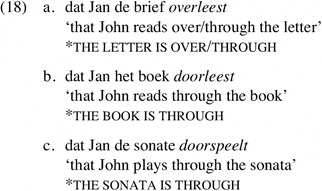
The particle in 18a does not predicate over the direct object referent at LCS: The result of dat Jan de brief overleest ‘that John reads over/through the letter’ is not that the letter is OVER/THROUGH. Instead, Jan metaphorically moves OVER/THROUGH THE LETTER. At LCS, then, the particle and the direct object referent express a telic path (through/over this referent) that is followed by the subject referent while performing the action denoted by the verb. Similarly, 18b expresses the fact that Jan goes THROUGH THE BOOK by reading, and 18c the fact that Jan goes THROUGH THE SONATA by playing. The telicity of SCV constructions with path particles is apparent from clauses such as dat Jan het boek in een uur/*urenlang had doorgelezen ‘that John read through the book in an hour/*for hours’).23
The construction with urenlang ‘for hours’ is acceptable with a repetitive reading, which supports the claim that it concerns a telic (bounded) event.
At LCS the referents of the direct objects in 18, being part of path expressions such as THROUGH THE SONATA, are the grounds of these particles, and not their figures. In this respect path particles are similar to the orienting preverbs discussed in the previous subsection (dat Jan de jongen aankijkt ‘John looks at the boy’).
The base verbs of SCVs with path particles are generally optionally transitive (de brief overlezen ‘read over/through the letter’, de sonate doorspelen ‘play through the sonata’) or intransitive (het probleem doorspreken ‘talk the problem over’. At LCS these particles select a participant to form a path expression with, and this participant introduction results in a transitivizing effect at the syntactic structure.
Although both path particles and orienting particles select a ground participant to conceptualize a directional expression with (THROUGH THE SONATA, AT THE BOY), the two classes of particles differ with respect to the function of that directional expression. As seen above, SCVs with orienting particles express (atelic) activities that are oriented toward a particular direction. This direction, conceptualized by the particle and the direct object NP, functions as a stative modifier (AT THE BOY) and does not express any dynamic progression along a path. However, the directional expression conceptualized by a path particle and the direct object NP (THROUGH THE SONATA) does indeed express such a dynamic progression, as illustrated above. The telic path (followed by the subject referent) along which this progression takes place is incremental: the progression of the event can be measured by looking at the progression of the subject referent along the path (the events in 18 being halfway implies their subject referents being halfway ‘over the letter’, ‘through the book’, and ‘through the sonata’; compare Jackendoff 1996).
Concerning their semantic properties, SCV constructions with path particles are similar to constructions with postpositions forming PPs that express telic paths, such as the one in 19.

The postposition construction in 19 expresses the path of the subject referent (John) through/over the direct object referent (Germany), as constructions with path particles do. I interpret this conceptual similarity as postposition constructions and SCV constructions with path particles having similar LCSs. This leads me to propose the provisional semantic structure for SCVs with path particles in 20, in which the directional path (THROUGH/OVER (y)) is telic.24
Following Levin 2000 and Levin and Rappoport Hovav 1999 I assume manner of motion verbs with goal phrases to represent telic, noncausative accomplishments.

Implicit in 20 is the assumption that the semantic core of SCV constructions with a path particle is the dynamic path of the subject referent through/over the direct object referent, the verb being conceptualized as a manner/means adjunct. Although the verb also functions as such in SCV constructions with predicative particles (discussed in section 3.2), the conceptual structure of these SCVs (given in 13) is clearly different from that in 20. The main difference is that a path particle is not conceptualized as a change of state predicate affecting the participant it selects (y), since this participant is the particle's conceptual ground instead of the figure undergoing a change of state the particle expresses.25
However, although path particles do not express a change of state predicate on their own, they do express a result state together with their ground participant, this result state (‘through the book’) being predicated over the subject referent (‘John ends up being through the book’).
On the basis of the semantic similarities between postpositional constructions and SCVs with path particles, I propose in section 5 that these SCVs have developed from postpositional constructions, thereby leaving their semantic structure virtually intact, but changing their morphosyntax (and certain properties of their lexical-semantic content). Historical data supporting such a diachronic relationship are presented in 5.3.1.26
In 5.3.1 differences between constructions like 19 and SCV constructions with path particles, such as the difference in auxiliary selection in the perfect tense (postposition constructions selecting zijn ‘be’ and SCV constructions selecting hebben ‘have’) and the fact that postposition constructions express actual motion, whereas SCVs with path particles may express either actual motion or metaphorical motion (‘John moves through the book by reading’), are also discussed.
In conclusion, path particles are conceptualized as postpositions that express, with their ground participant, a telic path through/over this ground, along which the subject referent metaphorically moves by performing the action denoted by the verb. These particles do not express a change of state predicate affecting the direct object referent of the construction, which means that they are semantically different from the predicative particles discussed in section 3.2.27
McIntyre (to appear) also claims that constructions with a path particle express a dynamic path through the direct object referent, but assumes this path to be followed by the event denoted by the verb and its subject (instead of assuming it to be followed by the subject referent): ‘John is reading and his reading goes through the book’. Nevertheless, the fact that it is John's reading that follows this particular path seems to imply that John is following this path while reading. In any case, despite the difference between McIntyre's analysis and my own our two approaches converge on what is at stake here, namely that path particles, as opposed to predicative particles (or, as McIntyre calls them, resultative particles), do not predicate over the referent of the direct object NP of the construction, this referent being not its figure, but its ground (see also section 5.3.1).
SCVs with Continuative Particles
Some particles contribute continuity to the verbal meaning, as the examples in 21 show.

These particles do not predicate over a theme participant at LCS as predicative particles do: 21a does not imply that John is door THROUGH/ON. In fact there is no theme in the constructions in 21, but only an agent.28
This is apparent from the fact that these SCVs select the auxiliary hebben ‘have’ instead of zijn ‘be’; they are unergative.
SCVs with door in this category may express the additional meaning ‘steadily, faster’, found in sentences such as Fiets eens door! ‘Bike on a bit!’, which can be seen as an extension of the continuative meaning.
At first sight, this “atransitivity effect” (as McIntyre [to appear] calls it) might appear to be brought about by a clash between the atelic (unbounded) Aktionsart of these SCVs and the telicity resulting from the presence of a direct object. However, such an account would not explain why indefinite plural direct objects are impossible as well (*dat Jan uren appels doorat ‘that John ate on apples for hours’), whereas the presence of such direct objects does generally not result in telicity (compare dat Jan jarenlang huizen bouwde ‘that John built houses for years’). Therefore, an aspectual account appealing to telicity or boundedness as such, as has been given by Stiebels (1996: 64–65), cannot explain the atransitivity effect satisfactorily.
Instead of telicity, directionality appears to be responsible for the atransitivity effect of continuative SCVs. This is illustrated in 22, containing a continuative PP and a direct object and showing the same kind of unacceptability as *dat Jan uren appels doorat ‘that John ate on apples for hours’ (compare McIntyre to appear).

The atransitivity effect in 22 appears to be related to a semantic clash: Either one just reads around (left and right), or one reads books, but one cannot simultaneously read left and right and read books. This is because reading books (more generally, reading any object) implies directionality, which is incompatible with the adirectional meaning of left and right (‘in an unstructured way’). Similarly, in *dat hij uren appels doorat ‘that he ate on apples for hours’ an iteration of apple-eating events is expressed, each of which involves the progression toward a goal, and this clashes with the meaning of the particle door, involving the absence of goal-oriented progression. These direct objects, then, introduce a directional component, which appears to be incompatible with the adirectional meaning of the continuative PP/particle.
Continuative particles express meanings such as ‘uninterruptedly’, ‘continuously’, and ‘without intended goal’. I label their function the “aspectual modifier” function. The provisional semantic structure of SCVs with a continuative particle is given in 23.

These particles, being aspectual modifiers, determine the aspectual structure (that is, Aktionsart) and the argument structure of the SCVs they form, SCVs with continuative particles always being intransitive and atelic.
As McIntyre (to appear) notes, a comparison of the continuative particles in the West Germanic languages (for example, Dutch door ‘through, on’, rond ‘around, about’, English on, about, around, along, German durch ‘through, on’, herum ‘around, about’) shows that all of these forms (some of which are historically unrelated to one another) have both the continuative function and a spatial, goal-oriented function (door THROUGH/ON TO THE NEXT POINT, rond AROUND). This can be accounted for by assuming the spatial function to be related to the continuative function by the same metaphorical extension in all of these cases; that from space to time. As is illustrated in section 5.3.1, constructions with door that express temporal directionality, which are metaphorically related to constructions with door expressing spatial directionality, appear to have been reanalyzed as continuative SCV constructions. As a consequence of this reanalysis, door does not express its directional meaning when used in a continuative SCV construction, but just the opposite, namely, adirectionality.30
Only forms expressing directional meanings appear to have developed into continuative particles, which is not the case for forms such as verder ‘further (away), more, longer’ and mee ‘(simultaneous) with’. These latter elements do not show the atransitivity effect: het lied meezingen ‘sing the song along’, het boek verder lezen ‘read the book further’. This is discussed more extensively in future work, where it will be shown that elements such as verder and mee are not conceptualized as aspectual modifiers, but as adverbial modifiers: sing the song {simultaneously}, read the book {further} (cf. 3.3.1). Future work will also discuss data such as *de taart doorsnijden ‘cut on the cake’ and *het boek doorlezen ‘read on the book’, which are unacceptable in a continuative reading, but not in a reading according to which door is a predicative particle (‘cause the cake to become in two by cutting’) or a path particle (‘read through the book’). It will be shown that the activation of such alternative functions, occurring when a direct object NP is added to a continuative SCV construction, results from the fact that the referent of the added direct object must be licensed at LCS, which neither a continuative particle, nor a verb in a continuative construction can take care of, but which can be done by a predicative particle or a path particle.
Although much more can be said about continuative particles, the relevant point for now is that these particles are not predicative in the Modern Dutch SCVs they form. That is, they are semantically different from the predicative particles in 3.2 that select a participant to predicate over. Continuative particles do not select a participant and these particles function as aspectual modifiers. The SCVs they form express durative, atelic, and a-directional events. Syntactically, SCVs with continuative particles are always intransitive.31
McIntyre (to appear) analyzes constructions with continuative particles as expressing continuous event paths. A brief comparison between his analysis and the one presented here is made in 3.3.6.
SCVs with Other Nonpredicative Particles
Some other non-predicative particles are exemplified in 24.

Again, the predicative phrases do not capture the intended meanings. In 24a the particle is conceptualized as an adverbial modifier, modifying the event expressed by the verb and the object: ‘sing the song {demonstratively}’. The meaning ‘demonstratively’ of voor in 24a might be derived from the temporal meaning of this particle, expressed in ‘sing the song beforehand/before someone else sings it’, which shows that this meaning is close to the IRP functions discussed in 3.3.1 above.
The ‘imitation’ meaning of na in 24b is also related to the temporal meaning of the particle (‘after’): Imitating someone implies repeating what someone else has already done. The semantic development in na ‘after’ > ‘imitation’ seems to be similar to the one described for voor above: ‘before’ > ‘demonstratively’. In both cases, temporal meanings seem to be extended to meanings that are not primarily temporal, and in the extended meanings, certain aspects of the original meanings are still detectable.
The provisional semantic representations for SCVs such as voorzingen ‘sing demonstratively’, and napraten ‘imitate by talking’ are given in 25.

The first representation is similar to the one for SCVs with IRP particles: The particle expresses an adverbial modifier at LCS. The representation in 25b is different, the particle introducing a participant (y), but here, too, the verb expresses the semantic core, the particle and its participant forming a modifier at LCS. The participant introduced by the particle is its ground: ‘after (y)’ > ‘imitating (y)’ (compare the semantic structure for SCVs with orienting particles in 3.3.2, according to which the direct object NP is also the conceptual ground of the particle).
It must be noted that voor ‘demonstratively’ may also introduce a participant, in the same way as na in 24b–25b does. At LCS, then, the modifier {demonstratively} seems to contain a participant slot that is, for instance, filled in dat ik Jan het lied voorzing ‘that I sing the song demonstratively for/to John (that is, I show John how to sing the song)’, where Jan is syntactically the indirect object of the SCV and semantically a participant selected by voor, expressing a benefactive relation: [VACTIVITY (x), (y) {demonstratively (for/to (z))}].32
Evidence for the claim that Jan is licensed by voor at LCS is provided by the fact that it is impossible to have this benefactive participant if voor is not present: *dat ik Jan het lied zing ‘that I sing the song to John’ is not acceptable in standard Dutch (but it is in certain Eastern and Northern dialects of Dutch, which have “ethical datives” or “datives of interest,” as does German). As we have seen, the benefactive function is not necessarily expressed (the ‘for/to (z)’ relation being represented as optional in the SCV's LCS); it is absent in dat ik het lied voorzing ‘that I sing the song demonstratively’, in which the particle voor expresses the meaning ‘demonstratively’. In dat ik Jan het lied voorzing ‘that I sing the song demonstratively for/to John’, then, voor seems to express both the benefactive relation ‘for/to (z)’ and the meaning ‘demonstratively’, the two functions apparently having collapsed in such constructions. (However, in dat ik het lied voorzing voor Jan ‘that I sing the song demonstratively for/to John’ the preposition voor expresses the benefactive relation, which in comparison with dat ik Jan het lied voorzing ‘that I sing the song demonstratively for/to John’ again illustrates that a particle and a preposition may perform a similar function at LCS, see 3.3.2.)
We thus see that the temporal particles voor and na may be conceptualized as a temporal modifier on their own (‘before event E’/‘beforehand’, ‘after event E’/‘afterward’), in which case the event they refer to must be construed from the information provided by the verb and its direct object (see section 3.3.1). Alternatively, they may be conceptualized as a temporal preposition, selecting a ground participant to express a temporal modifier with (‘before NP’, ‘after NP’). Both uses may be extended to nontemporal meanings, showing the same participant licensing properties. In the LCSs of all the SCV constructions they form the verb expresses the core event and the particle expresses (with the participant it selects, if it selects one) semantically secondary information.
Summary
Different categories of non-predicative particles, which all productively form SCVs, have been distinguished. These particles differ from the predicative particles in that they do not express a change of state that affects a participant they predicate over at LCS, and, correspondingly, do not uniformly have a transitive (or unaccusative) syntactic structure. Instead of having a predicative function, these particles may have various other functions, and, as a consequence, show different effects on the argument structure and the aspectual structure of the construction.
To begin with, IRP particles (as in de groenten voorkoken ‘precook the vegetables’) combine with both transitive and intransitive verbs and are conceptualized as adverbial modifiers. These particles leave both the aspectual structure (Aktionsart) and the argument structure of the base verb intact.
Orienting particles (as in het publiek toespreken ‘talk to the audience’), which attach to intransitive verbs, are conceptualized as prepositions selecting a ground participant to form a modifier with. This modifier indicates the direction the activity denoted by the verb is oriented toward, and as such, the particle does not change the Aktionsart of the construction. Because orienting particles introduce a participant at LCS, SCVs with these particles have a transitive syntactic structure.
Path particles (as in het boek doorlezen ‘read through the book’), attaching to either intransitive or optionally transitive verbs, always form transitive SCVs, as a consequence of the fact that in their semantic structure, as well, a participant is introduced. This participant is the conceptual ground of the particle, and expresses with the particle the telic, incremental path of the subject referent through/over this ground participant.
Continuative particles (as in dat Jan uren doorwerkt ‘John works on for hours’) function as aspectual modifiers, influencing the argument structure and the aspectual structure of the base verb in an important way: The SCVs they form are intransitive (unergative) and express atelic events (activities), no matter what the argument structure of the base verb is.
In addition, we saw a few particles with meanings derived from the meanings of IRP particles. These particles may be conceptualized as adverbial modifiers themselves, or may select a participant to form such a modifier with at LCS (het lied voorzingen ‘sing the song demonstratively’, de man napraten ‘imitate the man’). If a participant is indeed introduced at LCS, there is a transitivizing effect on the syntactic structure. These particles do not influence the Aktionsart of the verb.
The different types of nonpredicative particles may be classified according to the relations they hold at LCS with the verb and the participants of the event, leaving aside their exact lexical-semantic content. According to such a classification, nonpredicative particles may be conceptualized as adverbial modifiers (IRP particles and particles such as voor ‘demonstratively’, which do not introduce a participant), prepositions (orienting particles and other particles introducing a ground participant to form a stative modifier with at LCS), postpositions (path particles, which select a ground participant and express the dynamic, telic path of the subject referent through/over this participant), or aspectual modifiers expressing durativity without an intended goal (continuative particles).
From such a classification the effects that the addition of a particular particle may have on the argument structure and the Aktionsart of the construction follow straightforwardly. For instance, particles that are conceptually (that is, at LCS) similar to adverbial modifiers will not introduce a participant at LCS (since adverbial modifiers do not select participants), and therefore will not have a transitivizing effect on the syntactic structure. On the contrary, particles that are conceptually similar to prepositions selecting a participant will indeed have such an effect. Similarly, the telicity difference between, on the one hand, particles conceptualizing stative, directional modifiers with the ground participant they select (orienting particles: het publiek toespreken ‘talk to the audience’) and, on the other hand, particles conceptualizing dynamic, telic paths with the ground participant they select (path particles: het boek doorlezen ‘read through the book’) follows from the fact that PPs that syntactically realize these two semantic types of directional expression (talk [to the audience]PP, read [through the book]PP) show this telicity difference. These effects of argument structure and aspect, then, are not unpredictable, contrary to what has been claimed before (for example, Toivonen 2003: 150), but follow from the particle's function at LCS.33
McIntyre (to appear) also discusses different types of nonpredicative particles and assumes all of these to conceptualize “event paths,” that is, paths followed by the event. In his extended VP analysis of SCV constructions the different SCV types (showing argument structural and Aktionsart differences) require a different syntax (containing different light verbs). However, since the differences in question follow from lexical-conceptual differences, they should be located at LCS and not in the syntax (all particles behaving the same syntactically, see the remarks near the end of section 1 and in section 3.4). In addition, adopting an analysis according to which the different SCV types all express event paths would not in itself be incompatible with the classification of particles proposed here, according to which a particle is conceptualized as an adverbial modifier, an adposition licensing a participant, or an aspectual modifier (and from which the argument structural and Aktionsart properties of the different types of SCVs follow straightforwardly), since all of these elements could express event paths.
The Semantics of SCVs: Summary
The basic point of section 3 is that both predicative and nonpredicative particles productively form SCVs. In addition, we saw that one particle form may have different functions at LCS affecting the event structure and, consequently, the argument structure of the construction in different ways (for instance, the particle form door may function as a predicative, path, or continuative particle). As Stiebels and Wunderlich (1994) point out, the fact that a particle may have different functions explains why a uniform analysis of SCVs such as the resultative Small Clause analysis (assuming all particles to express resultative predicates) cannot explain the various argument structural and (lexical) aspectual effects, and the same seems to hold for a general percolation mechanism as is assumed in Neeleman and Weerman 1992.
There is, however, a clear motivation behind these uniform analyses, which is that despite their semantic differences all particles (both predicative and nonpredicative) behave in exactly the same morphosyntactic ways, that is, with respect to separability and the possibility to appear in the verb cluster. Thus in order to be able to account for the divergent argument structural and aspectual properties of SCVs, as well as for their uniform morphosyntactic behavior, a nonisomorphic mapping between the semantic structure of SCVs (according to which particles may be conceptualized as, for example, resultative predicates introducing a figure participant, adverbial modifiers not introducing any participant, or adpositions introducing a ground participant) and their constituent structure (according to which all particles are nonprojecting words) should be allowed for.
To reiterate, SCVs may contain either a predicative or a nonpredicative preverb. In the next section it will be shown that ICVs are very different from SCVs in this respect.
The Semantics of ICVs
Productive ICV Preverbs.34 As noted in the introduction, ICVs are assumed to be morphologically complex words consisting of a prefix (also called ICV preverb) and a verbal head: [prefix-V0]V0.
As noted in the introduction, ICVs are assumed to be morphologically complex words consisting of a prefix (also called ICV preverb) and a verbal head: [prefix-V0]V0.
There are only three preverbs that are homophonous with adpositions (prepositions and/or postpositions) and productively form ICVs in Modern Dutch: door ‘through’, om ‘around’, and over ‘over’.35
Other productive prefixes are be-, ver-, and ont-. I leave these prefixes aside and focus on the possible diachronic relationships between homophonous separable and inseparable preverbs (for example, door in dóorlezen ‘read on’ versus door in doorzóeken ‘search’).

As is illustrated in the paraphrases in 27, these ICVs contain nonpredicative preverbs.

The predicative phrases do not capture the intended meanings: It is not the case that, in 27a, the house ends up being THROUGH, meaning that door does not express a change of state affecting the house. Instead, the construction expresses the fact that Jan moves THROUGH THE HOUSE. Similarly, dat de rivier het land overspóelde in 27c does not express that THE LAND IS OVER, but that the river has come OVER THE LAND. This means that the direct object NPs in 27 are the conceptual grounds of the prefixes and not their figures, and that these prefixes are conceptualized as adpositions selecting a participant to express a telic path with (see 3.3.3). The semantic structure of the ICVs in 27 can be represented as in 28 (compare 20).

The examples in 27 show that the ICV preverbs have spatial meanings and that they do not in general have less lexical content than SCV preverbs, contrary to what may be assumed on the basis of the literature on grammaticalization phenomena in general (see section 2). However, as is shown below, the semantics of SCVs and ICVs with path preverbs differs in other respects.
All transparent ICVs with door listed in the van Dale dictionary express paths through the ground participant (appearing as the direct object NP). In most of these ICVs the path involves actual motion, although the base verb is not a motion verb in all cases. There seems to be a continuum from expressing actual motion to expressing a more abstract path; compare examples doorlópen (through-walk) ‘walk/go completely through’, doorzóeken (through-seek) ‘search completely (by moving through)’, (angstige ogenblikken) doorléven (through-live) ‘live through/spend (anxious moments)’. The end of the continuum is represented by two perception verbs, doordénken (through-think) ‘think through completely, reflect, consider’ and doorzíen (through-see) ‘see through completely’. Here the path is more abstract: haar bedoelingen doorzíen ‘see through her intentions’ > ‘see what she was up to’.36
It must be noted that the more abstract paths also occur in SCVs with path particles. Examples are het boek dóorlezen ‘read through the book’, het boek dóorkijken ‘look through the book’, and de sonate dóorspelen ‘play through the sonata’.
In the ICVs with om the prefix expresses a path of the subject referent completely surrounding the direct object referent (that is, the ground participant, compare 27b). These paths also vary from being concrete to being quite abstract. Some examples are omstúwen (around-stow) ‘crowd around completely’, omríngen (around-ring) ‘surround completely’, omsnóeren (around-snare) ‘put a string around X completely’, omlíjnen (around-line) ‘outline, draw a box around’, and omgrénzen (around-border) ‘enclose, fence in’. As these examples show, many ICVs with om have a nominal base. In many cases, too, the ICV has a stative reading that seems to be derived from an eventive one. This is, for instance, the case with omgéven ‘surround’ in 27b, which does not express the fact that the moat is moving around the castle, but that it is lying around it.
The prefix over ‘over, across’ has a path function (‘completely coming over the ground participant’, see 27c) in most ICVs (in fifty out of sixty ICVs in the van Dale dictionary). Here, too, the path followed by the subject referent can be concrete, involving actual motion (het land overspóelen ‘wash over the land completely’), or more abstract (het probleem overdénken ‘think over the problem completely’).
In the (ten) remaining ICVs with over the preverb is conceptualized as an adverbial modifier with the quantificational meaning ‘too much/many’ or ‘more than intended/allowed/necessary/good’. An example of this other (also nonpredicative) function of the prefix over is given in 29.

The result of the event het schip overláden ‘overload the ship’ is not that THE SHIP IS OVER, but that THE SHIP IS LOADED TOO HEAV(IL)Y. Other examples of ICVs in which the prefix has this adverbial modifier function with quantificational semantics are overpríkkelen ‘overstimulate’ and overvrágen ‘ask too much’. The semantic structure of such ICVs can be represented as in 30 (see 15 in 3.3.1).

The two nonpredicative functions of over are closely related to one another, and in nine ICVs with over that can be classified as expressing path semantics the quantificational reading is available as well. This is, for instance, the case with the ICV in 29: dat hij mij overláadde met cadeaus ‘that he overloaded me with presents’ could be interpreted as either conceptualizing a path (‘he loaded the presents over me’) or a quantificational modifier (‘he loaded me with presents and did this too much’ or ‘he loaded too many presents onto me’).37
Slavic prefixes similar to Dutch over show the same functional overlap between a path meaning and a quantificational meaning. As the Dutch example given here shows, the quantificational meaning itself may be ambiguous as well, in that either the action denoted by the verb or the referent of the direct object NP is quantified (that is, ‘too much loading’ or loading ‘too many presents’). In this respect, Dutch over is also similar to the Slavic prefixes (compare Filip 2000, p.c.). These synchronic ambiguities may reflect changes in progress, but in this paper I must remain agnostic about the exact historical relationship between the different meanings. The quantificational prefix might be historically related to the adjectival prefix over ‘very (much)’, present in overheerlijk (lit. over-delicious) ‘very delicious’, or to the nominal prefix over ‘too much’, present in overcapaciteit ‘overcapacity’.
To sum up the results of this section, most productive ICV prefixes express paths at LCS, and, further, the prefix over may also express an adverbial modifier with quantificational properties. This means that all productive ICV preverbs have nonpredicative functions, and in this respect the ICV system is very different from the SCV system.38
In addition, there are three ICVs with predicative over: overréden (over-*reason) ‘persuade’, overtúigen (over-*pull) ‘persuade’, and overhándigen (over-*hand) ‘hand over something’, in which over means ‘at/to the other side’ (for example, overtúigen ‘cause someone to go to the other side by pulling [figuratively]’). This function is not productive in ICVs; new ICVs with this preverb cannot be formed, and the verbal bases in these ICVs do not exist in isolation in Modern Dutch. Importantly, over ‘at/to the other side’ is productively used in SCVs (óverhalen [over-pull] ‘persuade’, óvergeven [over-give] ‘hand over’, and forty-four other SCVs in the van Dale dictionary). Thus this predicative preverb conforms to the general pattern of productive predicative preverbs occurring only in SCVs, and not in ICVs.
An important question is whether there is a systematic semantic difference correlating with the difference in separability between SCVs and ICVs with path preverbs. Indeed, there is such a difference: Whereas the path expressed by an SCV is one-dimensional (to be visualized as a line), the path expressed by an ICV is multidimensional (extending from one point into multiple directions). This semantic difference is illustrated in 31.

The paths expressed by the SCVs in 31 (that is, the paths of the subject through the sonata and over/through the letter) could be visualized as a line through/over the referents of these NPs, which are the conceptual grounds of the preverbs. However, the paths expressed by the ICVs in 31 (extending completely through the house and completely over the situation) cannot be visualized as a (one-dimensional) line, these paths being multidimensional. That is, the subject referent following such a path calls at every spot on/in the ground participant, the construction expressing the extension of the path through/over the whole surface or substance of the ground.39
In both the SCVs and the ICVs, however, the path is an incremental path (Dowty 1991); one can monitor the progression of the event by looking at the progression of the subject referent along the path through/over the direct object referent.
This complete-extension interpretation is also apparent in ICVs that alternate with constructions with locative PPs, thus showing the locative alternation, as in the examples in 32 and 33.

The two types of constructions express similar events, but show an important semantic difference concerning the “affectedness” of the participant that is the ground of the preverb/preposition (that is, THE PLANTS and THE STATUE). Specifically, 32b and 33b have interpretations according to which this participant is in some sense completely affected by the action denoted by the verb, while this is not the case for 32a and 33a (compare Levin 1993: 50, 118 and Stiebels 1996: 105). In the ICVs discussed in this subsection the “complete affectedness” concerns the extension of the path (which is followed by the subject referent while performing the action denoted by the verb) through/around/over the whole surface or substance of this ground.40
Both ICVs and SCVs with path preverbs may have a met-PP, such as the ICVs in 32–35 (and the SCV in de buis dóorspoelen met water ‘flush the pipe with water’). Such constructions contain three participants: the subject NP referring to the initiator of the event, the NP in the met-PP referring to the figure moving along the path through/around/over the ground, and the direct object NP referring to this ground. In virtually all other examples given in this paper, however, only two participants are present, which means that in all of these examples the subject NP refers to the figure following the path. Therefore, I refer to the path expressed in SCVs/ICVs with path preverbs in general as the path followed by the referent of the subject NP. The important property common to all constructions with path preverbs is that, irrespective of the presence of a third participant, the ground is realized as the direct object NP, so that the path extends through/around/over the referent of this NP.
Despite this semantic difference, however, the alternating constructions in 32–33 describe similar events, their participants fulfilling the same functions in the LCS. This is evidence for an analysis of path preverbs according to which at LCS they are similar to adpositions introducing a participant, where this participant is not their figure but their ground (see 3.3.3). In this respect, constructions with path preverbs and PPs (34a,b), describing the event of water coming OVER THE PLANTS (de planten being the conceptual ground of over), contrast radically with constructions with predicative preverbs (34c), describing the event of the plants themselves being poured over (‘transferred’), the result being that THE PLANTS ARE OVER ‘at the other side’ (de planten being the conceptual figure of over).

The LCSs of constructions with path preverbs (both SCVs and ICVs), then, are similar (though not identical) to those of constructions with locative PPs, and differ from those of constructions with predicative preverbs.
To conclude this subsection, all productive ICV preverbs are non-predicative. Most of them express a path (door, om, and over), but over may also express an adverbial modifier with quantificational content. The next subsection briefly discusses a few ICV preverbs that do not show any productive patterns.
Unproductive ICV Preverbs
There are four other preverbs that occur in ICVs, but not productively. The preverb onder ‘under’ shows up in forty-three ICVs in the van Dale dictionary (van Sterkenburg 1996), but many of these ICVs have a verbal base that does not exist in isolation, so that the function of the preverb cannot easily be assessed. Most of the remaining ICVs show functions of onder that are present in only one or two ICVs, and that generally cannot be used to form new ICVs. Those functions that do show up in a (very small) number of ICVs are nonpredicative; onder generally functions as an adverbial modifier. For instance, it may express the fact that the action denoted by the verb involves an interrelationship between the participants (ondervrágen [under-ask] ‘interrogate’), or the fact that the action denoted by the verb proceeds ‘from below, from the bottom’ (onderbóuwen [underbuild] ‘substantiate’). However, no actual systematicity can be found for either of these functions, and no new ICVs with onder expressing these meanings can be formed. With de Vries (1975) and Haeseryn et al. (1997) I conclude that there are no productive patterns among the ICVs with onder.41
In addition, onder has a predicative function in two ICVs: het volk onderdrúkken (under-press) ‘oppress the people’ and het volk onderwérpen (under-throw) ‘subject the people’, meaning ‘cause the people to go down(ward) by pressing/throwing’. This function of onder only occurs in these two ICVs, but is productive in SCVs, such as iemand ónderduwen ‘push someone down (in the water)’ and óndergaan ‘go down, set’ (the sun). Thus, predicative onder is not systematically used in ICVs, but is so in SCVs (compare note 38).
Three other ICV preverbs that occur in only a few ICVs are aan ‘at’, occurring in three ICVs in the van Dale dictionary, voor ‘for, before’, occurring in five ICVs, and achter ‘behind, after’, occurring in two ICVs. All of these ICVs are listed in 35.42
Except for the preverb in achterhálen (and maybe the one in aanváarden), all preverbs in 35 have nonpredicative functions, qualifying as orienting preverbs (aanbídden, aanschóuwen), IRP preverbs (see 3.3.1, voorkómen, voorspéllen, voorvóelen, voorzéggen, voorzíen), and path preverbs (achtervólgen).

Since the prefixes in 35 are unproductive (no new ICVs with these prefixes can be formed), no conclusions can be drawn with respect to the semantics of the ICV system on the basis of the ICVs with these prefixes.
The Semantics of ICVs: Summary
The investigation of the semantics of ICVs has shown that all productively used ICV preverbs are nonpredicative. The three productive ICV preverbs door ‘through’, om ‘around’, and over ‘over’ mostly express multidimensional paths followed by the subject referent and extending completely through/around/over the direct object referent, which is the conceptual ground of the preverb. In these path ICVs, the preverbs have spatial meanings, as opposed to what has been claimed before with respect to the semantic content of ICV preverbs. In addition, over may also have a modifier function, expressing quantification.
From these observations it follows that the semantics of the ICV system is very different from that of the SCV system: Whereas SCVs have either predicative or nonpredicative preverbs, ICVs do not have (productive) predicative preverbs at all. On the basis of these synchronic differences between SCVs and ICVs, I propose that predicative and nonpredicative preverbs develop differently diachronically. This proposal will be worked out in the next section.
In 5.1 the diachronic proposal is laid out, after which the implied formal and semantic historical changes are discussed in 5.2, and historical support for the diachronic hypothesis is given in 5.3. In 5.4 some factors are discussed that might be related to the dichotomy between predicative and nonpredicative elements, only the latter being able to become inseparable.
The Diachrony of Predicative and Nonpredicative Elements
Two Grammaticalization Chains
The results of the sections 3 and 4 can be summarized as follows: Productive separable preverbs are either predicative or nonpredicative, but all productive inseparable preverbs are nonpredicative. On the basis of these synchronic generalizations I would like to hypothesize two separate diachronic developments: First, predicative elements may grammaticalize into separable preverbs, but do not grammaticalize further into inseparable preverbs; second, nonpredicative elements may grammaticalize into separable preverbs as well, and these may subsequently grammaticalize further and become inseparable. These two developments are schematically represented in figure 1.43
I assume these grammaticalization developments to be unidirectional, that is, ICVs are not expected to develop into SCVs and SCVs are not expected to develop into syntactic constructions with predicative and nonpredicative elements. Historical support for this unidirectionality hypothesis can be found in Blom and Booij 2003.

Grammaticalization of predicative and nonpredicative elements.
The hypothesis represented in figure 1 is based on the assumption that the synchronic semantic similarities between different types of preverbs and syntactic constructions with syntactic resultatives, adverbial modifiers, aspectual modifiers, prepositions, and postpositions reflect diachronic relationships, according to which these semantically similar syntactic constructions represent the actual historical sources of the different types of preverbs. However, I do not assume that every SCV and ICV in Modern Dutch has passed through the previous stages. That is, there is also productive synchronic SCV and ICV formation.
The claims represented in figure 1 differ from those made in the literature in two major respects. First, not only syntactic resultatives, but also elements that are semantically (that is, at LCS) different from syntactic resultatives may develop into particles. Second, only the latter type of particles (nonpredicative particles) may develop further into prefixes. This means that syntactic resultative predicates and ICV preverbs are assumed not to be part of the same historical development.
The arrows in figure 1 represent the diachronic development of the different kinds of predicative and nonpredicative elements into preverbs. These arrows correspond to two separate structural developments and two separate preverb clines instead of to one of each, as has been previously hypothesized (see example 4). These separate patterns are illustrated in 36 and 37.

In the next subsection we look more closely at the different local changes implied in these developments in order to find out whether these changes are plausible.
Reanalysis and Semantic Change
In general it is assumed that grammaticalization involves structural reanalysis (Harris and Campbell 1995, Hopper and Traugott 2003), and that reanalysis may take place between elements that are adjacent in certain contexts. The question that needs to be answered, then, is whether the assumed historical sources of preverbs indeed immediately precede the verb in certain contexts, that is, whether they imply plausible reanalysis patterns.
As for the predicative pattern (the left-hand side in figure 1), the question is whether syntactic resultatives may immediately precede the verb. This is indeed the case, namely in OV contexts (that is, in subordinate clauses and in main clauses with more than one verb). The reanalysis pattern is illustrated in 38a (in 38b, as well as in the following structures, the subject NP is not represented).44
According to 38a the XP and the NP form a constituent (a Small Clause, SC). Without assuming a SC analysis, the left-hand side in 38b would be NP-XPPRED-V0. In addition, although both constructions in 38 receive the same translation, there are semantic differences between the XP constructions and the SCV constructions in the reanalysis patterns discussed in this subsection, as the SCV construction may develop its own semantic properties (see 5.3.1).

According to 38b the predicative XP that is adjacent to the verb develops into a nonprojecting word (X) and is reanalyzed as forming a (separable) unit with this verb, and the NP preceding this predicative XP is reinterpreted as the direct object of the complex predicate formed in this way. For predicative preverbs, then, a plausible reanalysis pattern can be assumed.
Next, we look at the nonpredicative side in figure 1 (the right-hand side). I posited adverbial modifiers to be the historical sources of the IRP preverbs and some other preverbs with functions comparable to those of adverbial modifiers. Adverbial modifiers, such as van tevoren ‘beforehand’, may immediately precede the verb in OV contexts, as 39a shows.

The reanalysis pattern for adverbial preverbs such as voor in het eten vóorkoken ‘precook the food’ is given in 39b: The adverbial modifier is reanalyzed with the verb as a separable unit.45
Subsequently, the SCV in 39b may develop into an ICV (for example, het schip overláden ‘load the ship too heav(il)y’), but as noted in note 37, this prefix might be related historically to the adjectival prefix over or to the nominal prefix over instead of to the SCV preverb over. Therefore, its development is not discussed further here.

The hypothesized diachronic relationship between adverbial modifiers and adverbial preverbs, then, implies a plausible reanalysis pattern, the adverbial modifier and the verb being adjacent in certain contexts.
Continuative preverbs (uren dóorwerken ‘work on for hours’) were shown to function as aspectual modifiers, like the aspectual PP in het rond (lit. in the round) ‘all around, about, left and right’. This aspectual PP is related to its spatial counterpart by metaphorical extension, and continuative particles seem to hold a similar metaphorical relation with their spatial counterparts (see McIntyre to appear). In order to determine how continuative door could have developed, Middle Dutch data with door were collected. These data are discussed in section 5.3.1.
Constructions with path preverbs (het boek dóorlezen ‘read through the book’, het huis doorzóeken ‘search the house’), expressing the telic path of the subject referent through/over the direct object referent, were assumed to be related historically to postposition constructions, in which the postposition forms a telic PP with the participant it selects. Postpositions being adjacent to the verb in OV contexts, the reanalysis pattern in 40 is plausible for path preverbs.

In addition, since path preverbs occur productively in both SCVs and ICVs, a secondary structural change is assumed to be involved, represented in 40c. This results in ICV constructions such as het huis doorzóeken ‘search the house’ and het land overspóelen ‘wash over the land’ (this second change, though, does not involve any rebracketing).

However, although constructions with path preverbs strongly resemble postposition constructions with respect to their semantic and aspectual properties (see 3.3.3), there is also an important difference between the two construction types: Whereas the postpositional constructions are unaccusative (selecting the perfect auxiliary zijn ‘be’), constructions with path particles are transitive (selecting the perfect auxiliary hebben ‘have’), as shown in 41.

In 5.3.1 I present historical data concerning the development of the path particle door, and show how this auxiliary change may be motivated.46
Both postposition constructions and SCV constructions with path particles express directional paths, and in this respect they differ from preposition constructions such as dat Jan (jarenlang) door Duitsland gereisd heeft, which may have a locative reading: ‘that John has been traveling around in Germany (for years)’.
Orienting preverbs (het publiek tóespreken ‘talk to the audience’) were hypothesized to be related historically to prepositions that form a stative PP modifier with the participant they select. These preverbs seem to pose a problem with respect to reanalysis, since prepositions do not immediately precede the verb in either OV or VO contexts:

This means that the reanalysis pattern for these preverbs is not a plausible one; the preposition and the verb seem to have been reanalyzed as a unit, thereby excluding the intervening NP. The pattern is illustrated in 43.

Thus, although the semantics of orienting preverbs suggests that they originate from prepositions, preposition constructions seem to constitute implausible historical sources of SCVs.
However, as noted in 3.3.2, the orienting particle toe formally resembles a postposition instead of a preposition. Postpositions form PPs as well, but are positioned after their NP complement, which means that they may immediately precede the verb and show a plausible reanalysis pattern (compare 40b). In order to determine what the historical source of the orienting preverbs could have been, Middle Dutch data containing toe were collected. These historical data are discussed in the next subsection, where it is shown that orienting toe indeed appears to have developed out of a postposition instead of a preposition.
The semantic changes that are assumed to accompany diachronic SCV formation involve the (often metaphorical) extension of the meanings of the preverbal element and of the combination of this element and the verb. The semantic structure (LCS) of the event expressed by the source construction is assumed to be preserved in the SCV and ICV constructions, the preverbs performing the same function in the LCS as the XPs that they are assumed to be historically related to do.
Diachronic ICV formation only concerns the path preverbs and here, as well, extended meanings are assumed to develop, while the event structure of the source construction is expected to be preserved. The spatiality in the preverb's meaning is assumed to be preserved also, but there is another specific semantic change expected to accompany the structural development from SCV into ICV: The one-dimensional path expressed by the SCV turns into a multidimensional path, the ICV expressing a path extending through/around/over the whole surface or substance of the ground participant (see section 4.1).
The result of the semantic changes taking place in the development of SCVs and ICVs is that the SCV/ICV formed in this way has specific semantic properties that differ from those of its source construction (as discussed in 3.1, their syntax is different as well). This is illustrated by the data presented in section 5.3 below.
In conclusion, both for the predicative and for most of the nonpredicative preverbs plausible reanalysis patterns seem to be available, according to which predicative and nonpredicative elements that immediately precede the verb in certain contexts may be reanalyzed as a unit together with the verb. Preverbs that are assumed to be historically related to prepositions (orienting preverbs) appear to be problematic in this respect, since prepositions do not immediately precede the verb in any context. Further, the development of continuative particles and path particles poses some questions. These questions are addressed in the next subsection.
The diachronic claims in 5.1 and 5.2 are based on an investigation of Modern Dutch data, and an important question is whether we can actually find historical data supporting the hypotheses concerning the historical source constructions of the different types of particles (5.3.1) and the development of SCVs into ICVs (5.3.2).
Historical Support
The Assumed Historical Sources of Particles
This section discusses only the assumed historical sources of continuative particles (uren doorwerken ‘work on for hours’), path particles (het boek doorlezen ‘read through the book’), and orienting particles (het publiek toespreken ‘talk to the audience’), since their reanalysis patterns appeared to raise several questions. I thus leave aside the sources of predicative particles and particles functioning as adverbial modifiers. As we have seen, both resultative predicates and adverbial modifiers may be adjacent to the verb (representing a straightforward reanalysis pattern) and, in addition, the claim that resultative predicates may develop into particles is not new (see Booij 2002a: 217, Neeleman and Weerman 1992), and adverbial functions have been assumed for particles before as well (Booij 2002a: 218, Lüdeling 2001).
In order to study the development of path particles and continuative particles, Middle Dutch data with door ‘through’ were collected. This search revealed many data like those in 44, in which a postpositional PP expresses a (telic) spatial path followed by the subject referent in an intransitive (or passive) construction or by the object referent in a transitive construction. In addition, many data such as 45 were found, in which a similar PP expresses a temporal path followed by the subject referent (or by the event itself).47
I searched texts on the CD-ROM Middelnederlands (1998). The Middle Dutch data presented in this paper are provided with the title of the text they come from, their date of appearance, and their line/section number in the relevant text. As these references show, some of the texts used appeared relatively late in the Middle Dutch period. This is a consequence of the criteria I used in selecting the texts, which were based on previous research (Blom 2002) and involved the exclusion of the (earlier appearing) official texts and rhyme texts.

My hypothesis is that intransitive constructions of the type in 44 have developed into SCVs with the path particle door (discussed below), whereas those of the type in 45 have developed into continuative SCVs, which I discuss now.
Continuative Particles
As stated above, in the condstruction type exemplified in 45 the PP expresses a modifier indicating the temporal path followed by the subject referent while performing the activity denoted by the verb. This PP, then, is a temporal modifier that expresses the duration of the event (the structure is unergative). It is related to the PP type in 44 by the well-known metaphorical extension from space to time.
If constructions such as 45a show the OV word order, the postposition and the verb are adjacent, so that these two elements could be reanalyzed as a unit (an SCV).48
Like Modern Dutch, Middle Dutch is an OV language, although it shows certain VO characteristics (van den Berg 1980, Blom 2002).

In the reanalysis in 46 the NP al den nacht that used to be part of the PP has been reinterpreted as an (optional) adverbial NP expressing the duration of the activity denoted by the SCV (such an adverbial NP functioning as a temporal modifier is also present in, for instance, de hele dag werken ‘work all day’). Its slot may also be filled with other temporal modifiers, such as jarenlang (lit. years-long) ‘for years’.
The reanalysis resulted in the SCV template (XP) [door-V] ‘V continuatively (for XP time)’. The durative meaning expressed by constructions formed with this template was already present in the source construction: The temporal PP, denoting a time span whose length is stressed (al den nacht dore, al den tijt dore), also expressed durativity. In the new construction, then, certain semantic properties of the source construction have been preserved, which is usually the case with grammaticalization (compare Hopper and Traugott 2003: 17).
Thus the construction with a temporal PP modifier expressing durativity may have played a role in the formation of continuative SCVs with door.49
The other Dutch continuative particle, rond, might have a different historical source, but space limits prevent me from discussing this issue here.

It must be noted that the Middle Dutch sentence in 45a is actually ambiguous, either containing a PP or an SCV, thereby showing the potential for reanalysis. The construction in 45b, though, unambiguously contains a PP (there is no possible [dore-V] combination), which means that it has been formed on the basis of the structure that had already been available before the reanalysis in 47 took place. Modern Dutch constructions such as lang doorwerken ‘continue working for a long time’, on the other hand, unambiguously contain an SCV (such constructions cannot be analyzed as containing a PP with the structure [NP door]PP, lang not being an NP, but an adverb), which means that these have been formed on the basis of the structure that emerged from the reanalysis, that is, on the basis of the SCV template.50
However, the temporal PP construction is still available in Modern Dutch as well (the Modern Dutch counterpart of 45a also being ambiguous), which is a manifestation of layering: “earlier meanings and functions typically persist” (Hopper and Traugott 2003: 11).
In sum, historical data provide support for the assumption that continuative particles may have developed out of postpositions in PPs that function as durative temporal modifiers.
Path Particles
I assume path particles (het boek doorlezen ‘read through the book’) to have developed out of postpositions that form part of directional PPs occurring with motion verbs and expressing telic paths (see example 44).51
It must be noted that the construction in 44a is ambiguous, either containing a postposition or a path particle (thus potentially leading to reanalysis), but 44b,c are unambiguously PP constructions.
The reanalysis that seems to have taken place is illustrated in 48 (which gives the subordinate clause of 44a, showing the OV word order).

The postposition construction is a goal-motion construction, expressing the movement of the subject referent along a telic path. Such postposition constructions are unaccusative and select the auxiliary zijn ‘be’ in the perfect tense (hi is alle dlant dore ghevaren ‘he drove through the whole country’, compare 41a above).
Example 48 shows how the adjacency of the postposition and the verb could lead to a reanalysis of these two elements as a unit, that is, an SCV. As a consequence, the NP alle dlant, appearing before the SCV, could be reinterpreted as the direct object of that complex verbal unit. Thus, although the referent of this NP is still the conceptual ground of dore, its syntactic expression is no longer that of an NP forming part of a PP, but is that of a direct object NP: It is realized syntactically as the direct object of the transitive (complex) verbal predicate dorevaren ‘drive through’. The crucial parts of the semantic and the syntactic structure of the construction are given in 49.

As a result of the reanalysis, then, the semantic structure in 49a may be mapped onto two different syntactic structures: the postposition structure (hiSUBJ [alle dlant dore]PP voerV) and the SCV structure (49b).
Further, the structural reanalysis may have semantic consequences (although the relations in the LCS of the construction remain the same). For instance, the referent of alle dlant may acquire certain semantic properties typically associated with direct objects, such as the property of undergoing the action denoted by the verbal predicate in some sense: ‘the whole country is being driven through’ (which, importantly, does not change the fact that this referent is the conceptual ground of dore). In addition, the subject referent, which is the moving entity, may highlight more agentive properties, such as that of initiating and controlling the movement event. As constructions with agentive subjects and direct objects select the auxiliary hebben ‘have’, an auxiliary change may eventually take place.52
I thus assume the auxiliary selection to be semantically determined (but syntactically encoded, compare Levin and Rappoport Hovav 1995): Subtle changes in the semantic properties of the participants or the predicate of an event may have the drastic consequence of an auxiliary change. See also Sorace (2000), who claims the semantic determinants of unaccusativity to be gradient, but its syntactic reflection to be discrete (since a choice between the be and the have auxiliary must be made), and discusses crosslinguistic data showing that different languages may locate the be/have cutoff point at different points on her auxiliary selection hierarchy. In addition, Lieber and Baayen (1997) assume auxiliary selection in Dutch to be determined by the presence of a specific semantic feature (labeled IEPS), which a verb may exhibit or obtain compositionally in syntax. Although the authors mentioned here differ in the precise semantic properties they assume to be relevant to auxiliary selection, they all claim that semantic differences underlie differences in auxiliary selection.
The auxiliary change results in the construction in 50, which still has the semantic structure in 49a (according to which alle dlant i s conceptualized as the ground of dore, and hi as the participant moving along the path through this ground participant) and the syntactic structure in 49b (according to which dorevaren forms a transitive verbal predicate with hi as its subject and alle dlant as its direct object).

After reanalysis had taken place, the resulting template [NP door-V] ‘go through NP by V’ could be generalized to non-motion verbs, expressing metaphorical paths followed by an agent, so that SCV constructions like het boek doorlezen ‘read through the book’ and de sonate doorspelen ‘play through the sonata’ could be formed.
It must be noted, though, that the former PP construction continued to be available as well, as is generally the case with grammaticalization (resulting in layering, compare note 50). Thus, we can still form (unaccusative) postposition constructions, but, in addition, we can use an SCV template to form constructions with slightly different semantic properties (but with the same conceptual structure, expressing a path followed by a participant through/over another participant), and, as a consequence, with different selectional restrictions (regarding the types of verbs that can be used and the selection of the auxiliary in the perfect tense).
As argued above, a change in the auxiliary selection may result from very subtle changes in the semantic properties of the construction. The same can be observed for the Modern Dutch constructions in 51 containing a simplex verb whose subject referent is also a moving entity. In these constructions subtle semantic and pragmatic differences, involving a change in perspective (which puts a different part of the event in focus), give rise to synchronic variation in the auxiliary selection (see Lieber and Baayen 1997, who present comparable examples with volgen selecting both hebben and zijn, taken from a Dutch newspaper).

The is-variant of 51a puts the endpoint of the event in focus, which is that John is at the end of his path (extending from Mary to her home, John ending up at Mary's home). This sentence expresses actual directed motion and is unaccusative. In the heeft-variant of 51a, as well as in 51b, the focus is on the activity of following Mary, John being the agent of this activity and Mary the undergoer. The temporal modifier in 51b highlights the durativity of the activity (which has no explicitly mentioned endpoint), and here the use of heeft is more natural than the use of is. Finally, in 51c focus is also on the activity of following, but here no actual motion of John is involved. Instead of John being the moving entity, only his eyes are moving and, in addition, John's agentivity seems to be highlighted by the PP met zijn ogen. Correspondingly, only heeft is acceptable in 51c.
What 51 shows is that constructions expressing similar events may show variation in the auxiliary selection as a consequence of semantic and pragmatic differences, involving a change in perspective. As synchronic variation is a source of diachronic change, such synchronically variable auxiliary selection may lead to changes in the auxiliary selection over time (see de Rooij 1988, which discusses historical changes in the auxiliary selection of simplex verbs).
As noted in 3.3.3, McIntyre (to appear) assumes path particles to conceptualize (with their ground participant) the path of the event instead of the path of the subject referent, relating path particles to constructions with prepositional phrases instead of postpositional phrases. His main argument against the latter analysis is that it would fail to capture the syntactic difference between unaccusative postpositional constructions and transitive SCV constructions with path particles, which is reflected in the difference in auxiliary selection. As we have seen, however, such a syntactic difference can be motivated: It is the syntactic reflection of subtle semantic and pragmatic differences that also plays a role synchronically, resulting in synchronic auxiliary variation, and must be accounted for in any case.53
Since McIntyre assumes an isomorphic semantics-syntax mapping, the combination of a lexical-conceptual similarity (both constructions expressing the telic path of the subject referent through/over the referent of the other NP, which is the ground participant) and a syntactic difference (unaccusativity versus transitivity) is not an option in his framework (see note 33).
I believe that the postpositional analysis of path particles, which claims these particles to have developed out of constructions with telic, spatial PPs, is on the right track, since it can account for the lexical-conceptual similarities between the two types of constructions in a satisfactory way. In addition, a postpositional source construction for path particles implies a plausible reanalysis pattern, since postpositions may be immediately adjacent to the verb. It is also supported by historical data that represent the assumed source construction and constructions containing a potential for the assumed reanalysis (that is, constructions that are structurally ambiguous).
For the other path particle that was distinguished in section 3, over ‘through, over’, a similar story can be told, since it shows the same postposition function and properties as door in all relevant respects (for example, the Middle Dutch clause sijn predicaren sullen alle die werelt over wanderen ‘his preachers will wander all over the world’ (example from: Tafel vanden kersten ghelove – Zomerstuk) allows for both a directional PP and an SCV analysis, containing a potential for reanalysis).
Orienting Particles
The assumed reanalysis pattern for the orienting particles (het publiek toespreken ‘talk to the audience’) appeared to be problematic, since orienting particles are related semantically to prepositions and prepositions are not adjacent to the verb. As noted in 3.3.2, though, the form toe is not used as a preposition, but is the postpositional allomorph of the preposition tot (*toe/tot de man ‘to the man’). Therefore, it could be the case that the particle toe has a postpositional instead of a prepositional source.
In order to determine how the orienting particle toe has developed, I searched Middle Dutch texts for the combinations toe segghen ‘say to’ and toe spreken ‘speak to’.54
It must be noted that the Middle Dutch SCV toesegghen (and also its Modern Dutch counterpart) has another meaning, ‘promise to’, which is an extension of the meaning ‘say to’ (see below).

These data reveal two differences between the Middle Dutch combination toe segghen and its Modern Dutch SCV counterpart toespreken in 53.

First, the Middle Dutch constructions in 52 contain two objects (a direct object, referring to the words spoken, and a P-object, referring to the person those words are spoken to), but their Modern Dutch counterpart may generally only contain one object (referring to the person spoken to), as appears from 53.
Second, the NP referring to the person spoken to is syntactically realized as the object of toe in the Middle Dutch examples; it is a P-object, forming a PP with toe and receiving dative case, as illustrated in 54a below. In the Modern Dutch example in 53 above, however, the NP het publiek, which also refers to the entity spoken to, is syntactically the direct object of the combination toespreken, and is not a P-object. In this respect, the Middle Dutch examples in 52 appear to resemble the Modern Dutch one in 54b, in which het publiek is part of a PP headed by the prepositional counterpart of toe; tot (the Modern Dutch postposition toe cannot be used in constructions such as 54b).

In 54 gheseyt and sprak are monotransitive, their direct object refers to the words spoken, and the NP referring to the entity spoken to appears in a PP headed by toe/tot.
Starting from 54a (=55a), the reanalysis could proceed as illustrated in 55 below: First, the adjacency of toe and segghen in 55a could lead to a reanalysis of these two words as a unit, resulting in toe no longer forming a PP with the NP desen goutsmet, but forming a syntactic unit (SCV) with the verb. As a consequence, the NP desen goutsmet could be reinterpreted as the indirect object (IO) of the complex verb toesegghen (it could not be interpreted as its direct object, since the construction already contained a direct object, and in addition, the semantic properties of the referent of this NP are similar to those of indirect objects, desen goutsmet being conceptualized as a recipient/goal). The result, then, is a ditransitive structure, containing a direct object and an indirect object: 55b.
In all constructions like 55b containing the combination NP1-NP2-toesegghen, NP1 was presumably conceptually similar, referring to the words spoken (and it was probably also formally often the same, namely ‘this/that’ or ‘these/those/such word[s]’). As a consequence, NP1 could become pragmatically optional and eventually be left out, which leaves us with 55c.
Since 55c contains only one non-subject NP (referring to the person spoken to), this NP could be reinterpreted as the direct object of the complex verb toesegghen, resulting in 55d (here, the fact that the single object of a monotransitive verb in Dutch is generally a direct object and not an indirect object possibly played a role). This last construction contains a monotransitive SCV and its direct object NP refers to the person spoken to, as is the case in the Modern Dutch example in 53b above.55
The referent of the words spoken could in constructions such as 52 also be expressed by the Middle Dutch pronoun so ‘this (thing)’. Since so was actually ambiguous between being a pronoun and being an adverb (meaning ‘like this’), clauses like 52a with so in the position of deze woorde were structurally ambiguous: They could be analyzed either as containing the direct object so and a PP, having the same structure as 55a, or as containing the adverb so, the direct object NP desen goudsmet, and an SCV, having the same structure as 55d. Such constructions, then, contained a clear potential for reanalysis, and after reanalysis had taken place, the older analysis remained possible as well, as long as constructions formed on the basis of the (new) SCV structure contained the adverbial so. In this way, the effects of the reanalysis could remain unnoticed for a long time.

After reanalysis had taken place, the original direct object NP (referring to the words spoken) could no longer be added to the construction, since the NP referring to the person spoken to has assumed its syntactic position, leaving no position for this other NP. This accounts for the unacceptability of the Modern Dutch sentence in 53b that arises when the NP de volgende woorden is added. However, the referent of this NP can be expressed as the direct object of a construction with a simplex verb (instead of an SCV) and with a tot-PP to host the NP referring to the person spoken to, as in 54b above.
To sum up, there seems to be support for the claim that the orienting particle toe has developed out of a postposition that could appear adjacently to the verb and, as a consequence, could be reanalyzed with this verb as a unit.56
Aan, the other orienting particle in Modern Dutch (de jongen aankijken ‘look at the boy’), might have a different historical source, but I have to leave this as a topic for future research.
There is additional evidence for the assumed postpositional source of the orienting particle toe. Both in Middle Dutch and in Modern Dutch the combination toesegghen/toezeggen has a second meaning; ‘promise’, as exemplified in 56.

As 56 shows, the relative order of the two objects is different in the two language stages, the direct object preceding the other object in Middle Dutch, but following it in Modern Dutch.
The order of the objects in 56b (IO – DO) is the canonical order of a direct object and an indirect object in Modern Dutch double object constructions (the alternative word order is not available in Modern Dutch [at least not with two full NPs]: *dat het bestuur de woning Jan toegezegd heeft). This construction is ditransitive, toezeggen being a unitary verbal predicate. A PP analysis according to which toe is a syntactically independent postposition forming a PP with Jan (compare 54a) is not available for 56b, since Jan and toe are not adjacent, but are separated by the intervening direct object de woning.
The Middle Dutch example in 56a, however, shows the alternative order, thereby allowing for a PP analysis: ick heb desen ionghen (…) [u toe]PP gheseyt. The word order difference between 56a and 56b, then, points toward the historical source of the Modern Dutch construction.
The construction in 56a, though, may also be analyzed as containing a ditransitive SCV instead of a PP: ick heb desen ionghen (…) u [toegheseyt]SCV. This means that it is ambiguous between having the structure in 55a or that in 55b above. However, the fact that the combination of toe and segghen has an extended, unitary meaning, just like its Modern Dutch counterpart, suggests that these two elements already form a unit in 56a (spaces in between words are generally not reliable in Middle Dutch texts). This would mean that 56a has been formed on the basis of the structure that resulted from only the first step in the reanalysis pattern in 55 (55a > 55b).
Subsequently, toesegghen ‘promise’ appears to have followed a developmental path different from that of toesegghen ‘say to’ in 55: Since the direct object referent was not conceptually similar in all constructions with toesegghen ‘promise’ (as it was, on the contrary, in constructions with toesegghen ‘say to’, in which it generally referred to the words spoken), it was informative and unlikely to be left out. As a consequence, both objects continued to be expressed, but in the course of time their relative order changed (so that they converged to the canonical order of a direct and an indirect object in Modern Dutch).
The Assumed Historical Sources of Particles: Conclusion
The changes discussed in this section, concerning the development of continuative, path, and orienting particles, show that structural reanalysis may lead to semantic changes. That is, certain structures contain a potential for reanalysis, and after this reanalysis has taken place, the new structure may (through semantic extension and pragmatic inference) develop its own semantic and pragmatic characteristics. As a consequence of the changed semantic and pragmatic properties, the new construction may be generalized to inputs that had not been available to the source construction, thus making the change apparent (compare Hopper and Traugott 2003: 3).
To reiterate, similar semantic and pragmatic changes may play a role in constructions with simplex verbs. For instance, changes in the semantic properties of a verb and its arguments may lead to a change in the auxiliary selection of that verb, or the metaphorical extension of a verb's meaning may cause this verb to participate in constructions that had not been available to it before. However, these changes are generally less apparent than the changes discussed here, since in most cases no change in the bracketing of the clause—leading to the formation of a new syntactic unit—is involved.
In sum, there is support for the claim that certain particles are historically related to adpositional source constructions in which the adpositions are adjacent to the verb. In particular, the assumed prepositional source of the orienting particles that appeared to be problematic (prepositions not being adjacent to the verb) turned out to be likely to be a postpositional source, thus eliminating the reanalysis problem. As for path particles and continuative particles, postpositional source constructions with the relevant semantic properties appeared to be available as well. These results call for a refinement of figure 1 in section 5.1: The nonpredicative elements that may grammaticalize into particles are adverbial modifiers and postpositions forming different types of PPs.
The Change from Particle into Prefix
Data concerning the change from SCV preverb into ICV preverb are available from a corpus study (reported in Blom and Booij 2003). The research questions guiding this study were: Can we find Middle Dutch SCVs that have developed into Modern Dutch ICVs, and has this change indeed only happened to SCVs with nonpredicative preverbs? In order to answer these questions, thirteen Middle Dutch texts were searched for complex verbs with the three preverbs that productively form both SCVs and ICVs, door ‘through’, over ‘over’, and om ‘around, down’. This resulted in a collection of eighty Middle Dutch complex verbs (SCVs and ICVs), each of which was compared to its Modern Dutch counterpart with respect to separability.
The results showed that most Middle Dutch SCVs are still SCVs in Modern Dutch (preserving the same form and the same function), and the same holds for most Middle Dutch ICVs. In addition, no Middle Dutch ICVs were found that have developed into Modern Dutch SCVs, thus supporting the unidirectionality hypothesis (see note 43). Finally, four Middle Dutch SCVs were found to have developed into Modern Dutch ICVs. These SCVs are given in 57.57
Although I refer to door, over, and om in 57 as particles, it must be noted that they can be either particles (Xs) or XPs, but in any case, they are not prefixes, since they are separated form the verb by the past participle marker ge- in 57a–c (and also by an auxiliary in 57b). As for 57d, the claim that omme is not a prefix is supported by several observations: First, the prefixal form of this preverb is om and not omme; second, omme is modified by al and modifiers cannot refer to prefixes (nor to particles, which suggests that omme is here an XP); and third, if omme were a prefix, this would imply 57d to contain a sequence of three unstressed syllables at the beginning of a word (om-me-be), which is highly exceptional in Dutch. Thus the preverbal elements in 57 are indeed separable in Middle Dutch (being either particles or projecting words forming XPs), and have developed into inseparable Modern Dutch preverbs.

The particles door, over, and om in 57 have developed into Modern Dutch prefixes, the Modern Dutch counterparts of the complex verbs in 57 being ICVs: doorléven ‘live through completely’, overzíen ‘survey’ (‘look over something completely’), overkómen ‘happen to’ (‘come over someone completely’), and omslúiten ‘enclose’. Semantically, all four particles are classified as path preverbs, conceptualizing a path through/over/around the ground participant (expressed by the direct object NP) that is followed by the subject referent (respectively, the path through one's life, over the situation, over him, and around the castle). These preverbs, then, are all nonpredicative, and express spatiality.
The SCVs in 57 seem to have the semantics typically associated with ICVs with path preverbs, expressing paths extending through/over/around the whole surface or substance of the ground participant. It thus seems as if the semantic change of acquiring the typical ICV semantics precedes the structural change of becoming inseparable (see also Blom and Booij 2003).
In sum, Middle Dutch SCVs that actually show the hypothesized development into Modern Dutch ICVs have been found, and although their number is small, these data show that this development is a possible one and indeed has taken place (presumably, an enlargement of the corpus would reveal more cases reflecting the change).58
As noted above (note 47) the texts used appeared relatively late in the Middle Dutch period. Data from older Middle Dutch texts, however, might reveal more changes from SCV into ICV.
Conclusion: The Use of Historical Data
The hypothesized reanalysis patterns appear to be supported by historical data showing the presumed source constructions of the different preverb types, as well as SCVs that have developed into ICVs. These data, then, have provided the diachronic hypotheses with plausibility.
However, this does not mean that it is proved that the changes have indeed taken place in the presumed way. In fact, though, historical developments cannot be proved in general, since one can never actually observe a change in progress. This is because data from older stages of a language are, of course, also synchronic data, reflecting the state of affairs at a particular moment. Therefore, the best one can do is to compare those different synchronic reflections and make a reasonable reconstruction of the development in question, which defines a plausible pattern of changes between the different stages observed, and shows how various factors have probably played a role in this development.59
However, because earlier functions may coexist with later ones, it is often not the case that a particular construction only belongs to a previous period and not to a later stage. As a result, the data generally do not fall into discrete, clear-cut stages (although the reanalysis itself is a discrete step in the course of grammaticalization).
What I hope to have shown by presenting the historical data is that there is convincing support for the claims made in this paper. These data show that the hypothesized historical developments are indeed possible developments, and support the claim that both predicative and nonpredicative elements that may be adjacent to the verb may develop into semantically different particle types.
Motivating the Diachronic Dichotomy
The basic claim represented in Figure 1 is that nonpredicative elements may develop into separable preverbs and later into inseparable ones, but that predicative elements can take only the first step. These, then, will tend not to develop into productive inseparable preverbs. An interesting question is why this diachronic dichotomy would be as it is represented in figure 1, that is, why would it be the case that predicative particles do not develop further into prefixes and that nonpredicative particles do undergo this development. Although I have no definitive answer to this question at this point, there are a few properties associated with predicative constituents in Germanic languages in particular that might be relevant here.
First, predicates are relatively heavily stressed (that is, compared to nonpredicative elements, such as adverbial modifiers and postpositions). If this is really a distinguishing property of predicates in languages such as Dutch, it might be that predicative preverbs do not develop into prefixes because they cannot lose their stress (for the assumption of a direct relationship between the separability of a preverb and its stress properties, see McIntyre 2001b: 53–60). Since adverbial modifiers and postpositions forming a PP with their NP complement do not receive heavy stress in general (as main stress in such a PP falls on the NP and not on the postposition), preverbs with those functions might lose their stress without any problem, and might, consequently, develop into prefixes.60
I hypothesize these nonpredicative, unstressed elements to develop first into (stressed) particles, and subsequently into (unstressed) prefixes. This gain and subsequent loss of stress might at first sight seem implausible, yet the gain of stress may be related to the power of the SCV system, this system being very productive, with all of its products showing the same stress pattern correlating with separability. SCVs with nonpredicative preverbs, then, may be formed analogously to these SCVs, showing the same morphosyntactic properties and adopting the same stress pattern as these SCVs. The nonpredicativity of these preverbs, however, allows them to subsequently lose their stress again.
Second, correlating with the prosodic prominence of predicates, there is a semantic or functional prominence: Predicative preverbs select a participant with which they express the core event of the construction, whereas preverbs that are conceptualized as adverbial modifiers express secondary information, and preverbs that are conceptualized as postpositions selecting a ground participant express relational information (that is, they express a relation between this ground and something else, the ground generally being more informative than the postposition itself).
In sum, the high prosodic and conceptual prominence of predicates compared to the low prominence of nonpredicative elements (adverbial modifiers and postpositions introducing a ground participant) in both domains might be related to the fact that predicates do not develop into prefixes, while nonpredicative elements do.61
There are also predicative prefixes in Modern Dutch: be- and ver- (het land bebossen ‘(af)forest the land’, al het geld verbellen ‘spend all the money by calling’). Their existence suggests that predicative preverbs may eventually lose their stress and become inseparable, contrary to the claims made here. However, the development of these prefixes is a very old one going back to the older Germanic languages (new be- and ver-verbs are only formed directly, that is, synchronically) and is still full of obscurity. Importantly, it took place at a stage in which there might have been other properties that distinguished predicates from nonpredicative elements (besides predicative stress), such as case and agreement inflections, their stress pattern possibly not being crucial to their predicative status.
A remaining question is why, among the nonpredicative preverbs, only the path preverbs (and possibly also preverbs with adverbial functions, but see note 37) develop into productively used ICV preverbs.
Summary and Conclusions
The main point of this paper is that SCVs and ICVs are semantically very different, in that productively used SCV preverbs are either predicative or nonpredicative, but all productive ICV preverbs are non-predicative. These synchronic differences between SCVs and ICVs were claimed to result from differences in the diachrony of predicative and nonpredicative elements: Whereas nonpredicative elements may develop into separable preverbs and then into inseparable ones, predicative elements can take only the first step, and will not in general develop into inseparable preverbs. Thus, it was claimed that predicative and non-predicative preverbs are part of separate grammaticalization chains.
It has been shown that a particle may fulfill different functions in the Lexical-Conceptual Structure (LCS) of an SCV construction, such as that of a resultative predicate introducing a figure participant, of an adverbial modifier not introducing any participant, or of an adposition introducing a ground participant. Since the LCS is mapped onto the argument structure, these lexical-conceptual differences result in different argument structural properties. The argument structural properties of SCVs, then, are not unpredictable, but follow from the different functions a particle may have at LCS.
Although particles may perform a range of different functions at LCS, all behave the same morphosyntactically, owing to their status as nonprojecting words (Xs). Thus there is a many-to-one mapping between the LCS of SCVs (which in turn maps onto the argument structure) and their constituent structure. Because of this nonisomorphic mapping, the data cannot easily be accounted for by analyses in which structure and function necessarily go hand in hand, such as the Small Clause analysis.
In addition, some of the functions of particles may also be performed by syntactically independent constituents and by prefixes, that is, they may be performed by elements representing different X-bar levels (XP, X, X−1). This is a synchronic reflection of the diachronic development according to which different types of syntactic constructions, in which elements that perform different functions in the LCS of the construction are adjacent to the verb, may grammaticalize into SCVs, and possibly further into ICVs. In this development, SCVs represent an intermediate stage between “ordinary” syntactic combinations and morphologically complex words, SCVs being phrases consisting of a nonprojecting word and a verbal head. So although SCVs might seem to fall in between categories from a synchronic point of view, their status follows straightforwardly from a diachronic perspective.
Thus SCVs have a structure of their own, and we saw that within the SCV system, most particle-verb combinations are compositionally formed: A particular particle forms classes of SCVs in each of which it performs a particular function. These classes may be extended as well, since the SCV system is very productive. However, although the semantics of these compositionally formed SCVs is motivated, it is often not fully predictable, which is a consequence of the fact that both the particle and the verb may have extended meanings dependent on their occurrence in the SCV construction. SCVs, then, show compositionality, productivity, and conventionalization, suggesting that they qualify as a special kind of idiomatically combining expression in the sense of Nunberg et al. 1994, namely as idiomatically combining expressions with a fixed particle slot and an open slot for the verb.
References
Auwera Johan van der.
1999
Dutch verbal prefixes. Meaning and form, grammaticalization and lexicalization. Boundaries of morphology and syntax,
ed. by Lunella Mereu,
121–
136.
Amsterdam and Philadelphia:
John Benjamins.
Bennis Hans.
1991
Theoretische aspekten van partikelvooropplaatsing II.
TABU
21.
89–
95.Google Scholar
Berg Evert van den.
1980
Het Middelnederlands als SOV-taal.
De Nieuwe Taalgids
73.
53–
60.Google Scholar
Blom Corrien.
2002
Word order in Middle Dutch texts: The interpretation of different types of data.
Linguistics in the Netherlands 2002 (AVT publications, 19),
ed. by Hans Broekhuis and
Paula Fikkert,
13–
24.
Amsterdam and Philadelphia:
John Benjamins.
Blom Corrien, and
Geert Booij.
2003
The diachrony of complex predicates in Dutch: A case study in grammaticalization.
Acta Linguistica Hungarica
50.
61–
91.Google Scholar
Booij Geert.
1990
The boundary between morphology and syntax: Separable complex verbs in Dutch.
Yearbook of Morphology 1990,
45–
63.
Dordrecht:
Kluwer.
Booij Geert.
2002a
The morphology of Dutch.
Oxford:
Oxford University Press.
Booij Geert.
2002b
Constructional idioms, morphology, and the Dutch lexicon.
Journal of Germanic Linguistics
14.
301–
329.Google Scholar
Bresnan Joan.
2001
Lexical-functional syntax.
Oxford:
Basil Blackwell.
Bresnan Joan, and
Sam Mchombo.
1995
The lexical integrity principle: Evidence from Bantu.
Natural Language and Linguistic Theory
13.
181–
254.Google Scholar
Cappelle Bert.
2002
And up it rises: Particle preposing in English.
In Dehé et al. (eds.),
43–
66.
CD-ROM Middelnederlands.
1998
The Hague and Antwerp:
Sdu/Standaard.
Chomsky Noam.
1995
Bare phrase structure.
Government and binding theory and the minimalist program: Principles and parameters in syntactic theory,
ed. by Gert Webelhuth,
383–
439.
Oxford:
Basil Blackwell.
Dehé Nicole,
Ray Jackendoff,
Andrew McIntyre, and
Silke Urban (eds.).
2002
Verb-particle explorations.
Berlin and New York:
Mouton de Gruyter.
Dikken Marcel den.
1995
Particles.
On the syntax of verb-particle, triadic, and causative constructions.
Oxford:
Oxford University Press.
Filip Hana.
2000
The quantization puzzle. Events as grammatical objects.
The converging perspectives of lexical semantics and syntax,
ed. by Carol Tenny and
James Pustejovsky,
39–
93.
Stanford:
CSLI Publications.
Haeseryn Walter,
Kirsten Romijn,
Guido Geerts,
Jaap de Rooij, and
Maarten van den Toorn.
1997
Algemene Nederlandse spraakkunst.
Groningen:
Martinus Nijhoff.
Handwoordenboek hedendaags Nederlands van Dale.
1996
Ed. by Piet van Sterkenburg.
Utrecht and Antwerpen:
van Dale Lexicografie.
Harris Alice, and
Lyle Campbell.
1995
Historical syntax in cross-linguistic perspective.
Cambridge:
Cambridge University Press.
Hiltunen Risto.
1983
The decline of the prefixes and the beginning of the English phrasal verb.
Turku:
Turun Yliopisto.
Hoeksema Jack.
1991a
Theoretische aspekten van partikelvooropplaatsing.
TABU
21.
18–
26.Google Scholar
Hopper Paul, and
Elizabeth Traugott.
2003
Grammaticalization.
Second, revised edition.
Cambridge:
Cambridge University Press.
Jackendoff Ray.
1990
Semantic structures.
Cambridge, MA:
MIT Press.
Jackendoff Ray.
1996
The proper treatment of measuring out, telicity, and perhaps even quantification in English.
Natural Language and Linguistic Theory
14.
305–
354.Google Scholar
Jackendoff Ray.
1997
The architecture of the language faculty.
Cambridge, MA:
MIT Press.
Jackendoff Ray.
2002a
English particle constructions, the lexicon, and the autonomy of syntax.
In Dehé et al. (eds.),
67–
94.
Jackendoff Ray.
2002b
Foundations of language.
Oxford:
Oxford University Press.
Lapointe Stephen.
1980
A theory of grammatical agreement.
Doctoral dissertation,
University of Massachusetts,
Amherst.
(Published 1985, New York and London:
Garland).
Levin Beth.
1993
English verb classes and alternations.
Chicago:
University of Chicago Press.
Levin Beth.
2000
Aspect, lexical semantic representation, and argument expression.
Proceedings of the 26th Annual Meeting of the Berkeley Linguistic Society,
413–
429.
Levin Beth, and
Malka Rappoport Hovav.
1995
Unaccusativity: At the syntaxsemantics interface.
Cambridge, MA:
MIT Press.
Levin Beth, and
Malka Rappoport Hovav.
1999
Two structures for compositionally derived events.
Proceedings of SALT 9.
199–
223.
Cornell University Ithaca, NY:
Cornell Linguistics Circle Publications.
Lieber Rochelle, and
Harald Baayen.
1997
A semantic principle of auxiliary selection in Dutch.
Natural Language and Linguistic Theory
15.
789–
845.Google Scholar
Lindner Susan J.
1983
A lexico-semantic analysis of English verb particle constructions with out and up.
Doctoral dissertation,
Indiana University.
Loey Adolphe van.
1976
Scheidbare en onscheidbare werkwoorden hoofdzakelijk in het Middelnederlands, analytische studiën.
Ghent:
Secretariaat van de Koninklijke Academie voor Nederlandse Taal en Letterkunde.
Los Bettelou.
To appear. From resultative predicate to event-modifier: The case of forth and on.
Proceedings of the 12th International Conference on English Historical Linguistics (Current issues in linguistic theory, 251),
ed. by C. J. Kay,
S. Horobin, and
J. Smith,
83–
102.
Amsterdam and Philadelphia:
John Benjamins.
Lüdeling Anke.
2001
On particle verbs and similar constructions in German.
Stanford:
CSLI Publications.
McIntyre Andrew.
2001a
Argument blockages induced by verb particles in English and German: Event modification and secondary predication.
Structural aspects of semantically complex verbs,
ed. by Nicole Dehé and
Anja Wanner,
131–
164.
Frankfurt am Main:
Peter Lang.
McIntyre Andrew.
2001b
German double particles as preverbs: Morphology and conceptual semantics.
Tübingen:
Stauffenberg.
McIntyre Andrew.
2002
Idiosyncrasy in particle verbs.
In Dehé et al. (eds.),
95–
111.
McIntyre Andrew.
To appear. Event paths, conflation, argument structure and VP shells.
To appear in Linguistics
42.
Morgan Pamela S.
1997
Figuring out figure out: Metaphor and the semantics of the English verb-particle construction.
Cognitive Linguistics
8.
327–
357.Google Scholar
Neeleman Ad.
1994
Complex predicates.
Doctoral dissertation,
University of Utrecht.
Neeleman Ad, and
Fred Weerman.
1992
Case Theory and the diachrony of complex predicates in Dutch.
Folia Linguistica Historica
13.
189–
217.Google Scholar
Ramchand Gillian, and
Peter Svenonius.
2002
The lexical syntax and lexical semantics of the verb-particle construction.
WCCFL 21 Proceedings,
ed. by L. Mikkelsen and
C. Potts,
387–
400.
Somerville, MA:
Cascadilla Press.
Rooij Jaap de.
1988
Van hebben naar zijn: het gebruik van hebben en zijn in de voltooide tijden (actief) van zijn, gaan, vergeten en verliezen in de standaardtaal, ouder Nederlands en dialect.
(Publicaties van het Meertens Instituut, 9.)
Amsterdam:
Meertens Instituut.
Sorace Antonella.
2000
Gradients in auxiliary selection with intransitive verbs.
Language
76.
859–
890.Google Scholar
Spencer Andrew, and
Marina Zaretskaya.
1998
Verb prefixation in Russian as lexical subordination.
Linguistics
36.
1–
39.Google Scholar
Stiebels Barbara.
1996
Lexikalische Argumente und Adjuncte.
(Studia grammatica, 39.)
Berlin:
Akademie Verlag.
Stiebels Barbara, and
Dieter Wunderlich.
1994
Morphology feeds syntax: The case of particle verbs.
Linguistics
32.
913–
968.Google Scholar
Tenny Carol L.
1992
The aspectual interface hypothesis.
Lexical matters,
ed. by Ivan A. Sag and
Anna Szabolcsi,
1–
27.
Stanford:
CSLI Publications.
Tenny Carol L.
1994
Aspectual roles and the syntax-semantics interface.
Dordrecht:
Kluwer.
Toivonen Ida.
2003
Non-projecting words.
A case study of Swedish particles.
(Studies in natural language and linguistic theory, 58.)
Dordrecht:
Kluwer.
Vries Jan Willem de.
1975
Lexicale morfologie van het werkwoord in modern Nederlands.
Doctoral dissertation,
Leiden University.
Wurmbrand Susi.
2000
The structure(s) of particle verbs.
Unpublished ms.
Zeller Jochen.
2000
Particle verbs and the conditions of projection.
Unpublished ms.,
University of Frankfurt
(available online at: http://www.jzeller.de/pdf/barephrase/pdf).
Zeller Jochen.
2001
Particle verbs and local domains.
(Linguistik aktuell/Linguistics today.)
Amsterdam and Philadelphia:
John Benjamins.
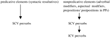
Grammaticalization of predicative and nonpredicative elements.
 You have
Access
- 7
- Cited by