Introduction
Anhedonia refers to the diminished ability to experience emotion, and avolition refers to the lack of goal-directed behaviour. These two negative symptoms of schizophrenia (Andreasen, Reference Andreasen1989) persist long after disease onset (Ventura et al. Reference Ventura2015) despite active antipsychotic treatments (Marder et al. Reference Marder, Rabinowitz and Kapur2013). Kring & Barch (Reference Kring and Barch2014) proposed a framework to understand anhedonia and avolition as manifestations of abnormal emotion processing, reward learning, working memory, decision-making and action plan formulation in schizophrenia patients. For instance, the unwillingness to exert effort to avoid aversion or to seek pleasure might be related to the diminished ability to experience negative and positive emotions in schizophrenia patients. However, extensive studies (Cohen & Minor, Reference Cohen and Minor2010) using emotion-inducing pictures to elicit emotions found that schizophrenia patients and healthy individuals reported a similar quality of emotion in terms of valence and arousal. It is plausible that, although emotion-inducing slides could elicit similar emotions in both groups, schizophrenia patients might be less able to anticipate pleasure than healthy individuals, because of their working memory impairments. In fact, the distinction between anticipatory pleasure (wanting) and consummatory pleasure (liking) proposed by Berridge & Robinson (Reference Berridge and Robinson1998) has been found in schizophrenia patients using self-reported questionnaires, such as the Temporal Experiences of Pleasure Scale (TEPS) (Gard et al. Reference Gard2006, Reference Gard2007; Chan et al. Reference Chan2010). On the other hand, the inability to form salient internal representations of the expected value of a reward might explain why schizophrenia patients who are able to experience pleasure normally are unmotivated to engage in pleasure-seeking behaviour (Gold et al. Reference Gold2008; Gold et al. Reference Gold2012, Reference Gold2013).
Several empirical studies (Heerey & Gold, Reference Heerey and Gold2007; Lui et al. Reference Lui2016a, Reference Luib) have investigated the connection between emotion and behaviour in schizophrenia patients. Typically, these studies utilised a paradigm with emotion-inducing slides to elicit participants’ affective experiences, and allowed participants to seek or avoid positive or negative slides by making button-pressing behaviour. Evidence from these studies generally supports the existence of emotion–behaviour decoupling in both first-episode (Lui et al. Reference Lui2016a) and chronic schizophrenia (Heerey & Gold, Reference Heerey and Gold2007; Lui et al. Reference Lui2016b). Recently, other empirical studies using effort-based decision-making paradigms (Gold et al. Reference Gold2012, Reference Gold2013; Fervaha et al. Reference Fervaha2013; Reddy et al. Reference Reddy2015; Treadway et al. Reference Treadway2015; Wang et al. Reference Wang2015) further suggested that schizophrenia patients are unwilling to exert greater effort for pursuing greater reward, and the abnormal cost–benefit computation as such may be one of the factors contributing to avolition.
Despite the growing understanding of the neuropsychological underpinning of avolition and anhedonia in schizophrenia patients, there is a paucity of behavioural studies conducted in genetically and behaviourally high-risk populations using these paradigms (such as the one used in Heerey & Gold (Reference Heerey and Gold2007)’s study, or the various effort-based decision-making paradigms reviewed in Reddy et al. (Reference Reddy2015)’s study) to investigate the connection between emotion and motivated behaviour. On the one hand, genetically high-risk populations such as unaffected first-degree relatives of schizophrenia patients are believed to have inherited a certain proportion of schizophrenia susceptibility genes, as evidenced by their higher lifetime risk to develop schizophrenia than individuals without such family history (Gottesman & Gould, Reference Gottesman and Gould2003). On the other hand, behaviourally high-risk populations, identified using psychometric self-report instruments based on the attenuated psychotic symptoms they exhibit, are believed to represent the underlying latent construct of schizophrenia (Lenzenweger, Reference Lenzenweger2015).
According to Meehl (Reference Meehl1962), schizophrenia is a decompensated end-stage of the interaction of an inherited neural integrative defect, which is termed schizotaxia or schizotype, with the environment. The behaviourally high-risk groups could, therefore, be construed as schizoptypy. Moreover, Meehl (Reference Meehl1962)’s postulation that ‘hypohedonia’, having more frequent experiences with negative emotion than positive emotion, may potentiate or aggravate the decompensation to schizophrenia. This further justifies the rationale for the careful study of avolition and anhedonia in genetically and behaviourally high-risk populations. These non-clinical groups also provide an opportunity to examine anheodonia and avolition in the absence of confounders such as institutionalisation and medication effects (Moritz et al. Reference Moritz2013).
To date, there have only been a few behavioural studies conducted in genetically and behaviourally high-risk populations to investigate the neuropsychological underpinning of avolition and anhedonia. Docherty et al. (Reference Docherty, Sponheim and Kerns2015) reported that unaffected relatives of schizophrenia patients experienced similar levels of emotional valence and arousal as healthy individuals when they viewed emotion-induced slides of Heerey & Gold (Reference Heerey and Gold2007)’s paradigm. However, Kerns et al. (Reference Kerns, Docherty and Martin2008) utilised the Revised Chapman's Social Anhedonia scale (Eckblad et al. Reference Eckblad1982) and reported that those with psychometrically defined schizotypy, with high levels of social anhedonia, experienced less intense emotion than comparison subjects when they viewed emotion-inducing pictures. Similarly, Cohen et al. (Reference Cohen2012) reported that individuals with schizotypal features, based on the Schizotypal Personality Questionnaire (Raine, Reference Raine1991), reported lower ratings of pleasantness than comparison subjects when they viewed emotion-inducing pictures. Lui et al. (Reference Lui2016b) administered the same paradigm as Heerey & Gold (Reference Heerey and Gold2007)’s study to individuals with high levels of social anhedonia, based on the Revised Chapman's Physical (Chapman et al. Reference Chapman, Chapman and Raulin1976) and Social Anhedonia scales (Eckblad et al. Reference Eckblad1982), and found that individuals with negative schizotypy and high levels of anhedonia reported lower valence ratings to positive slides than those without. However, negative schizotypy subjects showed similar level of aversion–avoidance and pleasure-seeking behaviour as the comparison subjects. In contrast, McCarthy et al. (Reference McCarthy, Treadway and Blanchard2015) utilised an effort-based decision-making paradigm to investigate individuals with high levels of social anhedonia, based on selected items of the Revised Social Anhedonia scale (Eckblad et al. Reference Eckblad1982), and found that these negative schizotypy subjects were more willing to expend effort than the comparison subjects to pursue low or medium magnitude of reward. The conflicting findings between Lui et al. (Reference Lui2016b) and McCarthy et al. (Reference McCarthy, Treadway and Blanchard2015) may be attributable to the differences in behavioural paradigms and definitions of negative schizotypy. Given these conflicting findings, affective experiences between genetically (Docherty et al. Reference Docherty, Sponheim and Kerns2015) and behaviourally (Kerns et al. Reference Kerns, Docherty and Martin2008; Cohen et al. Reference Cohen2012; Lui et al. Reference Lui2016b) high-risk populations, and the fact that many of these previous studies (Kerns et al. Reference Kerns, Docherty and Martin2008; Cohen et al. Reference Cohen2012; Docherty et al. Reference Docherty, Sponheim and Kerns2015) did not further investigate the extent to which emotions are translated into effortful behaviour, a more comprehensive study is needed.
To investigate the neuropsychological underpinning of avolition and anhedonia in schizophrenia and schizotypy, the present study utilised three independent samples, including schizophrenia patients, as well as genetically- and behaviourally defined high-risk individuals, and administered a validated and sophisticated behavioural paradigm (Heerey & Gold, Reference Heerey and Gold2007) designed to elicit both emotion and behaviour using emotion-inducing slides. Heerey & Gold (Reference Heerey and Gold2007)’s paradigm also attempted to distinguish the effect of anticipatory emotion from consummatory emotion on motivated behaviour. Compared with an earlier study (Lui et al. Reference Lui2016b), the present study attempted to enrich the sample by the inclusion of genetically high-risk individuals and the rigorous selection of psychometrically defined schizotypy (using 1.95 s.d. instead of 1 s.d.). Based on previous findings in studies using the same paradigm (Heerey & Gold, Reference Heerey and Gold2007; Lui et al. Reference Lui2016a, Reference Luib), we hypothesised that schizophrenia patients would show severe emotion–behaviour decoupling. Based on Meehl (Reference Meehl1962)’s postulation, we hypothesised that both genetically and behaviourally high-risk individuals would show a similar but milder form of emotion–behaviour decoupling.
Methods
Participants
In this study, three independent samples were recruited. Sample A consisted of 65 DSM-IV (First et al. Reference First1996) schizophrenia patients recruited from the Community Health Service Centre of Haidian of Beijing, as well as 63 healthy volunteers recruited from Haidian District of Beijing. Sample B (i.e. the genetically high-risk group) consisted of 40 non-psychotic first-degree relatives of the sample A participants as well as 45 age- and gender-matched healthy volunteers recruited from the Haidian District of Beijing. Sample C (i.e. the behaviourally high-risk group) consisted of 32 participants with social anhedonia and 32 comparison participants without social anhedonia. Participants in sample C were identified based on their scores on the Chinese version of the Chapman Social Anhedonia Scale (Chan et al. Reference Chan2012; Chapman et al. Reference Chapman, Chapman and Raulin1976; Eckblad et al. Reference Eckblad1982), which was used to screen a pool of 2994 students in a local college. Individuals who scored higher than 1.96 s.d. above the mean on the Chapman Social Anhedonia Scale were defined as having high levels of social anhedonia, while individuals without social anhedonia scored lower than the mean. The Chapman Social Anhedonia Scale was chosen to identify a behaviourally high-risk group because earlier findings (Kwapil, Reference Kwapil1998; Gooding et al. Reference Gooding, Tallent and Matts2005; Mason, Reference Mason2015) suggested that social anhedonia rather than magical ideation and perceptual aberrations better-predicted conversion to schizophrenia and related psychotic disorders.
To ensure that participants with schizophrenia in sample A were clinically stable, the Positive and Negative Syndrome Scale (PANSS; Kay et al. Reference Kay, Fiszbein and Opler1987) was administered by trained psychiatrists. Moreover, participants in samples B and C were assessed by qualified psychiatrists using structural interviews to ensure the absence of any Axis I DSM-IV psychiatric disorder. All schizophrenia participants in sample A were receiving antipsychotic medications at the time of assessment, but participants in samples B and C were medication-free. In sample A, eight schizophrenia participants received FGA (first-generation antipsychotic) medications, 21 received clozapine (clozapine monotherapy, n = 17; clozapine augmented with another second-generation antipsychotic (SGA), n = 4), 27 received SGAs monotherapy (olanzapine, n = 10; risperidone, n = 13; aripiprazole, n = 3; paliperidone, n = 1), four received SGAs polypharmacy and five were antipsychotic-free at the time of assessment. In addition, five schizophrenia participants were receiving anticholinergic (benzhexol, ranged 2–4 mg/day). No participants in sample A were taking benzodiazepine. The study was approved by the Ethics Committees of the Institute of Psychology and the Chinese Academy of Sciences. All participants provided informed consent before taking part in the study.
Assessments
Intelligence and working memory
A prorating method based on the Arithmetic, Similarities and Digit span subscales of the Chinese version of the Wechsler Adult Intelligence Scale-Revised (Gong, Reference Gong1992) was used to estimate participants’ intelligence. Moreover, participants completed the Chinese version of the Letter–Number Span Test (LNT; Gold et al. Reference Gold1997; Chan et al. Reference Chan2008), a measure for working memory. They first listened to a series of alternating letters and numbers and were then asked to rearrange the letters and numbers in successive order. The longest category they passed would be recorded.
The paradigm measuring anhedonia and avolition
The computerised behavioural paradigm has been described elsewhere (Heerey & Gold, Reference Heerey and Gold2007; Lui et al. Reference Lui2016a, Reference Luib). In brief, this task utilised pictures of both social and non-social nature to elicit emotion, and also provided opportunity for participants to reduce or enhance their exposure to these pictures by pressing buttons on the computer keyboard. In the first task phase (the representational responding phase), a total of 42 slides of photographs were presented for 2s each. Each slide contained three photos that were similar in content (e.g. three images of flowers). The slide set contained 14 positive slides, 14 negative slides, and 14 neutral slides. During the presentation of the slides, participants rated how pleasant/unpleasant they felt while viewing each slide (9-point Likert scale; 1 = extremely unpleasant and 9 = extremely pleasant feelings) and how arousing they found the slide (1 = extremely calm/dull and 9 = extremely exciting/arousing). Upon the cessation of a slide, participants were told that they could alter the probability of seeing the slide again later in the session by pressing buttons on the keyboard. Participants pressed the ‘m’ and ‘n’ keys repeatedly in rapid succession to attempt to see the slide again (pleasure-seeking response). They pressed ‘x’ and ‘z’ in similar fashion to reduce the chance that the slide would re-appear (aversion–avoidance response). The response window for pressing buttons in each trial was 2s. The effort expended during the representational responding phase is believed to capture the coupling between wanting and behaviour.
In the second task phase (the evoked responding phase), participants viewed a pre-defined set of 30 slides (10 positive, 10 neutral, and 10 negative) drawn from the original slide set. All participants viewed the same slide set, regardless of prior button pressing. In this task phase, participants could prolong or shorten stimulus exposure by making the same button-pressing response whilst the slides were present (rather than when the slides were off-screen). In this task phase, the response window ranged from 3s to 10s, depending on participants’ button-pressing behaviour. The effort expended during the evoked responding phase is believed to capture the coupling between liking and behaviour. Although this phase may also capture a certain degree of wanting–behaviour coupling, it does so to a lesser degree than the representational responding phase.
Statistical analysis
Data analysis was conducted in the same manner as in earlier studies (Heerey & Gold, Reference Heerey and Gold2007; Lui et al. Reference Lui2016a). It generated three key parameters: (1) self-reported liking, (2) motivational salience, and (3) correspondence between pleasantness ratings and button-pressing speed.
Based on participants’ pleasantness and arousal ratings in the 42 slides presented in the representational phase, we calculated self-reported liking (mean pleasantness ratings and mean arousal ratings) for the groups in our different samples. We examined the group differences in self-reported liking using mixed-model analysis of variances (ANOVAs), with diagnostic group (sample A: schizophrenia, controls; sample B: unaffected relatives, controls; sample C: individuals with social anhedonia, individuals without social anhedonia) as the between-subject variable and slide valence (positive, neutral, negative) as the within-subject variable.
If a participant rated a slide as pleasant, but he/she pressed buttons to avoid or shorten its exposure, or vice versa, this kind of button-pressing response was deemed ‘incongruent’ with self-reported emotion. If participants committed considerable incongruent button-pressing responses (>4 incongruent button presses), that particular trial was deemed invalid and removed from subsequent analyses. Presses that served to either prolong or shorten slide exposure were allowed for slides rated as neutral. Taking into account the varied response window (3s–10s) in the evoked responding phase and the fixed response window (2s) in the representational responding phase, we calculated button-pressing rate (presses per s) for each trial in order to make behaviour in both phases comparable.
To code motivational salience, we determined the valence of a slide based on individual participants’ pleasantness ratings (i.e. negative valence = pleasantness rating 1–3, neutral valence = pleasantness rating 4–6, and positive valence = pleasantness rating 7–9). We then calculated the average button-pressing speed for positive, neutral and negative slides, and entered these variables into mixed-model ANOVAs, with diagnostic group (sample A: schizophrenia, controls; sample B: unaffected relatives, controls; sample C: individuals with social anhedonia, individuals without social anhedonia) as the between-subject variable, and behavioural condition (representational responding v. evoked responding) and slide valence (negative, neutral, positive) as the within-subject variables.
In any of the three samples, if the groups differ significantly in terms of total number of buttons pressed and the average button-pressing speed in the behavioural paradigm, psychomotor slowing might be considered as a confounder. To address this limitation, we applied mean-centring to individual participants’ button-pressing speed, using the individual's mean button-pressing speed. The average mean-centred button-pressing speed were entered into the same mixed-model ANOVAs to estimate motivational salience.
To determine the correspondence between emotion and behaviour, we calculated for each participant the correlation coefficients between button pressing speed and pleasantness ratings during the two responding phases. Fisher's r to z transformation was then applied to all correlation coefficients. We then calculated the average z-transformed correlation coefficients, and entered these variables into a mixed-model ANOVAs, with diagnostic group (sample A: schizophrenia, controls; sample B: unaffected relatives, controls; sample C: individuals with social anhedonia, individuals without social anhedonia) as the between-subject variable, and behavioural condition (representational responding v. evoked responding) and slide desirability (desirable v. undesirable) as the within-subject variables.
Except where noted, all post hoc comparisons were Bonferroni corrected for multiple comparisons.
Results
Schizophrenia patients
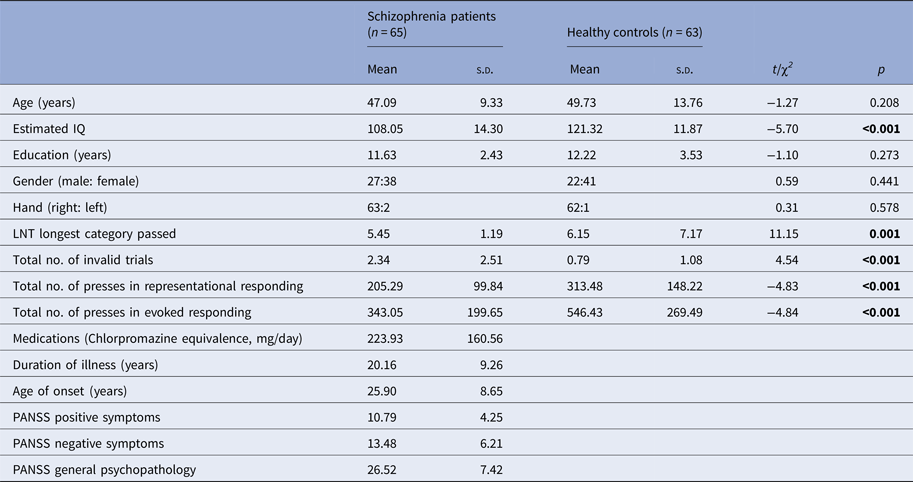
As shown in Table 1, schizophrenia patients were matched with healthy controls in age, education, gender and handedness, but had lower estimated IQ and working memory. Contrary to previous findings (Heerey & Gold, Reference Heerey and Gold2007; Lui et al. Reference Lui2016a, Reference Luib), schizophrenia patients expended significantly fewer button presses in the behavioural paradigm (representational responding: mean = 205.29 presses, s.d. = 99.84; evoked responding: mean = 343.05 presses, s.d. = 199.65) than healthy controls (representational responding: mean = 313.48 presses, s.d. = 148.22; evoked responding: mean = 546.43 presses, s.d. = 269.49) (p < 0.001). Consistent with previous findings, schizophrenia patients committed more ‘incongruent’ button-pressing responses (mean trials affected = 2.34, s.d. = 2.51) than controls (mean trials affected = 0.79, s.d. = 1.08; p < 0.001). Moreover, schizophrenia patients were found to have slower psychomotor speed with an average button-pressing speed of 2.418 presses per s (s.d. = 0.996 presses per s) in the behavioural paradigm compared with controls who had an average button-pressing speed of 3.453 presses per s (s.d. = 1.491 presses per s), t[126] = −4.634, p < 0.001.
Characteristics of participants in sample A

Note: PANSS, Positive and Negative Syndrome Scale; IQ, intelligence; LNT, Letter-Number Span Test.
p values < 0.05 are bold.
Self-reported liking
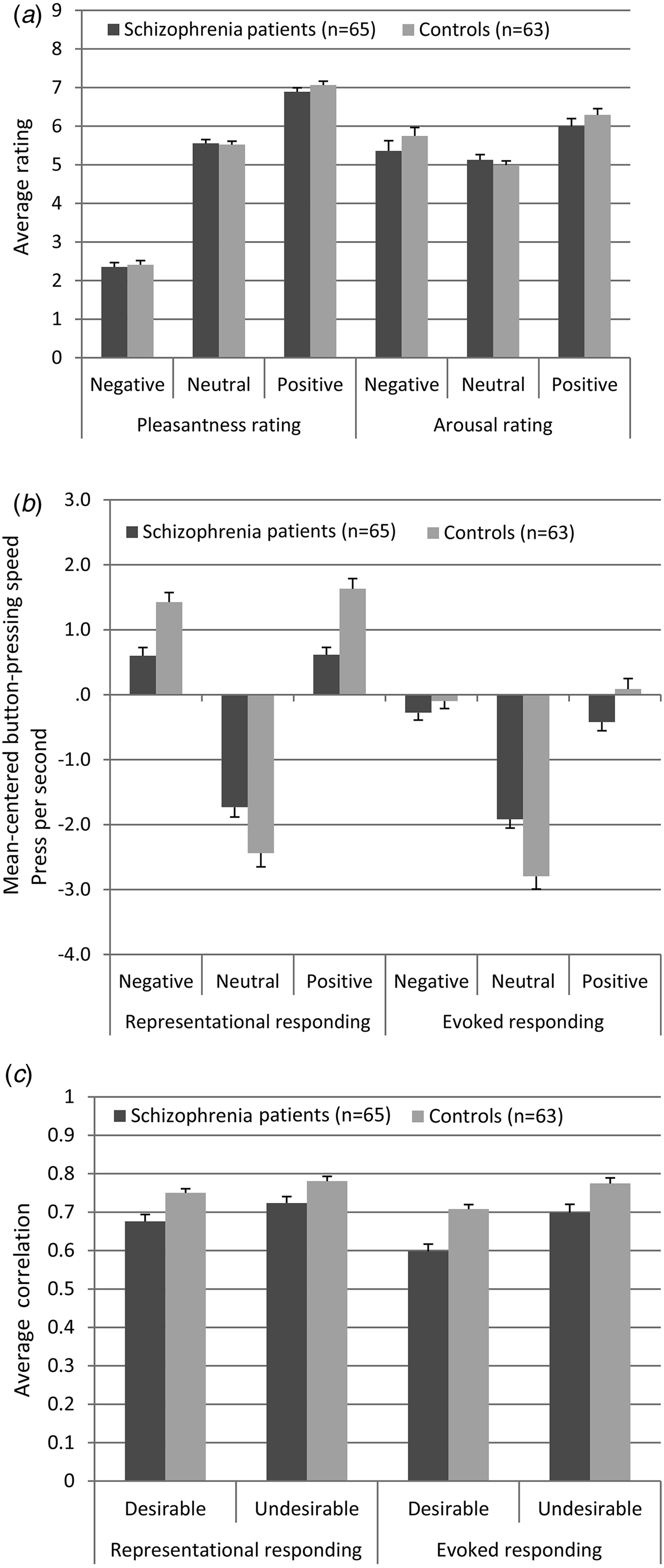
Figure 1a shows that schizophrenia patients and controls did not differ in self-reported pleasantness ratings. Neither the main effect of Group (F[1126] = 0.562, p = 0.455, η 2 = 0.004) nor the Group-by-Slide Valence interaction (F[2252] = 0.578, p = 0.513, η 2 = 0.005) reached statistical significance. Similarly, for arousal ratings, the two groups did not differ (the main effect of Group: F[1126] = 0.924, p = 0.338, η 2 = 0.007; the Group-by-Slide Valence interaction: F[2252] = 1.447, p =0.236, η 2 = 0.011). These findings concurred with Heerey & Gold (Reference Heerey and Gold2007) and Lui et al. (Reference Lui2016a, Reference Luib)’s studies, indicating that schizophrenia patients had intact ability in experiencing emotion.
Results of sample A (schizophrenia patients v. controls). (a) Pleasantness and arousal ratings across slide valence. (b) Motivated behaviour, i.e. mean-centred button-pressing speed (presses per s) in representational and evoked responding conditions. A positive value indicates that the button-pressing behaviour to the slides is faster than the individual's own mean button-pressing speed; a negative value indicates the vice versa. (c) Correspondence (correlation coefficient) between emotion (pleasantness rating) and behaviour (presses per s). Error bars show +1SEM.

Motivational salience
To account for psychomotor slowing of schizophrenia patients who made fewer number of button presses than controls, we applied mean-centring to individual participants’ button-pressing speed, using the individual's own mean button-pressing speed. Figure 1b shows the mean-centred button-pressing speed to slides of different valences. After mean-centring, mixed-model ANOVAs found that the main effect of Group was not significant (F[1126] = 1.906, p = 0.170, η 2 = 0.015). The main effect of Behavioural Condition (F[1126] = 138.872, p < 0.001, η 2 = 0.524), the Group-by-Behavioural Condition interaction (F[1126] = 8.019, p = 0.005, η 2 = 0.060), and the Group-by-Slide Valence interaction (F[2252] = 22.709, p < 0.001, η 2 = 0.153) were all statistically significant. However, the three-way interaction (F[2252] = 1.817, p = 0.165, η 2 = 0.014) was not significant. Post hoc independent samples t tests found that schizophrenia patients expended less effort (with slower button-pressing speed) during representational responding to slides of positive valence (t[126] = −5.286, p < 0.001) and negative valence (t[126] =−4.257, p < 0.001), but expended more effort (with faster button-pressing speed) to neutral valence slides (t[126] = 2.731, p = 0.042) than controls. During evoked responding, schizophrenia patients expended more effort to slides of neutral valence (t[126] = 3.668, p < 0.001) but not to slides with positive valence (t[126] =−2.413, p = 0.102) or negative valence (t[126] =−1.101, p > 0.999).
Correspondence between emotion and behaviour
Figure 1c shows the coefficients of the correlation between emotion and behaviour. The main effect of Group was significant (F[1126] =18.626, p < 0.001, η 2 = 0.129), showing that schizophrenia patients exhibited impairments in translating emotional experiences into motivational behaviour. The main effect of Behavioural Condition (F[1126] = 8.782, p = 0.004, η 2 = 0.065) was significant. However, contrary to previous findings (Heerey & Gold, Reference Heerey and Gold2007; Lui et al. Reference Lui2016a, Reference Luib), the Group-by-Behavioural Condition interaction (F[1126] = 0.882, p = 0.349, η 2 = 0.007), the Group-by-Slide Desirability (F[1126] = 0.387, p = 0. 535, η 2 = 0.003), and three-way interaction (F[1126] = 0.106, p = 0.745, η 2 = 0.001) all failed to reach statistical significance.
Unaffected first-degree relatives of schizophrenia patients
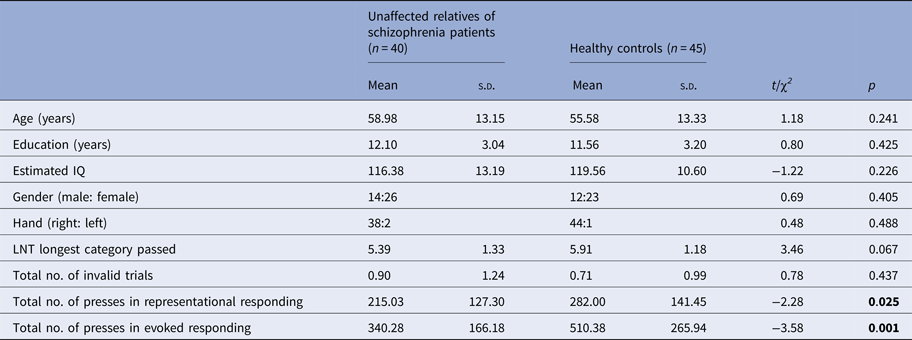
As shown in Table 2, unaffected first-degree relatives of schizophrenia patients were matched with controls in age, education, gender, handedness, working memory and estimated IQ (p > 0.05). In the behavioural paradigm, the unaffected first-degree relatives made fewer button presses (representational responding: mean = 215.03 presses, s.d. = 127.30; evoked responding: mean = 340.28 presses, s.d. = 166.18) than healthy controls (representational responding: mean = 282.00 presses, s.d. = 141.45; evoked responding: mean = 510.38 presses, s.d. = 265.94) (p < 0.05). Unaffected relatives generated incongruent-to-emotion pressing behaviour on a similar number of trials (mean = 0.90, s.d. = 1.24) as did controls (mean = 0.71, s.d. = 0.99; p = 0.437). Moreover, unaffected relatives demonstrated slower psychomotor speed in the behavioural paradigm, with an average button-pressing speed of 2.428 presses per s (s.d. = 1.052 presses per s), compared with controls who had an average button-pressing speed of 3.130 presses per s (s.d. = 1.434 presses per s), t[83] = −2.547, p = 0.013.
Characteristics of participants in sample B

Note: IQ, intelligence; LNT, Letter-Number Span Test.
p values < 0.05 are bold.
Self-reported liking
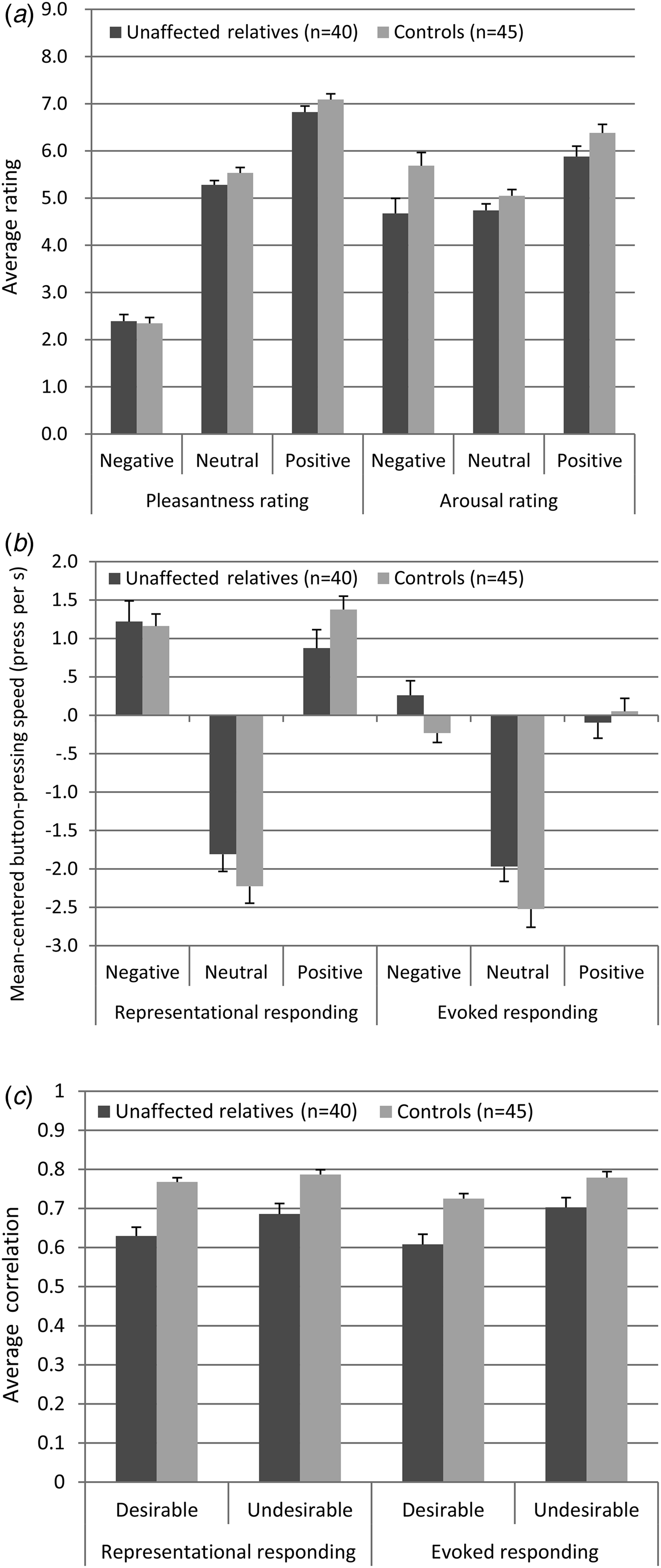
Figure 2a shows that unaffected relatives and controls did not differ in self-reported pleasantness ratings, as the main effect of Group (F[1,83] = 2.721, p = 0.103, η 2 = 0.032) and the Group-by-Slide Valence interaction (F[2166] = 1.026, p = 0.338, η 2 = 0.012) both did not reach statistical significance. For arousal ratings, the main effect of Group was significant (F[1,83] = 8.660, p = 0.004, η 2 = 0.094), showing that unaffected relatives experienced lower arousal levels than controls after viewing the slides in the paradigm. However, the Group-by-Slide Valence interaction was not significant (F[2166] = 1.589, p = 0.213, η 2 = 0.019).
Results of sample B (unaffected first-degree relatives of schizophrenia patients v. controls). (a) Pleasantness and arousal ratings across slide valence. (b) Motivated behaviour, i.e. mean-centred button-pressing speed (presses per s) in representational and evoked responding conditions. A positive value indicates that the button-pressing behaviour to the slides is faster than the individual's own mean button-pressing speed; a negative value indicates the vice versa. (c) Correspondence (correlation coefficient) between emotion (pleasantness rating) and behaviour (presses per s). Error bars show +1 s.e.m.

Motivational salience
Because unaffected relatives of schizophrenia patients had slower psychomotor speed than controls, we applied mean-centring method, using the individual's mean button-pressing speed. Figure 2b shows the mean-centred button-pressing speed to slides of different valences. After mean centring, the results showed that the main effect of Group (F[1,83] = 1.009, p = 0.318, η 2 = 0.012) and the Group-by-Behavioural Condition interaction (F[1,83] = 1.917, p = 0.170, η 2 = 0.023) failed to reach statistical significance. However, the main effect of Behavioural Condition was significant (F[1,83] = 58.474, p < 0.001, η 2 = 0.413), and the Group-by-Slide Valence interaction showed a trend towards significance (F [2166] = 3.088, p = 0.061, η 2 = 0.036). The three-way interaction was not significant (F[2166] = 0.383, p = 0.670, η 2 = 0.005). When the mean-centred button-pressing speed in representational and evoked conditions were averaged, post-hoc independent samples t tests did not find significant group difference in mean-centred button-pressing behaviour (presses per s) to slides of different valences (p > 0.05).
Correspondence between emotion and behaviour
As shown in Fig. 2c, the main effect of Group was significant (F[1,83] = 27.801, p < 0.001, η 2 = 0.251), showing that unaffected relatives exhibited impaired emotion–behaviour coupling. However, the main effect of Behavioural Condition (F[1,83] = 1.328, p = 0.252, η 2 = 0.016), the Group-by-Behavioural Condition interaction (F[1,83] = 1.157, p = 0.285, η 2 = 0.014), the Group-by-Slide Desirability (F[1,83] = 1.325, p = 0.253, η 2 = 0.016) and three-way interaction (F[1,83] = 0.232, p = 0.631, η 2 = 0.003) all failed to reach statistical significance.
Individuals with social anhedonia
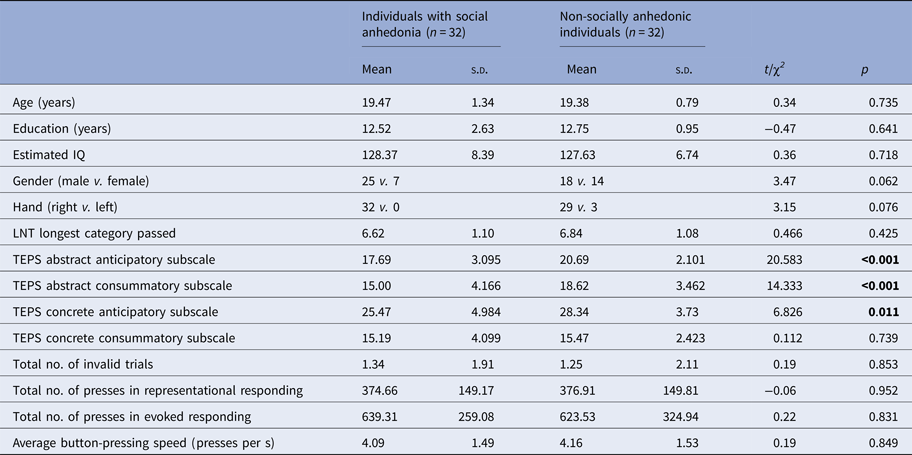
Table 3 shows that the two groups did not differ in age, education, gender, handedness, working memory and estimated IQ. Individuals with social anhedonia reported significantly less pleasure experienced in everyday life than controls, as measured by the TEPS abstract consummatory, abstract anticipatory, and concrete anticipatory subscales (p < 0.001). Individuals with social anhedonia and healthy controls expended similar degree of effort in terms of numbers of the button pressed, and the groups also did not differ in the number of invalid trials made and average button-pressing speed during the behavioural paradigm (p > 0.05; see Table 3 for means and standard deviations).
Characteristics of participants in sample C

Notes: IQ, intelligence, TEPS, the Temporal Experience of Pleasure Scale; LNT, Letter-Number Span Test
p values < 0.05 are bold.
Self-reported liking
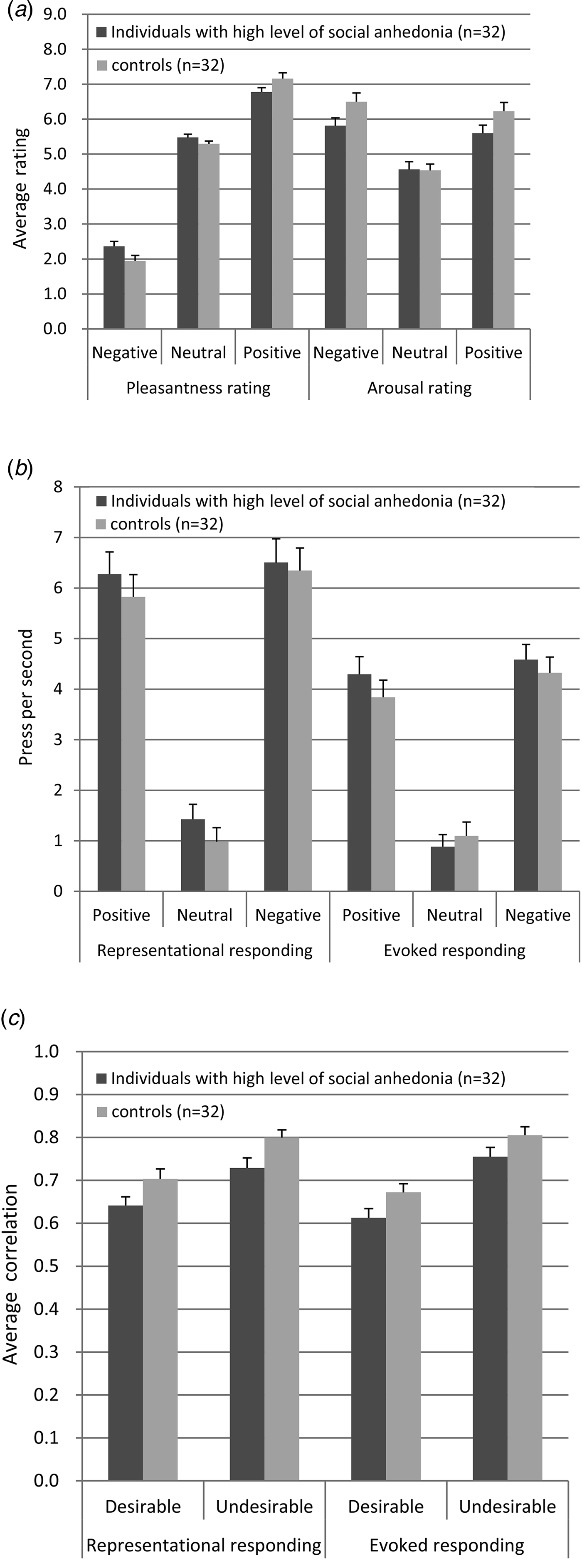
Figure 3a shows that the main effect of Group in self-reported pleasantness ratings (F[1,62] = 0.604, p = 0.440, η 2 = 0.010) did not reach statistical significance. However, the Group-by-Slide Valence interaction was significant (F[2124] = 4.595, p = 0.026, η 2 = 0.069). Post-hoc independent samples t tests did not show significant group difference (p > 0.05). For arousal ratings, the main effect of Group was not significant (F[1,62] = 2.588, p = 0.113, η 2 = 0.040). The Group-by-Slide Valence interaction almost reached statistical significance (F[2124] = 3.381, p = 0.050, η 2 = 0.052). Post-hoc independent samples t tests did not show significant group difference (p > 0.05).
Results of sample C (individuals with high level of social anhedonia v. controls) (a) Pleasantness and arousal ratings across slide valence split by participant group. (b) Motivated behaviour (presses per s) in representational and evoked responding conditions. (c) Correspondence (correlation coefficient) between emotion (pleasantness rating) and behaviour (presses per s). Error bars show +1 s.e.m.

Motivational salience
Figure 3b shows that the main effect of Behavioural Condition was significant (F[1,62] = 70.801, p < 0.001, η 2 = 0.533). However, the main effect of Group (F[1,62] = 0.550, p = 0.461, η 2 = 0.009), the Group-by-Behavioural Condition interaction (F[1,62] = 0.307, p = 0.581, η 2 = 0.005), the Group-by-Slide Valence interaction (F[2124] = 0.233, p = 0.751, η 2 = 0.004) and the three-way interaction (F[2124] = 1.655, p = 0.195, η 2 = 0.026) all failed to reach statistical significance.
Correspondence between emotion and behaviour
As shown in Fig. 3c, the main effect of Group was significant (F[1,62] = 8.561, p = 0.005, η 2 = 0.121), showing that individuals with social anhedonia exhibited impaired emotion–behaviour coupling. However, the main effect of Behavioural Condition (F[1,62] = 0.212, p = 0.647, η 2 = 0.003), the Group-by-Behavioural Condition interaction (F[1,62] = 0.159, p = 0.692, η2 = 0.003), the Group-by-Slide Desirability (F[1,62] = 0.221, p = 0.640, η 2 = 0.004) and three-way interaction (F[1,62] = 0.014, p = 0.907, η 2 < 0.001) all failed to reach statistical significance.
Discussion
Our findings are summarised as follows. Regarding self-reported liking, whereas schizophrenia patients reported similar affective experiences to controls, unaffected relatives of schizophrenia patients generally found emotion-inducing slides less arousing than controls. Moreover, individuals with social anhedonia exhibited prominent anhedonia as they apparently found positive slides less pleasant and negative slides less unpleasant, and both less arousing. Regarding motivational salience, schizophrenia patients and unaffected siblings expended less effort to seek pleasure and to avoid aversive stimuli than their respective controls, but individuals with social anhedonia showed similar effort expenditures as controls. Regarding emotion–behaviour coupling, schizophrenia patients, unaffected relatives, and individuals with social anhedonia all exhibited a weaker emotion–behaviour connection than their respective controls.
Corroborating earlier findings in schizophrenia (Heerey & Gold, Reference Heerey and Gold2007; Lui et al. Reference Lui2016a, Reference Luib), our study demonstrated emotion–behaviour decoupling in the largest sample of patients with chronic schizophrenia. In a recent study (Lui et al. Reference Lui2016b) using the same paradigm, individuals with less stringently defined schizotypy did not show emotion–behaviour decoupling. Contrary to Lui et al. (Reference Lui2016b)’s earlier study (Lui et al. Reference Lui2016b), our findings provide evidence for a clearer decoupling between affective experience and motivated behaviour, which might be attributable to the rigorous manner in which we defined schizotypy. Compared with McCarthy et al. (Reference McCarthy, Treadway and Blanchard2015) study, which defined negative schizotypy based on the top tenth percentile of scoring on selected items of the Revised Social Anhedonia scale (Eckblad et al. Reference Eckblad1982), our study adopted more stringent criteria, which may explain the conflicting findings between the two studies. Moreover, to our knowledge, few previous studies have investigated emotion–behaviour decoupling in unaffected first-degree relatives of schizophrenia patients. Therefore, our findings provide important and novel evidence for familial association of emotion–behaviour decoupling. Taken together, our findings suggest that the defective translation of emotion into motivated behaviour (Heerey & Gold, Reference Heerey and Gold2007; Lui et al. Reference Lui2016a, Reference Luib) might be a putative neuropsychological mechanism of avolition and anhedonia in the schizophrenia spectrum, and appear to be a trait marker for schizophrenia, consistent with Meehl (Reference Meehl1962, Reference Meehl1989)’s proposition.
There is considerable evidence suggesting that schizophrenia patients have difficulty in forming mental representations of the expected value of rewards (Gold et al. Reference Gold2008) and have distorted cost–benefit computation (Gold et al. Reference Gold2012, Reference Gold2013; Fervaha et al. Reference Fervaha2013; Gard et al. Reference Gard2014; Reddy et al. Reference Reddy2015; Treadway et al. Reference Treadway2015; Wang et al. Reference Wang2015); these impairments could have given rise to their inability to translate emotional salience into motivated behaviour. It is noteworthy that emotion–behaviour coupling in schizophrenia is not only dissociated during wanting, but also affects liking, as Lui et al. (Reference Lui2016a) have demonstrated that working memory impairments contributed to emotion–behaviour decoupling in evoked responding, using the same behavioural paradigm as in the present study. Consistent with an earlier study using the same paradigm (Lui et al. Reference Lui2016b), our findings demonstrated that patients with chronic schizophrenia exhibited a generalised disconnection of emotion and behaviour across wanting and liking conditions.
In this study, our behavioural paradigm failed to distinguish the effect of wanting from liking on motivated behaviour in schizophrenia patients and high-risk populations. It is noteworthy that both representational responding and evoked responding captured the wanting component of the motivational system (Heerey & Gold, Reference Heerey and Gold2007). In essence, the difference between the two responding phases of the paradigm is the ability to translate emotional salience into motivated behaviour when the stimulus is presented in front of participants (during evoked responding) v. the stimulus has disappeared but is being maintained by working memory (during representational responding). Since both the genetically and behaviourally high-risk individuals had intact working memory, our results show that emotion–behaviour coupling in both responding phases were comparable. On the other hand, schizophrenia participants were impaired in working memory. Contrary to earlier studies (Heerey & Gold, Reference Heerey and Gold2007; Lui et al. Reference Lui2016a), our findings did not support a differential impairment of emotion–behaviour coupling during representational responding v. evoked responding in schizophrenia patients. Compared with previous studies (Heerey & Gold, Reference Heerey and Gold2007; Lui et al. Reference Lui2016a, Reference Luib), our schizophrenia participants were older, and ageing might have further aggravated emotion–behaviour decoupling. The effect of ageing on working memory and other cognitive functions might also reconcile the discrepancy of findings between ours and these previous studies (Heerey & Gold, Reference Heerey and Gold2007; Lui et al. Reference Lui2016a, Reference Luib), such that our schizophrenia participants pressed fewer buttons throughout the behavioural paradigm than controls, contrary to earlier studies using the same paradigm (Heerey & Gold, Reference Heerey and Gold2007; Lui et al. Reference Lui2016a, Reference Luib).
Our findings have potential clinical implications. Early recoupling of emotion with motivated behaviour might enhance social functioning of these vulnerable individuals. Meehl (Reference Meehl1962, Reference Meehl1989)’s preposition that hypohedonia as a potentiator to aggravate the decompensation from schizotypy to schizophrenia has raised an interesting and important question as to whether early intervention on emotion–behaviour decoupling could reduce the future conversion rate to schizophrenia. To our knowledge, only one previous study (McCarthy et al. Reference McCarthy, Treadway and Blanchard2015) has utilised effort-based decision-making paradigms in behaviourally high-risk individuals. Future studies should utilise these novel paradigms to further examine emotion–behaviour decoupling in both genetically and behaviourally high-risk populations.
This study has several limitations. Sample B comprised parents as well as siblings of schizophrenia patients, such that the mean age was relatively high. The heterogeneous composition of the sample might be paralleled with similar heterogeneity in genetic architecture, because unaffected relatives who remain non-psychotic at a more advanced age may have inherited fewer susceptible genes for schizophrenia (Gottesman, 1991). Recruiting a sample of unaffected siblings of schizophrenia patients would confer better scientific rigour; however, this was not possible within our recruitment area. Secondly, we did not make a direct comparison of emotion–behaviour coupling between behaviourally high-risk and genetically high-risk participants. Evidence has suggested that different types of schizotypy exist (Kwapil et al. Reference Kwapil, Barrantes-Vidal and Silvia2008), which may be different in the nature and extent of emotion–behaviour coupling. Thirdly, since schizophrenia and high-risk participants differed in demographic characteristics, and different instruments (the PANSS v. the Chapman's scales) were administered to ascertain clinical/subclinical psychopathology in different samples (schizophrenia v. behaviourally high-risk participants), we chose not to make direct comparisons of results across samples. To better elucidate the onset and evolution of avolition and anhedonia in schizophrenia, future research should investigate emotion–behaviour coupling across different types of schizotypy and should include individuals with prodromal symptoms of schizophrenia. Fourthly, our paradigm-induced emotion using pictures instead of providing monetary reward, and therefore it is technically difficult to incorporate measures of cost-effort computation into the paradigm, unlike other effort-based decision-making paradigms (Gold et al. Reference Gold2012, Reference Gold2013; Fervaha et al. Reference Fervaha2013; Gard et al. Reference Gard2014; McCarthy et al. Reference McCarthy, Treadway and Blanchard2015; Reddy et al. Reference Reddy2015; Treadway et al. Reference Treadway2015; Wang et al. Reference Wang2015), which could investigate decisional anhedonia. Moreover, repeated button-pressing may have caused slight fatigue, and this appeared to be a potential confound to our findings in individuals with social anhedonia. We note, however, that this also affected their comparison counterparts (see online Supplementary Materials). Future studies might use multilevel modelling to address this limitation, which had been applied to data collected using effort-based decision-making paradigms (Wang et al. Reference Wang2015) but not our paradigm. Lastly, similar to our earlier studies (Lui et al. Reference Lui2016a, Reference Luib), this behavioural paradigm utilised a bipolar valence scale to measure picture-induced pleasant and unpleasant emotions. Our findings showed that schizophrenia participants made more button-pressing responses that were incongruent to self-reported emotions, as measured by the bipolar valence scale. The interesting phenomenon of affective ambivalence or co-activation of pleasant and unpleasant emotions in schizophrenia patients (Cohen & Minor, Reference Cohen and Minor2010) could account for the results of significantly more invalid trials in the schizophrenia sample.
To conclude, our investigation is an important extension of research on the neuropsychological underpinnings of anhedonia and avolition. Behaviourally and genetically high-risk individuals experience emotions as less arousing, and their emotions are less likely to motivate effortful behaviour, compared with healthy/unaffected people. Our findings provide empirical evidence for emotional and behavioural anhedonia in these high-risk populations. In addition to replicating earlier findings of emotion–behaviour decoupling in schizophrenia patients, this study also provides the first evidence for familial association of this important indicator.
Supplementary material
The supplementary material for this article can be found at https://doi.org/10.1017/S0033291717002926.
Acknowledgements
This study was supported by the National Science Fund China (grant no. 81571317), the National Basic Research Programme of China (Precision psychiatry Programme, 2016YFC0906402), the Beijing Training Project for the Leading Talents in Science and Technology (grant no. Z151100000315020), and the Beijing Municipal Science & Technology Commission Grant (grant no. Z161100000216138).