Introduction
With China's rapid urbanisation, an increasing amount of rural land is being occupied by urban construction, and rural residents are being forced to leave their homes and relocate to residential communities in urban areas (Huang et al., Reference Huang, Dijst and Van Weesep2017; Zhang, Reference Zhang2019). Separation from one's home, especially through involuntary relocation, might increase one's risk of distress (Scannell and Gifford, Reference Scannell and Gifford2017). Compared to younger adults, older adults are more vulnerable to the negative impacts of relocation because place becomes more significant to people as they age (Wu et al., Reference Wu, Penning, Zeng, Li and Chappell2016). Older adults’ strong attachment to a rural place might impede their adjustment to an urban community. The purpose of this study was to investigate the association between Chinese older adults’ rural place attachment (RPA) and their depression after relocating, as well as the protective roles of neighbourhood social cohesion (NSC) and sense of community (SOC) in the relocation place.
Theoretical background
Rural-to-urban relocation in China
With China's rapid urbanisation and economic development, many people have moved from rural to urban areas (Yan et al., Reference Yan, Hong, Yu, Yang, Liu, Quan, Xu, Zhu, Cheng, Xiao, Kitzman-Ulrich and DeHaven2016). The Chinese government expects to integrate 70 per cent of the country's population into cities by 2025 (Yan et al., Reference Yan, Hong, Yu, Yang, Liu, Quan, Xu, Zhu, Cheng, Xiao, Kitzman-Ulrich and DeHaven2016). Two types of rural-to-urban movements are currently happening in China. One is active movement, whose major participants are working-aged young adults. They move from rural to urban areas in pursuit of employment opportunities and better living conditions. The other type of movement is involuntary relocation, which is caused by government-led relocation policies that support infrastructure construction projects and address concerns about poverty, disaster, and so on (Wu et al., Reference Wu, Penning, Zeng, Li and Chappell2016). The government takes possession of farmers’ land and houses for commercial building or communal facility construction and rebuilds urban apartments for these farmers to live in at a low price or rent-free (Li et al., Reference Li, van Ham and Kleinhans2019). Because the farmers can no longer rely on planting to make a living, they change their rural hukou to an urban hukou; thus, they can receive social welfare of about 1,000 RMB each month for living in urban areas (Zhang, Reference Zhang2019). This kind of rural-to-urban relocation is an increasingly widespread phenomenon in contemporary China.
Rural-to-urban relocation may induce psychological adjustment problems for older adults through a lost sense of rural place and poor social integration into the urban place (Jiang et al., Reference Jiang, Waley and Gonzalez2018). Relocation disrupts the significance of a place in older people's lives, including their historical attachment, comfort with local amenities and social relationships (Gilroy, Reference Gilroy2012). In traditional Chinese culture, a good life means settling down and not moving. The ageing-in-place literature emphasises that playing out life events in one place and being part of a community's social fabric may give older adults rootedness (Gilleard et al., Reference Gilleard, Hyde and Higgs2007). Failure to achieve ageing-in-place may result in physical and mental health problems (Singh et al., Reference Singh, Bass, Sumbadze, Rebok, Perrin, Paichadze and Robinson2018). In addition, an old Chinese adage says that good neighbours are more helpful than faraway relatives are, and relocation might disrupt older adults’ place-based social networks and support systems, which are not easy to rebuild in a new place (Gilroy, Reference Gilroy2012). In contrast to rural villages, urban living environments are less feasible for cultivating social interaction due to their gated apartments and lack of public space and co-operative affairs such as farm work. Furthermore, for many older adults, the relocation will be their first time moving from their rural ancestral villages into urban apartments (Wu et al., Reference Wu, Penning, Zeng, Li and Chappell2016); thus, adapting to the urban lifestyle is not easy for them. Therefore, despite the potentially bad physical conditions of their rural dwellings, older people prefer to remain in rural dwellings, which support their feelings of control and social integration (Gilroy, Reference Gilroy2012). Given that the contemporary relocation programmes are influencing so many older adults living in China's rural villages, it is meaningful to understand how to promote older adults’ psychological adjustment after relocation.
Place attachment theory
Place includes both a physical space and a collective consciousness of social connection and is often defined through historical continuity, cultural significance, opportunities for belonging and the provision of physical comfort (Gilleard et al., Reference Gilleard, Hyde and Higgs2007; Lewicka, Reference Lewicka2011). As a common human experience, place attachment reflects the cognitive-emotional bonds between individuals and a place (Hidalgo and Hernández, Reference Hidalgo and Hernández2001; Scannell and Gifford, Reference Scannell and Gifford2017). Although places have a wide variety of types, such as homes, streets, cities and culturally significant sites, the majority of place attachment research has concentrated on neighbourhoods (Scannell and Gifford, Reference Scannell and Gifford2017). Scannell and Gifford (Reference Scannell and Gifford2010) proposed the person–process–place framework of place attachment. The person dimension refers to the individual or collectively determined meanings of a place; the process dimension describes the cognitive, affective and behavioural content of the bonds between the individual and the place; and the place dimension emphasises a place's physical and social characteristics (Scannell and Gifford, Reference Scannell and Gifford2010). Many previous studies have addressed the psychological and physical benefits of place attachment, such as promoting residents’ wellbeing and sense of belonging (Scannell and Gifford, Reference Scannell and Gifford2016, Reference Scannell and Gifford2017).
Some previous studies have applied place attachment theory to relocation situations and reported the negative impacts of displacement, such as it inducing feelings of bereavement, emotional distress and physical health problems among relocatees (e.g. Kuwert et al., Reference Kuwert, Brahler, Glaesmer, Freyberger and Decker2009; Cao et al., Reference Cao, Hwang and Xi2012; Le et al., Reference Le, Tracy, Norris and Galea2013). Compared to other age groups, older adults are more likely to suffer the negative consequences of relocation. People are encouraged to age in the same places they have always lived, which provides a sense of meaning, security, identity and social connection, thus facilitating older adults’ wellbeing and health (Gilleard et al., Reference Gilleard, Hyde and Higgs2007; Wiles et al., Reference Wiles, Allen, Palmer, Hayman, Keeling and Kerse2009, Reference Wiles, Rolleston, Pillai, Broad, Teh, Gott and Kerse2017). Previous studies found that relocation in later life increases risks of mortality and psychological distress (Gilleard et al., Reference Gilleard, Hyde and Higgs2007). The displaced older adults have substantially lower wellbeing and a higher prevalence of depressive symptoms than the lifelong residents (Kamo et al., Reference Kamo, Henderson and Roberto2011; Chao, Reference Chao2016). Older adults who experienced a forced displacement showed more anxiety and less resilience and life satisfaction than those who had not experienced a forced displacement (Kuwert et al., Reference Kuwert, Brahler, Glaesmer, Freyberger and Decker2009). In a study by Singh et al. (Reference Singh, Bass, Sumbadze, Rebok, Perrin, Paichadze and Robinson2018), internally displaced older adults experienced symptoms of distress, including depression, anxiety, feelings of abandonment, isolation and passivity, which were all linked with difficulties with integration as well as grief induced by displacement.
Some studies have specifically focused on Chinese relocation and provided insightful findings. For example, Huang et al. (Reference Huang, Tan and Liu2016) contrasted forced movers driven by demolition-led redevelopment programmes with voluntary movers and found that the forced movers were less likely than voluntary movers to participate in public activities, have contact with new neighbours, and ask for help from the residents’ committee and new neighbours. Li et al. (Reference Li, van Ham and Kleinhans2019) established a conceptual model stressing the time sequence of events and their context to understand relocatees’ experiences during urban redevelopment in China. The model conceptualised forced relocation as a process including a pre-demolition stage, a transitional stage and a post-relocation stage that affects the relocatees’ experience, including social, economic, physical, psychological and behavioural dimensions (Li et al., Reference Li, van Ham and Kleinhans2019). Wang et al. (Reference Wang, Li, Cheng and Luo2020) found that with China's urbanisation, residents in rural-to-urban fringes have a lower sense of place because of the dissolution of social bonding and the unsuccessful transition of their place identity during urbanisation. Wu et al. (Reference Wu, Penning, Zeng, Li and Chappell2016) found that Chinese rural elders who experienced relocation driven by a government-organised relocation project perceived social support resources as being less available, as compared to what non-relocated individuals perceived. In Cao et al. (Reference Cao, Hwang and Xi2012), relocatees driven by China's Three Gorges Dam Project had a higher level of depression than non-relocatees.
Research gap and framework in this study
Most of the previous studies took displacement as a dichotomous variable that distinguishes the displaced group from the non-displaced group and compared the groups’ physical and psychological outcomes (e.g. Cao et al., Reference Cao, Hwang and Xi2012; Le et al., Reference Le, Tracy, Norris and Galea2013; Jiang et al., Reference Jiang, Waley and Gonzalez2018). In addition, these studies supposed that all of the residents under a relocation programme experienced the same displacement but they did not measure each individual's perception of displacement. Although displacement is accompanied by a relocation process, it is too crude to use the terms forced relocation and displacement to describe what actually happens within restructuring processes as well as the effects on residents (Kearns and Mason, Reference Kearns and Mason2013). For example, some residents experience physical displacement but show little evidence of social and psychological displacement after relocation (Kearns and Mason, Reference Kearns and Mason2013). Change itself did not necessarily induce stress; whether changes are stressful depends on the psychological and social meanings of these changes (Cao et al., Reference Cao, Hwang and Xi2012). Although relocation itself may act as a stressor because it often consists of ‘grieving for a lost home’ and ‘anxiety about an uncertain future’, some relocatees showed a favourable picture, such as satisfaction and happiness after resettlement (Cao et al., Reference Cao, Hwang and Xi2012). Thus, relocation studies should consider not only the physical dimension but also the social and psychological dimensions of displacement, to explain better why the wellbeing of relocatees appears to differ even when they have experienced an apparently similar displacement process.
Place attachment exactly captures the social and psychological dimensions of displacement. In this study, we integrate place attachment literature with displacement literature and hypothesise that older adults with stronger original place attachment would be more likely to feel displacement and suffer psychological adjustment problems after relocation. We used the person–process–place framework to understand place attachment in a relocation context. Regarding person, older adults lose the special meaning of their rural village, such as their rootedness and ancestor worship. In the relocation process, the bonds between the individual and place are disrupted and reconstructed. Regarding place, rural villages and urban communities have different physical and social environments. According to Cernea's (Reference Cernea1997) impoverishment risks and reconstruction model, relocation commonly accompanies risk factors such as landlessness, homelessness and social disintegration, which would indirectly affect relocatees’ health. Relocatees’ strong attachment to their old neighbourhoods reduced their social interaction in their new neighbourhoods, and relocatees wanted to move back because of their familiarity with their original neighbourhoods (Li et al., Reference Li, van Ham and Kleinhans2019). Older adults with strong attachment to their rural villages might be more likely to immerse themselves in sadness and nostalgia, and suffer more intensely from displacement, making them less likely to adapt actively to the urban life. Thus, we hypothesise that older adults with a strong RPA may experience more depressive symptoms.
Neighbourhood social cohesion in a relocation place
Previous studies have highlighted social integration as a protective mechanism with which to achieve healthy ageing after displacement (Cao et al., Reference Cao, Hwang and Xi2012; Gilroy, Reference Gilroy2012; Singh et al., Reference Singh, Bass, Sumbadze, Rebok, Perrin, Paichadze and Robinson2018). Chinese rural older adults perceived fewer social support resources to be available after relocation (Wu et al., Reference Wu, Penning, Zeng, Li and Chappell2016), and constructing neighbourhood social ties in the new place would be helpful for their relocation adjustment. NSC – which refers to support, interaction, trust and reciprocity among neighbourhood members – indicates the quality of a neighbourhood environment (Bromell and Cagney, Reference Bromell and Cagney2014; Robinette et al., Reference Robinette, Charles and Gruenewald2018). The core element of NSC is positive social relationships (Maleku et al., Reference Maleku, Kim and Lee2019), which provide residents with socio-emotional resources in times of distress (Riina et al., Reference Riina, Martin, Gardner and Brooks-Gunn2013). NSC can enhance residents’ physical and mental health by fostering a host of favourable outcomes, including social interaction, outdoor activities, access to services and amenities, healthy behaviours, increased friendship quality and feelings of safety (Fone et al., Reference Fone, Dunstan, Lloyd, Williams, Watkins and Palmer2007; Bromell and Cagney, Reference Bromell and Cagney2014; Choi and Matz-Costa, Reference Choi and Matz-Costa2018). Older adults are more likely to attach themselves to a neighbourhood environment and to depend on their neighbourhood as a source of social integration than younger adults (Cramm et al., Reference Cramm, van Dijk and Nieboer2013). Social support within neighbourhoods can improve older adults’ relocation adjustment outcomes, such as promoting residential satisfaction and reducing depression (Chao, Reference Chao2017). Thus, NSC in a relocation place would be negatively associated with older adults’ depression.
The stress process model contains three main components – stressors, psycho-social resources and stress outcomes – and suggests psycho-social resources as mechanisms linking stressors to stress outcomes (Cao et al., Reference Cao, Hwang and Xi2012). These stressors include primary and secondary stressors; primary stressors occur first in one's experience and have a direct effect, whereas secondary stressors are usually triggered by primary stressors (Pearlin, Reference Pearlin1989). Displacement is often accompanied by secondary stressors such as deterioration of social integration, socio-economic status and community resources, which would exacerbate relocatees’ psychological maladjustment (Cao et al., Reference Cao, Hwang and Xi2012). However, not all displaced individuals are similarly exposed to secondary stressors; thus, the distinction between primary and secondary stressors helps to link stressful conditions to stress outcomes better. For example, a high level of NSC could weaken the association between income deprivation and mental health (Fone et al., Reference Fone, Dunstan, Lloyd, Williams, Watkins and Palmer2007), mitigate the adverse effects of low neighbourhood safety on the psychological health of older adults with limited physical functioning and attenuate the adverse effects of loss (such as being single and poor) on the wellbeing of older adults (Choi and Matz-Costa, Reference Choi and Matz-Costa2018). According to the socio-ecological model of health, the impacts of relocation may depend not only on the individuals but also on attributes of their communities (Le et al., Reference Le, Tracy, Norris and Galea2013). Displaced older adults who participated more often in outdoor activities showed fewer depressive symptoms but only when they had high community cohesion (Chao, Reference Chao2016). Communities with high NSC can provide social support to help community members cope better with traumatic events and buffer their experiences of stressors (Le et al., Reference Le, Tracy, Norris and Galea2013). After a natural disaster, displaced persons who resided in counties with high NSC experienced lower rates of depression than those who resided in counties with low NSC (Le et al., Reference Le, Tracy, Norris and Galea2013). Thus, we hypothesise that NSC in a relocation place will attenuate the association between RPA and depression.
Sense of community in a relocation place
Researchers usually define community according to shared geographical locations, such as neighbourhoods and cities, or according to social ties and relationships, such as clubs and organisations (Mak et al., Reference Mak, Cheung and Law2009). However, community has a specific meaning in the Chinese context and acts more as an institutional model of urban governance than as a place in which to cultivate social relations (Bray, Reference Bray2006; Zhu et al., Reference Zhu, Breitung and Li2012). The Chinese government has treated communities as the basic unit of urban social, political and administrative organisation, and has appointed neighbourhood committees as grassroots administrative units to implement governance and provide vital social services to citizens since the 1990s (Zhu et al., Reference Zhu, Breitung and Li2012; Yip et al., Reference Yip, Leung and Huang2013; Zhang et al., Reference Zhang, Yu, Zhang and Zhou2017). Since rural villages and urban communities are quite different in terms of administration, it is not easy for older adults to form a sense of community after relocation. In this study, we investigated whether older adults’ SOC would protect them from depression after relocation.
SOC is defined as ‘the sense that one belongs in and is meaningfully part of a larger collectivity’ (Sarason, Reference Sarason1974: 41); it refers to an individual's experience or evaluation of community life as a whole, which urban studies and community psychology particularly emphasise (Yetim and Yetim, Reference Yetim and Yetim2012). McMillan and Chavis (Reference McMillan and Chavis1986) proposed a theoretical model of SOC that contains four elements: group membership (a feeling of belonging), influence (one matters or can make a difference in a community's decision-making), need fulfilment (the community can meet one's needs) and shared emotional connection (a feeling of attachment or bonding rooted in members’ shared history and experience). Residents with a strong SOC could experience many positive outcomes, such as physical health and psychological wellbeing (Yetim and Yetim, Reference Yetim and Yetim2012). SOC is also a protective factor against traumatic experiences (Li et al., Reference Li, Sun, He and Chan2011). For example, for earthquake survivors, a sense of belonging in a new community promoted life satisfaction and reduced depression (Li et al., Reference Li, Sun, He and Chan2011; Huang and Wong, Reference Huang and Wong2014; Huang et al., Reference Huang, Tan and Liu2016). In a relocation situation, SOC promoted older women's wellbeing and decreased their depression and loneliness (Zhang, Reference Zhang2019).
Although previous studies have indicated social integration to be a protective mechanism in relocation, they did not illuminate how NSC and SOC interact to mitigate the negative impact of relocation. Especially in China, the connotations of community in rural areas and in urban cities are quite different, thus, it is necessary to investigate the role of SOC in rural-to-urban relocation adjustment. In fact, NSC and SOC are two different concepts. NSC represents the neighbourhood's social resources, while SOC represents the perceptions of the whole community, including the community's administration, environment and services. Although rural older adults move into urban communities and become urban residents after relocation, some may lack a SOC while living there due to the different administrative styles between rural villages and urban communities. A lack of SOC may hamper a neighbourhood's positive role in promoting relocation adjustment. For example, relocatees without SOC are less likely to be involved in community activities to take advantage of social resources within their neighbourhood to cope actively with the adversities of relocating. On the contrary, relocatees with a stronger identity of urban community are more likely to keep a good relationship with their neighbours and NSC may be more prominent to reduce depression after relocation. Thus, NSC's buffering role would depend on SOC in the relocation place, and NSC could alleviate the association between RPA and depression among older adults with a stronger SOC.
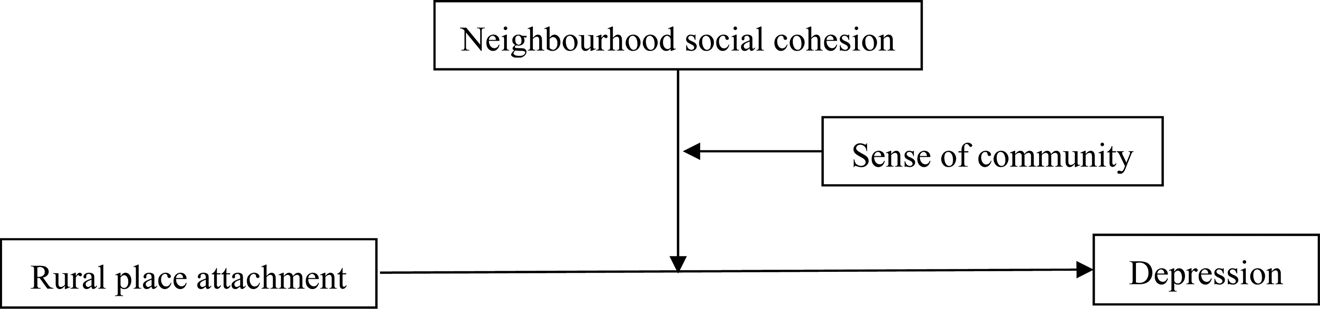
In summary, previous studies on relocation usually took displacement as a dichotomous variable. However, relocatees may have different psychological perceptions of displacement, and their wellbeing appears to differ even when an apparently similar relocation process is experienced. Thus, this study investigates the role of rural place attachment in relocation adjustment among Chinese older adults in rural-to-urban relocation. In addition, although previous studies have indicated that social integration is a protective mechanism for relocation, they did not illuminate how it specifically works. In this study, we examined how NSC and SOC in the relocation place interact to mitigate the association between RPA and depression. We hypothesised the following (Figure 1):
(1) RPA would be positively associated with depression.
(2) NSC in the relocation place would weaken the positive association between RPA and depression.
(3) The buffering role of NSC would depend on SOC in the relocation place. Specifically, NSC could buffer the association between RPA and depression among older adults with a strong SOC but not among older adults with a weak SOC.
The hypothesised theoretical model.

Methods
Participants and procedure
We conducted this study in six rural-to-urban communities located in peri-urban areas in Chengdu, in Sichuan province of China. These relocation communities were established within the last five years. The majority of the residents in these communities are peasants who relocated from rural villages ten kilometres or more away. Peasants from different villages may be placed in one urban community because of the greater capacity of urban buildings. After relocation, these peasants become urban residents, and their village committees become neighbourhood committees.
We conducted this study with the help of a social work organisation that provides community services to improve residents’ quality of life. Under the government-purchased service model, many social work organisations are involved in community services, and this social work organisation provides community elderly services purchased by the government. We involved these six communities in our study because this social work organisation provided services for them, which made them a convenient sample for our study. This organisation helped us to recruit participants, contact neighbourhood committees, and arrange the time and place for our surveys. This organisation had no further role in the study design, the data analysis, the data interpretation, writing the report or the decision to submit the article for publication. We recruited participants aged 60 years old or above and excluded those with cognitive impairment and mental health problems, as well as those who had not experienced rural-to-urban relocation. The participants completed the surveys in their community centres, which took about 30 minutes, and each participant earned 20 RMB as an incentive. Because the participants generally had low levels of education and some had vision problems, to ensure participants’ comprehension of the questions, all the participants completed the questionnaire orally through an ask-and-answer procedure. We recruited students majoring in social work at Chongqing University as interviewers to collect data and they received standardised training on psychological survey before conducting the research. This study obtained ethical approval from the Ethical Review Board of Chongqing University. We orally introduced our research purpose to participants and asked their consent before survey, and they can quit this survey at any time. As this study did not have any harm to participants, we did not prepare written consent for their signature.
Measures
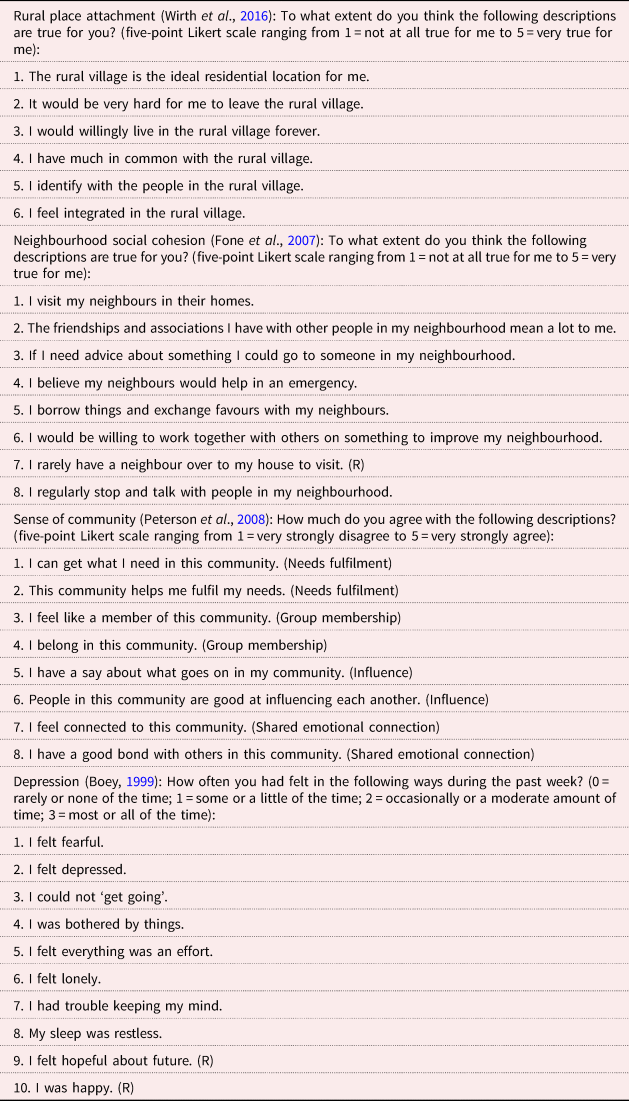
RPA was assessed with six items adapted from the Place Attachment Scale used by Wirth et al. (Reference Wirth, Grêt-Regamey, Moser and Stauffacher2016). The items are presented in Table 1. We used translation and back-translation to obtain the Chinese version of this scale. First, two psychology professors who understand both Chinese and English translated the scale from English to Chinese independently. Then, the authors of the current study and the two translators came together to synthesise the two Chinese versions and discuss the inconsistent or ambiguous wording. After that, another two bilingual psychology professors translated the Chinese version back to English. We compared the back-translated version with the original scale to make sure of the accuracy of the translation. Before the data analysis, we examined the factor structure of this scale using exploratory factor analysis with the principal component analysis method. The results showed that the six items loaded on one factor, which explained 62 per cent of the total variance. The items’ factor loadings ranged from 0.66 to 0.86. The correlations between each item and the total RPA score ranged from 0.66 to 0.85. These results indicated good psychometric properties of this scale. We added up the scores of the six items, with higher scores indicating higher levels of RPA (in this study, Cronbach's alpha coefficient, α = 0.86).
Measurement items for the study variables

Note: R: reverse coded.
NSC in relocation communities was measured with eight items developed by Fone et al. (Reference Fone, Dunstan, Lloyd, Williams, Watkins and Palmer2007) (Table 1). Yu et al. (Reference Yu, Cheung, Leung, Tong, Lau, Cheung and Woo2019) reported that the Chinese version of this instrument had good psychometric properties, so we adopted this Chinese version in this study. We computed the total score of these items, with higher scores representing participants perceiving higher levels of NSC (in this study, α = 0.70).
SOC in relocation places was measured with the Brief SOC Scale (Peterson et al., Reference Peterson, Speer and McMillan2008) (Table 1). The scale contained four dimensions: needs fulfilment, group membership, influence and shared emotional connection. This measure has been widely used with Chinese participants (e.g. Li et al., Reference Li, Sun, He and Chan2011; Huang and Wong, Reference Huang and Wong2014; Zhang et al., Reference Zhang, Yu, Zhang and Zhou2017; Zhang, Reference Zhang2019). We obtained the Chinese version of the SOC scale from Zhang et al. (Reference Zhang, Yu, Zhang and Zhou2017). The higher summed scores of this scale indicated participants’ stronger SOC (in this study, α = 0.85).
Depression was measured with the ten-item Center for Epidemiologic Studies Depression Scale (Boey, Reference Boey1999) (Table 1), which has been demonstrated to be a valid and reliable instrument for measuring depressive symptoms among Chinese older adults (Boey, Reference Boey1999; Cheng and Chan, Reference Cheng and Chan2005). We obtained the Chinese version of this scale from Cheng and Chan (Reference Cheng and Chan2005). The higher summed scores of the ten items indicated more depressive symptoms (in this study, α = 0.76).
The control variables included age (in years), gender (1 = male, 0 = female), education (illiterate, primary education, or secondary education or above), monthly income (<1,000, 1,000–2,000, 2,001–3,000 or >3,000 RMB), marriage status (1 = with a spouse, 0 = single (unmarried/divorced/widowed)), physical health (participants reported whether they had any of the following diseases: hypertension, cardiopathy, diabetes, coronary artery disease, cerebral haemorrhage, asthma, rheumatism, stroke, obesity, stomach illness, eye disease, tumour and other diseases specified by participants; 1 = without disease, 0 = with one or more diseases), living arrangements (1 = alone, 0 = with a spouse, children or others), dwelling time (in months) and whether they take care of grandchildren (1 = yes, 0 = no).
Statistical analysis
We computed Pearson correlations to determine the bivariate associations among the study variables. In a regression analysis, we used the z scores of study variables and treated age, gender, marital status, education, income, physical health, dwelling time, living arrangements and taking care of grandchildren as covariates. We first examined the association between RPA and depression. Then, we entered the two-way interaction term of RPA × NSC into the regression model to examine the moderating effect of NSC. Finally, we entered the three-way interaction term of RPA × NSC × SOC into the regression model to examine whether NSC's moderating effect was dependent on SOC. We used slope-difference tests to interpret the interaction results further (Dawson and Richter, Reference Dawson and Richter2006). To interpret the conditional effect, we defined high and low values of moderators as one standard deviation above and below the mean, respectively. We used SPSS 22.0 to obtain the general descriptive statistics and bivariate associations between the variables and considered p < 0.05 as statistically significant. We performed the moderation analysis with PROCESS version 2.13 for SPSS (Hayes, Reference Hayes2013; for more information, see http://www.afhayes.com/).
Results
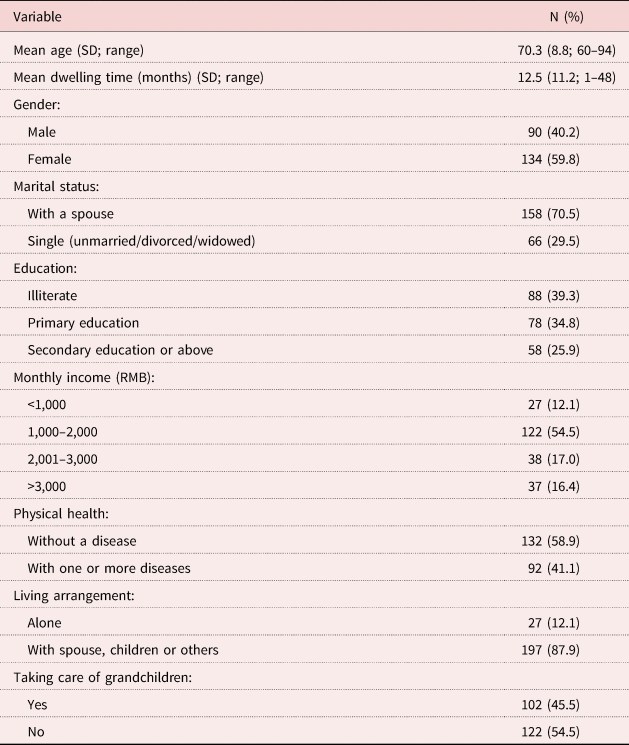
In total, 224 older adults participated in this survey: 90 men (40.2%) and 134 women (59.8%). The participants were an average of 70 years old (range 60–94). Table 2 describes their socio-demographic information.
Socio-demographic information of the participants
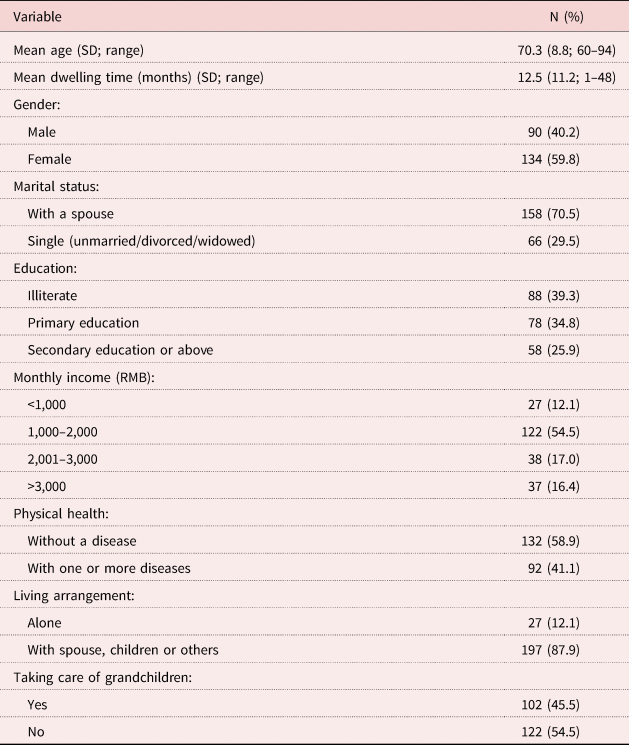
Notes: N = 224. SD: standard deviation. US $1 = 6.5 RMB.
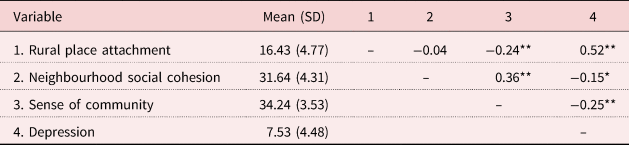
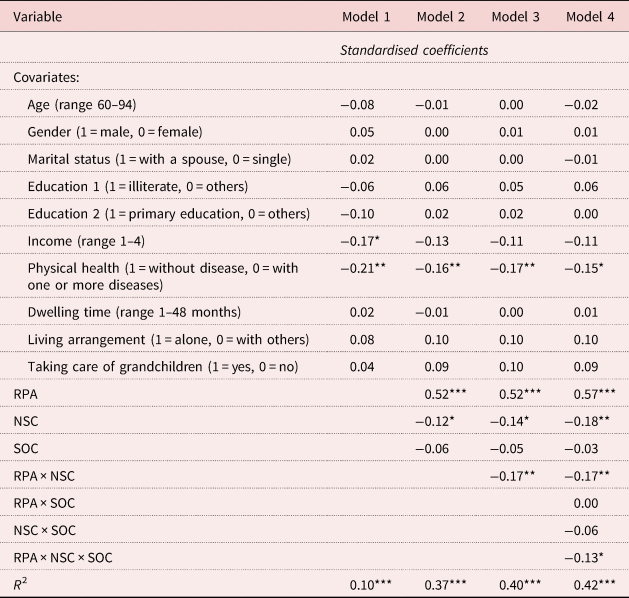
Table 3 presents the correlations of the study variables. RPA was positively associated with depression (r = 0.52, p < 0.01) and negatively associated with SOC (r =−0.24, p < 0.01). NSC (r = −0.15, p < 0.05) and SOC (r = −0.25, p < 0.01) were negatively associated with depression. In the regression model, RPA was associated with higher depression (Table 4, Model 2, β = 0.52, p < 0.001), NSC was associated with lower depression (Table 4, Model 2, β = −0.12, p < 0.05), and the association between SOC and depression was not significant after controlling for covariates (Table 4, Model 2, β = −0.06, p > 0.05). These results support Hypothesis 1: RPA was positively associated with depression.
Descriptive statistics and bivariate correlations of the study variables

Notes: N = 224. SD: standard deviation.
Significance levels: * p < 0.05, ** p < 0.01.
The interaction effect of rural place attachment, neighbourhood social cohesion and sense of community on depression

Notes: N = 224. RPA: rural place attachment. NSC: neighbourhood social cohesion. SOC: sense of community.
Significance levels: * p < 0.05, ** p < 0.01, *** p < 0.001.
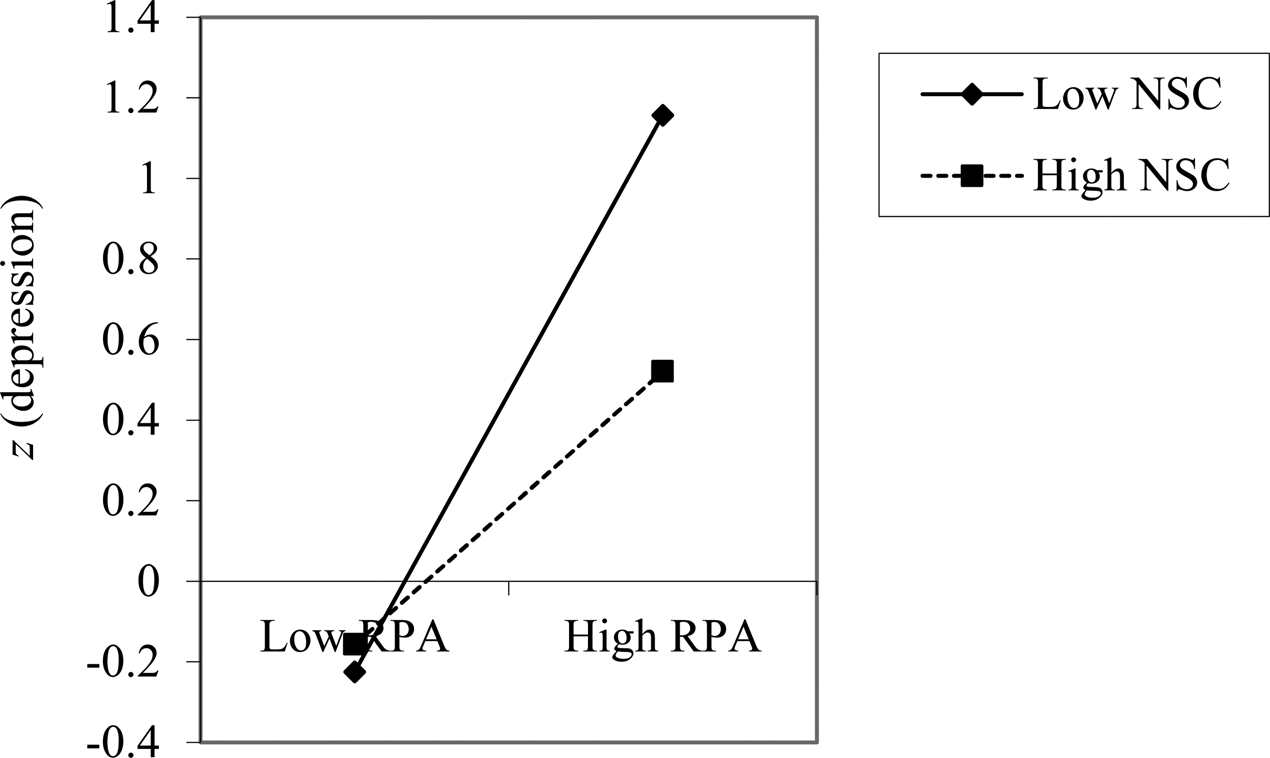
The interaction of RPA × NSC was significant in predicting depression (Table 4, Model 3, β = −0.17, p < 0.01). The association between RPA and depression was weaker for individuals with high NSC (slope = 0.34) than for individuals with low NSC (slope = 0.69; Figure 2). These results support Hypothesis 2: NSC weakened the association between RPA and depression.
The association between rural place attachment (RPA) and depression with neighbourhood social cohesion (NSC) as a moderator.

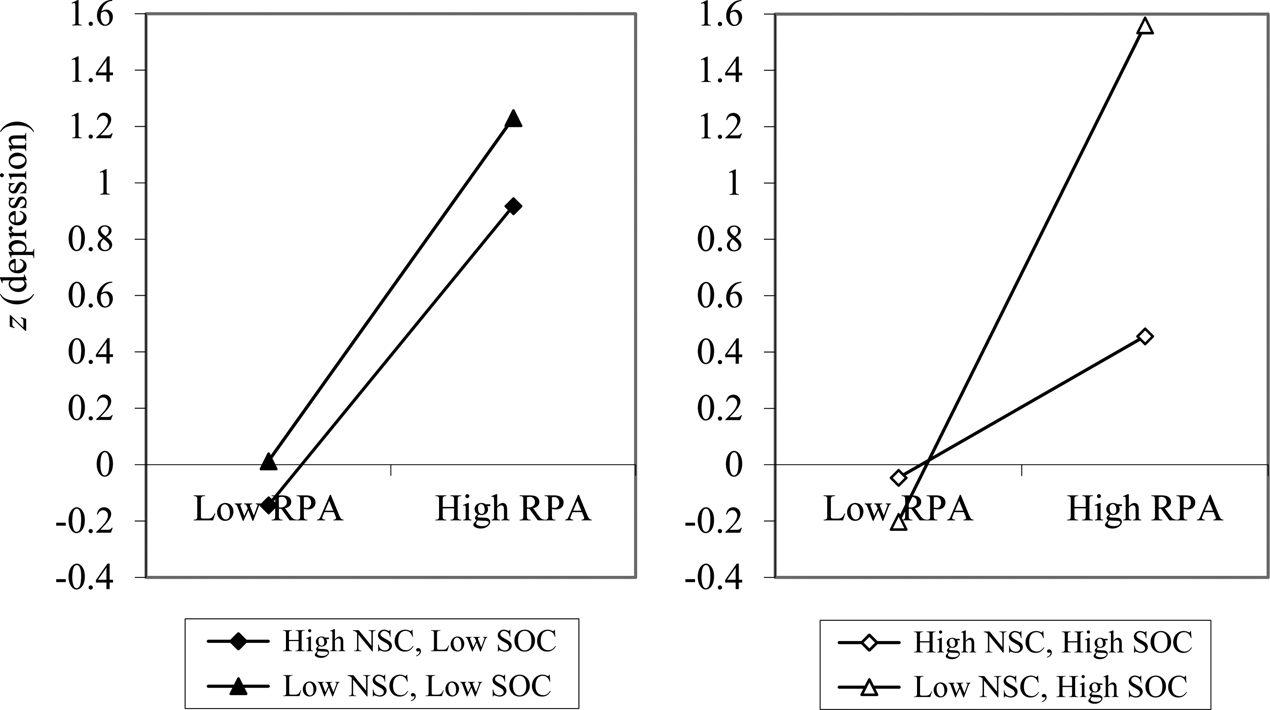
The three-way interaction of RPA × NSC × SOC was significant in predicting depression (Table 4, Model 4, β = −0.13, p < 0.05), which means that the interaction effect of RPA × NSC depended on SOC. We report the interaction effects of RPA × NSC at different SOC values (Table 5; low, one standard deviation (SD) below the mean; moderate, the mean; and high, one SD above the mean). For individuals with low SOC, the interaction effect of RPA × NSC was not significant (interaction effect = −0.0391, 95% confidence interval (CI) = −0.2256, 0.1473). For individuals with mean and high SOC, the interaction effect of RPA × NSC was significant (interaction effectmean SOC = −0.1767, 95% CI = −0.3018, −0.0515; interaction effecthigh SOC = −0.3142, 95% CI = −0.4920, −0.1363). These results show that the buffering effect of NSC on the association between RPA and depression increased with SOC. Specifically, for individuals with weak SOC, NSC did not moderate the association between RPA and depression (the left panel of Figure 3, slope-difference test t = −0.412, p = 0.681). For individuals with a strong SOC, NSC moderated the association between RPA and depression (the right panel of Figure 3, slope-difference test t = −3.492, p = 0.001). These results indicate that the moderating effect of NSC depends on SOC, which supports Hypothesis 3.
The moderating role of neighbourhood social cohesion (NSC) in the association between rural place attachment (RPA) and depression in conditions with low sense of community (SOC) and high SOC, respectively.

Conditional interaction effect of rural place attachment × neighbourhood social cohesion at different values of sense of community (SOC)

Discussion
We found that Chinese older adults with stronger attachment to their rural place reported more depressive symptoms, which supports Hypothesis 1. In addition, the association between RPA and depression was weaker for older adults perceiving high NSC than those perceiving low NSC, which is consistent with Hypothesis 2. Moreover, the buffering role of NSC was only manifested for older adults with a strong SOC and not for those with a weak SOC, which supports Hypothesis 3. These findings have theoretical contributions as follows. First, we expand the place attachment theory into a rural-to-urban relocation situation, that place attachment captures the psychological sense of displacement and is a destructive factor for relocatees’ mental health. Second, we supplement NSC as the psycho-social resources in the stress process model to protect older adults from the negative effect of relocation. Third, we apply the SOC theory into a Chinese relocation context, that SOC is an important part of urban community integration. These findings have practical implications for improving older adults’ psychological adjustment to rural-to-urban relocation.
We expand the place attachment theory by showing that although place attachment can benefit residents’ wellbeing, it captures the psychological sense of displacement and is a destructive factor for relocatees’ mental health in a relocation context. Our findings were consistent with previous literature showing that displacement was associated with higher risk of depression (Cao et al., Reference Cao, Hwang and Xi2012; Le et al., Reference Le, Tracy, Norris and Galea2013). However, this study was different from previous literature that compared displaced with non-displaced relocatees or that took displacement as a background variable for all of the relocatees (e.g. Kuwert et al., Reference Kuwert, Brahler, Glaesmer, Freyberger and Decker2009; Cao et al., Reference Cao, Hwang and Xi2012; Le et al., Reference Le, Tracy, Norris and Galea2013), we used rural place attachment to capture individuals’ sense of displacement and found that a strong attachment to one's previous place may hinder one's psychological adjustment to a relocation place. Under a relocation programme, all of the relocatees experience physical displacement, but the psychological and social dimensions of their displacement may be quite different (Kearns and Mason, Reference Kearns and Mason2013). Place attachment can describe what actually happens within relocation processes as well as the effects upon residents (Kearns and Mason, Reference Kearns and Mason2013). We found that the negative effect of relocation depended on how attached relocatees were to their original place. Generally, place attachment may be a protective factor for residents’ psychological wellbeing (Scannell and Gifford, Reference Scannell and Gifford2016, Reference Scannell and Gifford2017). However, in a relocation situation, a strong original place attachment may work against adaptation to one's relocation place. Some researchers believe that people's place attachment in their daily lives generally exists in the subconscious and that this attachment is expressed only when the individual leaves the place (Hidalgo and Hernández, Reference Hidalgo and Hernández2001).
Chinese culture emphasises that fallen leaves return to the roots. Some Chinese older adults live in rural villages their whole lives and integrate the memories of their ancestors and life events into their living place; thus, they perceive leaving a rural village for a new residence as a loss of their roots. Chinese older adults’ strong rural village attachment might cause them to immerse themselves in sadness and nostalgia following relocation, making them less likely to adapt to life in an urban community. With China's rapid urbanisation, the government needs to consider how to guarantee the quality of life of older adults, especially those with strong RPA, after relocation to urban areas.
We stress NSC as the psycho-social resources in the stress process model to protect older adults from the negative impact of relocation. This finding is consistent with those of previous studies such as Le et al. (Reference Le, Tracy, Norris and Galea2013) that high county-level social cohesion could protect displaced individuals from suffering from depression, and it supports the socio-ecological model of health, which indicates that relocation's impacts depend not only on individuals but also on attributes of their communities (Le et al., Reference Le, Tracy, Norris and Galea2013). In another study on Chinese people's relocation, Cao et al. (Reference Cao, Hwang and Xi2012) took social integration and community resources as mediators between displacement and depression, whereas we took community social cohesion as a moderator between RPA and depression, and both studies demonstrated that community social integration is a protective mechanism in displacement. In summary, these results demonstrate the key role of psycho-social resources in the stress process model (Pearlin, Reference Pearlin1989), in that although relocation may act as a stressor, psycho-social resources could protect individuals from negative stress outcomes. In addition, the secondary stressors that usually accompany relocation, such as deterioration in social integration and community resources, should be avoided as much as possible to reduce relocation maladjustment (Cao et al., Reference Cao, Hwang and Xi2012). However, in China, the social interactions in urban neighbourhoods are weaker and perceived as being less important than those in rural villages (Zhu et al., Reference Zhu, Breitung and Li2012). Given the influence of privatism and individualism, the importance of urban neighbourhoods for constructing social ties has declined, and the role of urban neighbourhoods has gradually transformed from that of a social support system to that of a grassroots political movement (Zhu et al., Reference Zhu, Breitung and Li2012). Urban community neighbourhood committees should help older adults to form new social connections, such as through organising activities to reduce older adults’ psychological distress.
We highlight SOC as an important part of urban community integration, which expands the SOC theory into a Chinese relocation context. SOC reflects one's general perceptions of the urban community and also includes the identity of the grassroots government due to the unique meaning of community in the Chinese context (Bray, Reference Bray2006; Zhu et al., Reference Zhu, Breitung and Li2012). These results indicate that the protective role of NSC depends on how older adults perceive their urban community. Older adults with a strong SOC in an urban community are more likely to benefit from NSC. Relocation from a rural village to an urban community is accompanied by changes to one's community management, lifestyle, social network, and so on, and forming a new identity and sense of belonging in an urban community in a short time is hard for older adults. We also found a negative association between RPA and SOC in this study, which indicates that older adults with stronger attachment to their rural village were less likely to form a SOC in an urban community. These results indicated that not only social cohesion but also the psychological sense of urban community act as protective factors in rural-to-urban relocation adjustment. Although previous studies have consistently demonstrated the benefits of SOC, this study expands the benefits of SOC to a relocation situation. Urban community neighbourhood committees should consider interventions such as community activities and services for elderly people to strengthen older adults’ SOC after relocation.
We must acknowledge some limitations in this study. First, we cannot infer any causal relationships between the study variables from this cross-sectional design. Nevertheless, this study indicated a positive association between RPA and depression, as well as the moderating roles of NSC and SOC in the rural-to-urban relocation context. Future studies may use longitudinal or experimental studies to examine the relationships between the study variables further. Second, due to the difficulty of strict probability sampling, we used convenience sampling in this study, which may restrict the conclusions’ generalisability. Third, the self-reported measures used in this study might induce common method variance and overestimation of the correlations between the study variables. Future studies may consider using multiple data sources to investigate older adults’ relocation adjustment. Lastly, this study was conducted in the Chinese context; whether these results can be applied to other cultures needs further examination.
In summary, Chinese older adults with stronger attachment to a rural place experienced more depressive symptoms after rural-to-urban relocation. In addition, protective factors related to neighbourhoods and communities in a relocation place could interact to mitigate the negative impacts of relocation. Community managers should consider interventions aimed at enhancing NSC and SOC to improve older adults’ adjustment to their relocation.
Financial support
This work was supported by The National Natural Science Foundation of China (grant number 71704017); and Fundamental Research Funds for the Central Universities (grant number 2019GGXY03).
Ethical standards
This study obtained ethical approval from the Ethical Review Board of Chongqing University.